L Systems Generator
This is a little project I’ve made between switching from working in one company to another. Now I realise, that maybe I’m a bit obsessed with fractals. But anyway, I like what I’ve done.
Try the interactive generator below, or open the full-screen version for the complete experience!
So hurray, an L-System fractal generator. What is L-system? according to Wikipedia, L-system or Lindenmayer system is a parallel rewriting system and a type of formal grammar. An L-system consists of an alphabet of symbols that can be used to make strings, a collection of production rules that expand each symbol into some larger string of symbols, an initial “axiom” string from which to begin construction, and a mechanism for translating the generated strings into geometric structures. L-systems were introduced and developed in 1968 by Aristid Lindenmayer, a Hungarian theoretical biologist and botanist at the University of Utrecht. Lindenmayer used L-systems to describe the behaviour of plant cells and to model the growth processes of plant development. L-systems have also been used to model the morphology of a variety of organisms and can be used to generate self-similar fractals such as iterated function systems.
In normal words, for example if you have axiom ‘F’ and the rule is only one and it’s F → F+F−F−F+F, on a first iteration you have
Fnext it’s
F+F−F−F+Fand next (all F’s now F+F−F−F+F)
F+F−F−F+F + F+F−F−F+F − F+F−F−F+F − F+F−F−F+F + F+F−F−F+Fand if F is a line in the plane, ’-’ change direction 90 degrees counter-clockwise, ’+’ 90 degrees clockwise you’ll have a simplest fractal named Koch Line:
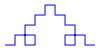
Really simple!
The core of code is a object LShape, which have a step method:
Lshape.prototype.step = function () {
  const arrState = this.currentState.split('');
  const nextStepArr = arrState.map((el) => {
    let res = el;
    if (this.rules[el]) {
      return (res = this.rules[el]);
    }
    return res;
  });
  this.currentState = nextStepArr.join('');
};
Of course, there is a canvas drawing functions and so on, you can look at them at the source code, the code is stupidly simple. But you can have a lot of fun playing with this — try the interactive demo below!
Select a preset from the scrollable gallery, or open the Controls panel to customize axiom, rules, iterations, colors, and more. You can drag to pan and scroll to zoom. Click “Download PNG” to save your creation.