Ten years of writing code by hand
Last winter I was going to quit and never work as a programmer again. I was sick of writing code, sick of leading, sick of everything.
I didn’t quit. Instead I started working with agents, and I haven’t written code by hand for several months now. I don’t see why I would: an agent does the same, better and a hundred times faster. A year ago I couldn’t imagine working the way I work now, even close.
A scrum team — usually five to eight people, sometimes up to eleven — became two developers and a business analyst, with agents doing the writing. There will be four posts about it; this one is about how it was before and how I got to that winter.
These posts are personal on purpose. For me they are a way to close the years when I wrote code with my own hands. There is no tutorial here — the harness I work with has its own posts (the first one, the revision).
The road
- before IT
- learning
- EPAM
- 2006 – 2010 Restoring historic buildings in St Petersburg
- 2010 – 2014 Tour guide on Phuket Then a photographer, virtual 3D tours
- 2011 Industrial climbing
- 2014 – 2016 Back in Russia Yoga classes, gypsum stucco, construction
- 2015 Restoring a historic interior
- Sep 2016 Learning JavaScript
- Spring 2017 First job, a small startup
- Autumn 2017 EPAM
- 2019 – 2021 Big online shops The crunch and the burnout
- 2021 – 2023 An internal portal, a team of four
- Oct 2021 Leaving Russia
- 2024 – 2026 The dream team, a WYSIWYG editor Ends in January 2026
Guide, climber, photographer
Once I hitchhiked, quite a lot and for a long time, and somehow I ended up in Thailand. I had no money, and my friends worked as tour guides, so I just joined them. First I tried Pattaya — I didn’t like Pattaya much. Then I went to Phuket, and on Phuket for about a year and a half I led sea excursions: to the Similan Islands, to Phi Phi and to others.
Between the seasons the guys invited me to work as an industrial climber, and I went for one summer.
Rope access, a high-rise facade
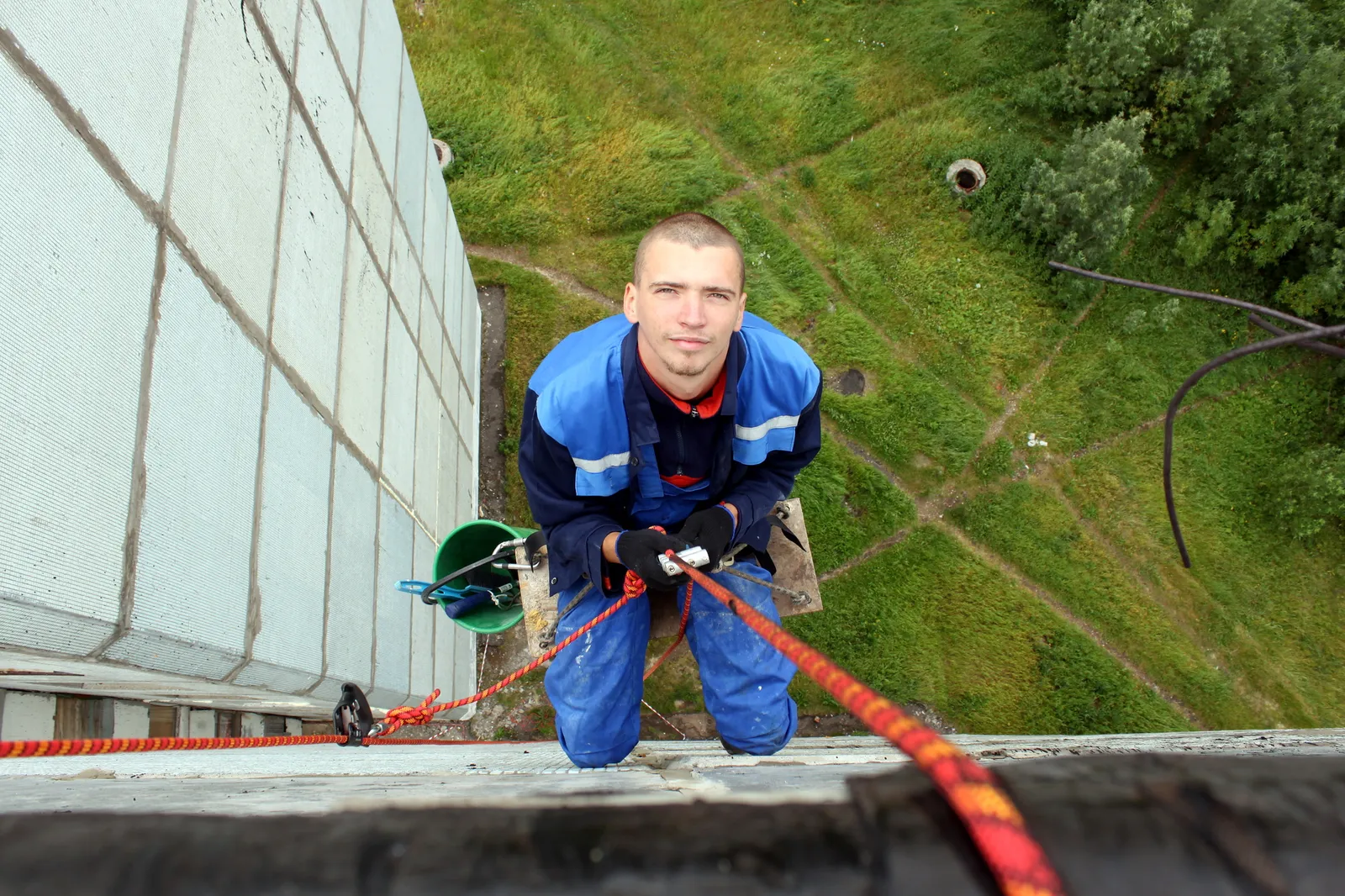
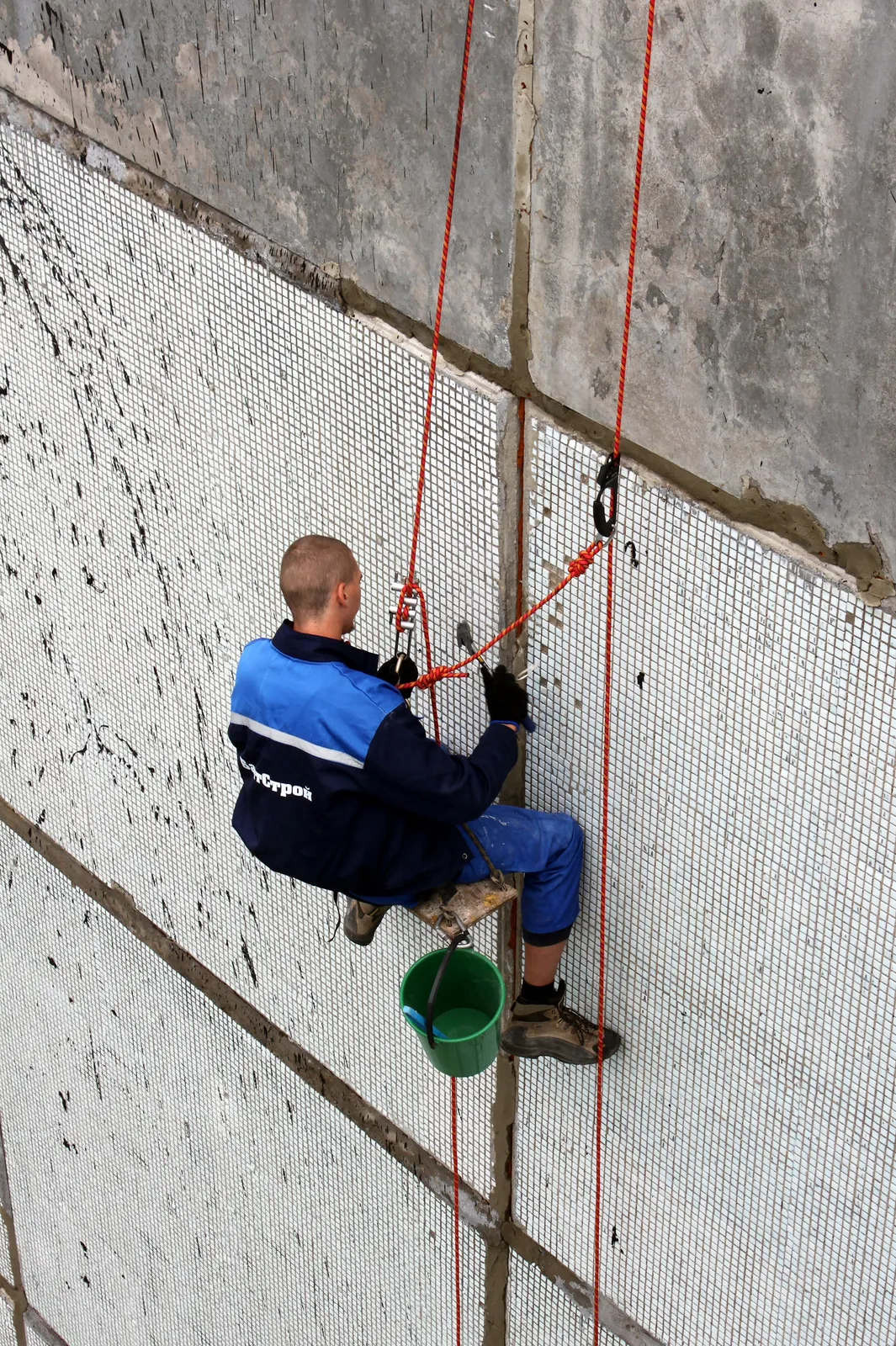
The first time I hung on a rope was very scary: I thought I was terribly afraid of heights, and to go over the edge the first time I needed at least forty minutes of fighting with my own fear. Then the fear passed. The work was hard, but I liked it very much, because you see the result right away.
At some point I got tired of being a guide and decided to try myself as a photographer. I tried shooting people — it didn’t work out very well. So I started making virtual 3D tours for commercial real estate — two of them are still on the About page. It was a fairly successful small business, which ended when another coup started in Thailand, in 2014, and the money ran out with it.
Construction
Two of the jobs before programming
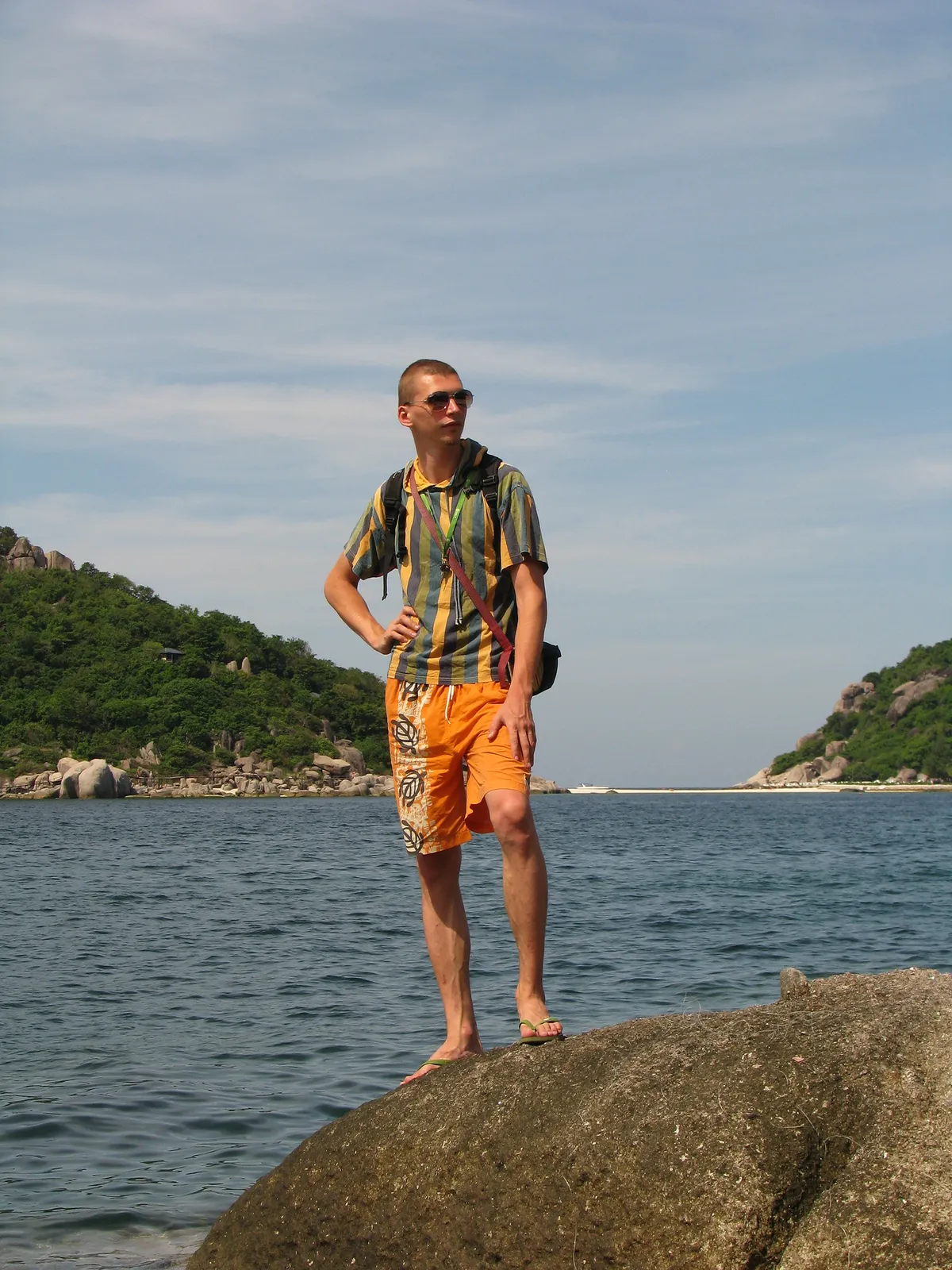
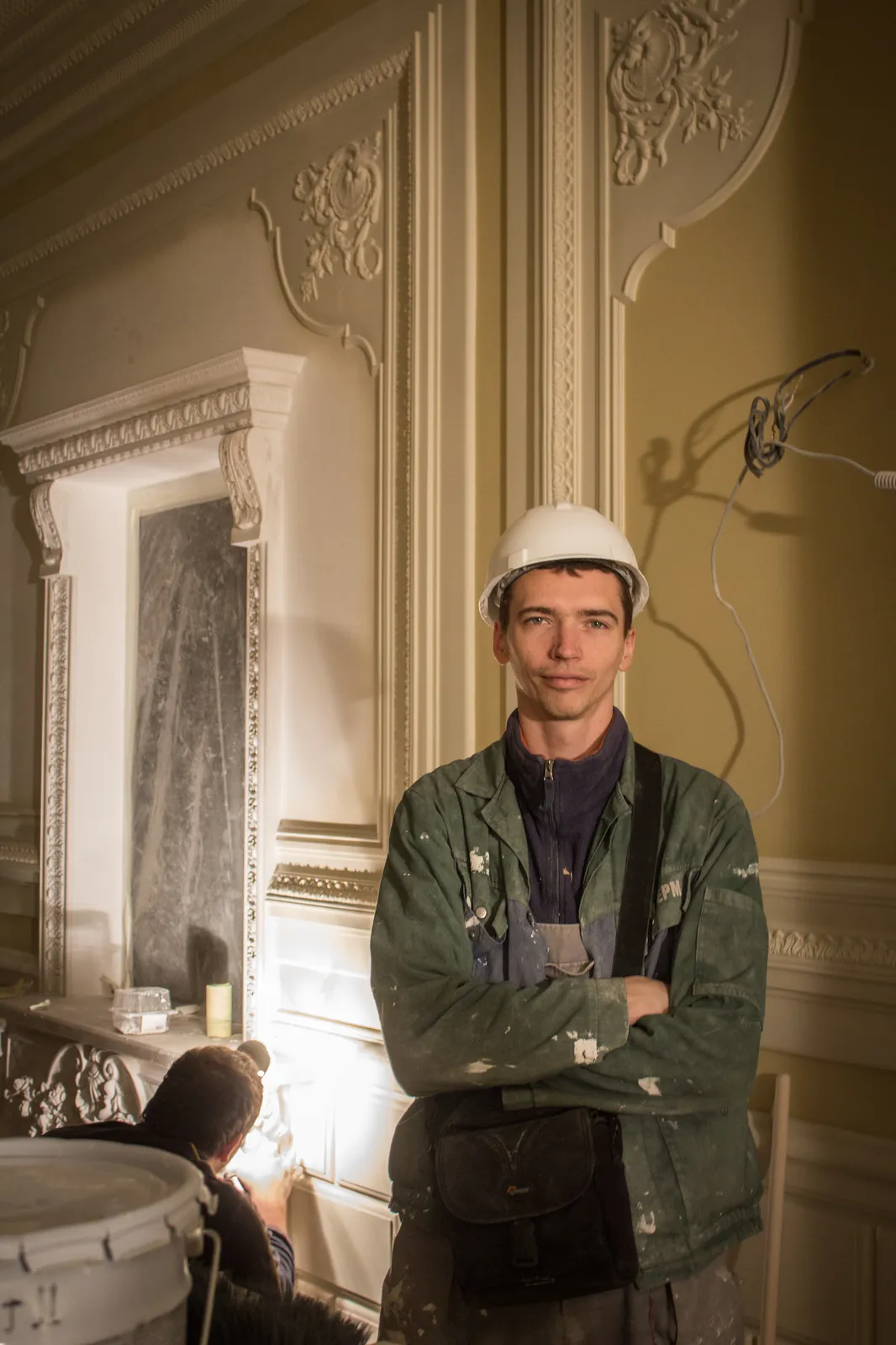
I came back to Russia, where nobody really needed 3D tours. Sometimes I taught yoga, gave personal classes. But there was really not enough money, and I decided to go to a construction site.
Construction was nothing new for me: before Thailand I had worked a lot on the restoration of historic facades in St Petersburg. This time it was installing gypsum stucco in new flats — I call that restoration too, because we often came after other craftsmen who had done it badly and redid it. I liked working on construction very much.
The big minus of this work is that there is fairly little money in it. Climbers and restorers are paid not badly, but there is a ceiling you will not get above, unless you become a foreman. And the work is very hard physically; I didn’t really have enough health for it any more.
And I needed the money: the family grew, and after we came back to Russia we lived on literally kopecks and ate whatever there was. I thought about what I could do at all, and in the end decided to become a programmer.
Why programming
I always liked computers; I loved playing games since I was a child. And I had had some small programming freelance work on WordPress, on PHP — I earned some money with it. It was also a big boom then: a lot of people were going into programming, and people were still really needed. I thought about it rationally — this is probably the most effective thing I can do — and fitted into this movement.
Before starting I asked programmer acquaintances what each of them did. At first I wanted to do Java, because it pays more. But it turned out that the entry into Java is quite hard, so I chose frontend and JavaScript.
One book and a few months
After one big job I had enough money to sit at home for two or three months and study — most likely September to November 2016. When the money ran out, I went back to the gypsum work and studied in the evenings. I didn’t stop for a single day.
At the beginning it was very hard: I had not used my head for a long time, honestly, and I was afraid I wouldn’t manage. But I never doubted the method: when the approach is rational, success is, generally, inevitable — and I have a lot of patience and method. The main book was Eloquent JavaScript. I read a chapter and did its exercises — honestly, not opening the next chapter until I had done everything in the previous one — and so, slowly, rereading again and again, I got through the whole book.
This blog started exactly then. The first post is from 31 December 2016: “Hello World!”, with a promise of the first little project. It came four days later: the Game of Life, one of the exercises from that same book, written in plain JavaScript. All eleven demos from 2017 that are still on this site — the L-systems, the roses, the random walkers — I wrote by hand, line by line, in the year I learned.
A crazy, brilliant director
I found my first job through an ad somewhere, I think. It was a startup in St Petersburg, a kind of proxy: it took young developers who wanted to learn, found the talented ones, trained them, sold their services on Upwork and kept a percentage. Three of us came there, and we were, basically, super-juniors.
The director was a really talented programmer — and completely crazy. He had 26-hour days: not 24 hours like a normal person, but 26. So every day his night shifted forward a bit, and he came to work at a different time. Sometimes he didn’t talk to anyone. Sometimes he shouted at us.
But the foundation I still stand on was built by him. He taught how applications develop, where to start, where to look for information, how to test, what to pay attention to and what not, how to work with people and with the client. That architecture matters, and to think as an engineer; TDD and extreme programming. I stayed there until late evenings, soaking all of it up.
Then the startup ran out of money, and I was hired into EPAM through a friend.
Six months that became nine years
I meant to stay six months at most. And bam! I stayed for nine years. Because of the people.
The guys on my first project were absolutely golden. It was one office, about fifty people on the project, and we were together for two and a half years. I had a wonderful team lead, a wonderful project manager. We drank beer together, stayed after work. I really went to work with joy. All the people I worked with then became my friends; with some of them we still talk.
And everyone there was at a high level, so I got comfortable quickly and got the experience that later helped me grow — to a senior, then to a team lead, then to teaching.
I was simply lucky with people — at that startup, for all the madness and, at times, the aggression of its director, and at EPAM. For some reason people like me: they want to teach me, and I want to learn.
I have done a lot of teaching at EPAM: I ran a lot of entry interviews. I still do assessments and prepare people for them — for the move to the next level. And yes — it sounds silly — the company partly became my family too, and a support when I left Russia. That is probably why it is so hard for me to part with it. It is like a glimmer of that old world, which isn’t there any more.
How a scrum team worked
I worked in outsourcing all these years: e-commerce at first, big online shops, then life sciences. For the last five years I led teams; a typical one looked like this:
flowchart TB
client["the client"]
pm["project manager"]
ba["business analyst"]
sm["scrum master"]
lead["team lead (me)"]
fe["2–3 frontend"]
be["2 backend"]
ops["1 DevOps"]
qa["2 testers"]
client --> pm
client --> ba
pm --> lead
ba --> lead
sm --> lead
lead --> fe
lead --> be
lead --> ops
fe --> qa
be --> qa
At the busiest times my day started at nine. Half an hour of coffee and email. Then meetings back to back for four or five hours, with code review and messages in between. The calls were status, conversations with the client, unblocking people — calls and approvals took up to 70% of my time as a lead, while a regular developer spent 15–20% of theirs on them. Lunch with colleagues in a café. After work, a couple of hours at the architecture school, EPAM’s internal course for architects. The days were very fast and filled with people to the limit. People usually don’t like that, but I often enjoyed it: the days were not only code.
The process was standard scrum with a lot of approval rounds: work was split into epics, then features, then tasks; there was a WBS — a breakdown of the work into pieces — sprint planning, refinement, estimates in story points. A typical two-week sprint delivered one page, or one block on a page.
For example, infinite scroll with facets for a shop took about three sprints — a month and a half. The API was ready, we did only the frontend. The hard part was SEO: while you scroll, the URL has to change to the right page. The product tiles had different heights, so the moment of switching pages was hard to catch — in both directions. Now something like this takes about a day.
A developer’s day went on code review, a lot of it, on demos to the testers, and on debugging: hunting bugs took up to 30–40% of the time. The bugs came mostly from regressions, from inattention to detail, from backend contracts that were not fully worked out, and from tech debt that was always underfoot. Tests were usually skipped; there was never time for them.
Velocity existed, but urgent tasks kept landing in the middle of a sprint, and bug fixing spoiled the picture even more. And we always underestimated: pressure from management, not understanding the depth and complexity up front, optimism. So before every release we stayed late or worked weekends. Nothing in the work was worse than that.
Kraków
Kraków, January 2019
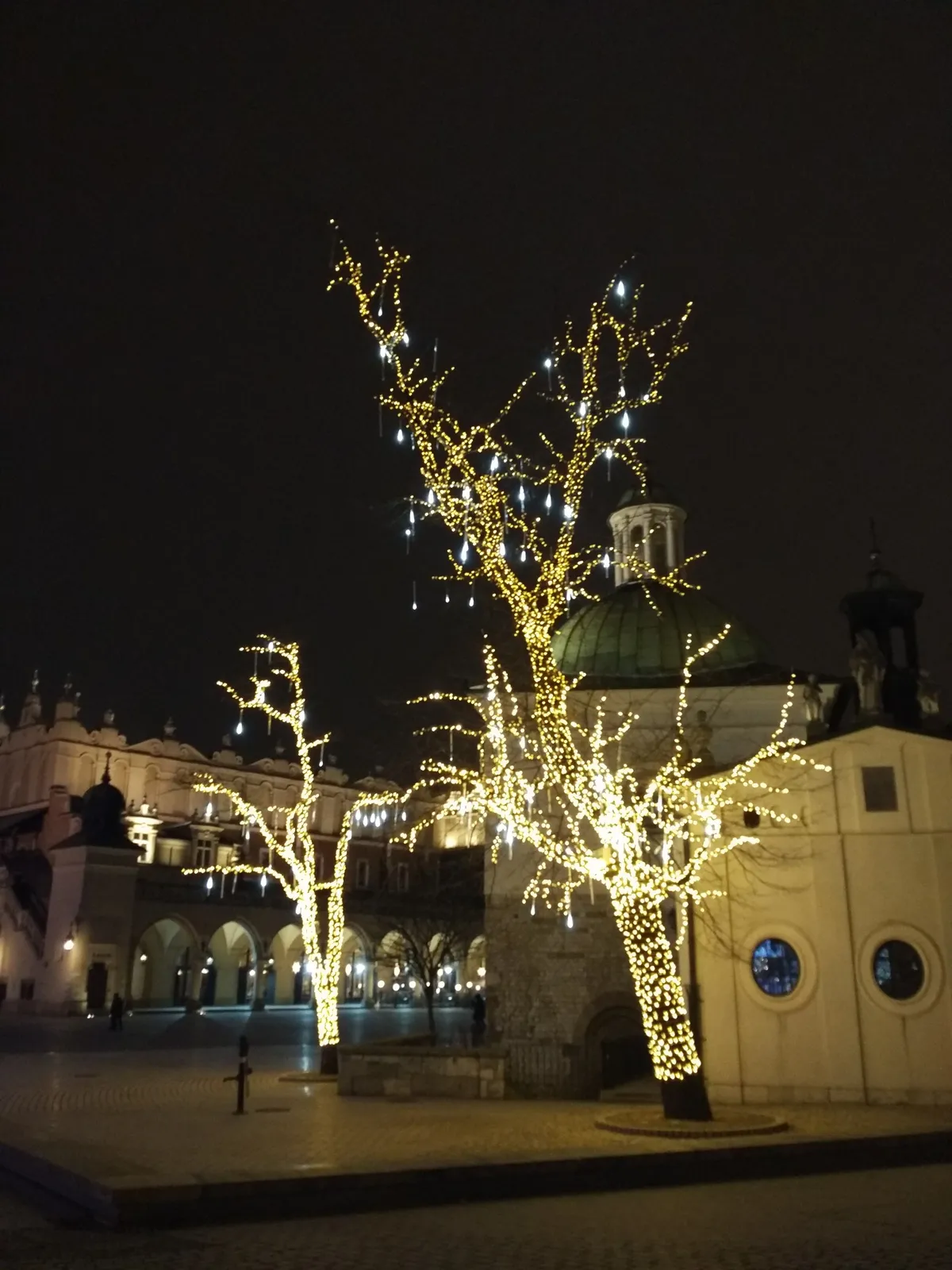
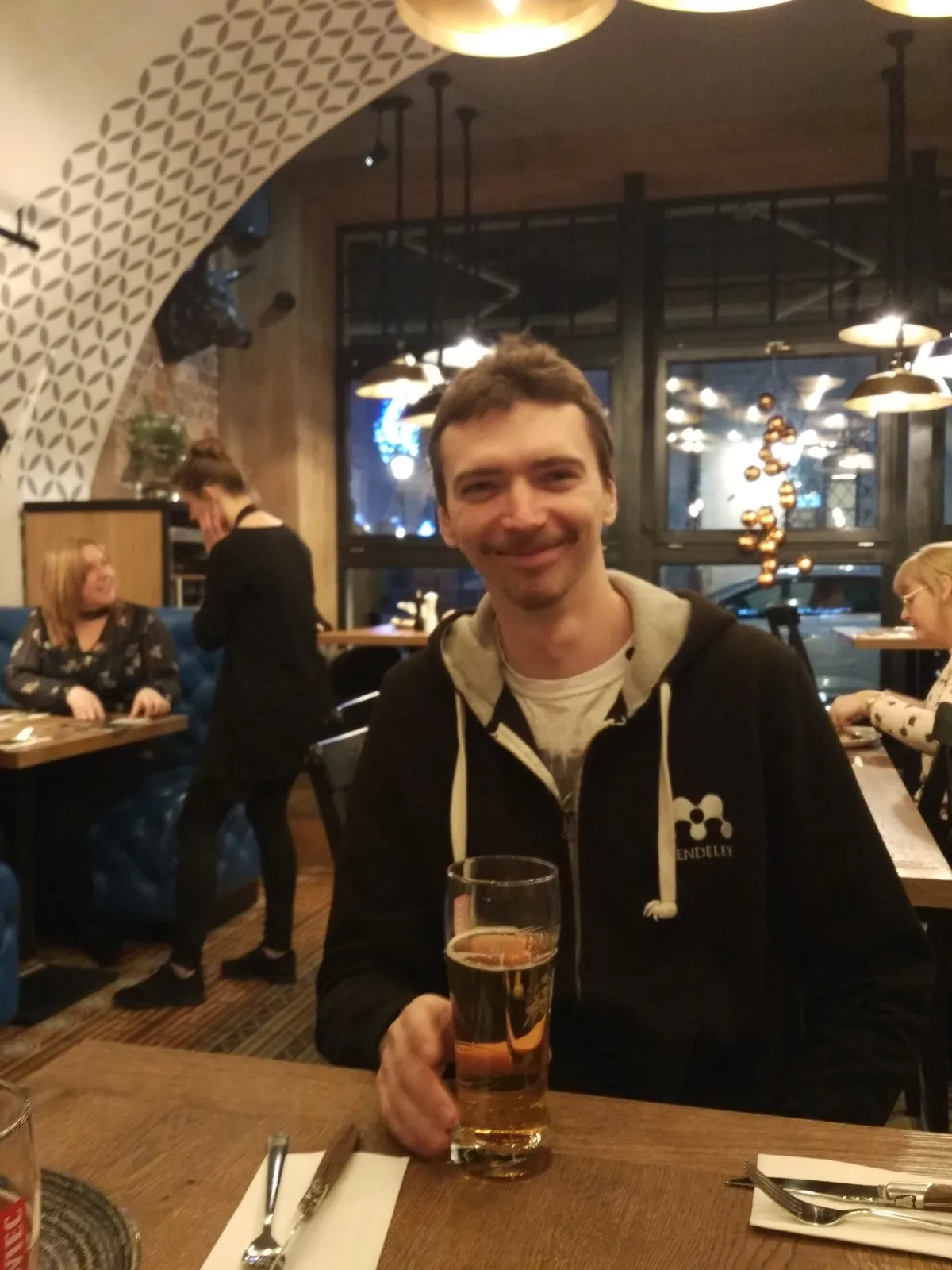
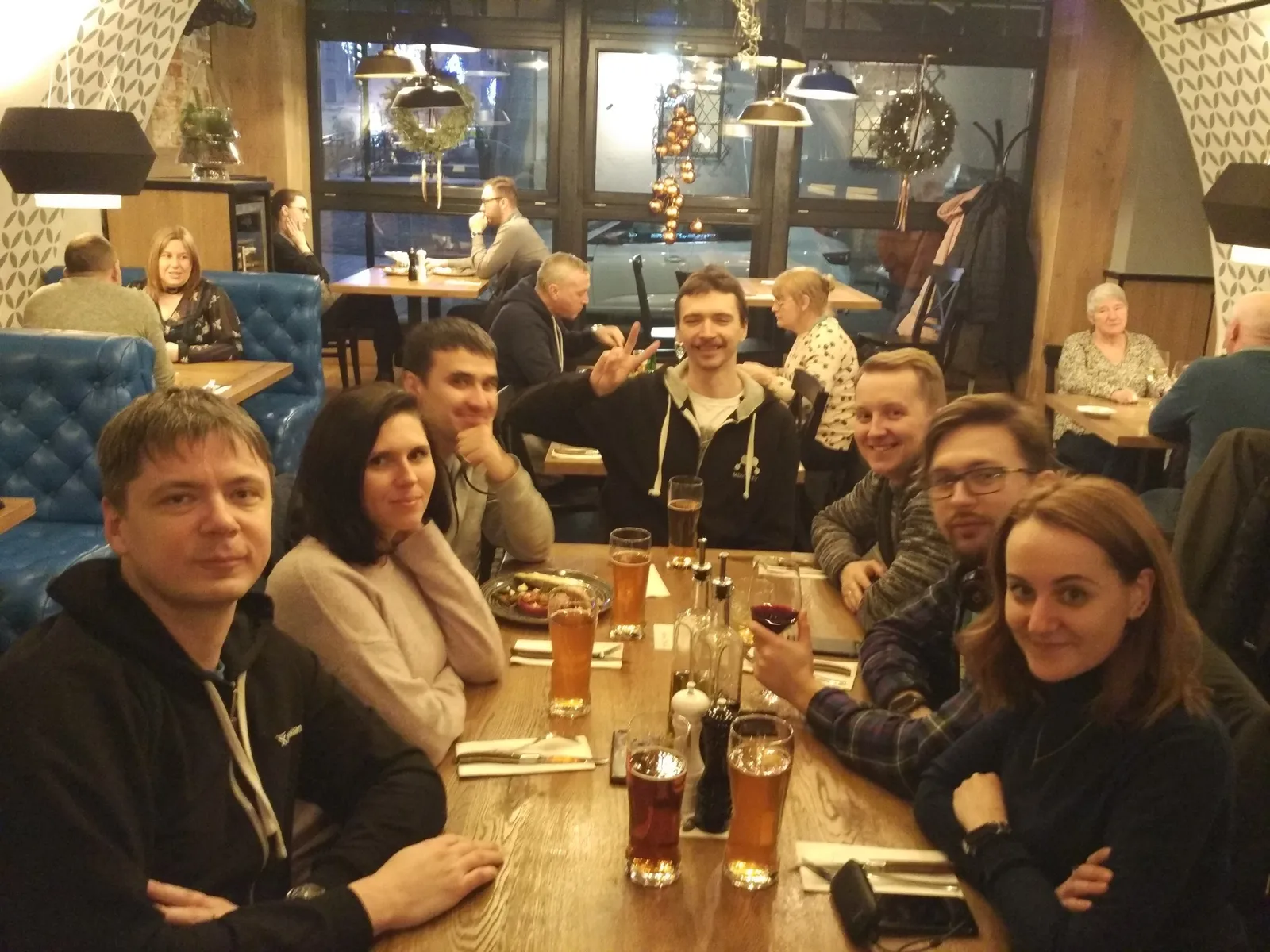
There were other days too. In January 2019 the old e-commerce team was building a big shop, and the client invited us on a business trip to their office. In the daytime we worked, and in the evenings walked from the hotel to eat. One of those days was my birthday, 21 January. It just fell on that day — I think I didn’t even tell anyone. We sat in that steak house, drank beer and told jokes. It was super fun; there was some incredible lift of the spirit and unity. And the food — really the best burger of my life.
The team at the table
Burnout
From May 2020 to January 2021 I was the team lead on a big online shop. I had little experience as a lead and didn’t know how to distribute my load. I tried to be the team lead and the architect, and do interviews, and go through the architecture school, and at the same time write code. Probably if I had chosen one thing, I would have avoided burnout — well, at least in that form.
We were rushing: the delivery date had been fixed when the contract was signed, before anyone knew how much the work would uncover. It was a move from legacy — PHP or Java, I don’t remember exactly — to Next.js and GraphQL, both new for me. Both were full of details I didn’t know, and we had to do fairly complex things on them: manage data from the API on the frontend so that it all didn’t fall apart with server-side rendering.
A commitment like that presses down the chain, and on the team there was a constant feeling that we were not making it, that we needed to be done yesterday, and that it was our fault. It was never said directly, but it was the leitmotif of all that work. The project went past the deadline several times — not because of COVID, but because of that date. It was hell, five or six months non-stop.
You open the laptop, close it twelve hours later and don’t remember where your day went, because the whole day went there. Sometimes I didn’t have the strength or the time even to eat. Thank God I wasn’t alone then, and at home I was helped a lot.
It all came together: the architecture school, which that year I only just managed to finish; the interviews — I loved them, they gave me a little distraction from the project I was fed up with; and COVID, which I took seriously then: everyone was at home under the constant fear of getting sick.
Gradually I stopped holding up. I became irritable, angry, I snapped at the people close to me. Depression started; I was sad all the time. But I kept working — until my head started to hurt very badly. It got to the point where I opened the laptop, worked for half an hour, and my head hurt so much that I just couldn’t work any more. My blood pressure went up, my face went red.
Then I told my lead, most likely on a one-to-one call: “Listen, I can’t. I think I’ve got really sick.” I left the project and went to the bench — paid time between projects at EPAM. I was there about two months.
Afterwards nobody even said thank you. I think work like that builds up a general irritation inside the team: people were just tired of each other, and no words of gratitude were left for anyone.
The village
Another village, 2020
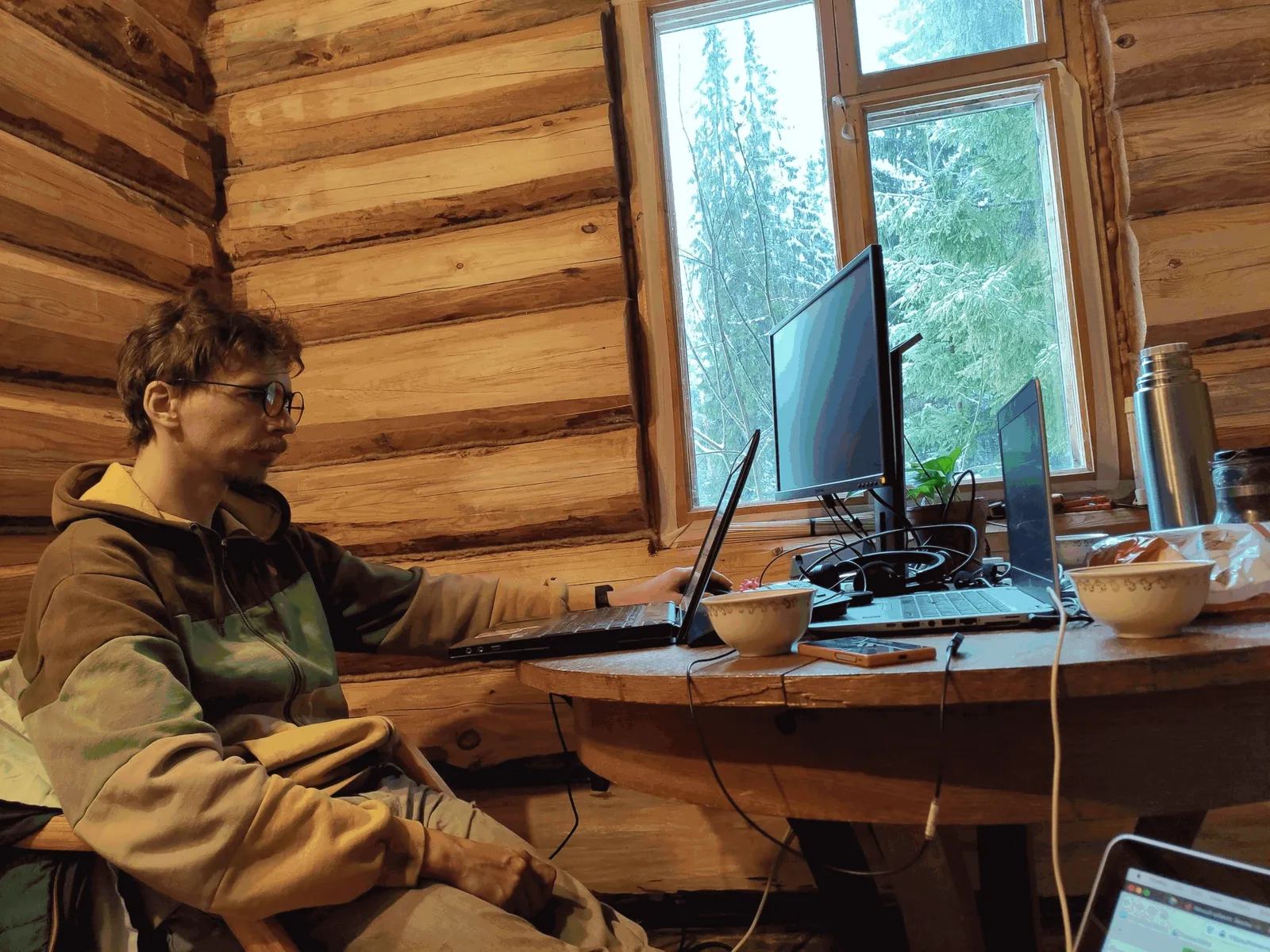
I lived in a village then: I moved there in 2020, escaping the lockdowns, a friend rented me a house, and I spent the winter from 2020 to 2021 there — the last months of the crunch, and then the bench. On the bench I just walked, went to the forest, made bonfires — nature always restores me. Long nights, the fireplace, no programming at all. Back then I also started doing yoga again after a long break, and gradually came back to myself. I have taken care of my body a lot since then — exercise, good food.
Coming back to work was hard: on the new project, for a long time, I couldn’t work at full strength and got tired fast. I started to set myself boundaries: I cut the load to a minimum and worked only on the project, no extra duties. I worked deliberately slowly and left on time no matter what. Then I moved to a four-day work week — and I still work that way: I pay for three days of rest a week with part of my salary, and it’s worth it.
The recovery took about a year and a half or two, I think. Completely, I think, I never really recovered, but now it’s more or less fine. To everyone who gets into the same situation I now say: don’t do it like that.
With agents there is something similar now. Everything seems easy — it’s like a slot machine in a casino: you pull the lever, and it throws you another hit of dopamine. And you have to deliberately refuse it at the moment you understand it’s time: time to close, time to finish.
Somebody nobody wanted to work with
From March 2021 and for two years, I led a team of four developers on an internal company portal for a client. The project was so-so. But there I met a guy nobody wanted to work with.
I saw right away that he was talented: he went deep into what he was doing and always tried to find the cause of a problem, not just fix the bug. But he was very bad with people: he came from a small town, had never worked in a team, his English was weak, and he was so unsociable that nobody wanted to work with him. He was thinking of leaving the company. I became his resource manager — at EPAM, the person who looks after a developer’s growth and projects.
I didn’t do any special trainings for him. We just talked a lot, and one way or another came to teamwork: he didn’t know how much the unity that happens in big teams means.
That unsociability was just a defence. He needed time to soften and to lower his shields, and he is really a wonderful, kind guy. In a year and a half together he relaxed and became a super cool, full member of the team. Now people want to work with him everywhere. We are still friends. He lives in Turkey.
Why I liked being a lead
Because a lead works with people a lot, and I always liked telling, explaining, helping — unblocking people who are stuck and don’t understand what to do next. Removing barriers, removing obstacles, teaching — I like it more than anything in the world, and nothing gives me such satisfaction.
From the client’s side it looked like this: in January 2022 an architect there wrote a recommendation for me on LinkedIn. I’ll quote it as it is, only without the client’s name:
Igor is one of the best developers and tech consultants I know. At [the client] we are every day happy to work with him.
We are lucky to work as one team with people from EPAM, regional IT and corporate IT. This is of cause [sic] possible because everybody and specially Igor concentrates on results and quality. It is so great have a business relationship that is based on trust and not time consuming politics.
Leaving
In October 2021, in the middle of that project, I left Russia. I was anxious: the crackdown on the internet had started, they began banning VPNs, censorship began, and I thought this was leading to nothing good. After COVID I also wanted to live somewhere else, and EPAM allowed it.
I drove through Georgia into Turkey. I didn’t plan not to come back, but I took my things just in case. I didn’t know where exactly I was going. Someone advised Fethiye. It turned out to be a small, great town by the sea, with a wonderful climate, very cheap.
When the war began and people started to leave — to Turkey too — it was completely natural for me to help them, since I was already there. Again this same unblocking, removing obstacles. I invited everybody to Fethiye, and a whole community formed there: guys from EPAM, people from St Petersburg. At one point Fethiye was a real EPAM settlement.
Then in Turkey problems with documents started, and many people saw Turkey from the start as a transit point on the way to Europe. I also understood fast that I don’t want to live there — the culture is too different. I chose for a long time between South America, Western Europe and Serbia, and in the end settled on Serbia: it is close to Russia in culture and a pleasant country to live in.
But I still love St Petersburg. I love its architecture — I worked a lot as a restorer on its historic buildings — and I feel completely in my place there. I like the canals, the river that goes through the whole city, the granite of the embankments. I lived for a long time in the centre, and it’s a special place: everyone in Russia who is somehow different from the rest comes there, and you meet all kinds of freaks. It’s very cool.
I miss Petersburg very much. I come once a year and see how much it has changed: the city I loved is almost gone, everyone left. And I would still like to come back someday.
The dream team
My last real scrum team was 2024–2026. At the peak, I think, we had five developers: me as the lead, one guy on the backend and three frontend developers. We also had a project manager, who was also the business analyst, and two testers. It was a life-science project, a WYSIWYG editor. It was a remote team.
We were all friends, and everyone was a wonderful person. Sometimes after work we would call each other and just chat. We kept more or less all the scrum ceremonies, but that wasn’t the point — the point was the people. I’m very fortunate to have met them, and I love all of them.
It ended when the client decided to hand the project over to developers from India. One by one, two by two, people started to leave, and in January 2026 I left too. It was very sad. But in outsourcing it is unfortunately unavoidable — projects change, even though you get attached to people. I try to keep in touch with them and not get lost in this big world. Everyone moved to different countries because of the war, not all stayed at EPAM, but we stayed friends.
The last code I wrote by hand
That editor was the last project where I wrote a big amount of code by hand. After it there was a small one, software for scientific microscopes, but there by hand I made only small edits and tests — and I moved to agents quickly.
One task from the editor I really remember; agents were only starting then. The application took a long time to load — up to three minutes for one page — and I had to understand why. Twice I retreated with nothing and said publicly that it couldn’t be solved. A month and a half later, on the third try, the answer turned out to be very simple: take all the updates of a big Redux store over some period, a second for example, and apply them as one change, instead of a million small changes, each of which re-renders the whole application. It came out even elegant, and I am still proud of it. I don’t know whether an agent would have come up with the same; the solution is very specific, completely non-standard and not described anywhere.
That was the real thrill of programming for me: finding a solution that is smart, original, interesting. That thrill is gone now too. But even before, solutions like that came to me once a year.
And one more thing, which I understood only now. When I came up with some project of my own, what stopped me was that I would have to spend a lot of time writing all that code myself, and I didn’t even start. During the years at EPAM there were practically no pet projects — GitHub shows it:
Repositories I created on GitHub, by year
Non-fork repositories, public and private, by creation date.
gh repo list IgorKonovalov, 28 October 2026. From 2018 to 2023 almost all of them are playgrounds of a day or a few weeks and examples for talks.
Then came 2026 — and that is the next post.
People
That is how I came to the winter this post began with.
Leading, unblocking, teaching — it was hard work, but rewarding. And now it is not needed. That’s a loss.
I think people were always the most important thing in the profession for me. And I’m a bit sad that all our work is getting fragmented, teams are getting smaller, that the machine is replacing us. We can work fast and efficiently — very fast and very efficiently. But this brotherhood, this society, is in fact already gone.