Randomness: one seed per thing
Diablo II has no single global dice roller. Every random decision is a draw from a small random-number state that belongs to one particular thing: the game, an act, a level, a room, a monster, an item. This page explains that seed state and how one step of it works, then follows the chain of seeds from the game’s starting number down to the rooms and units, and shows why the same starting number always gives every level the same starting seed. It restates two specs: the RNG core and the seed tree.
The big picture
Section titled “The big picture”A game has two roots. The map seed feeds everything about the map: acts, levels and rooms. The game seed is a separate object that feeds every unit the server creates, monsters included. The diagram is a simplified copy of the seed tree algorithm; the text below is what counts.
%3btext-align:center%3b%7d%23mermaid-0 .edgeLabel p%7bbackground-color:rgba(232%2c232%2c232%2c 0.8)%3b%7d%23mermaid-0 .edgeLabel rect%7bopacity:0.5%3bbackground-color:rgba(232%2c232%2c232%2c 0.8)%3bfill:rgba(232%2c232%2c232%2c 0.8)%3b%7d%23mermaid-0 .labelBkg%7bbackground-color:rgba(232%2c 232%2c 232%2c 0.5)%3b%7d%23mermaid-0 .cluster rect%7bfill:%23ffffde%3bstroke:%23aaaa33%3bstroke-width:1px%3b%7d%23mermaid-0 .cluster text%7bfill:%23333%3b%7d%23mermaid-0 .cluster span%7bcolor:%23333%3b%7d%23mermaid-0 .node .collapsed-indicator%7bfill:%23aaaa33%3bstroke:none%3bopacity:0.6%3b%7d%23mermaid-0 .node .collapsed-separator%7bstroke:%23aaaa33%3bstroke-width:0.75px%3b%7d%23mermaid-0 div.mermaidTooltip%7bposition:absolute%3btext-align:center%3bmax-width:200px%3bpadding:2px%3bfont-family:arial%2csans-serif%3bfont-size:12px%3bbackground:hsl(80%2c 100%25%2c 96.2745098039%25)%3bborder:1px solid %23aaaa33%3bborder-radius:2px%3bpointer-events:none%3bz-index:100%3b%7d%23mermaid-0 .flowchartTitleText%7btext-anchor:middle%3bfont-size:18px%3bfill:%23333%3b%7d%23mermaid-0 rect.text%7bfill:none%3bstroke-width:0%3b%7d%23mermaid-0 .icon-shape%2c%23mermaid-0 .image-shape%7bbackground-color:rgba(232%2c232%2c232%2c 0.8)%3btext-align:center%3b%7d%23mermaid-0 .icon-shape p%2c%23mermaid-0 .image-shape p%7bbackground-color:rgba(232%2c232%2c232%2c 0.8)%3bpadding:2px%3b%7d%23mermaid-0 .icon-shape .label rect%2c%23mermaid-0 .image-shape .label rect%7bopacity:0.5%3bbackground-color:rgba(232%2c232%2c232%2c 0.8)%3bfill:rgba(232%2c232%2c232%2c 0.8)%3b%7d%23mermaid-0 .label-icon%7bdisplay:inline-block%3bheight:1em%3boverflow:visible%3bvertical-align:-0.125em%3b%7d%23mermaid-0 .node .label-icon path%7bfill:currentColor%3bstroke:revert%3bstroke-width:revert%3b%7d%23mermaid-0 .node .neo-node%7bstroke:%239370DB%3b%7d%23mermaid-0 %5bdata-look='neo'%5d.node rect%2c%23mermaid-0 %5bdata-look='neo'%5d.cluster rect%2c%23mermaid-0 %5bdata-look='neo'%5d.node polygon%7bstroke:%239370DB%3bfilter:drop-shadow(1px 2px 2px rgba(185%2c 185%2c 185%2c 1))%3b%7d%23mermaid-0 %5bdata-look='neo'%5d.swimlane.cluster rect%7bfilter:none%3b%7d%23mermaid-0 %5bdata-look='neo'%5d.node path%7bstroke:%239370DB%3bstroke-width:1px%3b%7d%23mermaid-0 %5bdata-look='neo'%5d.node .outer-path%7bfilter:drop-shadow(1px 2px 2px rgba(185%2c 185%2c 185%2c 1))%3b%7d%23mermaid-0 %5bdata-look='neo'%5d.node .neo-line path%7bstroke:%239370DB%3bfilter:none%3b%7d%23mermaid-0 %5bdata-look='neo'%5d.node circle%7bstroke:%239370DB%3bfilter:drop-shadow(1px 2px 2px rgba(185%2c 185%2c 185%2c 1))%3b%7d%23mermaid-0 %5bdata-look='neo'%5d.node circle .state-start%7bfill:black%3b%7d%23mermaid-0 %5bdata-look='neo'%5d.icon-shape .icon%7bfill:%239370DB%3bfilter:drop-shadow(1px 2px 2px rgba(185%2c 185%2c 185%2c 1))%3b%7d%23mermaid-0 %5bdata-look='neo'%5d.icon-shape .icon-neo path%7bstroke:%239370DB%3bfilter:drop-shadow(1px 2px 2px rgba(185%2c 185%2c 185%2c 1))%3b%7d%23mermaid-0 :root%7b--mermaid-font-family:arial%2csans-serif%3b%7d%3c/style%3e%3cg%3e%3cmarker id='mermaid-0_flowchart-v2-pointEnd' class='marker flowchart-v2' viewBox='0 0 10 10' refX='5' refY='5' markerUnits='userSpaceOnUse' markerWidth='8' markerHeight='8' orient='auto'%3e%3cpath d='M 0 0 L 10 5 L 0 10 z' class='arrowMarkerPath' style='stroke-width: 1%3b stroke-dasharray: 1%2c 0%3b'/%3e%3c/marker%3e%3cmarker id='mermaid-0_flowchart-v2-pointStart' class='marker flowchart-v2' viewBox='0 0 10 10' refX='4.5' refY='5' markerUnits='userSpaceOnUse' markerWidth='8' markerHeight='8' orient='auto'%3e%3cpath d='M 0 5 L 10 10 L 10 0 z' class='arrowMarkerPath' style='stroke-width: 1%3b stroke-dasharray: 1%2c 0%3b'/%3e%3c/marker%3e%3cmarker id='mermaid-0_flowchart-v2-pointEnd-margin' class='marker flowchart-v2' viewBox='0 0 11.5 14' refX='11.5' refY='7' markerUnits='userSpaceOnUse' markerWidth='10.5' markerHeight='14' orient='auto'%3e%3cpath d='M 0 0 L 11.5 7 L 0 14 z' class='arrowMarkerPath' style='stroke-width: 0%3b stroke-dasharray: 1%2c 0%3b'/%3e%3c/marker%3e%3cmarker id='mermaid-0_flowchart-v2-pointStart-margin' class='marker flowchart-v2' viewBox='0 0 11.5 14' refX='1' refY='7' markerUnits='userSpaceOnUse' markerWidth='11.5' markerHeight='14' orient='auto'%3e%3cpolygon points='0%2c7 11.5%2c14 11.5%2c0' class='arrowMarkerPath' style='stroke-width: 0%3b stroke-dasharray: 1%2c 0%3b'/%3e%3c/marker%3e%3cmarker id='mermaid-0_flowchart-v2-circleEnd' class='marker flowchart-v2' viewBox='0 0 10 10' refX='11' refY='5' markerUnits='userSpaceOnUse' markerWidth='11' markerHeight='11' orient='auto'%3e%3ccircle cx='5' cy='5' r='5' class='arrowMarkerPath' style='stroke-width: 1%3b stroke-dasharray: 1%2c 0%3b'/%3e%3c/marker%3e%3cmarker id='mermaid-0_flowchart-v2-circleStart' class='marker flowchart-v2' viewBox='0 0 10 10' refX='-1' refY='5' markerUnits='userSpaceOnUse' markerWidth='11' markerHeight='11' orient='auto'%3e%3ccircle cx='5' cy='5' r='5' class='arrowMarkerPath' style='stroke-width: 1%3b stroke-dasharray: 1%2c 0%3b'/%3e%3c/marker%3e%3cmarker id='mermaid-0_flowchart-v2-circleEnd-margin' class='marker flowchart-v2' viewBox='0 0 10 10' refY='5' refX='12.25' markerUnits='userSpaceOnUse' markerWidth='14' markerHeight='14' orient='auto'%3e%3ccircle cx='5' cy='5' r='5' class='arrowMarkerPath' style='stroke-width: 0%3b stroke-dasharray: 1%2c 0%3b'/%3e%3c/marker%3e%3cmarker id='mermaid-0_flowchart-v2-circleStart-margin' class='marker flowchart-v2' viewBox='0 0 10 10' refX='-2' refY='5' markerUnits='userSpaceOnUse' markerWidth='14' markerHeight='14' orient='auto'%3e%3ccircle cx='5' cy='5' r='5' class='arrowMarkerPath' style='stroke-width: 0%3b stroke-dasharray: 1%2c 0%3b'/%3e%3c/marker%3e%3cmarker id='mermaid-0_flowchart-v2-crossEnd' class='marker cross flowchart-v2' viewBox='0 0 11 11' refX='12' refY='5.2' markerUnits='userSpaceOnUse' markerWidth='11' markerHeight='11' orient='auto'%3e%3cpath d='M 1%2c1 l 9%2c9 M 10%2c1 l -9%2c9' class='arrowMarkerPath' style='stroke-width: 2%3b stroke-dasharray: 1%2c 0%3b'/%3e%3c/marker%3e%3cmarker id='mermaid-0_flowchart-v2-crossStart' class='marker cross flowchart-v2' viewBox='0 0 11 11' refX='-1' refY='5.2' markerUnits='userSpaceOnUse' markerWidth='11' markerHeight='11' orient='auto'%3e%3cpath d='M 1%2c1 l 9%2c9 M 10%2c1 l -9%2c9' class='arrowMarkerPath' style='stroke-width: 2%3b stroke-dasharray: 1%2c 0%3b'/%3e%3c/marker%3e%3cmarker id='mermaid-0_flowchart-v2-crossEnd-margin' class='marker cross flowchart-v2' viewBox='0 0 15 15' refX='17.7' refY='7.5' markerUnits='userSpaceOnUse' markerWidth='12' markerHeight='12' orient='auto'%3e%3cpath d='M 1%2c1 L 14%2c14 M 1%2c14 L 14%2c1' class='arrowMarkerPath' style='stroke-width: 2.5%3b'/%3e%3c/marker%3e%3cmarker id='mermaid-0_flowchart-v2-crossStart-margin' class='marker cross flowchart-v2' viewBox='0 0 15 15' refX='-3.5' refY='7.5' markerUnits='userSpaceOnUse' markerWidth='12' markerHeight='12' orient='auto'%3e%3cpath d='M 1%2c1 L 14%2c14 M 1%2c14 L 14%2c1' class='arrowMarkerPath' style='stroke-width: 2.5%3b stroke-dasharray: 1%2c 0%3b'/%3e%3c/marker%3e%3cg class='root'%3e%3cg class='clusters'/%3e%3cg class='edgePaths'%3e%3cpath d='M318.184%2c59.574L298.957%2c64.145C279.73%2c68.716%2c241.277%2c77.858%2c222.051%2c85.929C202.824%2c94%2c202.824%2c101%2c202.824%2c104.5L202.824%2c108' id='mermaid-0-L_start_ms_0' class='edge-thickness-normal edge-pattern-solid edge-thickness-normal edge-pattern-solid flowchart-link' style='%3b' data-edge='true' data-et='edge' data-id='L_start_ms_0' data-points='W3sieCI6MzE4LjE4MzU5Mzc1LCJ5Ijo1OS41NzQ0OTAxMjM5NDE4NX0seyJ4IjoyMDIuODI0MjE4NzUsInkiOjg3fSx7IngiOjIwMi44MjQyMTg3NSwieSI6MTEyfV0=' data-look='classic' marker-end='url(%23mermaid-0_flowchart-v2-pointEnd)'/%3e%3cpath d='M524.918%2c51.322L562.575%2c57.269C600.232%2c63.215%2c675.546%2c75.107%2c713.202%2c84.554C750.859%2c94%2c750.859%2c101%2c750.859%2c104.5L750.859%2c108' id='mermaid-0-L_start_gs_0' class='edge-thickness-normal edge-pattern-solid edge-thickness-normal edge-pattern-solid flowchart-link' style='%3b' data-edge='true' data-et='edge' data-id='L_start_gs_0' data-points='W3sieCI6NTI0LjkxNzk2ODc1LCJ5Ijo1MS4zMjIzNjEwMDczMTg4NH0seyJ4Ijo3NTAuODU5Mzc1LCJ5Ijo4N30seyJ4Ijo3NTAuODU5Mzc1LCJ5IjoxMTJ9XQ==' data-look='classic' marker-end='url(%23mermaid-0_flowchart-v2-pointEnd)'/%3e%3cpath d='M163.538%2c166L151.656%2c174.167C139.773%2c182.333%2c116.008%2c198.667%2c104.125%2c216.333C92.242%2c234%2c92.242%2c253%2c92.242%2c262.5L92.242%2c272' id='mermaid-0-L_ms_sact_0' class='edge-thickness-normal edge-pattern-solid edge-thickness-normal edge-pattern-solid flowchart-link' style='%3b' data-edge='true' data-et='edge' data-id='L_ms_sact_0' data-points='W3sieCI6MTYzLjUzODQ5NzEyMTcxMDUyLCJ5IjoxNjZ9LHsieCI6OTIuMjQyMTg3NSwieSI6MjE1fSx7IngiOjkyLjI0MjE4NzUsInkiOjI3Nn1d' data-look='classic' marker-end='url(%23mermaid-0_flowchart-v2-pointEnd)'/%3e%3cpath d='M242.11%2c166L253.993%2c174.167C265.875%2c182.333%2c289.641%2c198.667%2c301.524%2c216.333C313.406%2c234%2c313.406%2c253%2c313.406%2c262.5L313.406%2c272' id='mermaid-0-L_ms_cact_0' class='edge-thickness-normal edge-pattern-solid edge-thickness-normal edge-pattern-solid flowchart-link' style='%3b' data-edge='true' data-et='edge' data-id='L_ms_cact_0' data-points='W3sieCI6MjQyLjEwOTk0MDM3ODI4OTQ4LCJ5IjoxNjZ9LHsieCI6MzEzLjQwNjI1LCJ5IjoyMTV9LHsieCI6MzEzLjQwNjI1LCJ5IjoyNzZ9XQ==' data-look='classic' marker-end='url(%23mermaid-0_flowchart-v2-pointEnd)'/%3e%3cpath d='M92.242%2c354L92.242%2c360.167C92.242%2c366.333%2c92.242%2c378.667%2c98.865%2c388.666C105.487%2c398.665%2c118.732%2c406.331%2c125.354%2c410.164L131.976%2c413.996' id='mermaid-0-L_sact_base_0' class='edge-thickness-normal edge-pattern-solid edge-thickness-normal edge-pattern-solid flowchart-link' style='%3b' data-edge='true' data-et='edge' data-id='L_sact_base_0' data-points='W3sieCI6OTIuMjQyMTg3NSwieSI6MzU0fSx7IngiOjkyLjI0MjE4NzUsInkiOjM5MX0seyJ4IjoxMzUuNDM4MjkzNDU3MDMxMjUsInkiOjQxNn1d' data-look='classic' marker-end='url(%23mermaid-0_flowchart-v2-pointEnd)'/%3e%3cpath d='M313.406%2c354L313.406%2c360.167C313.406%2c366.333%2c313.406%2c378.667%2c306.784%2c388.666C300.162%2c398.665%2c286.917%2c406.331%2c280.294%2c410.164L273.672%2c413.996' id='mermaid-0-L_cact_base_0' class='edge-thickness-normal edge-pattern-solid edge-thickness-normal edge-pattern-solid flowchart-link' style='%3b' data-edge='true' data-et='edge' data-id='L_cact_base_0' data-points='W3sieCI6MzEzLjQwNjI1LCJ5IjozNTR9LHsieCI6MzEzLjQwNjI1LCJ5IjozOTF9LHsieCI6MjcwLjIxMDE0NDA0Mjk2ODc1LCJ5Ijo0MTZ9XQ==' data-look='classic' marker-end='url(%23mermaid-0_flowchart-v2-pointEnd)'/%3e%3cpath d='M202.824%2c494L202.824%2c498.167C202.824%2c502.333%2c202.824%2c510.667%2c202.824%2c518.333C202.824%2c526%2c202.824%2c533%2c202.824%2c536.5L202.824%2c540' id='mermaid-0-L_base_lvl_0' class='edge-thickness-normal edge-pattern-solid edge-thickness-normal edge-pattern-solid flowchart-link' style='%3b' data-edge='true' data-et='edge' data-id='L_base_lvl_0' data-points='W3sieCI6MjAyLjgyNDIxODc1LCJ5Ijo0OTR9LHsieCI6MjAyLjgyNDIxODc1LCJ5Ijo1MTl9LHsieCI6MjAyLjgyNDIxODc1LCJ5Ijo1NDR9XQ==' data-look='classic' marker-end='url(%23mermaid-0_flowchart-v2-pointEnd)'/%3e%3cpath d='M202.824%2c646L202.824%2c652.167C202.824%2c658.333%2c202.824%2c670.667%2c202.824%2c682.333C202.824%2c694%2c202.824%2c705%2c202.824%2c710.5L202.824%2c716' id='mermaid-0-L_lvl_room_0' class='edge-thickness-normal edge-pattern-solid edge-thickness-normal edge-pattern-solid flowchart-link' style='%3b' data-edge='true' data-et='edge' data-id='L_lvl_room_0' data-points='W3sieCI6MjAyLjgyNDIxODc1LCJ5Ijo2NDZ9LHsieCI6MjAyLjgyNDIxODc1LCJ5Ijo2ODN9LHsieCI6MjAyLjgyNDIxODc1LCJ5Ijo3MjB9XQ==' data-look='classic' marker-end='url(%23mermaid-0_flowchart-v2-pointEnd)'/%3e%3cpath d='M202.824%2c774L202.824%2c782.167C202.824%2c790.333%2c202.824%2c806.667%2c202.824%2c822.333C202.824%2c838%2c202.824%2c853%2c202.824%2c860.5L202.824%2c868' id='mermaid-0-L_room_aroom_0' class='edge-thickness-normal edge-pattern-solid edge-thickness-normal edge-pattern-solid flowchart-link' style='%3b' data-edge='true' data-et='edge' data-id='L_room_aroom_0' data-points='W3sieCI6MjAyLjgyNDIxODc1LCJ5Ijo3NzR9LHsieCI6MjAyLjgyNDIxODc1LCJ5Ijo4MjN9LHsieCI6MjAyLjgyNDIxODc1LCJ5Ijo4NzJ9XQ==' data-look='classic' marker-end='url(%23mermaid-0_flowchart-v2-pointEnd)'/%3e%3cpath d='M202.824%2c926L202.824%2c932.167C202.824%2c938.333%2c202.824%2c950.667%2c202.824%2c962.333C202.824%2c974%2c202.824%2c985%2c202.824%2c990.5L202.824%2c996' id='mermaid-0-L_aroom_cunit_0' class='edge-thickness-normal edge-pattern-solid edge-thickness-normal edge-pattern-solid flowchart-link' style='%3b' data-edge='true' data-et='edge' data-id='L_aroom_cunit_0' data-points='W3sieCI6MjAyLjgyNDIxODc1LCJ5Ijo5MjZ9LHsieCI6MjAyLjgyNDIxODc1LCJ5Ijo5NjN9LHsieCI6MjAyLjgyNDIxODc1LCJ5IjoxMDAwfV0=' data-look='classic' marker-end='url(%23mermaid-0_flowchart-v2-pointEnd)'/%3e%3cpath d='M681.273%2c163.809L657.342%2c172.341C633.411%2c180.873%2c585.549%2c197.936%2c561.618%2c217.968C537.688%2c238%2c537.688%2c261%2c537.688%2c272.5L537.688%2c284' id='mermaid-0-L_gs_mreg_0' class='edge-thickness-normal edge-pattern-solid edge-thickness-normal edge-pattern-solid flowchart-link' style='%3b' data-edge='true' data-et='edge' data-id='L_gs_mreg_0' data-points='W3sieCI6NjgxLjI3MzQzNzUsInkiOjE2My44MDg3NjY0MDAzNTE4M30seyJ4Ijo1MzcuNjg3NSwieSI6MjE1fSx7IngiOjUzNy42ODc1LCJ5IjoyODh9XQ==' data-look='classic' marker-end='url(%23mermaid-0_flowchart-v2-pointEnd)'/%3e%3cpath d='M750.859%2c166L750.859%2c174.167C750.859%2c182.333%2c750.859%2c198.667%2c750.859%2c218.333C750.859%2c238%2c750.859%2c261%2c750.859%2c272.5L750.859%2c284' id='mermaid-0-L_gs_oreg_0' class='edge-thickness-normal edge-pattern-solid edge-thickness-normal edge-pattern-solid flowchart-link' style='%3b' data-edge='true' data-et='edge' data-id='L_gs_oreg_0' data-points='W3sieCI6NzUwLjg1OTM3NSwieSI6MTY2fSx7IngiOjc1MC44NTkzNzUsInkiOjIxNX0seyJ4Ijo3NTAuODU5Mzc1LCJ5IjoyODh9XQ==' data-look='classic' marker-end='url(%23mermaid-0_flowchart-v2-pointEnd)'/%3e%3cpath d='M820.445%2c159.673L851.483%2c168.895C882.521%2c178.116%2c944.596%2c196.558%2c975.634%2c213.279C1006.672%2c230%2c1006.672%2c245%2c1006.672%2c252.5L1006.672%2c260' id='mermaid-0-L_gs_sunit_0' class='edge-thickness-normal edge-pattern-solid edge-thickness-normal edge-pattern-solid flowchart-link' style='%3b' data-edge='true' data-et='edge' data-id='L_gs_sunit_0' data-points='W3sieCI6ODIwLjQ0NTMxMjUsInkiOjE1OS42NzM0NjY4OTQ2OTgyN30seyJ4IjoxMDA2LjY3MTg3NSwieSI6MjE1fSx7IngiOjEwMDYuNjcxODc1LCJ5IjoyNjR9XQ==' data-look='classic' marker-end='url(%23mermaid-0_flowchart-v2-pointEnd)'/%3e%3c/g%3e%3cg class='edgeLabels'%3e%3cg class='edgeLabel'%3e%3cg class='label' data-id='L_start_ms_0' transform='translate(0%2c 0)'%3e%3cforeignObject width='0' height='0'%3e%3cdiv xmlns='http://www.w3.org/1999/xhtml' class='labelBkg' style='display: table-cell%3b white-space: nowrap%3b line-height: 1.5%3b max-width: 200px%3b text-align: center%3b'%3e%3cspan class='edgeLabel'%3e%3c/span%3e%3c/div%3e%3c/foreignObject%3e%3c/g%3e%3c/g%3e%3cg class='edgeLabel'%3e%3cg class='label' data-id='L_start_gs_0' transform='translate(0%2c 0)'%3e%3cforeignObject width='0' height='0'%3e%3cdiv xmlns='http://www.w3.org/1999/xhtml' class='labelBkg' style='display: table-cell%3b white-space: nowrap%3b line-height: 1.5%3b max-width: 200px%3b text-align: center%3b'%3e%3cspan class='edgeLabel'%3e%3c/span%3e%3c/div%3e%3c/foreignObject%3e%3c/g%3e%3c/g%3e%3cg class='edgeLabel'%3e%3cg class='label' data-id='L_ms_sact_0' transform='translate(0%2c 0)'%3e%3cforeignObject width='0' height='0'%3e%3cdiv xmlns='http://www.w3.org/1999/xhtml' class='labelBkg' style='display: table-cell%3b white-space: nowrap%3b line-height: 1.5%3b max-width: 200px%3b text-align: center%3b'%3e%3cspan class='edgeLabel'%3e%3c/span%3e%3c/div%3e%3c/foreignObject%3e%3c/g%3e%3c/g%3e%3cg class='edgeLabel'%3e%3cg class='label' data-id='L_ms_cact_0' transform='translate(0%2c 0)'%3e%3cforeignObject width='0' height='0'%3e%3cdiv xmlns='http://www.w3.org/1999/xhtml' class='labelBkg' style='display: table-cell%3b white-space: nowrap%3b line-height: 1.5%3b max-width: 200px%3b text-align: center%3b'%3e%3cspan class='edgeLabel'%3e%3c/span%3e%3c/div%3e%3c/foreignObject%3e%3c/g%3e%3c/g%3e%3cg class='edgeLabel'%3e%3cg class='label' data-id='L_sact_base_0' transform='translate(0%2c 0)'%3e%3cforeignObject width='0' height='0'%3e%3cdiv xmlns='http://www.w3.org/1999/xhtml' class='labelBkg' style='display: table-cell%3b white-space: nowrap%3b line-height: 1.5%3b max-width: 200px%3b text-align: center%3b'%3e%3cspan class='edgeLabel'%3e%3c/span%3e%3c/div%3e%3c/foreignObject%3e%3c/g%3e%3c/g%3e%3cg class='edgeLabel'%3e%3cg class='label' data-id='L_cact_base_0' transform='translate(0%2c 0)'%3e%3cforeignObject width='0' height='0'%3e%3cdiv xmlns='http://www.w3.org/1999/xhtml' class='labelBkg' style='display: table-cell%3b white-space: nowrap%3b line-height: 1.5%3b max-width: 200px%3b text-align: center%3b'%3e%3cspan class='edgeLabel'%3e%3c/span%3e%3c/div%3e%3c/foreignObject%3e%3c/g%3e%3c/g%3e%3cg class='edgeLabel'%3e%3cg class='label' data-id='L_base_lvl_0' transform='translate(0%2c 0)'%3e%3cforeignObject width='0' height='0'%3e%3cdiv xmlns='http://www.w3.org/1999/xhtml' class='labelBkg' style='display: table-cell%3b white-space: nowrap%3b line-height: 1.5%3b max-width: 200px%3b text-align: center%3b'%3e%3cspan class='edgeLabel'%3e%3c/span%3e%3c/div%3e%3c/foreignObject%3e%3c/g%3e%3c/g%3e%3cg class='edgeLabel' transform='translate(202.82421875%2c 683)'%3e%3cg class='label' data-id='L_lvl_room_0' transform='translate(-85.8203125%2c -12)'%3e%3cforeignObject width='171.640625' height='24'%3e%3cdiv xmlns='http://www.w3.org/1999/xhtml' class='labelBkg' style='display: table-cell%3b white-space: nowrap%3b line-height: 1.5%3b max-width: 200px%3b text-align: center%3b'%3e%3cspan class='edgeLabel'%3e%3cp%3eone level draw per room%3c/p%3e%3c/span%3e%3c/div%3e%3c/foreignObject%3e%3c/g%3e%3c/g%3e%3cg class='edgeLabel' transform='translate(202.82421875%2c 823)'%3e%3cg class='label' data-id='L_room_aroom_0' transform='translate(-100%2c -24)'%3e%3cforeignObject width='200' height='48'%3e%3cdiv xmlns='http://www.w3.org/1999/xhtml' class='labelBkg' style='display: table%3b white-space: break-spaces%3b line-height: 1.5%3b max-width: 200px%3b text-align: center%3b width: 200px%3b'%3e%3cspan class='edgeLabel'%3e%3cp%3erestart%2c k tile draws%2c one more draw%3c/p%3e%3c/span%3e%3c/div%3e%3c/foreignObject%3e%3c/g%3e%3c/g%3e%3cg class='edgeLabel' transform='translate(202.82421875%2c 963)'%3e%3cg class='label' data-id='L_aroom_cunit_0' transform='translate(-54.6953125%2c -12)'%3e%3cforeignObject width='109.390625' height='24'%3e%3cdiv xmlns='http://www.w3.org/1999/xhtml' class='labelBkg' style='display: table-cell%3b white-space: nowrap%3b line-height: 1.5%3b max-width: 200px%3b text-align: center%3b'%3e%3cspan class='edgeLabel'%3e%3cp%3eclient units only%3c/p%3e%3c/span%3e%3c/div%3e%3c/foreignObject%3e%3c/g%3e%3c/g%3e%3cg class='edgeLabel' transform='translate(537.6875%2c 215)'%3e%3cg class='label' data-id='L_gs_mreg_0' transform='translate(-24.015625%2c -12)'%3e%3cforeignObject width='48.03125' height='24'%3e%3cdiv xmlns='http://www.w3.org/1999/xhtml' class='labelBkg' style='display: table-cell%3b white-space: nowrap%3b line-height: 1.5%3b max-width: 200px%3b text-align: center%3b'%3e%3cspan class='edgeLabel'%3e%3cp%3edraw 1%3c/p%3e%3c/span%3e%3c/div%3e%3c/foreignObject%3e%3c/g%3e%3c/g%3e%3cg class='edgeLabel' transform='translate(750.859375%2c 215)'%3e%3cg class='label' data-id='L_gs_oreg_0' transform='translate(-24.015625%2c -12)'%3e%3cforeignObject width='48.03125' height='24'%3e%3cdiv xmlns='http://www.w3.org/1999/xhtml' class='labelBkg' style='display: table-cell%3b white-space: nowrap%3b line-height: 1.5%3b max-width: 200px%3b text-align: center%3b'%3e%3cspan class='edgeLabel'%3e%3cp%3edraw 2%3c/p%3e%3c/span%3e%3c/div%3e%3c/foreignObject%3e%3c/g%3e%3c/g%3e%3cg class='edgeLabel' transform='translate(1006.671875%2c 215)'%3e%3cg class='label' data-id='L_gs_sunit_0' transform='translate(-100%2c -24)'%3e%3cforeignObject width='200' height='48'%3e%3cdiv xmlns='http://www.w3.org/1999/xhtml' class='labelBkg' style='display: table%3b white-space: break-spaces%3b line-height: 1.5%3b max-width: 200px%3b text-align: center%3b width: 200px%3b'%3e%3cspan class='edgeLabel'%3e%3cp%3eone draw per unit%2c in call order%3c/p%3e%3c/span%3e%3c/div%3e%3c/foreignObject%3e%3c/g%3e%3c/g%3e%3c/g%3e%3cg class='nodes'%3e%3cg class='node default' id='mermaid-0-flowchart-start-0' data-look='classic' transform='translate(421.55078125%2c 35)'%3e%3crect class='basic label-container' style='' x='-103.3671875' y='-27' width='206.734375' height='54'/%3e%3cg class='label' style='' transform='translate(-73.3671875%2c -12)'%3e%3crect/%3e%3cforeignObject width='146.734375' height='24'%3e%3cdiv xmlns='http://www.w3.org/1999/xhtml' style='display: table-cell%3b white-space: nowrap%3b line-height: 1.5%3b max-width: 200px%3b text-align: center%3b'%3e%3cspan class='nodeLabel'%3e%3cp%3e-seed N%2c or the clock%3c/p%3e%3c/span%3e%3c/div%3e%3c/foreignObject%3e%3c/g%3e%3c/g%3e%3cg class='node default' id='mermaid-0-flowchart-ms-1' data-look='classic' transform='translate(202.82421875%2c 139)'%3e%3crect class='basic label-container' style='' x='-65.1328125' y='-27' width='130.265625' height='54'/%3e%3cg class='label' style='' transform='translate(-35.1328125%2c -12)'%3e%3crect/%3e%3cforeignObject width='70.265625' height='24'%3e%3cdiv xmlns='http://www.w3.org/1999/xhtml' style='display: table-cell%3b white-space: nowrap%3b line-height: 1.5%3b max-width: 200px%3b text-align: center%3b'%3e%3cspan class='nodeLabel'%3e%3cp%3emap seed%3c/p%3e%3c/span%3e%3c/div%3e%3c/foreignObject%3e%3c/g%3e%3c/g%3e%3cg class='node default' id='mermaid-0-flowchart-gs-3' data-look='classic' transform='translate(750.859375%2c 139)'%3e%3crect class='basic label-container' style='' x='-69.5859375' y='-27' width='139.171875' height='54'/%3e%3cg class='label' style='' transform='translate(-39.5859375%2c -12)'%3e%3crect/%3e%3cforeignObject width='79.171875' height='24'%3e%3cdiv xmlns='http://www.w3.org/1999/xhtml' style='display: table-cell%3b white-space: nowrap%3b line-height: 1.5%3b max-width: 200px%3b text-align: center%3b'%3e%3cspan class='nodeLabel'%3e%3cp%3egame seed%3c/p%3e%3c/span%3e%3c/div%3e%3c/foreignObject%3e%3c/g%3e%3c/g%3e%3cg class='node default' id='mermaid-0-flowchart-sact-5' data-look='classic' transform='translate(92.2421875%2c 315)'%3e%3crect class='basic label-container' style='' x='-84.2421875' y='-39' width='168.484375' height='78'/%3e%3cg class='label' style='' transform='translate(-54.2421875%2c -24)'%3e%3crect/%3e%3cforeignObject width='108.484375' height='48'%3e%3cdiv xmlns='http://www.w3.org/1999/xhtml' style='display: table-cell%3b white-space: nowrap%3b line-height: 1.5%3b max-width: 200px%3b text-align: center%3b'%3e%3cspan class='nodeLabel'%3e%3cp%3eserver act copy%3cbr /%3eInit(map seed)%3c/p%3e%3c/span%3e%3c/div%3e%3c/foreignObject%3e%3c/g%3e%3c/g%3e%3cg class='node default' id='mermaid-0-flowchart-cact-7' data-look='classic' transform='translate(313.40625%2c 315)'%3e%3crect class='basic label-container' style='' x='-86.921875' y='-39' width='173.84375' height='78'/%3e%3cg class='label' style='' transform='translate(-56.921875%2c -24)'%3e%3crect/%3e%3cforeignObject width='113.84375' height='48'%3e%3cdiv xmlns='http://www.w3.org/1999/xhtml' style='display: table-cell%3b white-space: nowrap%3b line-height: 1.5%3b max-width: 200px%3b text-align: center%3b'%3e%3cspan class='nodeLabel'%3e%3cp%3eclient act copy%3cbr /%3esame map seed%3c/p%3e%3c/span%3e%3c/div%3e%3c/foreignObject%3e%3c/g%3e%3c/g%3e%3cg class='node default' id='mermaid-0-flowchart-base-9' data-look='classic' transform='translate(202.82421875%2c 455)'%3e%3crect class='basic label-container' style='' x='-85.59375' y='-39' width='171.1875' height='78'/%3e%3cg class='label' style='' transform='translate(-55.59375%2c -24)'%3e%3crect/%3e%3cforeignObject width='111.1875' height='48'%3e%3cdiv xmlns='http://www.w3.org/1999/xhtml' style='display: table-cell%3b white-space: nowrap%3b line-height: 1.5%3b max-width: 200px%3b text-align: center%3b'%3e%3cspan class='nodeLabel'%3e%3cp%3elevel seed base%3cbr /%3efirst act draw%3c/p%3e%3c/span%3e%3c/div%3e%3c/foreignObject%3e%3c/g%3e%3c/g%3e%3cg class='node default' id='mermaid-0-flowchart-lvl-13' data-look='classic' transform='translate(202.82421875%2c 595)'%3e%3crect class='basic label-container' style='' x='-130' y='-51' width='260' height='102'/%3e%3cg class='label' style='' transform='translate(-100%2c -36)'%3e%3crect/%3e%3cforeignObject width='200' height='72'%3e%3cdiv xmlns='http://www.w3.org/1999/xhtml' style='display: table%3b white-space: break-spaces%3b line-height: 1.5%3b max-width: 200px%3b text-align: center%3b width: 200px%3b'%3e%3cspan class='nodeLabel'%3e%3cp%3elevel seed%3cbr /%3eInit(base %2b level id)%2c no draw%3c/p%3e%3c/span%3e%3c/div%3e%3c/foreignObject%3e%3c/g%3e%3c/g%3e%3cg class='node default' id='mermaid-0-flowchart-room-15' data-look='classic' transform='translate(202.82421875%2c 747)'%3e%3crect class='basic label-container' style='' x='-92.25' y='-27' width='184.5' height='54'/%3e%3cg class='label' style='' transform='translate(-62.25%2c -12)'%3e%3crect/%3e%3cforeignObject width='124.5' height='24'%3e%3cdiv xmlns='http://www.w3.org/1999/xhtml' style='display: table-cell%3b white-space: nowrap%3b line-height: 1.5%3b max-width: 200px%3b text-align: center%3b'%3e%3cspan class='nodeLabel'%3e%3cp%3eDRLG room seed%3c/p%3e%3c/span%3e%3c/div%3e%3c/foreignObject%3e%3c/g%3e%3c/g%3e%3cg class='node default' id='mermaid-0-flowchart-aroom-17' data-look='classic' transform='translate(202.82421875%2c 899)'%3e%3crect class='basic label-container' style='' x='-90.921875' y='-27' width='181.84375' height='54'/%3e%3cg class='label' style='' transform='translate(-60.921875%2c -12)'%3e%3crect/%3e%3cforeignObject width='121.84375' height='24'%3e%3cdiv xmlns='http://www.w3.org/1999/xhtml' style='display: table-cell%3b white-space: nowrap%3b line-height: 1.5%3b max-width: 200px%3b text-align: center%3b'%3e%3cspan class='nodeLabel'%3e%3cp%3eactive room seed%3c/p%3e%3c/span%3e%3c/div%3e%3c/foreignObject%3e%3c/g%3e%3c/g%3e%3cg class='node default' id='mermaid-0-flowchart-cunit-19' data-look='classic' transform='translate(202.82421875%2c 1027)'%3e%3crect class='basic label-container' style='' x='-83.3671875' y='-27' width='166.734375' height='54'/%3e%3cg class='label' style='' transform='translate(-53.3671875%2c -12)'%3e%3crect/%3e%3cforeignObject width='106.734375' height='24'%3e%3cdiv xmlns='http://www.w3.org/1999/xhtml' style='display: table-cell%3b white-space: nowrap%3b line-height: 1.5%3b max-width: 200px%3b text-align: center%3b'%3e%3cspan class='nodeLabel'%3e%3cp%3eclient unit seed%3c/p%3e%3c/span%3e%3c/div%3e%3c/foreignObject%3e%3c/g%3e%3c/g%3e%3cg class='node default' id='mermaid-0-flowchart-mreg-21' data-look='classic' transform='translate(537.6875%2c 315)'%3e%3crect class='basic label-container' style='' x='-87.359375' y='-27' width='174.71875' height='54'/%3e%3cg class='label' style='' transform='translate(-57.359375%2c -12)'%3e%3crect/%3e%3cforeignObject width='114.71875' height='24'%3e%3cdiv xmlns='http://www.w3.org/1999/xhtml' style='display: table-cell%3b white-space: nowrap%3b line-height: 1.5%3b max-width: 200px%3b text-align: center%3b'%3e%3cspan class='nodeLabel'%3e%3cp%3emonster regions%3c/p%3e%3c/span%3e%3c/div%3e%3c/foreignObject%3e%3c/g%3e%3c/g%3e%3cg class='node default' id='mermaid-0-flowchart-oreg-23' data-look='classic' transform='translate(750.859375%2c 315)'%3e%3crect class='basic label-container' style='' x='-75.8125' y='-27' width='151.625' height='54'/%3e%3cg class='label' style='' transform='translate(-45.8125%2c -12)'%3e%3crect/%3e%3cforeignObject width='91.625' height='24'%3e%3cdiv xmlns='http://www.w3.org/1999/xhtml' style='display: table-cell%3b white-space: nowrap%3b line-height: 1.5%3b max-width: 200px%3b text-align: center%3b'%3e%3cspan class='nodeLabel'%3e%3cp%3eobject region%3c/p%3e%3c/span%3e%3c/div%3e%3c/foreignObject%3e%3c/g%3e%3c/g%3e%3cg class='node default' id='mermaid-0-flowchart-sunit-25' data-look='classic' transform='translate(1006.671875%2c 315)'%3e%3crect class='basic label-container' style='' x='-130' y='-51' width='260' height='102'/%3e%3cg class='label' style='' transform='translate(-100%2c -36)'%3e%3crect/%3e%3cforeignObject width='200' height='72'%3e%3cdiv xmlns='http://www.w3.org/1999/xhtml' style='display: table%3b white-space: break-spaces%3b line-height: 1.5%3b max-width: 200px%3b text-align: center%3b width: 200px%3b'%3e%3cspan class='nodeLabel'%3e%3cp%3eserver unit seed%3cbr /%3emonsters%2c objects%2c items%2c NPCs%3c/p%3e%3c/span%3e%3c/div%3e%3c/foreignObject%3e%3c/g%3e%3c/g%3e%3c/g%3e%3c/g%3e%3c/g%3e%3cdefs%3e%3cfilter id='mermaid-0-drop-shadow' height='130%25' width='130%25'%3e%3cfeDropShadow dx='4' dy='4' stdDeviation='0' flood-opacity='0.06' flood-color='black'/%3e%3c/filter%3e%3c/defs%3e%3cdefs%3e%3cfilter id='mermaid-0-drop-shadow-small' height='150%25' width='150%25'%3e%3cfeDropShadow dx='2' dy='2' stdDeviation='0' flood-opacity='0.06' flood-color='black'/%3e%3c/filter%3e%3c/defs%3e%3c/svg%3e)
The generator: eight bytes and one multiplication
Section titled “The generator: eight bytes and one multiplication”A seed is 8 bytes: two unsigned 32-bit halves, low and high. It is stored inside the thing
that owns it. The generator reads no table: its
code touches only the seed and the stack, and running it under an emulator with no table loaded gave the game’s
own results.
The whole generator is a handful of operations:
| Operation | What it does | Draws? |
|---|---|---|
| Init(v) | low = v, high = 666 |
no |
| InitOne | low = 1, high = 666 |
no |
| Step | low × 1791398085 + high, computed in 64 bits; the bottom half becomes the new low, the top half the new high |
yes, one |
| Range(n) | if n is below 1, return 0 and leave the seed alone; otherwise Step, then return the new low mod n |
one, or none |
| RangePow2(n) | always Step, then return the new low with the bits of n − 1 kept (for n a power of two) |
yes, one |
A few details matter to anyone who wants to reproduce the game exactly, and they are all confirmed:
- The result comes from the new
low, after the step, not the old one. highis not a constant.Initsets it to 666, but every step overwrites it with the carry, so all 64 bits carry forward.- The modulus is unsigned, and there is no correction for bias: the game takes
low mod nas it is.
A draw is one step of one named seed. A draw on one seed never changes another seed. Some seeds are shared by several parts of the game, though, and then the order in which those parts draw matters as much as what each one computes.
The “return 0 without drawing for n below 1” guard is not everywhere. Many call sites copy the step inline, and an inlined draw with a fixed modulus (such as a mod 7) has no guard; neither has RangePow2. So when a table-driven count can be zero, whether the game still draws depends on the call site. That much is confirmed: RangePow2 under the emulator steps the seed with n = 0 where Range does not, and the act’s inlined mod 7 draws in play with no guard. Which form each other site uses is stated call site by call site in the subsystem specs. One more helper, “power-of-two range plus a base”, is also in the program: what it computes is confirmed under the emulator, but by the code nothing calls it, and no spec depends on it. Eight other pieces of code holding inlined draws have no caller either, by the same reading.
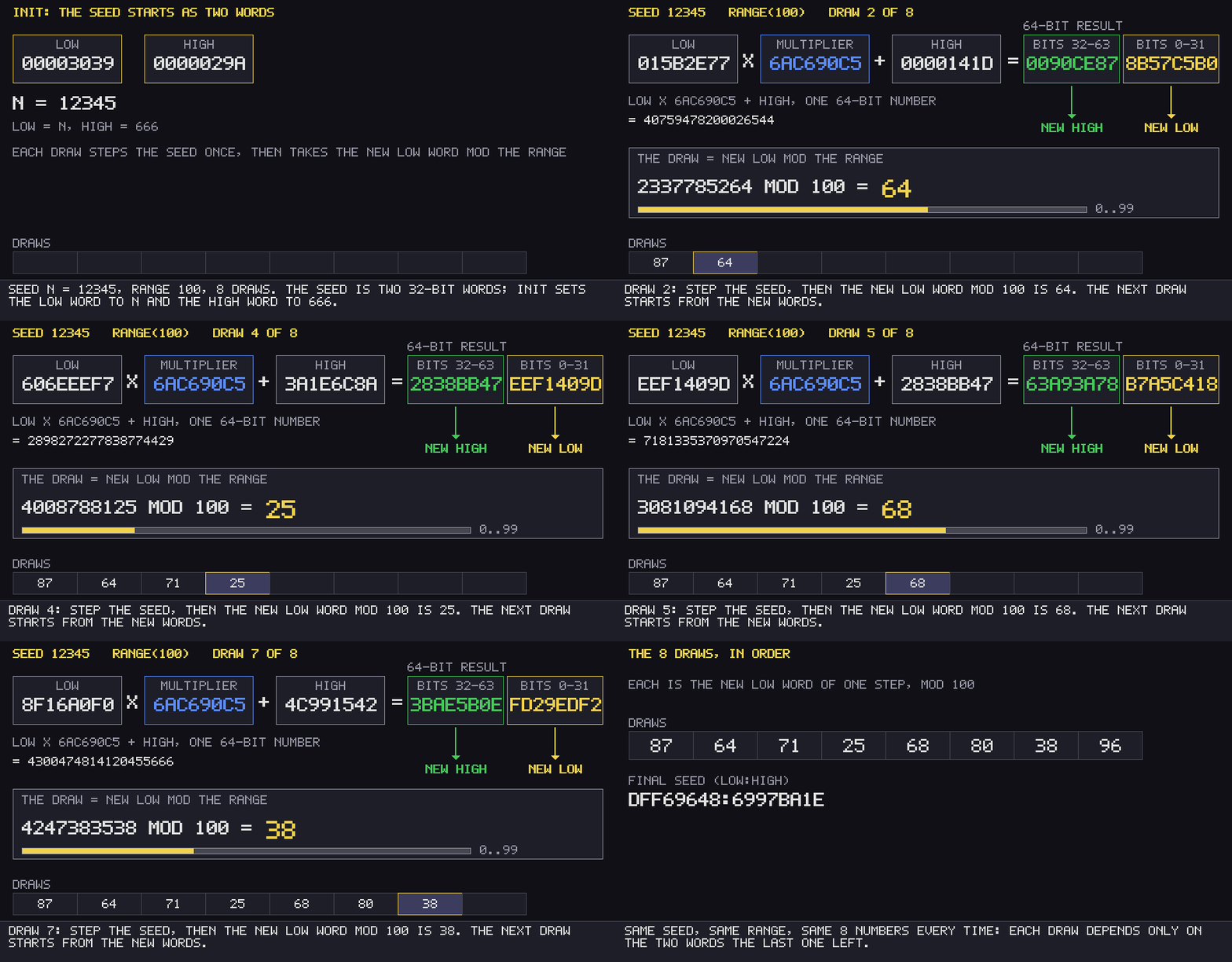
The generator on the seed 12345 with a range of 100, eight draws in a row. Init sets the low word to the seed and the high word to 666. A draw with a range of at least one steps the seed once: the low word times the multiplier plus the high word is one 64-bit number, its low 32 bits are the new low word and its high 32 bits the new high word, and the draw is the new low word mod the range (RNG core § Algorithm). The first draw is 87 and the first new seed is the one the randomness page’s worked example shows. Seed: illustrative, an input of our own. Every value shown is computed by our model, not observed in the game.
Two roots: the map seed and the game seed
Section titled “Two roots: the map seed and the game seed”When a game is created, the game picks its two roots (seed tree, algorithm, step 1):
- With an override (
-seed Non the command line, or the same option inD2.ini): the map seed is N, and the game seed isInit(N). No draw happens. - Without one: the game seed is initialised from a value mixed from the tick count, the clock and the performance counter, it is stepped once, and the map seed is mixed from that. These sources cannot be reproduced, so only the override path is repeatable.
-seed 0 is impossible: the option is only applied when it is not zero, so 0 takes the clock path. A negative seed cannot be given
on the command line either: the game cuts a switch’s text at the next -, so -seed -1 or -seed -2147483648
arrives empty, counts as 0 and takes the clock path. A value of 2 147 483 648 or more is clipped to 2 147 483 647.
So the seeds a command line can reproduce are 1 to 2 147 483 647; this was checked in a run. Whether the D2.ini route can reach the larger
values is an open question.
From the map seed to acts
Section titled “From the map seed to acts”Every act starts from the same number: Init(map seed). Its first draw becomes the
level seed base, the value every level of that act is built from
(seed tree, algorithm, step 3). Because all acts share the map seed, all acts
share the same level seed base.
Some acts then draw more from their own act seed. These draws come after the level seed base is taken, so they never change any level seed:
- Act II draws two numbers
mod 7and repeats until they differ. They pick two of the seven Tal Rasha tomb levels (level ids 66 to 72). Every rejected pair costs two act draws, and the loop has no fixed limit. Which of the two fields is the real tomb is still open. - Act III draws once and keeps the lowest bit. What that bit decides is still open.
- The level-link setup draws further, depending on the data. It mostly works on a throw-away copy of the act seed; the act seed itself is stepped only in a few cases. A run confirmed this: the model of these steps matched the logged act seed on all 42 act creations it saw, in all five acts, and no other code stepped an act seed. The counts seen in test runs were 0 or 1 extra steps in Act I, 119 in Act III and 0 in Acts II, IV and V.
Every act is built twice, as a server and a client act copy: the server builds its copy, and the client builds its own from the map seed the server sends. The two copies have identical seed trees up to room activation.
Levels: a sum, not a draw
Section titled “Levels: a sum, not a draw”A level’s seed is Init(level seed base + level id), an unsigned 32-bit sum that wraps around.
It is not a draw from the act seed.
The game then hands the level to one of three generators, chosen by the level’s
DrlgType in the Levels table: 1 maze, 2 preset, 3 outdoors. The rooms come later, after the
level is re-seeded with the same value (seed tree, step 4; see the
levels page).
This is why a player who walks into the levels of an act in a different order still gets the same level seeds: a level’s seed depends only on the map seed and the level id, never on when or by whom the level is built. The sum is confirmed by runs (197 level creations). Six other places in the code can create a level on demand. Three of them were logged in a run, and none created the same level twice in one act; that the other three, which no run reached, also go through this same path is read from the code.
Rooms: one draw each, then a restart
Section titled “Rooms: one draw each, then a restart”A level is built out of DRLG rooms. Each new DRLG room takes exactly one draw from its level’s seed, initialises its own seed from it, steps once, and keeps that first value as its starting point. So the order in which a level’s rooms are created matters.
Later the room is activated, and this is where the DRLG room and active room split:
- The room’s seed is restarted from its stored starting value. Anything drawn on it in between is forgotten.
- The room picks its tiles. This takes k draws; one set of runs saw k between 50 and 376 (157 activations), and a larger run between 0 and 388 (520 activations). Exactly how k is counted belongs to the room-tiles spec.
- If the room got at least one wall or floor tile, it draws once more and the result seeds the new active room. A room with no tiles draws nothing and gets no active room. That the test counts the room’s wall and floor tiles is confirmed by a run (the counts matched the model in 2066 activations, and exceeded it by animation frames in 5). A room with no tiles at all never occurred, so that branch is read from the code only.
The active room’s seed therefore depends on k but not on any draw made on the room between creation and activation. One surprise, confirmed in runs: the server and client copies of the same room can end up with different active-room seeds, because k can differ. Tiles at room borders look at the neighbour rooms already built in that copy of the act, so k depends on the order of activation. Gameplay uses the server copy.
On the server, every room of a walk over newly reached rooms gets one draw on its active-room seed (a wanderer tick), and on its first activation it then gets its presets, its objects and its monsters. The population pass draws its monster class picks, type rolls and positions from the active room’s seed, and its density rolls and one step per creation from the game seed. Details are on the monsters page. A flag on the active room marks it as already populated, and the pass skips such a room; a run confirmed it (no pass ever followed a check that found the flag set, and every one of 558 passes followed a check that found it clear). The DRLG room keeps that flag when its active room is released (or its level unloaded) and gives it back on the next activation, so a room is never populated twice. Another bit of the same flag value marks the rooms of the client act copy. Both are confirmed in a run.
Step through rng-seed-tree-c0ffee
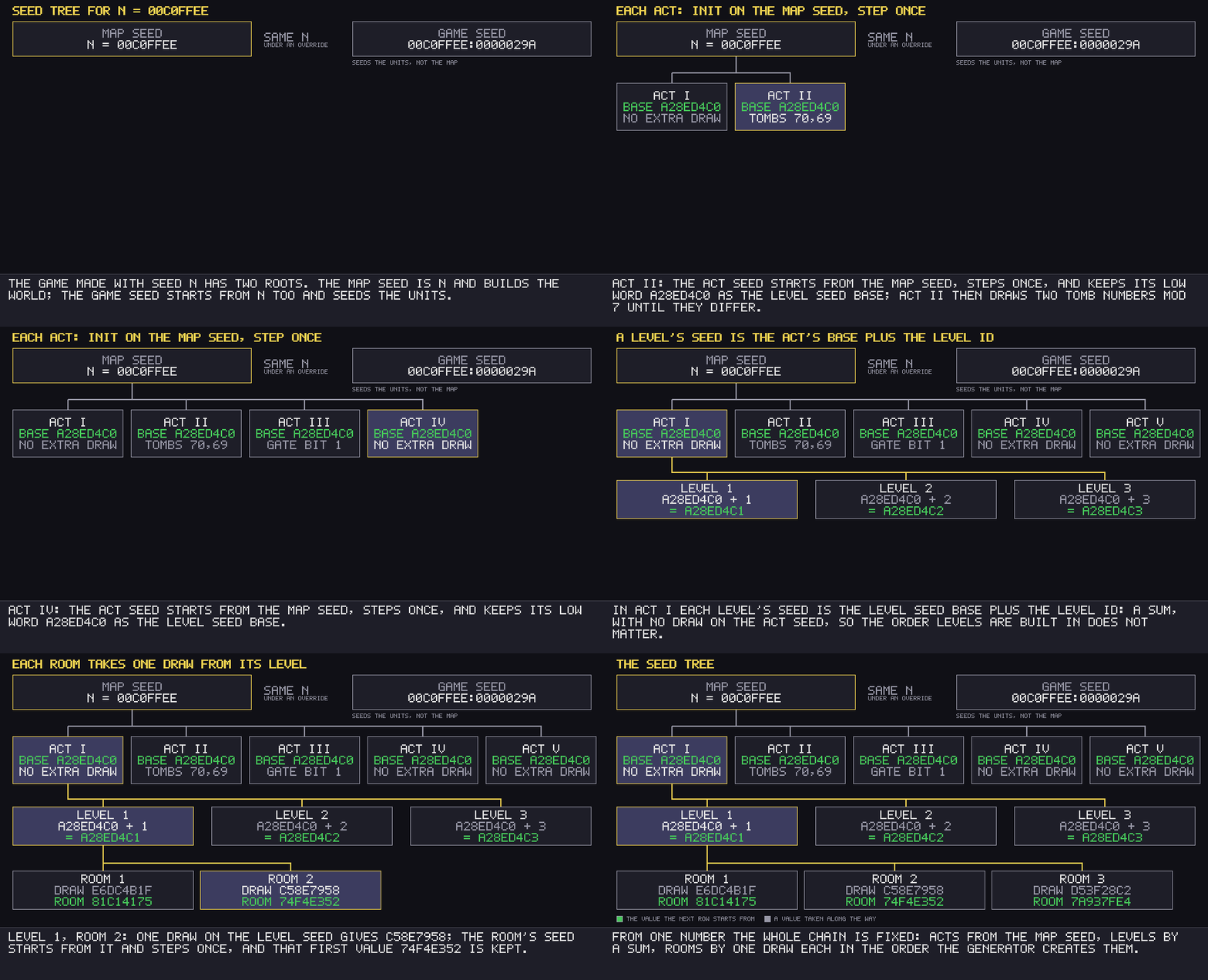
The seed tree for an illustrative seed N given as an override. The map seed is then N and builds the world; the game seed starts from N too, a separate seed that seeds the units (seeds § step 1). Each act’s seed starts from the map seed, steps once, and keeps that low word as the level seed base, the same for all five acts; Act II then draws pairs of numbers mod 7 until they differ to name its tombs, and Act III takes one more draw and keeps its lowest bit (§ step 3). A level’s seed is the base plus the level id, a sum with no draw, so the order levels are built in does not matter (§ step 4). Each room takes one draw on its level’s seed, starts its own seed from the result and steps once, so the order a level creates its rooms in does matter (§ step 5). Not shown: the act link builder’s later draws on the act seed, room activation, and the units. Seed: illustrative, an input of our own. Every value shown is computed by our model, not observed in the game.
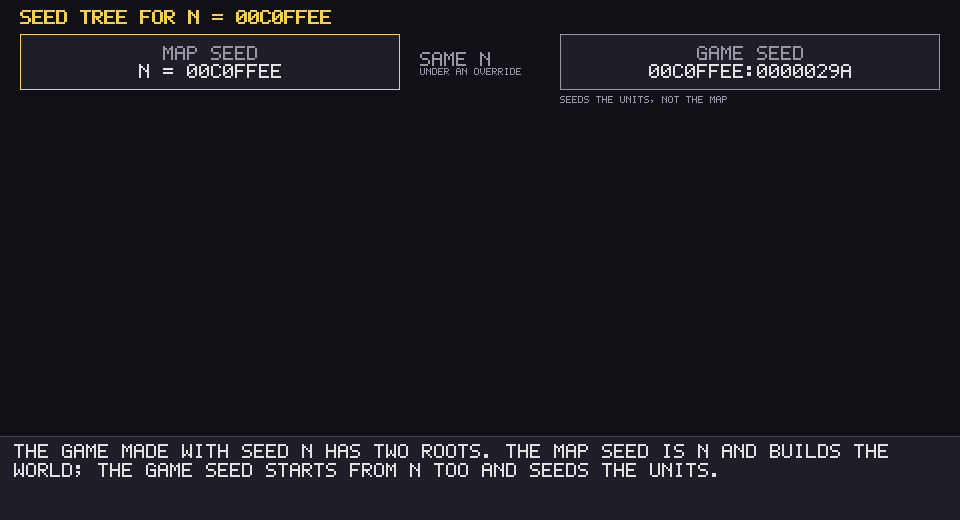
Type a seed N, as an override gives it, and see its seed tree: the map seed is N and the game seed is Init(N) with no draw (seeds § step 1). Each act’s seed starts from the map seed, steps once and keeps that low word as the level seed base, the same for all five acts; Act II then draws pairs mod 7 until they differ, Act III takes one more draw and keeps its lowest bit (§ step 3). The level id you type is only a number added to the base: a level’s seed is that sum, with no draw (§ step 4). Each room of the level takes one draw on the level’s seed, starts its own seed from the result and steps once (§ step 5). Not shown: the act link builder’s later draws on the act seed, room activation, and the units. Computed by our model of the rule, not observed in the game; the starting values are illustrative.
Units: the game seed, in call order
Section titled “Units: the game seed, in call order”Every unit the server creates, except players, takes one draw from the game seed and is initialised with it. This holds for monsters too: server monsters are seeded from the game seed, not from their room. An item takes one extra game-seed draw right after its unit seed; that draw gives the item’s own starting seed, the one its quality, affix and unique picks draw on. Item creation can also take two stored seeds instead, but by the code only one path passes them: items read from an old-format item list of a save. Drops, gold, stores, the cube, the imbue, objects and traps all take their seeds from the game seed, and a current save restores its items by another path.
Because the game seed is shared, a unit’s seed depends on everything that drew from the game seed before it:
| Game-seed draw | Who takes it | Status |
|---|---|---|
| 1 | the monster regions, which build every level’s monster pool from a local seed | confirmed |
| 2 | the game-wide object-region seed | confirmed |
| 3 | the store seed (also the mercenaries’ seed) | confirmed |
| 4 | the quest seed | confirmed |
| 5 | the player’s unit seed | confirmed in runs |
| 6, 8, 10… | the starting items, two draws each | confirmed in runs |
Players are seeded through their own creation paths. In the runs, the players’ seeds came from the game seed through these paths. A run that logged the caller saw both player loads take the path of the player’s unit set-up, which passes the game seed; the other four paths logged nothing there, and that each of them also passes the game seed is not established. A monster made by the population pass carries a unit seed already two steps along by the time the pass draws on it (in 914 of 916 logged creations; the other two were 6 and 15 steps along). If a unit is ever created with no parent seed, the code falls back to an unrepeatable clock-based seed; no run reached that path.
The client also seeds the units it creates, from the active room of its own act copy, as long as the unit’s position is not (0, 0). A run confirmed the (0, 0) rule: 252 client units created at (0, 0) made no room lookup and no room draw, against 24 565 that looked their room up. Those client seeds never decide drops or spawns. That the room lookup itself returns no room for (0, 0) is read from the code only, since the game never asks it for that position. Client monsters are created by a separate path and never take this one; for two rarer callers that is read from the code only.
Why the same seed gives the same map
Section titled “Why the same seed gives the same map”Putting it together: with a fixed map seed, the chain above fixes every act’s and every level’s starting seed, and so the inputs of the level generators. Nothing in that chain depends on the clock, on the game seed, or on the order in which levels are visited. A DRLG room’s seed depends on the level seed and on the order the generator creates rooms in; an active room’s seed also depends on k, which can depend on the order rooms are activated.
Under an override, the game seed and the act seed start from the same Init(N), so their sequences are the same
numbers (the player’s draw 5 equals the Act II act seed after its five draws). They are still two separate objects.
Which things have their own seeds
Section titled “Which things have their own seeds”| Owner | Seeded from | Draws taken from the parent |
|---|---|---|
| game | the override N, or the clock | — |
| act (server and client copy) | the map seed | none |
| level | level seed base + level id | none |
| DRLG room | its level | one |
| active room | its DRLG room, after the restart and k tile draws | one, only if the room has tiles |
| monster-region local seed | the game seed | one (draw 1) |
| object-region seed | the game seed | one (draw 2) |
| server unit (not players) | the game seed | one; items one more |
| client unit | the active room of the client act copy | one, unless at (0, 0) |
Sources: seed tree, outputs and step notes. Each subsystem page names the further seeds it uses.
A worked example
Section titled “A worked example”The generator. Copied from the RNG core worked example, which matches the game’s own functions bit for bit. Hex unless noted.
| # | Operation | Result | low after |
high after |
|---|---|---|---|---|
| 0 | Init(s, 12345) | — | 00003039 |
0000029A |
| 1 | Range(s, 100) | 87 (decimal) | 015B2E77 |
0000141D |
| 2 | Range(s, 0) | 0, no draw | 015B2E77 |
0000141D |
| 3 | Range(s, −5) | 0, no draw | 015B2E77 |
0000141D |
| 4 | Range(s, 8) | 0 | 8B57C5B0 |
0090CE87 |
| 5 | Range(s, 7) | 3 | 606EEEF7 |
3A1E6C8A |
Step 1 in full: 3039 × 6AC690C5 + 29A = 0000141D 015B2E77 (hex), and 015B2E77 mod 100 = 87.
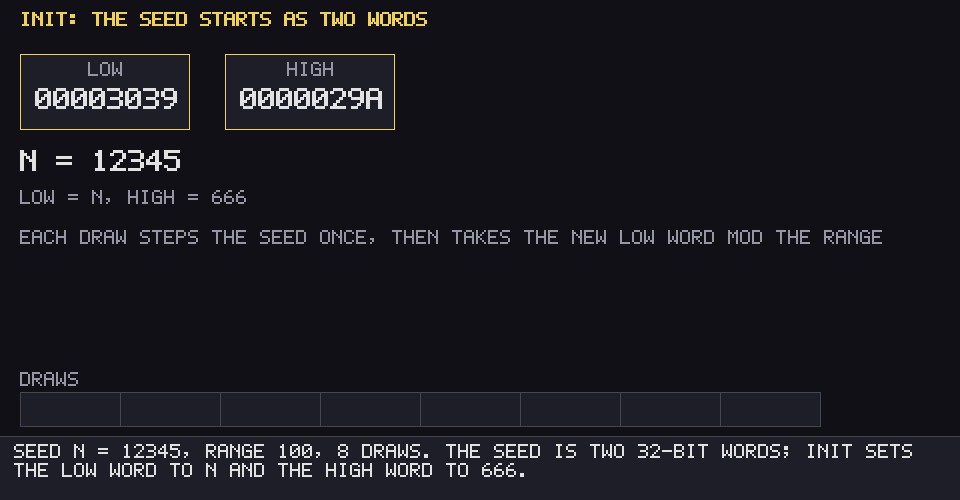
The generator to try by hand. The reader types a seed (an unsigned 32-bit number), a range n and a number of draws from 1 to 12, or picks one of a few illustrative seeds; the table then lists Init(seed), which sets the low word to the seed and the high word to 666, and each Range(n) draw in turn with its result and the low and high words after it, in hex. A draw steps the seed once and returns the new low word mod n; a range below 1 returns 0 and leaves the seed alone (RNG core § Algorithm). With the seed 12345 and the range 100 the first draw is step 1 of the worked example above. The picture is the first frame of the generator’s animation on the same seed, from the section on the generator; without JavaScript it stands in for the table. Computed by our model of the rule, not observed in the game; the starting values are illustrative.
The seed tree for -seed 12345. Copied from the
seed tree worked example, logged in a recorded game and reproduced from N
alone. Seeds are low:high, hex.
| Step | What happens | Value |
|---|---|---|
| game | override flag, map seed, game seed | 1, 00003039, 00003039:0000029A |
| act | Init(12345), then one step: level seed base | 015B2E77 |
| Act II | first pair mod 7 |
3, 3: equal, so retry |
| Act II | second pair | 6, 5: the tomb fields get 72 and 71 (decimal) |
| level 1 | Init(base + 1) | 015B2E78:0000029A |
| level 1, rooms 1–3 | level seed low after each room’s draw |
F61E44F2, F3CFFCC1, 6B277FA8 |
| room 3 | Init(6B277FA8), one step; stored start |
F923BEE2 |
| room 3 activated on the server | restart, then k = 64 tile draws | 2CE81EC1:55A43D6F |
| room 3 activated on the server | one more draw: the active-room seed | 28D677F4:0000029A |
| player | game-seed draw 5 | B7A5C418:0000029A |
| first starting item | game-seed draw 6 (then draw 7) | 8F16A0F0:0000029A |
With -seed 34844169 the level seed base is FFFFFF87, and level 134’s seed is 0000000D:0000029A: the sum
wrapped around.
What is not known yet
Section titled “What is not known yet”From the RNG core open questions and the seed tree open questions:
- Which inlined draw sites use the guarded form and which do not is answered subsystem by subsystem, as each spec reads its own call sites.
- The order of game-seed draws after game creation: draws 1 to 5 are pinned, but the gaps between later units are open.
- Which Act II tomb field is the real tomb, what the Act III bit means, and what decides the other Act III act-seed consumers, and what the level-27 bit set while building level 6 means, are open.
- Every function that initialises a seed is now classified, by reading the code. Besides the tree above there are seeds that never feed gameplay: the client automap’s own seed, two title-screen seeds and short-lived local seeds. The places in the skill and missile code that re-seed something are read from the code too: they restart a missile’s seed or a short-lived one, except Armageddon, which restarts its caster’s seed from a number it keeps. Two of them are confirmed by runs: the sub-missiles of Firestorm (and of some monster missiles) get a seed made from a position word plus their index, which the new missile’s own path setup then advances (20 steps for Firestorm’s), and the bolts made for a catapult spotter get one from the position word alone, advanced 10 steps. Casting Armageddon draws one number below 65 536 from the caster’s own seed, and a run has confirmed that draw. Reading the code, the cast then stores that number in the skill’s slot for the first time Armageddon fires. Whether that first firing really reads the same slot, untouched since the cast, is still open, and no run has logged one yet.
- Read from the code but not confirmed by a run: the “power-of-two range plus a base” helper and eight other
pieces of code with inlined draws being unused, three of the six on-demand level creators, a room with no tiles at all, which
player-creation paths run and what they pass, the clock fallback for a unit without a parent, and the room
lookup’s answer for (0, 0). Calling
InitOneright beforeInit, as the game does, has no effect, also by reading the code. - Not run at all: what the
D2.iniroute does with a negative or very large seed.
Where to read more
Section titled “Where to read more”- RNG core spec and seed tree spec.
- How k is counted: room tiles § k.
- The glossary for seed, draw, map seed, game seed and the room terms.
- Related wiki pages: levels, monsters, objects, items, skills and missiles for the seeds a skill and a missile draw on, and quests and travel for the quest seed’s draws and the level-seed step of each arrival.