Monsters
This page explains how the game decides which monsters exist. It covers which classes each level can host, how a room gets filled the first time it becomes active, which of those monsters become champions, uniques or superuniques, and what level, hit points, defence and experience each one is created with. It restates the reviewed monster specs: the overview in monsters, the level pools in pool, room population in spawn, special monsters in special and stats in stats. The specs carry the exact arithmetic and draw order; this page tells the story. Where something is read from the code but not yet seen in a test run, or is still unknown, the page says so.
The big picture
Section titled “The big picture”There are four stages, and they use different seeds:
- At game creation the game builds a monster pool for every level from one seed taken from the game seed. It holds up to 13 classes per level.
- When a room is activated for the first time, the server’s population pass makes a number of attempts. Each attempt passes a density roll, picks a class from the pool and decides between a normal group and a special one.
- Each monster is created with its level and its hit points, defence and experience. These are set once, at that moment.
- A random special becomes a champion or a unique by a roll on its own unit seed. It gets its mods and its minions, and the mods change its stats. On the client side, a name is rolled from a small seed the server sends.
%3btext-align:center%3b%7d%23mermaid-0 .edgeLabel p%7bbackground-color:rgba(232%2c232%2c232%2c 0.8)%3b%7d%23mermaid-0 .edgeLabel rect%7bopacity:0.5%3bbackground-color:rgba(232%2c232%2c232%2c 0.8)%3bfill:rgba(232%2c232%2c232%2c 0.8)%3b%7d%23mermaid-0 .labelBkg%7bbackground-color:rgba(232%2c 232%2c 232%2c 0.5)%3b%7d%23mermaid-0 .cluster rect%7bfill:%23ffffde%3bstroke:%23aaaa33%3bstroke-width:1px%3b%7d%23mermaid-0 .cluster text%7bfill:%23333%3b%7d%23mermaid-0 .cluster span%7bcolor:%23333%3b%7d%23mermaid-0 .node .collapsed-indicator%7bfill:%23aaaa33%3bstroke:none%3bopacity:0.6%3b%7d%23mermaid-0 .node .collapsed-separator%7bstroke:%23aaaa33%3bstroke-width:0.75px%3b%7d%23mermaid-0 div.mermaidTooltip%7bposition:absolute%3btext-align:center%3bmax-width:200px%3bpadding:2px%3bfont-family:arial%2csans-serif%3bfont-size:12px%3bbackground:hsl(80%2c 100%25%2c 96.2745098039%25)%3bborder:1px solid %23aaaa33%3bborder-radius:2px%3bpointer-events:none%3bz-index:100%3b%7d%23mermaid-0 .flowchartTitleText%7btext-anchor:middle%3bfont-size:18px%3bfill:%23333%3b%7d%23mermaid-0 rect.text%7bfill:none%3bstroke-width:0%3b%7d%23mermaid-0 .icon-shape%2c%23mermaid-0 .image-shape%7bbackground-color:rgba(232%2c232%2c232%2c 0.8)%3btext-align:center%3b%7d%23mermaid-0 .icon-shape p%2c%23mermaid-0 .image-shape p%7bbackground-color:rgba(232%2c232%2c232%2c 0.8)%3bpadding:2px%3b%7d%23mermaid-0 .icon-shape .label rect%2c%23mermaid-0 .image-shape .label rect%7bopacity:0.5%3bbackground-color:rgba(232%2c232%2c232%2c 0.8)%3bfill:rgba(232%2c232%2c232%2c 0.8)%3b%7d%23mermaid-0 .label-icon%7bdisplay:inline-block%3bheight:1em%3boverflow:visible%3bvertical-align:-0.125em%3b%7d%23mermaid-0 .node .label-icon path%7bfill:currentColor%3bstroke:revert%3bstroke-width:revert%3b%7d%23mermaid-0 .node .neo-node%7bstroke:%239370DB%3b%7d%23mermaid-0 %5bdata-look='neo'%5d.node rect%2c%23mermaid-0 %5bdata-look='neo'%5d.cluster rect%2c%23mermaid-0 %5bdata-look='neo'%5d.node polygon%7bstroke:%239370DB%3bfilter:drop-shadow(1px 2px 2px rgba(185%2c 185%2c 185%2c 1))%3b%7d%23mermaid-0 %5bdata-look='neo'%5d.swimlane.cluster rect%7bfilter:none%3b%7d%23mermaid-0 %5bdata-look='neo'%5d.node path%7bstroke:%239370DB%3bstroke-width:1px%3b%7d%23mermaid-0 %5bdata-look='neo'%5d.node .outer-path%7bfilter:drop-shadow(1px 2px 2px rgba(185%2c 185%2c 185%2c 1))%3b%7d%23mermaid-0 %5bdata-look='neo'%5d.node .neo-line path%7bstroke:%239370DB%3bfilter:none%3b%7d%23mermaid-0 %5bdata-look='neo'%5d.node circle%7bstroke:%239370DB%3bfilter:drop-shadow(1px 2px 2px rgba(185%2c 185%2c 185%2c 1))%3b%7d%23mermaid-0 %5bdata-look='neo'%5d.node circle .state-start%7bfill:black%3b%7d%23mermaid-0 %5bdata-look='neo'%5d.icon-shape .icon%7bfill:%239370DB%3bfilter:drop-shadow(1px 2px 2px rgba(185%2c 185%2c 185%2c 1))%3b%7d%23mermaid-0 %5bdata-look='neo'%5d.icon-shape .icon-neo path%7bstroke:%239370DB%3bfilter:drop-shadow(1px 2px 2px rgba(185%2c 185%2c 185%2c 1))%3b%7d%23mermaid-0 :root%7b--mermaid-font-family:arial%2csans-serif%3b%7d%3c/style%3e%3cg%3e%3cmarker id='mermaid-0_flowchart-v2-pointEnd' class='marker flowchart-v2' viewBox='0 0 10 10' refX='5' refY='5' markerUnits='userSpaceOnUse' markerWidth='8' markerHeight='8' orient='auto'%3e%3cpath d='M 0 0 L 10 5 L 0 10 z' class='arrowMarkerPath' style='stroke-width: 1%3b stroke-dasharray: 1%2c 0%3b'/%3e%3c/marker%3e%3cmarker id='mermaid-0_flowchart-v2-pointStart' class='marker flowchart-v2' viewBox='0 0 10 10' refX='4.5' refY='5' markerUnits='userSpaceOnUse' markerWidth='8' markerHeight='8' orient='auto'%3e%3cpath d='M 0 5 L 10 10 L 10 0 z' class='arrowMarkerPath' style='stroke-width: 1%3b stroke-dasharray: 1%2c 0%3b'/%3e%3c/marker%3e%3cmarker id='mermaid-0_flowchart-v2-pointEnd-margin' class='marker flowchart-v2' viewBox='0 0 11.5 14' refX='11.5' refY='7' markerUnits='userSpaceOnUse' markerWidth='10.5' markerHeight='14' orient='auto'%3e%3cpath d='M 0 0 L 11.5 7 L 0 14 z' class='arrowMarkerPath' style='stroke-width: 0%3b stroke-dasharray: 1%2c 0%3b'/%3e%3c/marker%3e%3cmarker id='mermaid-0_flowchart-v2-pointStart-margin' class='marker flowchart-v2' viewBox='0 0 11.5 14' refX='1' refY='7' markerUnits='userSpaceOnUse' markerWidth='11.5' markerHeight='14' orient='auto'%3e%3cpolygon points='0%2c7 11.5%2c14 11.5%2c0' class='arrowMarkerPath' style='stroke-width: 0%3b stroke-dasharray: 1%2c 0%3b'/%3e%3c/marker%3e%3cmarker id='mermaid-0_flowchart-v2-circleEnd' class='marker flowchart-v2' viewBox='0 0 10 10' refX='11' refY='5' markerUnits='userSpaceOnUse' markerWidth='11' markerHeight='11' orient='auto'%3e%3ccircle cx='5' cy='5' r='5' class='arrowMarkerPath' style='stroke-width: 1%3b stroke-dasharray: 1%2c 0%3b'/%3e%3c/marker%3e%3cmarker id='mermaid-0_flowchart-v2-circleStart' class='marker flowchart-v2' viewBox='0 0 10 10' refX='-1' refY='5' markerUnits='userSpaceOnUse' markerWidth='11' markerHeight='11' orient='auto'%3e%3ccircle cx='5' cy='5' r='5' class='arrowMarkerPath' style='stroke-width: 1%3b stroke-dasharray: 1%2c 0%3b'/%3e%3c/marker%3e%3cmarker id='mermaid-0_flowchart-v2-circleEnd-margin' class='marker flowchart-v2' viewBox='0 0 10 10' refY='5' refX='12.25' markerUnits='userSpaceOnUse' markerWidth='14' markerHeight='14' orient='auto'%3e%3ccircle cx='5' cy='5' r='5' class='arrowMarkerPath' style='stroke-width: 0%3b stroke-dasharray: 1%2c 0%3b'/%3e%3c/marker%3e%3cmarker id='mermaid-0_flowchart-v2-circleStart-margin' class='marker flowchart-v2' viewBox='0 0 10 10' refX='-2' refY='5' markerUnits='userSpaceOnUse' markerWidth='14' markerHeight='14' orient='auto'%3e%3ccircle cx='5' cy='5' r='5' class='arrowMarkerPath' style='stroke-width: 0%3b stroke-dasharray: 1%2c 0%3b'/%3e%3c/marker%3e%3cmarker id='mermaid-0_flowchart-v2-crossEnd' class='marker cross flowchart-v2' viewBox='0 0 11 11' refX='12' refY='5.2' markerUnits='userSpaceOnUse' markerWidth='11' markerHeight='11' orient='auto'%3e%3cpath d='M 1%2c1 l 9%2c9 M 10%2c1 l -9%2c9' class='arrowMarkerPath' style='stroke-width: 2%3b stroke-dasharray: 1%2c 0%3b'/%3e%3c/marker%3e%3cmarker id='mermaid-0_flowchart-v2-crossStart' class='marker cross flowchart-v2' viewBox='0 0 11 11' refX='-1' refY='5.2' markerUnits='userSpaceOnUse' markerWidth='11' markerHeight='11' orient='auto'%3e%3cpath d='M 1%2c1 l 9%2c9 M 10%2c1 l -9%2c9' class='arrowMarkerPath' style='stroke-width: 2%3b stroke-dasharray: 1%2c 0%3b'/%3e%3c/marker%3e%3cmarker id='mermaid-0_flowchart-v2-crossEnd-margin' class='marker cross flowchart-v2' viewBox='0 0 15 15' refX='17.7' refY='7.5' markerUnits='userSpaceOnUse' markerWidth='12' markerHeight='12' orient='auto'%3e%3cpath d='M 1%2c1 L 14%2c14 M 1%2c14 L 14%2c1' class='arrowMarkerPath' style='stroke-width: 2.5%3b'/%3e%3c/marker%3e%3cmarker id='mermaid-0_flowchart-v2-crossStart-margin' class='marker cross flowchart-v2' viewBox='0 0 15 15' refX='-3.5' refY='7.5' markerUnits='userSpaceOnUse' markerWidth='12' markerHeight='12' orient='auto'%3e%3cpath d='M 1%2c1 L 14%2c14 M 1%2c14 L 14%2c1' class='arrowMarkerPath' style='stroke-width: 2.5%3b stroke-dasharray: 1%2c 0%3b'/%3e%3c/marker%3e%3cg class='root'%3e%3cg class='clusters'/%3e%3cg class='edgePaths'%3e%3cpath d='M138%2c262.938L138%2c281.26C138%2c299.583%2c138%2c336.229%2c138%2c360.052C138%2c383.875%2c138%2c394.875%2c138%2c400.375L138%2c405.875' id='mermaid-0-L_gc_pools_0' class='edge-thickness-normal edge-pattern-solid edge-thickness-normal edge-pattern-solid flowchart-link' style='%3b' data-edge='true' data-et='edge' data-id='L_gc_pools_0' data-points='W3sieCI6MTM4LCJ5IjoyNjIuOTM3NX0seyJ4IjoxMzgsInkiOjM3Mi44NzV9LHsieCI6MTM4LCJ5Ijo0MDkuODc1fV0=' data-look='classic' marker-end='url(%23mermaid-0_flowchart-v2-pointEnd)'/%3e%3cpath d='M563.051%2c86L563.051%2c90.167C563.051%2c94.333%2c563.051%2c102.667%2c563.051%2c110.333C563.051%2c118%2c563.051%2c125%2c563.051%2c128.5L563.051%2c132' id='mermaid-0-L_act_gate_0' class='edge-thickness-normal edge-pattern-solid edge-thickness-normal edge-pattern-solid flowchart-link' style='%3b' data-edge='true' data-et='edge' data-id='L_act_gate_0' data-points='W3sieCI6NTYzLjA1MDc4MTI1LCJ5Ijo4Nn0seyJ4Ijo1NjMuMDUwNzgxMjUsInkiOjExMX0seyJ4Ijo1NjMuMDUwNzgxMjUsInkiOjEzNn1d' data-look='classic' marker-end='url(%23mermaid-0_flowchart-v2-pointEnd)'/%3e%3cpath d='M512.231%2c285.055L497.087%2c299.692C481.943%2c314.328%2c451.655%2c343.602%2c436.511%2c367.738C421.367%2c391.875%2c421.367%2c410.875%2c421.367%2c420.375L421.367%2c429.875' id='mermaid-0-L_gate_none_0' class='edge-thickness-normal edge-pattern-solid edge-thickness-normal edge-pattern-solid flowchart-link' style='%3b' data-edge='true' data-et='edge' data-id='L_gate_none_0' data-points='W3sieCI6NTEyLjIzMDg1MjQzNjIyNjgsInkiOjI4NS4wNTUwNzExODYyMjY4fSx7IngiOjQyMS4zNjcxODc1LCJ5IjozNzIuODc1fSx7IngiOjQyMS4zNjcxODc1LCJ5Ijo0MzMuODc1fV0=' data-look='classic' marker-end='url(%23mermaid-0_flowchart-v2-pointEnd)'/%3e%3cpath d='M613.871%2c285.055L629.015%2c299.692C644.159%2c314.328%2c674.446%2c343.602%2c689.59%2c363.738C704.734%2c383.875%2c704.734%2c394.875%2c704.734%2c400.375L704.734%2c405.875' id='mermaid-0-L_gate_att_0' class='edge-thickness-normal edge-pattern-solid edge-thickness-normal edge-pattern-solid flowchart-link' style='%3b' data-edge='true' data-et='edge' data-id='L_gate_att_0' data-points='W3sieCI6NjEzLjg3MDcxMDA2Mzc3MzIsInkiOjI4NS4wNTUwNzExODYyMjY4fSx7IngiOjcwNC43MzQzNzUsInkiOjM3Mi44NzV9LHsieCI6NzA0LjczNDM3NSwieSI6NDA5Ljg3NX1d' data-look='classic' marker-end='url(%23mermaid-0_flowchart-v2-pointEnd)'/%3e%3cpath d='M138%2c511.875L138%2c516.042C138%2c520.208%2c138%2c528.542%2c167.427%2c539.354C196.853%2c550.167%2c255.706%2c563.46%2c285.133%2c570.106L314.559%2c576.752' id='mermaid-0-L_pools_pick_0' class='edge-thickness-normal edge-pattern-solid edge-thickness-normal edge-pattern-solid flowchart-link' style='%3b' data-edge='true' data-et='edge' data-id='L_pools_pick_0' data-points='W3sieCI6MTM4LCJ5Ijo1MTEuODc1fSx7IngiOjEzOCwieSI6NTM2Ljg3NX0seyJ4IjozMTguNDYwOTM3NSwieSI6NTc3LjYzMzA3MTE4NjM0NzN9XQ==' data-look='classic' marker-end='url(%23mermaid-0_flowchart-v2-pointEnd)'/%3e%3cpath d='M704.734%2c511.875L704.734%2c516.042C704.734%2c520.208%2c704.734%2c528.542%2c675.308%2c539.354C645.881%2c550.167%2c587.028%2c563.46%2c557.602%2c570.106L528.175%2c576.752' id='mermaid-0-L_att_pick_0' class='edge-thickness-normal edge-pattern-solid edge-thickness-normal edge-pattern-solid flowchart-link' style='%3b' data-edge='true' data-et='edge' data-id='L_att_pick_0' data-points='W3sieCI6NzA0LjczNDM3NSwieSI6NTExLjg3NX0seyJ4Ijo3MDQuNzM0Mzc1LCJ5Ijo1MzYuODc1fSx7IngiOjUyNC4yNzM0Mzc1LCJ5Ijo1NzcuNjMzMDcxMTg2MzQ3M31d' data-look='classic' marker-end='url(%23mermaid-0_flowchart-v2-pointEnd)'/%3e%3cpath d='M421.367%2c639.875L421.367%2c644.042C421.367%2c648.208%2c421.367%2c656.542%2c421.367%2c664.208C421.367%2c671.875%2c421.367%2c678.875%2c421.367%2c682.375L421.367%2c685.875' id='mermaid-0-L_pick_typ_0' class='edge-thickness-normal edge-pattern-solid edge-thickness-normal edge-pattern-solid flowchart-link' style='%3b' data-edge='true' data-et='edge' data-id='L_pick_typ_0' data-points='W3sieCI6NDIxLjM2NzE4NzUsInkiOjYzOS44NzV9LHsieCI6NDIxLjM2NzE4NzUsInkiOjY2NC44NzV9LHsieCI6NDIxLjM2NzE4NzUsInkiOjY4OS44NzV9XQ==' data-look='classic' marker-end='url(%23mermaid-0_flowchart-v2-pointEnd)'/%3e%3cpath d='M352.809%2c832.707L320.33%2c850.3C287.852%2c867.893%2c222.895%2c903.079%2c190.416%2c931.339C157.938%2c959.599%2c157.938%2c980.932%2c157.938%2c1002.266C157.938%2c1023.599%2c157.938%2c1044.932%2c157.938%2c1081.016C157.938%2c1117.099%2c157.938%2c1167.932%2c157.938%2c1218.766C157.938%2c1269.599%2c157.938%2c1320.432%2c157.938%2c1351.349C157.938%2c1382.266%2c157.938%2c1393.266%2c157.938%2c1398.766L157.938%2c1404.266' id='mermaid-0-L_typ_grp_0' class='edge-thickness-normal edge-pattern-solid edge-thickness-normal edge-pattern-solid flowchart-link' style='%3b' data-edge='true' data-et='edge' data-id='L_typ_grp_0' data-points='W3sieCI6MzUyLjgwODc4MDI1NTcwMzY1LCJ5Ijo4MzIuNzA3MjE3NzU1NzAzN30seyJ4IjoxNTcuOTM3NSwieSI6OTM4LjI2NTYyNX0seyJ4IjoxNTcuOTM3NSwieSI6MTAwMi4yNjU2MjV9LHsieCI6MTU3LjkzNzUsInkiOjEwNjYuMjY1NjI1fSx7IngiOjE1Ny45Mzc1LCJ5IjoxMjE4Ljc2NTYyNX0seyJ4IjoxNTcuOTM3NSwieSI6MTM3MS4yNjU2MjV9LHsieCI6MTU3LjkzNzUsInkiOjE0MDguMjY1NjI1fV0=' data-look='classic' marker-end='url(%23mermaid-0_flowchart-v2-pointEnd)'/%3e%3cpath d='M473.736%2c848.897L488.363%2c863.792C502.991%2c878.686%2c532.245%2c908.476%2c546.873%2c928.871C561.5%2c949.266%2c561.5%2c960.266%2c561.5%2c965.766L561.5%2c971.266' id='mermaid-0-L_typ_boss_0' class='edge-thickness-normal edge-pattern-solid edge-thickness-normal edge-pattern-solid flowchart-link' style='%3b' data-edge='true' data-et='edge' data-id='L_typ_boss_0' data-points='W3sieCI6NDczLjczNjAyOTU2MTU1NzM2LCJ5Ijo4NDguODk2NzgyOTM4NDQyNn0seyJ4Ijo1NjEuNSwieSI6OTM4LjI2NTYyNX0seyJ4Ijo1NjEuNSwieSI6OTc1LjI2NTYyNX1d' data-look='classic' marker-end='url(%23mermaid-0_flowchart-v2-pointEnd)'/%3e%3cpath d='M561.5%2c1029.266L561.5%2c1035.432C561.5%2c1041.599%2c561.5%2c1053.932%2c561.5%2c1065.599C561.5%2c1077.266%2c561.5%2c1088.266%2c561.5%2c1093.766L561.5%2c1099.266' id='mermaid-0-L_boss_cu_0' class='edge-thickness-normal edge-pattern-solid edge-thickness-normal edge-pattern-solid flowchart-link' style='%3b' data-edge='true' data-et='edge' data-id='L_boss_cu_0' data-points='W3sieCI6NTYxLjUsInkiOjEwMjkuMjY1NjI1fSx7IngiOjU2MS41LCJ5IjoxMDY2LjI2NTYyNX0seyJ4Ijo1NjEuNSwieSI6MTEwMy4yNjU2MjV9XQ==' data-look='classic' marker-end='url(%23mermaid-0_flowchart-v2-pointEnd)'/%3e%3cpath d='M509.865%2c1282.631L497.921%2c1297.403C485.978%2c1312.176%2c462.09%2c1341.721%2c450.147%2c1361.993C438.203%2c1382.266%2c438.203%2c1393.266%2c438.203%2c1398.766L438.203%2c1404.266' id='mermaid-0-L_cu_pack_0' class='edge-thickness-normal edge-pattern-solid edge-thickness-normal edge-pattern-solid flowchart-link' style='%3b' data-edge='true' data-et='edge' data-id='L_cu_pack_0' data-points='W3sieCI6NTA5Ljg2NDkzNjgzMDc3NDQ3LCJ5IjoxMjgyLjYzMDU2MTgzMDc3NDV9LHsieCI6NDM4LjIwMzEyNSwieSI6MTM3MS4yNjU2MjV9LHsieCI6NDM4LjIwMzEyNSwieSI6MTQwOC4yNjU2MjV9XQ==' data-look='classic' marker-end='url(%23mermaid-0_flowchart-v2-pointEnd)'/%3e%3cpath d='M613.135%2c1282.631L625.079%2c1297.403C637.022%2c1312.176%2c660.91%2c1341.721%2c672.853%2c1361.993C684.797%2c1382.266%2c684.797%2c1393.266%2c684.797%2c1398.766L684.797%2c1404.266' id='mermaid-0-L_cu_uniq_0' class='edge-thickness-normal edge-pattern-solid edge-thickness-normal edge-pattern-solid flowchart-link' style='%3b' data-edge='true' data-et='edge' data-id='L_cu_uniq_0' data-points='W3sieCI6NjEzLjEzNTA2MzE2OTIyNTUsInkiOjEyODIuNjMwNTYxODMwNzc0NX0seyJ4Ijo2ODQuNzk2ODc1LCJ5IjoxMzcxLjI2NTYyNX0seyJ4Ijo2ODQuNzk2ODc1LCJ5IjoxNDA4LjI2NTYyNX1d' data-look='classic' marker-end='url(%23mermaid-0_flowchart-v2-pointEnd)'/%3e%3cpath d='M961.125%2c1245.766L961.125%2c1266.682C961.125%2c1287.599%2c961.125%2c1329.432%2c961.125%2c1355.849C961.125%2c1382.266%2c961.125%2c1393.266%2c961.125%2c1398.766L961.125%2c1404.266' id='mermaid-0-L_preset_su_0' class='edge-thickness-normal edge-pattern-solid edge-thickness-normal edge-pattern-solid flowchart-link' style='%3b' data-edge='true' data-et='edge' data-id='L_preset_su_0' data-points='W3sieCI6OTYxLjEyNSwieSI6MTI0NS43NjU2MjV9LHsieCI6OTYxLjEyNSwieSI6MTM3MS4yNjU2MjV9LHsieCI6OTYxLjEyNSwieSI6MTQwOC4yNjU2MjV9XQ==' data-look='classic' marker-end='url(%23mermaid-0_flowchart-v2-pointEnd)'/%3e%3cpath d='M157.938%2c1486.266L157.938%2c1490.432C157.938%2c1494.599%2c157.938%2c1502.932%2c202.876%2c1515.562C247.815%2c1528.192%2c337.692%2c1545.117%2c382.63%2c1553.58L427.569%2c1562.043' id='mermaid-0-L_grp_create_0' class='edge-thickness-normal edge-pattern-solid edge-thickness-normal edge-pattern-solid flowchart-link' style='%3b' data-edge='true' data-et='edge' data-id='L_grp_create_0' data-points='W3sieCI6MTU3LjkzNzUsInkiOjE0ODYuMjY1NjI1fSx7IngiOjE1Ny45Mzc1LCJ5IjoxNTExLjI2NTYyNX0seyJ4Ijo0MzEuNSwieSI6MTU2Mi43ODM2Njc0MzQ1NjcyfV0=' data-look='classic' marker-end='url(%23mermaid-0_flowchart-v2-pointEnd)'/%3e%3cpath d='M438.203%2c1486.266L438.203%2c1490.432C438.203%2c1494.599%2c438.203%2c1502.932%2c444.395%2c1510.916C450.587%2c1518.899%2c462.972%2c1526.533%2c469.164%2c1530.35L475.356%2c1534.167' id='mermaid-0-L_pack_create_0' class='edge-thickness-normal edge-pattern-solid edge-thickness-normal edge-pattern-solid flowchart-link' style='%3b' data-edge='true' data-et='edge' data-id='L_pack_create_0' data-points='W3sieCI6NDM4LjIwMzEyNSwieSI6MTQ4Ni4yNjU2MjV9LHsieCI6NDM4LjIwMzEyNSwieSI6MTUxMS4yNjU2MjV9LHsieCI6NDc4Ljc2MTMwNzU2NTc4OTUsInkiOjE1MzYuMjY1NjI1fV0=' data-look='classic' marker-end='url(%23mermaid-0_flowchart-v2-pointEnd)'/%3e%3cpath d='M684.797%2c1486.266L684.797%2c1490.432C684.797%2c1494.599%2c684.797%2c1502.932%2c678.605%2c1510.916C672.413%2c1518.899%2c660.028%2c1526.533%2c653.836%2c1530.35L647.644%2c1534.167' id='mermaid-0-L_uniq_create_0' class='edge-thickness-normal edge-pattern-solid edge-thickness-normal edge-pattern-solid flowchart-link' style='%3b' data-edge='true' data-et='edge' data-id='L_uniq_create_0' data-points='W3sieCI6Njg0Ljc5Njg3NSwieSI6MTQ4Ni4yNjU2MjV9LHsieCI6Njg0Ljc5Njg3NSwieSI6MTUxMS4yNjU2MjV9LHsieCI6NjQ0LjIzODY5MjQzNDIxMDUsInkiOjE1MzYuMjY1NjI1fV0=' data-look='classic' marker-end='url(%23mermaid-0_flowchart-v2-pointEnd)'/%3e%3cpath d='M961.125%2c1486.266L961.125%2c1490.432C961.125%2c1494.599%2c961.125%2c1502.932%2c916.842%2c1515.521C872.56%2c1528.109%2c783.995%2c1544.952%2c739.712%2c1553.374L695.43%2c1561.795' id='mermaid-0-L_su_create_0' class='edge-thickness-normal edge-pattern-solid edge-thickness-normal edge-pattern-solid flowchart-link' style='%3b' data-edge='true' data-et='edge' data-id='L_su_create_0' data-points='W3sieCI6OTYxLjEyNSwieSI6MTQ4Ni4yNjU2MjV9LHsieCI6OTYxLjEyNSwieSI6MTUxMS4yNjU2MjV9LHsieCI6NjkxLjUsInkiOjE1NjIuNTQyNDQ3MDIwNjQ0NH1d' data-look='classic' marker-end='url(%23mermaid-0_flowchart-v2-pointEnd)'/%3e%3cpath d='M561.5%2c1638.266L561.5%2c1642.432C561.5%2c1646.599%2c561.5%2c1654.932%2c561.5%2c1662.599C561.5%2c1670.266%2c561.5%2c1677.266%2c561.5%2c1680.766L561.5%2c1684.266' id='mermaid-0-L_create_mods_0' class='edge-thickness-normal edge-pattern-solid edge-thickness-normal edge-pattern-solid flowchart-link' style='%3b' data-edge='true' data-et='edge' data-id='L_create_mods_0' data-points='W3sieCI6NTYxLjUsInkiOjE2MzguMjY1NjI1fSx7IngiOjU2MS41LCJ5IjoxNjYzLjI2NTYyNX0seyJ4Ijo1NjEuNSwieSI6MTY4OC4yNjU2MjV9XQ==' data-look='classic' marker-end='url(%23mermaid-0_flowchart-v2-pointEnd)'/%3e%3cpath d='M561.5%2c1766.266L561.5%2c1770.432C561.5%2c1774.599%2c561.5%2c1782.932%2c561.5%2c1790.599C561.5%2c1798.266%2c561.5%2c1805.266%2c561.5%2c1808.766L561.5%2c1812.266' id='mermaid-0-L_mods_name_0' class='edge-thickness-normal edge-pattern-solid edge-thickness-normal edge-pattern-solid flowchart-link' style='%3b' data-edge='true' data-et='edge' data-id='L_mods_name_0' data-points='W3sieCI6NTYxLjUsInkiOjE3NjYuMjY1NjI1fSx7IngiOjU2MS41LCJ5IjoxNzkxLjI2NTYyNX0seyJ4Ijo1NjEuNSwieSI6MTgxNi4yNjU2MjV9XQ==' data-look='classic' marker-end='url(%23mermaid-0_flowchart-v2-pointEnd)'/%3e%3c/g%3e%3cg class='edgeLabels'%3e%3cg class='edgeLabel'%3e%3cg class='label' data-id='L_gc_pools_0' transform='translate(0%2c 0)'%3e%3cforeignObject width='0' height='0'%3e%3cdiv xmlns='http://www.w3.org/1999/xhtml' class='labelBkg' style='display: table-cell%3b white-space: nowrap%3b line-height: 1.5%3b max-width: 200px%3b text-align: center%3b'%3e%3cspan class='edgeLabel'%3e%3c/span%3e%3c/div%3e%3c/foreignObject%3e%3c/g%3e%3c/g%3e%3cg class='edgeLabel'%3e%3cg class='label' data-id='L_act_gate_0' transform='translate(0%2c 0)'%3e%3cforeignObject width='0' height='0'%3e%3cdiv xmlns='http://www.w3.org/1999/xhtml' class='labelBkg' style='display: table-cell%3b white-space: nowrap%3b line-height: 1.5%3b max-width: 200px%3b text-align: center%3b'%3e%3cspan class='edgeLabel'%3e%3c/span%3e%3c/div%3e%3c/foreignObject%3e%3c/g%3e%3c/g%3e%3cg class='edgeLabel' transform='translate(421.3671875%2c 372.875)'%3e%3cg class='label' data-id='L_gate_none_0' transform='translate(-8.8984375%2c -12)'%3e%3cforeignObject width='17.796875' height='24'%3e%3cdiv xmlns='http://www.w3.org/1999/xhtml' class='labelBkg' style='display: table-cell%3b white-space: nowrap%3b line-height: 1.5%3b max-width: 200px%3b text-align: center%3b'%3e%3cspan class='edgeLabel'%3e%3cp%3eno%3c/p%3e%3c/span%3e%3c/div%3e%3c/foreignObject%3e%3c/g%3e%3c/g%3e%3cg class='edgeLabel' transform='translate(704.734375%2c 372.875)'%3e%3cg class='label' data-id='L_gate_att_0' transform='translate(-12.453125%2c -12)'%3e%3cforeignObject width='24.90625' height='24'%3e%3cdiv xmlns='http://www.w3.org/1999/xhtml' class='labelBkg' style='display: table-cell%3b white-space: nowrap%3b line-height: 1.5%3b max-width: 200px%3b text-align: center%3b'%3e%3cspan class='edgeLabel'%3e%3cp%3eyes%3c/p%3e%3c/span%3e%3c/div%3e%3c/foreignObject%3e%3c/g%3e%3c/g%3e%3cg class='edgeLabel'%3e%3cg class='label' data-id='L_pools_pick_0' transform='translate(0%2c 0)'%3e%3cforeignObject width='0' height='0'%3e%3cdiv xmlns='http://www.w3.org/1999/xhtml' class='labelBkg' style='display: table-cell%3b white-space: nowrap%3b line-height: 1.5%3b max-width: 200px%3b text-align: center%3b'%3e%3cspan class='edgeLabel'%3e%3c/span%3e%3c/div%3e%3c/foreignObject%3e%3c/g%3e%3c/g%3e%3cg class='edgeLabel'%3e%3cg class='label' data-id='L_att_pick_0' transform='translate(0%2c 0)'%3e%3cforeignObject width='0' height='0'%3e%3cdiv xmlns='http://www.w3.org/1999/xhtml' class='labelBkg' style='display: table-cell%3b white-space: nowrap%3b line-height: 1.5%3b max-width: 200px%3b text-align: center%3b'%3e%3cspan class='edgeLabel'%3e%3c/span%3e%3c/div%3e%3c/foreignObject%3e%3c/g%3e%3c/g%3e%3cg class='edgeLabel'%3e%3cg class='label' data-id='L_pick_typ_0' transform='translate(0%2c 0)'%3e%3cforeignObject width='0' height='0'%3e%3cdiv xmlns='http://www.w3.org/1999/xhtml' class='labelBkg' style='display: table-cell%3b white-space: nowrap%3b line-height: 1.5%3b max-width: 200px%3b text-align: center%3b'%3e%3cspan class='edgeLabel'%3e%3c/span%3e%3c/div%3e%3c/foreignObject%3e%3c/g%3e%3c/g%3e%3cg class='edgeLabel' transform='translate(157.9375%2c 1066.265625)'%3e%3cg class='label' data-id='L_typ_grp_0' transform='translate(-24.453125%2c -12)'%3e%3cforeignObject width='48.90625' height='24'%3e%3cdiv xmlns='http://www.w3.org/1999/xhtml' class='labelBkg' style='display: table-cell%3b white-space: nowrap%3b line-height: 1.5%3b max-width: 200px%3b text-align: center%3b'%3e%3cspan class='edgeLabel'%3e%3cp%3enormal%3c/p%3e%3c/span%3e%3c/div%3e%3c/foreignObject%3e%3c/g%3e%3c/g%3e%3cg class='edgeLabel' transform='translate(561.5%2c 938.265625)'%3e%3cg class='label' data-id='L_typ_boss_0' transform='translate(-24.90625%2c -12)'%3e%3cforeignObject width='49.8125' height='24'%3e%3cdiv xmlns='http://www.w3.org/1999/xhtml' class='labelBkg' style='display: table-cell%3b white-space: nowrap%3b line-height: 1.5%3b max-width: 200px%3b text-align: center%3b'%3e%3cspan class='edgeLabel'%3e%3cp%3especial%3c/p%3e%3c/span%3e%3c/div%3e%3c/foreignObject%3e%3c/g%3e%3c/g%3e%3cg class='edgeLabel'%3e%3cg class='label' data-id='L_boss_cu_0' transform='translate(0%2c 0)'%3e%3cforeignObject width='0' height='0'%3e%3cdiv xmlns='http://www.w3.org/1999/xhtml' class='labelBkg' style='display: table-cell%3b white-space: nowrap%3b line-height: 1.5%3b max-width: 200px%3b text-align: center%3b'%3e%3cspan class='edgeLabel'%3e%3c/span%3e%3c/div%3e%3c/foreignObject%3e%3c/g%3e%3c/g%3e%3cg class='edgeLabel' transform='translate(438.203125%2c 1371.265625)'%3e%3cg class='label' data-id='L_cu_pack_0' transform='translate(-34.6875%2c -12)'%3e%3cforeignObject width='69.375' height='24'%3e%3cdiv xmlns='http://www.w3.org/1999/xhtml' class='labelBkg' style='display: table-cell%3b white-space: nowrap%3b line-height: 1.5%3b max-width: 200px%3b text-align: center%3b'%3e%3cspan class='edgeLabel'%3e%3cp%3echampion%3c/p%3e%3c/span%3e%3c/div%3e%3c/foreignObject%3e%3c/g%3e%3c/g%3e%3cg class='edgeLabel' transform='translate(684.796875%2c 1371.265625)'%3e%3cg class='label' data-id='L_cu_uniq_0' transform='translate(-24.0234375%2c -12)'%3e%3cforeignObject width='48.046875' height='24'%3e%3cdiv xmlns='http://www.w3.org/1999/xhtml' class='labelBkg' style='display: table-cell%3b white-space: nowrap%3b line-height: 1.5%3b max-width: 200px%3b text-align: center%3b'%3e%3cspan class='edgeLabel'%3e%3cp%3eunique%3c/p%3e%3c/span%3e%3c/div%3e%3c/foreignObject%3e%3c/g%3e%3c/g%3e%3cg class='edgeLabel'%3e%3cg class='label' data-id='L_preset_su_0' transform='translate(0%2c 0)'%3e%3cforeignObject width='0' height='0'%3e%3cdiv xmlns='http://www.w3.org/1999/xhtml' class='labelBkg' style='display: table-cell%3b white-space: nowrap%3b line-height: 1.5%3b max-width: 200px%3b text-align: center%3b'%3e%3cspan class='edgeLabel'%3e%3c/span%3e%3c/div%3e%3c/foreignObject%3e%3c/g%3e%3c/g%3e%3cg class='edgeLabel'%3e%3cg class='label' data-id='L_grp_create_0' transform='translate(0%2c 0)'%3e%3cforeignObject width='0' height='0'%3e%3cdiv xmlns='http://www.w3.org/1999/xhtml' class='labelBkg' style='display: table-cell%3b white-space: nowrap%3b line-height: 1.5%3b max-width: 200px%3b text-align: center%3b'%3e%3cspan class='edgeLabel'%3e%3c/span%3e%3c/div%3e%3c/foreignObject%3e%3c/g%3e%3c/g%3e%3cg class='edgeLabel'%3e%3cg class='label' data-id='L_pack_create_0' transform='translate(0%2c 0)'%3e%3cforeignObject width='0' height='0'%3e%3cdiv xmlns='http://www.w3.org/1999/xhtml' class='labelBkg' style='display: table-cell%3b white-space: nowrap%3b line-height: 1.5%3b max-width: 200px%3b text-align: center%3b'%3e%3cspan class='edgeLabel'%3e%3c/span%3e%3c/div%3e%3c/foreignObject%3e%3c/g%3e%3c/g%3e%3cg class='edgeLabel'%3e%3cg class='label' data-id='L_uniq_create_0' transform='translate(0%2c 0)'%3e%3cforeignObject width='0' height='0'%3e%3cdiv xmlns='http://www.w3.org/1999/xhtml' class='labelBkg' style='display: table-cell%3b white-space: nowrap%3b line-height: 1.5%3b max-width: 200px%3b text-align: center%3b'%3e%3cspan class='edgeLabel'%3e%3c/span%3e%3c/div%3e%3c/foreignObject%3e%3c/g%3e%3c/g%3e%3cg class='edgeLabel'%3e%3cg class='label' data-id='L_su_create_0' transform='translate(0%2c 0)'%3e%3cforeignObject width='0' height='0'%3e%3cdiv xmlns='http://www.w3.org/1999/xhtml' class='labelBkg' style='display: table-cell%3b white-space: nowrap%3b line-height: 1.5%3b max-width: 200px%3b text-align: center%3b'%3e%3cspan class='edgeLabel'%3e%3c/span%3e%3c/div%3e%3c/foreignObject%3e%3c/g%3e%3c/g%3e%3cg class='edgeLabel'%3e%3cg class='label' data-id='L_create_mods_0' transform='translate(0%2c 0)'%3e%3cforeignObject width='0' height='0'%3e%3cdiv xmlns='http://www.w3.org/1999/xhtml' class='labelBkg' style='display: table-cell%3b white-space: nowrap%3b line-height: 1.5%3b max-width: 200px%3b text-align: center%3b'%3e%3cspan class='edgeLabel'%3e%3c/span%3e%3c/div%3e%3c/foreignObject%3e%3c/g%3e%3c/g%3e%3cg class='edgeLabel'%3e%3cg class='label' data-id='L_mods_name_0' transform='translate(0%2c 0)'%3e%3cforeignObject width='0' height='0'%3e%3cdiv xmlns='http://www.w3.org/1999/xhtml' class='labelBkg' style='display: table-cell%3b white-space: nowrap%3b line-height: 1.5%3b max-width: 200px%3b text-align: center%3b'%3e%3cspan class='edgeLabel'%3e%3c/span%3e%3c/div%3e%3c/foreignObject%3e%3c/g%3e%3c/g%3e%3c/g%3e%3cg class='nodes'%3e%3cg class='node default' id='mermaid-0-flowchart-gc-0' data-look='classic' transform='translate(138%2c 235.9375)'%3e%3crect class='basic label-container' style='' x='-80.6953125' y='-27' width='161.390625' height='54'/%3e%3cg class='label' style='' transform='translate(-50.6953125%2c -12)'%3e%3crect/%3e%3cforeignObject width='101.390625' height='24'%3e%3cdiv xmlns='http://www.w3.org/1999/xhtml' style='display: table-cell%3b white-space: nowrap%3b line-height: 1.5%3b max-width: 200px%3b text-align: center%3b'%3e%3cspan class='nodeLabel'%3e%3cp%3eGame created%3c/p%3e%3c/span%3e%3c/div%3e%3c/foreignObject%3e%3c/g%3e%3c/g%3e%3cg class='node default' id='mermaid-0-flowchart-pools-1' data-look='classic' transform='translate(138%2c 460.875)'%3e%3crect class='basic label-container' style='' x='-130' y='-51' width='260' height='102'/%3e%3cg class='label' style='' transform='translate(-100%2c -36)'%3e%3crect/%3e%3cforeignObject width='200' height='72'%3e%3cdiv xmlns='http://www.w3.org/1999/xhtml' style='display: table%3b white-space: break-spaces%3b line-height: 1.5%3b max-width: 200px%3b text-align: center%3b width: 200px%3b'%3e%3cspan class='nodeLabel'%3e%3cp%3eMonster pools for all levels%3cbr /%3eone region seed from the game seed%3c/p%3e%3c/span%3e%3c/div%3e%3c/foreignObject%3e%3c/g%3e%3c/g%3e%3cg class='node default' id='mermaid-0-flowchart-act-2' data-look='classic' transform='translate(563.05078125%2c 47)'%3e%3crect class='basic label-container' style='' x='-130' y='-39' width='260' height='78'/%3e%3cg class='label' style='' transform='translate(-100%2c -24)'%3e%3crect/%3e%3cforeignObject width='200' height='48'%3e%3cdiv xmlns='http://www.w3.org/1999/xhtml' style='display: table%3b white-space: break-spaces%3b line-height: 1.5%3b max-width: 200px%3b text-align: center%3b width: 200px%3b'%3e%3cspan class='nodeLabel'%3e%3cp%3eRoom activated for the first time%3c/p%3e%3c/span%3e%3c/div%3e%3c/foreignObject%3e%3c/g%3e%3c/g%3e%3cg class='node default' id='mermaid-0-flowchart-gate-3' data-look='classic' transform='translate(563.05078125%2c 235.9375)'%3e%3cpolygon points='99.9375%2c0 199.875%2c-99.9375 99.9375%2c-199.875 0%2c-99.9375' class='label-container' transform='translate(-99.4375%2c 99.9375)'/%3e%3cg class='label' style='' transform='translate(-72.9375%2c -12)'%3e%3crect/%3e%3cforeignObject width='145.875' height='24'%3e%3cdiv xmlns='http://www.w3.org/1999/xhtml' style='display: table-cell%3b white-space: nowrap%3b line-height: 1.5%3b max-width: 200px%3b text-align: center%3b'%3e%3cspan class='nodeLabel'%3e%3cp%3eLevel has a density%3f%3c/p%3e%3c/span%3e%3c/div%3e%3c/foreignObject%3e%3c/g%3e%3c/g%3e%3cg class='node default' id='mermaid-0-flowchart-none-5' data-look='classic' transform='translate(421.3671875%2c 460.875)'%3e%3crect class='basic label-container' style='' x='-103.3671875' y='-27' width='206.734375' height='54'/%3e%3cg class='label' style='' transform='translate(-73.3671875%2c -12)'%3e%3crect/%3e%3cforeignObject width='146.734375' height='24'%3e%3cdiv xmlns='http://www.w3.org/1999/xhtml' style='display: table-cell%3b white-space: nowrap%3b line-height: 1.5%3b max-width: 200px%3b text-align: center%3b'%3e%3cspan class='nodeLabel'%3e%3cp%3eno random monsters%3c/p%3e%3c/span%3e%3c/div%3e%3c/foreignObject%3e%3c/g%3e%3c/g%3e%3cg class='node default' id='mermaid-0-flowchart-att-7' data-look='classic' transform='translate(704.734375%2c 460.875)'%3e%3crect class='basic label-container' style='' x='-130' y='-51' width='260' height='102'/%3e%3cg class='label' style='' transform='translate(-100%2c -36)'%3e%3crect/%3e%3cforeignObject width='200' height='72'%3e%3cdiv xmlns='http://www.w3.org/1999/xhtml' style='display: table%3b white-space: break-spaces%3b line-height: 1.5%3b max-width: 200px%3b text-align: center%3b width: 200px%3b'%3e%3cspan class='nodeLabel'%3e%3cp%3eAttempts per logic box%3cbr /%3edensity roll on the game seed%3c/p%3e%3c/span%3e%3c/div%3e%3c/foreignObject%3e%3c/g%3e%3c/g%3e%3cg class='node default' id='mermaid-0-flowchart-pick-9' data-look='classic' transform='translate(421.3671875%2c 600.875)'%3e%3crect class='basic label-container' style='' x='-102.90625' y='-39' width='205.8125' height='78'/%3e%3cg class='label' style='' transform='translate(-72.90625%2c -24)'%3e%3crect/%3e%3cforeignObject width='145.8125' height='48'%3e%3cdiv xmlns='http://www.w3.org/1999/xhtml' style='display: table-cell%3b white-space: nowrap%3b line-height: 1.5%3b max-width: 200px%3b text-align: center%3b'%3e%3cspan class='nodeLabel'%3e%3cp%3ePick a class by rarity%3cbr /%3eroom seed%3c/p%3e%3c/span%3e%3c/div%3e%3c/foreignObject%3e%3c/g%3e%3c/g%3e%3cg class='node default' id='mermaid-0-flowchart-typ-13' data-look='classic' transform='translate(421.3671875%2c 795.5703125)'%3e%3cpolygon points='105.6953125%2c0 211.390625%2c-105.6953125 105.6953125%2c-211.390625 0%2c-105.6953125' class='label-container' transform='translate(-105.1953125%2c 105.6953125)'/%3e%3cg class='label' style='' transform='translate(-66.6953125%2c -24)'%3e%3crect/%3e%3cforeignObject width='133.390625' height='48'%3e%3cdiv xmlns='http://www.w3.org/1999/xhtml' style='display: table-cell%3b white-space: nowrap%3b line-height: 1.5%3b max-width: 200px%3b text-align: center%3b'%3e%3cspan class='nodeLabel'%3e%3cp%3eNormal or special%3f%3cbr /%3eroom seed%3c/p%3e%3c/span%3e%3c/div%3e%3c/foreignObject%3e%3c/g%3e%3c/g%3e%3cg class='node default' id='mermaid-0-flowchart-grp-15' data-look='classic' transform='translate(157.9375%2c 1447.265625)'%3e%3crect class='basic label-container' style='' x='-130' y='-39' width='260' height='78'/%3e%3cg class='label' style='' transform='translate(-100%2c -24)'%3e%3crect/%3e%3cforeignObject width='200' height='48'%3e%3cdiv xmlns='http://www.w3.org/1999/xhtml' style='display: table%3b white-space: break-spaces%3b line-height: 1.5%3b max-width: 200px%3b text-align: center%3b width: 200px%3b'%3e%3cspan class='nodeLabel'%3e%3cp%3eLeader%2c group members%2c minions%3c/p%3e%3c/span%3e%3c/div%3e%3c/foreignObject%3e%3c/g%3e%3c/g%3e%3cg class='node default' id='mermaid-0-flowchart-boss-17' data-look='classic' transform='translate(561.5%2c 1002.265625)'%3e%3crect class='basic label-container' style='' x='-73.5859375' y='-27' width='147.171875' height='54'/%3e%3cg class='label' style='' transform='translate(-43.5859375%2c -12)'%3e%3crect/%3e%3cforeignObject width='87.171875' height='24'%3e%3cdiv xmlns='http://www.w3.org/1999/xhtml' style='display: table-cell%3b white-space: nowrap%3b line-height: 1.5%3b max-width: 200px%3b text-align: center%3b'%3e%3cspan class='nodeLabel'%3e%3cp%3eBoss placed%3c/p%3e%3c/span%3e%3c/div%3e%3c/foreignObject%3e%3c/g%3e%3c/g%3e%3cg class='node default' id='mermaid-0-flowchart-cu-19' data-look='classic' transform='translate(561.5%2c 1218.765625)'%3e%3cpolygon points='115.5%2c0 231%2c-115.5 115.5%2c-231 0%2c-115.5' class='label-container' transform='translate(-115%2c 115.5)'/%3e%3cg class='label' style='' transform='translate(-76.5%2c -24)'%3e%3crect/%3e%3cforeignObject width='153' height='48'%3e%3cdiv xmlns='http://www.w3.org/1999/xhtml' style='display: table-cell%3b white-space: nowrap%3b line-height: 1.5%3b max-width: 200px%3b text-align: center%3b'%3e%3cspan class='nodeLabel'%3e%3cp%3eChampion or unique%3f%3cbr /%3eboss's own seed%3c/p%3e%3c/span%3e%3c/div%3e%3c/foreignObject%3e%3c/g%3e%3c/g%3e%3cg class='node default' id='mermaid-0-flowchart-pack-21' data-look='classic' transform='translate(438.203125%2c 1447.265625)'%3e%3crect class='basic label-container' style='' x='-100.265625' y='-39' width='200.53125' height='78'/%3e%3cg class='label' style='' transform='translate(-70.265625%2c -24)'%3e%3crect/%3e%3cforeignObject width='140.53125' height='48'%3e%3cdiv xmlns='http://www.w3.org/1999/xhtml' style='display: table-cell%3b white-space: nowrap%3b line-height: 1.5%3b max-width: 200px%3b text-align: center%3b'%3e%3cspan class='nodeLabel'%3e%3cp%3eone champion mod%2c%3cbr /%3epack of 1 to 3%3c/p%3e%3c/span%3e%3c/div%3e%3c/foreignObject%3e%3c/g%3e%3c/g%3e%3cg class='node default' id='mermaid-0-flowchart-uniq-23' data-look='classic' transform='translate(684.796875%2c 1447.265625)'%3e%3crect class='basic label-container' style='' x='-96.328125' y='-39' width='192.65625' height='78'/%3e%3cg class='label' style='' transform='translate(-66.328125%2c -24)'%3e%3crect/%3e%3cforeignObject width='132.65625' height='48'%3e%3cdiv xmlns='http://www.w3.org/1999/xhtml' style='display: table-cell%3b white-space: nowrap%3b line-height: 1.5%3b max-width: 200px%3b text-align: center%3b'%3e%3cspan class='nodeLabel'%3e%3cp%3e1 %2b difficulty mods%2c%3cbr /%3e3 to 6 minions%3c/p%3e%3c/span%3e%3c/div%3e%3c/foreignObject%3e%3c/g%3e%3c/g%3e%3cg class='node default' id='mermaid-0-flowchart-preset-24' data-look='classic' transform='translate(961.125%2c 1218.765625)'%3e%3crect class='basic label-container' style='' x='-70.0234375' y='-27' width='140.046875' height='54'/%3e%3cg class='label' style='' transform='translate(-40.0234375%2c -12)'%3e%3crect/%3e%3cforeignObject width='80.046875' height='24'%3e%3cdiv xmlns='http://www.w3.org/1999/xhtml' style='display: table-cell%3b white-space: nowrap%3b line-height: 1.5%3b max-width: 200px%3b text-align: center%3b'%3e%3cspan class='nodeLabel'%3e%3cp%3eMap preset%3c/p%3e%3c/span%3e%3c/div%3e%3c/foreignObject%3e%3c/g%3e%3c/g%3e%3cg class='node default' id='mermaid-0-flowchart-su-25' data-look='classic' transform='translate(961.125%2c 1447.265625)'%3e%3crect class='basic label-container' style='' x='-130' y='-39' width='260' height='78'/%3e%3cg class='label' style='' transform='translate(-100%2c -24)'%3e%3crect/%3e%3cforeignObject width='200' height='48'%3e%3cdiv xmlns='http://www.w3.org/1999/xhtml' style='display: table%3b white-space: break-spaces%3b line-height: 1.5%3b max-width: 200px%3b text-align: center%3b width: 200px%3b'%3e%3cspan class='nodeLabel'%3e%3cp%3eSuperunique or preset special%3c/p%3e%3c/span%3e%3c/div%3e%3c/foreignObject%3e%3c/g%3e%3c/g%3e%3cg class='node default' id='mermaid-0-flowchart-create-27' data-look='classic' transform='translate(561.5%2c 1587.265625)'%3e%3crect class='basic label-container' style='' x='-130' y='-51' width='260' height='102'/%3e%3cg class='label' style='' transform='translate(-100%2c -36)'%3e%3crect/%3e%3cforeignObject width='200' height='72'%3e%3cdiv xmlns='http://www.w3.org/1999/xhtml' style='display: table%3b white-space: break-spaces%3b line-height: 1.5%3b max-width: 200px%3b text-align: center%3b width: 200px%3b'%3e%3cspan class='nodeLabel'%3e%3cp%3eEach monster created:%3cbr /%3elevel%2c hit points%2c defence%2c experience%3c/p%3e%3c/span%3e%3c/div%3e%3c/foreignObject%3e%3c/g%3e%3c/g%3e%3cg class='node default' id='mermaid-0-flowchart-mods-35' data-look='classic' transform='translate(561.5%2c 1727.265625)'%3e%3crect class='basic label-container' style='' x='-130' y='-39' width='260' height='78'/%3e%3cg class='label' style='' transform='translate(-100%2c -24)'%3e%3crect/%3e%3cforeignObject width='200' height='48'%3e%3cdiv xmlns='http://www.w3.org/1999/xhtml' style='display: table%3b white-space: break-spaces%3b line-height: 1.5%3b max-width: 200px%3b text-align: center%3b width: 200px%3b'%3e%3cspan class='nodeLabel'%3e%3cp%3eMod effects on the specials' stats%3c/p%3e%3c/span%3e%3c/div%3e%3c/foreignObject%3e%3c/g%3e%3c/g%3e%3cg class='node default' id='mermaid-0-flowchart-name-37' data-look='classic' transform='translate(561.5%2c 1855.265625)'%3e%3crect class='basic label-container' style='' x='-130' y='-39' width='260' height='78'/%3e%3cg class='label' style='' transform='translate(-100%2c -24)'%3e%3crect/%3e%3cforeignObject width='200' height='48'%3e%3cdiv xmlns='http://www.w3.org/1999/xhtml' style='display: table%3b white-space: break-spaces%3b line-height: 1.5%3b max-width: 200px%3b text-align: center%3b width: 200px%3b'%3e%3cspan class='nodeLabel'%3e%3cp%3eClient builds the display name%3c/p%3e%3c/span%3e%3c/div%3e%3c/foreignObject%3e%3c/g%3e%3c/g%3e%3c/g%3e%3c/g%3e%3c/g%3e%3cdefs%3e%3cfilter id='mermaid-0-drop-shadow' height='130%25' width='130%25'%3e%3cfeDropShadow dx='4' dy='4' stdDeviation='0' flood-opacity='0.06' flood-color='black'/%3e%3c/filter%3e%3c/defs%3e%3cdefs%3e%3cfilter id='mermaid-0-drop-shadow-small' height='150%25' width='150%25'%3e%3cfeDropShadow dx='2' dy='2' stdDeviation='0' flood-opacity='0.06' flood-color='black'/%3e%3c/filter%3e%3c/defs%3e%3c/svg%3e)
Population draws on three seeds. The room’s seed gives the class picks, the normal-or-special roll and every position. The game seed gives the density roll of each attempt and one step for each monster created. The leader’s or boss’s own unit seed gives the group size, the minion counts, the champion roll and the size of a champion pack. That each monster’s unit seed is made from one game-seed draw is read from the code. Its exact value after creation, which the population runs took from the logs, is now predicted when the parts are run together.
Which monsters a level can have: the pool
Section titled “Which monsters a level can have: the pool”Every level gets a monster region at game creation. It holds the level’s pool plus copies of
its density and unique-count columns from Levels. All regions are built in one pass, in level id order, from
one region seed. That seed is set from the game seed’s first draw after the game’s seeds are initialised, and it
is thrown away when the build ends.
What this means for a player: the pool is fixed per game, not per visit. It depends on the game seed and the difficulty only. The map seed and the order in which you enter levels do not change it.
How one level’s pool is picked:
- Normal difficulty picks from the level’s
moncolumns. Nightmare and hell pick fromnmon, in classic and expansion alike. - The number of picks is the smallest of
NumMon, 13 and the number of candidates. Each pick takes a random remaining slot, so a slot is never taken twice. A class named in two slots can still end up in the pool twice, and every test run had 6 to 10 regions that held one class twice. - In a level with
rangedspawnset, the first pick is redrawn up to 20 times until it lands on a ranged class. After 20 redraws the last class drawn is kept, whatever it is. - A picked class whose
isSpawnis 0 is dropped after the pick, and the pick still counts. Mountain Top holds three such classes, so its pool is empty. Rarityis only copied at this stage. It is used later, when a room picks from the pool.
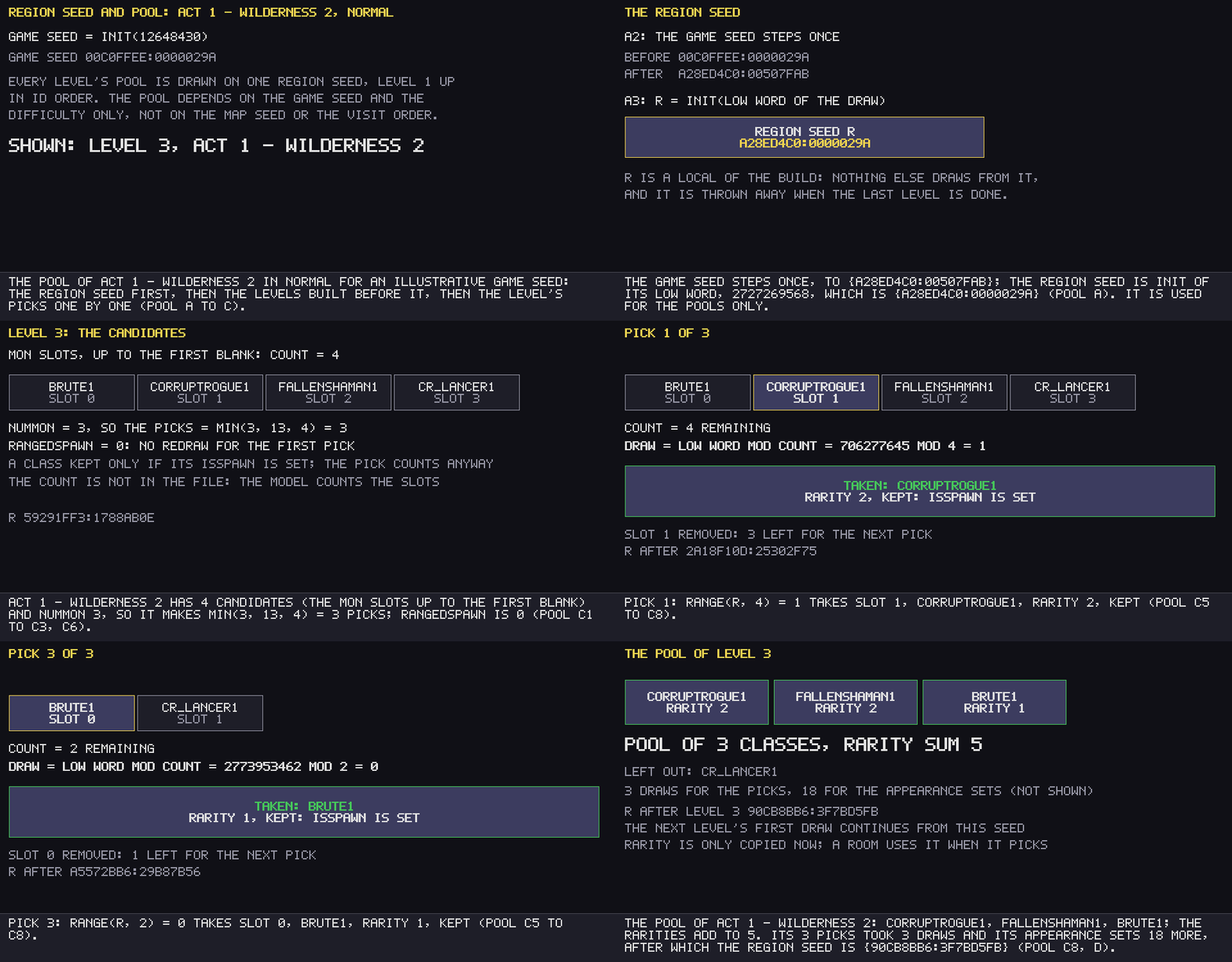
Step through monsters-pool-wilderness2
The pool of Act 1 - Wilderness 2 in normal for a game seed started with Init(12648430), one step at a time. The game seed steps once, and the region seed is Init of the low word of that draw (pool § A); the frames give both seeds. All levels are built on that one seed in id order, a level’s picks and its appearance sets both done before the next level’s first draw: level 1 draws nothing, level 2 draws 30 times, and level 3 starts from the seed they leave (§ B). Level 3 has four candidates in its mon slots and NumMon 3, so it makes min(3, 13, 4) = 3 picks, and its rangedspawn is 0, so no pick is redrawn. Each pick draws over the candidates that remain, takes that slot and removes it (§ C): Range(R, 4) = 1 takes corruptrogue1, Range(R, 3) = 1 takes fallenshaman1, Range(R, 2) = 0 takes brute1, and cr_lancer1 is left out. Each taken class has isSpawn set, so it is kept with its rarity (2, 2 and 1, which add to 5). Of the 21 draws the level makes, 3 are the picks and 18 are the appearance sets of § D, which the pictures do not show. Seed: illustrative, an input of our own. Every value shown is computed by our model, not observed in the game.
The game counts the candidates when it loads Levels, not from a column: the two count bytes are 0 in the shipped
file, so a program that reads the file must count them itself, or every pool comes out empty. The candidate count is read from
the code as the number of leading filled slots, stopping at the first blank.
Stock data has no gaps, so a test run cannot tell this apart from “the number of filled slots”. The nightmare and
hell pools were checked in natural games for one seed only. A classic normal game reads mon like an expansion game:
a logged one matched all 136 regions, and in 23 of the 27 levels 110–136 the nmon slots would have given another
pool.
Appearance sets
Section titled “Appearance sets”Each kept entry also gets up to three appearance sets, one variant per body component, drawn on the same region seed. Every set after the first differs from the first in at most two components. These draws come between one level’s picks and the next level’s, so a reimplementation has to make them even if it never draws a monster. If it skips them, every later level’s pool comes out wrong.
A short example from the spec’s worked example (pool § Worked example,
-seed 1, normal, expansion): Act 1 - Wilderness 2 has four candidates, brute1, corruptrogue1,
fallenshaman1 and cr_lancer1, and NumMon 3. The three draws take brute1, then fallenshaman1, then
cr_lancer1, so corruptrogue1 is left out of that game’s pool for that level.
Monster level per difficulty
Section titled “Monster level per difficulty”The monster level (mlvl) is set each time the server creates a monster. It depends on the class and the level the monster stands in:
| Game | Normal | Nightmare and hell |
|---|---|---|
| Expansion | MonStats Level |
the area’s MonLvl2Ex / MonLvl3Ex |
| Classic | MonStats Level |
MonStats Level(N) / Level(H) |
The exceptions are as follows:
- Classes with
noRatio(player summons and pets) andbossclasses keep MonStatsLevel(N)/Level(H)even in expansion nightmare and hell. Thebossrule was seen with Andariel, at level 49 in nightmare and 75 in hell instead of her area’s 43 and 73. In an expansion nightmare game four more kept their own level where the area’s differs: Blood Raven, Radament, Mephisto and Nihlathak. That makes five of the 25bossclasses met. The test reads the class’s own flag, with no list of classes. - A mercenary is created at its normal-difficulty
Level(1) in every difficulty, and its level and stats are then overwritten from the hireling table. - The classic area-level columns
MonLvl1..3gave no monster’s level in any classic difficulty of the logged games: every creation took its MonStats level, including the many where the area level differs. In expansion normal the area’sMonLvl1Exis not used either.
The logged cases from the spec: in Jail Level 1, two classes with MonStats levels 10/40/70 are created at 41
(nightmare) and 71 (hell) in an expansion game, and at 40 and 70 in a classic game. In Stony Field, expansion
normal, zombie2 gets 2 (its MonStats Level), not the area’s 4.
A classic normal game takes MonStats Level like an expansion one; all 163 creations of a logged classic normal
game did. Still open: when the monster’s level has no Levels record the code returns 1, but no stock case has
one, so this may never be logged. Town NPCs in expansion
nightmare or hell would take their town’s blank area level, 0, which their MonStats level also gives, so the runs
cannot tell the two sources apart.
Critters are not population
Section titled “Critters are not population”Ambient critters such as chickens and bugs are a separate, client-side draw for each room, on
the room’s seed. They never read the monster pool. Each of up to four critter slots makes one roll against its
percentage. A slot that passes creates MinGrp plus a random amount below MaxGrp − MinGrp, so MaxGrp itself
is never reached when the two differ. The draws made while each critter is created are not read yet, so the slots
after the first one that creates critters are not predicted.
When a room is populated, and how many attempts
Section titled “When a room is populated, and how many attempts”The population pass runs on the server only, once per room, the first time it is activated. The wanderer tick, the room’s preset monsters and objects come first, then the pass, and then the room is marked as populated. The client never runs this pass: only server code calls it, and every one of 4 154 logged passes ran on the server’s game. On the client, the room’s own content is the critter draw.
The gate. A level whose density (MonDen for the
difficulty) is 0 gets no random population, and neither does a room flagged “no population” by the map
generator. The gate also counts every room of the level that reaches it. That count is the level’s “rooms
visited”, which the special catch-up below uses. A test for Chaos Sanctuary closes the gate when a quest byte is
set. A run met it 91 times, always with the byte clear and the gate open. The closed state, once the three seal
bosses are dead, was not logged, so it rests on the code. The quest side of it is on
quests and travel.
Density. The room is split into its
logic boxes. Each box gets (5h ÷ 3) × (5w ÷ 3) attempts, where h and w are its size in
tiles, so an 8 × 8-tile box gets 169 attempts. Each attempt draws on the game seed and passes when
draw mod 100000 ≤ MonDen, a chance of (MonDen + 1)/100000. The test is “at most”, so a draw equal to the
density passes. A density above 10000 is clamped to 10000, and the stock maximum is 2200.
Picking a class, and normal versus special
Section titled “Picking a class, and normal versus special”The class pick is a weighted draw on the room seed
over the pool’s Rarity values, so, by the code, a class with Rarity 0 could never be picked; no stock pool holds
one. A class flagged placespawn (in
stock data the three crow nests) turns into its spawn class with a further room draw: 79 times in 100 for a
normal pick, 99 in 100 for the special pick of nightmare and hell. In normal difficulty the special class comes
from the level’s umon columns with no substitution.
Normal or special depends on the
level’s live count of specials, compared with its MonUMin and MonUMax:
%3btext-align:center%3b%7d%23mermaid-1 .edgeLabel p%7bbackground-color:rgba(232%2c232%2c232%2c 0.8)%3b%7d%23mermaid-1 .edgeLabel rect%7bopacity:0.5%3bbackground-color:rgba(232%2c232%2c232%2c 0.8)%3bfill:rgba(232%2c232%2c232%2c 0.8)%3b%7d%23mermaid-1 .labelBkg%7bbackground-color:rgba(232%2c 232%2c 232%2c 0.5)%3b%7d%23mermaid-1 .cluster rect%7bfill:%23ffffde%3bstroke:%23aaaa33%3bstroke-width:1px%3b%7d%23mermaid-1 .cluster text%7bfill:%23333%3b%7d%23mermaid-1 .cluster span%7bcolor:%23333%3b%7d%23mermaid-1 .node .collapsed-indicator%7bfill:%23aaaa33%3bstroke:none%3bopacity:0.6%3b%7d%23mermaid-1 .node .collapsed-separator%7bstroke:%23aaaa33%3bstroke-width:0.75px%3b%7d%23mermaid-1 div.mermaidTooltip%7bposition:absolute%3btext-align:center%3bmax-width:200px%3bpadding:2px%3bfont-family:arial%2csans-serif%3bfont-size:12px%3bbackground:hsl(80%2c 100%25%2c 96.2745098039%25)%3bborder:1px solid %23aaaa33%3bborder-radius:2px%3bpointer-events:none%3bz-index:100%3b%7d%23mermaid-1 .flowchartTitleText%7btext-anchor:middle%3bfont-size:18px%3bfill:%23333%3b%7d%23mermaid-1 rect.text%7bfill:none%3bstroke-width:0%3b%7d%23mermaid-1 .icon-shape%2c%23mermaid-1 .image-shape%7bbackground-color:rgba(232%2c232%2c232%2c 0.8)%3btext-align:center%3b%7d%23mermaid-1 .icon-shape p%2c%23mermaid-1 .image-shape p%7bbackground-color:rgba(232%2c232%2c232%2c 0.8)%3bpadding:2px%3b%7d%23mermaid-1 .icon-shape .label rect%2c%23mermaid-1 .image-shape .label rect%7bopacity:0.5%3bbackground-color:rgba(232%2c232%2c232%2c 0.8)%3bfill:rgba(232%2c232%2c232%2c 0.8)%3b%7d%23mermaid-1 .label-icon%7bdisplay:inline-block%3bheight:1em%3boverflow:visible%3bvertical-align:-0.125em%3b%7d%23mermaid-1 .node .label-icon path%7bfill:currentColor%3bstroke:revert%3bstroke-width:revert%3b%7d%23mermaid-1 .node .neo-node%7bstroke:%239370DB%3b%7d%23mermaid-1 %5bdata-look='neo'%5d.node rect%2c%23mermaid-1 %5bdata-look='neo'%5d.cluster rect%2c%23mermaid-1 %5bdata-look='neo'%5d.node polygon%7bstroke:%239370DB%3bfilter:drop-shadow(1px 2px 2px rgba(185%2c 185%2c 185%2c 1))%3b%7d%23mermaid-1 %5bdata-look='neo'%5d.swimlane.cluster rect%7bfilter:none%3b%7d%23mermaid-1 %5bdata-look='neo'%5d.node path%7bstroke:%239370DB%3bstroke-width:1px%3b%7d%23mermaid-1 %5bdata-look='neo'%5d.node .outer-path%7bfilter:drop-shadow(1px 2px 2px rgba(185%2c 185%2c 185%2c 1))%3b%7d%23mermaid-1 %5bdata-look='neo'%5d.node .neo-line path%7bstroke:%239370DB%3bfilter:none%3b%7d%23mermaid-1 %5bdata-look='neo'%5d.node circle%7bstroke:%239370DB%3bfilter:drop-shadow(1px 2px 2px rgba(185%2c 185%2c 185%2c 1))%3b%7d%23mermaid-1 %5bdata-look='neo'%5d.node circle .state-start%7bfill:black%3b%7d%23mermaid-1 %5bdata-look='neo'%5d.icon-shape .icon%7bfill:%239370DB%3bfilter:drop-shadow(1px 2px 2px rgba(185%2c 185%2c 185%2c 1))%3b%7d%23mermaid-1 %5bdata-look='neo'%5d.icon-shape .icon-neo path%7bstroke:%239370DB%3bfilter:drop-shadow(1px 2px 2px rgba(185%2c 185%2c 185%2c 1))%3b%7d%23mermaid-1 :root%7b--mermaid-font-family:arial%2csans-serif%3b%7d%3c/style%3e%3cg%3e%3cmarker id='mermaid-1_flowchart-v2-pointEnd' class='marker flowchart-v2' viewBox='0 0 10 10' refX='5' refY='5' markerUnits='userSpaceOnUse' markerWidth='8' markerHeight='8' orient='auto'%3e%3cpath d='M 0 0 L 10 5 L 0 10 z' class='arrowMarkerPath' style='stroke-width: 1%3b stroke-dasharray: 1%2c 0%3b'/%3e%3c/marker%3e%3cmarker id='mermaid-1_flowchart-v2-pointStart' class='marker flowchart-v2' viewBox='0 0 10 10' refX='4.5' refY='5' markerUnits='userSpaceOnUse' markerWidth='8' markerHeight='8' orient='auto'%3e%3cpath d='M 0 5 L 10 10 L 10 0 z' class='arrowMarkerPath' style='stroke-width: 1%3b stroke-dasharray: 1%2c 0%3b'/%3e%3c/marker%3e%3cmarker id='mermaid-1_flowchart-v2-pointEnd-margin' class='marker flowchart-v2' viewBox='0 0 11.5 14' refX='11.5' refY='7' markerUnits='userSpaceOnUse' markerWidth='10.5' markerHeight='14' orient='auto'%3e%3cpath d='M 0 0 L 11.5 7 L 0 14 z' class='arrowMarkerPath' style='stroke-width: 0%3b stroke-dasharray: 1%2c 0%3b'/%3e%3c/marker%3e%3cmarker id='mermaid-1_flowchart-v2-pointStart-margin' class='marker flowchart-v2' viewBox='0 0 11.5 14' refX='1' refY='7' markerUnits='userSpaceOnUse' markerWidth='11.5' markerHeight='14' orient='auto'%3e%3cpolygon points='0%2c7 11.5%2c14 11.5%2c0' class='arrowMarkerPath' style='stroke-width: 0%3b stroke-dasharray: 1%2c 0%3b'/%3e%3c/marker%3e%3cmarker id='mermaid-1_flowchart-v2-circleEnd' class='marker flowchart-v2' viewBox='0 0 10 10' refX='11' refY='5' markerUnits='userSpaceOnUse' markerWidth='11' markerHeight='11' orient='auto'%3e%3ccircle cx='5' cy='5' r='5' class='arrowMarkerPath' style='stroke-width: 1%3b stroke-dasharray: 1%2c 0%3b'/%3e%3c/marker%3e%3cmarker id='mermaid-1_flowchart-v2-circleStart' class='marker flowchart-v2' viewBox='0 0 10 10' refX='-1' refY='5' markerUnits='userSpaceOnUse' markerWidth='11' markerHeight='11' orient='auto'%3e%3ccircle cx='5' cy='5' r='5' class='arrowMarkerPath' style='stroke-width: 1%3b stroke-dasharray: 1%2c 0%3b'/%3e%3c/marker%3e%3cmarker id='mermaid-1_flowchart-v2-circleEnd-margin' class='marker flowchart-v2' viewBox='0 0 10 10' refY='5' refX='12.25' markerUnits='userSpaceOnUse' markerWidth='14' markerHeight='14' orient='auto'%3e%3ccircle cx='5' cy='5' r='5' class='arrowMarkerPath' style='stroke-width: 0%3b stroke-dasharray: 1%2c 0%3b'/%3e%3c/marker%3e%3cmarker id='mermaid-1_flowchart-v2-circleStart-margin' class='marker flowchart-v2' viewBox='0 0 10 10' refX='-2' refY='5' markerUnits='userSpaceOnUse' markerWidth='14' markerHeight='14' orient='auto'%3e%3ccircle cx='5' cy='5' r='5' class='arrowMarkerPath' style='stroke-width: 0%3b stroke-dasharray: 1%2c 0%3b'/%3e%3c/marker%3e%3cmarker id='mermaid-1_flowchart-v2-crossEnd' class='marker cross flowchart-v2' viewBox='0 0 11 11' refX='12' refY='5.2' markerUnits='userSpaceOnUse' markerWidth='11' markerHeight='11' orient='auto'%3e%3cpath d='M 1%2c1 l 9%2c9 M 10%2c1 l -9%2c9' class='arrowMarkerPath' style='stroke-width: 2%3b stroke-dasharray: 1%2c 0%3b'/%3e%3c/marker%3e%3cmarker id='mermaid-1_flowchart-v2-crossStart' class='marker cross flowchart-v2' viewBox='0 0 11 11' refX='-1' refY='5.2' markerUnits='userSpaceOnUse' markerWidth='11' markerHeight='11' orient='auto'%3e%3cpath d='M 1%2c1 l 9%2c9 M 10%2c1 l -9%2c9' class='arrowMarkerPath' style='stroke-width: 2%3b stroke-dasharray: 1%2c 0%3b'/%3e%3c/marker%3e%3cmarker id='mermaid-1_flowchart-v2-crossEnd-margin' class='marker cross flowchart-v2' viewBox='0 0 15 15' refX='17.7' refY='7.5' markerUnits='userSpaceOnUse' markerWidth='12' markerHeight='12' orient='auto'%3e%3cpath d='M 1%2c1 L 14%2c14 M 1%2c14 L 14%2c1' class='arrowMarkerPath' style='stroke-width: 2.5%3b'/%3e%3c/marker%3e%3cmarker id='mermaid-1_flowchart-v2-crossStart-margin' class='marker cross flowchart-v2' viewBox='0 0 15 15' refX='-3.5' refY='7.5' markerUnits='userSpaceOnUse' markerWidth='12' markerHeight='12' orient='auto'%3e%3cpath d='M 1%2c1 L 14%2c14 M 1%2c14 L 14%2c1' class='arrowMarkerPath' style='stroke-width: 2.5%3b stroke-dasharray: 1%2c 0%3b'/%3e%3c/marker%3e%3cg class='root'%3e%3cg class='clusters'/%3e%3cg class='edgePaths'%3e%3cpath d='M266.617%2c86L266.617%2c90.167C266.617%2c94.333%2c266.617%2c102.667%2c266.617%2c110.333C266.617%2c118%2c266.617%2c125%2c266.617%2c128.5L266.617%2c132' id='mermaid-1-L_s_a_0' class='edge-thickness-normal edge-pattern-solid edge-thickness-normal edge-pattern-solid flowchart-link' style='%3b' data-edge='true' data-et='edge' data-id='L_s_a_0' data-points='W3sieCI6MjY2LjYxNzE4NzUsInkiOjg2fSx7IngiOjI2Ni42MTcxODc1LCJ5IjoxMTF9LHsieCI6MjY2LjYxNzE4NzUsInkiOjEzNn1d' data-look='classic' marker-end='url(%23mermaid-1_flowchart-v2-pointEnd)'/%3e%3cpath d='M220.337%2c267.329L205.232%2c281.209C190.126%2c295.089%2c159.914%2c322.849%2c144.809%2c342.229C129.703%2c361.609%2c129.703%2c372.609%2c129.703%2c378.109L129.703%2c383.609' id='mermaid-1-L_a_d1_0' class='edge-thickness-normal edge-pattern-solid edge-thickness-normal edge-pattern-solid flowchart-link' style='%3b' data-edge='true' data-et='edge' data-id='L_a_d1_0' data-points='W3sieCI6MjIwLjMzNzIzNzgwMjIwMzUzLCJ5IjoyNjcuMzI5NDI1MzAyMjAzNX0seyJ4IjoxMjkuNzAzMTI1LCJ5IjozNTAuNjA5Mzc1fSx7IngiOjEyOS43MDMxMjUsInkiOjM4Ny42MDkzNzV9XQ==' data-look='classic' marker-end='url(%23mermaid-1_flowchart-v2-pointEnd)'/%3e%3cpath d='M119.547%2c620.86L118.832%2c628.719C118.116%2c636.578%2c116.685%2c652.297%2c115.969%2c681.495C115.254%2c710.693%2c115.254%2c753.37%2c115.254%2c796.047C115.254%2c838.724%2c115.254%2c881.401%2c115.254%2c927.559C115.254%2c973.716%2c115.254%2c1023.354%2c115.254%2c1072.992C115.254%2c1122.63%2c115.254%2c1172.268%2c116.858%2c1204.602C118.463%2c1236.936%2c121.672%2c1251.965%2c123.276%2c1259.48L124.881%2c1266.994' id='mermaid-1-L_d1_sp_0' class='edge-thickness-normal edge-pattern-solid edge-thickness-normal edge-pattern-solid flowchart-link' style='%3b' data-edge='true' data-et='edge' data-id='L_d1_sp_0' data-points='W3sieCI6MTE5LjU0NzI0MTI0MTIyOTk1LCJ5Ijo2MjAuODU5NzQxMjQxMjI5OX0seyJ4IjoxMTUuMjUzOTA2MjUsInkiOjY2OC4wMTU2MjV9LHsieCI6MTE1LjI1MzkwNjI1LCJ5Ijo3OTYuMDQ2ODc1fSx7IngiOjExNS4yNTM5MDYyNSwieSI6OTI0LjA3ODEyNX0seyJ4IjoxMTUuMjUzOTA2MjUsInkiOjEwNzIuOTkyMTg3NX0seyJ4IjoxMTUuMjUzOTA2MjUsInkiOjEyMjEuOTA2MjV9LHsieCI6MTI1LjcxNTc2ODkxNDQ3MzY4LCJ5IjoxMjcwLjkwNjI1fV0=' data-look='classic' marker-end='url(%23mermaid-1_flowchart-v2-pointEnd)'/%3e%3cpath d='M168.211%2c592.508L174.036%2c605.093C179.861%2c617.677%2c191.51%2c642.846%2c211.827%2c668.983C232.144%2c695.119%2c261.127%2c722.222%2c275.619%2c735.774L290.111%2c749.325' id='mermaid-1-L_d1_b_0' class='edge-thickness-normal edge-pattern-solid edge-thickness-normal edge-pattern-solid flowchart-link' style='%3b' data-edge='true' data-et='edge' data-id='L_d1_b_0' data-points='W3sieCI6MTY4LjIxMDgxMDM4NzMyNjkyLCJ5Ijo1OTIuNTA3OTM5NjEyNjczMX0seyJ4IjoyMDMuMTYwMTU2MjUsInkiOjY2OC4wMTU2MjV9LHsieCI6MjkzLjAzMjU5MjkzNTQxNTYsInkiOjc1Mi4wNTcyNTA4MTQ1ODQzfV0=' data-look='classic' marker-end='url(%23mermaid-1_flowchart-v2-pointEnd)'/%3e%3cpath d='M303.145%2c277.081L311.708%2c289.336C320.271%2c301.591%2c337.397%2c326.1%2c345.96%2c364.805C354.523%2c403.51%2c354.523%2c456.411%2c354.523%2c509.313C354.523%2c562.214%2c354.523%2c615.115%2c353.729%2c648.608C352.934%2c682.101%2c351.344%2c696.187%2c350.549%2c703.23L349.754%2c710.273' id='mermaid-1-L_a_b_0' class='edge-thickness-normal edge-pattern-solid edge-thickness-normal edge-pattern-solid flowchart-link' style='%3b' data-edge='true' data-et='edge' data-id='L_a_b_0' data-points='W3sieCI6MzAzLjE0NTQzOTg3NjE2NTI2LCJ5IjoyNzcuMDgxMTIyNjIzODM0NzR9LHsieCI6MzU0LjUyMzQzNzUsInkiOjM1MC42MDkzNzV9LHsieCI6MzU0LjUyMzQzNzUsInkiOjUwOS4zMTI1fSx7IngiOjM1NC41MjM0Mzc1LCJ5Ijo2NjguMDE1NjI1fSx7IngiOjM0OS4zMDU4NzMxMzY1NjYxNiwieSI6NzE0LjI0NzI3OTM4NjU2NjF9XQ==' data-look='classic' marker-end='url(%23mermaid-1_flowchart-v2-pointEnd)'/%3e%3cpath d='M305.637%2c852.641L298.392%2c864.547C291.147%2c876.453%2c276.658%2c900.266%2c269.413%2c917.672C262.168%2c935.078%2c262.168%2c946.078%2c262.168%2c951.578L262.168%2c957.078' id='mermaid-1-L_b_d2_0' class='edge-thickness-normal edge-pattern-solid edge-thickness-normal edge-pattern-solid flowchart-link' style='%3b' data-edge='true' data-et='edge' data-id='L_b_d2_0' data-points='W3sieCI6MzA1LjYzNzA1NTQzNDM3MDI3LCJ5Ijo4NTIuNjQwOTYxNjg0MzcwM30seyJ4IjoyNjIuMTY3OTY4NzUsInkiOjkyNC4wNzgxMjV9LHsieCI6MjYyLjE2Nzk2ODc1LCJ5Ijo5NjEuMDc4MTI1fV0=' data-look='classic' marker-end='url(%23mermaid-1_flowchart-v2-pointEnd)'/%3e%3cpath d='M231.098%2c1153.836L226.738%2c1165.181C222.378%2c1176.526%2c213.658%2c1199.216%2c201.867%2c1218.249C190.077%2c1237.281%2c175.217%2c1252.655%2c167.787%2c1260.343L160.357%2c1268.03' id='mermaid-1-L_d2_sp_0' class='edge-thickness-normal edge-pattern-solid edge-thickness-normal edge-pattern-solid flowchart-link' style='%3b' data-edge='true' data-et='edge' data-id='L_d2_sp_0' data-points='W3sieCI6MjMxLjA5ODA0Nzk2MzA5MTkxLCJ5IjoxMTUzLjgzNjMyOTIxMzA5MTl9LHsieCI6MjA0LjkzNzUsInkiOjEyMjEuOTA2MjV9LHsieCI6MTU3LjU3NzA0NTY0MTQ0NzM3LCJ5IjoxMjcwLjkwNjI1fV0=' data-look='classic' marker-end='url(%23mermaid-1_flowchart-v2-pointEnd)'/%3e%3cpath d='M295.608%2c1151.466L300.611%2c1163.206C305.614%2c1174.946%2c315.619%2c1198.426%2c326.466%2c1215.867C337.313%2c1233.309%2c349.002%2c1244.711%2c354.846%2c1250.412L360.69%2c1256.113' id='mermaid-1-L_d2_last_0' class='edge-thickness-normal edge-pattern-solid edge-thickness-normal edge-pattern-solid flowchart-link' style='%3b' data-edge='true' data-et='edge' data-id='L_d2_last_0' data-points='W3sieCI6Mjk1LjYwODE3OTYzNzM0ODk0LCJ5IjoxMTUxLjQ2NjAzOTExMjY1MX0seyJ4IjozMjUuNjI1LCJ5IjoxMjIxLjkwNjI1fSx7IngiOjM2My41NTMwNDI3NjMxNTc5LCJ5IjoxMjU4LjkwNjI1fV0=' data-look='classic' marker-end='url(%23mermaid-1_flowchart-v2-pointEnd)'/%3e%3cpath d='M374.511%2c852.641L381.756%2c864.547C389.001%2c876.453%2c403.491%2c900.266%2c410.736%2c936.991C417.98%2c973.716%2c417.98%2c1023.354%2c417.98%2c1072.992C417.98%2c1122.63%2c417.98%2c1172.268%2c416.933%2c1202.599C415.885%2c1232.93%2c413.789%2c1243.953%2c412.741%2c1249.465L411.693%2c1254.977' id='mermaid-1-L_b_last_0' class='edge-thickness-normal edge-pattern-solid edge-thickness-normal edge-pattern-solid flowchart-link' style='%3b' data-edge='true' data-et='edge' data-id='L_b_last_0' data-points='W3sieCI6Mzc0LjUxMTM4MjA2NTYyOTczLCJ5Ijo4NTIuNjQwOTYxNjg0MzcwM30seyJ4Ijo0MTcuOTgwNDY4NzUsInkiOjkyNC4wNzgxMjV9LHsieCI6NDE3Ljk4MDQ2ODc1LCJ5IjoxMDcyLjk5MjE4NzV9LHsieCI6NDE3Ljk4MDQ2ODc1LCJ5IjoxMjIxLjkwNjI1fSx7IngiOjQxMC45NDU5ODA2NzQzNDIxLCJ5IjoxMjU4LjkwNjI1fV0=' data-look='classic' marker-end='url(%23mermaid-1_flowchart-v2-pointEnd)'/%3e%3cpath d='M403.531%2c1336.906L403.531%2c1341.073C403.531%2c1345.24%2c403.531%2c1353.573%2c403.531%2c1361.24C403.531%2c1368.906%2c403.531%2c1375.906%2c403.531%2c1379.406L403.531%2c1382.906' id='mermaid-1-L_last_nm_0' class='edge-thickness-normal edge-pattern-solid edge-thickness-normal edge-pattern-solid flowchart-link' style='%3b' data-edge='true' data-et='edge' data-id='L_last_nm_0' data-points='W3sieCI6NDAzLjUzMTI1LCJ5IjoxMzM2LjkwNjI1fSx7IngiOjQwMy41MzEyNSwieSI6MTM2MS45MDYyNX0seyJ4Ijo0MDMuNTMxMjUsInkiOjEzODYuOTA2MjV9XQ==' data-look='classic' marker-end='url(%23mermaid-1_flowchart-v2-pointEnd)'/%3e%3c/g%3e%3cg class='edgeLabels'%3e%3cg class='edgeLabel'%3e%3cg class='label' data-id='L_s_a_0' transform='translate(0%2c 0)'%3e%3cforeignObject width='0' height='0'%3e%3cdiv xmlns='http://www.w3.org/1999/xhtml' class='labelBkg' style='display: table-cell%3b white-space: nowrap%3b line-height: 1.5%3b max-width: 200px%3b text-align: center%3b'%3e%3cspan class='edgeLabel'%3e%3c/span%3e%3c/div%3e%3c/foreignObject%3e%3c/g%3e%3c/g%3e%3cg class='edgeLabel' transform='translate(129.703125%2c 350.609375)'%3e%3cg class='label' data-id='L_a_d1_0' transform='translate(-12.453125%2c -12)'%3e%3cforeignObject width='24.90625' height='24'%3e%3cdiv xmlns='http://www.w3.org/1999/xhtml' class='labelBkg' style='display: table-cell%3b white-space: nowrap%3b line-height: 1.5%3b max-width: 200px%3b text-align: center%3b'%3e%3cspan class='edgeLabel'%3e%3cp%3eyes%3c/p%3e%3c/span%3e%3c/div%3e%3c/foreignObject%3e%3c/g%3e%3c/g%3e%3cg class='edgeLabel' transform='translate(115.25390625%2c 924.078125)'%3e%3cg class='label' data-id='L_d1_sp_0' transform='translate(-12.453125%2c -12)'%3e%3cforeignObject width='24.90625' height='24'%3e%3cdiv xmlns='http://www.w3.org/1999/xhtml' class='labelBkg' style='display: table-cell%3b white-space: nowrap%3b line-height: 1.5%3b max-width: 200px%3b text-align: center%3b'%3e%3cspan class='edgeLabel'%3e%3cp%3eyes%3c/p%3e%3c/span%3e%3c/div%3e%3c/foreignObject%3e%3c/g%3e%3c/g%3e%3cg class='edgeLabel' transform='translate(217.71021%2c 681.62169)'%3e%3cg class='label' data-id='L_d1_b_0' transform='translate(-8.8984375%2c -12)'%3e%3cforeignObject width='17.796875' height='24'%3e%3cdiv xmlns='http://www.w3.org/1999/xhtml' class='labelBkg' style='display: table-cell%3b white-space: nowrap%3b line-height: 1.5%3b max-width: 200px%3b text-align: center%3b'%3e%3cspan class='edgeLabel'%3e%3cp%3eno%3c/p%3e%3c/span%3e%3c/div%3e%3c/foreignObject%3e%3c/g%3e%3c/g%3e%3cg class='edgeLabel' transform='translate(354.5234375%2c 509.3125)'%3e%3cg class='label' data-id='L_a_b_0' transform='translate(-8.8984375%2c -12)'%3e%3cforeignObject width='17.796875' height='24'%3e%3cdiv xmlns='http://www.w3.org/1999/xhtml' class='labelBkg' style='display: table-cell%3b white-space: nowrap%3b line-height: 1.5%3b max-width: 200px%3b text-align: center%3b'%3e%3cspan class='edgeLabel'%3e%3cp%3eno%3c/p%3e%3c/span%3e%3c/div%3e%3c/foreignObject%3e%3c/g%3e%3c/g%3e%3cg class='edgeLabel' transform='translate(262.16796875%2c 924.078125)'%3e%3cg class='label' data-id='L_b_d2_0' transform='translate(-12.453125%2c -12)'%3e%3cforeignObject width='24.90625' height='24'%3e%3cdiv xmlns='http://www.w3.org/1999/xhtml' class='labelBkg' style='display: table-cell%3b white-space: nowrap%3b line-height: 1.5%3b max-width: 200px%3b text-align: center%3b'%3e%3cspan class='edgeLabel'%3e%3cp%3eyes%3c/p%3e%3c/span%3e%3c/div%3e%3c/foreignObject%3e%3c/g%3e%3c/g%3e%3cg class='edgeLabel' transform='translate(205.79432%2c 1219.6768)'%3e%3cg class='label' data-id='L_d2_sp_0' transform='translate(-12.453125%2c -12)'%3e%3cforeignObject width='24.90625' height='24'%3e%3cdiv xmlns='http://www.w3.org/1999/xhtml' class='labelBkg' style='display: table-cell%3b white-space: nowrap%3b line-height: 1.5%3b max-width: 200px%3b text-align: center%3b'%3e%3cspan class='edgeLabel'%3e%3cp%3eyes%3c/p%3e%3c/span%3e%3c/div%3e%3c/foreignObject%3e%3c/g%3e%3c/g%3e%3cg class='edgeLabel' transform='translate(325.625%2c 1221.90625)'%3e%3cg class='label' data-id='L_d2_last_0' transform='translate(-8.8984375%2c -12)'%3e%3cforeignObject width='17.796875' height='24'%3e%3cdiv xmlns='http://www.w3.org/1999/xhtml' class='labelBkg' style='display: table-cell%3b white-space: nowrap%3b line-height: 1.5%3b max-width: 200px%3b text-align: center%3b'%3e%3cspan class='edgeLabel'%3e%3cp%3eno%3c/p%3e%3c/span%3e%3c/div%3e%3c/foreignObject%3e%3c/g%3e%3c/g%3e%3cg class='edgeLabel' transform='translate(417.98046875%2c 1072.9921875)'%3e%3cg class='label' data-id='L_b_last_0' transform='translate(-8.8984375%2c -12)'%3e%3cforeignObject width='17.796875' height='24'%3e%3cdiv xmlns='http://www.w3.org/1999/xhtml' class='labelBkg' style='display: table-cell%3b white-space: nowrap%3b line-height: 1.5%3b max-width: 200px%3b text-align: center%3b'%3e%3cspan class='edgeLabel'%3e%3cp%3eno%3c/p%3e%3c/span%3e%3c/div%3e%3c/foreignObject%3e%3c/g%3e%3c/g%3e%3cg class='edgeLabel'%3e%3cg class='label' data-id='L_last_nm_0' transform='translate(0%2c 0)'%3e%3cforeignObject width='0' height='0'%3e%3cdiv xmlns='http://www.w3.org/1999/xhtml' class='labelBkg' style='display: table-cell%3b white-space: nowrap%3b line-height: 1.5%3b max-width: 200px%3b text-align: center%3b'%3e%3cspan class='edgeLabel'%3e%3c/span%3e%3c/div%3e%3c/foreignObject%3e%3c/g%3e%3c/g%3e%3c/g%3e%3cg class='nodes'%3e%3cg class='node default' id='mermaid-1-flowchart-s-0' data-look='classic' transform='translate(266.6171875%2c 47)'%3e%3crect class='basic label-container' style='' x='-130' y='-39' width='260' height='78'/%3e%3cg class='label' style='' transform='translate(-100%2c -24)'%3e%3crect/%3e%3cforeignObject width='200' height='48'%3e%3cdiv xmlns='http://www.w3.org/1999/xhtml' style='display: table%3b white-space: break-spaces%3b line-height: 1.5%3b max-width: 200px%3b text-align: center%3b width: 200px%3b'%3e%3cspan class='nodeLabel'%3e%3cp%3elive special count of the level%3c/p%3e%3c/span%3e%3c/div%3e%3c/foreignObject%3e%3c/g%3e%3c/g%3e%3cg class='node default' id='mermaid-1-flowchart-a-1' data-look='classic' transform='translate(266.6171875%2c 224.8046875)'%3e%3cpolygon points='88.8046875%2c0 177.609375%2c-88.8046875 88.8046875%2c-177.609375 0%2c-88.8046875' class='label-container' transform='translate(-88.3046875%2c 88.8046875)'/%3e%3cg class='label' style='' transform='translate(-61.8046875%2c -12)'%3e%3crect/%3e%3cforeignObject width='123.609375' height='24'%3e%3cdiv xmlns='http://www.w3.org/1999/xhtml' style='display: table-cell%3b white-space: nowrap%3b line-height: 1.5%3b max-width: 200px%3b text-align: center%3b'%3e%3cspan class='nodeLabel'%3e%3cp%3ebelow MonUMin%3f%3c/p%3e%3c/span%3e%3c/div%3e%3c/foreignObject%3e%3c/g%3e%3c/g%3e%3cg class='node default' id='mermaid-1-flowchart-d1-3' data-look='classic' transform='translate(129.703125%2c 509.3125)'%3e%3cpolygon points='121.703125%2c0 243.40625%2c-121.703125 121.703125%2c-243.40625 0%2c-121.703125' class='label-container' transform='translate(-121.203125%2c 121.703125)'/%3e%3cg class='label' style='' transform='translate(-82.703125%2c -24)'%3e%3crect/%3e%3cforeignObject width='165.40625' height='48'%3e%3cdiv xmlns='http://www.w3.org/1999/xhtml' style='display: table-cell%3b white-space: nowrap%3b line-height: 1.5%3b max-width: 200px%3b text-align: center%3b'%3e%3cspan class='nodeLabel'%3e%3cp%3eroom draw below%3cbr /%3evisited share of rooms%3f%3c/p%3e%3c/span%3e%3c/div%3e%3c/foreignObject%3e%3c/g%3e%3c/g%3e%3cg class='node default' id='mermaid-1-flowchart-sp-5' data-look='classic' transform='translate(131.48046875%2c 1297.90625)'%3e%3crect class='basic label-container' style='' x='-54.90625' y='-27' width='109.8125' height='54'/%3e%3cg class='label' style='' transform='translate(-24.90625%2c -12)'%3e%3crect/%3e%3cforeignObject width='49.8125' height='24'%3e%3cdiv xmlns='http://www.w3.org/1999/xhtml' style='display: table-cell%3b white-space: nowrap%3b line-height: 1.5%3b max-width: 200px%3b text-align: center%3b'%3e%3cspan class='nodeLabel'%3e%3cp%3especial%3c/p%3e%3c/span%3e%3c/div%3e%3c/foreignObject%3e%3c/g%3e%3c/g%3e%3cg class='node default' id='mermaid-1-flowchart-b-7' data-look='classic' transform='translate(340.07421875%2c 796.046875)'%3e%3cpolygon points='91.03125%2c0 182.0625%2c-91.03125 91.03125%2c-182.0625 0%2c-91.03125' class='label-container' transform='translate(-90.53125%2c 91.03125)'/%3e%3cg class='label' style='' transform='translate(-64.03125%2c -12)'%3e%3crect/%3e%3cforeignObject width='128.0625' height='24'%3e%3cdiv xmlns='http://www.w3.org/1999/xhtml' style='display: table-cell%3b white-space: nowrap%3b line-height: 1.5%3b max-width: 200px%3b text-align: center%3b'%3e%3cspan class='nodeLabel'%3e%3cp%3ebelow MonUMax%3f%3c/p%3e%3c/span%3e%3c/div%3e%3c/foreignObject%3e%3c/g%3e%3c/g%3e%3cg class='node default' id='mermaid-1-flowchart-d2-11' data-look='classic' transform='translate(262.16796875%2c 1072.9921875)'%3e%3cpolygon points='111.9140625%2c0 223.828125%2c-111.9140625 111.9140625%2c-223.828125 0%2c-111.9140625' class='label-container' transform='translate(-111.4140625%2c 111.9140625)'/%3e%3cg class='label' style='' transform='translate(-72.9140625%2c -24)'%3e%3crect/%3e%3cforeignObject width='145.828125' height='48'%3e%3cdiv xmlns='http://www.w3.org/1999/xhtml' style='display: table-cell%3b white-space: nowrap%3b line-height: 1.5%3b max-width: 200px%3b text-align: center%3b'%3e%3cspan class='nodeLabel'%3e%3cp%3eroom draw at most 5%3cbr /%3e(6 in 100)%3f%3c/p%3e%3c/span%3e%3c/div%3e%3c/foreignObject%3e%3c/g%3e%3c/g%3e%3cg class='node default' id='mermaid-1-flowchart-last-15' data-look='classic' transform='translate(403.53125%2c 1297.90625)'%3e%3crect class='basic label-container' style='' x='-105.59375' y='-39' width='211.1875' height='78'/%3e%3cg class='label' style='' transform='translate(-75.59375%2c -24)'%3e%3crect/%3e%3cforeignObject width='151.1875' height='48'%3e%3cdiv xmlns='http://www.w3.org/1999/xhtml' style='display: table-cell%3b white-space: nowrap%3b line-height: 1.5%3b max-width: 200px%3b text-align: center%3b'%3e%3cspan class='nodeLabel'%3e%3cp%3eone more room draw%2c%3cbr /%3ealways normal%3c/p%3e%3c/span%3e%3c/div%3e%3c/foreignObject%3e%3c/g%3e%3c/g%3e%3cg class='node default' id='mermaid-1-flowchart-nm-19' data-look='classic' transform='translate(403.53125%2c 1413.90625)'%3e%3crect class='basic label-container' style='' x='-77.140625' y='-27' width='154.28125' height='54'/%3e%3cg class='label' style='' transform='translate(-47.140625%2c -12)'%3e%3crect/%3e%3cforeignObject width='94.28125' height='24'%3e%3cdiv xmlns='http://www.w3.org/1999/xhtml' style='display: table-cell%3b white-space: nowrap%3b line-height: 1.5%3b max-width: 200px%3b text-align: center%3b'%3e%3cspan class='nodeLabel'%3e%3cp%3enormal group%3c/p%3e%3c/span%3e%3c/div%3e%3c/foreignObject%3e%3c/g%3e%3c/g%3e%3c/g%3e%3c/g%3e%3c/g%3e%3cdefs%3e%3cfilter id='mermaid-1-drop-shadow' height='130%25' width='130%25'%3e%3cfeDropShadow dx='4' dy='4' stdDeviation='0' flood-opacity='0.06' flood-color='black'/%3e%3c/filter%3e%3c/defs%3e%3cdefs%3e%3cfilter id='mermaid-1-drop-shadow-small' height='150%25' width='150%25'%3e%3cfeDropShadow dx='2' dy='2' stdDeviation='0' flood-opacity='0.06' flood-color='black'/%3e%3c/filter%3e%3c/defs%3e%3c/svg%3e)
- While the level has fewer specials than
MonUMin, an attempt that passed density is special with a chance of about the explored fraction of the level (rooms visited ÷ rooms). The catch-up therefore grows as you explore, but it is not a guarantee. - Below
MonUMax, a flat 6 in 100 applies to every attempt that passed density. A community page describes 5 in 100 per room, withMonUMaxcapping successful attempts. In 1.14d it is per attempt, and a run caught a special at exactly the boundary value. - A level with
MonUMin=MonUMax= 0 gets no random champions or uniques. - The last draw can return a “type 1”, but the pass turns it into a normal group. The champion-formation branch for type 1 is never reached. The draw still happens.
- The count is live and builds up over the game. It goes up for each random boss, each champion-pack member, each preset special and each superunique, and goes down by one when a special leaves its level. All of these were logged: the increments for superuniques and preset specials too, and 188 decreases, all outside a pass. The 7 910 logged region snapshots equal the count these rules give.
Groups and minions
Section titled “Groups and minions”A normal group is a leader plus a uniform
MinGrp … MaxGrp total, drawn on the leader’s seed. Members whose placement fails are simply missing. Fallen and
scarab classes always form a group of one, and their company comes from their minions instead.
Minions: every leader, group
member and champion-pack member of a class with minion1 brings PartyMin … PartyMax minions of minion1, or
of minion1 and minion2 in turn. A shaman-type class therefore brings its own party for each member. Bosses,
unique minions and minions themselves bring none. The minion count is drawn on the leader’s seed before its
group size.
The sparsePopulate column would add a roll on the game seed before a group. Stock data never reaches it, because
the only class with a value is the evil hut, which appears only as a map preset. What the roll does is read from
the code only: the group would spawn with probability (value + 1)/100, and nothing would take its place.
Community descriptions disagree with this, and no stock-data run can settle it.
Group sizes, minions and density do not scale with the player count: passes logged at /players 3
and /players 8 are reproduced by the same model as those at one player, and the code read for this pass has no
read of the player count. Games with several real players were not logged, so for them this rests on the code.
Placement: where each monster stands
Section titled “Placement: where each monster stands”A leader or boss gets a random point in its logic box: up to 20 tries of two room draws each, rejecting points too
close to the level’s warp points or its waypoint point (the level’s WarpDist). Then a placement test checks the exact point. Group members,
minions and pack members are placed in growing square rings around their leader, each ring starting at a random
cell. The walk tests cells against the room’s collision grid. Points to know:
- Every placement costs room draws, even when it fails. An exact placement still makes 3 room draws, and the random point’s test is made twice: once as a probe, once to create the monster.
- The grid changes as the pass runs. A monster just placed blocks later ones through its centre mark, so a later group
member may have to take another cell. Read from the code, every monster the server creates is marked the same way,
not only those of the pass, and a monster created already dead takes a corpse mark too, as its
class’s
deadColcolumn decides. For a monster re-created when its room comes back, the marks were compared in a run and agree. - The near-warp test can activate another room in the middle of the pass and, in some levels, step that level’s seed. The levels page steps a toy room through the four tests in their order.
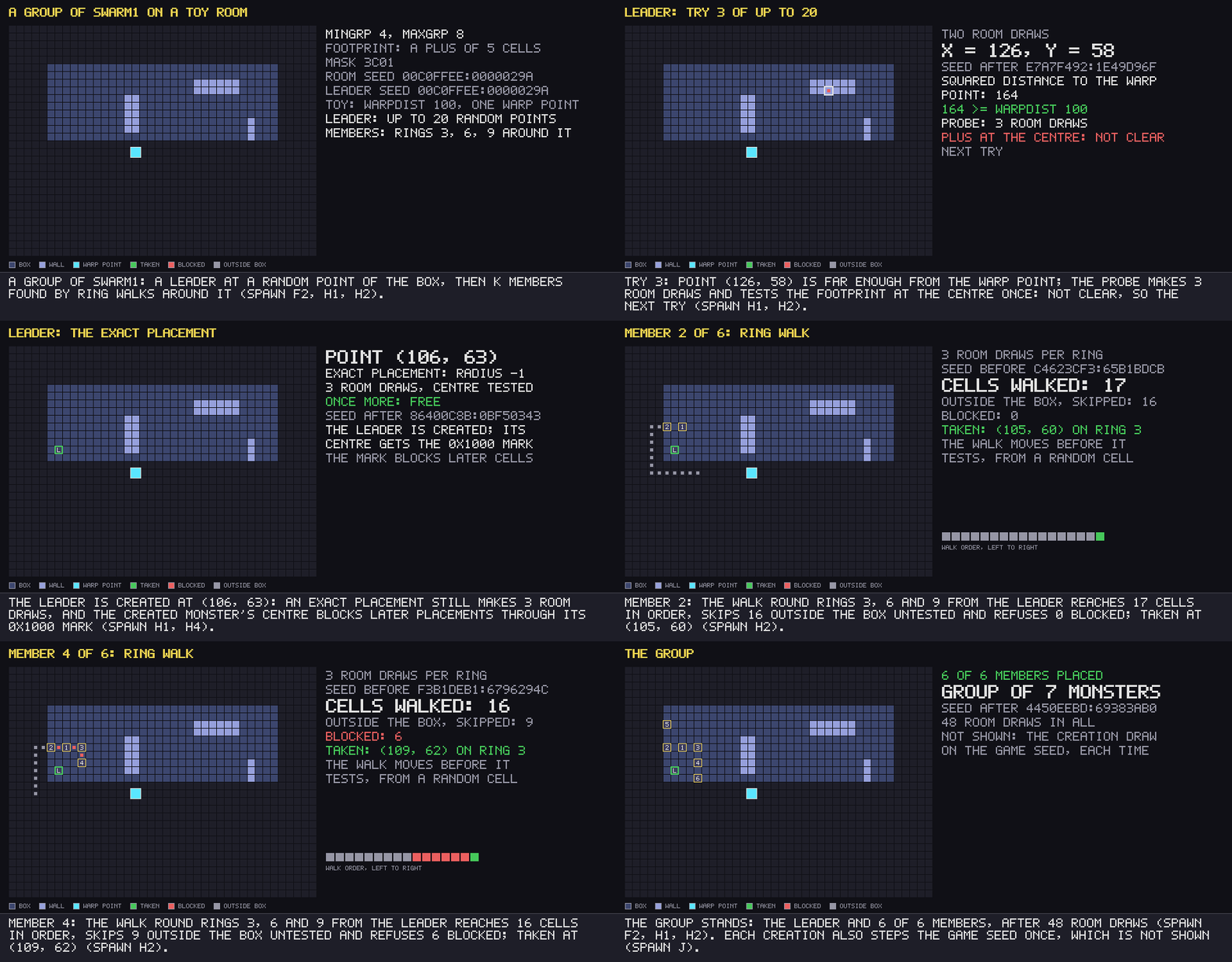
Step through monsters-pack-toy-room
One normal group of the class swarm1 (MinGrp 4, MaxGrp 8, a footprint of two, no minions) placed on a toy room of our own that has a logic box, three walls, one warp point and a WarpDist of 100; the room seed and the leader’s seed are each started with Init(12648430). The leader’s point is drawn in up to 20 tries of two room draws each. A point whose squared distance to a warp point is below WarpDist is refused with no probe; any other gets a probe of three room draws that tests the footprint at the point once (spawn § H1). Here the first try is too close to the warp point, the next two are refused by their probe, and the fourth stands. The exact placement then makes three room draws again, and the created leader marks its centre (§ H1, H4). The group size is the leader seed’s draw, k = (MinGrp − 1) + Range(seed, MaxGrp − MinGrp + 1) = 3 + 3 = 6 members, a group of seven with the leader (§ F2). Each member is placed by a walk round square rings 3, 6 and 9 subtiles from the leader: each ring starts at a random cell, the walk moves before it tests, a cell outside the box is skipped with no test (members 2, 4 and 5 walk past such cells), and a cell is taken when the plus of its footprint is clear under the mask 0x3C01 (§ H2, H3). A cell is refused when the plus is not clear, because of a wall or of the 0x1000 mark of a monster already placed (members 3 to 6 meet such cells) (§ H4). Member 5 finds no cell on its first ring and takes one on the second (§ H2). A member whose placement fails is missing. Not shown: the step of the game seed that each creation makes, the class cell test, the region-id test (the toy box is one region) and the level’s waypoint point, which the warp test also measures. Seed: illustrative, an input of our own. Every value shown is computed by our model, not observed in the game.
Each creation steps the game seed once. The new monster’s own seed comes from that step. On 914 of 916 logged creations it was 2 steps past its starting value when the pass first drew on it, and 6 and 15 steps on the other two. The spawn spec’s own run took that seed as an input. The stats spec names the two usual steps, the appearance pick and the hit-point draw. The extra steps come from the level’s list of classes and their appearance sets: when a class with more than two pieces is created for the first time in a level, it is added to that list, and its sets are rolled on the new monster’s own seed before the two usual steps. This is confirmed: across the 1 786 creations in the logs, 14 were such additions, and each took exactly the number of steps the model predicts from its seed (6 to 16), the two odd ones of the pass included. Which of the other creations found their class already listed is not told apart by the logs. With the level’s class list and the stats draws modelled together, the end-to-end run predicted this seed for all 12 580 monster creations it met.
A skill’s summon is created the same way, outside the pass. In 219 logged summons (207 Druid Ravens and 12 skeletons of Raise Skeleton) the game seed stepped once, the summon’s own seed came from that step, and its hit points and defence were what the creation draws give on that seed. The summon’s other stats, the skill’s bonuses among them, were not checked; the skills page has the summon side. That the summoning step itself adds no draw is read from the code.
Wanderers. Every room in the update walk takes one
room-seed draw per tick, and it goes on doing so after the room is populated: 4 044 logged ticks on
populated rooms each took exactly one step. Rarely, a wanderer roll follows. It fired once in a run, in the Chaos
Sanctuary: the roll stepped the room seed once more, missed its 3 in 100, and spawned nothing, so that tick took two
steps. The spawn itself was never reached and is read from the code only. The rest of the gate, which this single case cannot
separate, ran under emulation as the code’s map: the draw passes only when its low 15 bits are 0, only in a level with MonWndr
set, only in a room no player is near, and the roll spawns only with fewer than 3 wanderers in the level’s region, a signed count.
That this is 1 pass in 32 768 ticks is read from the code. The wanderer class list holds one class, for Act I
only. MonWndr gates only this roll: the code has no other reader of it, and watching it in play found none. It
does not decide whether monsters roam, which is what a community page says.
Champions and uniques
Section titled “Champions and uniques”When the type roll says “special”, the pass makes a second class pick: from the level’s umon columns in
normal difficulty, from the pool in nightmare and hell. It places the boss and only then decides what the boss is:
- Champion when a draw of
Range(100)on the boss’s own seed is below 20 (theconstantsvalue of MonUMod row 0), so 20 in 100. A champion gets exactly one champion mod, then a champion pack of 1 to 3 more monsters of its class. - Unique otherwise. A unique gets
1 + difficultyunique mods (1, 2 or 3) and 3 to 6 minions.
The mod picks are weighted draws over the
MonUMod rows allowed for this monster, by the difficulty’s cpick or upick weight. With stock data every weight
is 1 (champion) or 6 (unique), so the allowed candidates are equally likely:
| Classic | Expansion | |
|---|---|---|
| Champion mods | champion only |
champion, ghostly, fanatic, possessed, berserk |
| Unique mods | 12 in normal, 13 in nightmare and hell (resist joins) |
the same |
A row can also be refused for the class. teleport needs the class to have the A1 mode, fast the WL mode, and
multishot a class that is neither isMelee nor nomultishot. The one stock exclusion is lightning on sand
leapers. A run met it once: a unique sand leaper’s candidate list lacked lightning, as predicted. A unique never
gets the same mod twice. A unique’s
mod count costs one extra draw (Range(1), which always gives 0 but still steps the seed).
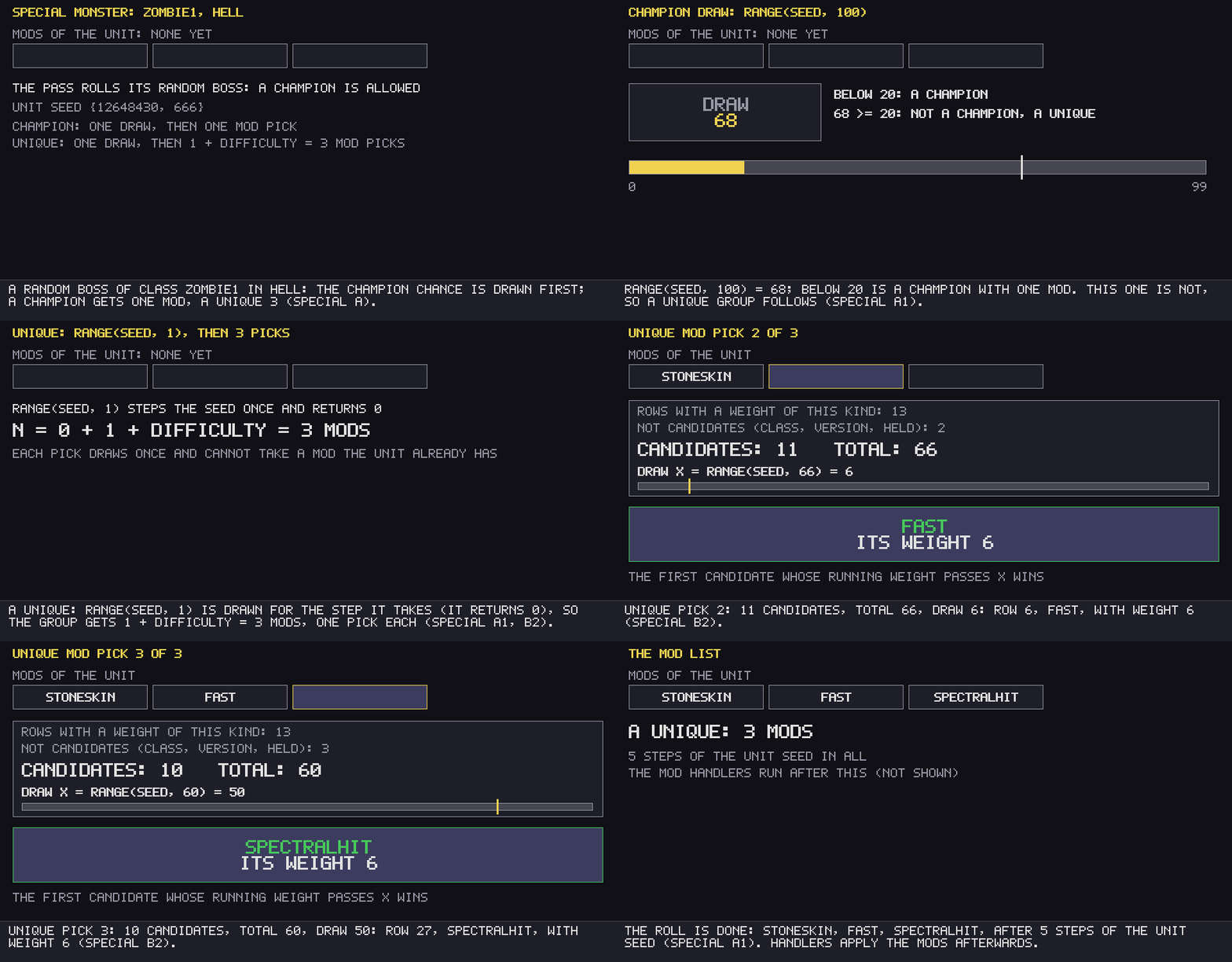
Step through monsters-special-zombie1-hell
The roll of a random boss of class zombie1 in Hell, on an illustrative seed. First one draw from 0 to 99 on the boss’s own seed: below 20 (the chance in MonUMod row 0) it is a champion and takes one champion mod; here the draw is 68, so it is a unique (special § A). A unique steps the seed once more with Range(1), which returns 0, and takes 1 + difficulty mods, three in Hell, one pick each (§ A). A pick keeps the rows that carry a weight of its kind, drops those the eligibility tests refuse (a disabled row, an expansion row in a classic game, an excluded monster type, a mode the class lacks) and, for a unique, those it already has, then draws once from 0 to the total of the weights left minus 1 and takes the first candidate whose running weight passes the draw (§ B). The frames show for each pick the number of candidates, their total, the draw and the winner with its own weight, not the table of weights. Not shown: the handlers that apply the mods, the minions and the name. Seed: illustrative, an input of our own. Every value shown is computed by our model, not observed in the game.
Pack members and preset champions
are not rolled. Each one always gets mod 16 champion, whatever the boss drew. Each counts as a special, and each
brings its own MonStats minions if its class has them. They are not linked to the boss as minions. A pack member whose
class is a SetBoss class (three such classes were logged, fallenshaman2 and fallenshaman6 among them) is a small leader in its
own right: its mod handlers also
run on its MonStats minions, as a unique’s do on its minions.
Map presets can also make specials. One preset
kind makes a unique, its class picked as for a random special, at a random point of the room, with no champion roll. Another makes a champion
at the preset point, with mod 16 and a champion pack. Both were reproduced in Tristram. Many other preset kinds,
by the code, place nothing at all when the room’s presets are spawned or restored: the group presets that the map’s
keep/drop roll keeps, the river, nest, guard and maggot kinds among them. Five
place one fixed monster at the point with no special code: the rogue warner (navi), Blood Raven, the Maggot Queen,
and two tentacle-head kinds whose type depends on the level. A further range of kinds places one fixed class at the
point, not as a special: the fallen camps, fallen shamans, fetish shamans and imps among them. The class is first
turned into the level’s own variant, then a fallen class into its camp variant, a step that looks at the class’s base
type. In level 6, for example, a fallen camp comes out as fallen2 and a shaman as fallenshaman2; both were logged.
The variants of the other levels, and a few of the kinds, were not logged and are read from the code. The
imp-group and minion-group kinds place a leader and its group around the point in Normal only; in Nightmare and Hell
they place nothing. That was logged in Hell; Nightmare and the Normal groups are read from the code. Other code that reads a
room’s presets is not yet followed.
Unique minions and mod transfer
Section titled “Unique minions and mod transfer”A unique’s 3 to 6 minions are of its minion1 class, or of its own class when it has none. PartyMin/PartyMax
play no part here. As each minion is created, it copies the boss’s mods that have xfer set. With stock data that is
every unique mod except aura, so a unique’s minions carry its rolled mods, except the aura. The minion’s own
mods, if any, stay first in its list.
The copy is the list the server sends for the minion, but a minion’s own handlers are never called for it, and runs confirm both. The effects reach a minion another way: the boss’s mod handlers run on each group member, for every boss mod, copied or not. The other readers of the copied list (the save of an inactive monster, the restore, a packet that sends only its first three slots) are read from the code.
Mod handlers and the name seed
Section titled “Mod handlers and the name seed”After the minions, each special runs its mod handlers in a fixed order: the always-run mods rndname,
hpmultiply, (light, which has no handler) and leveladd, then its own list in slot order. A mod listed twice runs
twice.
rndnameis the only handler that draws on a lasting seed. It steps the special’s unit seed once and keeps the low 16 bits as the name seed. Champions and pack members run it too.auradraws on a local seed made from the name seed, which no other seed sees. It picks one of the aura rows whose minimum level the monster has reached: Might, Holy Fire, Blessed Aim, Holy Freeze, Conviction and Fanaticism from level 0, and Holy Shock from level 20. The aura table was read from the game’s memory, and runs reproduced the aura skill and its level for six of its rows, in all three difficulties. A Thorns row needs level 999, so it is never drawn. The clamps of the aura’s level to 1 and 99 were never met.- A restored aura special holds two auras. When a special comes back with its room, its handlers run again and
rndnamemakes a fresh name seed, soauradraws on that one. Only after that does the restore put back the saved name seed and draw the aura a second time. The monster gets another aura and then its first one: a loggedregurgitator3got Holy Shock first, then its original Holy Freeze. - Every other handler only writes stats.
The draw order on the boss’s seed is: for a champion,
the champion roll, its one pick, rndname, then the pack size. For a unique, the champion roll, Range(1), one draw
per mod, the minion count, then rndname.
Superuniques
Section titled “Superuniques”A superunique is placed by a preset unit in the map and built from its
SuperUniques row:
- Placement. At the preset point, or anywhere in the room when the row’s
AutoPosis set. A row withStacks0 can be placed only once per game: three second attempts in the logs were refused, with no monster made. The placement makes no quest test of its own that a done quest fails. Every logged character had all its quests done, so whether an open quest changes anything is read from the code. - Fixed mods
Mod1–Mod3are written as they are and skip the eligibility tests. That they skip the tests is read from the code. - Extra mods:
difficultyunique picks, so 0, 1 or 2, with noRange(1)before them. An extra never repeats a fixed mod. - Minions:
MinGrp + d … MaxGrp + d, wheredis the difficulty. Rakanishu (8 and 8 in his row) got 8, 9 and 10 minions in normal, nightmare and hell. A row with both bounds 0 still makes one draw and gets no minion. - A tail per record for a few superuniques, such as Radament’s extra skeletons, the Countess’s set-up and various quest hooks. A run met the tails of Radament, the three council members, the Infector of Souls, the Grand Vizier of Chaos, Shenk (20 escorts) and Nihlathak (20 escorts), each making exactly its listed calls, and records with no tail made none. Radament’s skeleton count is two plus a draw, but the draw came out 0, so the “plus a draw” is read from the code. The tails of the Countess, Lord De Seis, the Cow King, the Ancients and Baal’s second subject were not met.
- Mod 22
questcompleteis appended last.
A fixed aura runs its handler a second time, on the same seed, so it writes the same aura twice: logged for
Bremm Sparkfist. Read from the code only: the thief mod is dropped from a row’s fixed mods, and a superunique
that already holds 5 or more mods gets nothing below placement.
Mods a class is created with
Section titled “Mods a class is created with”Some monsters hold mods before any special code runs: the creation step writes them by the class’s base type. Two helpers do this.
- The first gives four base types a fixed mod at the head of the list: the base types of
brute2,scarab1,reanimatedhorde1andfrozenhorror1held mods 13, 20, 34 and 35 in every logged list (42 units), and none of the 718 logged units of other base types held them. Its other cases (mummies, Duriel, traps, the bone prisons, the suicide minions, the Ancients) were not met and are read from the code. None of its mods has a server handler, so they draw nothing: the superunique Beetleburst and its minions came in with mod 20 already present, as modelled. By the code the helper is skipped when the creation request carries a certain flag; 590 logged requests carried it, but none of their mod lists was compared. - The second covers the act bosses and a few others. By the code, Andariel, Mephisto, Diablo, Izual, Baal,
the compelling orb, the smith and Nihlathak get mod 22
questcomplete; Blood Raven gets 12 and 22, the Maggot Queen 23 and 22 and the fire golem 31; Duriel gets none from this helper; the uber bosses get longer sets of their own. By the code, outside the uber classes, only the Maggot Queen’s 23 calls a mod handler. Only Nihlathak’s row is confirmed: he left his placement holding 22 and then held 22 and 30, as logged, and a model without his case fails. The other bosses that were logged were created where no mod list was compared, so their rows rest on the code. For Andariel, Duriel, Mephisto, Diablo, Izual and Baal and each one’s uber class, only the first call of the helper was checked by running the code under emulation: Mephisto, Baal and Duriel call their quest hook first, the others a mod (the uber classes: mod 22, 23 or 6). The later mods stay read from the code. The uber sets describe what such a unit would get: a search of this game file found no code that creates Uber Mephisto, Uber Diablo or Uber Baal and no driver of their own, and the levels of that event are not reached from stock play on the same reading. The search cannot see a class number worked out at run time, no stock session has watched the spawn helpers, and it says nothing about other builds or the realm.
By the code, mods from either helper count as already held: the special’s mod roll treats them as taken, and a superunique’s fixed mods come after them.
The name is built on the client:
- A random unique rolls its name from the name seed the server sends. The client keeps only the low byte of that
seed, so only 256 random-unique names can exist. It draws a suffix and then a prefix. Then, with 50 in 100, it
discards that pair and draws an appellation, a new suffix and a new prefix, giving a name of prefix, suffix and appellation
(in one recorded game, from the keys
Fire,lustandthe Mauler). Every name roll of a test run followed this. The roll runs on its own seed, so by the code it cannot affect any server seed. - A champion shows a word for its champion mod in front of the class name. A superunique shows its row’s
Name. A run reproduced both from the string tables, and showed that a minion gets no name. A few bosses have a fixed name: Andariel’s, Mephisto’s, Izual’s and Blood Raven’s were logged; those of the other fixed-name classes are read from the code. Where a unique’s random colour is drawn is not known.
The Warping Shrine. One path makes an existing monster special outside population: the Warping Shrine (“nearest
monster becomes unique”). Read from the code, operating an unused one picks the nearest monster to the player, over the
player’s room and the rooms near it, with no real distance limit; the first one met wins a tie. Only an ordinary
hostile monster that stands or walks qualifies: never a champion, unique, superunique or minion, a boss, a prime evil
or a monster with no height. It gets a mod roll that allows champion mods, and no minions. With no candidate, nothing
happens. No test session operated one.
Stats at creation: hit points, defence, experience
Section titled “Stats at creation: hit points, defence, experience”Every monster gets its stats once, when it is created. In order:
- The appearance pick (one draw on the unit seed).
- The player bonus, then the level, the resistances and block straight from
MonStatsfor the difficulty. Blank cells count as 0. - Hit points, defence and experience as
MonLvlvalue ×MonStatsvalue ÷ 100, from theMonLvlrow of the monster level.noRatioclasses take theMonStatsvalue as it is. - One hit-point draw between the scaled minimum and maximum. It still steps the seed when the two are equal.
- The player bonus added to hit points and experience, then the regeneration value (0 for a monster with few hit points, read from the code).
- In classic nightmare and hell, the classic factors (below). Then skills, MonProp and monster equipment.
The invented scaled monster at monster level 7 on difficulty 1, computed by our model: MulDiv(row value, cell, 100).
| Stat | Level row value | Monster cell | Result |
|---|---|---|---|
| Minimum hit points | 101 | 90 | 90 |
| Maximum hit points | 101 | 130 | 131 |
| Defence | 62 | 100 | 62 |
| Experience | 848 | 90 | 763 |
Pick an invented monster, a monster level and a difficulty, and see its minimum and maximum hit points, defence and experience scaled by the level’s row of an invented level table. A level selects the row min(level, last row), and no row below 0; the difficulty is 0 below 1 and at most 2; a scaled monster gets MulDiv(row value, cell, 100) for each stat, a monster flagged noRatio takes its cell as it is (stats § A2). MulDiv is a signed 32-bit product divided by 100, truncating toward zero (§ A1, the branch every creation takes on stock data). Not shown: the hit-point draw, the player bonus and every later step of the creation (stats § B). Computed by our model of the rule, not observed in the game; the starting values are illustrative.
A surprise from the runs: single-player games read the MonLvl columns prefixed L-, which a community
source reserves for ladder games. In 3 954 nightmare and hell creations where the two column sets differ, every one
matched L-. The two sets differ only in nightmare and hell defence and in hell hit points.
The game stores hit points times 256. A minimum above the maximum makes no draw and gives the minimum; no logged
creation met one (two stock rows have one, in normal), but each piece of that path is confirmed on its own. The scaling
arithmetic’s branches, overflow included, were checked under emulation, all but one input that faults. Read from
the code but never reached: a hit-point cap for very large values and the overflow branches of the hit-point
percentage step. Skills get the difficulty’s MonsterSkillBonus (0, 3 or 7) added to their level, with no draw; a
run confirmed the skill list of every creation in all three difficulties.
MonProp gives every monster
of a class its row’s properties for the difficulty, special or not, with any value range rolled on the unit seed.
On stock data only thorns has a range, and a test run reproduced it. Stock chance is 0 everywhere, so the
chance roll is never reached. Of the three rows with a normal-difficulty part, two cannot be reached on stock
data. The third, druidhawk, can: it belongs to the Druid’s Raven, so by the code a Raven in a normal game reads its
normal row. Ravens were created in a skills run, but only their seed, hit points and defence were checked, not
this list.
Monster equipment (MonEquip, stats § B, step B12) comes
last. Only two classes have a row that equips at creation in the stock table: 234 (a flying scimitar) and 267 (Blood
Raven), each with one row of level 0 and one location. For them one unit-seed step picks the location and the item is
created there when it is free, taking two game-seed steps like any item. The end-to-end run created Blood Raven three
times and the flying scimitar once, with the seed after the equipment and each item predicted. The rest of the rule
is read from the code only, because no stock row reaches it: a first row above the monster level is skipped, and with
two or three locations the step picks one of them; a location already taken gets no item.
The player count
Section titled “The player count”The player count is the number of living players, raised to the /players setting. A two-client game confirmed that a
second real player counts like /players 2 for the monsters created while it is in the game; whether a dead player
counts was not tested there. Hostile
monsters get +50 % hit points and +50 % experience for each player beyond the first, so +350 % at 8 players.
Town NPCs, critters, hirelings, summons and a few neutral classes get no bonus. At /players 8 this was confirmed
for Lut Gholein’s NPCs, the rogue hireling and the cow; the camel was not met.
The count is applied once, at creation. A test run changed /players 13 times and compared 302 live monsters
at each change: none changed. Monsters created after the change get the new count. A monster that is re-created when
its room comes back from inactive is created anew, then gets its first instance’s maximum hit points and experience
back from the saved record; its level comes out of the new creation and the re-applied mods again, so a minion
created at the plain pool level comes back 3 levels higher at its first restore (stats § Inputs and oracles,
lifecycle § H; the page on levels
tells the whole story). The formula above 8 players is read from the code only.
Classic nightmare and hell
Section titled “Classic nightmare and hell”A classic (non-expansion) nightmare or hell monster first gets its stats from the MonLvl row of its MonStats
Level(N)/Level(H), and is then cut down:
| Stat | Nightmare | Hell |
|---|---|---|
| Max hit points | × 1/2 | × 1/2 |
| Defence | × 10/12 | × 10/12 |
| Experience | × 10/17 | × 10/26 |
Its level stat is then rewritten to its normal Level + 25 × difficulty. So a classic nightmare or hell monster
uses two levels: one chose its base stats, the other is what everything later sees, including the mods’ level
bonus, the enchant damage and the aura. In classic hell a run logged aura uniques whose Level is 18 drawing their
aura at level 71 (18 + 50 + 3).
When max hit points change, current hit points follow in proportion. The calculation is done in floating point and truncated. The run settles the rounding mode. That the precision is 53 bits rests on the code. Whether a graphics renderer could change that precision is an open question.
What the mods do to stats
Section titled “What the mods do to stats”The handlers run in the order of Mod handlers. “Group member” means a minion of a
unique or superunique, or a MonStats minion of a champion-pack member whose class is a SetBoss class. Champion-pack
members run their own pass as champions. A selection (percentages from MonUMod’s
constants, normal / nightmare / hell):
| Mod | On the special | On its minions |
|---|---|---|
hpmultiply (always) |
champion +200 / +150 / +100 % hit points; unique +300 / +200 / +100 % | +100 / +75 / +50 % |
leveladd (always) |
level + 3, experience × 5 | the same |
champion |
level − 1, experience − 2/5, more damage and to-hit (scaled by CDB), speed + 20 if the class has a Velocity |
nothing |
possessed |
+ 100 % hit points on top, then the champion part | nothing |
berserk |
− 75 % hit points, large damage and to-hit bonus, no champion part | nothing |
fire / cold / lightning |
enchant damage from the level’s MonLvl damage, resistance + 75 |
weaker enchant, no resistance |
spectralhit |
cold, fire, lightning resistance + 20 each (below 75) | nothing |
stoneskin |
defence × 2, damage resistance + 50 | nothing |
Notes the spec makes a point of:
- Spectral Hit adds 20, not the 40 of community pages. Seen in 17 uniques of a run.
- A berserker ends at + 3 levels, every other champion at + 2 (
leveladd+ 3,champion− 1). This was shown by a forced test run with edited data, which backs the handler only, not how oftenberserkappears. - The speed bonus of
fastandfanaticis2048 ÷ Velocity − 128, kept between 10 and 100. Runs saw 100 at velocities 1 and 3 to 7 and 42 at 12. By the formula it is 100 up toVelocity8 and 99 at 9; 8 and 9 were not met. - Mod order matters. The resistance mods stop adding once two resistances are already at 100 or more, and each mod checks this when it runs, so an earlier mod can block a later one.
- The
ChampionDamageBonuscolumn (90 / 75 / 66) also scales a unique’sstrongbonus. ThatUniqueDamageBonusis never read comes from the code; the two columns are equal in stock data, so play cannot tell them apart. - Read from the code only: the
poisonhitandalways_run_aihandlers, the halving for will-o’-wisp classes, and theghostly/fanatic/possessed/berserkhandlers on group members.
To-hit and damage are not creation stats. They are computed each time the monster enters an attack mode. The random draws of that
step are confirmed by the combat run, and again by the skills runs: one draw of 100 for each elemental group of that
attack mode whose chance is between 1 and 99, one draw of 5 for one element type, and nothing else. The plain values
are now confirmed too. In 26 425 logged calls the minimum and maximum damage and the to-hit were the mode’s MonStats
cells scaled by the MonLvl row of the monster’s level, as at creation: the A2 cells for one attack mode, the S1
cells for two others and the A1 cells for every other mode (the raw cells for a noRatio class). Read from the code
only: whether the L- columns or the plain ones are used here (they gave the same values in every call), the classic
cut, the expansion’s 6.25 % more damage per player beyond the first in nightmare and hell (every logged call was at one
player), the extra damage a monster skill adds beyond the one case measured (the Druid’s Raven at level 20 in games with one
player, skills and missiles), and the redraw for one element type. By the code,
too, a noRatio class (a summon or pet) ends up with no elemental damage at attack time, because its elemental values
are written to one place and read from another. The attack itself is on the combat page.
Worked examples
Section titled “Worked examples”A room in Dark Wood
Section titled “A room in Dark Wood”Copied from spawn § Worked example: -seed 1, expansion hell, level 5
Dark Wood, one room of a recorded game.
The region holds three classes: fallen2 (rarity 2), cr_lancer2 (1) and quillrat2 (2), rarity sum 5. Density
is 520, MonUMin 7, MonUMax 9, and the level already has 7 specials. The room has one 8 × 8-tile box:
(40 ÷ 3) × (40 ÷ 3) = 169 attempts.
| Attempt | Density draw | Class | Type roll | Result |
|---|---|---|---|---|
| 1–45 | above 520 | — | — | nothing |
| 46 | 504, passes | Range(5) + 1 = 4 → quillrat2 |
7 specials is not below MonUMin 7, so no catch-up; below MonUMax: 51 > 5; last draw 24 → 1 → normal |
leader + Range(3) = 2 members |
| 90 | 31 | 5 → quillrat2 |
70, then 17 → normal | a group of one |
| 100 | 520, equal to the density, passes | 2 → fallen2 |
34, then 92 → normal | fallen: group of one, plus 2 + Range(3) = 2 fallen2 minions |
| 101–169 | above 520 | — | — | nothing |
During attempt 46, member 2’s ring walk finds member 1 standing on a cell and moves on to the next one. The room ends
with seven monsters: three quillrat2, one more quillrat2, and a fallen2 with two fallen2 minions. The level’s
special count stays at 7.
A unique group and its name
Section titled “A unique group and its name”Copied from special § Example 2:
expansion nightmare, Arreat Plateau, a random boss of class blunderbore6.
| # | Draw on the boss’s seed | Result |
|---|---|---|
| 1 | Range(100) |
36, not below 20: unique |
| 2 | Range(1) |
0; mod count 0 + 1 + 1 = 2 |
| 3 | 13 candidates of weight 6, total 78: Range(78) |
21 → resist |
| 4 | 12 left, total 72: Range(72) |
68 → aura |
| 5 | minion count Range(4) |
0 → 3 minions, each copying resist (not aura) |
| 6 | rndname step |
name seed 33102 |
| — | aura on a local seed from 33102, level 63, 7 rows |
6 → Holy Shock |
On the client, 33102 keeps its low byte, 78. On a seed made from 78 it draws suffix 37 (BangUM) and prefix 47
(DoomUM), then Range(100) = 55, which is not below 50, so there is no appellation. The name is “Doom Bang”.
A possessed champion’s stats
Section titled “A possessed champion’s stats”Copied from stats § Example 2:
sk_archer7 in Frozen Tundra, expansion hell, /players 8, monster level 81 (the area’s MonLvl3Ex). The MonLvl
row 81 gives hit points 5722, defence 1581 and experience 45759. The class’s hell MonStats give 70, 100, 100 and 95.
| Step | Value |
|---|---|
| hit-point range | 4005 … 5722; draw 65 → base 4070 |
| + 350 % for 8 players | 18315 hit points (stored as 4688640) |
| defence, experience | 1581; 43471 + 152148 = 195619 |
hpmultiply, champion in hell (+100 %) |
stored 9377240 |
leveladd |
level 84, experience 978095 |
possessed (+100 %) |
stored 18754440 |
| champion part | level 83, experience 586857; damage + 66, to-hit + 49, speed 75 + 20 = 95 |
What is not known yet
Section titled “What is not known yet”Each spec’s Open questions has the full list: pool, spawn, special, stats. The ones that bear on this page:
- Pools: a creation in a level with no record (the fallback level 1) has no stock case. Natural nightmare and hell pools are checked for one seed, with Act I visited.
- Population: what
sparsePopulatereally does (unreachable on stock data, and the community sources disagree), and games with several real players, which were not logged. The Chaos Sanctuary gate’s closed state needs the three seal bosses dead, Lord De Seis among them, and no session created him. The room field the wanderer roll tests and the restore of inactive monsters are answered by the room lifecycle spec. Many guard exits and rare branches were never reached: the evil hut object, the wanderer spawn, and others listed in the spec. Monster positions also depend on inputs no spec yet produces end to end: the collision grid at the start of the pass, whose object marks are modelled but whose marks of players, monsters that walked in, items and corpses are not (the grid the models build equals the recorded one in 4 723 of 4 883 rooms of the end-to-end run), and one waypoint point. - Specials: whether a
MonUModrow withchampion0 could ever be a champion mod (no stock row tests it, and a community source claims it can). Where a unique’s colour is drawn. Read from the code only: the superunique tails not met (the Countess, Lord De Seis, the Cow King, the Ancients, Baal’s second subject) and the draw in Radament’s count,thief, the fixed names not met, the aura level clamps, the preset kinds not logged and the Warping Shrine. Lord De Seis was never created, so his forced aura and his tail rest on the code; an owner-played Chaos Sanctuary session would log him. The restore of inactive specials was reached by runs; a minion restored without its boss was not. - Stats: whether a graphics renderer can change the
floating-point precision of the hit-point rescale, the will-o’-wisp halving, and the unreached branches (
poisonhit,always_run_ai, monster equipment beyond the one-row case, aMonPropslot with a chance,fastandfanaticatVelocity8 and 9, more than 8 players, the hit-point percentage and regeneration overflows). A Druid’s Raven reading the normaldruidhawkrow was not logged. Of the attack-time values, the plain cells are confirmed, and a monster skill’s extra damage for the Druid’s Raven at one level with one player; theL-cells, that extra damage otherwise, the classic cut, the expansion player bonus, the element-type redraw and an attack of the second or third elemental group are not.
Where to read more
Section titled “Where to read more”- The specs: monsters overview, pool, spawn, special, stats. Each Reimplementation notes section lists the traps for someone rebuilding the system.
- The glossary for D2 terms.
- Related wiki pages: randomness (seeds and draws), levels (rooms, logic boxes, the collision grid), monster AI (when a monster thinks, how it finds a target and what it commands), pathing (how a monster’s route is planned, and what its corpse does to the grid), objects (what fills a room before the monsters), items (what a monster drops), quests and travel (the quest hooks and the forced deaths) and how we know.