Seed to world: how a game is built
The other pages each explain one part of the game: randomness, levels, monsters, objects and items. This page puts them in the order the server runs them, from the moment a game is created with a seed to the moment a monster dies and its items fall. It adds no rule of its own. Each step is explained on the page that owns it; this page says only what runs when, which seed is handed from one step to the next, and what has to come from outside: where the player walks, and what happens in the fights. It restates the seed-to-world spec.
The short version: everything that does not depend on what the player does is built from the seed the game was created with, and 37 recorded games were rebuilt step by step with 0 mismatches, given what the player did and what the fights produced, as taken from the recordings, and a few counted values still read from them. What the player does (which rooms it walks into, in what order, what it kills and clicks) is not a detail to be modelled: it is an input, and it decides most of the seeds after the first room.
The big picture
Section titled “The big picture”%3btext-align:center%3b%7d%23mermaid-0 .edgeLabel p%7bbackground-color:rgba(232%2c232%2c232%2c 0.8)%3b%7d%23mermaid-0 .edgeLabel rect%7bopacity:0.5%3bbackground-color:rgba(232%2c232%2c232%2c 0.8)%3bfill:rgba(232%2c232%2c232%2c 0.8)%3b%7d%23mermaid-0 .labelBkg%7bbackground-color:rgba(232%2c 232%2c 232%2c 0.5)%3b%7d%23mermaid-0 .cluster rect%7bfill:%23ffffde%3bstroke:%23aaaa33%3bstroke-width:1px%3b%7d%23mermaid-0 .cluster text%7bfill:%23333%3b%7d%23mermaid-0 .cluster span%7bcolor:%23333%3b%7d%23mermaid-0 .node .collapsed-indicator%7bfill:%23aaaa33%3bstroke:none%3bopacity:0.6%3b%7d%23mermaid-0 .node .collapsed-separator%7bstroke:%23aaaa33%3bstroke-width:0.75px%3b%7d%23mermaid-0 div.mermaidTooltip%7bposition:absolute%3btext-align:center%3bmax-width:200px%3bpadding:2px%3bfont-family:arial%2csans-serif%3bfont-size:12px%3bbackground:hsl(80%2c 100%25%2c 96.2745098039%25)%3bborder:1px solid %23aaaa33%3bborder-radius:2px%3bpointer-events:none%3bz-index:100%3b%7d%23mermaid-0 .flowchartTitleText%7btext-anchor:middle%3bfont-size:18px%3bfill:%23333%3b%7d%23mermaid-0 rect.text%7bfill:none%3bstroke-width:0%3b%7d%23mermaid-0 .icon-shape%2c%23mermaid-0 .image-shape%7bbackground-color:rgba(232%2c232%2c232%2c 0.8)%3btext-align:center%3b%7d%23mermaid-0 .icon-shape p%2c%23mermaid-0 .image-shape p%7bbackground-color:rgba(232%2c232%2c232%2c 0.8)%3bpadding:2px%3b%7d%23mermaid-0 .icon-shape .label rect%2c%23mermaid-0 .image-shape .label rect%7bopacity:0.5%3bbackground-color:rgba(232%2c232%2c232%2c 0.8)%3bfill:rgba(232%2c232%2c232%2c 0.8)%3b%7d%23mermaid-0 .label-icon%7bdisplay:inline-block%3bheight:1em%3boverflow:visible%3bvertical-align:-0.125em%3b%7d%23mermaid-0 .node .label-icon path%7bfill:currentColor%3bstroke:revert%3bstroke-width:revert%3b%7d%23mermaid-0 .node .neo-node%7bstroke:%239370DB%3b%7d%23mermaid-0 %5bdata-look='neo'%5d.node rect%2c%23mermaid-0 %5bdata-look='neo'%5d.cluster rect%2c%23mermaid-0 %5bdata-look='neo'%5d.node polygon%7bstroke:%239370DB%3bfilter:drop-shadow(1px 2px 2px rgba(185%2c 185%2c 185%2c 1))%3b%7d%23mermaid-0 %5bdata-look='neo'%5d.swimlane.cluster rect%7bfilter:none%3b%7d%23mermaid-0 %5bdata-look='neo'%5d.node path%7bstroke:%239370DB%3bstroke-width:1px%3b%7d%23mermaid-0 %5bdata-look='neo'%5d.node .outer-path%7bfilter:drop-shadow(1px 2px 2px rgba(185%2c 185%2c 185%2c 1))%3b%7d%23mermaid-0 %5bdata-look='neo'%5d.node .neo-line path%7bstroke:%239370DB%3bfilter:none%3b%7d%23mermaid-0 %5bdata-look='neo'%5d.node circle%7bstroke:%239370DB%3bfilter:drop-shadow(1px 2px 2px rgba(185%2c 185%2c 185%2c 1))%3b%7d%23mermaid-0 %5bdata-look='neo'%5d.node circle .state-start%7bfill:black%3b%7d%23mermaid-0 %5bdata-look='neo'%5d.icon-shape .icon%7bfill:%239370DB%3bfilter:drop-shadow(1px 2px 2px rgba(185%2c 185%2c 185%2c 1))%3b%7d%23mermaid-0 %5bdata-look='neo'%5d.icon-shape .icon-neo path%7bstroke:%239370DB%3bfilter:drop-shadow(1px 2px 2px rgba(185%2c 185%2c 185%2c 1))%3b%7d%23mermaid-0 :root%7b--mermaid-font-family:arial%2csans-serif%3b%7d%3c/style%3e%3cg%3e%3cmarker id='mermaid-0_flowchart-v2-pointEnd' class='marker flowchart-v2' viewBox='0 0 10 10' refX='5' refY='5' markerUnits='userSpaceOnUse' markerWidth='8' markerHeight='8' orient='auto'%3e%3cpath d='M 0 0 L 10 5 L 0 10 z' class='arrowMarkerPath' style='stroke-width: 1%3b stroke-dasharray: 1%2c 0%3b'/%3e%3c/marker%3e%3cmarker id='mermaid-0_flowchart-v2-pointStart' class='marker flowchart-v2' viewBox='0 0 10 10' refX='4.5' refY='5' markerUnits='userSpaceOnUse' markerWidth='8' markerHeight='8' orient='auto'%3e%3cpath d='M 0 5 L 10 10 L 10 0 z' class='arrowMarkerPath' style='stroke-width: 1%3b stroke-dasharray: 1%2c 0%3b'/%3e%3c/marker%3e%3cmarker id='mermaid-0_flowchart-v2-pointEnd-margin' class='marker flowchart-v2' viewBox='0 0 11.5 14' refX='11.5' refY='7' markerUnits='userSpaceOnUse' markerWidth='10.5' markerHeight='14' orient='auto'%3e%3cpath d='M 0 0 L 11.5 7 L 0 14 z' class='arrowMarkerPath' style='stroke-width: 0%3b stroke-dasharray: 1%2c 0%3b'/%3e%3c/marker%3e%3cmarker id='mermaid-0_flowchart-v2-pointStart-margin' class='marker flowchart-v2' viewBox='0 0 11.5 14' refX='1' refY='7' markerUnits='userSpaceOnUse' markerWidth='11.5' markerHeight='14' orient='auto'%3e%3cpolygon points='0%2c7 11.5%2c14 11.5%2c0' class='arrowMarkerPath' style='stroke-width: 0%3b stroke-dasharray: 1%2c 0%3b'/%3e%3c/marker%3e%3cmarker id='mermaid-0_flowchart-v2-circleEnd' class='marker flowchart-v2' viewBox='0 0 10 10' refX='11' refY='5' markerUnits='userSpaceOnUse' markerWidth='11' markerHeight='11' orient='auto'%3e%3ccircle cx='5' cy='5' r='5' class='arrowMarkerPath' style='stroke-width: 1%3b stroke-dasharray: 1%2c 0%3b'/%3e%3c/marker%3e%3cmarker id='mermaid-0_flowchart-v2-circleStart' class='marker flowchart-v2' viewBox='0 0 10 10' refX='-1' refY='5' markerUnits='userSpaceOnUse' markerWidth='11' markerHeight='11' orient='auto'%3e%3ccircle cx='5' cy='5' r='5' class='arrowMarkerPath' style='stroke-width: 1%3b stroke-dasharray: 1%2c 0%3b'/%3e%3c/marker%3e%3cmarker id='mermaid-0_flowchart-v2-circleEnd-margin' class='marker flowchart-v2' viewBox='0 0 10 10' refY='5' refX='12.25' markerUnits='userSpaceOnUse' markerWidth='14' markerHeight='14' orient='auto'%3e%3ccircle cx='5' cy='5' r='5' class='arrowMarkerPath' style='stroke-width: 0%3b stroke-dasharray: 1%2c 0%3b'/%3e%3c/marker%3e%3cmarker id='mermaid-0_flowchart-v2-circleStart-margin' class='marker flowchart-v2' viewBox='0 0 10 10' refX='-2' refY='5' markerUnits='userSpaceOnUse' markerWidth='14' markerHeight='14' orient='auto'%3e%3ccircle cx='5' cy='5' r='5' class='arrowMarkerPath' style='stroke-width: 0%3b stroke-dasharray: 1%2c 0%3b'/%3e%3c/marker%3e%3cmarker id='mermaid-0_flowchart-v2-crossEnd' class='marker cross flowchart-v2' viewBox='0 0 11 11' refX='12' refY='5.2' markerUnits='userSpaceOnUse' markerWidth='11' markerHeight='11' orient='auto'%3e%3cpath d='M 1%2c1 l 9%2c9 M 10%2c1 l -9%2c9' class='arrowMarkerPath' style='stroke-width: 2%3b stroke-dasharray: 1%2c 0%3b'/%3e%3c/marker%3e%3cmarker id='mermaid-0_flowchart-v2-crossStart' class='marker cross flowchart-v2' viewBox='0 0 11 11' refX='-1' refY='5.2' markerUnits='userSpaceOnUse' markerWidth='11' markerHeight='11' orient='auto'%3e%3cpath d='M 1%2c1 l 9%2c9 M 10%2c1 l -9%2c9' class='arrowMarkerPath' style='stroke-width: 2%3b stroke-dasharray: 1%2c 0%3b'/%3e%3c/marker%3e%3cmarker id='mermaid-0_flowchart-v2-crossEnd-margin' class='marker cross flowchart-v2' viewBox='0 0 15 15' refX='17.7' refY='7.5' markerUnits='userSpaceOnUse' markerWidth='12' markerHeight='12' orient='auto'%3e%3cpath d='M 1%2c1 L 14%2c14 M 1%2c14 L 14%2c1' class='arrowMarkerPath' style='stroke-width: 2.5%3b'/%3e%3c/marker%3e%3cmarker id='mermaid-0_flowchart-v2-crossStart-margin' class='marker cross flowchart-v2' viewBox='0 0 15 15' refX='-3.5' refY='7.5' markerUnits='userSpaceOnUse' markerWidth='12' markerHeight='12' orient='auto'%3e%3cpath d='M 1%2c1 L 14%2c14 M 1%2c14 L 14%2c1' class='arrowMarkerPath' style='stroke-width: 2.5%3b stroke-dasharray: 1%2c 0%3b'/%3e%3c/marker%3e%3cg class='root'%3e%3cg class='clusters'/%3e%3cg class='edgePaths'%3e%3cpath d='M268%2c139L272.167%2c139C276.333%2c139%2c284.667%2c139%2c292.333%2c139C300%2c139%2c307%2c139%2c310.5%2c139L314%2c139' id='mermaid-0-L_in_gc_0' class='edge-thickness-normal edge-pattern-solid edge-thickness-normal edge-pattern-solid flowchart-link' style='%3b' data-edge='true' data-et='edge' data-id='L_in_gc_0' data-points='W3sieCI6MjY4LCJ5IjoxMzl9LHsieCI6MjkzLCJ5IjoxMzl9LHsieCI6MzE4LCJ5IjoxMzl9XQ==' data-look='classic' marker-end='url(%23mermaid-0_flowchart-v2-pointEnd)'/%3e%3cpath d='M498.953%2c139L503.12%2c139C507.286%2c139%2c515.62%2c139%2c523.286%2c139C530.953%2c139%2c537.953%2c139%2c541.453%2c139L544.953%2c139' id='mermaid-0-L_gc_lv_0' class='edge-thickness-normal edge-pattern-solid edge-thickness-normal edge-pattern-solid flowchart-link' style='%3b' data-edge='true' data-et='edge' data-id='L_gc_lv_0' data-points='W3sieCI6NDk4Ljk1MzEyNSwieSI6MTM5fSx7IngiOjUyMy45NTMxMjUsInkiOjEzOX0seyJ4Ijo1NDguOTUzMTI1LCJ5IjoxMzl9XQ==' data-look='classic' marker-end='url(%23mermaid-0_flowchart-v2-pointEnd)'/%3e%3cpath d='M734.359%2c139L738.526%2c139C742.693%2c139%2c751.026%2c139%2c758.693%2c139C766.359%2c139%2c773.359%2c139%2c776.859%2c139L780.359%2c139' id='mermaid-0-L_lv_act_0' class='edge-thickness-normal edge-pattern-solid edge-thickness-normal edge-pattern-solid flowchart-link' style='%3b' data-edge='true' data-et='edge' data-id='L_lv_act_0' data-points='W3sieCI6NzM0LjM1OTM3NSwieSI6MTM5fSx7IngiOjc1OS4zNTkzNzUsInkiOjEzOX0seyJ4Ijo3ODQuMzU5Mzc1LCJ5IjoxMzl9XQ==' data-look='classic' marker-end='url(%23mermaid-0_flowchart-v2-pointEnd)'/%3e%3cpath d='M982.188%2c139L986.354%2c139C990.521%2c139%2c998.854%2c139%2c1006.521%2c139C1014.188%2c139%2c1021.188%2c139%2c1024.688%2c139L1028.188%2c139' id='mermaid-0-L_act_walk_0' class='edge-thickness-normal edge-pattern-solid edge-thickness-normal edge-pattern-solid flowchart-link' style='%3b' data-edge='true' data-et='edge' data-id='L_act_walk_0' data-points='W3sieCI6OTgyLjE4NzUsInkiOjEzOX0seyJ4IjoxMDA3LjE4NzUsInkiOjEzOX0seyJ4IjoxMDMyLjE4NzUsInkiOjEzOX1d' data-look='classic' marker-end='url(%23mermaid-0_flowchart-v2-pointEnd)'/%3e%3cpath d='M1214.349%2c112L1225.275%2c107.833C1236.201%2c103.667%2c1258.054%2c95.333%2c1272.48%2c91.167C1286.906%2c87%2c1293.906%2c87%2c1297.406%2c87L1300.906%2c87' id='mermaid-0-L_walk_win_0' class='edge-thickness-normal edge-pattern-solid edge-thickness-normal edge-pattern-solid flowchart-link' style='%3b' data-edge='true' data-et='edge' data-id='L_walk_win_0' data-points='W3sieCI6MTIxNC4zNDg4NTgxNzMwNzcsInkiOjExMn0seyJ4IjoxMjc5LjkwNjI1LCJ5Ijo4N30seyJ4IjoxMzA0LjkwNjI1LCJ5Ijo4N31d' data-look='classic' marker-end='url(%23mermaid-0_flowchart-v2-pointEnd)'/%3e%3cpath d='M1535.656%2c87L1539.823%2c87C1543.99%2c87%2c1552.323%2c87%2c1559.99%2c87C1567.656%2c87%2c1574.656%2c87%2c1578.156%2c87L1581.656%2c87' id='mermaid-0-L_win_pass_0' class='edge-thickness-normal edge-pattern-solid edge-thickness-normal edge-pattern-solid flowchart-link' style='%3b' data-edge='true' data-et='edge' data-id='L_win_pass_0' data-points='W3sieCI6MTUzNS42NTYyNSwieSI6ODd9LHsieCI6MTU2MC42NTYyNSwieSI6ODd9LHsieCI6MTU4NS42NTYyNSwieSI6ODd9XQ==' data-look='classic' marker-end='url(%23mermaid-0_flowchart-v2-pointEnd)'/%3e%3cpath d='M1776.636%2c60L1788.028%2c55.833C1799.419%2c51.667%2c1822.202%2c43.333%2c1837.093%2c39.167C1851.984%2c35%2c1858.984%2c35%2c1862.484%2c35L1865.984%2c35' id='mermaid-0-L_pass_cre_0' class='edge-thickness-normal edge-pattern-solid edge-thickness-normal edge-pattern-solid flowchart-link' style='%3b' data-edge='true' data-et='edge' data-id='L_pass_cre_0' data-points='W3sieCI6MTc3Ni42MzYyNjgwMjg4NDYyLCJ5Ijo2MH0seyJ4IjoxODQ0Ljk4NDM3NSwieSI6MzV9LHsieCI6MTg2OS45ODQzNzUsInkiOjM1fV0=' data-look='classic' marker-end='url(%23mermaid-0_flowchart-v2-pointEnd)'/%3e%3cpath d='M1214.349%2c166L1225.275%2c170.167C1236.201%2c174.333%2c1258.054%2c182.667%2c1273.001%2c186.833C1287.948%2c191%2c1295.99%2c191%2c1300.01%2c191L1304.031%2c191' id='mermaid-0-L_walk_rec_0' class='edge-thickness-normal edge-pattern-solid edge-thickness-normal edge-pattern-solid flowchart-link' style='%3b' data-edge='true' data-et='edge' data-id='L_walk_rec_0' data-points='W3sieCI6MTIxNC4zNDg4NTgxNzMwNzcsInkiOjE2Nn0seyJ4IjoxMjc5LjkwNjI1LCJ5IjoxOTF9LHsieCI6MTMwOC4wMzEyNSwieSI6MTkxfV0=' data-look='classic' marker-end='url(%23mermaid-0_flowchart-v2-pointEnd)'/%3e%3cpath d='M1776.636%2c114L1788.028%2c118.167C1799.419%2c122.333%2c1822.202%2c130.667%2c1841.348%2c134.833C1860.495%2c139%2c1876.005%2c139%2c1883.76%2c139L1891.516%2c139' id='mermaid-0-L_pass_sim_0' class='edge-thickness-normal edge-pattern-solid edge-thickness-normal edge-pattern-solid flowchart-link' style='%3b' data-edge='true' data-et='edge' data-id='L_pass_sim_0' data-points='W3sieCI6MTc3Ni42MzYyNjgwMjg4NDYyLCJ5IjoxMTR9LHsieCI6MTg0NC45ODQzNzUsInkiOjEzOX0seyJ4IjoxODk1LjUxNTYyNSwieSI6MTM5fV0=' data-look='classic' marker-end='url(%23mermaid-0_flowchart-v2-pointEnd)'/%3e%3cpath d='M2093.375%2c139L2101.797%2c139C2110.219%2c139%2c2127.063%2c139%2c2138.984%2c139C2150.906%2c139%2c2157.906%2c139%2c2161.406%2c139L2164.906%2c139' id='mermaid-0-L_sim_drop_0' class='edge-thickness-normal edge-pattern-solid edge-thickness-normal edge-pattern-solid flowchart-link' style='%3b' data-edge='true' data-et='edge' data-id='L_sim_drop_0' data-points='W3sieCI6MjA5My4zNzUsInkiOjEzOX0seyJ4IjoyMTQzLjkwNjI1LCJ5IjoxMzl9LHsieCI6MjE2OC45MDYyNSwieSI6MTM5fV0=' data-look='classic' marker-end='url(%23mermaid-0_flowchart-v2-pointEnd)'/%3e%3cpath d='M2391.688%2c139L2395.854%2c139C2400.021%2c139%2c2408.354%2c139%2c2416.021%2c139C2423.688%2c139%2c2430.688%2c139%2c2434.188%2c139L2437.688%2c139' id='mermaid-0-L_drop_item_0' class='edge-thickness-normal edge-pattern-solid edge-thickness-normal edge-pattern-solid flowchart-link' style='%3b' data-edge='true' data-et='edge' data-id='L_drop_item_0' data-points='W3sieCI6MjM5MS42ODc1LCJ5IjoxMzl9LHsieCI6MjQxNi42ODc1LCJ5IjoxMzl9LHsieCI6MjQ0MS42ODc1LCJ5IjoxMzl9XQ==' data-look='classic' marker-end='url(%23mermaid-0_flowchart-v2-pointEnd)'/%3e%3c/g%3e%3cg class='edgeLabels'%3e%3cg class='edgeLabel'%3e%3cg class='label' data-id='L_in_gc_0' transform='translate(0%2c 0)'%3e%3cforeignObject width='0' height='0'%3e%3cdiv xmlns='http://www.w3.org/1999/xhtml' class='labelBkg' style='display: table-cell%3b white-space: nowrap%3b line-height: 1.5%3b max-width: 200px%3b text-align: center%3b'%3e%3cspan class='edgeLabel'%3e%3c/span%3e%3c/div%3e%3c/foreignObject%3e%3c/g%3e%3c/g%3e%3cg class='edgeLabel'%3e%3cg class='label' data-id='L_gc_lv_0' transform='translate(0%2c 0)'%3e%3cforeignObject width='0' height='0'%3e%3cdiv xmlns='http://www.w3.org/1999/xhtml' class='labelBkg' style='display: table-cell%3b white-space: nowrap%3b line-height: 1.5%3b max-width: 200px%3b text-align: center%3b'%3e%3cspan class='edgeLabel'%3e%3c/span%3e%3c/div%3e%3c/foreignObject%3e%3c/g%3e%3c/g%3e%3cg class='edgeLabel'%3e%3cg class='label' data-id='L_lv_act_0' transform='translate(0%2c 0)'%3e%3cforeignObject width='0' height='0'%3e%3cdiv xmlns='http://www.w3.org/1999/xhtml' class='labelBkg' style='display: table-cell%3b white-space: nowrap%3b line-height: 1.5%3b max-width: 200px%3b text-align: center%3b'%3e%3cspan class='edgeLabel'%3e%3c/span%3e%3c/div%3e%3c/foreignObject%3e%3c/g%3e%3c/g%3e%3cg class='edgeLabel'%3e%3cg class='label' data-id='L_act_walk_0' transform='translate(0%2c 0)'%3e%3cforeignObject width='0' height='0'%3e%3cdiv xmlns='http://www.w3.org/1999/xhtml' class='labelBkg' style='display: table-cell%3b white-space: nowrap%3b line-height: 1.5%3b max-width: 200px%3b text-align: center%3b'%3e%3cspan class='edgeLabel'%3e%3c/span%3e%3c/div%3e%3c/foreignObject%3e%3c/g%3e%3c/g%3e%3cg class='edgeLabel'%3e%3cg class='label' data-id='L_walk_win_0' transform='translate(0%2c 0)'%3e%3cforeignObject width='0' height='0'%3e%3cdiv xmlns='http://www.w3.org/1999/xhtml' class='labelBkg' style='display: table-cell%3b white-space: nowrap%3b line-height: 1.5%3b max-width: 200px%3b text-align: center%3b'%3e%3cspan class='edgeLabel'%3e%3c/span%3e%3c/div%3e%3c/foreignObject%3e%3c/g%3e%3c/g%3e%3cg class='edgeLabel'%3e%3cg class='label' data-id='L_win_pass_0' transform='translate(0%2c 0)'%3e%3cforeignObject width='0' height='0'%3e%3cdiv xmlns='http://www.w3.org/1999/xhtml' class='labelBkg' style='display: table-cell%3b white-space: nowrap%3b line-height: 1.5%3b max-width: 200px%3b text-align: center%3b'%3e%3cspan class='edgeLabel'%3e%3c/span%3e%3c/div%3e%3c/foreignObject%3e%3c/g%3e%3c/g%3e%3cg class='edgeLabel'%3e%3cg class='label' data-id='L_pass_cre_0' transform='translate(0%2c 0)'%3e%3cforeignObject width='0' height='0'%3e%3cdiv xmlns='http://www.w3.org/1999/xhtml' class='labelBkg' style='display: table-cell%3b white-space: nowrap%3b line-height: 1.5%3b max-width: 200px%3b text-align: center%3b'%3e%3cspan class='edgeLabel'%3e%3c/span%3e%3c/div%3e%3c/foreignObject%3e%3c/g%3e%3c/g%3e%3cg class='edgeLabel'%3e%3cg class='label' data-id='L_walk_rec_0' transform='translate(0%2c 0)'%3e%3cforeignObject width='0' height='0'%3e%3cdiv xmlns='http://www.w3.org/1999/xhtml' class='labelBkg' style='display: table-cell%3b white-space: nowrap%3b line-height: 1.5%3b max-width: 200px%3b text-align: center%3b'%3e%3cspan class='edgeLabel'%3e%3c/span%3e%3c/div%3e%3c/foreignObject%3e%3c/g%3e%3c/g%3e%3cg class='edgeLabel'%3e%3cg class='label' data-id='L_pass_sim_0' transform='translate(0%2c 0)'%3e%3cforeignObject width='0' height='0'%3e%3cdiv xmlns='http://www.w3.org/1999/xhtml' class='labelBkg' style='display: table-cell%3b white-space: nowrap%3b line-height: 1.5%3b max-width: 200px%3b text-align: center%3b'%3e%3cspan class='edgeLabel'%3e%3c/span%3e%3c/div%3e%3c/foreignObject%3e%3c/g%3e%3c/g%3e%3cg class='edgeLabel'%3e%3cg class='label' data-id='L_sim_drop_0' transform='translate(0%2c 0)'%3e%3cforeignObject width='0' height='0'%3e%3cdiv xmlns='http://www.w3.org/1999/xhtml' class='labelBkg' style='display: table-cell%3b white-space: nowrap%3b line-height: 1.5%3b max-width: 200px%3b text-align: center%3b'%3e%3cspan class='edgeLabel'%3e%3c/span%3e%3c/div%3e%3c/foreignObject%3e%3c/g%3e%3c/g%3e%3cg class='edgeLabel'%3e%3cg class='label' data-id='L_drop_item_0' transform='translate(0%2c 0)'%3e%3cforeignObject width='0' height='0'%3e%3cdiv xmlns='http://www.w3.org/1999/xhtml' class='labelBkg' style='display: table-cell%3b white-space: nowrap%3b line-height: 1.5%3b max-width: 200px%3b text-align: center%3b'%3e%3cspan class='edgeLabel'%3e%3c/span%3e%3c/div%3e%3c/foreignObject%3e%3c/g%3e%3c/g%3e%3c/g%3e%3cg class='nodes'%3e%3cg class='node default' id='mermaid-0-flowchart-in-0' data-look='classic' transform='translate(138%2c 139)'%3e%3crect class='basic label-container' style='' x='-130' y='-63' width='260' height='126'/%3e%3cg class='label' style='' transform='translate(-100%2c -48)'%3e%3crect/%3e%3cforeignObject width='200' height='96'%3e%3cdiv xmlns='http://www.w3.org/1999/xhtml' style='display: table%3b white-space: break-spaces%3b line-height: 1.5%3b max-width: 200px%3b text-align: center%3b width: 200px%3b'%3e%3cspan class='nodeLabel'%3e%3cp%3eseed%2c difficulty%2c game type%3b the player's walk%2c simulation%2c character%2c quest state%3c/p%3e%3c/span%3e%3c/div%3e%3c/foreignObject%3e%3c/g%3e%3c/g%3e%3cg class='node default' id='mermaid-0-flowchart-gc-1' data-look='classic' transform='translate(408.4765625%2c 139)'%3e%3crect class='basic label-container' style='' x='-90.4765625' y='-27' width='180.953125' height='54'/%3e%3cg class='label' style='' transform='translate(-60.4765625%2c -12)'%3e%3crect/%3e%3cforeignObject width='120.953125' height='24'%3e%3cdiv xmlns='http://www.w3.org/1999/xhtml' style='display: table-cell%3b white-space: nowrap%3b line-height: 1.5%3b max-width: 200px%3b text-align: center%3b'%3e%3cspan class='nodeLabel'%3e%3cp%3eA. game creation%3c/p%3e%3c/span%3e%3c/div%3e%3c/foreignObject%3e%3c/g%3e%3c/g%3e%3cg class='node default' id='mermaid-0-flowchart-lv-3' data-look='classic' transform='translate(641.65625%2c 139)'%3e%3crect class='basic label-container' style='' x='-92.703125' y='-27' width='185.40625' height='54'/%3e%3cg class='label' style='' transform='translate(-62.703125%2c -12)'%3e%3crect/%3e%3cforeignObject width='125.40625' height='24'%3e%3cdiv xmlns='http://www.w3.org/1999/xhtml' style='display: table-cell%3b white-space: nowrap%3b line-height: 1.5%3b max-width: 200px%3b text-align: center%3b'%3e%3cspan class='nodeLabel'%3e%3cp%3eB. acts and levels%3c/p%3e%3c/span%3e%3c/div%3e%3c/foreignObject%3e%3c/g%3e%3c/g%3e%3cg class='node default' id='mermaid-0-flowchart-act-5' data-look='classic' transform='translate(883.2734375%2c 139)'%3e%3crect class='basic label-container' style='' x='-98.9140625' y='-27' width='197.828125' height='54'/%3e%3cg class='label' style='' transform='translate(-68.9140625%2c -12)'%3e%3crect/%3e%3cforeignObject width='137.828125' height='24'%3e%3cdiv xmlns='http://www.w3.org/1999/xhtml' style='display: table-cell%3b white-space: nowrap%3b line-height: 1.5%3b max-width: 200px%3b text-align: center%3b'%3e%3cspan class='nodeLabel'%3e%3cp%3eC. a room activates%3c/p%3e%3c/span%3e%3c/div%3e%3c/foreignObject%3e%3c/g%3e%3c/g%3e%3cg class='node default' id='mermaid-0-flowchart-walk-7' data-look='classic' transform='translate(1143.546875%2c 139)'%3e%3crect class='basic label-container' style='' x='-111.359375' y='-27' width='222.71875' height='54'/%3e%3cg class='label' style='' transform='translate(-81.359375%2c -12)'%3e%3crect/%3e%3cforeignObject width='162.71875' height='24'%3e%3cdiv xmlns='http://www.w3.org/1999/xhtml' style='display: table-cell%3b white-space: nowrap%3b line-height: 1.5%3b max-width: 200px%3b text-align: center%3b'%3e%3cspan class='nodeLabel'%3e%3cp%3eD. the new-rooms walk%3c/p%3e%3c/span%3e%3c/div%3e%3c/foreignObject%3e%3c/g%3e%3c/g%3e%3cg class='node default' id='mermaid-0-flowchart-win-9' data-look='classic' transform='translate(1420.28125%2c 87)'%3e%3crect class='basic label-container' style='' x='-115.375' y='-27' width='230.75' height='54'/%3e%3cg class='label' style='' transform='translate(-85.375%2c -12)'%3e%3crect/%3e%3cforeignObject width='170.75' height='24'%3e%3cdiv xmlns='http://www.w3.org/1999/xhtml' style='display: table-cell%3b white-space: nowrap%3b line-height: 1.5%3b max-width: 200px%3b text-align: center%3b'%3e%3cspan class='nodeLabel'%3e%3cp%3epresets%2c restore%2c objects%3c/p%3e%3c/span%3e%3c/div%3e%3c/foreignObject%3e%3c/g%3e%3c/g%3e%3cg class='node default' id='mermaid-0-flowchart-pass-11' data-look='classic' transform='translate(1702.8203125%2c 87)'%3e%3crect class='basic label-container' style='' x='-117.1640625' y='-27' width='234.328125' height='54'/%3e%3cg class='label' style='' transform='translate(-87.1640625%2c -12)'%3e%3crect/%3e%3cforeignObject width='174.328125' height='24'%3e%3cdiv xmlns='http://www.w3.org/1999/xhtml' style='display: table-cell%3b white-space: nowrap%3b line-height: 1.5%3b max-width: 200px%3b text-align: center%3b'%3e%3cspan class='nodeLabel'%3e%3cp%3emonster population pass%3c/p%3e%3c/span%3e%3c/div%3e%3c/foreignObject%3e%3c/g%3e%3c/g%3e%3cg class='node default' id='mermaid-0-flowchart-cre-13' data-look='classic' transform='translate(1994.4453125%2c 35)'%3e%3crect class='basic label-container' style='' x='-124.4609375' y='-27' width='248.921875' height='54'/%3e%3cg class='label' style='' transform='translate(-94.4609375%2c -12)'%3e%3crect/%3e%3cforeignObject width='188.921875' height='24'%3e%3cdiv xmlns='http://www.w3.org/1999/xhtml' style='display: table-cell%3b white-space: nowrap%3b line-height: 1.5%3b max-width: 200px%3b text-align: center%3b'%3e%3cspan class='nodeLabel'%3e%3cp%3eE. each monster's creation%3c/p%3e%3c/span%3e%3c/div%3e%3c/foreignObject%3e%3c/g%3e%3c/g%3e%3cg class='node default' id='mermaid-0-flowchart-rec-15' data-look='classic' transform='translate(1420.28125%2c 191)'%3e%3crect class='basic label-container' style='' x='-112.25' y='-27' width='224.5' height='54'/%3e%3cg class='label' style='' transform='translate(-82.25%2c -12)'%3e%3crect/%3e%3cforeignObject width='164.5' height='24'%3e%3cdiv xmlns='http://www.w3.org/1999/xhtml' style='display: table-cell%3b white-space: nowrap%3b line-height: 1.5%3b max-width: 200px%3b text-align: center%3b'%3e%3cspan class='nodeLabel'%3e%3cp%3eF. a revisit: restore only%3c/p%3e%3c/span%3e%3c/div%3e%3c/foreignObject%3e%3c/g%3e%3c/g%3e%3cg class='node default' id='mermaid-0-flowchart-sim-17' data-look='classic' transform='translate(1994.4453125%2c 139)'%3e%3crect class='basic label-container' style='' x='-98.9296875' y='-27' width='197.859375' height='54'/%3e%3cg class='label' style='' transform='translate(-68.9296875%2c -12)'%3e%3crect/%3e%3cforeignObject width='137.859375' height='24'%3e%3cdiv xmlns='http://www.w3.org/1999/xhtml' style='display: table-cell%3b white-space: nowrap%3b line-height: 1.5%3b max-width: 200px%3b text-align: center%3b'%3e%3cspan class='nodeLabel'%3e%3cp%3esimulation: an input%3c/p%3e%3c/span%3e%3c/div%3e%3c/foreignObject%3e%3c/g%3e%3c/g%3e%3cg class='node default' id='mermaid-0-flowchart-drop-19' data-look='classic' transform='translate(2280.296875%2c 139)'%3e%3crect class='basic label-container' style='' x='-111.390625' y='-27' width='222.78125' height='54'/%3e%3cg class='label' style='' transform='translate(-81.390625%2c -12)'%3e%3crect/%3e%3cforeignObject width='162.78125' height='24'%3e%3cdiv xmlns='http://www.w3.org/1999/xhtml' style='display: table-cell%3b white-space: nowrap%3b line-height: 1.5%3b max-width: 200px%3b text-align: center%3b'%3e%3cspan class='nodeLabel'%3e%3cp%3eG. a death and its drop%3c/p%3e%3c/span%3e%3c/div%3e%3c/foreignObject%3e%3c/g%3e%3c/g%3e%3cg class='node default' id='mermaid-0-flowchart-item-21' data-look='classic' transform='translate(2541.25%2c 139)'%3e%3crect class='basic label-container' style='' x='-99.5625' y='-27' width='199.125' height='54'/%3e%3cg class='label' style='' transform='translate(-69.5625%2c -12)'%3e%3crect/%3e%3cforeignObject width='139.125' height='24'%3e%3cdiv xmlns='http://www.w3.org/1999/xhtml' style='display: table-cell%3b white-space: nowrap%3b line-height: 1.5%3b max-width: 200px%3b text-align: center%3b'%3e%3cspan class='nodeLabel'%3e%3cp%3eH. each item's build%3c/p%3e%3c/span%3e%3c/div%3e%3c/foreignObject%3e%3c/g%3e%3c/g%3e%3c/g%3e%3c/g%3e%3c/g%3e%3cdefs%3e%3cfilter id='mermaid-0-drop-shadow' height='130%25' width='130%25'%3e%3cfeDropShadow dx='4' dy='4' stdDeviation='0' flood-opacity='0.06' flood-color='black'/%3e%3c/filter%3e%3c/defs%3e%3cdefs%3e%3cfilter id='mermaid-0-drop-shadow-small' height='150%25' width='150%25'%3e%3cfeDropShadow dx='2' dy='2' stdDeviation='0' flood-opacity='0.06' flood-color='black'/%3e%3c/filter%3e%3c/defs%3e%3c/svg%3e)
There are three kinds of seed in play, and the build moves between them:
- Seeds that depend only on the seed the game was created with. The act seeds, every level’s seed and every room’s seed in the level generator. These are the same in every game made from the same seed, whatever the player does.
- Seeds shared by the whole game. The game seed itself, which steps once for every unit other than a player that the server creates (twice for an item), and the object-region seed, one stream for every object roll in the game. Their values at any moment depend on everything created or rolled before.
- A unit’s own seed. Each monster, object and item gets its own seed from one game-seed step when it is created.
What has to come from outside
Section titled “What has to come from outside”To rebuild a game exactly, a reimplementation needs the following besides the tables. The counts are those of the end-to-end run, 37 recorded games, where each of these was taken from the recording.
| Input | What it decides | In the run |
|---|---|---|
| the seed, the difficulty, the game type | the game seed and map seed, the monster pools, every level’s parameters | 37 games |
| which rooms activate, in which order, with which neighbours already active (the player’s walk) | each room’s near list and so its collision grid, and the order of the new-rooms walk (what it decides is read from the code) | 18 459 activations |
| which object a player operates, and when | the operate’s rolls and any monster it spawns | 6, 25 and 2 operate and trap spawns; 53 operates of handlers other than containers |
| the dying unit’s seed at its death | the treasure class walk and the quality rolls of its drop; combat draws on that seed too | 3 784 treasure-class resolutions |
| the game seed at each drop | each dropped item’s own two seeds; every unit simulation creates (a missile, a summon) steps it | 3 784 |
| when an object timer event runs | which timer rolls happen (what each one rolls is modelled) | 20 109 timer draws |
| a restored monster’s class, id, cell, and whether it comes back alive or dead | which monsters a revisit re-creates, where, and in what state (monster movement and AI decide this) | 7 290 re-creations, 103 of which made no unit |
| the killer’s magic find, and a summon’s owner’s | the quality roll’s magic-find terms | 473 and 479 |
| quest state | the mode or state byte of quest objects, one class’s mode, the Chaos Sanctuary gate test, the quest seed at a scripted drop | 952 modes, 49 state bytes, 3 |
| a revisited room’s saved objects | the saved state of each re-created object | 35 |
Two consequences of this, both inferred from the code and not tested on their own by a run:
- The order in which rooms activate matters beyond the room seeds. A level’s seed and a room’s seed do not depend on it, but the game seed (one step per unit created), the object-region seed (carried from room to room) and each room’s near list do.
- The game seed at the start of a room’s population pass is a value the build itself produces only while nothing else created a unit since the previous pass. A missile or a summon in between shifts it. That is also why the game seed at each drop is an input.
The build, step by step
Section titled “The build, step by step”The letters are those of the spec. Each step names the page that explains it.
)%3b%7d%23mermaid-1 rect.note%5bdata-look='neo'%5d%7bstroke:%23aaaa33%3bfill:%23fff5ad%3bfilter:drop-shadow(1px 2px 2px rgba(185%2c 185%2c 185%2c 1))%3b%7d%23mermaid-1 text.actor%26gt%3btspan%7bfill:black%3bstroke:none%3b%7d%23mermaid-1 .actor-line%7bstroke:%239370DB%3b%7d%23mermaid-1 .innerArc%7bstroke-width:1.5%3bstroke-dasharray:none%3b%7d%23mermaid-1 .messageLine0%7bstroke-width:1.5%3bstroke-dasharray:none%3bstroke:%23333%3b%7d%23mermaid-1 .messageLine1%7bstroke-width:1.5%3bstroke-dasharray:2%2c2%3bstroke:%23333%3b%7d%23mermaid-1 %5bid%24='-arrowhead'%5d path%7bfill:%23333%3bstroke:%23333%3b%7d%23mermaid-1 .sequenceNumber%7bfill:white%3b%7d%23mermaid-1 %5bid%24='-sequencenumber'%5d%7bfill:%23333%3b%7d%23mermaid-1 %5bid%24='-crosshead'%5d path%7bfill:%23333%3bstroke:%23333%3b%7d%23mermaid-1 .messageText%7bfill:%23333%3bstroke:none%3b%7d%23mermaid-1 .labelBox%7bstroke:%239370DB%3bfill:%23ECECFF%3bfilter:none%3b%7d%23mermaid-1 .labelText%2c%23mermaid-1 .labelText%26gt%3btspan%7bfill:black%3bstroke:none%3b%7d%23mermaid-1 .loopText%2c%23mermaid-1 .loopText%26gt%3btspan%7bfill:black%3bstroke:none%3b%7d%23mermaid-1 .sectionTitle%2c%23mermaid-1 .sectionTitle%26gt%3btspan%7bfill:black%3bstroke:none%3b%7d%23mermaid-1 .loopLine%7bstroke-width:2px%3bstroke-dasharray:2%2c2%3bstroke:%239370DB%3bfill:%239370DB%3b%7d%23mermaid-1 .note%7bstroke:%23aaaa33%3bfill:%23fff5ad%3b%7d%23mermaid-1 .noteText%2c%23mermaid-1 .noteText%26gt%3btspan%7bfill:black%3bstroke:none%3bfont-weight:normal%3b%7d%23mermaid-1 .activation0%7bfill:%23f4f4f4%3bstroke:%23666%3b%7d%23mermaid-1 .activation1%7bfill:%23f4f4f4%3bstroke:%23666%3b%7d%23mermaid-1 .activation2%7bfill:%23f4f4f4%3bstroke:%23666%3b%7d%23mermaid-1 .actorPopupMenu%7bposition:absolute%3b%7d%23mermaid-1 .actorPopupMenuPanel%7bposition:absolute%3bfill:%23ECECFF%3bbox-shadow:0px 8px 16px 0px rgba(0%2c0%2c0%2c0.2)%3bfilter:drop-shadow(3px 5px 2px rgb(0 0 0 / 0.4))%3b%7d%23mermaid-1 .actor-man circle%2c%23mermaid-1 line%7bfill:%23ECECFF%3bstroke-width:2px%3b%7d%23mermaid-1 g rect.rect%7bfilter:drop-shadow(1px 2px 2px rgba(185%2c 185%2c 185%2c 1))%3bstroke:%239370DB%3b%7d%23mermaid-1 .node .neo-node%7bstroke:%239370DB%3b%7d%23mermaid-1 %5bdata-look='neo'%5d.node rect%2c%23mermaid-1 %5bdata-look='neo'%5d.cluster rect%2c%23mermaid-1 %5bdata-look='neo'%5d.node polygon%7bstroke:%239370DB%3bfilter:drop-shadow(1px 2px 2px rgba(185%2c 185%2c 185%2c 1))%3b%7d%23mermaid-1 %5bdata-look='neo'%5d.swimlane.cluster rect%7bfilter:none%3b%7d%23mermaid-1 %5bdata-look='neo'%5d.node path%7bstroke:%239370DB%3bstroke-width:1px%3b%7d%23mermaid-1 %5bdata-look='neo'%5d.node .outer-path%7bfilter:drop-shadow(1px 2px 2px rgba(185%2c 185%2c 185%2c 1))%3b%7d%23mermaid-1 %5bdata-look='neo'%5d.node .neo-line path%7bstroke:%239370DB%3bfilter:none%3b%7d%23mermaid-1 %5bdata-look='neo'%5d.node circle%7bstroke:%239370DB%3bfilter:drop-shadow(1px 2px 2px rgba(185%2c 185%2c 185%2c 1))%3b%7d%23mermaid-1 %5bdata-look='neo'%5d.node circle .state-start%7bfill:black%3b%7d%23mermaid-1 %5bdata-look='neo'%5d.icon-shape .icon%7bfill:%239370DB%3bfilter:drop-shadow(1px 2px 2px rgba(185%2c 185%2c 185%2c 1))%3b%7d%23mermaid-1 %5bdata-look='neo'%5d.icon-shape .icon-neo path%7bstroke:%239370DB%3bfilter:drop-shadow(1px 2px 2px rgba(185%2c 185%2c 185%2c 1))%3b%7d%23mermaid-1 :root%7b--mermaid-font-family:arial%2csans-serif%3b%7d%3c/style%3e%3cg/%3e%3cdefs%3e%3csymbol id='mermaid-1-computer' width='24' height='24'%3e%3cpath transform='scale(.5)' d='M2 2v13h20v-13h-20zm18 11h-16v-9h16v9zm-10.228 6l.466-1h3.524l.467 1h-4.457zm14.228 3h-24l2-6h2.104l-1.33 4h18.45l-1.297-4h2.073l2 6zm-5-10h-14v-7h14v7z'/%3e%3c/symbol%3e%3c/defs%3e%3cdefs%3e%3csymbol id='mermaid-1-database' fill-rule='evenodd' clip-rule='evenodd'%3e%3cpath transform='scale(.5)' d='M12.258.001l.256.004.255.005.253.008.251.01.249.012.247.015.246.016.242.019.241.02.239.023.236.024.233.027.231.028.229.031.225.032.223.034.22.036.217.038.214.04.211.041.208.043.205.045.201.046.198.048.194.05.191.051.187.053.183.054.18.056.175.057.172.059.168.06.163.061.16.063.155.064.15.066.074.033.073.033.071.034.07.034.069.035.068.035.067.035.066.035.064.036.064.036.062.036.06.036.06.037.058.037.058.037.055.038.055.038.053.038.052.038.051.039.05.039.048.039.047.039.045.04.044.04.043.04.041.04.04.041.039.041.037.041.036.041.034.041.033.042.032.042.03.042.029.042.027.042.026.043.024.043.023.043.021.043.02.043.018.044.017.043.015.044.013.044.012.044.011.045.009.044.007.045.006.045.004.045.002.045.001.045v17l-.001.045-.002.045-.004.045-.006.045-.007.045-.009.044-.011.045-.012.044-.013.044-.015.044-.017.043-.018.044-.02.043-.021.043-.023.043-.024.043-.026.043-.027.042-.029.042-.03.042-.032.042-.033.042-.034.041-.036.041-.037.041-.039.041-.04.041-.041.04-.043.04-.044.04-.045.04-.047.039-.048.039-.05.039-.051.039-.052.038-.053.038-.055.038-.055.038-.058.037-.058.037-.06.037-.06.036-.062.036-.064.036-.064.036-.066.035-.067.035-.068.035-.069.035-.07.034-.071.034-.073.033-.074.033-.15.066-.155.064-.16.063-.163.061-.168.06-.172.059-.175.057-.18.056-.183.054-.187.053-.191.051-.194.05-.198.048-.201.046-.205.045-.208.043-.211.041-.214.04-.217.038-.22.036-.223.034-.225.032-.229.031-.231.028-.233.027-.236.024-.239.023-.241.02-.242.019-.246.016-.247.015-.249.012-.251.01-.253.008-.255.005-.256.004-.258.001-.258-.001-.256-.004-.255-.005-.253-.008-.251-.01-.249-.012-.247-.015-.245-.016-.243-.019-.241-.02-.238-.023-.236-.024-.234-.027-.231-.028-.228-.031-.226-.032-.223-.034-.22-.036-.217-.038-.214-.04-.211-.041-.208-.043-.204-.045-.201-.046-.198-.048-.195-.05-.19-.051-.187-.053-.184-.054-.179-.056-.176-.057-.172-.059-.167-.06-.164-.061-.159-.063-.155-.064-.151-.066-.074-.033-.072-.033-.072-.034-.07-.034-.069-.035-.068-.035-.067-.035-.066-.035-.064-.036-.063-.036-.062-.036-.061-.036-.06-.037-.058-.037-.057-.037-.056-.038-.055-.038-.053-.038-.052-.038-.051-.039-.049-.039-.049-.039-.046-.039-.046-.04-.044-.04-.043-.04-.041-.04-.04-.041-.039-.041-.037-.041-.036-.041-.034-.041-.033-.042-.032-.042-.03-.042-.029-.042-.027-.042-.026-.043-.024-.043-.023-.043-.021-.043-.02-.043-.018-.044-.017-.043-.015-.044-.013-.044-.012-.044-.011-.045-.009-.044-.007-.045-.006-.045-.004-.045-.002-.045-.001-.045v-17l.001-.045.002-.045.004-.045.006-.045.007-.045.009-.044.011-.045.012-.044.013-.044.015-.044.017-.043.018-.044.02-.043.021-.043.023-.043.024-.043.026-.043.027-.042.029-.042.03-.042.032-.042.033-.042.034-.041.036-.041.037-.041.039-.041.04-.041.041-.04.043-.04.044-.04.046-.04.046-.039.049-.039.049-.039.051-.039.052-.038.053-.038.055-.038.056-.038.057-.037.058-.037.06-.037.061-.036.062-.036.063-.036.064-.036.066-.035.067-.035.068-.035.069-.035.07-.034.072-.034.072-.033.074-.033.151-.066.155-.064.159-.063.164-.061.167-.06.172-.059.176-.057.179-.056.184-.054.187-.053.19-.051.195-.05.198-.048.201-.046.204-.045.208-.043.211-.041.214-.04.217-.038.22-.036.223-.034.226-.032.228-.031.231-.028.234-.027.236-.024.238-.023.241-.02.243-.019.245-.016.247-.015.249-.012.251-.01.253-.008.255-.005.256-.004.258-.001.258.001zm-9.258 20.499v.01l.001.021.003.021.004.022.005.021.006.022.007.022.009.023.01.022.011.023.012.023.013.023.015.023.016.024.017.023.018.024.019.024.021.024.022.025.023.024.024.025.052.049.056.05.061.051.066.051.07.051.075.051.079.052.084.052.088.052.092.052.097.052.102.051.105.052.11.052.114.051.119.051.123.051.127.05.131.05.135.05.139.048.144.049.147.047.152.047.155.047.16.045.163.045.167.043.171.043.176.041.178.041.183.039.187.039.19.037.194.035.197.035.202.033.204.031.209.03.212.029.216.027.219.025.222.024.226.021.23.02.233.018.236.016.24.015.243.012.246.01.249.008.253.005.256.004.259.001.26-.001.257-.004.254-.005.25-.008.247-.011.244-.012.241-.014.237-.016.233-.018.231-.021.226-.021.224-.024.22-.026.216-.027.212-.028.21-.031.205-.031.202-.034.198-.034.194-.036.191-.037.187-.039.183-.04.179-.04.175-.042.172-.043.168-.044.163-.045.16-.046.155-.046.152-.047.148-.048.143-.049.139-.049.136-.05.131-.05.126-.05.123-.051.118-.052.114-.051.11-.052.106-.052.101-.052.096-.052.092-.052.088-.053.083-.051.079-.052.074-.052.07-.051.065-.051.06-.051.056-.05.051-.05.023-.024.023-.025.021-.024.02-.024.019-.024.018-.024.017-.024.015-.023.014-.024.013-.023.012-.023.01-.023.01-.022.008-.022.006-.022.006-.022.004-.022.004-.021.001-.021.001-.021v-4.127l-.077.055-.08.053-.083.054-.085.053-.087.052-.09.052-.093.051-.095.05-.097.05-.1.049-.102.049-.105.048-.106.047-.109.047-.111.046-.114.045-.115.045-.118.044-.12.043-.122.042-.124.042-.126.041-.128.04-.13.04-.132.038-.134.038-.135.037-.138.037-.139.035-.142.035-.143.034-.144.033-.147.032-.148.031-.15.03-.151.03-.153.029-.154.027-.156.027-.158.026-.159.025-.161.024-.162.023-.163.022-.165.021-.166.02-.167.019-.169.018-.169.017-.171.016-.173.015-.173.014-.175.013-.175.012-.177.011-.178.01-.179.008-.179.008-.181.006-.182.005-.182.004-.184.003-.184.002h-.37l-.184-.002-.184-.003-.182-.004-.182-.005-.181-.006-.179-.008-.179-.008-.178-.01-.176-.011-.176-.012-.175-.013-.173-.014-.172-.015-.171-.016-.17-.017-.169-.018-.167-.019-.166-.02-.165-.021-.163-.022-.162-.023-.161-.024-.159-.025-.157-.026-.156-.027-.155-.027-.153-.029-.151-.03-.15-.03-.148-.031-.146-.032-.145-.033-.143-.034-.141-.035-.14-.035-.137-.037-.136-.037-.134-.038-.132-.038-.13-.04-.128-.04-.126-.041-.124-.042-.122-.042-.12-.044-.117-.043-.116-.045-.113-.045-.112-.046-.109-.047-.106-.047-.105-.048-.102-.049-.1-.049-.097-.05-.095-.05-.093-.052-.09-.051-.087-.052-.085-.053-.083-.054-.08-.054-.077-.054v4.127zm0-5.654v.011l.001.021.003.021.004.021.005.022.006.022.007.022.009.022.01.022.011.023.012.023.013.023.015.024.016.023.017.024.018.024.019.024.021.024.022.024.023.025.024.024.052.05.056.05.061.05.066.051.07.051.075.052.079.051.084.052.088.052.092.052.097.052.102.052.105.052.11.051.114.051.119.052.123.05.127.051.131.05.135.049.139.049.144.048.147.048.152.047.155.046.16.045.163.045.167.044.171.042.176.042.178.04.183.04.187.038.19.037.194.036.197.034.202.033.204.032.209.03.212.028.216.027.219.025.222.024.226.022.23.02.233.018.236.016.24.014.243.012.246.01.249.008.253.006.256.003.259.001.26-.001.257-.003.254-.006.25-.008.247-.01.244-.012.241-.015.237-.016.233-.018.231-.02.226-.022.224-.024.22-.025.216-.027.212-.029.21-.03.205-.032.202-.033.198-.035.194-.036.191-.037.187-.039.183-.039.179-.041.175-.042.172-.043.168-.044.163-.045.16-.045.155-.047.152-.047.148-.048.143-.048.139-.05.136-.049.131-.05.126-.051.123-.051.118-.051.114-.052.11-.052.106-.052.101-.052.096-.052.092-.052.088-.052.083-.052.079-.052.074-.051.07-.052.065-.051.06-.05.056-.051.051-.049.023-.025.023-.024.021-.025.02-.024.019-.024.018-.024.017-.024.015-.023.014-.023.013-.024.012-.022.01-.023.01-.023.008-.022.006-.022.006-.022.004-.021.004-.022.001-.021.001-.021v-4.139l-.077.054-.08.054-.083.054-.085.052-.087.053-.09.051-.093.051-.095.051-.097.05-.1.049-.102.049-.105.048-.106.047-.109.047-.111.046-.114.045-.115.044-.118.044-.12.044-.122.042-.124.042-.126.041-.128.04-.13.039-.132.039-.134.038-.135.037-.138.036-.139.036-.142.035-.143.033-.144.033-.147.033-.148.031-.15.03-.151.03-.153.028-.154.028-.156.027-.158.026-.159.025-.161.024-.162.023-.163.022-.165.021-.166.02-.167.019-.169.018-.169.017-.171.016-.173.015-.173.014-.175.013-.175.012-.177.011-.178.009-.179.009-.179.007-.181.007-.182.005-.182.004-.184.003-.184.002h-.37l-.184-.002-.184-.003-.182-.004-.182-.005-.181-.007-.179-.007-.179-.009-.178-.009-.176-.011-.176-.012-.175-.013-.173-.014-.172-.015-.171-.016-.17-.017-.169-.018-.167-.019-.166-.02-.165-.021-.163-.022-.162-.023-.161-.024-.159-.025-.157-.026-.156-.027-.155-.028-.153-.028-.151-.03-.15-.03-.148-.031-.146-.033-.145-.033-.143-.033-.141-.035-.14-.036-.137-.036-.136-.037-.134-.038-.132-.039-.13-.039-.128-.04-.126-.041-.124-.042-.122-.043-.12-.043-.117-.044-.116-.044-.113-.046-.112-.046-.109-.046-.106-.047-.105-.048-.102-.049-.1-.049-.097-.05-.095-.051-.093-.051-.09-.051-.087-.053-.085-.052-.083-.054-.08-.054-.077-.054v4.139zm0-5.666v.011l.001.02.003.022.004.021.005.022.006.021.007.022.009.023.01.022.011.023.012.023.013.023.015.023.016.024.017.024.018.023.019.024.021.025.022.024.023.024.024.025.052.05.056.05.061.05.066.051.07.051.075.052.079.051.084.052.088.052.092.052.097.052.102.052.105.051.11.052.114.051.119.051.123.051.127.05.131.05.135.05.139.049.144.048.147.048.152.047.155.046.16.045.163.045.167.043.171.043.176.042.178.04.183.04.187.038.19.037.194.036.197.034.202.033.204.032.209.03.212.028.216.027.219.025.222.024.226.021.23.02.233.018.236.017.24.014.243.012.246.01.249.008.253.006.256.003.259.001.26-.001.257-.003.254-.006.25-.008.247-.01.244-.013.241-.014.237-.016.233-.018.231-.02.226-.022.224-.024.22-.025.216-.027.212-.029.21-.03.205-.032.202-.033.198-.035.194-.036.191-.037.187-.039.183-.039.179-.041.175-.042.172-.043.168-.044.163-.045.16-.045.155-.047.152-.047.148-.048.143-.049.139-.049.136-.049.131-.051.126-.05.123-.051.118-.052.114-.051.11-.052.106-.052.101-.052.096-.052.092-.052.088-.052.083-.052.079-.052.074-.052.07-.051.065-.051.06-.051.056-.05.051-.049.023-.025.023-.025.021-.024.02-.024.019-.024.018-.024.017-.024.015-.023.014-.024.013-.023.012-.023.01-.022.01-.023.008-.022.006-.022.006-.022.004-.022.004-.021.001-.021.001-.021v-4.153l-.077.054-.08.054-.083.053-.085.053-.087.053-.09.051-.093.051-.095.051-.097.05-.1.049-.102.048-.105.048-.106.048-.109.046-.111.046-.114.046-.115.044-.118.044-.12.043-.122.043-.124.042-.126.041-.128.04-.13.039-.132.039-.134.038-.135.037-.138.036-.139.036-.142.034-.143.034-.144.033-.147.032-.148.032-.15.03-.151.03-.153.028-.154.028-.156.027-.158.026-.159.024-.161.024-.162.023-.163.023-.165.021-.166.02-.167.019-.169.018-.169.017-.171.016-.173.015-.173.014-.175.013-.175.012-.177.01-.178.01-.179.009-.179.007-.181.006-.182.006-.182.004-.184.003-.184.001-.185.001-.185-.001-.184-.001-.184-.003-.182-.004-.182-.006-.181-.006-.179-.007-.179-.009-.178-.01-.176-.01-.176-.012-.175-.013-.173-.014-.172-.015-.171-.016-.17-.017-.169-.018-.167-.019-.166-.02-.165-.021-.163-.023-.162-.023-.161-.024-.159-.024-.157-.026-.156-.027-.155-.028-.153-.028-.151-.03-.15-.03-.148-.032-.146-.032-.145-.033-.143-.034-.141-.034-.14-.036-.137-.036-.136-.037-.134-.038-.132-.039-.13-.039-.128-.041-.126-.041-.124-.041-.122-.043-.12-.043-.117-.044-.116-.044-.113-.046-.112-.046-.109-.046-.106-.048-.105-.048-.102-.048-.1-.05-.097-.049-.095-.051-.093-.051-.09-.052-.087-.052-.085-.053-.083-.053-.08-.054-.077-.054v4.153zm8.74-8.179l-.257.004-.254.005-.25.008-.247.011-.244.012-.241.014-.237.016-.233.018-.231.021-.226.022-.224.023-.22.026-.216.027-.212.028-.21.031-.205.032-.202.033-.198.034-.194.036-.191.038-.187.038-.183.04-.179.041-.175.042-.172.043-.168.043-.163.045-.16.046-.155.046-.152.048-.148.048-.143.048-.139.049-.136.05-.131.05-.126.051-.123.051-.118.051-.114.052-.11.052-.106.052-.101.052-.096.052-.092.052-.088.052-.083.052-.079.052-.074.051-.07.052-.065.051-.06.05-.056.05-.051.05-.023.025-.023.024-.021.024-.02.025-.019.024-.018.024-.017.023-.015.024-.014.023-.013.023-.012.023-.01.023-.01.022-.008.022-.006.023-.006.021-.004.022-.004.021-.001.021-.001.021.001.021.001.021.004.021.004.022.006.021.006.023.008.022.01.022.01.023.012.023.013.023.014.023.015.024.017.023.018.024.019.024.02.025.021.024.023.024.023.025.051.05.056.05.06.05.065.051.07.052.074.051.079.052.083.052.088.052.092.052.096.052.101.052.106.052.11.052.114.052.118.051.123.051.126.051.131.05.136.05.139.049.143.048.148.048.152.048.155.046.16.046.163.045.168.043.172.043.175.042.179.041.183.04.187.038.191.038.194.036.198.034.202.033.205.032.21.031.212.028.216.027.22.026.224.023.226.022.231.021.233.018.237.016.241.014.244.012.247.011.25.008.254.005.257.004.26.001.26-.001.257-.004.254-.005.25-.008.247-.011.244-.012.241-.014.237-.016.233-.018.231-.021.226-.022.224-.023.22-.026.216-.027.212-.028.21-.031.205-.032.202-.033.198-.034.194-.036.191-.038.187-.038.183-.04.179-.041.175-.042.172-.043.168-.043.163-.045.16-.046.155-.046.152-.048.148-.048.143-.048.139-.049.136-.05.131-.05.126-.051.123-.051.118-.051.114-.052.11-.052.106-.052.101-.052.096-.052.092-.052.088-.052.083-.052.079-.052.074-.051.07-.052.065-.051.06-.05.056-.05.051-.05.023-.025.023-.024.021-.024.02-.025.019-.024.018-.024.017-.023.015-.024.014-.023.013-.023.012-.023.01-.023.01-.022.008-.022.006-.023.006-.021.004-.022.004-.021.001-.021.001-.021-.001-.021-.001-.021-.004-.021-.004-.022-.006-.021-.006-.023-.008-.022-.01-.022-.01-.023-.012-.023-.013-.023-.014-.023-.015-.024-.017-.023-.018-.024-.019-.024-.02-.025-.021-.024-.023-.024-.023-.025-.051-.05-.056-.05-.06-.05-.065-.051-.07-.052-.074-.051-.079-.052-.083-.052-.088-.052-.092-.052-.096-.052-.101-.052-.106-.052-.11-.052-.114-.052-.118-.051-.123-.051-.126-.051-.131-.05-.136-.05-.139-.049-.143-.048-.148-.048-.152-.048-.155-.046-.16-.046-.163-.045-.168-.043-.172-.043-.175-.042-.179-.041-.183-.04-.187-.038-.191-.038-.194-.036-.198-.034-.202-.033-.205-.032-.21-.031-.212-.028-.216-.027-.22-.026-.224-.023-.226-.022-.231-.021-.233-.018-.237-.016-.241-.014-.244-.012-.247-.011-.25-.008-.254-.005-.257-.004-.26-.001-.26.001z'/%3e%3c/symbol%3e%3c/defs%3e%3cdefs%3e%3csymbol id='mermaid-1-clock' width='24' height='24'%3e%3cpath transform='scale(.5)' d='M12 2c5.514 0 10 4.486 10 10s-4.486 10-10 10-10-4.486-10-10 4.486-10 10-10zm0-2c-6.627 0-12 5.373-12 12s5.373 12 12 12 12-5.373 12-12-5.373-12-12-12zm5.848 12.459c.202.038.202.333.001.372-1.907.361-6.045 1.111-6.547 1.111-.719 0-1.301-.582-1.301-1.301 0-.512.77-5.447 1.125-7.445.034-.192.312-.181.343.014l.985 6.238 5.394 1.011z'/%3e%3c/symbol%3e%3c/defs%3e%3cdefs%3e%3cmarker id='mermaid-1-arrowhead' refX='7.9' refY='5' markerUnits='userSpaceOnUse' markerWidth='12' markerHeight='12' orient='auto-start-reverse'%3e%3cpath d='M -1 0 L 10 5 L 0 10 z'/%3e%3c/marker%3e%3c/defs%3e%3cdefs%3e%3cmarker id='mermaid-1-crosshead' markerWidth='15' markerHeight='8' orient='auto' refX='4' refY='4.5'%3e%3cpath fill='none' stroke='black' stroke-width='1pt' d='M 1%2c2 L 6%2c7 M 6%2c2 L 1%2c7' style='stroke-dasharray: 0%2c 0%3b'/%3e%3c/marker%3e%3c/defs%3e%3cdefs%3e%3cmarker id='mermaid-1-filled-head' refX='15.5' refY='7' markerWidth='20' markerHeight='28' orient='auto'%3e%3cpath d='M 18%2c7 L9%2c13 L14%2c7 L9%2c1 Z'/%3e%3c/marker%3e%3c/defs%3e%3cdefs%3e%3cmarker id='mermaid-1-sequencenumber' refX='15' refY='15' markerWidth='60' markerHeight='40' orient='auto'%3e%3ccircle cx='15' cy='15' r='6'/%3e%3c/marker%3e%3c/defs%3e%3cdefs%3e%3cmarker id='mermaid-1-solidTopArrowHead' refX='7.9' refY='7.25' markerUnits='userSpaceOnUse' markerWidth='12' markerHeight='12' orient='auto-start-reverse'%3e%3cpath d='M 0 0 L 10 8 L 0 8 z'/%3e%3c/marker%3e%3c/defs%3e%3cdefs%3e%3cmarker id='mermaid-1-solidBottomArrowHead' refX='7.9' refY='0.75' markerUnits='userSpaceOnUse' markerWidth='12' markerHeight='12' orient='auto-start-reverse'%3e%3cpath d='M 0 0 L 10 0 L 0 8 z'/%3e%3c/marker%3e%3c/defs%3e%3cdefs%3e%3cmarker id='mermaid-1-stickTopArrowHead' refX='7.5' refY='7' markerUnits='userSpaceOnUse' markerWidth='12' markerHeight='12' orient='auto-start-reverse'%3e%3cpath d='M 0 0 L 7 7' stroke='black' stroke-width='1.5' fill='none'/%3e%3c/marker%3e%3c/defs%3e%3cdefs%3e%3cmarker id='mermaid-1-stickBottomArrowHead' refX='7.5' refY='0' markerUnits='userSpaceOnUse' markerWidth='12' markerHeight='12' orient='auto-start-reverse'%3e%3cpath d='M 0 7 L 7 0' stroke='black' stroke-width='1.5' fill='none'/%3e%3c/marker%3e%3c/defs%3e%3cg data-et='note' data-id='i0'%3e%3crect x='-71' y='75' fill='%23EDF2AE' stroke='%23666' width='292' height='37' class='note'/%3e%3ctext x='75' y='80' text-anchor='middle' dominant-baseline='middle' alignment-baseline='middle' class='noteText' dy='1em' style='font-family: arial%2c sans-serif%3b font-size: 16px%3b font-weight: 400%3b'%3e%3ctspan x='75'%3eA: start from the seed%2c then four draws%3c/tspan%3e%3c/text%3e%3c/g%3e%3cg data-et='note' data-id='i1'%3e%3crect x='150' y='122' fill='%23EDF2AE' stroke='%23666' width='302' height='37' class='note'/%3e%3ctext x='301' y='127' text-anchor='middle' dominant-baseline='middle' alignment-baseline='middle' class='noteText' dy='1em' style='font-family: arial%2c sans-serif%3b font-size: 16px%3b font-weight: 400%3b'%3e%3ctspan x='301'%3eB: act seed%2c level seed = base %2b level id%3c/tspan%3e%3c/text%3e%3c/g%3e%3cg data-et='note' data-id='i2'%3e%3crect x='383' y='169' fill='%23EDF2AE' stroke='%23666' width='288' height='37' class='note'/%3e%3ctext x='527' y='174' text-anchor='middle' dominant-baseline='middle' alignment-baseline='middle' class='noteText' dy='1em' style='font-family: arial%2c sans-serif%3b font-size: 16px%3b font-weight: 400%3b'%3e%3ctspan x='527'%3eC: activation%2c k draws%2c one more draw%3c/tspan%3e%3c/text%3e%3c/g%3e%3cg data-et='note' data-id='i9'%3e%3crect x='50' y='600' fill='%23EDF2AE' stroke='%23666' width='904' height='37' class='note'/%3e%3ctext x='502' y='605' text-anchor='middle' dominant-baseline='middle' alignment-baseline='middle' class='noteText' dy='1em' style='font-family: arial%2c sans-serif%3b font-size: 16px%3b font-weight: 400%3b'%3e%3ctspan x='502'%3esimulation: an input%3c/tspan%3e%3c/text%3e%3c/g%3e%3ctext x='528' y='221' text-anchor='middle' dominant-baseline='middle' alignment-baseline='middle' class='messageText' dy='1em' style='font-family: arial%2c sans-serif%3b font-size: 16px%3b font-weight: 400%3b'%3eD: wanderer tick%2c one draw%3c/text%3e%3cpath d='M 528%2c250 C 588%2c240 588%2c280 528%2c270' class='messageLine0' data-et='message' data-id='i3' data-from='RS' data-to='RS' stroke-width='2' stroke='none' marker-end='url(%23mermaid-1-arrowhead)' style='fill: none%3b'/%3e%3ctext x='303' y='295' text-anchor='middle' dominant-baseline='middle' alignment-baseline='middle' class='messageText' dy='1em' style='font-family: arial%2c sans-serif%3b font-size: 16px%3b font-weight: 400%3b'%3eD: presets window%2c each creation steps the game seed%3c/text%3e%3cline x1='526' y1='324' x2='79' y2='324' class='messageLine0' data-et='message' data-id='i4' data-from='RS' data-to='GS' stroke-width='2' stroke='none' marker-end='url(%23mermaid-1-arrowhead)' style='fill: none%3b'/%3e%3ctext x='729' y='339' text-anchor='middle' dominant-baseline='middle' alignment-baseline='middle' class='messageText' dy='1em' style='font-family: arial%2c sans-serif%3b font-size: 16px%3b font-weight: 400%3b'%3eD: object population rolls%3c/text%3e%3cpath d='M 729%2c368 C 789%2c358 789%2c398 729%2c388' class='messageLine0' data-et='message' data-id='i5' data-from='O' data-to='O' stroke-width='2' stroke='none' marker-end='url(%23mermaid-1-arrowhead)' style='fill: none%3b'/%3e%3ctext x='528' y='413' text-anchor='middle' dominant-baseline='middle' alignment-baseline='middle' class='messageText' dy='1em' style='font-family: arial%2c sans-serif%3b font-size: 16px%3b font-weight: 400%3b'%3eD: population pass draws%3c/text%3e%3cpath d='M 528%2c442 C 588%2c432 588%2c472 528%2c462' class='messageLine0' data-et='message' data-id='i6' data-from='RS' data-to='RS' stroke-width='2' stroke='none' marker-end='url(%23mermaid-1-arrowhead)' style='fill: none%3b'/%3e%3ctext x='501' y='487' text-anchor='middle' dominant-baseline='middle' alignment-baseline='middle' class='messageText' dy='1em' style='font-family: arial%2c sans-serif%3b font-size: 16px%3b font-weight: 400%3b'%3eE: one step%2c the monster's own seed%3c/text%3e%3cline x1='76' y1='516' x2='925' y2='516' class='messageLine0' data-et='message' data-id='i7' data-from='GS' data-to='U' stroke-width='2' stroke='none' marker-end='url(%23mermaid-1-arrowhead)' style='fill: none%3b'/%3e%3ctext x='930' y='531' text-anchor='middle' dominant-baseline='middle' alignment-baseline='middle' class='messageText' dy='1em' style='font-family: arial%2c sans-serif%3b font-size: 16px%3b font-weight: 400%3b'%3eE: appearance%2c stats%2c equipment%2c special mods%3c/text%3e%3cpath d='M 930%2c560 C 990%2c550 990%2c590 930%2c580' class='messageLine0' data-et='message' data-id='i8' data-from='U' data-to='U' stroke-width='2' stroke='none' marker-end='url(%23mermaid-1-arrowhead)' style='fill: none%3b'/%3e%3ctext x='930' y='652' text-anchor='middle' dominant-baseline='middle' alignment-baseline='middle' class='messageText' dy='1em' style='font-family: arial%2c sans-serif%3b font-size: 16px%3b font-weight: 400%3b'%3eG: treasure class and quality on the dying unit's seed%3c/text%3e%3cpath d='M 930%2c681 C 990%2c671 990%2c711 930%2c701' class='messageLine0' data-et='message' data-id='i10' data-from='U' data-to='U' stroke-width='2' stroke='none' marker-end='url(%23mermaid-1-arrowhead)' style='fill: none%3b'/%3e%3ctext x='624' y='726' text-anchor='middle' dominant-baseline='middle' alignment-baseline='middle' class='messageText' dy='1em' style='font-family: arial%2c sans-serif%3b font-size: 16px%3b font-weight: 400%3b'%3eG: two steps per item: its unit seed%2c then its item seed%3c/text%3e%3cline x1='76' y1='755' x2='1172.5' y2='755' class='messageLine0' data-et='message' data-id='i11' data-from='GS' data-to='I' stroke-width='2' stroke='none' marker-end='url(%23mermaid-1-arrowhead)' style='fill: none%3b'/%3e%3ctext x='1178' y='770' text-anchor='middle' dominant-baseline='middle' alignment-baseline='middle' class='messageText' dy='1em' style='font-family: arial%2c sans-serif%3b font-size: 16px%3b font-weight: 400%3b'%3eH: unique or set%2c affixes%2c staff mods%2c ethereal%2c sockets%3c/text%3e%3cpath d='M 1177.5%2c799 C 1237.5%2c789 1237.5%2c829 1177.5%2c819' class='messageLine0' data-et='message' data-id='i12' data-from='I' data-to='I' stroke-width='2' stroke='none' marker-end='url(%23mermaid-1-arrowhead)' style='fill: none%3b'/%3e%3c/svg%3e)
A. Game creation
Section titled “A. Game creation”(chain § Algorithm A, rng/seeds) The game seed and the map seed both start from the seed given at creation. Four game-seed draws follow, in this order: one seeds the monster regions (the monster pools), one the object-region seed, one the vendors’ store seed and one the quest seed. The project’s tool reproduces all four from the seed alone, along with every act’s level-seed base and every level’s seed; on seed 12345 it prints the randomness page’s worked example.
B. Acts and levels
Section titled “B. Acts and levels”(chain § Algorithm B, levels) Each act’s seed starts from the map seed and gives a level-seed base. A level, when it is first needed, starts its seed from that base plus its level id: a sum, not a draw, so a level’s seed does not depend on which levels were built before it. The run built 176 combinations of level, difficulty and game type, with all three generator kinds and every act of each game type in each difficulty. The level’s generator (preset, maze or outdoor) then runs on that seed, and each room it creates takes one draw.
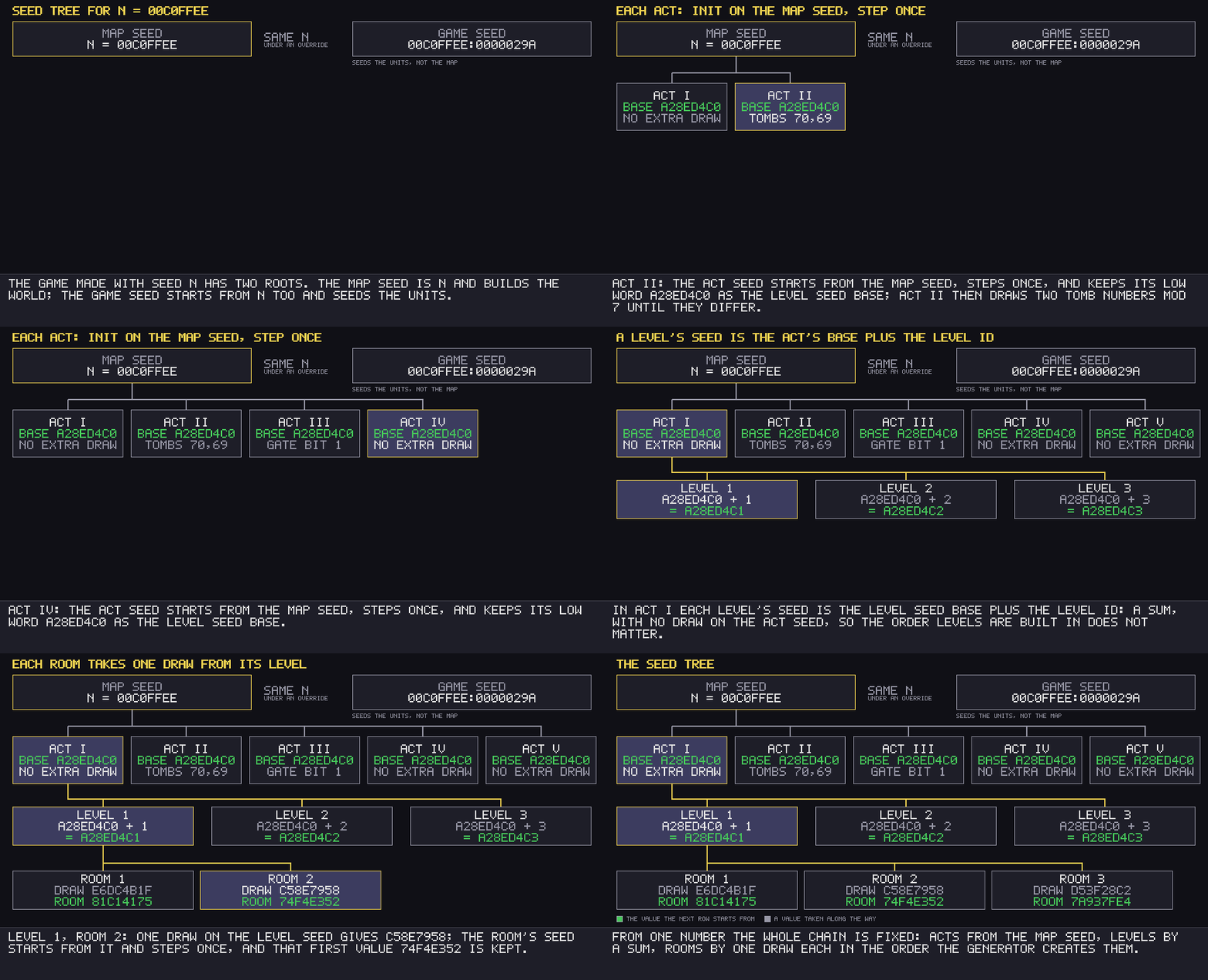
Step through rng-seed-tree-c0ffee-build
The seed tree for an illustrative seed N given as an override. The map seed is then N and builds the world; the game seed starts from N too, a separate seed that seeds the units (seeds § step 1). Each act’s seed starts from the map seed, steps once, and keeps that low word as the level seed base, the same for all five acts; Act II then draws pairs of numbers mod 7 until they differ to name its tombs, and Act III takes one more draw and keeps its lowest bit (§ step 3). A level’s seed is the base plus the level id, a sum with no draw, so the order levels are built in does not matter (§ step 4). Each room takes one draw on its level’s seed, starts its own seed from the result and steps once, so the order a level creates its rooms in does matter (§ step 5). Not shown: the act link builder’s later draws on the act seed, room activation, and the units. Seed: illustrative, an input of our own. Every value shown is computed by our model, not observed in the game.
C. A room activates
Section titled “C. A room activates”(chain § Algorithm C, levels) When a room activates (a player comes near), it is re-seeded, picks its tiles with k draws, and gets its collision grid, stamped from its own tiles and those of the neighbours already active. That is how the walk reaches the grid: a neighbour that activates later is not stamped in. One more draw then gives the active room its seed. The tile rule on some wall cells that can draw during the tile pick makes a preset unit of the room, not a unit; the units it names are created later, in the presets window of step D. That last point is inferred: the code that adds the preset unit has not been read.
D. The new-rooms walk
Section titled “D. The new-rooms walk”(chain § Algorithm D, lifecycle § D) At the start of the next frame the server walks the act’s new rooms in the order of the act’s room list. For each:
- The wanderer tick: one draw on the room’s seed, always.
- On the room’s first activation:
- the presets window: the room’s hand-placed units in order. Hand-placed monsters go through the same creation as random ones (step E); superuniques and the special map presets go through their own path. 311 hand-placed monsters of the ordinary class kind were predicted in the recordings of the plan’s first phase;
- the restore, which finds nothing to restore on a first visit and draws nothing (1 459 first activations, both seeds unchanged);
- the object population on the object-region seed: the gate, the eight group slots and each object’s creation rolls. The window draws on the room seed, the game seed and the object-region seed; in the run it created 13 056 objects (2 888 by the population, 10 168 hand-placed) with every seed predicted;
- the monster population pass, on the room seed and the game seed, each creation through step E.
- On a later activation: the restore of what the room saved when it was released, and nothing else (step F). A room is never populated twice: the run’s 408 hand-placed units were all placed in a first population, none in the 286 later restore-only walks of those rooms.
Two details carry seeds across rooms. The object-region seed is one stream for the whole game, so the order of the rooms’ object populations decides each room’s object rolls. And a monster that the pass places on a neighbour room’s tile draws from that room’s seed, either its seed from activation or the seed its own last pass left; the pass’s warp test can even activate a room and step a level’s seed.
E. One monster’s creation
Section titled “E. One monster’s creation”(chain § Algorithm E, monsters) Every server unit other than a player steps the game seed once when it is created (an item twice). For a monster:
- one game-seed step, and the monster’s own seed starts from it;
- if its class is new to the level’s list and has appearance sets, the sets are rolled on the monster’s seed;
- the stats draws (appearance, hit points, MonProp), then the monster’s equipment;
- for a champion, unique or minion, the mod picks and their effects;
- its marks on the collision grid.
In the run, 12 580 monster seeds were predicted out of 12 580 creations, and 63 champion packs and 162 unique and minion packs, with 217 special-mod rolls.
Monster equipment is reached by two classes only in the stock tables, 234 (a flying scimitar) and 267 (Blood Raven), each with one row and one location; the run reproduced their 4 creations with their items, each item taking two game-seed steps. The table’s other branches (a level skip, a second row, two or three locations, an occupied location) are read from the code only: no stock row reaches them.
F. Coming back to a room
Section titled “F. Coming back to a room”(chain § Algorithm F, levels) A released room that activates again re-creates its saved monsters, then its items, then its other units, each kind in the reverse of the order the release saved it: the saved list’s order, which the specs call oldest first, and not the units’ age. A re-created monster is a new unit for the seeds: a new game-seed step, a new own seed and a full creation, keeping only its id, class, cell, a few saved stats and, for a special, its mods from the save. Where it lands and whether it comes back alive or dead depend on what it did in the meantime, so they are inputs.
It also marks the collision grid like a monster of the pass, though outside any window. One that comes back alive
marks its footprint twice, then is unmarked and marked again with the pattern for its size. One that comes back dead
is marked once, and then, if its class’s deadCol is 0, takes the corpse marks; with deadCol 1 the one mark stays.
This is confirmed on 1 903 re-creations compared mark by mark, the dead cases on 140 of them. It covers the marks made
from the recorded cell and state, not where or in what state a monster comes back. The call path that makes the marks is read
from the code; the marks and their order are what the run compared. Leaving the marks out breaks later placement tests: the first end-to-end run’s
only two mismatches were exactly that.
G. A death and its drop
Section titled “G. A death and its drop”(chain § Algorithm G, items) When a monster dies, its treasure class is walked on the dying unit’s own seed, and each pick’s quality is rolled on the same seed. Then each item made takes two game-seed steps: the first gives the item’s unit seed, on which its base stats are drawn; the second gives the start of its item seed, on which the rest of its build runs (step H). In the run, 1 314 monster drops with an item (1 492 items) were predicted from the dying unit’s recorded seed, with every builder modelled; all 3 784 treasure-class resolutions and 1 913 item creations reproduce.
A chest’s drop runs the same steps on the chest’s own seed. After it, the chest’s seed is where the treasure class walk left it, the game seed has moved two steps per item, and the object-region seed has not moved.
H. Each item’s build
Section titled “H. Each item’s build”(chain § Algorithm H, items) On the item seed: the unique or set pick and, when it fails, the fallback builders; the builder’s affix picks with their property rolls; the staff mods; then the ethereal roll, the socket roll and the automagic pick. The staff mods, once taken from the recording, are modelled and run in the chain.
How it was checked
Section titled “How it was checked”Each part above was first reproduced on its own, and where a part called into another that was not yet modelled, the check took that call’s result from the recording: a boundary oracle. For this page’s spec those calls were modelled one by one and retired: the property rolls, the staff mods, the builders under a failed unique or set, the drop quality roll, a chest’s drop, the gold piles’ items, a monster’s seed after its creation, the hand-placed monsters, the City of the Damned’s spawns, a neighbour room’s seed in a pass, and the units of the wall-cell tile rule. The gold piles’ spot is read from the code, and the model’s spot matched 69 of 71 piles.
The end-to-end run then rebuilt 37 recorded games with all of these models in: 0 mismatches, and 2 189 room populations with no seed taken from the recording anywhere in their window or pass.
A few things are still read from the recording inside the chain, each counted:
- the level generator’s parts of the object gate (room flags, the population level, the preset and town tests, the level’s room count): the run checks the recorded values against the code’s reading at every one of 4 883 gates, but the room flags are not yet handed over from the level model;
- the collision grid at the start of each pass: the grid the models build equals it in 4 723 of 4 883 rooms, and the rest are marks of players, monsters that walked, items and corpses; the barrier grid of the region flood and the waypoint point are read too;
- the monster-spawning creation rules of three other objects (2, 2 and 7 times) and three map-preset rows (3, 4 and 3);
- creations the model does not run (operate and object spawns): 34 with no level known, and 12 additions to a level’s class list made by such creations;
- 35 placement tests in a room the grid model holds no cells for, 8 special-count increments of hand-placed monsters, 1 gold pile’s spot, and 7 chests’ state bytes at their operate (see below).
Worked examples
Section titled “Worked examples”Copied from the spec; seeds are written low:high in hex. Each was reproduced by the end-to-end check.
From seed 4802 to level 57 (the Halls of the Dead level 2, Normal, expansion). The tool prints these from the seed alone, and the recording agrees:
| Step | Value |
|---|---|
| game seed, map seed | 000012C2:0000029A, 000012C2 |
| monster regions | E0A791E4:0000029A |
| object-region seed | 615B8C46:0000029A; the game seed then 615B8C46:5DB3A30E |
| store seed, quest seed | 4231F4EC:0000029A, 5959A58E:0000029A |
| level-seed base | E0A791E4 |
| level 57 | E0A791E4 + 0x39 gives E0A7921D:0000029A; a maze level; region pool 374, 101, 101 |
One room of that level, end to end, one of the 2 189 populations with nothing taken from the recording. The room
activates with seed 4DAC63D4:0000029A. The wanderer tick’s draw keeps 0x14BE in its low 15 bits, not 0, so no wanderer. No hand-placed unit
and nothing to restore. The object gate passes and all eight slots are rolled, but no object is created. The pass then
takes 27 game-seed steps before its first placement, and creates a leader of class 374 and two group members, each
with one game-seed step and its own seed; the leader’s own seed takes two steps (appearance and hit points) and then
gives the group size. The room leaves the pass at D0F81837:1908F5BF and the game seed at 04994E9F:59583410.
A gold drop. A class-101 monster dies with seed 3798A5AC:63BFE189, treasure class 475, item level 15; the game
seed at the drop is 8B0F9E11:1D78C39B, an input.
| Step | Value |
|---|---|
| treasure class | the pick draws 101 in a range of 160 and lands on item 523, gold, quality 2 |
| first game-seed step | 348CF6B0:3A00542B: the item’s unit seed starts at 348CF6B0 |
| second game-seed step | A15D299B:15EB20E3: the item seed starts at A15D299B |
| base stats | one unit-seed step; the pile holds 31 gold |
| build | no draw on the item seed |
The next drop of that game starts from the game seed A15D299B:15EB20E3 that this one left.
Traps for a reimplementer
Section titled “Traps for a reimplementer”- The player’s walk is an input, not a detail. Two games from the same seed agree on every level and room seed, but their game seed and object-region seed part as soon as rooms activate or populate in another order, or the fights create a unit. This follows from the code; it is not a separate run’s result.
- The object-region seed is one stream for the whole game, not one per room or per level.
- A room’s seed outlives its pass. A later monster placed on that room’s tile by another room’s pass draws from the seed the earlier pass left.
- A re-created monster is a new unit for the seeds: a new game-seed step, a new own seed and a full creation. And it marks the grid: leaving its marks out broke later placement tests in the first end-to-end run.
- A class added to a level’s list is state. If a creation the model does not run adds a class, its appearance sets are rolled then, and a later monster of that class reads them.
What is not known yet
Section titled “What is not known yet”- Who changes a chest’s state byte before it is opened. Seven chests reached their operate with a lock bit or state their creation had not left (the lock bit set on 2, cleared on 3, the byte cleared on 2), and no recorded line wrote it. The check takes the byte at the operate; it decides only the locked test and that chest’s drop.
- Monster equipment beyond the one-row path: reachable only with an edited table.
- The room flags of the object gate, still taken from the recording: handing the level model’s per-room values to the walk would remove them.
- The rest of the collision grid at a pass: the barrier grid and the waypoint point are read but not modelled.
- Three other monster-spawning objects and three map-preset rows still take their seeds from the recording.
- A world built from the seed alone, with no recording at all, would need the player’s activation order as an input record and a hand-off between the objects and monsters models; the plan behind this page does not build it.
Where to read more
Section titled “Where to read more”- The spec: seed to world, with the entry table of what each step receives.
- The pages in build order: randomness (the seed tree), levels (steps B, C and F), objects and monsters (steps D and E), items (steps G and H).
- How we know for runs, recordings and boundary oracles; the glossary for D2 terms.