How a level is built
Every map you walk in Diablo II comes out of the DRLG, the game’s level generator. This page follows it from the top: an act is laid out, each level is built from a seed by one of three generators (preset, maze or outdoor), the level is cut into rooms, and each room gets its floor and wall tiles, its preset monsters and objects, its warps and finally a collision grid that monster spawning and object placement read. It restates the reviewed DRLG specs: the overview, room tiles, preset units, the maze and outdoor generators, warps and the collision grid. Where you want the exact order of every random draw, follow the links.
The big picture
Section titled “The big picture”A level has its own seed, and the generator’s random choices are draws on that level seed, on the act seed (while the act is laid out) or on the seeds of the rooms it creates. All of these come from the map seed. The specs give every draw in order, and the recorded games were replayed against them draw by draw.
%3btext-align:center%3b%7d%23mermaid-0 .edgeLabel p%7bbackground-color:rgba(232%2c232%2c232%2c 0.8)%3b%7d%23mermaid-0 .edgeLabel rect%7bopacity:0.5%3bbackground-color:rgba(232%2c232%2c232%2c 0.8)%3bfill:rgba(232%2c232%2c232%2c 0.8)%3b%7d%23mermaid-0 .labelBkg%7bbackground-color:rgba(232%2c 232%2c 232%2c 0.5)%3b%7d%23mermaid-0 .cluster rect%7bfill:%23ffffde%3bstroke:%23aaaa33%3bstroke-width:1px%3b%7d%23mermaid-0 .cluster text%7bfill:%23333%3b%7d%23mermaid-0 .cluster span%7bcolor:%23333%3b%7d%23mermaid-0 .node .collapsed-indicator%7bfill:%23aaaa33%3bstroke:none%3bopacity:0.6%3b%7d%23mermaid-0 .node .collapsed-separator%7bstroke:%23aaaa33%3bstroke-width:0.75px%3b%7d%23mermaid-0 div.mermaidTooltip%7bposition:absolute%3btext-align:center%3bmax-width:200px%3bpadding:2px%3bfont-family:arial%2csans-serif%3bfont-size:12px%3bbackground:hsl(80%2c 100%25%2c 96.2745098039%25)%3bborder:1px solid %23aaaa33%3bborder-radius:2px%3bpointer-events:none%3bz-index:100%3b%7d%23mermaid-0 .flowchartTitleText%7btext-anchor:middle%3bfont-size:18px%3bfill:%23333%3b%7d%23mermaid-0 rect.text%7bfill:none%3bstroke-width:0%3b%7d%23mermaid-0 .icon-shape%2c%23mermaid-0 .image-shape%7bbackground-color:rgba(232%2c232%2c232%2c 0.8)%3btext-align:center%3b%7d%23mermaid-0 .icon-shape p%2c%23mermaid-0 .image-shape p%7bbackground-color:rgba(232%2c232%2c232%2c 0.8)%3bpadding:2px%3b%7d%23mermaid-0 .icon-shape .label rect%2c%23mermaid-0 .image-shape .label rect%7bopacity:0.5%3bbackground-color:rgba(232%2c232%2c232%2c 0.8)%3bfill:rgba(232%2c232%2c232%2c 0.8)%3b%7d%23mermaid-0 .label-icon%7bdisplay:inline-block%3bheight:1em%3boverflow:visible%3bvertical-align:-0.125em%3b%7d%23mermaid-0 .node .label-icon path%7bfill:currentColor%3bstroke:revert%3bstroke-width:revert%3b%7d%23mermaid-0 .node .neo-node%7bstroke:%239370DB%3b%7d%23mermaid-0 %5bdata-look='neo'%5d.node rect%2c%23mermaid-0 %5bdata-look='neo'%5d.cluster rect%2c%23mermaid-0 %5bdata-look='neo'%5d.node polygon%7bstroke:%239370DB%3bfilter:drop-shadow(1px 2px 2px rgba(185%2c 185%2c 185%2c 1))%3b%7d%23mermaid-0 %5bdata-look='neo'%5d.swimlane.cluster rect%7bfilter:none%3b%7d%23mermaid-0 %5bdata-look='neo'%5d.node path%7bstroke:%239370DB%3bstroke-width:1px%3b%7d%23mermaid-0 %5bdata-look='neo'%5d.node .outer-path%7bfilter:drop-shadow(1px 2px 2px rgba(185%2c 185%2c 185%2c 1))%3b%7d%23mermaid-0 %5bdata-look='neo'%5d.node .neo-line path%7bstroke:%239370DB%3bfilter:none%3b%7d%23mermaid-0 %5bdata-look='neo'%5d.node circle%7bstroke:%239370DB%3bfilter:drop-shadow(1px 2px 2px rgba(185%2c 185%2c 185%2c 1))%3b%7d%23mermaid-0 %5bdata-look='neo'%5d.node circle .state-start%7bfill:black%3b%7d%23mermaid-0 %5bdata-look='neo'%5d.icon-shape .icon%7bfill:%239370DB%3bfilter:drop-shadow(1px 2px 2px rgba(185%2c 185%2c 185%2c 1))%3b%7d%23mermaid-0 %5bdata-look='neo'%5d.icon-shape .icon-neo path%7bstroke:%239370DB%3bfilter:drop-shadow(1px 2px 2px rgba(185%2c 185%2c 185%2c 1))%3b%7d%23mermaid-0 :root%7b--mermaid-font-family:arial%2csans-serif%3b%7d%3c/style%3e%3cg%3e%3cmarker id='mermaid-0_flowchart-v2-pointEnd' class='marker flowchart-v2' viewBox='0 0 10 10' refX='5' refY='5' markerUnits='userSpaceOnUse' markerWidth='8' markerHeight='8' orient='auto'%3e%3cpath d='M 0 0 L 10 5 L 0 10 z' class='arrowMarkerPath' style='stroke-width: 1%3b stroke-dasharray: 1%2c 0%3b'/%3e%3c/marker%3e%3cmarker id='mermaid-0_flowchart-v2-pointStart' class='marker flowchart-v2' viewBox='0 0 10 10' refX='4.5' refY='5' markerUnits='userSpaceOnUse' markerWidth='8' markerHeight='8' orient='auto'%3e%3cpath d='M 0 5 L 10 10 L 10 0 z' class='arrowMarkerPath' style='stroke-width: 1%3b stroke-dasharray: 1%2c 0%3b'/%3e%3c/marker%3e%3cmarker id='mermaid-0_flowchart-v2-pointEnd-margin' class='marker flowchart-v2' viewBox='0 0 11.5 14' refX='11.5' refY='7' markerUnits='userSpaceOnUse' markerWidth='10.5' markerHeight='14' orient='auto'%3e%3cpath d='M 0 0 L 11.5 7 L 0 14 z' class='arrowMarkerPath' style='stroke-width: 0%3b stroke-dasharray: 1%2c 0%3b'/%3e%3c/marker%3e%3cmarker id='mermaid-0_flowchart-v2-pointStart-margin' class='marker flowchart-v2' viewBox='0 0 11.5 14' refX='1' refY='7' markerUnits='userSpaceOnUse' markerWidth='11.5' markerHeight='14' orient='auto'%3e%3cpolygon points='0%2c7 11.5%2c14 11.5%2c0' class='arrowMarkerPath' style='stroke-width: 0%3b stroke-dasharray: 1%2c 0%3b'/%3e%3c/marker%3e%3cmarker id='mermaid-0_flowchart-v2-circleEnd' class='marker flowchart-v2' viewBox='0 0 10 10' refX='11' refY='5' markerUnits='userSpaceOnUse' markerWidth='11' markerHeight='11' orient='auto'%3e%3ccircle cx='5' cy='5' r='5' class='arrowMarkerPath' style='stroke-width: 1%3b stroke-dasharray: 1%2c 0%3b'/%3e%3c/marker%3e%3cmarker id='mermaid-0_flowchart-v2-circleStart' class='marker flowchart-v2' viewBox='0 0 10 10' refX='-1' refY='5' markerUnits='userSpaceOnUse' markerWidth='11' markerHeight='11' orient='auto'%3e%3ccircle cx='5' cy='5' r='5' class='arrowMarkerPath' style='stroke-width: 1%3b stroke-dasharray: 1%2c 0%3b'/%3e%3c/marker%3e%3cmarker id='mermaid-0_flowchart-v2-circleEnd-margin' class='marker flowchart-v2' viewBox='0 0 10 10' refY='5' refX='12.25' markerUnits='userSpaceOnUse' markerWidth='14' markerHeight='14' orient='auto'%3e%3ccircle cx='5' cy='5' r='5' class='arrowMarkerPath' style='stroke-width: 0%3b stroke-dasharray: 1%2c 0%3b'/%3e%3c/marker%3e%3cmarker id='mermaid-0_flowchart-v2-circleStart-margin' class='marker flowchart-v2' viewBox='0 0 10 10' refX='-2' refY='5' markerUnits='userSpaceOnUse' markerWidth='14' markerHeight='14' orient='auto'%3e%3ccircle cx='5' cy='5' r='5' class='arrowMarkerPath' style='stroke-width: 0%3b stroke-dasharray: 1%2c 0%3b'/%3e%3c/marker%3e%3cmarker id='mermaid-0_flowchart-v2-crossEnd' class='marker cross flowchart-v2' viewBox='0 0 11 11' refX='12' refY='5.2' markerUnits='userSpaceOnUse' markerWidth='11' markerHeight='11' orient='auto'%3e%3cpath d='M 1%2c1 l 9%2c9 M 10%2c1 l -9%2c9' class='arrowMarkerPath' style='stroke-width: 2%3b stroke-dasharray: 1%2c 0%3b'/%3e%3c/marker%3e%3cmarker id='mermaid-0_flowchart-v2-crossStart' class='marker cross flowchart-v2' viewBox='0 0 11 11' refX='-1' refY='5.2' markerUnits='userSpaceOnUse' markerWidth='11' markerHeight='11' orient='auto'%3e%3cpath d='M 1%2c1 l 9%2c9 M 10%2c1 l -9%2c9' class='arrowMarkerPath' style='stroke-width: 2%3b stroke-dasharray: 1%2c 0%3b'/%3e%3c/marker%3e%3cmarker id='mermaid-0_flowchart-v2-crossEnd-margin' class='marker cross flowchart-v2' viewBox='0 0 15 15' refX='17.7' refY='7.5' markerUnits='userSpaceOnUse' markerWidth='12' markerHeight='12' orient='auto'%3e%3cpath d='M 1%2c1 L 14%2c14 M 1%2c14 L 14%2c1' class='arrowMarkerPath' style='stroke-width: 2.5%3b'/%3e%3c/marker%3e%3cmarker id='mermaid-0_flowchart-v2-crossStart-margin' class='marker cross flowchart-v2' viewBox='0 0 15 15' refX='-3.5' refY='7.5' markerUnits='userSpaceOnUse' markerWidth='12' markerHeight='12' orient='auto'%3e%3cpath d='M 1%2c1 L 14%2c14 M 1%2c14 L 14%2c1' class='arrowMarkerPath' style='stroke-width: 2.5%3b stroke-dasharray: 1%2c 0%3b'/%3e%3c/marker%3e%3cg class='root'%3e%3cg class='clusters'/%3e%3cg class='edgePaths'%3e%3cpath d='M448%2c86L448%2c90.167C448%2c94.333%2c448%2c102.667%2c448%2c110.333C448%2c118%2c448%2c125%2c448%2c128.5L448%2c132' id='mermaid-0-L_act_lc_0' class='edge-thickness-normal edge-pattern-solid edge-thickness-normal edge-pattern-solid flowchart-link' style='%3b' data-edge='true' data-et='edge' data-id='L_act_lc_0' data-points='W3sieCI6NDQ4LCJ5Ijo4Nn0seyJ4Ijo0NDgsInkiOjExMX0seyJ4Ijo0NDgsInkiOjEzNn1d' data-look='classic' marker-end='url(%23mermaid-0_flowchart-v2-pointEnd)'/%3e%3cpath d='M448%2c214L448%2c218.167C448%2c222.333%2c448%2c230.667%2c448%2c238.333C448%2c246%2c448%2c253%2c448%2c256.5L448%2c260' id='mermaid-0-L_lc_li_0' class='edge-thickness-normal edge-pattern-solid edge-thickness-normal edge-pattern-solid flowchart-link' style='%3b' data-edge='true' data-et='edge' data-id='L_lc_li_0' data-points='W3sieCI6NDQ4LCJ5IjoyMTR9LHsieCI6NDQ4LCJ5IjoyMzl9LHsieCI6NDQ4LCJ5IjoyNjR9XQ==' data-look='classic' marker-end='url(%23mermaid-0_flowchart-v2-pointEnd)'/%3e%3cpath d='M448%2c366L448%2c370.167C448%2c374.333%2c448%2c382.667%2c448%2c390.333C448%2c398%2c448%2c405%2c448%2c408.5L448%2c412' id='mermaid-0-L_li_dt_0' class='edge-thickness-normal edge-pattern-solid edge-thickness-normal edge-pattern-solid flowchart-link' style='%3b' data-edge='true' data-et='edge' data-id='L_li_dt_0' data-points='W3sieCI6NDQ4LCJ5IjozNjZ9LHsieCI6NDQ4LCJ5IjozOTF9LHsieCI6NDQ4LCJ5Ijo0MTZ9XQ==' data-look='classic' marker-end='url(%23mermaid-0_flowchart-v2-pointEnd)'/%3e%3cpath d='M402.941%2c488.972L358.784%2c502.648C314.627%2c516.325%2c226.314%2c543.678%2c182.157%2c562.855C138%2c582.031%2c138%2c593.031%2c138%2c598.531L138%2c604.031' id='mermaid-0-L_dt_pre_0' class='edge-thickness-normal edge-pattern-solid edge-thickness-normal edge-pattern-solid flowchart-link' style='%3b' data-edge='true' data-et='edge' data-id='L_dt_pre_0' data-points='W3sieCI6NDAyLjk0MDU0MjYyMDc0Mjc1LCJ5Ijo0ODguOTcxNzkyNjIwNzQyNzV9LHsieCI6MTM4LCJ5Ijo1NzEuMDMxMjV9LHsieCI6MTM4LCJ5Ijo2MDguMDMxMjV9XQ==' data-look='classic' marker-end='url(%23mermaid-0_flowchart-v2-pointEnd)'/%3e%3cpath d='M448%2c534.031L448%2c540.198C448%2c546.365%2c448%2c558.698%2c448%2c570.365C448%2c582.031%2c448%2c593.031%2c448%2c598.531L448%2c604.031' id='mermaid-0-L_dt_maze_0' class='edge-thickness-normal edge-pattern-solid edge-thickness-normal edge-pattern-solid flowchart-link' style='%3b' data-edge='true' data-et='edge' data-id='L_dt_maze_0' data-points='W3sieCI6NDQ4LCJ5Ijo1MzQuMDMxMjV9LHsieCI6NDQ4LCJ5Ijo1NzEuMDMxMjV9LHsieCI6NDQ4LCJ5Ijo2MDguMDMxMjV9XQ==' data-look='classic' marker-end='url(%23mermaid-0_flowchart-v2-pointEnd)'/%3e%3cpath d='M493.059%2c488.972L537.216%2c502.648C581.373%2c516.325%2c669.686%2c543.678%2c713.843%2c562.855C758%2c582.031%2c758%2c593.031%2c758%2c598.531L758%2c604.031' id='mermaid-0-L_dt_out_0' class='edge-thickness-normal edge-pattern-solid edge-thickness-normal edge-pattern-solid flowchart-link' style='%3b' data-edge='true' data-et='edge' data-id='L_dt_out_0' data-points='W3sieCI6NDkzLjA1OTQ1NzM3OTI1NzI1LCJ5Ijo0ODguOTcxNzkyNjIwNzQyNzV9LHsieCI6NzU4LCJ5Ijo1NzEuMDMxMjV9LHsieCI6NzU4LCJ5Ijo2MDguMDMxMjV9XQ==' data-look='classic' marker-end='url(%23mermaid-0_flowchart-v2-pointEnd)'/%3e%3cpath d='M138%2c686.031L138%2c690.198C138%2c694.365%2c138%2c702.698%2c167.347%2c712.923C196.694%2c723.149%2c255.388%2c735.266%2c284.736%2c741.325L314.083%2c747.384' id='mermaid-0-L_pre_rooms_0' class='edge-thickness-normal edge-pattern-solid edge-thickness-normal edge-pattern-solid flowchart-link' style='%3b' data-edge='true' data-et='edge' data-id='L_pre_rooms_0' data-points='W3sieCI6MTM4LCJ5Ijo2ODYuMDMxMjV9LHsieCI6MTM4LCJ5Ijo3MTEuMDMxMjV9LHsieCI6MzE4LCJ5Ijo3NDguMTkyNTQwMzIyNTgwNn1d' data-look='classic' marker-end='url(%23mermaid-0_flowchart-v2-pointEnd)'/%3e%3cpath d='M448%2c686.031L448%2c690.198C448%2c694.365%2c448%2c702.698%2c448%2c710.365C448%2c718.031%2c448%2c725.031%2c448%2c728.531L448%2c732.031' id='mermaid-0-L_maze_rooms_0' class='edge-thickness-normal edge-pattern-solid edge-thickness-normal edge-pattern-solid flowchart-link' style='%3b' data-edge='true' data-et='edge' data-id='L_maze_rooms_0' data-points='W3sieCI6NDQ4LCJ5Ijo2ODYuMDMxMjV9LHsieCI6NDQ4LCJ5Ijo3MTEuMDMxMjV9LHsieCI6NDQ4LCJ5Ijo3MzYuMDMxMjV9XQ==' data-look='classic' marker-end='url(%23mermaid-0_flowchart-v2-pointEnd)'/%3e%3cpath d='M758%2c686.031L758%2c690.198C758%2c694.365%2c758%2c702.698%2c728.653%2c712.923C699.306%2c723.149%2c640.612%2c735.266%2c611.264%2c741.325L581.917%2c747.384' id='mermaid-0-L_out_rooms_0' class='edge-thickness-normal edge-pattern-solid edge-thickness-normal edge-pattern-solid flowchart-link' style='%3b' data-edge='true' data-et='edge' data-id='L_out_rooms_0' data-points='W3sieCI6NzU4LCJ5Ijo2ODYuMDMxMjV9LHsieCI6NzU4LCJ5Ijo3MTEuMDMxMjV9LHsieCI6NTc4LCJ5Ijo3NDguMTkyNTQwMzIyNTgwNn1d' data-look='classic' marker-end='url(%23mermaid-0_flowchart-v2-pointEnd)'/%3e%3cpath d='M358.634%2c814.031L349.086%2c818.198C339.538%2c822.365%2c320.443%2c830.698%2c310.895%2c842.365C301.348%2c854.031%2c301.348%2c869.031%2c301.348%2c876.531L301.348%2c884.031' id='mermaid-0-L_rooms_wp_0' class='edge-thickness-normal edge-pattern-solid edge-thickness-normal edge-pattern-solid flowchart-link' style='%3b' data-edge='true' data-et='edge' data-id='L_rooms_wp_0' data-points='W3sieCI6MzU4LjYzMzcyODAyNzM0Mzc1LCJ5Ijo4MTQuMDMxMjV9LHsieCI6MzAxLjM0NzY1NjI1LCJ5Ijo4MzkuMDMxMjV9LHsieCI6MzAxLjM0NzY1NjI1LCJ5Ijo4ODguMDMxMjV9XQ==' data-look='classic' marker-end='url(%23mermaid-0_flowchart-v2-pointEnd)'/%3e%3cpath d='M537.366%2c814.031L546.914%2c818.198C556.462%2c822.365%2c575.557%2c830.698%2c585.105%2c838.365C594.652%2c846.031%2c594.652%2c853.031%2c594.652%2c856.531L594.652%2c860.031' id='mermaid-0-L_rooms_actv_0' class='edge-thickness-normal edge-pattern-solid edge-thickness-normal edge-pattern-solid flowchart-link' style='%3b' data-edge='true' data-et='edge' data-id='L_rooms_actv_0' data-points='W3sieCI6NTM3LjM2NjI3MTk3MjY1NjIsInkiOjgxNC4wMzEyNX0seyJ4Ijo1OTQuNjUyMzQzNzUsInkiOjgzOS4wMzEyNX0seyJ4Ijo1OTQuNjUyMzQzNzUsInkiOjg2NC4wMzEyNX1d' data-look='classic' marker-end='url(%23mermaid-0_flowchart-v2-pointEnd)'/%3e%3cpath d='M594.652%2c966.031L594.652%2c970.198C594.652%2c974.365%2c594.652%2c982.698%2c594.652%2c990.365C594.652%2c998.031%2c594.652%2c1005.031%2c594.652%2c1008.531L594.652%2c1012.031' id='mermaid-0-L_actv_coll_0' class='edge-thickness-normal edge-pattern-solid edge-thickness-normal edge-pattern-solid flowchart-link' style='%3b' data-edge='true' data-et='edge' data-id='L_actv_coll_0' data-points='W3sieCI6NTk0LjY1MjM0Mzc1LCJ5Ijo5NjYuMDMxMjV9LHsieCI6NTk0LjY1MjM0Mzc1LCJ5Ijo5OTEuMDMxMjV9LHsieCI6NTk0LjY1MjM0Mzc1LCJ5IjoxMDE2LjAzMTI1fV0=' data-look='classic' marker-end='url(%23mermaid-0_flowchart-v2-pointEnd)'/%3e%3cpath d='M594.652%2c1094.031L594.652%2c1098.198C594.652%2c1102.365%2c594.652%2c1110.698%2c594.652%2c1118.365C594.652%2c1126.031%2c594.652%2c1133.031%2c594.652%2c1136.531L594.652%2c1140.031' id='mermaid-0-L_coll_units_0' class='edge-thickness-normal edge-pattern-solid edge-thickness-normal edge-pattern-solid flowchart-link' style='%3b' data-edge='true' data-et='edge' data-id='L_coll_units_0' data-points='W3sieCI6NTk0LjY1MjM0Mzc1LCJ5IjoxMDk0LjAzMTI1fSx7IngiOjU5NC42NTIzNDM3NSwieSI6MTExOS4wMzEyNX0seyJ4Ijo1OTQuNjUyMzQzNzUsInkiOjExNDQuMDMxMjV9XQ==' data-look='classic' marker-end='url(%23mermaid-0_flowchart-v2-pointEnd)'/%3e%3c/g%3e%3cg class='edgeLabels'%3e%3cg class='edgeLabel'%3e%3cg class='label' data-id='L_act_lc_0' transform='translate(0%2c 0)'%3e%3cforeignObject width='0' height='0'%3e%3cdiv xmlns='http://www.w3.org/1999/xhtml' class='labelBkg' style='display: table-cell%3b white-space: nowrap%3b line-height: 1.5%3b max-width: 200px%3b text-align: center%3b'%3e%3cspan class='edgeLabel'%3e%3c/span%3e%3c/div%3e%3c/foreignObject%3e%3c/g%3e%3c/g%3e%3cg class='edgeLabel'%3e%3cg class='label' data-id='L_lc_li_0' transform='translate(0%2c 0)'%3e%3cforeignObject width='0' height='0'%3e%3cdiv xmlns='http://www.w3.org/1999/xhtml' class='labelBkg' style='display: table-cell%3b white-space: nowrap%3b line-height: 1.5%3b max-width: 200px%3b text-align: center%3b'%3e%3cspan class='edgeLabel'%3e%3c/span%3e%3c/div%3e%3c/foreignObject%3e%3c/g%3e%3c/g%3e%3cg class='edgeLabel'%3e%3cg class='label' data-id='L_li_dt_0' transform='translate(0%2c 0)'%3e%3cforeignObject width='0' height='0'%3e%3cdiv xmlns='http://www.w3.org/1999/xhtml' class='labelBkg' style='display: table-cell%3b white-space: nowrap%3b line-height: 1.5%3b max-width: 200px%3b text-align: center%3b'%3e%3cspan class='edgeLabel'%3e%3c/span%3e%3c/div%3e%3c/foreignObject%3e%3c/g%3e%3c/g%3e%3cg class='edgeLabel' transform='translate(138%2c 571.03125)'%3e%3cg class='label' data-id='L_dt_pre_0' transform='translate(-4.453125%2c -12)'%3e%3cforeignObject width='8.90625' height='24'%3e%3cdiv xmlns='http://www.w3.org/1999/xhtml' class='labelBkg' style='display: table-cell%3b white-space: nowrap%3b line-height: 1.5%3b max-width: 200px%3b text-align: center%3b'%3e%3cspan class='edgeLabel'%3e%3cp%3e2%3c/p%3e%3c/span%3e%3c/div%3e%3c/foreignObject%3e%3c/g%3e%3c/g%3e%3cg class='edgeLabel' transform='translate(448%2c 571.03125)'%3e%3cg class='label' data-id='L_dt_maze_0' transform='translate(-4.453125%2c -12)'%3e%3cforeignObject width='8.90625' height='24'%3e%3cdiv xmlns='http://www.w3.org/1999/xhtml' class='labelBkg' style='display: table-cell%3b white-space: nowrap%3b line-height: 1.5%3b max-width: 200px%3b text-align: center%3b'%3e%3cspan class='edgeLabel'%3e%3cp%3e1%3c/p%3e%3c/span%3e%3c/div%3e%3c/foreignObject%3e%3c/g%3e%3c/g%3e%3cg class='edgeLabel' transform='translate(758%2c 571.03125)'%3e%3cg class='label' data-id='L_dt_out_0' transform='translate(-4.453125%2c -12)'%3e%3cforeignObject width='8.90625' height='24'%3e%3cdiv xmlns='http://www.w3.org/1999/xhtml' class='labelBkg' style='display: table-cell%3b white-space: nowrap%3b line-height: 1.5%3b max-width: 200px%3b text-align: center%3b'%3e%3cspan class='edgeLabel'%3e%3cp%3e3%3c/p%3e%3c/span%3e%3c/div%3e%3c/foreignObject%3e%3c/g%3e%3c/g%3e%3cg class='edgeLabel'%3e%3cg class='label' data-id='L_pre_rooms_0' transform='translate(0%2c 0)'%3e%3cforeignObject width='0' height='0'%3e%3cdiv xmlns='http://www.w3.org/1999/xhtml' class='labelBkg' style='display: table-cell%3b white-space: nowrap%3b line-height: 1.5%3b max-width: 200px%3b text-align: center%3b'%3e%3cspan class='edgeLabel'%3e%3c/span%3e%3c/div%3e%3c/foreignObject%3e%3c/g%3e%3c/g%3e%3cg class='edgeLabel'%3e%3cg class='label' data-id='L_maze_rooms_0' transform='translate(0%2c 0)'%3e%3cforeignObject width='0' height='0'%3e%3cdiv xmlns='http://www.w3.org/1999/xhtml' class='labelBkg' style='display: table-cell%3b white-space: nowrap%3b line-height: 1.5%3b max-width: 200px%3b text-align: center%3b'%3e%3cspan class='edgeLabel'%3e%3c/span%3e%3c/div%3e%3c/foreignObject%3e%3c/g%3e%3c/g%3e%3cg class='edgeLabel'%3e%3cg class='label' data-id='L_out_rooms_0' transform='translate(0%2c 0)'%3e%3cforeignObject width='0' height='0'%3e%3cdiv xmlns='http://www.w3.org/1999/xhtml' class='labelBkg' style='display: table-cell%3b white-space: nowrap%3b line-height: 1.5%3b max-width: 200px%3b text-align: center%3b'%3e%3cspan class='edgeLabel'%3e%3c/span%3e%3c/div%3e%3c/foreignObject%3e%3c/g%3e%3c/g%3e%3cg class='edgeLabel'%3e%3cg class='label' data-id='L_rooms_wp_0' transform='translate(0%2c 0)'%3e%3cforeignObject width='0' height='0'%3e%3cdiv xmlns='http://www.w3.org/1999/xhtml' class='labelBkg' style='display: table-cell%3b white-space: nowrap%3b line-height: 1.5%3b max-width: 200px%3b text-align: center%3b'%3e%3cspan class='edgeLabel'%3e%3c/span%3e%3c/div%3e%3c/foreignObject%3e%3c/g%3e%3c/g%3e%3cg class='edgeLabel'%3e%3cg class='label' data-id='L_rooms_actv_0' transform='translate(0%2c 0)'%3e%3cforeignObject width='0' height='0'%3e%3cdiv xmlns='http://www.w3.org/1999/xhtml' class='labelBkg' style='display: table-cell%3b white-space: nowrap%3b line-height: 1.5%3b max-width: 200px%3b text-align: center%3b'%3e%3cspan class='edgeLabel'%3e%3c/span%3e%3c/div%3e%3c/foreignObject%3e%3c/g%3e%3c/g%3e%3cg class='edgeLabel'%3e%3cg class='label' data-id='L_actv_coll_0' transform='translate(0%2c 0)'%3e%3cforeignObject width='0' height='0'%3e%3cdiv xmlns='http://www.w3.org/1999/xhtml' class='labelBkg' style='display: table-cell%3b white-space: nowrap%3b line-height: 1.5%3b max-width: 200px%3b text-align: center%3b'%3e%3cspan class='edgeLabel'%3e%3c/span%3e%3c/div%3e%3c/foreignObject%3e%3c/g%3e%3c/g%3e%3cg class='edgeLabel'%3e%3cg class='label' data-id='L_coll_units_0' transform='translate(0%2c 0)'%3e%3cforeignObject width='0' height='0'%3e%3cdiv xmlns='http://www.w3.org/1999/xhtml' class='labelBkg' style='display: table-cell%3b white-space: nowrap%3b line-height: 1.5%3b max-width: 200px%3b text-align: center%3b'%3e%3cspan class='edgeLabel'%3e%3c/span%3e%3c/div%3e%3c/foreignObject%3e%3c/g%3e%3c/g%3e%3c/g%3e%3cg class='nodes'%3e%3cg class='node default' id='mermaid-0-flowchart-act-0' data-look='classic' transform='translate(448%2c 47)'%3e%3crect class='basic label-container' style='' x='-130' y='-39' width='260' height='78'/%3e%3cg class='label' style='' transform='translate(-100%2c -24)'%3e%3crect/%3e%3cforeignObject width='200' height='48'%3e%3cdiv xmlns='http://www.w3.org/1999/xhtml' style='display: table%3b white-space: break-spaces%3b line-height: 1.5%3b max-width: 200px%3b text-align: center%3b width: 200px%3b'%3e%3cspan class='nodeLabel'%3e%3cp%3eAct created: act seed%2c level links laid out%3c/p%3e%3c/span%3e%3c/div%3e%3c/foreignObject%3e%3c/g%3e%3c/g%3e%3cg class='node default' id='mermaid-0-flowchart-lc-1' data-look='classic' transform='translate(448%2c 175)'%3e%3crect class='basic label-container' style='' x='-130' y='-39' width='260' height='78'/%3e%3cg class='label' style='' transform='translate(-100%2c -24)'%3e%3crect/%3e%3cforeignObject width='200' height='48'%3e%3cdiv xmlns='http://www.w3.org/1999/xhtml' style='display: table%3b white-space: break-spaces%3b line-height: 1.5%3b max-width: 200px%3b text-align: center%3b width: 200px%3b'%3e%3cspan class='nodeLabel'%3e%3cp%3eLevel created: level seed = Init(base %2b level id)%3c/p%3e%3c/span%3e%3c/div%3e%3c/foreignObject%3e%3c/g%3e%3c/g%3e%3cg class='node default' id='mermaid-0-flowchart-li-2' data-look='classic' transform='translate(448%2c 315)'%3e%3crect class='basic label-container' style='' x='-130' y='-51' width='260' height='102'/%3e%3cg class='label' style='' transform='translate(-100%2c -36)'%3e%3crect/%3e%3cforeignObject width='200' height='72'%3e%3cdiv xmlns='http://www.w3.org/1999/xhtml' style='display: table%3b white-space: break-spaces%3b line-height: 1.5%3b max-width: 200px%3b text-align: center%3b width: 200px%3b'%3e%3cspan class='nodeLabel'%3e%3cp%3eLevel built on first need: level seed re-initialised to the same value%3c/p%3e%3c/span%3e%3c/div%3e%3c/foreignObject%3e%3c/g%3e%3c/g%3e%3cg class='node default' id='mermaid-0-flowchart-dt-3' data-look='classic' transform='translate(448%2c 475.015625)'%3e%3cpolygon points='59.015625%2c0 118.03125%2c-59.015625 59.015625%2c-118.03125 0%2c-59.015625' class='label-container' transform='translate(-58.515625%2c 59.015625)'/%3e%3cg class='label' style='' transform='translate(-32.015625%2c -12)'%3e%3crect/%3e%3cforeignObject width='64.03125' height='24'%3e%3cdiv xmlns='http://www.w3.org/1999/xhtml' style='display: table-cell%3b white-space: nowrap%3b line-height: 1.5%3b max-width: 200px%3b text-align: center%3b'%3e%3cspan class='nodeLabel'%3e%3cp%3eDrlgType%3c/p%3e%3c/span%3e%3c/div%3e%3c/foreignObject%3e%3c/g%3e%3c/g%3e%3cg class='node default' id='mermaid-0-flowchart-pre-4' data-look='classic' transform='translate(138%2c 647.03125)'%3e%3crect class='basic label-container' style='' x='-130' y='-39' width='260' height='78'/%3e%3cg class='label' style='' transform='translate(-100%2c -24)'%3e%3crect/%3e%3cforeignObject width='200' height='48'%3e%3cdiv xmlns='http://www.w3.org/1999/xhtml' style='display: table%3b white-space: break-spaces%3b line-height: 1.5%3b max-width: 200px%3b text-align: center%3b width: 200px%3b'%3e%3cspan class='nodeLabel'%3e%3cp%3ePreset: one DS1 map cut into 8 x 8 rooms%3c/p%3e%3c/span%3e%3c/div%3e%3c/foreignObject%3e%3c/g%3e%3c/g%3e%3cg class='node default' id='mermaid-0-flowchart-maze-5' data-look='classic' transform='translate(448%2c 647.03125)'%3e%3crect class='basic label-container' style='' x='-130' y='-39' width='260' height='78'/%3e%3cg class='label' style='' transform='translate(-100%2c -24)'%3e%3crect/%3e%3cforeignObject width='200' height='48'%3e%3cdiv xmlns='http://www.w3.org/1999/xhtml' style='display: table%3b white-space: break-spaces%3b line-height: 1.5%3b max-width: 200px%3b text-align: center%3b width: 200px%3b'%3e%3cspan class='nodeLabel'%3e%3cp%3eMaze: grow maze rooms%2c turn each into a preset%3c/p%3e%3c/span%3e%3c/div%3e%3c/foreignObject%3e%3c/g%3e%3c/g%3e%3cg class='node default' id='mermaid-0-flowchart-out-6' data-look='classic' transform='translate(758%2c 647.03125)'%3e%3crect class='basic label-container' style='' x='-130' y='-39' width='260' height='78'/%3e%3cg class='label' style='' transform='translate(-100%2c -24)'%3e%3crect/%3e%3cforeignObject width='200' height='48'%3e%3cdiv xmlns='http://www.w3.org/1999/xhtml' style='display: table%3b white-space: break-spaces%3b line-height: 1.5%3b max-width: 200px%3b text-align: center%3b width: 200px%3b'%3e%3cspan class='nodeLabel'%3e%3cp%3eOutdoor: fill an 8 x 8 cell grid%2c one room per free cell%3c/p%3e%3c/span%3e%3c/div%3e%3c/foreignObject%3e%3c/g%3e%3c/g%3e%3cg class='node default' id='mermaid-0-flowchart-rooms-7' data-look='classic' transform='translate(448%2c 775.03125)'%3e%3crect class='basic label-container' style='' x='-130' y='-39' width='260' height='78'/%3e%3cg class='label' style='' transform='translate(-100%2c -24)'%3e%3crect/%3e%3cforeignObject width='200' height='48'%3e%3cdiv xmlns='http://www.w3.org/1999/xhtml' style='display: table%3b white-space: break-spaces%3b line-height: 1.5%3b max-width: 200px%3b text-align: center%3b width: 200px%3b'%3e%3cspan class='nodeLabel'%3e%3cp%3eEach new room: one level draw seeds it%3c/p%3e%3c/span%3e%3c/div%3e%3c/foreignObject%3e%3c/g%3e%3c/g%3e%3cg class='node default' id='mermaid-0-flowchart-wp-8' data-look='classic' transform='translate(301.34765625%2c 915.03125)'%3e%3crect class='basic label-container' style='' x='-113.3046875' y='-27' width='226.609375' height='54'/%3e%3cg class='label' style='' transform='translate(-83.3046875%2c -12)'%3e%3crect/%3e%3cforeignObject width='166.609375' height='24'%3e%3cdiv xmlns='http://www.w3.org/1999/xhtml' style='display: table-cell%3b white-space: nowrap%3b line-height: 1.5%3b max-width: 200px%3b text-align: center%3b'%3e%3cspan class='nodeLabel'%3e%3cp%3eWarp points of the level%3c/p%3e%3c/span%3e%3c/div%3e%3c/foreignObject%3e%3c/g%3e%3c/g%3e%3cg class='node default' id='mermaid-0-flowchart-actv-9' data-look='classic' transform='translate(594.65234375%2c 915.03125)'%3e%3crect class='basic label-container' style='' x='-130' y='-51' width='260' height='102'/%3e%3cg class='label' style='' transform='translate(-100%2c -36)'%3e%3crect/%3e%3cforeignObject width='200' height='72'%3e%3cdiv xmlns='http://www.w3.org/1999/xhtml' style='display: table%3b white-space: break-spaces%3b line-height: 1.5%3b max-width: 200px%3b text-align: center%3b width: 200px%3b'%3e%3cspan class='nodeLabel'%3e%3cp%3eRoom activated: tiles picked%2c k room draws%2c active-room seed%3c/p%3e%3c/span%3e%3c/div%3e%3c/foreignObject%3e%3c/g%3e%3c/g%3e%3cg class='node default' id='mermaid-0-flowchart-coll-10' data-look='classic' transform='translate(594.65234375%2c 1055.03125)'%3e%3crect class='basic label-container' style='' x='-130' y='-39' width='260' height='78'/%3e%3cg class='label' style='' transform='translate(-100%2c -24)'%3e%3crect/%3e%3cforeignObject width='200' height='48'%3e%3cdiv xmlns='http://www.w3.org/1999/xhtml' style='display: table%3b white-space: break-spaces%3b line-height: 1.5%3b max-width: 200px%3b text-align: center%3b width: 200px%3b'%3e%3cspan class='nodeLabel'%3e%3cp%3eCollision grid and logic regions%3c/p%3e%3c/span%3e%3c/div%3e%3c/foreignObject%3e%3c/g%3e%3c/g%3e%3cg class='node default' id='mermaid-0-flowchart-units-11' data-look='classic' transform='translate(594.65234375%2c 1195.03125)'%3e%3crect class='basic label-container' style='' x='-130' y='-51' width='260' height='102'/%3e%3cg class='label' style='' transform='translate(-100%2c -36)'%3e%3crect/%3e%3cforeignObject width='200' height='72'%3e%3cdiv xmlns='http://www.w3.org/1999/xhtml' style='display: table%3b white-space: break-spaces%3b line-height: 1.5%3b max-width: 200px%3b text-align: center%3b width: 200px%3b'%3e%3cspan class='nodeLabel'%3e%3cp%3ePreset units and population: monsters%2c objects%3c/p%3e%3c/span%3e%3c/div%3e%3c/foreignObject%3e%3c/g%3e%3c/g%3e%3c/g%3e%3c/g%3e%3c/g%3e%3cdefs%3e%3cfilter id='mermaid-0-drop-shadow' height='130%25' width='130%25'%3e%3cfeDropShadow dx='4' dy='4' stdDeviation='0' flood-opacity='0.06' flood-color='black'/%3e%3c/filter%3e%3c/defs%3e%3cdefs%3e%3cfilter id='mermaid-0-drop-shadow-small' height='150%25' width='150%25'%3e%3cfeDropShadow dx='2' dy='2' stdDeviation='0' flood-opacity='0.06' flood-color='black'/%3e%3c/filter%3e%3c/defs%3e%3c/svg%3e)
The diagram reads in two halves. The top half runs once per level build and makes DRLG rooms: rectangles with a seed, a type and a DT1 mask that selects its tile files. The bottom half runs per room, later, when the room is activated: only then are its tiles chosen and its active room made, with the grid that units stand on.
Acts, levels and rooms
Section titled “Acts, levels and rooms”When an act is created, the game first lays out the act’s linked levels (next section), then creates its town and builds it. Each other level is created with its seed set to the act’s level seed base plus the level id. Creation may make one draw (a preset level picks its map file), but that draw is thrown away: when the level is actually built, the game initialises the level seed again to the same value, so the rooms never depend on anything that happened between creation and build.
A level is built lazily, the first time it is needed. When the player leaves it, its rooms are freed, and on re-entry the build runs again on the same level. Both are confirmed: a later run logged 188 level unloads and 59 rebuilds of an unloaded level, and no level was built twice without an unload in between. In a recorded Catacombs game, levels 35 and 36 were built three times each and level 34 twice, and every build gave the same draws, files and rooms. So a level re-entered in the same game is rebuilt with the same rooms and map files.
Each room a generator creates costs exactly one level draw, and that draw seeds the room. So the order in which rooms are created fixes every room’s seed. A room has a type: type 1 is an outdoor room, type 2 a room cut out of a preset map. Maze levels end up with type-2 rooms only.
Each act exists in two copies, one for the server and one for the client; gameplay uses the server copy. The two copies make the same rooms, but, as later sections show, the order in which their rooms activate can differ, and some per-room results with it.
Laying out the act: level links
Section titled “Laying out the act: level links”Before any level is built, the act’s link builder places the act’s outdoor levels next to each other. For Acts I, II, IV and V it walks small tables of levels. Each entry places one level’s rectangle against an anchor level, on a side that is usually chosen by a draw on a copy of the act seed (a few entries are fixed). If the act’s check rejects the new rectangle, the entry tries its next side, with no new draw for most entries; if it runs out of choices, the builder backs up one entry. A check rejects a rectangle that overlaps one already placed; in Act I it also rejects a side of the Rogue Encampment that a small table of allowed sides does not list, and a side of the Burial Grounds that another level placed against the Cold Plains already holds. Rejects of all three kinds were logged, and each was followed by the same entry’s next choice, until a later choice of that entry was accepted: the recorded games, and an offline scan of the builder, never needed a back-up. Act III is different: its jungle layout steps the act seed itself and is part of the outdoor generator.
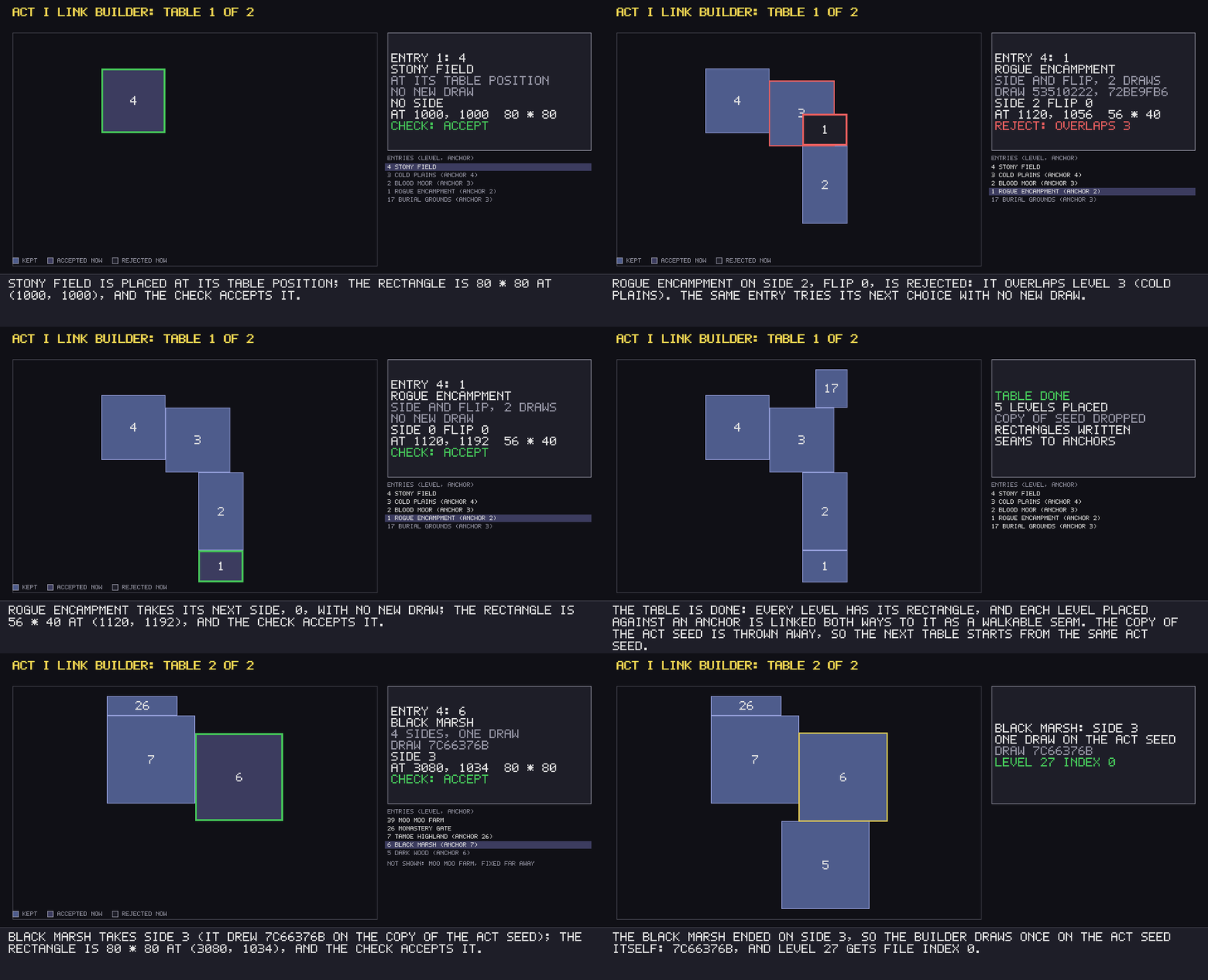
Step through drlg-act1-links-c0ffee
Act I’s two link tables for an illustrative map seed, one placement per frame. Each entry places one level’s rectangle against its anchor’s on a side that a draw on a copy of the act seed usually chooses; when the act’s check rejects the rectangle, the same entry tries its next choice, for most entries with no new draw (warps § B1). The check rejects a rectangle that overlaps one already placed; in Act I it also rejects a side of the Rogue Encampment that the table of allowed sides does not list, and a side of the Burial Grounds that another level placed against the Cold Plains holds (§ B3). Both tables start from the same act seed, so their first draws repeat one another (§ B1). Each level placed against an anchor gets a seam both ways to it, and when the Black Marsh ends on side 1 or 3 the builder makes its one draw on the act seed itself, which gives level 27’s file index (§ C1). Moo Moo Farm, which its table fixes far from the others, is left out of the picture. Seed: illustrative, an input of our own. Every value shown is computed by our model, not observed in the game.
Every side choice of every entry was reached in runs: besides one fully logged game, nine map seeds were chosen offline so that between them they end on every choice but two, those two were placed and logged, and their builds were replayed pick by pick. Two choices of the Rogue Encampment’s entry are placed and always rejected: its table of allowed sides cannot accept them, so the Rogue Encampment ends on one of the six other choices in every game. One more Act I test treats the Moo Moo Farm’s rectangle as 200 tiles longer toward lower y while it checks the other levels of its table. A reimplementation has to make that test, but on the shipped data it never decides a check; that is the code’s reading backed by an offline scan of every input the table can get, not a run.
Because each table starts from a copy of the same act seed, the first draws of different tables repeat one another. The builder also writes three things other generators read later: each level’s rectangle, the map file index of the Rogue Encampment and Lut Gholein (from the sides it chose), and the file index of level 27, the Courtyard. That index comes from the link builder’s only draw on the act seed itself, made after the layout while it writes the Black Marsh’s links, and only when the Black Marsh ends on side 1 or 3, each side with its own formula. When the Black Marsh ends on side 0, nothing is drawn or written, and the Courtyard keeps the index its own creation drew. All three cases were reached in runs, and the Courtyard was built with each of its indices 0, 1 and 2. One outcome of the side-1 formula, index 2, cannot happen with the shipped data: the Black Marsh’s side and the Courtyard’s draw come from the same random value, and side 1 is kept only when that value makes the formula give 1. For the same reason the Black Marsh never ends on side 2. Both points are the code’s reading, with every possible draw value enumerated, not something a run can show.
Each level carries eight link slots, Vis0..7 (the destination level) and Warp0..7 (which warp record). A slot
that names a level and whose Warp is −1 is a seam: a walkable border between two touching levels,
not stairs. An empty slot (Vis 0) also has Warp −1 and is no seam: the outdoor generators make no border for it. The link
builder writes a seam both ways between each placed level and its anchor; the seams of Act V, and of Act III’s
jungle levels, come from a “do these rectangles touch” test instead. Some levels also get a size from the builder that differs from the Levels table:
the Blood Moor is 56 × 96 or 96 × 56 depending on its side, and the Barricade-type levels of Act V are 64 × 160 or
160 × 64.
Choosing a generator
Section titled “Choosing a generator”Each level’s row in the Levels table names its generator, the DrlgType: 1 maze, 2 preset,
3 outdoor. The game dispatches on it twice, once when the level is created and once when it is built. Whatever the generator, its output is a list of DRLG
rooms, each with a position, a type, a seed and a DT1 mask: the bits that pick which tile files of
the level type the room’s tiles may come from.
DrlgType |
Generator | What it makes |
|---|---|---|
| 2 preset | one map file for the whole level | the map cut into 8 × 8 rooms, rows then columns |
| 1 maze | maze rooms grown edge to edge | each maze room turned into a preset, then freed |
| 3 outdoor | a grid of 8 × 8 cells | one outdoor room per free cell, or an embedded preset |
Preset levels
Section titled “Preset levels”A preset level is one hand-made map, a DS1 file. The LvlPrest table lists, per preset record, up to six files and
a Files count. When a preset instance is placed, one draw picks the file: Range(Files) on the level seed. Two details
matter for anyone reproducing it:
Filesis the operand, not the number of files the row names. A record withFiles1 still makes a draw; a record withFiles0 makes none.- The level’s own index wins. For the Rogue Encampment and Lut Gholein, and for the Courtyard when the Black Marsh ended on side 1 or 3, the link builder has already written the index, and that index is used instead of the draw. The draw is still made. Otherwise the level’s own index is the one its creation drew from the same seed value, so the two agree.
The map is then cut into 8 × 8 rooms, rows outer and columns inner; the Rogue Encampment (56 × 40) becomes 35 rooms
and a 24 × 24 preset 9. Each room costs one level draw. If the preset record has Scan or Pops set, the game also
reads the map before making the rooms and makes the preset’s keep/drop rolls on the level seed in between (see
What a preset places below). Those rolls therefore shift the seeds of every later room of the level.
Maze levels
Section titled “Maze levels”Caves, crypts, the Jail, the Catacombs, sewers, tombs and the other level types listed in
maze § F are mazes. The generator works with maze rooms, all of one
LvlMaze size (24 × 24 tiles in the Den of Evil), and builds a graph of them before any real room exists.
%3btext-align:center%3b%7d%23mermaid-1 .edgeLabel p%7bbackground-color:rgba(232%2c232%2c232%2c 0.8)%3b%7d%23mermaid-1 .edgeLabel rect%7bopacity:0.5%3bbackground-color:rgba(232%2c232%2c232%2c 0.8)%3bfill:rgba(232%2c232%2c232%2c 0.8)%3b%7d%23mermaid-1 .labelBkg%7bbackground-color:rgba(232%2c 232%2c 232%2c 0.5)%3b%7d%23mermaid-1 .cluster rect%7bfill:%23ffffde%3bstroke:%23aaaa33%3bstroke-width:1px%3b%7d%23mermaid-1 .cluster text%7bfill:%23333%3b%7d%23mermaid-1 .cluster span%7bcolor:%23333%3b%7d%23mermaid-1 .node .collapsed-indicator%7bfill:%23aaaa33%3bstroke:none%3bopacity:0.6%3b%7d%23mermaid-1 .node .collapsed-separator%7bstroke:%23aaaa33%3bstroke-width:0.75px%3b%7d%23mermaid-1 div.mermaidTooltip%7bposition:absolute%3btext-align:center%3bmax-width:200px%3bpadding:2px%3bfont-family:arial%2csans-serif%3bfont-size:12px%3bbackground:hsl(80%2c 100%25%2c 96.2745098039%25)%3bborder:1px solid %23aaaa33%3bborder-radius:2px%3bpointer-events:none%3bz-index:100%3b%7d%23mermaid-1 .flowchartTitleText%7btext-anchor:middle%3bfont-size:18px%3bfill:%23333%3b%7d%23mermaid-1 rect.text%7bfill:none%3bstroke-width:0%3b%7d%23mermaid-1 .icon-shape%2c%23mermaid-1 .image-shape%7bbackground-color:rgba(232%2c232%2c232%2c 0.8)%3btext-align:center%3b%7d%23mermaid-1 .icon-shape p%2c%23mermaid-1 .image-shape p%7bbackground-color:rgba(232%2c232%2c232%2c 0.8)%3bpadding:2px%3b%7d%23mermaid-1 .icon-shape .label rect%2c%23mermaid-1 .image-shape .label rect%7bopacity:0.5%3bbackground-color:rgba(232%2c232%2c232%2c 0.8)%3bfill:rgba(232%2c232%2c232%2c 0.8)%3b%7d%23mermaid-1 .label-icon%7bdisplay:inline-block%3bheight:1em%3boverflow:visible%3bvertical-align:-0.125em%3b%7d%23mermaid-1 .node .label-icon path%7bfill:currentColor%3bstroke:revert%3bstroke-width:revert%3b%7d%23mermaid-1 .node .neo-node%7bstroke:%239370DB%3b%7d%23mermaid-1 %5bdata-look='neo'%5d.node rect%2c%23mermaid-1 %5bdata-look='neo'%5d.cluster rect%2c%23mermaid-1 %5bdata-look='neo'%5d.node polygon%7bstroke:%239370DB%3bfilter:drop-shadow(1px 2px 2px rgba(185%2c 185%2c 185%2c 1))%3b%7d%23mermaid-1 %5bdata-look='neo'%5d.swimlane.cluster rect%7bfilter:none%3b%7d%23mermaid-1 %5bdata-look='neo'%5d.node path%7bstroke:%239370DB%3bstroke-width:1px%3b%7d%23mermaid-1 %5bdata-look='neo'%5d.node .outer-path%7bfilter:drop-shadow(1px 2px 2px rgba(185%2c 185%2c 185%2c 1))%3b%7d%23mermaid-1 %5bdata-look='neo'%5d.node .neo-line path%7bstroke:%239370DB%3bfilter:none%3b%7d%23mermaid-1 %5bdata-look='neo'%5d.node circle%7bstroke:%239370DB%3bfilter:drop-shadow(1px 2px 2px rgba(185%2c 185%2c 185%2c 1))%3b%7d%23mermaid-1 %5bdata-look='neo'%5d.node circle .state-start%7bfill:black%3b%7d%23mermaid-1 %5bdata-look='neo'%5d.icon-shape .icon%7bfill:%239370DB%3bfilter:drop-shadow(1px 2px 2px rgba(185%2c 185%2c 185%2c 1))%3b%7d%23mermaid-1 %5bdata-look='neo'%5d.icon-shape .icon-neo path%7bstroke:%239370DB%3bfilter:drop-shadow(1px 2px 2px rgba(185%2c 185%2c 185%2c 1))%3b%7d%23mermaid-1 :root%7b--mermaid-font-family:arial%2csans-serif%3b%7d%3c/style%3e%3cg%3e%3cmarker id='mermaid-1_flowchart-v2-pointEnd' class='marker flowchart-v2' viewBox='0 0 10 10' refX='5' refY='5' markerUnits='userSpaceOnUse' markerWidth='8' markerHeight='8' orient='auto'%3e%3cpath d='M 0 0 L 10 5 L 0 10 z' class='arrowMarkerPath' style='stroke-width: 1%3b stroke-dasharray: 1%2c 0%3b'/%3e%3c/marker%3e%3cmarker id='mermaid-1_flowchart-v2-pointStart' class='marker flowchart-v2' viewBox='0 0 10 10' refX='4.5' refY='5' markerUnits='userSpaceOnUse' markerWidth='8' markerHeight='8' orient='auto'%3e%3cpath d='M 0 5 L 10 10 L 10 0 z' class='arrowMarkerPath' style='stroke-width: 1%3b stroke-dasharray: 1%2c 0%3b'/%3e%3c/marker%3e%3cmarker id='mermaid-1_flowchart-v2-pointEnd-margin' class='marker flowchart-v2' viewBox='0 0 11.5 14' refX='11.5' refY='7' markerUnits='userSpaceOnUse' markerWidth='10.5' markerHeight='14' orient='auto'%3e%3cpath d='M 0 0 L 11.5 7 L 0 14 z' class='arrowMarkerPath' style='stroke-width: 0%3b stroke-dasharray: 1%2c 0%3b'/%3e%3c/marker%3e%3cmarker id='mermaid-1_flowchart-v2-pointStart-margin' class='marker flowchart-v2' viewBox='0 0 11.5 14' refX='1' refY='7' markerUnits='userSpaceOnUse' markerWidth='11.5' markerHeight='14' orient='auto'%3e%3cpolygon points='0%2c7 11.5%2c14 11.5%2c0' class='arrowMarkerPath' style='stroke-width: 0%3b stroke-dasharray: 1%2c 0%3b'/%3e%3c/marker%3e%3cmarker id='mermaid-1_flowchart-v2-circleEnd' class='marker flowchart-v2' viewBox='0 0 10 10' refX='11' refY='5' markerUnits='userSpaceOnUse' markerWidth='11' markerHeight='11' orient='auto'%3e%3ccircle cx='5' cy='5' r='5' class='arrowMarkerPath' style='stroke-width: 1%3b stroke-dasharray: 1%2c 0%3b'/%3e%3c/marker%3e%3cmarker id='mermaid-1_flowchart-v2-circleStart' class='marker flowchart-v2' viewBox='0 0 10 10' refX='-1' refY='5' markerUnits='userSpaceOnUse' markerWidth='11' markerHeight='11' orient='auto'%3e%3ccircle cx='5' cy='5' r='5' class='arrowMarkerPath' style='stroke-width: 1%3b stroke-dasharray: 1%2c 0%3b'/%3e%3c/marker%3e%3cmarker id='mermaid-1_flowchart-v2-circleEnd-margin' class='marker flowchart-v2' viewBox='0 0 10 10' refY='5' refX='12.25' markerUnits='userSpaceOnUse' markerWidth='14' markerHeight='14' orient='auto'%3e%3ccircle cx='5' cy='5' r='5' class='arrowMarkerPath' style='stroke-width: 0%3b stroke-dasharray: 1%2c 0%3b'/%3e%3c/marker%3e%3cmarker id='mermaid-1_flowchart-v2-circleStart-margin' class='marker flowchart-v2' viewBox='0 0 10 10' refX='-2' refY='5' markerUnits='userSpaceOnUse' markerWidth='14' markerHeight='14' orient='auto'%3e%3ccircle cx='5' cy='5' r='5' class='arrowMarkerPath' style='stroke-width: 0%3b stroke-dasharray: 1%2c 0%3b'/%3e%3c/marker%3e%3cmarker id='mermaid-1_flowchart-v2-crossEnd' class='marker cross flowchart-v2' viewBox='0 0 11 11' refX='12' refY='5.2' markerUnits='userSpaceOnUse' markerWidth='11' markerHeight='11' orient='auto'%3e%3cpath d='M 1%2c1 l 9%2c9 M 10%2c1 l -9%2c9' class='arrowMarkerPath' style='stroke-width: 2%3b stroke-dasharray: 1%2c 0%3b'/%3e%3c/marker%3e%3cmarker id='mermaid-1_flowchart-v2-crossStart' class='marker cross flowchart-v2' viewBox='0 0 11 11' refX='-1' refY='5.2' markerUnits='userSpaceOnUse' markerWidth='11' markerHeight='11' orient='auto'%3e%3cpath d='M 1%2c1 l 9%2c9 M 10%2c1 l -9%2c9' class='arrowMarkerPath' style='stroke-width: 2%3b stroke-dasharray: 1%2c 0%3b'/%3e%3c/marker%3e%3cmarker id='mermaid-1_flowchart-v2-crossEnd-margin' class='marker cross flowchart-v2' viewBox='0 0 15 15' refX='17.7' refY='7.5' markerUnits='userSpaceOnUse' markerWidth='12' markerHeight='12' orient='auto'%3e%3cpath d='M 1%2c1 L 14%2c14 M 1%2c14 L 14%2c1' class='arrowMarkerPath' style='stroke-width: 2.5%3b'/%3e%3c/marker%3e%3cmarker id='mermaid-1_flowchart-v2-crossStart-margin' class='marker cross flowchart-v2' viewBox='0 0 15 15' refX='-3.5' refY='7.5' markerUnits='userSpaceOnUse' markerWidth='12' markerHeight='12' orient='auto'%3e%3cpath d='M 1%2c1 L 14%2c14 M 1%2c14 L 14%2c1' class='arrowMarkerPath' style='stroke-width: 2.5%3b stroke-dasharray: 1%2c 0%3b'/%3e%3c/marker%3e%3cg class='root'%3e%3cg class='clusters'/%3e%3cg class='edgePaths'%3e%3cpath d='M138%2c86L138%2c90.167C138%2c94.333%2c138%2c102.667%2c138%2c110.333C138%2c118%2c138%2c125%2c138%2c128.5L138%2c132' id='mermaid-1-L_r0_st_0' class='edge-thickness-normal edge-pattern-solid edge-thickness-normal edge-pattern-solid flowchart-link' style='%3b' data-edge='true' data-et='edge' data-id='L_r0_st_0' data-points='W3sieCI6MTM4LCJ5Ijo4Nn0seyJ4IjoxMzgsInkiOjExMX0seyJ4IjoxMzgsInkiOjEzNn1d' data-look='classic' marker-end='url(%23mermaid-1_flowchart-v2-pointEnd)'/%3e%3cpath d='M138%2c238L138%2c242.167C138%2c246.333%2c138%2c254.667%2c138%2c262.333C138%2c270%2c138%2c277%2c138%2c280.5L138%2c284' id='mermaid-1-L_st_gr_0' class='edge-thickness-normal edge-pattern-solid edge-thickness-normal edge-pattern-solid flowchart-link' style='%3b' data-edge='true' data-et='edge' data-id='L_st_gr_0' data-points='W3sieCI6MTM4LCJ5IjoyMzh9LHsieCI6MTM4LCJ5IjoyNjN9LHsieCI6MTM4LCJ5IjoyODh9XQ==' data-look='classic' marker-end='url(%23mermaid-1_flowchart-v2-pointEnd)'/%3e%3cpath d='M138%2c390L138%2c394.167C138%2c398.333%2c138%2c406.667%2c138%2c414.333C138%2c422%2c138%2c429%2c138%2c432.5L138%2c436' id='mermaid-1-L_gr_fin_0' class='edge-thickness-normal edge-pattern-solid edge-thickness-normal edge-pattern-solid flowchart-link' style='%3b' data-edge='true' data-et='edge' data-id='L_gr_fin_0' data-points='W3sieCI6MTM4LCJ5IjozOTB9LHsieCI6MTM4LCJ5Ijo0MTV9LHsieCI6MTM4LCJ5Ijo0NDB9XQ==' data-look='classic' marker-end='url(%23mermaid-1_flowchart-v2-pointEnd)'/%3e%3cpath d='M138%2c542L138%2c546.167C138%2c550.333%2c138%2c558.667%2c138%2c566.333C138%2c574%2c138%2c581%2c138%2c584.5L138%2c588' id='mermaid-1-L_fin_pl_0' class='edge-thickness-normal edge-pattern-solid edge-thickness-normal edge-pattern-solid flowchart-link' style='%3b' data-edge='true' data-et='edge' data-id='L_fin_pl_0' data-points='W3sieCI6MTM4LCJ5Ijo1NDJ9LHsieCI6MTM4LCJ5Ijo1Njd9LHsieCI6MTM4LCJ5Ijo1OTJ9XQ==' data-look='classic' marker-end='url(%23mermaid-1_flowchart-v2-pointEnd)'/%3e%3cpath d='M138%2c694L138%2c698.167C138%2c702.333%2c138%2c710.667%2c138%2c718.333C138%2c726%2c138%2c733%2c138%2c736.5L138%2c740' id='mermaid-1-L_pl_th_0' class='edge-thickness-normal edge-pattern-solid edge-thickness-normal edge-pattern-solid flowchart-link' style='%3b' data-edge='true' data-et='edge' data-id='L_pl_th_0' data-points='W3sieCI6MTM4LCJ5Ijo2OTR9LHsieCI6MTM4LCJ5Ijo3MTl9LHsieCI6MTM4LCJ5Ijo3NDR9XQ==' data-look='classic' marker-end='url(%23mermaid-1_flowchart-v2-pointEnd)'/%3e%3cpath d='M138%2c846L138%2c850.167C138%2c854.333%2c138%2c862.667%2c138%2c870.333C138%2c878%2c138%2c885%2c138%2c888.5L138%2c892' id='mermaid-1-L_th_cv_0' class='edge-thickness-normal edge-pattern-solid edge-thickness-normal edge-pattern-solid flowchart-link' style='%3b' data-edge='true' data-et='edge' data-id='L_th_cv_0' data-points='W3sieCI6MTM4LCJ5Ijo4NDZ9LHsieCI6MTM4LCJ5Ijo4NzF9LHsieCI6MTM4LCJ5Ijo4OTZ9XQ==' data-look='classic' marker-end='url(%23mermaid-1_flowchart-v2-pointEnd)'/%3e%3c/g%3e%3cg class='edgeLabels'%3e%3cg class='edgeLabel'%3e%3cg class='label' data-id='L_r0_st_0' transform='translate(0%2c 0)'%3e%3cforeignObject width='0' height='0'%3e%3cdiv xmlns='http://www.w3.org/1999/xhtml' class='labelBkg' style='display: table-cell%3b white-space: nowrap%3b line-height: 1.5%3b max-width: 200px%3b text-align: center%3b'%3e%3cspan class='edgeLabel'%3e%3c/span%3e%3c/div%3e%3c/foreignObject%3e%3c/g%3e%3c/g%3e%3cg class='edgeLabel'%3e%3cg class='label' data-id='L_st_gr_0' transform='translate(0%2c 0)'%3e%3cforeignObject width='0' height='0'%3e%3cdiv xmlns='http://www.w3.org/1999/xhtml' class='labelBkg' style='display: table-cell%3b white-space: nowrap%3b line-height: 1.5%3b max-width: 200px%3b text-align: center%3b'%3e%3cspan class='edgeLabel'%3e%3c/span%3e%3c/div%3e%3c/foreignObject%3e%3c/g%3e%3c/g%3e%3cg class='edgeLabel'%3e%3cg class='label' data-id='L_gr_fin_0' transform='translate(0%2c 0)'%3e%3cforeignObject width='0' height='0'%3e%3cdiv xmlns='http://www.w3.org/1999/xhtml' class='labelBkg' style='display: table-cell%3b white-space: nowrap%3b line-height: 1.5%3b max-width: 200px%3b text-align: center%3b'%3e%3cspan class='edgeLabel'%3e%3c/span%3e%3c/div%3e%3c/foreignObject%3e%3c/g%3e%3c/g%3e%3cg class='edgeLabel'%3e%3cg class='label' data-id='L_fin_pl_0' transform='translate(0%2c 0)'%3e%3cforeignObject width='0' height='0'%3e%3cdiv xmlns='http://www.w3.org/1999/xhtml' class='labelBkg' style='display: table-cell%3b white-space: nowrap%3b line-height: 1.5%3b max-width: 200px%3b text-align: center%3b'%3e%3cspan class='edgeLabel'%3e%3c/span%3e%3c/div%3e%3c/foreignObject%3e%3c/g%3e%3c/g%3e%3cg class='edgeLabel'%3e%3cg class='label' data-id='L_pl_th_0' transform='translate(0%2c 0)'%3e%3cforeignObject width='0' height='0'%3e%3cdiv xmlns='http://www.w3.org/1999/xhtml' class='labelBkg' style='display: table-cell%3b white-space: nowrap%3b line-height: 1.5%3b max-width: 200px%3b text-align: center%3b'%3e%3cspan class='edgeLabel'%3e%3c/span%3e%3c/div%3e%3c/foreignObject%3e%3c/g%3e%3c/g%3e%3cg class='edgeLabel'%3e%3cg class='label' data-id='L_th_cv_0' transform='translate(0%2c 0)'%3e%3cforeignObject width='0' height='0'%3e%3cdiv xmlns='http://www.w3.org/1999/xhtml' class='labelBkg' style='display: table-cell%3b white-space: nowrap%3b line-height: 1.5%3b max-width: 200px%3b text-align: center%3b'%3e%3cspan class='edgeLabel'%3e%3c/span%3e%3c/div%3e%3c/foreignObject%3e%3c/g%3e%3c/g%3e%3c/g%3e%3cg class='nodes'%3e%3cg class='node default' id='mermaid-1-flowchart-r0-0' data-look='classic' transform='translate(138%2c 47)'%3e%3crect class='basic label-container' style='' x='-130' y='-39' width='260' height='78'/%3e%3cg class='label' style='' transform='translate(-100%2c -24)'%3e%3crect/%3e%3cforeignObject width='200' height='48'%3e%3cdiv xmlns='http://www.w3.org/1999/xhtml' style='display: table%3b white-space: break-spaces%3b line-height: 1.5%3b max-width: 200px%3b text-align: center%3b width: 200px%3b'%3e%3cspan class='nodeLabel'%3e%3cp%3eFirst room%2c centred in the level: one level draw%3c/p%3e%3c/span%3e%3c/div%3e%3c/foreignObject%3e%3c/g%3e%3c/g%3e%3cg class='node default' id='mermaid-1-flowchart-st-1' data-look='classic' transform='translate(138%2c 187)'%3e%3crect class='basic label-container' style='' x='-130' y='-51' width='260' height='102'/%3e%3cg class='label' style='' transform='translate(-100%2c -36)'%3e%3crect/%3e%3cforeignObject width='200' height='72'%3e%3cdiv xmlns='http://www.w3.org/1999/xhtml' style='display: table%3b white-space: break-spaces%3b line-height: 1.5%3b max-width: 200px%3b text-align: center%3b width: 200px%3b'%3e%3cspan class='nodeLabel'%3e%3cp%3eStart shape for some level types: ring%2c tee%2c Catacombs%2c Arcane%2c hell%3c/p%3e%3c/span%3e%3c/div%3e%3c/foreignObject%3e%3c/g%3e%3c/g%3e%3cg class='node default' id='mermaid-1-flowchart-gr-2' data-look='classic' transform='translate(138%2c 339)'%3e%3crect class='basic label-container' style='' x='-130' y='-51' width='260' height='102'/%3e%3cg class='label' style='' transform='translate(-100%2c -36)'%3e%3crect/%3e%3cforeignObject width='200' height='72'%3e%3cdiv xmlns='http://www.w3.org/1999/xhtml' style='display: table%3b white-space: break-spaces%3b line-height: 1.5%3b max-width: 200px%3b text-align: center%3b width: 200px%3b'%3e%3cspan class='nodeLabel'%3e%3cp%3eRandom growth until Rooms per difficulty is reached%3c/p%3e%3c/span%3e%3c/div%3e%3c/foreignObject%3e%3c/g%3e%3c/g%3e%3cg class='node default' id='mermaid-1-flowchart-fin-3' data-look='classic' transform='translate(138%2c 491)'%3e%3crect class='basic label-container' style='' x='-130' y='-51' width='260' height='102'/%3e%3cg class='label' style='' transform='translate(-100%2c -36)'%3e%3crect/%3e%3cforeignObject width='200' height='72'%3e%3cdiv xmlns='http://www.w3.org/1999/xhtml' style='display: table%3b white-space: break-spaces%3b line-height: 1.5%3b max-width: 200px%3b text-align: center%3b width: 200px%3b'%3e%3cspan class='nodeLabel'%3e%3cp%3eFinisher: one draw r%2c then special rooms: stairs%2c waypoint%2c quest rooms%3c/p%3e%3c/span%3e%3c/div%3e%3c/foreignObject%3e%3c/g%3e%3c/g%3e%3cg class='node default' id='mermaid-1-flowchart-pl-4' data-look='classic' transform='translate(138%2c 643)'%3e%3crect class='basic label-container' style='' x='-130' y='-51' width='260' height='102'/%3e%3cg class='label' style='' transform='translate(-100%2c -36)'%3e%3crect/%3e%3cforeignObject width='200' height='72'%3e%3cdiv xmlns='http://www.w3.org/1999/xhtml' style='display: table%3b white-space: break-spaces%3b line-height: 1.5%3b max-width: 200px%3b text-align: center%3b width: 200px%3b'%3e%3cspan class='nodeLabel'%3e%3cp%3eShift the rooms to the level origin%3b levels 28 and 107 attach to a neighbour level%3c/p%3e%3c/span%3e%3c/div%3e%3c/foreignObject%3e%3c/g%3e%3c/g%3e%3cg class='node default' id='mermaid-1-flowchart-th-5' data-look='classic' transform='translate(138%2c 795)'%3e%3crect class='basic label-container' style='' x='-130' y='-51' width='260' height='102'/%3e%3cg class='label' style='' transform='translate(-100%2c -36)'%3e%3crect/%3e%3cforeignObject width='200' height='72'%3e%3cdiv xmlns='http://www.w3.org/1999/xhtml' style='display: table%3b white-space: break-spaces%3b line-height: 1.5%3b max-width: 200px%3b text-align: center%3b width: 200px%3b'%3e%3cspan class='nodeLabel'%3e%3cp%3eThemes: some unlocked rooms become Theme rooms%2c 31 level draws%3c/p%3e%3c/span%3e%3c/div%3e%3c/foreignObject%3e%3c/g%3e%3c/g%3e%3cg class='node default' id='mermaid-1-flowchart-cv-6' data-look='classic' transform='translate(138%2c 947)'%3e%3crect class='basic label-container' style='' x='-130' y='-51' width='260' height='102'/%3e%3cg class='label' style='' transform='translate(-100%2c -36)'%3e%3crect/%3e%3cforeignObject width='200' height='72'%3e%3cdiv xmlns='http://www.w3.org/1999/xhtml' style='display: table%3b white-space: break-spaces%3b line-height: 1.5%3b max-width: 200px%3b text-align: center%3b width: 200px%3b'%3e%3cspan class='nodeLabel'%3e%3cp%3eEach maze room becomes a preset instance%2c newest first%2c and is freed%3c/p%3e%3c/span%3e%3c/div%3e%3c/foreignObject%3e%3c/g%3e%3c/g%3e%3c/g%3e%3c/g%3e%3c/g%3e%3cdefs%3e%3cfilter id='mermaid-1-drop-shadow' height='130%25' width='130%25'%3e%3cfeDropShadow dx='4' dy='4' stdDeviation='0' flood-opacity='0.06' flood-color='black'/%3e%3c/filter%3e%3c/defs%3e%3cdefs%3e%3cfilter id='mermaid-1-drop-shadow-small' height='150%25' width='150%25'%3e%3cfeDropShadow dx='2' dy='2' stdDeviation='0' flood-opacity='0.06' flood-color='black'/%3e%3c/filter%3e%3c/defs%3e%3c/svg%3e)
Growth. While the level has fewer rooms than its Rooms
count for the difficulty, the game picks an existing room with a level draw, then picks a direction with a draw on
that room’s own seed, and tries to put a new room there. A new room that would overlap is freed, but all its
draws are spent. A new room also checks the other rooms it shares an edge with (not its parent, and no locked room)
and may link to each (the Merge chance, out of 1000); that check draws on the other room’s seed even when Merge is 0 or 1000, which changes the
direction that room will draw next. Two of Act II’s seven tombs,
chosen when the act is created, grow larger: the true tomb to three times its Rooms count and Kaa’s tomb to twice
it (a game whose tombs have 6 grew them to 18 and 12 rooms). By the code the two choices always differ, since the act
draws again while they are equal.
Map pieces from exits. Each maze room gets its LvlPrest
record from its exits: on most level types, a bit per side (west 1, east 2, south 4, north 8) added to the level
type’s base record; a few level types use small fixed tables instead. A room with only a west exit in the Den of Evil’s level
type, for example, is record 53, Cave W.
Special rooms. After growth, a special room
pass places the level’s Prev and Next stairs, waypoint and quest rooms. Each special replaces a dead end facing the
right way if one exists; otherwise a new room is attached. On most level types a single draw r picks the starting
entry of the special tables (the tombs take it from their start shape instead, with no draw), and each following special moves to the next entry, so consecutive specials face different directions. Which specials
each level type places is a table in maze § F, and every row of
it was built in runs and matched room for room, the tombs’ Tal Rasha and Kaa entries and Lair 64 included, with two
kinds of exception. Levels 133 and 135 have no build in the stock game. Tombs 69 and 72 were not built, but the code
gives a tomb no path of its own: it follows the tomb’s role (true tomb, Kaa’s or plain), and all three roles were
built. A special that no room can take was met in none of 337 logged attaches; by the code, nothing is placed then.
Placement and themes.
Growth ignores the level rectangle; afterwards all rooms are shifted so their bounding box sits at the level’s
origin. The Barracks (28) and the River of Flame (107) are instead attached to a neighbour level (the Courtyard, the
Chaos Sanctuary) and set their own rectangle. The Barracks’ side comes from the Courtyard’s file index as the link
builder left it: index 0 puts the connection to the Courtyard on the
maze’s east side, 1 on its south side and 2 on its west side, each by its own search for the outermost room, and all
three were built in runs. Finally the theme pass locks up to max(2, rooms ÷ 5 + 1) unlocked
rooms, of any exit shape except the four-way one, as their … Theme … records. It always makes 31 level draws on level types that have themes, whatever it
finds (the Den of Evil skips the pass). The specials come first, so a dead end gets a theme only if no special took it.
Conversion. Each maze room then becomes a
preset instance (one file draw when Files is at least 1, as for preset levels). A forced index can override the
draw, and on some level types a file rotation does: the first use of a record in a build draws a start value, and each use, the first included, takes the next
file. A maze room of up to 12 × 12 becomes a single room; a larger one is cut into 8 × 8 rooms. The maze rooms are
then freed, so a maze level’s real rooms are all preset rooms.
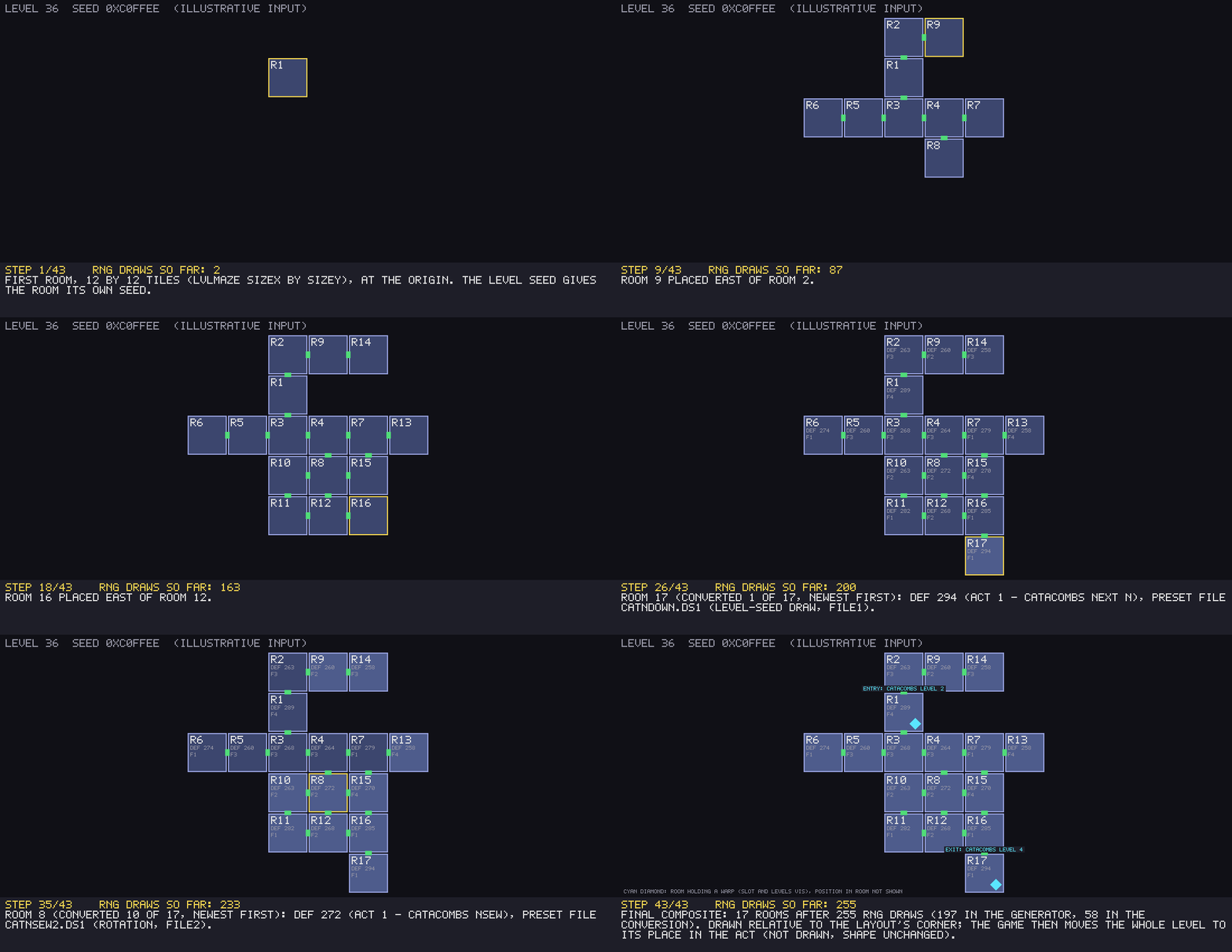
Step through drlg-maze-level36
Catacombs Level 3 (level 36) built room by room. A level draw picks the start shape’s two arms on the locked first room (maze § E3); growth then picks a parent room with a level draw and a side with a draw on that parent’s own seed, and each new room may link to the rooms it shares an edge with by a Merge roll on their seeds (§ C, § B); each room’s Def is the level type’s base plus its exit bits (§ B); each special takes a dead end facing the right way or attaches a new room, then the theme pass locks up to max(2, rooms ÷ 5 + 1) rooms as their Theme records (§ D, § H). Every value shown is computed by our replay model, not observed in the game, and the seed is an illustrative input, not a level seed a game produces. The last steps convert the rooms newest first and name each room’s preset file as the overview’s step 9 picks it: each instance first draws an index over Files on the level seed (9a); a forced index replaces it if the room has one, else, for a Def strictly between the level type’s rotation base and base + 16, the level type’s per-build file rotation does (9b) (drlg overview, steps 9a and 9b). Seed: illustrative, an input of our own. Every value shown is computed by our model, not observed in the game.
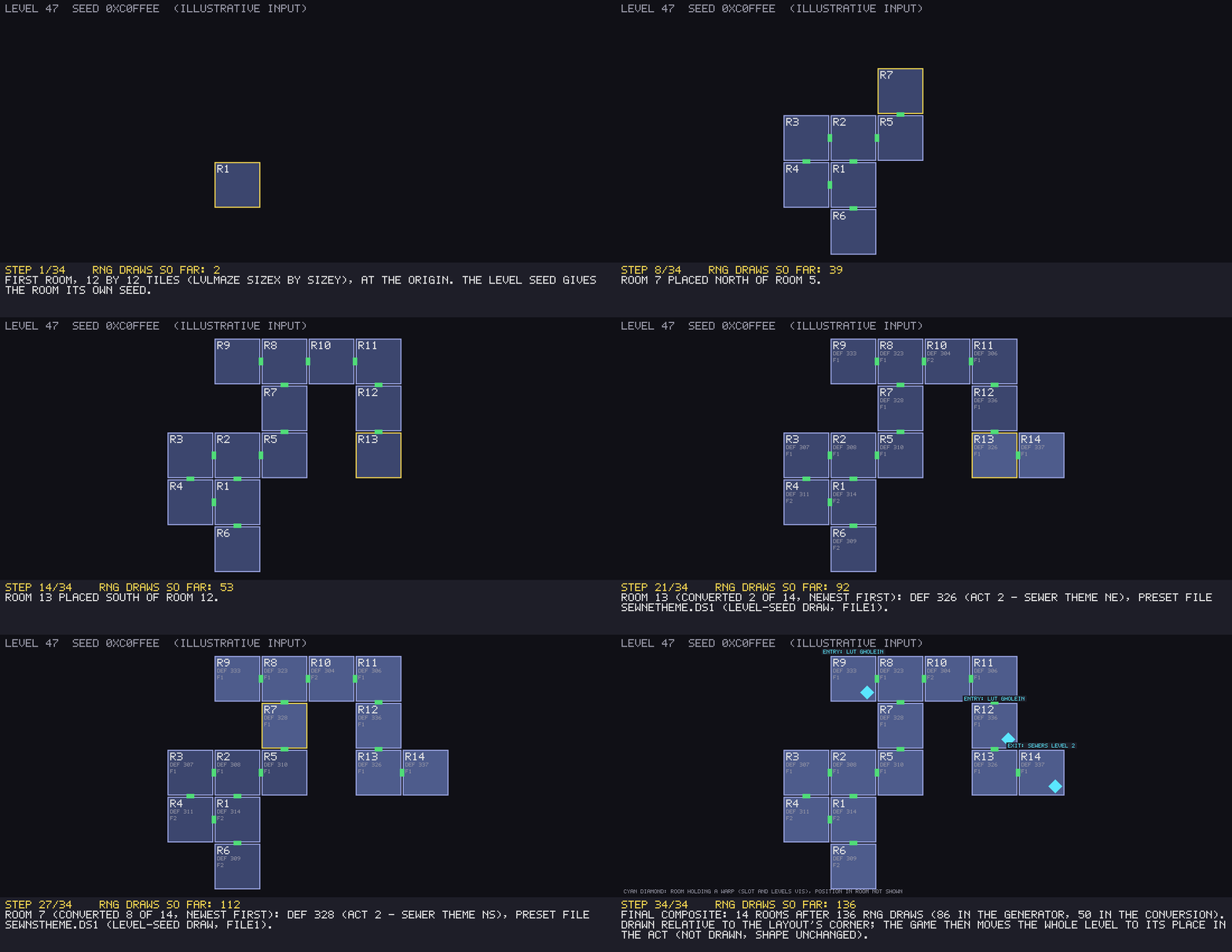
Step through drlg-maze-level47
Sewers Level 1 (level 47) built room by room, for a different start shape and theme count than the Catacombs level. This level starts with a ring: rooms grown north, west and south of the first room and joined back to it, where the Catacombs level starts with two arms (maze § E1, § E3). Random growth follows (§ C), then the Sewers finisher’s dock path: two rooms grown north and two east, each pair ending in a fixed, locked room (the previous-level room and the dock), a free room below the dock, and the next-level special attached as a new room, which recomputes its parent’s Def (§ F2, § D). The theme pass locks up to max(2, rooms ÷ 5 + 1) free rooms as their Theme records, here three of fourteen rooms where the Catacombs level has four of seventeen (§ H). Seed: illustrative, an input of our own. Every value shown is computed by our model, not observed in the game.
Outdoor levels
Section titled “Outdoor levels”The outdoor levels are those listed per act in outdoor § A: Act I’s wilderness (levels 2–7), the Burial Grounds and the Moo Moo Farm, Act II’s 41–46, Act III’s jungle 76–83, Act IV’s 104–106 and 108, and Act V’s 110–112 and 117. The level is a grid of outdoor cells, each 8 × 8 tiles. Each act has its own generator, which marks what each cell is: border, seam opening, road, waypoint, shrine, covered, or part of a placed preset.
%3btext-align:center%3b%7d%23mermaid-2 .edgeLabel p%7bbackground-color:rgba(232%2c232%2c232%2c 0.8)%3b%7d%23mermaid-2 .edgeLabel rect%7bopacity:0.5%3bbackground-color:rgba(232%2c232%2c232%2c 0.8)%3bfill:rgba(232%2c232%2c232%2c 0.8)%3b%7d%23mermaid-2 .labelBkg%7bbackground-color:rgba(232%2c 232%2c 232%2c 0.5)%3b%7d%23mermaid-2 .cluster rect%7bfill:%23ffffde%3bstroke:%23aaaa33%3bstroke-width:1px%3b%7d%23mermaid-2 .cluster text%7bfill:%23333%3b%7d%23mermaid-2 .cluster span%7bcolor:%23333%3b%7d%23mermaid-2 .node .collapsed-indicator%7bfill:%23aaaa33%3bstroke:none%3bopacity:0.6%3b%7d%23mermaid-2 .node .collapsed-separator%7bstroke:%23aaaa33%3bstroke-width:0.75px%3b%7d%23mermaid-2 div.mermaidTooltip%7bposition:absolute%3btext-align:center%3bmax-width:200px%3bpadding:2px%3bfont-family:arial%2csans-serif%3bfont-size:12px%3bbackground:hsl(80%2c 100%25%2c 96.2745098039%25)%3bborder:1px solid %23aaaa33%3bborder-radius:2px%3bpointer-events:none%3bz-index:100%3b%7d%23mermaid-2 .flowchartTitleText%7btext-anchor:middle%3bfont-size:18px%3bfill:%23333%3b%7d%23mermaid-2 rect.text%7bfill:none%3bstroke-width:0%3b%7d%23mermaid-2 .icon-shape%2c%23mermaid-2 .image-shape%7bbackground-color:rgba(232%2c232%2c232%2c 0.8)%3btext-align:center%3b%7d%23mermaid-2 .icon-shape p%2c%23mermaid-2 .image-shape p%7bbackground-color:rgba(232%2c232%2c232%2c 0.8)%3bpadding:2px%3b%7d%23mermaid-2 .icon-shape .label rect%2c%23mermaid-2 .image-shape .label rect%7bopacity:0.5%3bbackground-color:rgba(232%2c232%2c232%2c 0.8)%3bfill:rgba(232%2c232%2c232%2c 0.8)%3b%7d%23mermaid-2 .label-icon%7bdisplay:inline-block%3bheight:1em%3boverflow:visible%3bvertical-align:-0.125em%3b%7d%23mermaid-2 .node .label-icon path%7bfill:currentColor%3bstroke:revert%3bstroke-width:revert%3b%7d%23mermaid-2 .node .neo-node%7bstroke:%239370DB%3b%7d%23mermaid-2 %5bdata-look='neo'%5d.node rect%2c%23mermaid-2 %5bdata-look='neo'%5d.cluster rect%2c%23mermaid-2 %5bdata-look='neo'%5d.node polygon%7bstroke:%239370DB%3bfilter:drop-shadow(1px 2px 2px rgba(185%2c 185%2c 185%2c 1))%3b%7d%23mermaid-2 %5bdata-look='neo'%5d.swimlane.cluster rect%7bfilter:none%3b%7d%23mermaid-2 %5bdata-look='neo'%5d.node path%7bstroke:%239370DB%3bstroke-width:1px%3b%7d%23mermaid-2 %5bdata-look='neo'%5d.node .outer-path%7bfilter:drop-shadow(1px 2px 2px rgba(185%2c 185%2c 185%2c 1))%3b%7d%23mermaid-2 %5bdata-look='neo'%5d.node .neo-line path%7bstroke:%239370DB%3bfilter:none%3b%7d%23mermaid-2 %5bdata-look='neo'%5d.node circle%7bstroke:%239370DB%3bfilter:drop-shadow(1px 2px 2px rgba(185%2c 185%2c 185%2c 1))%3b%7d%23mermaid-2 %5bdata-look='neo'%5d.node circle .state-start%7bfill:black%3b%7d%23mermaid-2 %5bdata-look='neo'%5d.icon-shape .icon%7bfill:%239370DB%3bfilter:drop-shadow(1px 2px 2px rgba(185%2c 185%2c 185%2c 1))%3b%7d%23mermaid-2 %5bdata-look='neo'%5d.icon-shape .icon-neo path%7bstroke:%239370DB%3bfilter:drop-shadow(1px 2px 2px rgba(185%2c 185%2c 185%2c 1))%3b%7d%23mermaid-2 :root%7b--mermaid-font-family:arial%2csans-serif%3b%7d%3c/style%3e%3cg%3e%3cmarker id='mermaid-2_flowchart-v2-pointEnd' class='marker flowchart-v2' viewBox='0 0 10 10' refX='5' refY='5' markerUnits='userSpaceOnUse' markerWidth='8' markerHeight='8' orient='auto'%3e%3cpath d='M 0 0 L 10 5 L 0 10 z' class='arrowMarkerPath' style='stroke-width: 1%3b stroke-dasharray: 1%2c 0%3b'/%3e%3c/marker%3e%3cmarker id='mermaid-2_flowchart-v2-pointStart' class='marker flowchart-v2' viewBox='0 0 10 10' refX='4.5' refY='5' markerUnits='userSpaceOnUse' markerWidth='8' markerHeight='8' orient='auto'%3e%3cpath d='M 0 5 L 10 10 L 10 0 z' class='arrowMarkerPath' style='stroke-width: 1%3b stroke-dasharray: 1%2c 0%3b'/%3e%3c/marker%3e%3cmarker id='mermaid-2_flowchart-v2-pointEnd-margin' class='marker flowchart-v2' viewBox='0 0 11.5 14' refX='11.5' refY='7' markerUnits='userSpaceOnUse' markerWidth='10.5' markerHeight='14' orient='auto'%3e%3cpath d='M 0 0 L 11.5 7 L 0 14 z' class='arrowMarkerPath' style='stroke-width: 0%3b stroke-dasharray: 1%2c 0%3b'/%3e%3c/marker%3e%3cmarker id='mermaid-2_flowchart-v2-pointStart-margin' class='marker flowchart-v2' viewBox='0 0 11.5 14' refX='1' refY='7' markerUnits='userSpaceOnUse' markerWidth='11.5' markerHeight='14' orient='auto'%3e%3cpolygon points='0%2c7 11.5%2c14 11.5%2c0' class='arrowMarkerPath' style='stroke-width: 0%3b stroke-dasharray: 1%2c 0%3b'/%3e%3c/marker%3e%3cmarker id='mermaid-2_flowchart-v2-circleEnd' class='marker flowchart-v2' viewBox='0 0 10 10' refX='11' refY='5' markerUnits='userSpaceOnUse' markerWidth='11' markerHeight='11' orient='auto'%3e%3ccircle cx='5' cy='5' r='5' class='arrowMarkerPath' style='stroke-width: 1%3b stroke-dasharray: 1%2c 0%3b'/%3e%3c/marker%3e%3cmarker id='mermaid-2_flowchart-v2-circleStart' class='marker flowchart-v2' viewBox='0 0 10 10' refX='-1' refY='5' markerUnits='userSpaceOnUse' markerWidth='11' markerHeight='11' orient='auto'%3e%3ccircle cx='5' cy='5' r='5' class='arrowMarkerPath' style='stroke-width: 1%3b stroke-dasharray: 1%2c 0%3b'/%3e%3c/marker%3e%3cmarker id='mermaid-2_flowchart-v2-circleEnd-margin' class='marker flowchart-v2' viewBox='0 0 10 10' refY='5' refX='12.25' markerUnits='userSpaceOnUse' markerWidth='14' markerHeight='14' orient='auto'%3e%3ccircle cx='5' cy='5' r='5' class='arrowMarkerPath' style='stroke-width: 0%3b stroke-dasharray: 1%2c 0%3b'/%3e%3c/marker%3e%3cmarker id='mermaid-2_flowchart-v2-circleStart-margin' class='marker flowchart-v2' viewBox='0 0 10 10' refX='-2' refY='5' markerUnits='userSpaceOnUse' markerWidth='14' markerHeight='14' orient='auto'%3e%3ccircle cx='5' cy='5' r='5' class='arrowMarkerPath' style='stroke-width: 0%3b stroke-dasharray: 1%2c 0%3b'/%3e%3c/marker%3e%3cmarker id='mermaid-2_flowchart-v2-crossEnd' class='marker cross flowchart-v2' viewBox='0 0 11 11' refX='12' refY='5.2' markerUnits='userSpaceOnUse' markerWidth='11' markerHeight='11' orient='auto'%3e%3cpath d='M 1%2c1 l 9%2c9 M 10%2c1 l -9%2c9' class='arrowMarkerPath' style='stroke-width: 2%3b stroke-dasharray: 1%2c 0%3b'/%3e%3c/marker%3e%3cmarker id='mermaid-2_flowchart-v2-crossStart' class='marker cross flowchart-v2' viewBox='0 0 11 11' refX='-1' refY='5.2' markerUnits='userSpaceOnUse' markerWidth='11' markerHeight='11' orient='auto'%3e%3cpath d='M 1%2c1 l 9%2c9 M 10%2c1 l -9%2c9' class='arrowMarkerPath' style='stroke-width: 2%3b stroke-dasharray: 1%2c 0%3b'/%3e%3c/marker%3e%3cmarker id='mermaid-2_flowchart-v2-crossEnd-margin' class='marker cross flowchart-v2' viewBox='0 0 15 15' refX='17.7' refY='7.5' markerUnits='userSpaceOnUse' markerWidth='12' markerHeight='12' orient='auto'%3e%3cpath d='M 1%2c1 L 14%2c14 M 1%2c14 L 14%2c1' class='arrowMarkerPath' style='stroke-width: 2.5%3b'/%3e%3c/marker%3e%3cmarker id='mermaid-2_flowchart-v2-crossStart-margin' class='marker cross flowchart-v2' viewBox='0 0 15 15' refX='-3.5' refY='7.5' markerUnits='userSpaceOnUse' markerWidth='12' markerHeight='12' orient='auto'%3e%3cpath d='M 1%2c1 L 14%2c14 M 1%2c14 L 14%2c1' class='arrowMarkerPath' style='stroke-width: 2.5%3b stroke-dasharray: 1%2c 0%3b'/%3e%3c/marker%3e%3cg class='root'%3e%3cg class='clusters'/%3e%3cg class='edgePaths'%3e%3cpath d='M758%2c110L758%2c114.167C758%2c118.333%2c758%2c126.667%2c758%2c134.333C758%2c142%2c758%2c149%2c758%2c152.5L758%2c156' id='mermaid-2-L_ring_sw_0' class='edge-thickness-normal edge-pattern-solid edge-thickness-normal edge-pattern-solid flowchart-link' style='%3b' data-edge='true' data-et='edge' data-id='L_ring_sw_0' data-points='W3sieCI6NzU4LCJ5IjoxMTB9LHsieCI6NzU4LCJ5IjoxMzV9LHsieCI6NzU4LCJ5IjoxNjB9XQ==' data-look='classic' marker-end='url(%23mermaid-2_flowchart-v2-pointEnd)'/%3e%3cpath d='M723.627%2c202.752L626.022%2c214.647C528.418%2c226.543%2c333.209%2c250.334%2c235.604%2c269.729C138%2c289.125%2c138%2c304.125%2c138%2c311.625L138%2c319.125' id='mermaid-2-L_sw_a1_0' class='edge-thickness-normal edge-pattern-solid edge-thickness-normal edge-pattern-solid flowchart-link' style='%3b' data-edge='true' data-et='edge' data-id='L_sw_a1_0' data-points='W3sieCI6NzIzLjYyNjc0MDk0NzA3NTIsInkiOjIwMi43NTE3NDA5NDcwNzUyfSx7IngiOjEzOCwieSI6Mjc0LjEyNX0seyJ4IjoxMzgsInkiOjMyMy4xMjV9XQ==' data-look='classic' marker-end='url(%23mermaid-2_flowchart-v2-pointEnd)'/%3e%3cpath d='M726.995%2c206.12L680.496%2c217.454C633.997%2c228.788%2c540.998%2c251.457%2c494.499%2c268.291C448%2c285.125%2c448%2c296.125%2c448%2c301.625L448%2c307.125' id='mermaid-2-L_sw_a2_0' class='edge-thickness-normal edge-pattern-solid edge-thickness-normal edge-pattern-solid flowchart-link' style='%3b' data-edge='true' data-et='edge' data-id='L_sw_a2_0' data-points='W3sieCI6NzI2Ljk5NDk3NDg3NDM3MTksInkiOjIwNi4xMTk5NzQ4NzQzNzE4NX0seyJ4Ijo0NDgsInkiOjI3NC4xMjV9LHsieCI6NDQ4LCJ5IjozMTEuMTI1fV0=' data-look='classic' marker-end='url(%23mermaid-2_flowchart-v2-pointEnd)'/%3e%3cpath d='M758%2c237.125L758%2c243.292C758%2c249.458%2c758%2c261.792%2c758%2c275.458C758%2c289.125%2c758%2c304.125%2c758%2c311.625L758%2c319.125' id='mermaid-2-L_sw_a3_0' class='edge-thickness-normal edge-pattern-solid edge-thickness-normal edge-pattern-solid flowchart-link' style='%3b' data-edge='true' data-et='edge' data-id='L_sw_a3_0' data-points='W3sieCI6NzU4LCJ5IjoyMzcuMTI1fSx7IngiOjc1OCwieSI6Mjc0LjEyNX0seyJ4Ijo3NTgsInkiOjMyMy4xMjV9XQ==' data-look='classic' marker-end='url(%23mermaid-2_flowchart-v2-pointEnd)'/%3e%3cpath d='M789.005%2c206.12L835.504%2c217.454C882.003%2c228.788%2c975.002%2c251.457%2c1021.501%2c270.291C1068%2c289.125%2c1068%2c304.125%2c1068%2c311.625L1068%2c319.125' id='mermaid-2-L_sw_a4_0' class='edge-thickness-normal edge-pattern-solid edge-thickness-normal edge-pattern-solid flowchart-link' style='%3b' data-edge='true' data-et='edge' data-id='L_sw_a4_0' data-points='W3sieCI6Nzg5LjAwNTAyNTEyNTYyODEsInkiOjIwNi4xMTk5NzQ4NzQzNzE4NX0seyJ4IjoxMDY4LCJ5IjoyNzQuMTI1fSx7IngiOjEwNjgsInkiOjMyMy4xMjV9XQ==' data-look='classic' marker-end='url(%23mermaid-2_flowchart-v2-pointEnd)'/%3e%3cpath d='M792.373%2c202.752L889.978%2c214.647C987.582%2c226.543%2c1182.791%2c250.334%2c1280.396%2c269.729C1378%2c289.125%2c1378%2c304.125%2c1378%2c311.625L1378%2c319.125' id='mermaid-2-L_sw_a5_0' class='edge-thickness-normal edge-pattern-solid edge-thickness-normal edge-pattern-solid flowchart-link' style='%3b' data-edge='true' data-et='edge' data-id='L_sw_a5_0' data-points='W3sieCI6NzkyLjM3MzI1OTA1MjkyNDgsInkiOjIwMi43NTE3NDA5NDcwNzUyfSx7IngiOjEzNzgsInkiOjI3NC4xMjV9LHsieCI6MTM3OCwieSI6MzIzLjEyNX1d' data-look='classic' marker-end='url(%23mermaid-2_flowchart-v2-pointEnd)'/%3e%3cpath d='M138%2c425.125L138%2c431.292C138%2c437.458%2c138%2c449.792%2c219.005%2c465.888C300.01%2c481.984%2c462.02%2c501.844%2c543.025%2c511.773L624.03%2c521.703' id='mermaid-2-L_a1_rc_0' class='edge-thickness-normal edge-pattern-solid edge-thickness-normal edge-pattern-solid flowchart-link' style='%3b' data-edge='true' data-et='edge' data-id='L_a1_rc_0' data-points='W3sieCI6MTM4LCJ5Ijo0MjUuMTI1fSx7IngiOjEzOCwieSI6NDYyLjEyNX0seyJ4Ijo2MjgsInkiOjUyMi4xODk1MTYxMjkwMzIzfV0=' data-look='classic' marker-end='url(%23mermaid-2_flowchart-v2-pointEnd)'/%3e%3cpath d='M448%2c437.125L448%2c441.292C448%2c445.458%2c448%2c453.792%2c477.353%2c465.154C506.705%2c476.517%2c565.41%2c490.909%2c594.763%2c498.105L624.115%2c505.302' id='mermaid-2-L_a2_rc_0' class='edge-thickness-normal edge-pattern-solid edge-thickness-normal edge-pattern-solid flowchart-link' style='%3b' data-edge='true' data-et='edge' data-id='L_a2_rc_0' data-points='W3sieCI6NDQ4LCJ5Ijo0MzcuMTI1fSx7IngiOjQ0OCwieSI6NDYyLjEyNX0seyJ4Ijo2MjgsInkiOjUwNi4yNTQwMzIyNTgwNjQ1fV0=' data-look='classic' marker-end='url(%23mermaid-2_flowchart-v2-pointEnd)'/%3e%3cpath d='M758%2c425.125L758%2c431.292C758%2c437.458%2c758%2c449.792%2c758%2c459.458C758%2c469.125%2c758%2c476.125%2c758%2c479.625L758%2c483.125' id='mermaid-2-L_a3_rc_0' class='edge-thickness-normal edge-pattern-solid edge-thickness-normal edge-pattern-solid flowchart-link' style='%3b' data-edge='true' data-et='edge' data-id='L_a3_rc_0' data-points='W3sieCI6NzU4LCJ5Ijo0MjUuMTI1fSx7IngiOjc1OCwieSI6NDYyLjEyNX0seyJ4Ijo3NTgsInkiOjQ4Ny4xMjV9XQ==' data-look='classic' marker-end='url(%23mermaid-2_flowchart-v2-pointEnd)'/%3e%3cpath d='M1068%2c425.125L1068%2c431.292C1068%2c437.458%2c1068%2c449.792%2c1038.647%2c463.154C1009.295%2c476.517%2c950.59%2c490.909%2c921.237%2c498.105L891.885%2c505.302' id='mermaid-2-L_a4_rc_0' class='edge-thickness-normal edge-pattern-solid edge-thickness-normal edge-pattern-solid flowchart-link' style='%3b' data-edge='true' data-et='edge' data-id='L_a4_rc_0' data-points='W3sieCI6MTA2OCwieSI6NDI1LjEyNX0seyJ4IjoxMDY4LCJ5Ijo0NjIuMTI1fSx7IngiOjg4OCwieSI6NTA2LjI1NDAzMjI1ODA2NDV9XQ==' data-look='classic' marker-end='url(%23mermaid-2_flowchart-v2-pointEnd)'/%3e%3cpath d='M1378%2c425.125L1378%2c431.292C1378%2c437.458%2c1378%2c449.792%2c1296.995%2c465.888C1215.99%2c481.984%2c1053.98%2c501.844%2c972.975%2c511.773L891.97%2c521.703' id='mermaid-2-L_a5_rc_0' class='edge-thickness-normal edge-pattern-solid edge-thickness-normal edge-pattern-solid flowchart-link' style='%3b' data-edge='true' data-et='edge' data-id='L_a5_rc_0' data-points='W3sieCI6MTM3OCwieSI6NDI1LjEyNX0seyJ4IjoxMzc4LCJ5Ijo0NjIuMTI1fSx7IngiOjg4OCwieSI6NTIyLjE4OTUxNjEyOTAzMjN9XQ==' data-look='classic' marker-end='url(%23mermaid-2_flowchart-v2-pointEnd)'/%3e%3c/g%3e%3cg class='edgeLabels'%3e%3cg class='edgeLabel'%3e%3cg class='label' data-id='L_ring_sw_0' transform='translate(0%2c 0)'%3e%3cforeignObject width='0' height='0'%3e%3cdiv xmlns='http://www.w3.org/1999/xhtml' class='labelBkg' style='display: table-cell%3b white-space: nowrap%3b line-height: 1.5%3b max-width: 200px%3b text-align: center%3b'%3e%3cspan class='edgeLabel'%3e%3c/span%3e%3c/div%3e%3c/foreignObject%3e%3c/g%3e%3c/g%3e%3cg class='edgeLabel' transform='translate(138%2c 274.125)'%3e%3cg class='label' data-id='L_sw_a1_0' transform='translate(-2.2265625%2c -12)'%3e%3cforeignObject width='4.453125' height='24'%3e%3cdiv xmlns='http://www.w3.org/1999/xhtml' class='labelBkg' style='display: table-cell%3b white-space: nowrap%3b line-height: 1.5%3b max-width: 200px%3b text-align: center%3b'%3e%3cspan class='edgeLabel'%3e%3cp%3eI%3c/p%3e%3c/span%3e%3c/div%3e%3c/foreignObject%3e%3c/g%3e%3c/g%3e%3cg class='edgeLabel' transform='translate(448%2c 274.125)'%3e%3cg class='label' data-id='L_sw_a2_0' transform='translate(-4.4453125%2c -12)'%3e%3cforeignObject width='8.890625' height='24'%3e%3cdiv xmlns='http://www.w3.org/1999/xhtml' class='labelBkg' style='display: table-cell%3b white-space: nowrap%3b line-height: 1.5%3b max-width: 200px%3b text-align: center%3b'%3e%3cspan class='edgeLabel'%3e%3cp%3eII%3c/p%3e%3c/span%3e%3c/div%3e%3c/foreignObject%3e%3c/g%3e%3c/g%3e%3cg class='edgeLabel' transform='translate(758%2c 274.125)'%3e%3cg class='label' data-id='L_sw_a3_0' transform='translate(-6.671875%2c -12)'%3e%3cforeignObject width='13.34375' height='24'%3e%3cdiv xmlns='http://www.w3.org/1999/xhtml' class='labelBkg' style='display: table-cell%3b white-space: nowrap%3b line-height: 1.5%3b max-width: 200px%3b text-align: center%3b'%3e%3cspan class='edgeLabel'%3e%3cp%3eIII%3c/p%3e%3c/span%3e%3c/div%3e%3c/foreignObject%3e%3c/g%3e%3c/g%3e%3cg class='edgeLabel' transform='translate(1068%2c 274.125)'%3e%3cg class='label' data-id='L_sw_a4_0' transform='translate(-7.5625%2c -12)'%3e%3cforeignObject width='15.125' height='24'%3e%3cdiv xmlns='http://www.w3.org/1999/xhtml' class='labelBkg' style='display: table-cell%3b white-space: nowrap%3b line-height: 1.5%3b max-width: 200px%3b text-align: center%3b'%3e%3cspan class='edgeLabel'%3e%3cp%3eIV%3c/p%3e%3c/span%3e%3c/div%3e%3c/foreignObject%3e%3c/g%3e%3c/g%3e%3cg class='edgeLabel' transform='translate(1378%2c 274.125)'%3e%3cg class='label' data-id='L_sw_a5_0' transform='translate(-5.3359375%2c -12)'%3e%3cforeignObject width='10.671875' height='24'%3e%3cdiv xmlns='http://www.w3.org/1999/xhtml' class='labelBkg' style='display: table-cell%3b white-space: nowrap%3b line-height: 1.5%3b max-width: 200px%3b text-align: center%3b'%3e%3cspan class='edgeLabel'%3e%3cp%3eV%3c/p%3e%3c/span%3e%3c/div%3e%3c/foreignObject%3e%3c/g%3e%3c/g%3e%3cg class='edgeLabel'%3e%3cg class='label' data-id='L_a1_rc_0' transform='translate(0%2c 0)'%3e%3cforeignObject width='0' height='0'%3e%3cdiv xmlns='http://www.w3.org/1999/xhtml' class='labelBkg' style='display: table-cell%3b white-space: nowrap%3b line-height: 1.5%3b max-width: 200px%3b text-align: center%3b'%3e%3cspan class='edgeLabel'%3e%3c/span%3e%3c/div%3e%3c/foreignObject%3e%3c/g%3e%3c/g%3e%3cg class='edgeLabel'%3e%3cg class='label' data-id='L_a2_rc_0' transform='translate(0%2c 0)'%3e%3cforeignObject width='0' height='0'%3e%3cdiv xmlns='http://www.w3.org/1999/xhtml' class='labelBkg' style='display: table-cell%3b white-space: nowrap%3b line-height: 1.5%3b max-width: 200px%3b text-align: center%3b'%3e%3cspan class='edgeLabel'%3e%3c/span%3e%3c/div%3e%3c/foreignObject%3e%3c/g%3e%3c/g%3e%3cg class='edgeLabel'%3e%3cg class='label' data-id='L_a3_rc_0' transform='translate(0%2c 0)'%3e%3cforeignObject width='0' height='0'%3e%3cdiv xmlns='http://www.w3.org/1999/xhtml' class='labelBkg' style='display: table-cell%3b white-space: nowrap%3b line-height: 1.5%3b max-width: 200px%3b text-align: center%3b'%3e%3cspan class='edgeLabel'%3e%3c/span%3e%3c/div%3e%3c/foreignObject%3e%3c/g%3e%3c/g%3e%3cg class='edgeLabel'%3e%3cg class='label' data-id='L_a4_rc_0' transform='translate(0%2c 0)'%3e%3cforeignObject width='0' height='0'%3e%3cdiv xmlns='http://www.w3.org/1999/xhtml' class='labelBkg' style='display: table-cell%3b white-space: nowrap%3b line-height: 1.5%3b max-width: 200px%3b text-align: center%3b'%3e%3cspan class='edgeLabel'%3e%3c/span%3e%3c/div%3e%3c/foreignObject%3e%3c/g%3e%3c/g%3e%3cg class='edgeLabel'%3e%3cg class='label' data-id='L_a5_rc_0' transform='translate(0%2c 0)'%3e%3cforeignObject width='0' height='0'%3e%3cdiv xmlns='http://www.w3.org/1999/xhtml' class='labelBkg' style='display: table-cell%3b white-space: nowrap%3b line-height: 1.5%3b max-width: 200px%3b text-align: center%3b'%3e%3cspan class='edgeLabel'%3e%3c/span%3e%3c/div%3e%3c/foreignObject%3e%3c/g%3e%3c/g%3e%3c/g%3e%3cg class='nodes'%3e%3cg class='node default' id='mermaid-2-flowchart-ring-0' data-look='classic' transform='translate(758%2c 59)'%3e%3crect class='basic label-container' style='' x='-130' y='-51' width='260' height='102'/%3e%3cg class='label' style='' transform='translate(-100%2c -36)'%3e%3crect/%3e%3cforeignObject width='200' height='72'%3e%3cdiv xmlns='http://www.w3.org/1999/xhtml' style='display: table%3b white-space: break-spaces%3b line-height: 1.5%3b max-width: 200px%3b text-align: center%3b width: 200px%3b'%3e%3cspan class='nodeLabel'%3e%3cp%3eLevel outline: an extra vertex where a seam starts or ends%3c/p%3e%3c/span%3e%3c/div%3e%3c/foreignObject%3e%3c/g%3e%3c/g%3e%3cg class='node default' id='mermaid-2-flowchart-sw-1' data-look='classic' transform='translate(758%2c 198.5625)'%3e%3cpolygon points='38.5625%2c0 77.125%2c-38.5625 38.5625%2c-77.125 0%2c-38.5625' class='label-container' transform='translate(-38.0625%2c 38.5625)'/%3e%3cg class='label' style='' transform='translate(-11.5625%2c -12)'%3e%3crect/%3e%3cforeignObject width='23.125' height='24'%3e%3cdiv xmlns='http://www.w3.org/1999/xhtml' style='display: table-cell%3b white-space: nowrap%3b line-height: 1.5%3b max-width: 200px%3b text-align: center%3b'%3e%3cspan class='nodeLabel'%3e%3cp%3eAct%3c/p%3e%3c/span%3e%3c/div%3e%3c/foreignObject%3e%3c/g%3e%3c/g%3e%3cg class='node default' id='mermaid-2-flowchart-a1-3' data-look='classic' transform='translate(138%2c 374.125)'%3e%3crect class='basic label-container' style='' x='-130' y='-51' width='260' height='102'/%3e%3cg class='label' style='' transform='translate(-100%2c -36)'%3e%3crect/%3e%3cforeignObject width='200' height='72'%3e%3cdiv xmlns='http://www.w3.org/1999/xhtml' style='display: table%3b white-space: break-spaces%3b line-height: 1.5%3b max-width: 200px%3b text-align: center%3b width: 200px%3b'%3e%3cspan class='nodeLabel'%3e%3cp%3ecliffs%2c border%2c stamps%2c rivers and bridge%2c cave%2c roads%2c waypoint%2c shrines%2c areas%3c/p%3e%3c/span%3e%3c/div%3e%3c/foreignObject%3e%3c/g%3e%3c/g%3e%3cg class='node default' id='mermaid-2-flowchart-a2-5' data-look='classic' transform='translate(448%2c 374.125)'%3e%3crect class='basic label-container' style='' x='-130' y='-63' width='260' height='126'/%3e%3cg class='label' style='' transform='translate(-100%2c -48)'%3e%3crect/%3e%3cforeignObject width='200' height='96'%3e%3cdiv xmlns='http://www.w3.org/1999/xhtml' style='display: table%3b white-space: break-spaces%3b line-height: 1.5%3b max-width: 200px%3b text-align: center%3b width: 200px%3b'%3e%3cspan class='nodeLabel'%3e%3cp%3eborder with seam pairs%2c cliff or town edge%2c stamps%2c special area%2c waypoint%2c shrines%2c fills%3c/p%3e%3c/span%3e%3c/div%3e%3c/foreignObject%3e%3c/g%3e%3c/g%3e%3cg class='node default' id='mermaid-2-flowchart-a3-7' data-look='classic' transform='translate(758%2c 374.125)'%3e%3crect class='basic label-container' style='' x='-130' y='-51' width='260' height='102'/%3e%3cg class='label' style='' transform='translate(-100%2c -36)'%3e%3crect/%3e%3cforeignObject width='200' height='72'%3e%3cdiv xmlns='http://www.w3.org/1999/xhtml' style='display: table%3b white-space: break-spaces%3b line-height: 1.5%3b max-width: 200px%3b text-align: center%3b width: 200px%3b'%3e%3cspan class='nodeLabel'%3e%3cp%3ejungle blocks from the act-time layout%2c Kurast%2c Travincal%3c/p%3e%3c/span%3e%3c/div%3e%3c/foreignObject%3e%3c/g%3e%3c/g%3e%3cg class='node default' id='mermaid-2-flowchart-a4-9' data-look='classic' transform='translate(1068%2c 374.125)'%3e%3crect class='basic label-container' style='' x='-130' y='-51' width='260' height='102'/%3e%3cg class='label' style='' transform='translate(-100%2c -36)'%3e%3crect/%3e%3cforeignObject width='200' height='72'%3e%3cdiv xmlns='http://www.w3.org/1999/xhtml' style='display: table%3b white-space: break-spaces%3b line-height: 1.5%3b max-width: 200px%3b text-align: center%3b width: 200px%3b'%3e%3cspan class='nodeLabel'%3e%3cp%3eborder%2c fortress edge%2c stamps%2c Mesa fills%3b Chaos Sanctuary grid%3c/p%3e%3c/span%3e%3c/div%3e%3c/foreignObject%3e%3c/g%3e%3c/g%3e%3cg class='node default' id='mermaid-2-flowchart-a5-11' data-look='classic' transform='translate(1378%2c 374.125)'%3e%3crect class='basic label-container' style='' x='-130' y='-51' width='260' height='102'/%3e%3cg class='label' style='' transform='translate(-100%2c -36)'%3e%3crect/%3e%3cforeignObject width='200' height='72'%3e%3cdiv xmlns='http://www.w3.org/1999/xhtml' style='display: table%3b white-space: break-spaces%3b line-height: 1.5%3b max-width: 200px%3b text-align: center%3b width: 200px%3b'%3e%3cspan class='nodeLabel'%3e%3cp%3eSiege strips or Barricade ring%2c ravine%2c gates%2c caves%2c stamps%3c/p%3e%3c/span%3e%3c/div%3e%3c/foreignObject%3e%3c/g%3e%3c/g%3e%3cg class='node default' id='mermaid-2-flowchart-rc-17' data-look='classic' transform='translate(758%2c 538.125)'%3e%3crect class='basic label-container' style='' x='-130' y='-51' width='260' height='102'/%3e%3cg class='label' style='' transform='translate(-100%2c -36)'%3e%3crect/%3e%3cforeignObject width='200' height='72'%3e%3cdiv xmlns='http://www.w3.org/1999/xhtml' style='display: table%3b white-space: break-spaces%3b line-height: 1.5%3b max-width: 200px%3b text-align: center%3b width: 200px%3b'%3e%3cspan class='nodeLabel'%3e%3cp%3ePer cell: an outdoor room%2c an embedded preset%2c or nothing%3c/p%3e%3c/span%3e%3c/div%3e%3c/foreignObject%3e%3c/g%3e%3c/g%3e%3c/g%3e%3c/g%3e%3c/g%3e%3cdefs%3e%3cfilter id='mermaid-2-drop-shadow' height='130%25' width='130%25'%3e%3cfeDropShadow dx='4' dy='4' stdDeviation='0' flood-opacity='0.06' flood-color='black'/%3e%3c/filter%3e%3c/defs%3e%3cdefs%3e%3cfilter id='mermaid-2-drop-shadow-small' height='150%25' width='150%25'%3e%3cfeDropShadow dx='2' dy='2' stdDeviation='0' flood-opacity='0.06' flood-color='black'/%3e%3c/filter%3e%3c/defs%3e%3c/svg%3e)
The main building blocks, all on the level seed:
- The border pass of Acts I, II and IV (not level 108) walks the outline and places edge and corner pieces (Act V lays its own ring, Act III has none). In Acts I, IV and V, where a side borders another outdoor level, the middle cell of that segment becomes the seam opening: its map file index is forced to 3 (4 on the Burial Grounds), after the rotation draw for that piece was made. Act II places a pair of seam pieces there instead, and Act III nothing. The cells along a seam also carry the link slot of the neighbour.
- File rotation: a preset placed “from the
rotation” takes the next file of its record. The first use of a record in a build draws a start value, even when
Filesis 1, and the first file used is one past the drawn value. This is the commonest draw of the outdoor generators. - Random placement shuffles the interior cells (two draws per cell) and takes the first spot that fits. The shuffle is drawn in full whether or not anything fits.
- Waypoint and shrines only mark cells. The room
later made on that cell runs the
SubWaypointorSubShrinesubstitution, which is what puts the waypoint or shrine tiles there. A level gets up to five shrine cells. The Cold Plains waypoint is placed on the first cell of the Blood Moor seam opening, pulled inside the border, with no draw. - Border stamps: five
LvlSubrecords act as rewrite rules on the cell grid (cliff and border shapes), matched and stamped at shuffled positions. - Act I extras: first, on every Act I outdoor level except the Blood Moor, the Cold Plains and the Burial Grounds, the cliff marking walks the outline and marks as cliff each stretch that goes up and right with no seam and ends at a corner, with no draw; then a river column and bridge, a cave entrance in a cliff or a corner, or else at a random spot (in the Blood Moor, the Den of Evil entrance, placed as far as possible from the Rogue Encampment), and the roads, whose tiles are laid when each road room is prepared.
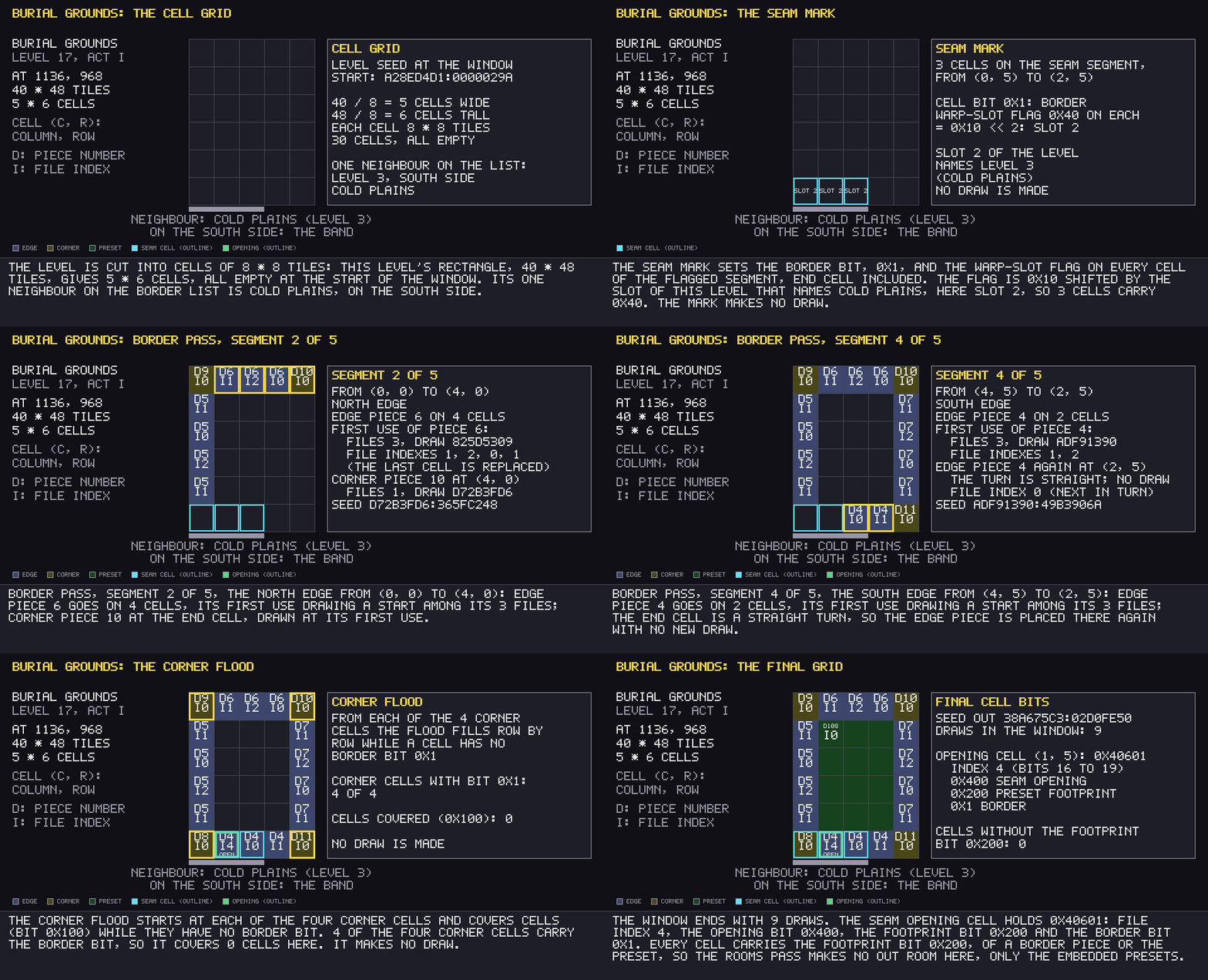
Step through drlg-outdoor-burial-grounds-c0ffee
The Burial Grounds, one Act I outdoor level, built step by step for an illustrative map seed. The level is a grid of cells of 8 × 8 tiles, here 5 × 6 from the rectangle the link builder gave it, and its outline is a ring of vertices with an extra one where the seam with the Cold Plains starts (outdoor § B, C). The seam mark sets the border bit and a warp-slot flag on the seam’s cells (§ E1). The border pass then walks the ring from its first vertex, up the west side, putting an edge piece on each cell and a corner piece at each turn; the first use of a piece in the level draws a start for its file rotation, and a straight turn puts the edge piece again (§ E2). Where the seam borders another outdoor level, its middle cell becomes the seam opening, with its file index forced to 4 on this level after the rotation gave it one. Act I then places one preset, whose first use draws too, and the finished cells hold the bits of § B: border, preset footprint and opening. Not shown: the other Act I levels, whose generators add cliffs, rivers, roads, a waypoint and shrines. Seed: illustrative, an input of our own. Every value shown is computed by our model, not observed in the game.
When the act generator is done, the rooms are made row by row.
A cell that anchors a preset makes a preset instance; its file draw (when Files is at least 1) is made and then
overwritten by the index the generator stored in the cell. A cell covered by a preset makes nothing. Every other cell makes one 8 × 8 outdoor
room, which right away rolls its LvlSub substitutions on its own room seed. Each record passes with its
Prob chance for the level’s theme and adds tile files to the room’s DT1 mask.
No outdoor generator branches on difficulty, expansion or player count: one model reproduces all three difficulties and, for Acts I–IV, both classic and expansion games. Level 134 (Pandemonium Run 2) uses the Act II generator by the code, but no run built it.
Room tiles and the k draws
Section titled “Room tiles and the k draws”When a DRLG room is activated, the game re-seeds it from the value stored at its creation, builds its floor, wall and shadow tiles, and then makes one more draw to seed the active room.
%3btext-align:center%3b%7d%23mermaid-3 .edgeLabel p%7bbackground-color:rgba(232%2c232%2c232%2c 0.8)%3b%7d%23mermaid-3 .edgeLabel rect%7bopacity:0.5%3bbackground-color:rgba(232%2c232%2c232%2c 0.8)%3bfill:rgba(232%2c232%2c232%2c 0.8)%3b%7d%23mermaid-3 .labelBkg%7bbackground-color:rgba(232%2c 232%2c 232%2c 0.5)%3b%7d%23mermaid-3 .cluster rect%7bfill:%23ffffde%3bstroke:%23aaaa33%3bstroke-width:1px%3b%7d%23mermaid-3 .cluster text%7bfill:%23333%3b%7d%23mermaid-3 .cluster span%7bcolor:%23333%3b%7d%23mermaid-3 .node .collapsed-indicator%7bfill:%23aaaa33%3bstroke:none%3bopacity:0.6%3b%7d%23mermaid-3 .node .collapsed-separator%7bstroke:%23aaaa33%3bstroke-width:0.75px%3b%7d%23mermaid-3 div.mermaidTooltip%7bposition:absolute%3btext-align:center%3bmax-width:200px%3bpadding:2px%3bfont-family:arial%2csans-serif%3bfont-size:12px%3bbackground:hsl(80%2c 100%25%2c 96.2745098039%25)%3bborder:1px solid %23aaaa33%3bborder-radius:2px%3bpointer-events:none%3bz-index:100%3b%7d%23mermaid-3 .flowchartTitleText%7btext-anchor:middle%3bfont-size:18px%3bfill:%23333%3b%7d%23mermaid-3 rect.text%7bfill:none%3bstroke-width:0%3b%7d%23mermaid-3 .icon-shape%2c%23mermaid-3 .image-shape%7bbackground-color:rgba(232%2c232%2c232%2c 0.8)%3btext-align:center%3b%7d%23mermaid-3 .icon-shape p%2c%23mermaid-3 .image-shape p%7bbackground-color:rgba(232%2c232%2c232%2c 0.8)%3bpadding:2px%3b%7d%23mermaid-3 .icon-shape .label rect%2c%23mermaid-3 .image-shape .label rect%7bopacity:0.5%3bbackground-color:rgba(232%2c232%2c232%2c 0.8)%3bfill:rgba(232%2c232%2c232%2c 0.8)%3b%7d%23mermaid-3 .label-icon%7bdisplay:inline-block%3bheight:1em%3boverflow:visible%3bvertical-align:-0.125em%3b%7d%23mermaid-3 .node .label-icon path%7bfill:currentColor%3bstroke:revert%3bstroke-width:revert%3b%7d%23mermaid-3 .node .neo-node%7bstroke:%239370DB%3b%7d%23mermaid-3 %5bdata-look='neo'%5d.node rect%2c%23mermaid-3 %5bdata-look='neo'%5d.cluster rect%2c%23mermaid-3 %5bdata-look='neo'%5d.node polygon%7bstroke:%239370DB%3bfilter:drop-shadow(1px 2px 2px rgba(185%2c 185%2c 185%2c 1))%3b%7d%23mermaid-3 %5bdata-look='neo'%5d.swimlane.cluster rect%7bfilter:none%3b%7d%23mermaid-3 %5bdata-look='neo'%5d.node path%7bstroke:%239370DB%3bstroke-width:1px%3b%7d%23mermaid-3 %5bdata-look='neo'%5d.node .outer-path%7bfilter:drop-shadow(1px 2px 2px rgba(185%2c 185%2c 185%2c 1))%3b%7d%23mermaid-3 %5bdata-look='neo'%5d.node .neo-line path%7bstroke:%239370DB%3bfilter:none%3b%7d%23mermaid-3 %5bdata-look='neo'%5d.node circle%7bstroke:%239370DB%3bfilter:drop-shadow(1px 2px 2px rgba(185%2c 185%2c 185%2c 1))%3b%7d%23mermaid-3 %5bdata-look='neo'%5d.node circle .state-start%7bfill:black%3b%7d%23mermaid-3 %5bdata-look='neo'%5d.icon-shape .icon%7bfill:%239370DB%3bfilter:drop-shadow(1px 2px 2px rgba(185%2c 185%2c 185%2c 1))%3b%7d%23mermaid-3 %5bdata-look='neo'%5d.icon-shape .icon-neo path%7bstroke:%239370DB%3bfilter:drop-shadow(1px 2px 2px rgba(185%2c 185%2c 185%2c 1))%3b%7d%23mermaid-3 :root%7b--mermaid-font-family:arial%2csans-serif%3b%7d%3c/style%3e%3cg%3e%3cmarker id='mermaid-3_flowchart-v2-pointEnd' class='marker flowchart-v2' viewBox='0 0 10 10' refX='5' refY='5' markerUnits='userSpaceOnUse' markerWidth='8' markerHeight='8' orient='auto'%3e%3cpath d='M 0 0 L 10 5 L 0 10 z' class='arrowMarkerPath' style='stroke-width: 1%3b stroke-dasharray: 1%2c 0%3b'/%3e%3c/marker%3e%3cmarker id='mermaid-3_flowchart-v2-pointStart' class='marker flowchart-v2' viewBox='0 0 10 10' refX='4.5' refY='5' markerUnits='userSpaceOnUse' markerWidth='8' markerHeight='8' orient='auto'%3e%3cpath d='M 0 5 L 10 10 L 10 0 z' class='arrowMarkerPath' style='stroke-width: 1%3b stroke-dasharray: 1%2c 0%3b'/%3e%3c/marker%3e%3cmarker id='mermaid-3_flowchart-v2-pointEnd-margin' class='marker flowchart-v2' viewBox='0 0 11.5 14' refX='11.5' refY='7' markerUnits='userSpaceOnUse' markerWidth='10.5' markerHeight='14' orient='auto'%3e%3cpath d='M 0 0 L 11.5 7 L 0 14 z' class='arrowMarkerPath' style='stroke-width: 0%3b stroke-dasharray: 1%2c 0%3b'/%3e%3c/marker%3e%3cmarker id='mermaid-3_flowchart-v2-pointStart-margin' class='marker flowchart-v2' viewBox='0 0 11.5 14' refX='1' refY='7' markerUnits='userSpaceOnUse' markerWidth='11.5' markerHeight='14' orient='auto'%3e%3cpolygon points='0%2c7 11.5%2c14 11.5%2c0' class='arrowMarkerPath' style='stroke-width: 0%3b stroke-dasharray: 1%2c 0%3b'/%3e%3c/marker%3e%3cmarker id='mermaid-3_flowchart-v2-circleEnd' class='marker flowchart-v2' viewBox='0 0 10 10' refX='11' refY='5' markerUnits='userSpaceOnUse' markerWidth='11' markerHeight='11' orient='auto'%3e%3ccircle cx='5' cy='5' r='5' class='arrowMarkerPath' style='stroke-width: 1%3b stroke-dasharray: 1%2c 0%3b'/%3e%3c/marker%3e%3cmarker id='mermaid-3_flowchart-v2-circleStart' class='marker flowchart-v2' viewBox='0 0 10 10' refX='-1' refY='5' markerUnits='userSpaceOnUse' markerWidth='11' markerHeight='11' orient='auto'%3e%3ccircle cx='5' cy='5' r='5' class='arrowMarkerPath' style='stroke-width: 1%3b stroke-dasharray: 1%2c 0%3b'/%3e%3c/marker%3e%3cmarker id='mermaid-3_flowchart-v2-circleEnd-margin' class='marker flowchart-v2' viewBox='0 0 10 10' refY='5' refX='12.25' markerUnits='userSpaceOnUse' markerWidth='14' markerHeight='14' orient='auto'%3e%3ccircle cx='5' cy='5' r='5' class='arrowMarkerPath' style='stroke-width: 0%3b stroke-dasharray: 1%2c 0%3b'/%3e%3c/marker%3e%3cmarker id='mermaid-3_flowchart-v2-circleStart-margin' class='marker flowchart-v2' viewBox='0 0 10 10' refX='-2' refY='5' markerUnits='userSpaceOnUse' markerWidth='14' markerHeight='14' orient='auto'%3e%3ccircle cx='5' cy='5' r='5' class='arrowMarkerPath' style='stroke-width: 0%3b stroke-dasharray: 1%2c 0%3b'/%3e%3c/marker%3e%3cmarker id='mermaid-3_flowchart-v2-crossEnd' class='marker cross flowchart-v2' viewBox='0 0 11 11' refX='12' refY='5.2' markerUnits='userSpaceOnUse' markerWidth='11' markerHeight='11' orient='auto'%3e%3cpath d='M 1%2c1 l 9%2c9 M 10%2c1 l -9%2c9' class='arrowMarkerPath' style='stroke-width: 2%3b stroke-dasharray: 1%2c 0%3b'/%3e%3c/marker%3e%3cmarker id='mermaid-3_flowchart-v2-crossStart' class='marker cross flowchart-v2' viewBox='0 0 11 11' refX='-1' refY='5.2' markerUnits='userSpaceOnUse' markerWidth='11' markerHeight='11' orient='auto'%3e%3cpath d='M 1%2c1 l 9%2c9 M 10%2c1 l -9%2c9' class='arrowMarkerPath' style='stroke-width: 2%3b stroke-dasharray: 1%2c 0%3b'/%3e%3c/marker%3e%3cmarker id='mermaid-3_flowchart-v2-crossEnd-margin' class='marker cross flowchart-v2' viewBox='0 0 15 15' refX='17.7' refY='7.5' markerUnits='userSpaceOnUse' markerWidth='12' markerHeight='12' orient='auto'%3e%3cpath d='M 1%2c1 L 14%2c14 M 1%2c14 L 14%2c1' class='arrowMarkerPath' style='stroke-width: 2.5%3b'/%3e%3c/marker%3e%3cmarker id='mermaid-3_flowchart-v2-crossStart-margin' class='marker cross flowchart-v2' viewBox='0 0 15 15' refX='-3.5' refY='7.5' markerUnits='userSpaceOnUse' markerWidth='12' markerHeight='12' orient='auto'%3e%3cpath d='M 1%2c1 L 14%2c14 M 1%2c14 L 14%2c1' class='arrowMarkerPath' style='stroke-width: 2.5%3b stroke-dasharray: 1%2c 0%3b'/%3e%3c/marker%3e%3cg class='root'%3e%3cg class='clusters'/%3e%3cg class='edgePaths'%3e%3cpath d='M268%2c111L272.167%2c111C276.333%2c111%2c284.667%2c111%2c292.333%2c111C300%2c111%2c307%2c111%2c310.5%2c111L314%2c111' id='mermaid-3-L_pre_rs_0' class='edge-thickness-normal edge-pattern-solid edge-thickness-normal edge-pattern-solid flowchart-link' style='%3b' data-edge='true' data-et='edge' data-id='L_pre_rs_0' data-points='W3sieCI6MjY4LCJ5IjoxMTF9LHsieCI6MjkzLCJ5IjoxMTF9LHsieCI6MzE4LCJ5IjoxMTF9XQ==' data-look='classic' marker-end='url(%23mermaid-3_flowchart-v2-pointEnd)'/%3e%3cpath d='M462.248%2c84L473.717%2c77.833C485.186%2c71.667%2c508.124%2c59.333%2c523.093%2c53.167C538.063%2c47%2c545.063%2c47%2c548.563%2c47L552.063%2c47' id='mermaid-3-L_rs_p1_0' class='edge-thickness-normal edge-pattern-solid edge-thickness-normal edge-pattern-solid flowchart-link' style='%3b' data-edge='true' data-et='edge' data-id='L_rs_p1_0' data-points='W3sieCI6NDYyLjI0NzU1ODU5Mzc1LCJ5Ijo4NH0seyJ4Ijo1MzEuMDYyNSwieSI6NDd9LHsieCI6NTU2LjA2MjUsInkiOjQ3fV0=' data-look='classic' marker-end='url(%23mermaid-3_flowchart-v2-pointEnd)'/%3e%3cpath d='M462.248%2c138L473.717%2c144.167C485.186%2c150.333%2c508.124%2c162.667%2c523.093%2c168.833C538.063%2c175%2c545.063%2c175%2c548.563%2c175L552.063%2c175' id='mermaid-3-L_rs_p2_0' class='edge-thickness-normal edge-pattern-solid edge-thickness-normal edge-pattern-solid flowchart-link' style='%3b' data-edge='true' data-et='edge' data-id='L_rs_p2_0' data-points='W3sieCI6NDYyLjI0NzU1ODU5Mzc1LCJ5IjoxMzh9LHsieCI6NTMxLjA2MjUsInkiOjE3NX0seyJ4Ijo1NTYuMDYyNSwieSI6MTc1fV0=' data-look='classic' marker-end='url(%23mermaid-3_flowchart-v2-pointEnd)'/%3e%3cpath d='M816.063%2c47L820.229%2c47C824.396%2c47%2c832.729%2c47%2c841.527%2c48.912C850.325%2c50.824%2c859.587%2c54.649%2c864.218%2c56.561L868.85%2c58.473' id='mermaid-3-L_p1_b_0' class='edge-thickness-normal edge-pattern-solid edge-thickness-normal edge-pattern-solid flowchart-link' style='%3b' data-edge='true' data-et='edge' data-id='L_p1_b_0' data-points='W3sieCI6ODE2LjA2MjUsInkiOjQ3fSx7IngiOjg0MS4wNjI1LCJ5Ijo0N30seyJ4Ijo4NzIuNTQ2ODc1LCJ5Ijo2MH1d' data-look='classic' marker-end='url(%23mermaid-3_flowchart-v2-pointEnd)'/%3e%3cpath d='M816.063%2c175L820.229%2c175C824.396%2c175%2c832.729%2c175%2c841.527%2c173.088C850.325%2c171.176%2c859.587%2c167.351%2c864.218%2c165.439L868.85%2c163.527' id='mermaid-3-L_p2_b_0' class='edge-thickness-normal edge-pattern-solid edge-thickness-normal edge-pattern-solid flowchart-link' style='%3b' data-edge='true' data-et='edge' data-id='L_p2_b_0' data-points='W3sieCI6ODE2LjA2MjUsInkiOjE3NX0seyJ4Ijo4NDEuMDYyNSwieSI6MTc1fSx7IngiOjg3Mi41NDY4NzUsInkiOjE2Mn1d' data-look='classic' marker-end='url(%23mermaid-3_flowchart-v2-pointEnd)'/%3e%3cpath d='M1126.063%2c111L1130.229%2c111C1134.396%2c111%2c1142.729%2c111%2c1150.396%2c111C1158.063%2c111%2c1165.063%2c111%2c1168.563%2c111L1172.063%2c111' id='mermaid-3-L_b_ad_0' class='edge-thickness-normal edge-pattern-solid edge-thickness-normal edge-pattern-solid flowchart-link' style='%3b' data-edge='true' data-et='edge' data-id='L_b_ad_0' data-points='W3sieCI6MTEyNi4wNjI1LCJ5IjoxMTF9LHsieCI6MTE1MS4wNjI1LCJ5IjoxMTF9LHsieCI6MTE3Ni4wNjI1LCJ5IjoxMTF9XQ==' data-look='classic' marker-end='url(%23mermaid-3_flowchart-v2-pointEnd)'/%3e%3c/g%3e%3cg class='edgeLabels'%3e%3cg class='edgeLabel'%3e%3cg class='label' data-id='L_pre_rs_0' transform='translate(0%2c 0)'%3e%3cforeignObject width='0' height='0'%3e%3cdiv xmlns='http://www.w3.org/1999/xhtml' class='labelBkg' style='display: table-cell%3b white-space: nowrap%3b line-height: 1.5%3b max-width: 200px%3b text-align: center%3b'%3e%3cspan class='edgeLabel'%3e%3c/span%3e%3c/div%3e%3c/foreignObject%3e%3c/g%3e%3c/g%3e%3cg class='edgeLabel'%3e%3cg class='label' data-id='L_rs_p1_0' transform='translate(0%2c 0)'%3e%3cforeignObject width='0' height='0'%3e%3cdiv xmlns='http://www.w3.org/1999/xhtml' class='labelBkg' style='display: table-cell%3b white-space: nowrap%3b line-height: 1.5%3b max-width: 200px%3b text-align: center%3b'%3e%3cspan class='edgeLabel'%3e%3c/span%3e%3c/div%3e%3c/foreignObject%3e%3c/g%3e%3c/g%3e%3cg class='edgeLabel'%3e%3cg class='label' data-id='L_rs_p2_0' transform='translate(0%2c 0)'%3e%3cforeignObject width='0' height='0'%3e%3cdiv xmlns='http://www.w3.org/1999/xhtml' class='labelBkg' style='display: table-cell%3b white-space: nowrap%3b line-height: 1.5%3b max-width: 200px%3b text-align: center%3b'%3e%3cspan class='edgeLabel'%3e%3c/span%3e%3c/div%3e%3c/foreignObject%3e%3c/g%3e%3c/g%3e%3cg class='edgeLabel'%3e%3cg class='label' data-id='L_p1_b_0' transform='translate(0%2c 0)'%3e%3cforeignObject width='0' height='0'%3e%3cdiv xmlns='http://www.w3.org/1999/xhtml' class='labelBkg' style='display: table-cell%3b white-space: nowrap%3b line-height: 1.5%3b max-width: 200px%3b text-align: center%3b'%3e%3cspan class='edgeLabel'%3e%3c/span%3e%3c/div%3e%3c/foreignObject%3e%3c/g%3e%3c/g%3e%3cg class='edgeLabel'%3e%3cg class='label' data-id='L_p2_b_0' transform='translate(0%2c 0)'%3e%3cforeignObject width='0' height='0'%3e%3cdiv xmlns='http://www.w3.org/1999/xhtml' class='labelBkg' style='display: table-cell%3b white-space: nowrap%3b line-height: 1.5%3b max-width: 200px%3b text-align: center%3b'%3e%3cspan class='edgeLabel'%3e%3c/span%3e%3c/div%3e%3c/foreignObject%3e%3c/g%3e%3c/g%3e%3cg class='edgeLabel'%3e%3cg class='label' data-id='L_b_ad_0' transform='translate(0%2c 0)'%3e%3cforeignObject width='0' height='0'%3e%3cdiv xmlns='http://www.w3.org/1999/xhtml' class='labelBkg' style='display: table-cell%3b white-space: nowrap%3b line-height: 1.5%3b max-width: 200px%3b text-align: center%3b'%3e%3cspan class='edgeLabel'%3e%3c/span%3e%3c/div%3e%3c/foreignObject%3e%3c/g%3e%3c/g%3e%3c/g%3e%3cg class='nodes'%3e%3cg class='node default' id='mermaid-3-flowchart-pre-0' data-look='classic' transform='translate(138%2c 111)'%3e%3crect class='basic label-container' style='' x='-130' y='-39' width='260' height='78'/%3e%3cg class='label' style='' transform='translate(-100%2c -24)'%3e%3crect/%3e%3cforeignObject width='200' height='48'%3e%3cdiv xmlns='http://www.w3.org/1999/xhtml' style='display: table%3b white-space: break-spaces%3b line-height: 1.5%3b max-width: 200px%3b text-align: center%3b width: 200px%3b'%3e%3cspan class='nodeLabel'%3e%3cp%3eDT1 list%2c DS1 load%2c neighbours: draws not kept%3c/p%3e%3c/span%3e%3c/div%3e%3c/foreignObject%3e%3c/g%3e%3c/g%3e%3cg class='node default' id='mermaid-3-flowchart-rs-1' data-look='classic' transform='translate(412.03125%2c 111)'%3e%3crect class='basic label-container' style='' x='-94.03125' y='-27' width='188.0625' height='54'/%3e%3cg class='label' style='' transform='translate(-64.03125%2c -12)'%3e%3crect/%3e%3cforeignObject width='128.0625' height='24'%3e%3cdiv xmlns='http://www.w3.org/1999/xhtml' style='display: table-cell%3b white-space: nowrap%3b line-height: 1.5%3b max-width: 200px%3b text-align: center%3b'%3e%3cspan class='nodeLabel'%3e%3cp%3eRe-seed the room%3c/p%3e%3c/span%3e%3c/div%3e%3c/foreignObject%3e%3c/g%3e%3c/g%3e%3cg class='node default' id='mermaid-3-flowchart-p1-3' data-look='classic' transform='translate(686.0625%2c 47)'%3e%3crect class='basic label-container' style='' x='-130' y='-39' width='260' height='78'/%3e%3cg class='label' style='' transform='translate(-100%2c -24)'%3e%3crect/%3e%3cforeignObject width='200' height='48'%3e%3cdiv xmlns='http://www.w3.org/1999/xhtml' style='display: table%3b white-space: break-spaces%3b line-height: 1.5%3b max-width: 200px%3b text-align: center%3b width: 200px%3b'%3e%3cspan class='nodeLabel'%3e%3cp%3eOutdoor room: LvlSub substitutions%3c/p%3e%3c/span%3e%3c/div%3e%3c/foreignObject%3e%3c/g%3e%3c/g%3e%3cg class='node default' id='mermaid-3-flowchart-p2-5' data-look='classic' transform='translate(686.0625%2c 175)'%3e%3crect class='basic label-container' style='' x='-130' y='-39' width='260' height='78'/%3e%3cg class='label' style='' transform='translate(-100%2c -24)'%3e%3crect/%3e%3cforeignObject width='200' height='48'%3e%3cdiv xmlns='http://www.w3.org/1999/xhtml' style='display: table%3b white-space: break-spaces%3b line-height: 1.5%3b max-width: 200px%3b text-align: center%3b width: 200px%3b'%3e%3cspan class='nodeLabel'%3e%3cp%3ePreset room: grids are views of the DS1%2c no draw%3c/p%3e%3c/span%3e%3c/div%3e%3c/foreignObject%3e%3c/g%3e%3c/g%3e%3cg class='node default' id='mermaid-3-flowchart-b-8' data-look='classic' transform='translate(996.0625%2c 111)'%3e%3crect class='basic label-container' style='' x='-130' y='-51' width='260' height='102'/%3e%3cg class='label' style='' transform='translate(-100%2c -36)'%3e%3crect/%3e%3cforeignObject width='200' height='72'%3e%3cdiv xmlns='http://www.w3.org/1999/xhtml' style='display: table%3b white-space: break-spaces%3b line-height: 1.5%3b max-width: 200px%3b text-align: center%3b width: 200px%3b'%3e%3cspan class='nodeLabel'%3e%3cp%3eTile build: one draw per pick whose rarity sum is above 0%3c/p%3e%3c/span%3e%3c/div%3e%3c/foreignObject%3e%3c/g%3e%3c/g%3e%3cg class='node default' id='mermaid-3-flowchart-ad-10' data-look='classic' transform='translate(1306.0625%2c 111)'%3e%3crect class='basic label-container' style='' x='-130' y='-39' width='260' height='78'/%3e%3cg class='label' style='' transform='translate(-100%2c -24)'%3e%3crect/%3e%3cforeignObject width='200' height='48'%3e%3cdiv xmlns='http://www.w3.org/1999/xhtml' style='display: table%3b white-space: break-spaces%3b line-height: 1.5%3b max-width: 200px%3b text-align: center%3b width: 200px%3b'%3e%3cspan class='nodeLabel'%3e%3cp%3eOne more draw: the active-room seed%3c/p%3e%3c/span%3e%3c/div%3e%3c/foreignObject%3e%3c/g%3e%3c/g%3e%3c/g%3e%3c/g%3e%3c/g%3e%3cdefs%3e%3cfilter id='mermaid-3-drop-shadow' height='130%25' width='130%25'%3e%3cfeDropShadow dx='4' dy='4' stdDeviation='0' flood-opacity='0.06' flood-color='black'/%3e%3c/filter%3e%3c/defs%3e%3cdefs%3e%3cfilter id='mermaid-3-drop-shadow-small' height='150%25' width='150%25'%3e%3cfeDropShadow dx='2' dy='2' stdDeviation='0' flood-opacity='0.06' flood-color='black'/%3e%3c/filter%3e%3c/defs%3e%3c/svg%3e)
The tile list. The room’s DT1 mask selects tile files from its level type’s LvlTypes row, and three fixed
files are added at the end. A preset room’s mask is its LvlPrest record’s Dt1Mask; an
outdoor room’s is a value per level type OR the Dt1Mask of the substitutions it rolled. The values for four level
types were checked against logged rooms: type 2 in 56 rooms, types 16 and 21 in 40 and 20 rooms, and type 31 in 145
rooms of three Act V levels. No run logged an outdoor room of types 22, 27, 28 or 30, so their values are read from
the code only.
The tile pick. Each map cell names a tile key (orientation, main index, sub index). The game gathers the tiles of
that key from the list (at most 40, a limit read from the code that never comes into play with the shipped data,
where no key has more than 28 candidates) and sums their rarity. If the sum is above 0 it
makes one draw on the room seed, even when only one tile is a candidate; if the sum is 0 it takes the first tile
with no draw. Which tile is chosen does not change the draw count, and the choice itself is confirmed: the model
picked the logged tile for each of 1 852 097 tile entries, where taking the candidates in file order would have
been wrong for 781 380 of them. If a key has no candidate at all, the game falls back to one fixed tile with no
draw. That fallback is confirmed: in replays of logged games 1 280 picks had no candidate, the model took the
fallback with no draw each time, and every room’s draw count still matched. If even the fallback tile were missing,
the game would stop with a fatal error; that branch is read from the code only and no logged game met it.
k. The number of room-seed draws between the re-seed and the activation draw is called k. It counts the substitution draws of an outdoor room, one per pick with a positive rarity sum, and the draws of a unit rule on some wall cells (orientations 8 and 9), and it fixes the active-room seed, which monster and object placement later draw on. k was predicted exactly for all 520 room activations of the first run (k from 0 to 388), and for 12 974 more activations in later runs. What the wall-cell unit rule makes at activation is a preset unit of the room, not a unit: the units it names are created later, with the room’s other preset units, in the window before its objects and monsters (room tiles § Algorithm, step 11; see seed to world). That reading is inferred: the code that adds the preset unit has not been read.
Why k depends on what is already built. Neighbouring rooms share their edge cells, and both rooms build them
(unless a preset’s KillEdge drops its own outer edge). The second room
to build a shared cell looks for the tile the first one placed and either adds a new tile or merges with it (the
bit-2 path). So the number of picks, and k, depends on which neighbours were already built: the
server and client copies of one room can get different k. In one recorded town room, k was 64 on the server and 55
on the client, from the same grids and tile list. A merge can even re-pick a tile on the neighbour’s seed, which
moves that neighbour’s seed after its own activation.
A built room can also be released while its level stays loaded and later activated again. The release frees the room’s tiles but keeps its tile list, its loaded map, its neighbour list and its starting seed, so the next activation restarts from the same seed and rebuilds the tiles. A run confirmed this with 1516 releases and 235 re-activations, each rebuilt as the model predicts. k may still differ on the rebuild, because the neighbours built at that moment may have changed, and what the first build merged into its neighbours is not undone: of the 235 re-activations, 183 got the same k as the first build and 52 a different one. The release sets one flag only when the server releases the room: a later run saw it set on every one of 2 440 server releases and clear on every one of 8 277 client releases. No code that reads that flag was found.
What a preset places: units and keep/drop rolls
Section titled “What a preset places: units and keep/drop rolls”A DS1 map lists objects, monsters, NPCs and their walking paths. These become preset units.
%3btext-align:center%3b%7d%23mermaid-4 .edgeLabel p%7bbackground-color:rgba(232%2c232%2c232%2c 0.8)%3b%7d%23mermaid-4 .edgeLabel rect%7bopacity:0.5%3bbackground-color:rgba(232%2c232%2c232%2c 0.8)%3bfill:rgba(232%2c232%2c232%2c 0.8)%3b%7d%23mermaid-4 .labelBkg%7bbackground-color:rgba(232%2c 232%2c 232%2c 0.5)%3b%7d%23mermaid-4 .cluster rect%7bfill:%23ffffde%3bstroke:%23aaaa33%3bstroke-width:1px%3b%7d%23mermaid-4 .cluster text%7bfill:%23333%3b%7d%23mermaid-4 .cluster span%7bcolor:%23333%3b%7d%23mermaid-4 .node .collapsed-indicator%7bfill:%23aaaa33%3bstroke:none%3bopacity:0.6%3b%7d%23mermaid-4 .node .collapsed-separator%7bstroke:%23aaaa33%3bstroke-width:0.75px%3b%7d%23mermaid-4 div.mermaidTooltip%7bposition:absolute%3btext-align:center%3bmax-width:200px%3bpadding:2px%3bfont-family:arial%2csans-serif%3bfont-size:12px%3bbackground:hsl(80%2c 100%25%2c 96.2745098039%25)%3bborder:1px solid %23aaaa33%3bborder-radius:2px%3bpointer-events:none%3bz-index:100%3b%7d%23mermaid-4 .flowchartTitleText%7btext-anchor:middle%3bfont-size:18px%3bfill:%23333%3b%7d%23mermaid-4 rect.text%7bfill:none%3bstroke-width:0%3b%7d%23mermaid-4 .icon-shape%2c%23mermaid-4 .image-shape%7bbackground-color:rgba(232%2c232%2c232%2c 0.8)%3btext-align:center%3b%7d%23mermaid-4 .icon-shape p%2c%23mermaid-4 .image-shape p%7bbackground-color:rgba(232%2c232%2c232%2c 0.8)%3bpadding:2px%3b%7d%23mermaid-4 .icon-shape .label rect%2c%23mermaid-4 .image-shape .label rect%7bopacity:0.5%3bbackground-color:rgba(232%2c232%2c232%2c 0.8)%3bfill:rgba(232%2c232%2c232%2c 0.8)%3b%7d%23mermaid-4 .label-icon%7bdisplay:inline-block%3bheight:1em%3boverflow:visible%3bvertical-align:-0.125em%3b%7d%23mermaid-4 .node .label-icon path%7bfill:currentColor%3bstroke:revert%3bstroke-width:revert%3b%7d%23mermaid-4 .node .neo-node%7bstroke:%239370DB%3b%7d%23mermaid-4 %5bdata-look='neo'%5d.node rect%2c%23mermaid-4 %5bdata-look='neo'%5d.cluster rect%2c%23mermaid-4 %5bdata-look='neo'%5d.node polygon%7bstroke:%239370DB%3bfilter:drop-shadow(1px 2px 2px rgba(185%2c 185%2c 185%2c 1))%3b%7d%23mermaid-4 %5bdata-look='neo'%5d.swimlane.cluster rect%7bfilter:none%3b%7d%23mermaid-4 %5bdata-look='neo'%5d.node path%7bstroke:%239370DB%3bstroke-width:1px%3b%7d%23mermaid-4 %5bdata-look='neo'%5d.node .outer-path%7bfilter:drop-shadow(1px 2px 2px rgba(185%2c 185%2c 185%2c 1))%3b%7d%23mermaid-4 %5bdata-look='neo'%5d.node .neo-line path%7bstroke:%239370DB%3bfilter:none%3b%7d%23mermaid-4 %5bdata-look='neo'%5d.node circle%7bstroke:%239370DB%3bfilter:drop-shadow(1px 2px 2px rgba(185%2c 185%2c 185%2c 1))%3b%7d%23mermaid-4 %5bdata-look='neo'%5d.node circle .state-start%7bfill:black%3b%7d%23mermaid-4 %5bdata-look='neo'%5d.icon-shape .icon%7bfill:%239370DB%3bfilter:drop-shadow(1px 2px 2px rgba(185%2c 185%2c 185%2c 1))%3b%7d%23mermaid-4 %5bdata-look='neo'%5d.icon-shape .icon-neo path%7bstroke:%239370DB%3bfilter:drop-shadow(1px 2px 2px rgba(185%2c 185%2c 185%2c 1))%3b%7d%23mermaid-4 :root%7b--mermaid-font-family:arial%2csans-serif%3b%7d%3c/style%3e%3cg%3e%3cmarker id='mermaid-4_flowchart-v2-pointEnd' class='marker flowchart-v2' viewBox='0 0 10 10' refX='5' refY='5' markerUnits='userSpaceOnUse' markerWidth='8' markerHeight='8' orient='auto'%3e%3cpath d='M 0 0 L 10 5 L 0 10 z' class='arrowMarkerPath' style='stroke-width: 1%3b stroke-dasharray: 1%2c 0%3b'/%3e%3c/marker%3e%3cmarker id='mermaid-4_flowchart-v2-pointStart' class='marker flowchart-v2' viewBox='0 0 10 10' refX='4.5' refY='5' markerUnits='userSpaceOnUse' markerWidth='8' markerHeight='8' orient='auto'%3e%3cpath d='M 0 5 L 10 10 L 10 0 z' class='arrowMarkerPath' style='stroke-width: 1%3b stroke-dasharray: 1%2c 0%3b'/%3e%3c/marker%3e%3cmarker id='mermaid-4_flowchart-v2-pointEnd-margin' class='marker flowchart-v2' viewBox='0 0 11.5 14' refX='11.5' refY='7' markerUnits='userSpaceOnUse' markerWidth='10.5' markerHeight='14' orient='auto'%3e%3cpath d='M 0 0 L 11.5 7 L 0 14 z' class='arrowMarkerPath' style='stroke-width: 0%3b stroke-dasharray: 1%2c 0%3b'/%3e%3c/marker%3e%3cmarker id='mermaid-4_flowchart-v2-pointStart-margin' class='marker flowchart-v2' viewBox='0 0 11.5 14' refX='1' refY='7' markerUnits='userSpaceOnUse' markerWidth='11.5' markerHeight='14' orient='auto'%3e%3cpolygon points='0%2c7 11.5%2c14 11.5%2c0' class='arrowMarkerPath' style='stroke-width: 0%3b stroke-dasharray: 1%2c 0%3b'/%3e%3c/marker%3e%3cmarker id='mermaid-4_flowchart-v2-circleEnd' class='marker flowchart-v2' viewBox='0 0 10 10' refX='11' refY='5' markerUnits='userSpaceOnUse' markerWidth='11' markerHeight='11' orient='auto'%3e%3ccircle cx='5' cy='5' r='5' class='arrowMarkerPath' style='stroke-width: 1%3b stroke-dasharray: 1%2c 0%3b'/%3e%3c/marker%3e%3cmarker id='mermaid-4_flowchart-v2-circleStart' class='marker flowchart-v2' viewBox='0 0 10 10' refX='-1' refY='5' markerUnits='userSpaceOnUse' markerWidth='11' markerHeight='11' orient='auto'%3e%3ccircle cx='5' cy='5' r='5' class='arrowMarkerPath' style='stroke-width: 1%3b stroke-dasharray: 1%2c 0%3b'/%3e%3c/marker%3e%3cmarker id='mermaid-4_flowchart-v2-circleEnd-margin' class='marker flowchart-v2' viewBox='0 0 10 10' refY='5' refX='12.25' markerUnits='userSpaceOnUse' markerWidth='14' markerHeight='14' orient='auto'%3e%3ccircle cx='5' cy='5' r='5' class='arrowMarkerPath' style='stroke-width: 0%3b stroke-dasharray: 1%2c 0%3b'/%3e%3c/marker%3e%3cmarker id='mermaid-4_flowchart-v2-circleStart-margin' class='marker flowchart-v2' viewBox='0 0 10 10' refX='-2' refY='5' markerUnits='userSpaceOnUse' markerWidth='14' markerHeight='14' orient='auto'%3e%3ccircle cx='5' cy='5' r='5' class='arrowMarkerPath' style='stroke-width: 0%3b stroke-dasharray: 1%2c 0%3b'/%3e%3c/marker%3e%3cmarker id='mermaid-4_flowchart-v2-crossEnd' class='marker cross flowchart-v2' viewBox='0 0 11 11' refX='12' refY='5.2' markerUnits='userSpaceOnUse' markerWidth='11' markerHeight='11' orient='auto'%3e%3cpath d='M 1%2c1 l 9%2c9 M 10%2c1 l -9%2c9' class='arrowMarkerPath' style='stroke-width: 2%3b stroke-dasharray: 1%2c 0%3b'/%3e%3c/marker%3e%3cmarker id='mermaid-4_flowchart-v2-crossStart' class='marker cross flowchart-v2' viewBox='0 0 11 11' refX='-1' refY='5.2' markerUnits='userSpaceOnUse' markerWidth='11' markerHeight='11' orient='auto'%3e%3cpath d='M 1%2c1 l 9%2c9 M 10%2c1 l -9%2c9' class='arrowMarkerPath' style='stroke-width: 2%3b stroke-dasharray: 1%2c 0%3b'/%3e%3c/marker%3e%3cmarker id='mermaid-4_flowchart-v2-crossEnd-margin' class='marker cross flowchart-v2' viewBox='0 0 15 15' refX='17.7' refY='7.5' markerUnits='userSpaceOnUse' markerWidth='12' markerHeight='12' orient='auto'%3e%3cpath d='M 1%2c1 L 14%2c14 M 1%2c14 L 14%2c1' class='arrowMarkerPath' style='stroke-width: 2.5%3b'/%3e%3c/marker%3e%3cmarker id='mermaid-4_flowchart-v2-crossStart-margin' class='marker cross flowchart-v2' viewBox='0 0 15 15' refX='-3.5' refY='7.5' markerUnits='userSpaceOnUse' markerWidth='12' markerHeight='12' orient='auto'%3e%3cpath d='M 1%2c1 L 14%2c14 M 1%2c14 L 14%2c1' class='arrowMarkerPath' style='stroke-width: 2.5%3b stroke-dasharray: 1%2c 0%3b'/%3e%3c/marker%3e%3cg class='root'%3e%3cg class='clusters'/%3e%3cg class='edgePaths'%3e%3cpath d='M151.594%2c111L155.76%2c111C159.927%2c111%2c168.26%2c111%2c175.927%2c111C183.594%2c111%2c190.594%2c111%2c194.094%2c111L197.594%2c111' id='mermaid-4-L_ds1_map_0' class='edge-thickness-normal edge-pattern-solid edge-thickness-normal edge-pattern-solid flowchart-link' style='%3b' data-edge='true' data-et='edge' data-id='L_ds1_map_0' data-points='W3sieCI6MTUxLjU5Mzc1LCJ5IjoxMTF9LHsieCI6MTc2LjU5Mzc1LCJ5IjoxMTF9LHsieCI6MjAxLjU5Mzc1LCJ5IjoxMTF9XQ==' data-look='classic' marker-end='url(%23mermaid-4_flowchart-v2-pointEnd)'/%3e%3cpath d='M408.313%2c111L412.479%2c111C416.646%2c111%2c424.979%2c111%2c432.646%2c111C440.313%2c111%2c447.313%2c111%2c450.813%2c111L454.313%2c111' id='mermaid-4-L_map_who_0' class='edge-thickness-normal edge-pattern-solid edge-thickness-normal edge-pattern-solid flowchart-link' style='%3b' data-edge='true' data-et='edge' data-id='L_map_who_0' data-points='W3sieCI6NDA4LjMxMjUsInkiOjExMX0seyJ4Ijo0MzMuMzEyNSwieSI6MTExfSx7IngiOjQ1OC4zMTI1LCJ5IjoxMTF9XQ==' data-look='classic' marker-end='url(%23mermaid-4_flowchart-v2-pointEnd)'/%3e%3cpath d='M622.051%2c89.989L646.387%2c82.824C670.722%2c75.659%2c719.392%2c61.33%2c763.894%2c54.165C808.396%2c47%2c848.729%2c47%2c868.896%2c47L889.063%2c47' id='mermaid-4-L_who_lvl_0' class='edge-thickness-normal edge-pattern-solid edge-thickness-normal edge-pattern-solid flowchart-link' style='%3b' data-edge='true' data-et='edge' data-id='L_who_lvl_0' data-points='W3sieCI6NjIyLjA1MTM5MzgyNDk2NjcsInkiOjg5Ljk4ODg5MzgyNDk2NjY4fSx7IngiOjc2OC4wNjI1LCJ5Ijo0N30seyJ4Ijo4OTMuMDYyNSwieSI6NDd9XQ==' data-look='classic' marker-end='url(%23mermaid-4_flowchart-v2-pointEnd)'/%3e%3cpath d='M622.051%2c132.011L646.387%2c139.176C670.722%2c146.341%2c719.392%2c160.67%2c763.894%2c167.835C808.396%2c175%2c848.729%2c175%2c868.896%2c175L889.063%2c175' id='mermaid-4-L_who_room_0' class='edge-thickness-normal edge-pattern-solid edge-thickness-normal edge-pattern-solid flowchart-link' style='%3b' data-edge='true' data-et='edge' data-id='L_who_room_0' data-points='W3sieCI6NjIyLjA1MTM5MzgyNDk2NjcsInkiOjEzMi4wMTExMDYxNzUwMzMzMn0seyJ4Ijo3NjguMDYyNSwieSI6MTc1fSx7IngiOjg5My4wNjI1LCJ5IjoxNzV9XQ==' data-look='classic' marker-end='url(%23mermaid-4_flowchart-v2-pointEnd)'/%3e%3cpath d='M1153.063%2c47L1157.229%2c47C1161.396%2c47%2c1169.729%2c47%2c1183.371%2c50.912C1197.012%2c54.824%2c1215.962%2c62.649%2c1225.437%2c66.561L1234.912%2c70.473' id='mermaid-4-L_lvl_rl_0' class='edge-thickness-normal edge-pattern-solid edge-thickness-normal edge-pattern-solid flowchart-link' style='%3b' data-edge='true' data-et='edge' data-id='L_lvl_rl_0' data-points='W3sieCI6MTE1My4wNjI1LCJ5Ijo0N30seyJ4IjoxMTc4LjA2MjUsInkiOjQ3fSx7IngiOjEyMzguNjA5Mzc1LCJ5Ijo3Mn1d' data-look='classic' marker-end='url(%23mermaid-4_flowchart-v2-pointEnd)'/%3e%3cpath d='M1153.063%2c175L1157.229%2c175C1161.396%2c175%2c1169.729%2c175%2c1183.371%2c171.088C1197.012%2c167.176%2c1215.962%2c159.351%2c1225.437%2c155.439L1234.912%2c151.527' id='mermaid-4-L_room_rl_0' class='edge-thickness-normal edge-pattern-solid edge-thickness-normal edge-pattern-solid flowchart-link' style='%3b' data-edge='true' data-et='edge' data-id='L_room_rl_0' data-points='W3sieCI6MTE1My4wNjI1LCJ5IjoxNzV9LHsieCI6MTE3OC4wNjI1LCJ5IjoxNzV9LHsieCI6MTIzOC42MDkzNzUsInkiOjE1MH1d' data-look='classic' marker-end='url(%23mermaid-4_flowchart-v2-pointEnd)'/%3e%3cpath d='M1463.063%2c111L1467.229%2c111C1471.396%2c111%2c1479.729%2c111%2c1487.396%2c111C1495.063%2c111%2c1502.063%2c111%2c1505.563%2c111L1509.063%2c111' id='mermaid-4-L_rl_srv_0' class='edge-thickness-normal edge-pattern-solid edge-thickness-normal edge-pattern-solid flowchart-link' style='%3b' data-edge='true' data-et='edge' data-id='L_rl_srv_0' data-points='W3sieCI6MTQ2My4wNjI1LCJ5IjoxMTF9LHsieCI6MTQ4OC4wNjI1LCJ5IjoxMTF9LHsieCI6MTUxMy4wNjI1LCJ5IjoxMTF9XQ==' data-look='classic' marker-end='url(%23mermaid-4_flowchart-v2-pointEnd)'/%3e%3c/g%3e%3cg class='edgeLabels'%3e%3cg class='edgeLabel'%3e%3cg class='label' data-id='L_ds1_map_0' transform='translate(0%2c 0)'%3e%3cforeignObject width='0' height='0'%3e%3cdiv xmlns='http://www.w3.org/1999/xhtml' class='labelBkg' style='display: table-cell%3b white-space: nowrap%3b line-height: 1.5%3b max-width: 200px%3b text-align: center%3b'%3e%3cspan class='edgeLabel'%3e%3c/span%3e%3c/div%3e%3c/foreignObject%3e%3c/g%3e%3c/g%3e%3cg class='edgeLabel'%3e%3cg class='label' data-id='L_map_who_0' transform='translate(0%2c 0)'%3e%3cforeignObject width='0' height='0'%3e%3cdiv xmlns='http://www.w3.org/1999/xhtml' class='labelBkg' style='display: table-cell%3b white-space: nowrap%3b line-height: 1.5%3b max-width: 200px%3b text-align: center%3b'%3e%3cspan class='edgeLabel'%3e%3c/span%3e%3c/div%3e%3c/foreignObject%3e%3c/g%3e%3c/g%3e%3cg class='edgeLabel' transform='translate(768.0625%2c 47)'%3e%3cg class='label' data-id='L_who_lvl_0' transform='translate(-96.4921875%2c -12)'%3e%3cforeignObject width='192.984375' height='24'%3e%3cdiv xmlns='http://www.w3.org/1999/xhtml' class='labelBkg' style='display: table-cell%3b white-space: nowrap%3b line-height: 1.5%3b max-width: 200px%3b text-align: center%3b'%3e%3cspan class='edgeLabel'%3e%3cp%3eyes%2c when rooms are made%3c/p%3e%3c/span%3e%3c/div%3e%3c/foreignObject%3e%3c/g%3e%3c/g%3e%3cg class='edgeLabel' transform='translate(768.0625%2c 175)'%3e%3cg class='label' data-id='L_who_room_0' transform='translate(-100%2c -24)'%3e%3cforeignObject width='200' height='48'%3e%3cdiv xmlns='http://www.w3.org/1999/xhtml' class='labelBkg' style='display: table%3b white-space: break-spaces%3b line-height: 1.5%3b max-width: 200px%3b text-align: center%3b width: 200px%3b'%3e%3cspan class='edgeLabel'%3e%3cp%3eno%2c when the first room loads%3c/p%3e%3c/span%3e%3c/div%3e%3c/foreignObject%3e%3c/g%3e%3c/g%3e%3cg class='edgeLabel'%3e%3cg class='label' data-id='L_lvl_rl_0' transform='translate(0%2c 0)'%3e%3cforeignObject width='0' height='0'%3e%3cdiv xmlns='http://www.w3.org/1999/xhtml' class='labelBkg' style='display: table-cell%3b white-space: nowrap%3b line-height: 1.5%3b max-width: 200px%3b text-align: center%3b'%3e%3cspan class='edgeLabel'%3e%3c/span%3e%3c/div%3e%3c/foreignObject%3e%3c/g%3e%3c/g%3e%3cg class='edgeLabel'%3e%3cg class='label' data-id='L_room_rl_0' transform='translate(0%2c 0)'%3e%3cforeignObject width='0' height='0'%3e%3cdiv xmlns='http://www.w3.org/1999/xhtml' class='labelBkg' style='display: table-cell%3b white-space: nowrap%3b line-height: 1.5%3b max-width: 200px%3b text-align: center%3b'%3e%3cspan class='edgeLabel'%3e%3c/span%3e%3c/div%3e%3c/foreignObject%3e%3c/g%3e%3c/g%3e%3cg class='edgeLabel'%3e%3cg class='label' data-id='L_rl_srv_0' transform='translate(0%2c 0)'%3e%3cforeignObject width='0' height='0'%3e%3cdiv xmlns='http://www.w3.org/1999/xhtml' class='labelBkg' style='display: table-cell%3b white-space: nowrap%3b line-height: 1.5%3b max-width: 200px%3b text-align: center%3b'%3e%3cspan class='edgeLabel'%3e%3c/span%3e%3c/div%3e%3c/foreignObject%3e%3c/g%3e%3c/g%3e%3c/g%3e%3cg class='nodes'%3e%3cg class='node default' id='mermaid-4-flowchart-ds1-0' data-look='classic' transform='translate(79.796875%2c 111)'%3e%3crect class='basic label-container' style='' x='-71.796875' y='-27' width='143.59375' height='54'/%3e%3cg class='label' style='' transform='translate(-41.796875%2c -12)'%3e%3crect/%3e%3cforeignObject width='83.59375' height='24'%3e%3cdiv xmlns='http://www.w3.org/1999/xhtml' style='display: table-cell%3b white-space: nowrap%3b line-height: 1.5%3b max-width: 200px%3b text-align: center%3b'%3e%3cspan class='nodeLabel'%3e%3cp%3eDS1 entries%3c/p%3e%3c/span%3e%3c/div%3e%3c/foreignObject%3e%3c/g%3e%3c/g%3e%3cg class='node default' id='mermaid-4-flowchart-map-1' data-look='classic' transform='translate(304.953125%2c 111)'%3e%3crect class='basic label-container' style='' x='-103.359375' y='-27' width='206.71875' height='54'/%3e%3cg class='label' style='' transform='translate(-73.359375%2c -12)'%3e%3crect/%3e%3cforeignObject width='146.71875' height='24'%3e%3cdiv xmlns='http://www.w3.org/1999/xhtml' style='display: table-cell%3b white-space: nowrap%3b line-height: 1.5%3b max-width: 200px%3b text-align: center%3b'%3e%3cspan class='nodeLabel'%3e%3cp%3eMap ids%3b act rewrites%3c/p%3e%3c/span%3e%3c/div%3e%3c/foreignObject%3e%3c/g%3e%3c/g%3e%3cg class='node default' id='mermaid-4-flowchart-who-3' data-look='classic' transform='translate(550.6875%2c 111)'%3e%3cpolygon points='92.375%2c0 184.75%2c-92.375 92.375%2c-184.75 0%2c-92.375' class='label-container' transform='translate(-91.875%2c 92.375)'/%3e%3cg class='label' style='' transform='translate(-65.375%2c -12)'%3e%3crect/%3e%3cforeignObject width='130.75' height='24'%3e%3cdiv xmlns='http://www.w3.org/1999/xhtml' style='display: table-cell%3b white-space: nowrap%3b line-height: 1.5%3b max-width: 200px%3b text-align: center%3b'%3e%3cspan class='nodeLabel'%3e%3cp%3eScan or Pops set%3f%3c/p%3e%3c/span%3e%3c/div%3e%3c/foreignObject%3e%3c/g%3e%3c/g%3e%3cg class='node default' id='mermaid-4-flowchart-lvl-5' data-look='classic' transform='translate(1023.0625%2c 47)'%3e%3crect class='basic label-container' style='' x='-130' y='-39' width='260' height='78'/%3e%3cg class='label' style='' transform='translate(-100%2c -24)'%3e%3crect/%3e%3cforeignObject width='200' height='48'%3e%3cdiv xmlns='http://www.w3.org/1999/xhtml' style='display: table%3b white-space: break-spaces%3b line-height: 1.5%3b max-width: 200px%3b text-align: center%3b width: 200px%3b'%3e%3cspan class='nodeLabel'%3e%3cp%3eKeep/drop rolls on the level seed%3c/p%3e%3c/span%3e%3c/div%3e%3c/foreignObject%3e%3c/g%3e%3c/g%3e%3cg class='node default' id='mermaid-4-flowchart-room-7' data-look='classic' transform='translate(1023.0625%2c 175)'%3e%3crect class='basic label-container' style='' x='-130' y='-39' width='260' height='78'/%3e%3cg class='label' style='' transform='translate(-100%2c -24)'%3e%3crect/%3e%3cforeignObject width='200' height='48'%3e%3cdiv xmlns='http://www.w3.org/1999/xhtml' style='display: table%3b white-space: break-spaces%3b line-height: 1.5%3b max-width: 200px%3b text-align: center%3b width: 200px%3b'%3e%3cspan class='nodeLabel'%3e%3cp%3eKeep/drop rolls on that room's seed%3c/p%3e%3c/span%3e%3c/div%3e%3c/foreignObject%3e%3c/g%3e%3c/g%3e%3cg class='node default' id='mermaid-4-flowchart-rl-10' data-look='classic' transform='translate(1333.0625%2c 111)'%3e%3crect class='basic label-container' style='' x='-130' y='-39' width='260' height='78'/%3e%3cg class='label' style='' transform='translate(-100%2c -24)'%3e%3crect/%3e%3cforeignObject width='200' height='48'%3e%3cdiv xmlns='http://www.w3.org/1999/xhtml' style='display: table%3b white-space: break-spaces%3b line-height: 1.5%3b max-width: 200px%3b text-align: center%3b width: 200px%3b'%3e%3cspan class='nodeLabel'%3e%3cp%3eUnits moved to the room that contains them%3c/p%3e%3c/span%3e%3c/div%3e%3c/foreignObject%3e%3c/g%3e%3c/g%3e%3cg class='node default' id='mermaid-4-flowchart-srv-12' data-look='classic' transform='translate(1643.0625%2c 111)'%3e%3crect class='basic label-container' style='' x='-130' y='-39' width='260' height='78'/%3e%3cg class='label' style='' transform='translate(-100%2c -24)'%3e%3crect/%3e%3cforeignObject width='200' height='48'%3e%3cdiv xmlns='http://www.w3.org/1999/xhtml' style='display: table%3b white-space: break-spaces%3b line-height: 1.5%3b max-width: 200px%3b text-align: center%3b width: 200px%3b'%3e%3cspan class='nodeLabel'%3e%3cp%3eServer spawns: objects first%2c then monsters%3c/p%3e%3c/span%3e%3c/div%3e%3c/foreignObject%3e%3c/g%3e%3c/g%3e%3c/g%3e%3c/g%3e%3c/g%3e%3cdefs%3e%3cfilter id='mermaid-4-drop-shadow' height='130%25' width='130%25'%3e%3cfeDropShadow dx='4' dy='4' stdDeviation='0' flood-opacity='0.06' flood-color='black'/%3e%3c/filter%3e%3c/defs%3e%3cdefs%3e%3cfilter id='mermaid-4-drop-shadow-small' height='150%25' width='150%25'%3e%3cfeDropShadow dx='2' dy='2' stdDeviation='0' flood-opacity='0.06' flood-color='black'/%3e%3c/filter%3e%3c/defs%3e%3c/svg%3e)
Rewrites by act. A few monster entries become objects when the map is read: in Act III Natalya and the compelling orb, in Act V Nihlathak and three more ids (536 < id ≤ 539). All four rewrites were reproduced in runs.
Keep/drop rolls. Ten unit ids are kept or dropped by chance, one draw each. Everything else, superuniques included, is always kept with no draw.
| Unit | Kept with chance |
|---|---|
MonStats 204, 205 (act2vendor1, act2vendor2) |
1/3 |
MonStats 371 lightningspire, 372 firetower |
1/3 |
MonPlace place_group25 |
3/4 |
MonPlace place_group50 |
1/2 |
MonPlace place_group75 |
1/4 |
| objects 196, 261 (floor traps) | 1/2 |
| object 581 | 3/4 |
The place_group25 and place_group75 chances run against their names: 25 is kept three times in four, 75 once
in four. That is the code, and every observed outcome matches it. A kept group preset still places no monster when
the room is filled: by the code, the spawner does nothing for any of the four group kinds. The roll is still drawn. The rolls walk the units from the last one in
the file, and no difficulty, expansion or player-count test is involved.
Which seed. Each preset instance rolls exactly once.
With the record’s Scan or Pops set, it rolls on the level seed while the rooms are made, so the rolls move every
later room’s seed. Otherwise the first room of the instance to load rolls on its creation-time seed, just before its
re-seed, so those draws change nothing else; but they still decide the units of every room of the instance. Server
and client copies roll separately, and with the room-seed roll they agree only when the same room loads first in
both: in a run, 888 server/client pairs loaded the same room first and rolled alike, and in 4 pairs different rooms
loaded first and the roll seeds differed.
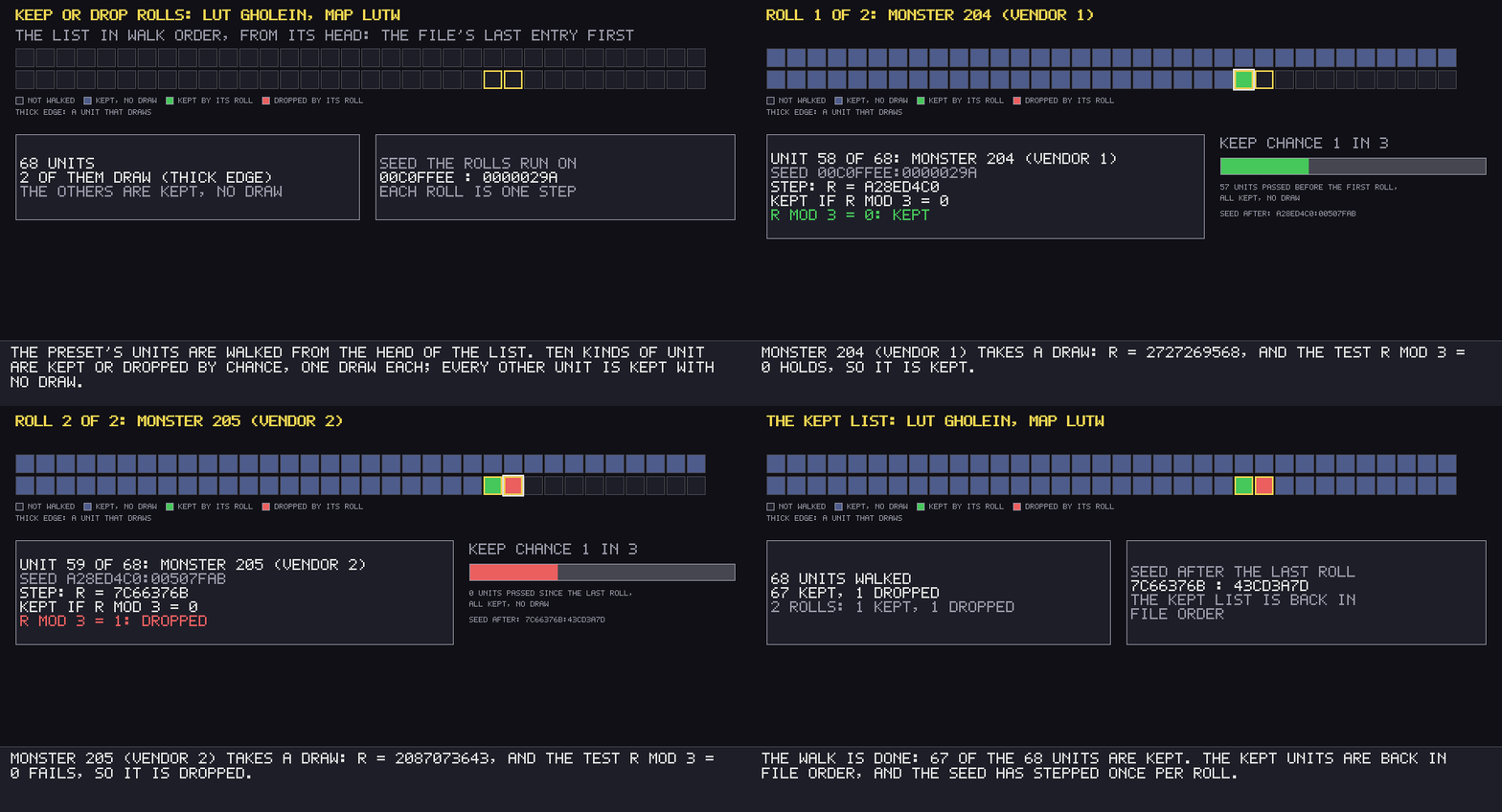
Step through drlg-preset-lutw-rolls
The keep/drop rolls of one preset, the Lut Gholein map LutW, on an illustrative seed started with Init; in a game these rolls run on Lut Gholein’s level seed while its rooms are made (preset § 2). The units are walked from the head of the list, which is the last entry of the file; ten kinds of unit are kept or dropped by chance with one draw each, every other unit is kept with no draw (preset § 3). Here the two vendors (MonStats 204 and 205) draw, each kept when the draw mod 3 is 0, one chance in three. The kept units are back in file order (§ 3, step note 5). Each preset instance rolls once, on the level seed or on the first room’s seed (§ 2). Seed: illustrative, an input of our own. Every value shown is computed by our model, not observed in the game.
Units the game adds. Some river presets get ambient
river objects that exist only in the client copy; all six preset types that get them were reached in runs. In the
Blood Moor a preset of record 4–7 with file index 3 gets a monster (navi) at its centre, with no draw; runs built
that case on two map seeds and matched it.
To the room and to the spawners. Each unit moves to the room whose rectangle holds it. When the server later fills the room, it walks the list twice, non-monsters first, then monsters; a unit whose skip flag is set, such as the client-only river objects, is skipped (read from the code). This is where the monsters and objects pages take over.
Populate 0 is not “no monsters”. A
preset record with Populate 0 turns off the random population of its rooms, but its preset units still spawn: in
Harrogath and the Pandemonium Fortress 48 preset monsters were created. The same no-population flag is also set on a
room outside a town that borders a town level.
Warps, stairs and seams
Section titled “Warps, stairs and seams”Stairs and cave mouths come from the maps themselves.
A wall cell of a warp orientation in a DS1 carries a warp slot m: it means “this is the way to
Vism”. When the map of a preset whose Scan column is set is scanned, that slot becomes a flag on the room that
holds the cell, and so does a waypoint object. Every preset room is also pre-flagged with the seam slots of its level.
In a maze level the warp rooms are exactly the specials and fixed rooms whose map holds a slot; outdoor generators
flag their own seam rooms and waypoint cells.
Warp points. At the end of every level build, the game lists the centre of each room that has a waypoint flag or a warp slot with a real warp (seams don’t count). The population pass reads this list to test whether a spawn point is too close to a warp (next section).
Pairing. When a room with a warp flag activates, the game calls the pairing once per warp flag, in slot order, builds the destination level if needed and finds the matching room there; a run logged 695 such activations. If a level names the same destination in several slots (a wilderness level with four cave slots), the slots are paired in order by rank; when rank fails, the first destination slot that names the source and has a room is taken. Rank alone mispairs the Durance levels and some caves, so the fallback matters. 172 pairings were predicted without error.
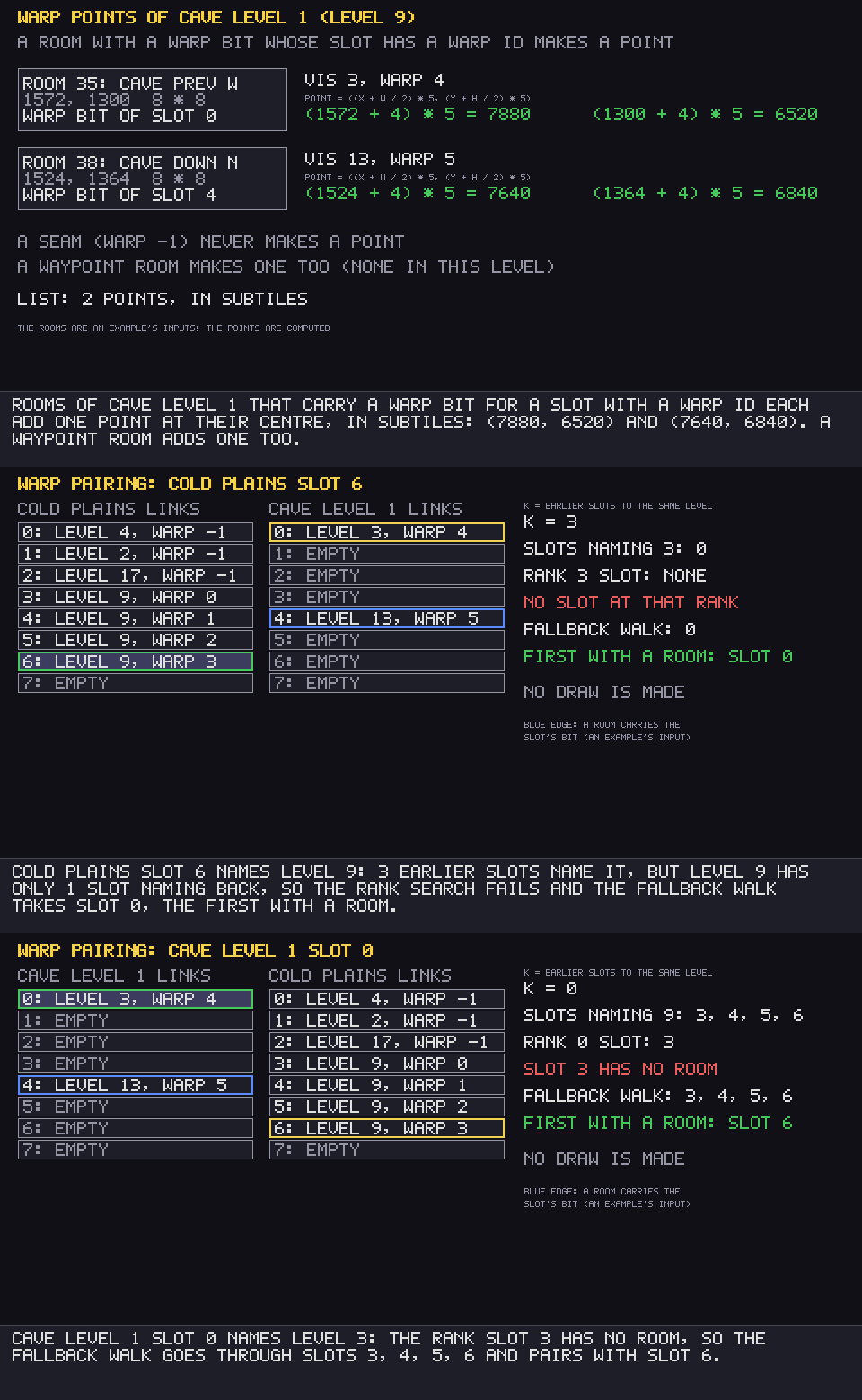
Step through drlg-warps-cave1-coldplains
Cave Level 1’s two warp rooms and how Cold Plains and Cave Level 1 pair, as in the worked example of the warps specification. A room with a warp bit for a slot whose warp id is not −1 adds one point at its centre, in subtiles: (x + w ÷ 2) × 5 and (y + h ÷ 2) × 5, and so does a waypoint room; a seam slot (warp id −1) adds none (warps § E1). A slot pairs by rank: k is the number of earlier slots of the source that name the same level, and the match is the k-th slot of the destination that names the source; if that slot does not exist or has no room, a fallback walk takes the first slot naming the source whose room exists, and no draw is made (§ F1). From Cold Plains slot 6 the rank search fails (k = 3) and the walk takes slot 0; from Cave Level 1 slot 0 the rank slot 3 has no room and the walk ends on slot 6. The rooms are the example’s inputs. The picture takes no seed. The picture restates the spec; nothing shown is observed in the game.
Pairing also widens what the stairs room can see, by the code. When the room activates, the game rebuilds its near list (the level-building room’s list, which the active room’s is filtered from) from the rooms of its own level less than 6 tiles away on both axes, itself included, then adds the paired room of the next level at the end and sorts the list again, so that room becomes a near room of the stairs room for the tile merge and the collision tests. The stairs room also gets a link to the paired room; nothing is marked on the destination room. For a seam slot the call makes no link and adds every destination room with that slot and less than 6 tiles away to the near list instead. A room of the Matron’s Den (level 133) makes no pairing call at all.
The collision grid and logic regions
Section titled “The collision grid and logic regions”When a room becomes an active room on the server, it gets a collision grid: one 16-bit cell per subtile (five per tile in each direction) of its rectangle. The grid is built once, from the tile data of the room and of its already active neighbours, and then every unit that stands in it marks its footprint and unmarks it when it moves, dies or leaves.
Built once, never redone. Only tiles whose top-left corner lies in the room are stamped, and only from rooms that are active at that moment. A grid is not stamped again when a neighbour activates later. So a room’s border tiles can end up in no grid at all if its right or bottom neighbour was active first; the run found 702 such rooms.
Outside the room. A cell outside every room the test can reach (the room and its near list) counts as blocked, whatever the test asks for, with one exception: a plus-shaped test whose centre is outside returns just the mask it was given. The spec notes that this is what keeps monsters off the rows next to an inactive neighbour.
What blocks a spawn. For the default spawn test, tiles block only through bit 0 of their cells. Earlier monsters block only through the centre marks of their footprint pattern, not through their whole footprint, so a new monster may be placed with one cell of an earlier monster’s footprint inside its own. What most of the other bits mean to movement, missiles and line of sight is not specified: those readers have not been read. Two bits have no writer at all on stock data (read from the code): no stock tile carries one of them and no marking code sets either, so the player’s movement test of one of them never meets a set cell, and the other is neither written nor read.
Logic regions. Each room also gets
a list of logic boxes, the rectangles the population pass makes its spawn attempts in. An outdoor
room, or a preset room whose record has Logicals 0, is one box covering the room, and it resets the level’s region
counter, so the next flooded room of the level numbers its regions from 1 again; the runs matched every such build. A
preset with Logicals 1 floods its tiles into regions separated by walls, cuts them into rectangles and relabels
regions that continue into neighbour rooms. All three steps are reproduced on all 1 475 floods of two runs:
- The walls. A tile is a wall for the flood when one of the room’s own wall entries there is on the first wall layer, is not a roof and lacks one exclusion flag (which a wall can take from its tile’s own flags), or when a neighbour room’s tile merge puts such an entry inside this room. Built this way from the room-tile model, the wall grid matches every recorded one.
- The flood. It spreads in four directions and, through a wall tile, by rules that depend on the wall’s orientation and the direction it came from. Two of those rule entries, and three orientations that no wall tile had, were never used by a flood and rest on the code.
- The relabelling. The points along the room’s four edges are walked and, for each neighbour in the near list that touches the room and whose tiles hold the point, the two regions there are merged. A released room takes no part until it is built again; leaving that out breaks 200 comparisons. With it, the region ids after every flood and in every logged box grid are reproduced, renames by later rooms included.
Side effects of the warp test.
The “is this point too close to a warp” test that spawning calls is not a pure test. When no warp point is near, it
looks up the level’s waypoint point, which can activate a room in the middle of the population pass (17 times in
the run). In a level whose Levels row has Position set and that has a matching waypoint point, it also steps the
level seed once per call. That was seen in Tristram (20 lookups), the Canyon of the Magi (100), the Arcane Sanctuary
(554) and level 125 (1), point and seed predicted each time. A lookup with no match makes no draw. Every lookup met
had exactly one match, so the draw’s range for two or more matches is read from the code. The order in which spawning
calls its tests is fixed, and a test that fails skips the later ones.
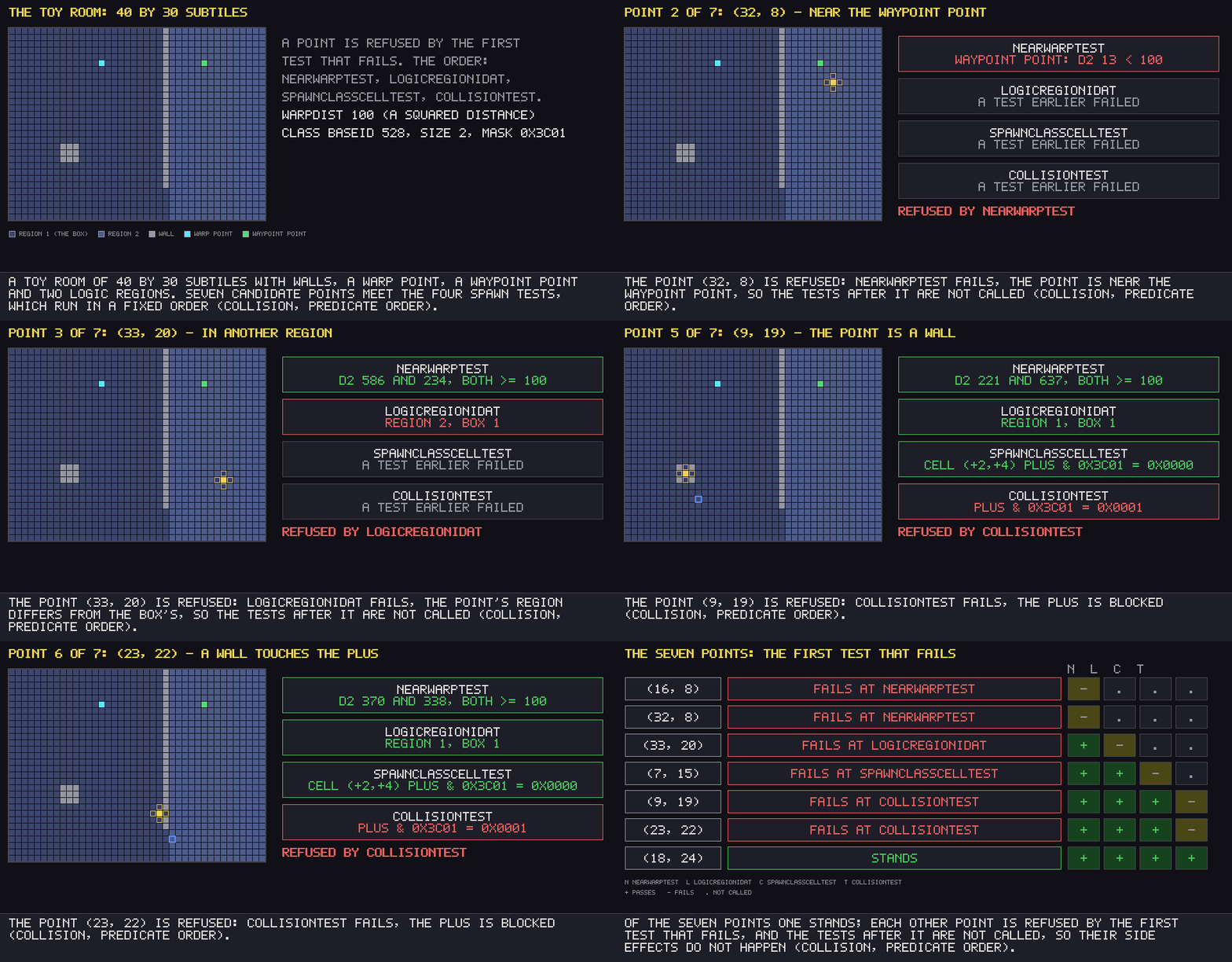
Step through levels-spawn-tests-toy-room
The four spawn tests on seven candidate points of a toy room of 40 by 30 subtiles with a long wall, a block, one warp point, one waypoint point, a WarpDist of 100 and two logic regions, region 1 being the box’s. The tests run in the predicate order: the point pick makes NearWarpTest, against the warp points and then the level’s waypoint point, then LogicRegionIdAt against the box’s id; the probe at the point then tests the region again, then SpawnClassCellTest, here for a class that tests the cell two to the right and four below its point with the mask 0x3C01 (BaseId 528, § H), then CollisionTest, the plus of a size-2 footprint against the mask 0x3C01 (§ E). A test that fails skips the later ones, so the points show one refusal each: a warp point, the waypoint point, another region, the class’s cell, the point itself a wall, a wall touching the plus; the seventh point passes all four. The waypoint lookup runs only when no warp point is near, and its side effects, the room activation and the level-seed step, are not drawn (§ I). The picture takes no seed. Every value shown is computed by our model, not observed in the game.
Rooms that come and go: release and restore
Section titled “Rooms that come and go: release and restore”A level is built once, but its rooms are not kept active all the time. The server activates the rooms around each player and releases rooms nobody has been near for a while; when a released room comes back, its monsters, objects and ground items are re-created from what the release saved. The room lifecycle spec has the rules; this section tells them in order. Where these passes fall in a frame is the server frame.
%3btext-align:center%3b%7d%23mermaid-5 .edgeLabel p%7bbackground-color:rgba(232%2c232%2c232%2c 0.8)%3b%7d%23mermaid-5 .edgeLabel rect%7bopacity:0.5%3bbackground-color:rgba(232%2c232%2c232%2c 0.8)%3bfill:rgba(232%2c232%2c232%2c 0.8)%3b%7d%23mermaid-5 .labelBkg%7bbackground-color:rgba(232%2c 232%2c 232%2c 0.5)%3b%7d%23mermaid-5 .cluster rect%7bfill:%23ffffde%3bstroke:%23aaaa33%3bstroke-width:1px%3b%7d%23mermaid-5 .cluster text%7bfill:%23333%3b%7d%23mermaid-5 .cluster span%7bcolor:%23333%3b%7d%23mermaid-5 .node .collapsed-indicator%7bfill:%23aaaa33%3bstroke:none%3bopacity:0.6%3b%7d%23mermaid-5 .node .collapsed-separator%7bstroke:%23aaaa33%3bstroke-width:0.75px%3b%7d%23mermaid-5 div.mermaidTooltip%7bposition:absolute%3btext-align:center%3bmax-width:200px%3bpadding:2px%3bfont-family:arial%2csans-serif%3bfont-size:12px%3bbackground:hsl(80%2c 100%25%2c 96.2745098039%25)%3bborder:1px solid %23aaaa33%3bborder-radius:2px%3bpointer-events:none%3bz-index:100%3b%7d%23mermaid-5 .flowchartTitleText%7btext-anchor:middle%3bfont-size:18px%3bfill:%23333%3b%7d%23mermaid-5 rect.text%7bfill:none%3bstroke-width:0%3b%7d%23mermaid-5 .icon-shape%2c%23mermaid-5 .image-shape%7bbackground-color:rgba(232%2c232%2c232%2c 0.8)%3btext-align:center%3b%7d%23mermaid-5 .icon-shape p%2c%23mermaid-5 .image-shape p%7bbackground-color:rgba(232%2c232%2c232%2c 0.8)%3bpadding:2px%3b%7d%23mermaid-5 .icon-shape .label rect%2c%23mermaid-5 .image-shape .label rect%7bopacity:0.5%3bbackground-color:rgba(232%2c232%2c232%2c 0.8)%3bfill:rgba(232%2c232%2c232%2c 0.8)%3b%7d%23mermaid-5 .label-icon%7bdisplay:inline-block%3bheight:1em%3boverflow:visible%3bvertical-align:-0.125em%3b%7d%23mermaid-5 .node .label-icon path%7bfill:currentColor%3bstroke:revert%3bstroke-width:revert%3b%7d%23mermaid-5 .node .neo-node%7bstroke:%239370DB%3b%7d%23mermaid-5 %5bdata-look='neo'%5d.node rect%2c%23mermaid-5 %5bdata-look='neo'%5d.cluster rect%2c%23mermaid-5 %5bdata-look='neo'%5d.node polygon%7bstroke:%239370DB%3bfilter:drop-shadow(1px 2px 2px rgba(185%2c 185%2c 185%2c 1))%3b%7d%23mermaid-5 %5bdata-look='neo'%5d.swimlane.cluster rect%7bfilter:none%3b%7d%23mermaid-5 %5bdata-look='neo'%5d.node path%7bstroke:%239370DB%3bstroke-width:1px%3b%7d%23mermaid-5 %5bdata-look='neo'%5d.node .outer-path%7bfilter:drop-shadow(1px 2px 2px rgba(185%2c 185%2c 185%2c 1))%3b%7d%23mermaid-5 %5bdata-look='neo'%5d.node .neo-line path%7bstroke:%239370DB%3bfilter:none%3b%7d%23mermaid-5 %5bdata-look='neo'%5d.node circle%7bstroke:%239370DB%3bfilter:drop-shadow(1px 2px 2px rgba(185%2c 185%2c 185%2c 1))%3b%7d%23mermaid-5 %5bdata-look='neo'%5d.node circle .state-start%7bfill:black%3b%7d%23mermaid-5 %5bdata-look='neo'%5d.icon-shape .icon%7bfill:%239370DB%3bfilter:drop-shadow(1px 2px 2px rgba(185%2c 185%2c 185%2c 1))%3b%7d%23mermaid-5 %5bdata-look='neo'%5d.icon-shape .icon-neo path%7bstroke:%239370DB%3bfilter:drop-shadow(1px 2px 2px rgba(185%2c 185%2c 185%2c 1))%3b%7d%23mermaid-5 :root%7b--mermaid-font-family:arial%2csans-serif%3b%7d%3c/style%3e%3cg%3e%3cmarker id='mermaid-5_flowchart-v2-pointEnd' class='marker flowchart-v2' viewBox='0 0 10 10' refX='5' refY='5' markerUnits='userSpaceOnUse' markerWidth='8' markerHeight='8' orient='auto'%3e%3cpath d='M 0 0 L 10 5 L 0 10 z' class='arrowMarkerPath' style='stroke-width: 1%3b stroke-dasharray: 1%2c 0%3b'/%3e%3c/marker%3e%3cmarker id='mermaid-5_flowchart-v2-pointStart' class='marker flowchart-v2' viewBox='0 0 10 10' refX='4.5' refY='5' markerUnits='userSpaceOnUse' markerWidth='8' markerHeight='8' orient='auto'%3e%3cpath d='M 0 5 L 10 10 L 10 0 z' class='arrowMarkerPath' style='stroke-width: 1%3b stroke-dasharray: 1%2c 0%3b'/%3e%3c/marker%3e%3cmarker id='mermaid-5_flowchart-v2-pointEnd-margin' class='marker flowchart-v2' viewBox='0 0 11.5 14' refX='11.5' refY='7' markerUnits='userSpaceOnUse' markerWidth='10.5' markerHeight='14' orient='auto'%3e%3cpath d='M 0 0 L 11.5 7 L 0 14 z' class='arrowMarkerPath' style='stroke-width: 0%3b stroke-dasharray: 1%2c 0%3b'/%3e%3c/marker%3e%3cmarker id='mermaid-5_flowchart-v2-pointStart-margin' class='marker flowchart-v2' viewBox='0 0 11.5 14' refX='1' refY='7' markerUnits='userSpaceOnUse' markerWidth='11.5' markerHeight='14' orient='auto'%3e%3cpolygon points='0%2c7 11.5%2c14 11.5%2c0' class='arrowMarkerPath' style='stroke-width: 0%3b stroke-dasharray: 1%2c 0%3b'/%3e%3c/marker%3e%3cmarker id='mermaid-5_flowchart-v2-circleEnd' class='marker flowchart-v2' viewBox='0 0 10 10' refX='11' refY='5' markerUnits='userSpaceOnUse' markerWidth='11' markerHeight='11' orient='auto'%3e%3ccircle cx='5' cy='5' r='5' class='arrowMarkerPath' style='stroke-width: 1%3b stroke-dasharray: 1%2c 0%3b'/%3e%3c/marker%3e%3cmarker id='mermaid-5_flowchart-v2-circleStart' class='marker flowchart-v2' viewBox='0 0 10 10' refX='-1' refY='5' markerUnits='userSpaceOnUse' markerWidth='11' markerHeight='11' orient='auto'%3e%3ccircle cx='5' cy='5' r='5' class='arrowMarkerPath' style='stroke-width: 1%3b stroke-dasharray: 1%2c 0%3b'/%3e%3c/marker%3e%3cmarker id='mermaid-5_flowchart-v2-circleEnd-margin' class='marker flowchart-v2' viewBox='0 0 10 10' refY='5' refX='12.25' markerUnits='userSpaceOnUse' markerWidth='14' markerHeight='14' orient='auto'%3e%3ccircle cx='5' cy='5' r='5' class='arrowMarkerPath' style='stroke-width: 0%3b stroke-dasharray: 1%2c 0%3b'/%3e%3c/marker%3e%3cmarker id='mermaid-5_flowchart-v2-circleStart-margin' class='marker flowchart-v2' viewBox='0 0 10 10' refX='-2' refY='5' markerUnits='userSpaceOnUse' markerWidth='14' markerHeight='14' orient='auto'%3e%3ccircle cx='5' cy='5' r='5' class='arrowMarkerPath' style='stroke-width: 0%3b stroke-dasharray: 1%2c 0%3b'/%3e%3c/marker%3e%3cmarker id='mermaid-5_flowchart-v2-crossEnd' class='marker cross flowchart-v2' viewBox='0 0 11 11' refX='12' refY='5.2' markerUnits='userSpaceOnUse' markerWidth='11' markerHeight='11' orient='auto'%3e%3cpath d='M 1%2c1 l 9%2c9 M 10%2c1 l -9%2c9' class='arrowMarkerPath' style='stroke-width: 2%3b stroke-dasharray: 1%2c 0%3b'/%3e%3c/marker%3e%3cmarker id='mermaid-5_flowchart-v2-crossStart' class='marker cross flowchart-v2' viewBox='0 0 11 11' refX='-1' refY='5.2' markerUnits='userSpaceOnUse' markerWidth='11' markerHeight='11' orient='auto'%3e%3cpath d='M 1%2c1 l 9%2c9 M 10%2c1 l -9%2c9' class='arrowMarkerPath' style='stroke-width: 2%3b stroke-dasharray: 1%2c 0%3b'/%3e%3c/marker%3e%3cmarker id='mermaid-5_flowchart-v2-crossEnd-margin' class='marker cross flowchart-v2' viewBox='0 0 15 15' refX='17.7' refY='7.5' markerUnits='userSpaceOnUse' markerWidth='12' markerHeight='12' orient='auto'%3e%3cpath d='M 1%2c1 L 14%2c14 M 1%2c14 L 14%2c1' class='arrowMarkerPath' style='stroke-width: 2.5%3b'/%3e%3c/marker%3e%3cmarker id='mermaid-5_flowchart-v2-crossStart-margin' class='marker cross flowchart-v2' viewBox='0 0 15 15' refX='-3.5' refY='7.5' markerUnits='userSpaceOnUse' markerWidth='12' markerHeight='12' orient='auto'%3e%3cpath d='M 1%2c1 L 14%2c14 M 1%2c14 L 14%2c1' class='arrowMarkerPath' style='stroke-width: 2.5%3b stroke-dasharray: 1%2c 0%3b'/%3e%3c/marker%3e%3cg class='root'%3e%3cg class='clusters'/%3e%3cg class='edgePaths'%3e%3cpath d='M174.734%2c66L178.901%2c66C183.068%2c66%2c191.401%2c66%2c199.068%2c66C206.734%2c66%2c213.734%2c66%2c217.234%2c66L220.734%2c66' id='mermaid-5-L_a_b_0' class='edge-thickness-normal edge-pattern-solid edge-thickness-normal edge-pattern-solid flowchart-link' style='%3b' data-edge='true' data-et='edge' data-id='L_a_b_0' data-points='W3sieCI6MTc0LjczNDM3NSwieSI6NjZ9LHsieCI6MTk5LjczNDM3NSwieSI6NjZ9LHsieCI6MjI0LjczNDM3NSwieSI6NjZ9XQ==' data-look='classic' marker-end='url(%23mermaid-5_flowchart-v2-pointEnd)'/%3e%3cpath d='M444.859%2c57.851L449.026%2c57.542C453.193%2c57.234%2c461.526%2c56.617%2c469.194%2c56.534C476.862%2c56.452%2c483.865%2c56.904%2c487.366%2c57.129L490.868%2c57.355' id='mermaid-5-L_b_c_0' class='edge-thickness-normal edge-pattern-solid edge-thickness-normal edge-pattern-solid flowchart-link' style='%3b' data-edge='true' data-et='edge' data-id='L_b_c_0' data-points='W3sieCI6NDQ0Ljg1OTM3NSwieSI6NTcuODUwOTk0OTA5NzY0fSx7IngiOjQ2OS44NTkzNzUsInkiOjU2fSx7IngiOjQ5NC44NTkzNzUsInkiOjU3LjYxMjkwMzIyNTgwNjQ1fV0=' data-look='classic' marker-end='url(%23mermaid-5_flowchart-v2-pointEnd)'/%3e%3cpath d='M494.859%2c74.387L490.693%2c74.656C486.526%2c74.925%2c478.193%2c75.462%2c470.524%2c75.472C462.856%2c75.481%2c455.852%2c74.963%2c452.35%2c74.704L448.848%2c74.444' id='mermaid-5-L_c_b_0' class='edge-thickness-normal edge-pattern-solid edge-thickness-normal edge-pattern-solid flowchart-link' style='%3b' data-edge='true' data-et='edge' data-id='L_c_b_0' data-points='W3sieCI6NDk0Ljg1OTM3NSwieSI6NzQuMzg3MDk2Nzc0MTkzNTV9LHsieCI6NDY5Ljg1OTM3NSwieSI6NzZ9LHsieCI6NDQ0Ljg1OTM3NSwieSI6NzQuMTQ5MDA1MDkwMjM2fV0=' data-look='classic' marker-end='url(%23mermaid-5_flowchart-v2-pointEnd)'/%3e%3cpath d='M754.859%2c40L759.026%2c39.167C763.193%2c38.333%2c771.526%2c36.667%2c779.193%2c35.833C786.859%2c35%2c793.859%2c35%2c797.359%2c35L800.859%2c35' id='mermaid-5-L_c_d_0' class='edge-thickness-normal edge-pattern-solid edge-thickness-normal edge-pattern-solid flowchart-link' style='%3b' data-edge='true' data-et='edge' data-id='L_c_d_0' data-points='W3sieCI6NzU0Ljg1OTM3NSwieSI6NDB9LHsieCI6Nzc5Ljg1OTM3NSwieSI6MzV9LHsieCI6ODA0Ljg1OTM3NSwieSI6MzV9XQ==' data-look='classic' marker-end='url(%23mermaid-5_flowchart-v2-pointEnd)'/%3e%3cpath d='M1059.641%2c35L1063.807%2c35C1067.974%2c35%2c1076.307%2c35%2c1083.987%2c35.703C1091.667%2c36.405%2c1098.692%2c37.81%2c1102.205%2c38.513L1105.718%2c39.216' id='mermaid-5-L_d_e_0' class='edge-thickness-normal edge-pattern-solid edge-thickness-normal edge-pattern-solid flowchart-link' style='%3b' data-edge='true' data-et='edge' data-id='L_d_e_0' data-points='W3sieCI6MTA1OS42NDA2MjUsInkiOjM1fSx7IngiOjEwODQuNjQwNjI1LCJ5IjozNX0seyJ4IjoxMTA5LjY0MDYyNSwieSI6NDB9XQ==' data-look='classic' marker-end='url(%23mermaid-5_flowchart-v2-pointEnd)'/%3e%3cpath d='M1109.641%2c92L1105.474%2c92.833C1101.307%2c93.667%2c1092.974%2c95.333%2c1063.409%2c96.167C1033.844%2c97%2c983.047%2c97%2c932.25%2c97C881.453%2c97%2c830.656%2c97%2c801.745%2c96.297C772.833%2c95.595%2c765.808%2c94.19%2c762.295%2c93.487L758.782%2c92.784' id='mermaid-5-L_e_c_0' class='edge-thickness-normal edge-pattern-solid edge-thickness-normal edge-pattern-solid flowchart-link' style='%3b' data-edge='true' data-et='edge' data-id='L_e_c_0' data-points='W3sieCI6MTEwOS42NDA2MjUsInkiOjkyfSx7IngiOjEwODQuNjQwNjI1LCJ5Ijo5N30seyJ4Ijo5MzIuMjUsInkiOjk3fSx7IngiOjc3OS44NTkzNzUsInkiOjk3fSx7IngiOjc1NC44NTkzNzUsInkiOjkyfV0=' data-look='classic' marker-end='url(%23mermaid-5_flowchart-v2-pointEnd)'/%3e%3c/g%3e%3cg class='edgeLabels'%3e%3cg class='edgeLabel'%3e%3cg class='label' data-id='L_a_b_0' transform='translate(0%2c 0)'%3e%3cforeignObject width='0' height='0'%3e%3cdiv xmlns='http://www.w3.org/1999/xhtml' class='labelBkg' style='display: table-cell%3b white-space: nowrap%3b line-height: 1.5%3b max-width: 200px%3b text-align: center%3b'%3e%3cspan class='edgeLabel'%3e%3c/span%3e%3c/div%3e%3c/foreignObject%3e%3c/g%3e%3c/g%3e%3cg class='edgeLabel'%3e%3cg class='label' data-id='L_b_c_0' transform='translate(0%2c 0)'%3e%3cforeignObject width='0' height='0'%3e%3cdiv xmlns='http://www.w3.org/1999/xhtml' class='labelBkg' style='display: table-cell%3b white-space: nowrap%3b line-height: 1.5%3b max-width: 200px%3b text-align: center%3b'%3e%3cspan class='edgeLabel'%3e%3c/span%3e%3c/div%3e%3c/foreignObject%3e%3c/g%3e%3c/g%3e%3cg class='edgeLabel'%3e%3cg class='label' data-id='L_c_b_0' transform='translate(0%2c 0)'%3e%3cforeignObject width='0' height='0'%3e%3cdiv xmlns='http://www.w3.org/1999/xhtml' class='labelBkg' style='display: table-cell%3b white-space: nowrap%3b line-height: 1.5%3b max-width: 200px%3b text-align: center%3b'%3e%3cspan class='edgeLabel'%3e%3c/span%3e%3c/div%3e%3c/foreignObject%3e%3c/g%3e%3c/g%3e%3cg class='edgeLabel'%3e%3cg class='label' data-id='L_c_d_0' transform='translate(0%2c 0)'%3e%3cforeignObject width='0' height='0'%3e%3cdiv xmlns='http://www.w3.org/1999/xhtml' class='labelBkg' style='display: table-cell%3b white-space: nowrap%3b line-height: 1.5%3b max-width: 200px%3b text-align: center%3b'%3e%3cspan class='edgeLabel'%3e%3c/span%3e%3c/div%3e%3c/foreignObject%3e%3c/g%3e%3c/g%3e%3cg class='edgeLabel'%3e%3cg class='label' data-id='L_d_e_0' transform='translate(0%2c 0)'%3e%3cforeignObject width='0' height='0'%3e%3cdiv xmlns='http://www.w3.org/1999/xhtml' class='labelBkg' style='display: table-cell%3b white-space: nowrap%3b line-height: 1.5%3b max-width: 200px%3b text-align: center%3b'%3e%3cspan class='edgeLabel'%3e%3c/span%3e%3c/div%3e%3c/foreignObject%3e%3c/g%3e%3c/g%3e%3cg class='edgeLabel'%3e%3cg class='label' data-id='L_e_c_0' transform='translate(0%2c 0)'%3e%3cforeignObject width='0' height='0'%3e%3cdiv xmlns='http://www.w3.org/1999/xhtml' class='labelBkg' style='display: table-cell%3b white-space: nowrap%3b line-height: 1.5%3b max-width: 200px%3b text-align: center%3b'%3e%3cspan class='edgeLabel'%3e%3c/span%3e%3c/div%3e%3c/foreignObject%3e%3c/g%3e%3c/g%3e%3c/g%3e%3cg class='nodes'%3e%3cg class='node default' id='mermaid-5-flowchart-a-0' data-look='classic' transform='translate(91.3671875%2c 66)'%3e%3crect class='basic label-container' style='' x='-83.3671875' y='-27' width='166.734375' height='54'/%3e%3cg class='label' style='' transform='translate(-53.3671875%2c -12)'%3e%3crect/%3e%3cforeignObject width='106.734375' height='24'%3e%3cdiv xmlns='http://www.w3.org/1999/xhtml' style='display: table-cell%3b white-space: nowrap%3b line-height: 1.5%3b max-width: 200px%3b text-align: center%3b'%3e%3cspan class='nodeLabel'%3e%3cp%3ebuilt%2c not active%3c/p%3e%3c/span%3e%3c/div%3e%3c/foreignObject%3e%3c/g%3e%3c/g%3e%3cg class='node default' id='mermaid-5-flowchart-b-1' data-look='classic' transform='translate(334.796875%2c 66)'%3e%3crect class='basic label-container' style='' x='-110.0625' y='-27' width='220.125' height='54'/%3e%3cg class='label' style='' transform='translate(-80.0625%2c -12)'%3e%3crect/%3e%3cforeignObject width='160.125' height='24'%3e%3cdiv xmlns='http://www.w3.org/1999/xhtml' style='display: table-cell%3b white-space: nowrap%3b line-height: 1.5%3b max-width: 200px%3b text-align: center%3b'%3e%3cspan class='nodeLabel'%3e%3cp%3eactive: populated once%3c/p%3e%3c/span%3e%3c/div%3e%3c/foreignObject%3e%3c/g%3e%3c/g%3e%3cg class='node default' id='mermaid-5-flowchart-c-3' data-look='classic' transform='translate(624.859375%2c 66)'%3e%3crect class='basic label-container' style='' x='-130' y='-39' width='260' height='78'/%3e%3cg class='label' style='' transform='translate(-100%2c -24)'%3e%3crect/%3e%3cforeignObject width='200' height='48'%3e%3cdiv xmlns='http://www.w3.org/1999/xhtml' style='display: table%3b white-space: break-spaces%3b line-height: 1.5%3b max-width: 200px%3b text-align: center%3b width: 200px%3b'%3e%3cspan class='nodeLabel'%3e%3cp%3eno player near: counting passes%3c/p%3e%3c/span%3e%3c/div%3e%3c/foreignObject%3e%3c/g%3e%3c/g%3e%3cg class='node default' id='mermaid-5-flowchart-d-7' data-look='classic' transform='translate(932.25%2c 35)'%3e%3crect class='basic label-container' style='' x='-127.390625' y='-27' width='254.78125' height='54'/%3e%3cg class='label' style='' transform='translate(-97.390625%2c -12)'%3e%3crect/%3e%3cforeignObject width='194.78125' height='24'%3e%3cdiv xmlns='http://www.w3.org/1999/xhtml' style='display: table-cell%3b white-space: nowrap%3b line-height: 1.5%3b max-width: 200px%3b text-align: center%3b'%3e%3cspan class='nodeLabel'%3e%3cp%3ereleased: some units saved%3c/p%3e%3c/span%3e%3c/div%3e%3c/foreignObject%3e%3c/g%3e%3c/g%3e%3cg class='node default' id='mermaid-5-flowchart-e-9' data-look='classic' transform='translate(1239.640625%2c 66)'%3e%3crect class='basic label-container' style='' x='-130' y='-39' width='260' height='78'/%3e%3cg class='label' style='' transform='translate(-100%2c -24)'%3e%3crect/%3e%3cforeignObject width='200' height='48'%3e%3cdiv xmlns='http://www.w3.org/1999/xhtml' style='display: table%3b white-space: break-spaces%3b line-height: 1.5%3b max-width: 200px%3b text-align: center%3b width: 200px%3b'%3e%3cspan class='nodeLabel'%3e%3cp%3eactive again: units restored%2c no new population%3c/p%3e%3c/span%3e%3c/div%3e%3c/foreignObject%3e%3c/g%3e%3c/g%3e%3c/g%3e%3c/g%3e%3c/g%3e%3cdefs%3e%3cfilter id='mermaid-5-drop-shadow' height='130%25' width='130%25'%3e%3cfeDropShadow dx='4' dy='4' stdDeviation='0' flood-opacity='0.06' flood-color='black'/%3e%3c/filter%3e%3c/defs%3e%3cdefs%3e%3cfilter id='mermaid-5-drop-shadow-small' height='150%25' width='150%25'%3e%3cfeDropShadow dx='2' dy='2' stdDeviation='0' flood-opacity='0.06' flood-color='black'/%3e%3c/filter%3e%3c/defs%3e%3c/svg%3e)
Which rooms are active. Each room keeps four counts, one per distance 0 to 3 along the rooms’ near lists from a player’s room. A count holds one reference per path, so a room reached by several routes at the same distance counts each of them. When a room gains its first distance-1 reference it becomes active; at distances 2 and 3 the game only prepares its tile list and map file. A run predicted every one of the 634 982 callbacks these counts triggered, and every activation: after each move every room of the new room’s near list was active, 9 944 of 9 944. Each active room also counts the players whose current room’s near list holds it; that count drives the release and the wanderers below. With several players the counts simply add up, but no multiplayer game was logged, so that part is read from the code only.
Rooms needed at once. A warp’s destination, a waypoint’s room, a level point, a preset level build and a unit spawned at given coordinates activate their room on demand, ten calls in all (checked by a second reading). Seen in a run: such a call builds the room only when it is not active (7 690 calls, 244 on an unbuilt room), and a room it activated gets no reference: one that no later move reached was still active and unreferenced at the next release pass, 158 of 158. Only the idle count below releases such a room (read from the code).
Populate once, restore after. New active rooms are handled at the start of the next game frame: seen in the frame windows, a room a player’s move activated in one frame was populated or restored at the start of the next, 80 of 80. A room active for the first time gets its preset units, objects and monster population. A room that comes back after a release is never populated again: only its saved units are restored, once per activation. A run met 1 137 first activations and 1 361 restores, and its 408 preset-unit placements all fell in a first population, none in the 286 later restore-only walks of those rooms. Three other callers populate a room at once, outside this walk: a unit spawned at coordinates in a room not yet active, the far end of a portal at a level point, and a quest spawn in the Act II town (checked by a second reading).
When a room is released. Every 12th frame a pass looks at each active room (its period seen in the frame windows). If no player is near, the room’s idle count goes up by one; if one is, it drops to zero. On the 11th player-free pass in a row the room is released, unless it is pinned (by a portal, or, read from the code, while some quest events run), the room still holds a distance-0 or distance-1 reference, or it is in a town and some room of that level still does (the same rule for level 120 is read from the code only). In 2 224 of the run’s 2 440 releases that came 120 to 131 frames after the player’s room change took the room out of range, every value of that window seen; the others came later, after a refused pass. The rule counts passes, not frames: a player who comes back and leaves again between two passes does not reset the count.
What is saved. Each unit of the released room is saved, kept or freed:
| Unit | Rule |
|---|---|
| live monster | saved when the level’s SaveMonsters flag is set or the monster came from a preset or an earlier restore, unless a later test refuses it |
| dead monster | one draw on the room seed for every corpse; saved only when that draw’s low word divides by 3, and never one that carries the special-monster or minion flag |
| object | by the objects rule: Restore set, and for RestoreVirgins objects only an unused one |
| ground item | always, as its saved bytes, with an expiry 15 000, 30 000 or 45 000 frames ahead by quality and kind (a quest item never expires, checked under emulation, no run saved one) |
| missile | freed |
Every logged champion carries the flag that bars a dead special from the save, so no dead champion was saved in the
run. A second reading finds three writes of the champion mark and no code that clears the special-monster flag; that each write
follows the special-monster marking on the same unit, so a dead champion is not saved with the shipped data, is read from the code.
A released room holds no live player: a player’s own room is always in its near set (seen in a run, 0 of 12 476 save tests on a
player). Anything the rule does not save is gone
for good. Several tests (pets and summons, a few special monster classes, restore 0 classes) and the case of a
level whose flag is clear for a monster that came from neither a preset nor a restore were never met, and stay
readings of the code.
What comes back. Monsters first, then items, then objects. Each kind comes back in the reverse of the order the release saved it, seen for monsters in 829 of 829 restores; that is the order of the saved list, not the units’ age (unit ids rise along only 372 of 563 restores with two monsters or more). A restored monster is a new unit with the old id and class. A plain one is placed at its saved position with three room-seed draws (seven when it has to search nearby); each gets a new unit seed from one game-seed draw and is created in full, then gets its saved experience and maximum hit points back. Its hit points are the saved ones if fewer than 7 500 frames passed since the release, and full otherwise. It comes back in its neutral mode whatever mode it was saved in (2 726 of 2 726 alive monsters, 32 of them saved mid-move). Its level comes from the new creation and its re-applied mods: a minion created at the plain pool level comes back 3 levels higher at its first restore, and a champion comes back 2 levels above the plain level. For the champion, the code and the run agree: its restore re-applies its mods in full, as at its first creation, and passes 0 for the minions argument (checked by a second reading), so it makes no new minions (read from the code). A minion’s restore re-applies its mods in the lighter form, which also skips the step a random name takes on the monster’s own seed: a second reading finds the minion restore calling the mod handlers itself in that form, though its level does not show the form in a game. States, timers and anything a hit left behind are lost (read from the code; the logs do not hold them). Each restored item takes two game-seed draws; an item saved in full keeps its seed, while a simple one (gold, potions, keys) comes back with seed 0. Its expiry becomes the later of the saved one and 15 000 frames from now; an item whose expiry has already passed is not re-created (5 seen in a run). In a room that stays active, read from the code: a monster’s or chest’s drop has no expiry until its room has been released, so nothing removes it till then. An item the ground-placement function places has an expiry at once (seen in a run, 80 of 80): a player’s drop, an overflow, a gold amount, NPC menus, the cube’s, a quest gift, an ear, a player’s corpse and a belt item sent to the ground, twelve calls in all (checked by a second reading). A pass every 1 500 frames, seen at those frames and no others in the frame windows, frees a ground item past it (seen in a run for 4 of 4 swept; its test checked under emulation). A run reproduced 2 035 monster, 876 item and 1 799 object restores.
A restored monster marks the collision grid like a monster of the population pass, though outside any window. One that comes back alive marks its footprint twice, then is
unmarked and marked again with the pattern for its size. One that comes back dead is marked once and then, if its
class’s deadCol column is 0, takes the corpse marks (a 3 × 3 corpse rectangle, then the corpse pattern); with
deadCol 1 the one mark stays. The end-to-end run compared 1 903 re-creations mark by mark, 0 different; the dead
cases rest on 140 of them. That covers the marks made from the recorded cell and alive-or-dead state, which are
inputs (they depend on what the monster did before the release), not where or in what state a monster comes back.
The call path that makes the marks is checked by a second reading; the marks and their order are what the run compared. Leaving the marks out breaks later placement
tests: the first end-to-end run’s only two mismatches were that.
Wanderers. Each time a room is handled at the start of a frame it takes one room-seed draw for the wandering monster. In the lifecycle run no draw passed. A later run saw one pass, in the Chaos Sanctuary: the second draw followed on the room seed, did not fall below 3 out of 100, and nothing spawned. The gate’s tests ran under emulation, the code’s map: the draw passes only when its low 15 bits are all 0 (the one pass in a game cannot tell how many bits are tested), the room must have no player near, the level must allow wanderers, and the second draw is followed by a spawn only below 3 out of 100 with fewer than 3 wanderers already in the level’s region, a signed count. Only Act I has a wanderer class, one rogue class. Read from the code: the draw so passes 1 time in 32 768, and the spawn itself, which no game has met. So wanderers can only appear in active rooms no player is near.
An example. In the run’s Cold Plains game, one room left the player’s range at frame 5331 and was released at frame 5460, 129 frames later. It held four corpses: each took one room-seed draw, and only the one whose draw divided by 3 was saved, with an item and an object. At frame 6570 the player came back: the corpse was re-created where it lay with its saved experience and maximum hit points, the item came back with an expiry of 21 570, and the object was re-created by the objects rules.
A worked example: the Den of Evil, map seed 12345
Section titled “A worked example: the Den of Evil, map seed 12345”All numbers below are copied from the specs’ worked examples; seeds are written low:high in hex. The Den of Evil
is level 8, a maze level (DrlgType 1) of level type 3, with a level seed base of 015B2E77.
The maze (maze § Worked example, example 1). LvlMaze gives Rooms 1 in
every difficulty, 24 × 24 rooms. With one room already there, growth makes no draw at all.
| # | Draw | Seed after | Effect |
|---|---|---|---|
| 1 | finisher r |
C20781F3:5E130228 |
value 3 |
| 2 | Prev stairs, entry 3 | 06E4B227:50ED9B57 |
no room has record 53: a new room is attached east of the first; the first becomes 54 |
| 3 | Den of Evil room, entry 0 | 334AA35A:02E00A8C |
the first room is 54, not 60: a new room is attached south of it; the first becomes 58 |
Level 8 has no theme pass. The result, newest first: record 98 at (1500, 1024), record 83 at (1524, 1000), record 58 at (1500, 1000), all 24 × 24.
The conversion. Records 53–67 rotate on this level type.
| Step | Operation | Level seed after | Result |
|---|---|---|---|
| re-seed | level seed set to base + 8 | 015B2E7F:0000029A |
|
| first maze room | one room creation | E18C3A55:0090CE8A |
|
| maze generator | (above) | 334AA35A:02E00A8C |
three maze rooms |
record 98, Files 1 |
Range(1) |
12CE5ECE:1564B05F |
index 0 (a draw even though there is one file); Act1\Caves\CaveNSpec.ds1 |
| 24 × 24 → 9 rooms | 42DB84E5:07D80981 … F38BE870:3FC9280D |
||
record 83, Files 2 |
Range(2) |
83D2063D:6594D62E |
index 1: Act1\Caves\CaveWPre2.ds1 |
| first room of its split, at (1524, 1000), 8 × 8 | 0EE3F31F:36FB3592 |
its stored creation draw is 8E258975 |
|
record 58, Files 2 |
Range(2) |
35E895EF:42FA8C7C |
index 1, then overridden |
58 rotates, first use: RangeB(2) |
80265D67:167C1E75 |
start 1, then (1 + 1) mod 2 = 0: Act1\Caves\CaveSE.ds1 |
One room’s activation. The room with
creation draw 8E258975 is re-seeded to 8E258975:0000029A on the client copy. Its tile list is Cave.dt1 plus the
three fixed files. Its floor pass makes 15 draws: one for a border floor cell and 14 for other floor cells, all of key
(0, 5, 0), whose nine candidate tiles have rarities summing to 13; the other cells have a rarity sum of 0 and draw
nothing. So k = 15, the seed after the last pick is 6CC2E5DB:673E363A, and the activation draw gives
2FE647C1:2D5D0F6C: the active room’s seed is Init(2FE647C1).
A worked example: a keep/drop roll in the Catacombs
Section titled “A worked example: a keep/drop roll in the Catacombs”From preset § Worked example: Catacombs Level 2 (level 35), preset record
267, file Act1\Catacomb\CatNE.ds1, 12 × 12, so a single room. Its Scan and Pops are 0, so the room rolls on its
creation seed, 653A205E:685C5276. The file holds two candles, a pool of blood and one place_group50. The roll walks
from the last entry, so place_group50 is first: the draw gives F5001ACC, the test keeps it only if the lowest bit
is 1, and F5001ACC is even, so it is dropped. The three objects need no draw and stay. The room’s later re-seed
is Init(653A205E), so this draw changes nothing else in the room.
The same section shows a level-seed roll in Lut Gholein: with LutW.ds1 both vendors (204, 205) drew r mod 3 = 2
and neither was kept; with LutN.ds1 both drew 0 and both were kept.
What is not known yet
Section titled “What is not known yet”These points are read from the code but not confirmed by a run, or are open questions in the specs. Each links its section.
- Generator dispatch: when a level has a
SubTypeand aSubThemeof −1, the substitution roll is skipped with no draw, and each outdoor room’s position is the level’s corner plus 8 tiles per cell; both are confirmed by runs. A level with only one of the two −1 is read from the code only (no shipped level with that case has an outdoor room), and so are the outdoor room DT1 mask values for level types 22, 27, 28 and 30. - Maze paths not reached: later runs reached the tombs, Lair 64, the other finisher rows and the Barracks on all three sides. Two paths remain: a special that no room can take (met in none of 337 logged attaches), and the “level too small” error, which an offline sample of 408 000 maze builds never raised for any pair of tombs the act can choose; a sample is not a proof, so whether a shipped seed can reach it stays open. Levels 133 and 135 have no stock build, and tombs 69 and 72 rest on the code’s reading of the tomb finisher.
- Outdoor: level 134 is not built by any run (the cube cannot open its portal in this version, and no other code opens a portal to levels 133–136). Three branches once missing are now reached in runs and match the model: the Frigid Highlands prisons placed by the fallback scan, a road search that fails in the Black Marsh, and the bridge search on the non-square Blood Moor. A link-builder back-up was never reached. A vertex merge in the level outline and a waypoint pass with no free cell were never reached either, in the logged games or in 52 200 windows of an offline scan. For the vertex merge, an enumeration of every layout the act link builder can give rules out a case in Acts I, II, IV and V (a reading of the code, since the merge rule is read, not run); Act III’s layouts cannot be enumerated that way and keep only the scan. Nothing yet shows that the shipped data cannot reach the waypoint pass. Three other branches have no case in the shipped data, by a reading of the code that the scan agrees with: roads with 5 or 6 endpoints (an Act I level has at most 4, since its border pieces never take the opening’s variant), an exhausted road search (it uses at most 45 of its 900 nodes), and the cliff-cave scan’s swapped bounds, which only a non-square level would show (of the Act I levels 2–7 only the Blood Moor is non-square, and nothing between the step that skips its cliffs and the scan gives it a cliff run). A few table reads past the end are not reached by the shipped tables. Some smaller steps are not yet written from the code: details of how a border stamp is matched and written, the edges and scan order of Act V’s gates and prisons, a few arguments of the Kurast fills, which cells beside the Act I bridge must be free, and the vertex merge itself.
- Room tiles: the tile-merge
branches that would re-orient a wall or shadow, or treat orientation 3 specially, are unreachable on the shipped
data, outdoor rooms included: every wall and shadow cell of the 2077 map files a room can read carries the bit
that skips them, and the logged merges agree one by one. The spec keeps them only as the code’s reading of edited
data. A room with no tiles was never exercised, nor was the fatal error when even the fallback tile is missing. Release
and re-activation is confirmed, and so is the flag a server release leaves; nothing that reads that flag was
found. A tile-file
name of
"0"in a room’s list would not stop the build, but what happens next depends on memory contents and cannot be told from the code; no checked shipped room has one (the check leaves out the outdoor anchor rooms and some maze special rooms). One shipped file (Act1/Outdoors/Trees.ds1) is 12 bytes short; reading the missing bytes as zeros matches every observed draw, but the original reads whatever is in memory there. - Preset units: the Blood Moor centre monster
and the river objects of all six preset types are now reached in runs. What stays read from the code has no case in
the shipped data: the row skip for floor tiles other than the one the Act I town uses, the Courtyard’s index 2 from
the side-1 formula, the Black Marsh ending on side 2, a few map-entry branches no shipped map uses. The special filters of levels 133–136 were checked by running the code under emulation, up to the first
spawn of a walk, and never in a game: no code path found opens a portal to those levels, so on that reading stock play does not reach them. The reader of the
Outdoorsflag is found, by the code: a test of whether a room is outdoors, called by the client when the player changes room and by one server walk in the skill code; what the client does with the result is presentation and not found. On the server a preset monster’s path is detached when the monster is spawned, which takes the path over (confirmed by a run); who detaches it on the client copy is unknown, and so is what a path point’sactiondoes. - Warps: every side choice of the link builder
and every reject rule but one was reached in runs. What stays read from the code has no case in the shipped data,
by the code and an offline scan of every input the builder can get: a reject decided by the Moo Moo Farm’s widened
rectangle, the Courtyard’s index 2 from the side-1 formula, and the outcomes of Act V’s “do these rectangles touch”
test other than a shared edge, and that test’s other mode. Only edited data could reach them. What happens when the Matron’s Den stairs (133 → 17),
which have no way back, are used is unknown. The units of the
LvlWarpcolumns are now read from the code: theOffsetandExitWalkcolumns are subtiles, theSelectcolumns screen pixels. More than nine warp points in a level was not seen in 1452 logged builds (the most was 8, in the Valley of the Kings), and the slot counts in the data cannot give it; only one slot’s warp cells falling in two rooms of a level could, and nothing in the code rules that out. - Room lifecycle: whether a hostile monster can follow a player into a town room at all (if it can, the town’s release frees it instead of saving it). Read from the code: such a monster cannot plan a path whose goal is in town, but nothing tests the rooms a path only crosses, and the teleport code tests no destination room. A scan of the town layouts in the kept logs found no shortest route that crosses a town (each town meets its neighbour at one gate, some camp layouts at one more opening a cell or two wide), and the two monster AIs read that choose a teleport point both refuse one in town; neither covers every case, so the question stays open. Also open: whether the lighter form of a restored minion’s mods shows in a game, the wanderer spawn (the roll before it fired once in a later run, spawn § K), a quest item that never expires, the dropped-record case for one alignment, which call sets one monster flag before the record is written, several save tests and restore paths, and multiplayer games, none of which a run met.
- Collision: runs have now reached the
one-cell placement tests (sizes 0 and 1), the
sarcophagusandevilhutcell checks, and the NPC footprints. A third special-class check has no class that stock data creates, so it cannot be seen. An NPC takes the larger footprint pattern when its class is flaggednpcorinTownandinteractis clear. Only theinTownhalf is confirmed: every upgraded class met hasinTown, and no stock row hasnpcwithoutinTownand withinteractclear, so thenpctest (and a third, unit-level test) rests on the code. Still open: a spawn test rejected by a missile’s mark, the clear-and-restamp of a merged tile in an active neighbour (none of 41 logged calls reached a room it could write), aflyingtest in the spawn path, the level-seed step’s range when a level has two or more matching points, spawn tests rejected by object marks, and the meaning of the bits that only movement reads.
Where to read more
Section titled “Where to read more”- The specs: overview, room tiles, preset units, maze, outdoor, warps and collision, and the room lifecycle. Each has a Reimplementation notes section listing the traps.
- The glossary for every term linked above.
- Related wiki pages: randomness (the seed tree behind the level and room seeds), monsters (the population pass that uses the logic boxes and the collision grid), pathing (the planners that read the live grid, and corpses on each copy of the grid), objects (how preset and random objects are created), quests and travel (where a player lands after a warp, a waypoint or a portal, and the quest gates on five warps) and how we know.