Objects: shrines, chests, barrels and the rest
Every room the game activates for the first time gets its objects: the ones placed by hand in the room’s map pieces, and a random set chosen from the level’s object groups. This page explains how those objects are chosen and placed, the dice they roll when they are created (is this chest trapped? locked? which shrine is this?), what happens when a player clicks a chest, urn or barrel, and where the chest hands over to the drop tables. It also names the timer events and the quest objects. It restates the reviewed objects spec, plus the short part of the treasure class spec that picks a chest’s drop table. What a shrine, a well or a trap actually does to the player is game simulation and is out of scope: the spec only names it.
The big picture
Section titled “The big picture”Objects are made on the server, in a fixed window of the room’s first activation, just before the room’s monster population pass. The window has three steps:
- the hand-placed objects of the room’s map pieces;
- a restore of objects saved when the room was last deactivated (nothing on a first visit);
- the random object population, which walks the eight object-group slots of the level and places members of the groups that pass their roll.
Every object made in any of these ways then runs the same creation rolls. Later, a player may operate it.
%3btext-align:center%3b%7d%23mermaid-0 .edgeLabel p%7bbackground-color:rgba(232%2c232%2c232%2c 0.8)%3b%7d%23mermaid-0 .edgeLabel rect%7bopacity:0.5%3bbackground-color:rgba(232%2c232%2c232%2c 0.8)%3bfill:rgba(232%2c232%2c232%2c 0.8)%3b%7d%23mermaid-0 .labelBkg%7bbackground-color:rgba(232%2c 232%2c 232%2c 0.5)%3b%7d%23mermaid-0 .cluster rect%7bfill:%23ffffde%3bstroke:%23aaaa33%3bstroke-width:1px%3b%7d%23mermaid-0 .cluster text%7bfill:%23333%3b%7d%23mermaid-0 .cluster span%7bcolor:%23333%3b%7d%23mermaid-0 .node .collapsed-indicator%7bfill:%23aaaa33%3bstroke:none%3bopacity:0.6%3b%7d%23mermaid-0 .node .collapsed-separator%7bstroke:%23aaaa33%3bstroke-width:0.75px%3b%7d%23mermaid-0 div.mermaidTooltip%7bposition:absolute%3btext-align:center%3bmax-width:200px%3bpadding:2px%3bfont-family:arial%2csans-serif%3bfont-size:12px%3bbackground:hsl(80%2c 100%25%2c 96.2745098039%25)%3bborder:1px solid %23aaaa33%3bborder-radius:2px%3bpointer-events:none%3bz-index:100%3b%7d%23mermaid-0 .flowchartTitleText%7btext-anchor:middle%3bfont-size:18px%3bfill:%23333%3b%7d%23mermaid-0 rect.text%7bfill:none%3bstroke-width:0%3b%7d%23mermaid-0 .icon-shape%2c%23mermaid-0 .image-shape%7bbackground-color:rgba(232%2c232%2c232%2c 0.8)%3btext-align:center%3b%7d%23mermaid-0 .icon-shape p%2c%23mermaid-0 .image-shape p%7bbackground-color:rgba(232%2c232%2c232%2c 0.8)%3bpadding:2px%3b%7d%23mermaid-0 .icon-shape .label rect%2c%23mermaid-0 .image-shape .label rect%7bopacity:0.5%3bbackground-color:rgba(232%2c232%2c232%2c 0.8)%3bfill:rgba(232%2c232%2c232%2c 0.8)%3b%7d%23mermaid-0 .label-icon%7bdisplay:inline-block%3bheight:1em%3boverflow:visible%3bvertical-align:-0.125em%3b%7d%23mermaid-0 .node .label-icon path%7bfill:currentColor%3bstroke:revert%3bstroke-width:revert%3b%7d%23mermaid-0 .node .neo-node%7bstroke:%239370DB%3b%7d%23mermaid-0 %5bdata-look='neo'%5d.node rect%2c%23mermaid-0 %5bdata-look='neo'%5d.cluster rect%2c%23mermaid-0 %5bdata-look='neo'%5d.node polygon%7bstroke:%239370DB%3bfilter:drop-shadow(1px 2px 2px rgba(185%2c 185%2c 185%2c 1))%3b%7d%23mermaid-0 %5bdata-look='neo'%5d.swimlane.cluster rect%7bfilter:none%3b%7d%23mermaid-0 %5bdata-look='neo'%5d.node path%7bstroke:%239370DB%3bstroke-width:1px%3b%7d%23mermaid-0 %5bdata-look='neo'%5d.node .outer-path%7bfilter:drop-shadow(1px 2px 2px rgba(185%2c 185%2c 185%2c 1))%3b%7d%23mermaid-0 %5bdata-look='neo'%5d.node .neo-line path%7bstroke:%239370DB%3bfilter:none%3b%7d%23mermaid-0 %5bdata-look='neo'%5d.node circle%7bstroke:%239370DB%3bfilter:drop-shadow(1px 2px 2px rgba(185%2c 185%2c 185%2c 1))%3b%7d%23mermaid-0 %5bdata-look='neo'%5d.node circle .state-start%7bfill:black%3b%7d%23mermaid-0 %5bdata-look='neo'%5d.icon-shape .icon%7bfill:%239370DB%3bfilter:drop-shadow(1px 2px 2px rgba(185%2c 185%2c 185%2c 1))%3b%7d%23mermaid-0 %5bdata-look='neo'%5d.icon-shape .icon-neo path%7bstroke:%239370DB%3bfilter:drop-shadow(1px 2px 2px rgba(185%2c 185%2c 185%2c 1))%3b%7d%23mermaid-0 :root%7b--mermaid-font-family:arial%2csans-serif%3b%7d%3c/style%3e%3cg%3e%3cmarker id='mermaid-0_flowchart-v2-pointEnd' class='marker flowchart-v2' viewBox='0 0 10 10' refX='5' refY='5' markerUnits='userSpaceOnUse' markerWidth='8' markerHeight='8' orient='auto'%3e%3cpath d='M 0 0 L 10 5 L 0 10 z' class='arrowMarkerPath' style='stroke-width: 1%3b stroke-dasharray: 1%2c 0%3b'/%3e%3c/marker%3e%3cmarker id='mermaid-0_flowchart-v2-pointStart' class='marker flowchart-v2' viewBox='0 0 10 10' refX='4.5' refY='5' markerUnits='userSpaceOnUse' markerWidth='8' markerHeight='8' orient='auto'%3e%3cpath d='M 0 5 L 10 10 L 10 0 z' class='arrowMarkerPath' style='stroke-width: 1%3b stroke-dasharray: 1%2c 0%3b'/%3e%3c/marker%3e%3cmarker id='mermaid-0_flowchart-v2-pointEnd-margin' class='marker flowchart-v2' viewBox='0 0 11.5 14' refX='11.5' refY='7' markerUnits='userSpaceOnUse' markerWidth='10.5' markerHeight='14' orient='auto'%3e%3cpath d='M 0 0 L 11.5 7 L 0 14 z' class='arrowMarkerPath' style='stroke-width: 0%3b stroke-dasharray: 1%2c 0%3b'/%3e%3c/marker%3e%3cmarker id='mermaid-0_flowchart-v2-pointStart-margin' class='marker flowchart-v2' viewBox='0 0 11.5 14' refX='1' refY='7' markerUnits='userSpaceOnUse' markerWidth='11.5' markerHeight='14' orient='auto'%3e%3cpolygon points='0%2c7 11.5%2c14 11.5%2c0' class='arrowMarkerPath' style='stroke-width: 0%3b stroke-dasharray: 1%2c 0%3b'/%3e%3c/marker%3e%3cmarker id='mermaid-0_flowchart-v2-circleEnd' class='marker flowchart-v2' viewBox='0 0 10 10' refX='11' refY='5' markerUnits='userSpaceOnUse' markerWidth='11' markerHeight='11' orient='auto'%3e%3ccircle cx='5' cy='5' r='5' class='arrowMarkerPath' style='stroke-width: 1%3b stroke-dasharray: 1%2c 0%3b'/%3e%3c/marker%3e%3cmarker id='mermaid-0_flowchart-v2-circleStart' class='marker flowchart-v2' viewBox='0 0 10 10' refX='-1' refY='5' markerUnits='userSpaceOnUse' markerWidth='11' markerHeight='11' orient='auto'%3e%3ccircle cx='5' cy='5' r='5' class='arrowMarkerPath' style='stroke-width: 1%3b stroke-dasharray: 1%2c 0%3b'/%3e%3c/marker%3e%3cmarker id='mermaid-0_flowchart-v2-circleEnd-margin' class='marker flowchart-v2' viewBox='0 0 10 10' refY='5' refX='12.25' markerUnits='userSpaceOnUse' markerWidth='14' markerHeight='14' orient='auto'%3e%3ccircle cx='5' cy='5' r='5' class='arrowMarkerPath' style='stroke-width: 0%3b stroke-dasharray: 1%2c 0%3b'/%3e%3c/marker%3e%3cmarker id='mermaid-0_flowchart-v2-circleStart-margin' class='marker flowchart-v2' viewBox='0 0 10 10' refX='-2' refY='5' markerUnits='userSpaceOnUse' markerWidth='14' markerHeight='14' orient='auto'%3e%3ccircle cx='5' cy='5' r='5' class='arrowMarkerPath' style='stroke-width: 0%3b stroke-dasharray: 1%2c 0%3b'/%3e%3c/marker%3e%3cmarker id='mermaid-0_flowchart-v2-crossEnd' class='marker cross flowchart-v2' viewBox='0 0 11 11' refX='12' refY='5.2' markerUnits='userSpaceOnUse' markerWidth='11' markerHeight='11' orient='auto'%3e%3cpath d='M 1%2c1 l 9%2c9 M 10%2c1 l -9%2c9' class='arrowMarkerPath' style='stroke-width: 2%3b stroke-dasharray: 1%2c 0%3b'/%3e%3c/marker%3e%3cmarker id='mermaid-0_flowchart-v2-crossStart' class='marker cross flowchart-v2' viewBox='0 0 11 11' refX='-1' refY='5.2' markerUnits='userSpaceOnUse' markerWidth='11' markerHeight='11' orient='auto'%3e%3cpath d='M 1%2c1 l 9%2c9 M 10%2c1 l -9%2c9' class='arrowMarkerPath' style='stroke-width: 2%3b stroke-dasharray: 1%2c 0%3b'/%3e%3c/marker%3e%3cmarker id='mermaid-0_flowchart-v2-crossEnd-margin' class='marker cross flowchart-v2' viewBox='0 0 15 15' refX='17.7' refY='7.5' markerUnits='userSpaceOnUse' markerWidth='12' markerHeight='12' orient='auto'%3e%3cpath d='M 1%2c1 L 14%2c14 M 1%2c14 L 14%2c1' class='arrowMarkerPath' style='stroke-width: 2.5%3b'/%3e%3c/marker%3e%3cmarker id='mermaid-0_flowchart-v2-crossStart-margin' class='marker cross flowchart-v2' viewBox='0 0 15 15' refX='-3.5' refY='7.5' markerUnits='userSpaceOnUse' markerWidth='12' markerHeight='12' orient='auto'%3e%3cpath d='M 1%2c1 L 14%2c14 M 1%2c14 L 14%2c1' class='arrowMarkerPath' style='stroke-width: 2.5%3b stroke-dasharray: 1%2c 0%3b'/%3e%3c/marker%3e%3cg class='root'%3e%3cg class='clusters'/%3e%3cg class='edgePaths'%3e%3cpath d='M220.5%2c86L220.5%2c90.167C220.5%2c94.333%2c220.5%2c102.667%2c220.5%2c110.333C220.5%2c118%2c220.5%2c125%2c220.5%2c128.5L220.5%2c132' id='mermaid-0-L_gc_win_0' class='edge-thickness-normal edge-pattern-solid edge-thickness-normal edge-pattern-solid flowchart-link' style='%3b' data-edge='true' data-et='edge' data-id='L_gc_win_0' data-points='W3sieCI6MjIwLjUsInkiOjg2fSx7IngiOjIyMC41LCJ5IjoxMTF9LHsieCI6MjIwLjUsInkiOjEzNn1d' data-look='classic' marker-end='url(%23mermaid-0_flowchart-v2-pointEnd)'/%3e%3cpath d='M220.5%2c214L220.5%2c218.167C220.5%2c222.333%2c220.5%2c230.667%2c220.5%2c238.333C220.5%2c246%2c220.5%2c253%2c220.5%2c256.5L220.5%2c260' id='mermaid-0-L_win_pre_0' class='edge-thickness-normal edge-pattern-solid edge-thickness-normal edge-pattern-solid flowchart-link' style='%3b' data-edge='true' data-et='edge' data-id='L_win_pre_0' data-points='W3sieCI6MjIwLjUsInkiOjIxNH0seyJ4IjoyMjAuNSwieSI6MjM5fSx7IngiOjIyMC41LCJ5IjoyNjR9XQ==' data-look='classic' marker-end='url(%23mermaid-0_flowchart-v2-pointEnd)'/%3e%3cpath d='M177.663%2c318L171.053%2c322.167C164.442%2c326.333%2c151.221%2c334.667%2c144.611%2c342.333C138%2c350%2c138%2c357%2c138%2c360.5L138%2c364' id='mermaid-0-L_pre_rst_0' class='edge-thickness-normal edge-pattern-solid edge-thickness-normal edge-pattern-solid flowchart-link' style='%3b' data-edge='true' data-et='edge' data-id='L_pre_rst_0' data-points='W3sieCI6MTc3LjY2MzQ2MTUzODQ2MTU1LCJ5IjozMTh9LHsieCI6MTM4LCJ5IjozNDN9LHsieCI6MTM4LCJ5IjozNjh9XQ==' data-look='classic' marker-end='url(%23mermaid-0_flowchart-v2-pointEnd)'/%3e%3cpath d='M138%2c446L138%2c450.167C138%2c454.333%2c138%2c462.667%2c138%2c470.333C138%2c478%2c138%2c485%2c138%2c488.5L138%2c492' id='mermaid-0-L_rst_gate_0' class='edge-thickness-normal edge-pattern-solid edge-thickness-normal edge-pattern-solid flowchart-link' style='%3b' data-edge='true' data-et='edge' data-id='L_rst_gate_0' data-points='W3sieCI6MTM4LCJ5Ijo0NDZ9LHsieCI6MTM4LCJ5Ijo0NzF9LHsieCI6MTM4LCJ5Ijo0OTZ9XQ==' data-look='classic' marker-end='url(%23mermaid-0_flowchart-v2-pointEnd)'/%3e%3cpath d='M138%2c550L138%2c556.167C138%2c562.333%2c138%2c574.667%2c138%2c586.333C138%2c598%2c138%2c609%2c138%2c614.5L138%2c620' id='mermaid-0-L_gate_slots_0' class='edge-thickness-normal edge-pattern-solid edge-thickness-normal edge-pattern-solid flowchart-link' style='%3b' data-edge='true' data-et='edge' data-id='L_gate_slots_0' data-points='W3sieCI6MTM4LCJ5Ijo1NTB9LHsieCI6MTM4LCJ5Ijo1ODd9LHsieCI6MTM4LCJ5Ijo2MjR9XQ==' data-look='classic' marker-end='url(%23mermaid-0_flowchart-v2-pointEnd)'/%3e%3cpath d='M138%2c702L138%2c706.167C138%2c710.333%2c138%2c718.667%2c138%2c726.333C138%2c734%2c138%2c741%2c138%2c744.5L138%2c748' id='mermaid-0-L_slots_place_0' class='edge-thickness-normal edge-pattern-solid edge-thickness-normal edge-pattern-solid flowchart-link' style='%3b' data-edge='true' data-et='edge' data-id='L_slots_place_0' data-points='W3sieCI6MTM4LCJ5Ijo3MDJ9LHsieCI6MTM4LCJ5Ijo3Mjd9LHsieCI6MTM4LCJ5Ijo3NTJ9XQ==' data-look='classic' marker-end='url(%23mermaid-0_flowchart-v2-pointEnd)'/%3e%3cpath d='M138%2c830L138%2c834.167C138%2c838.333%2c138%2c846.667%2c142.033%2c854.548C146.065%2c862.43%2c154.131%2c869.86%2c158.164%2c873.575L162.196%2c877.29' id='mermaid-0-L_place_cr_0' class='edge-thickness-normal edge-pattern-solid edge-thickness-normal edge-pattern-solid flowchart-link' style='%3b' data-edge='true' data-et='edge' data-id='L_place_cr_0' data-points='W3sieCI6MTM4LCJ5Ijo4MzB9LHsieCI6MTM4LCJ5Ijo4NTV9LHsieCI6MTY1LjEzODE1Nzg5NDczNjg1LCJ5Ijo4ODB9XQ==' data-look='classic' marker-end='url(%23mermaid-0_flowchart-v2-pointEnd)'/%3e%3cpath d='M263.337%2c318L269.947%2c322.167C276.558%2c326.333%2c289.779%2c334.667%2c296.389%2c349.5C303%2c364.333%2c303%2c385.667%2c303%2c407C303%2c428.333%2c303%2c449.667%2c303%2c469C303%2c488.333%2c303%2c505.667%2c303%2c525C303%2c544.333%2c303%2c565.667%2c303%2c589C303%2c612.333%2c303%2c637.667%2c303%2c661C303%2c684.333%2c303%2c705.667%2c303%2c727C303%2c748.333%2c303%2c769.667%2c303%2c791C303%2c812.333%2c303%2c833.667%2c298.967%2c848.048C294.935%2c862.43%2c286.869%2c869.86%2c282.836%2c873.575L278.804%2c877.29' id='mermaid-0-L_pre_cr_0' class='edge-thickness-normal edge-pattern-solid edge-thickness-normal edge-pattern-solid flowchart-link' style='%3b' data-edge='true' data-et='edge' data-id='L_pre_cr_0' data-points='W3sieCI6MjYzLjMzNjUzODQ2MTUzODQ1LCJ5IjozMTh9LHsieCI6MzAzLCJ5IjozNDN9LHsieCI6MzAzLCJ5Ijo0MDd9LHsieCI6MzAzLCJ5Ijo0NzF9LHsieCI6MzAzLCJ5Ijo1MjN9LHsieCI6MzAzLCJ5Ijo1ODd9LHsieCI6MzAzLCJ5Ijo2NjN9LHsieCI6MzAzLCJ5Ijo3Mjd9LHsieCI6MzAzLCJ5Ijo3OTF9LHsieCI6MzAzLCJ5Ijo4NTV9LHsieCI6Mjc1Ljg2MTg0MjEwNTI2MzIsInkiOjg4MH1d' data-look='classic' marker-end='url(%23mermaid-0_flowchart-v2-pointEnd)'/%3e%3cpath d='M220.5%2c982L220.5%2c986.167C220.5%2c990.333%2c220.5%2c998.667%2c220.5%2c1006.333C220.5%2c1014%2c220.5%2c1021%2c220.5%2c1024.5L220.5%2c1028' id='mermaid-0-L_cr_mon_0' class='edge-thickness-normal edge-pattern-solid edge-thickness-normal edge-pattern-solid flowchart-link' style='%3b' data-edge='true' data-et='edge' data-id='L_cr_mon_0' data-points='W3sieCI6MjIwLjUsInkiOjk4Mn0seyJ4IjoyMjAuNSwieSI6MTAwN30seyJ4IjoyMjAuNSwieSI6MTAzMn1d' data-look='classic' marker-end='url(%23mermaid-0_flowchart-v2-pointEnd)'/%3e%3cpath d='M530.5%2c86L530.5%2c90.167C530.5%2c94.333%2c530.5%2c102.667%2c530.5%2c110.333C530.5%2c118%2c530.5%2c125%2c530.5%2c128.5L530.5%2c132' id='mermaid-0-L_op_drop_0' class='edge-thickness-normal edge-pattern-solid edge-thickness-normal edge-pattern-solid flowchart-link' style='%3b' data-edge='true' data-et='edge' data-id='L_op_drop_0' data-points='W3sieCI6NTMwLjUsInkiOjg2fSx7IngiOjUzMC41LCJ5IjoxMTF9LHsieCI6NTMwLjUsInkiOjEzNn1d' data-look='classic' marker-end='url(%23mermaid-0_flowchart-v2-pointEnd)'/%3e%3cpath d='M840.5%2c86L840.5%2c90.167C840.5%2c94.333%2c840.5%2c102.667%2c840.5%2c112.333C840.5%2c122%2c840.5%2c133%2c840.5%2c138.5L840.5%2c144' id='mermaid-0-L_ev_rolls_0' class='edge-thickness-normal edge-pattern-solid edge-thickness-normal edge-pattern-solid flowchart-link' style='%3b' data-edge='true' data-et='edge' data-id='L_ev_rolls_0' data-points='W3sieCI6ODQwLjUsInkiOjg2fSx7IngiOjg0MC41LCJ5IjoxMTF9LHsieCI6ODQwLjUsInkiOjE0OH1d' data-look='classic' marker-end='url(%23mermaid-0_flowchart-v2-pointEnd)'/%3e%3c/g%3e%3cg class='edgeLabels'%3e%3cg class='edgeLabel'%3e%3cg class='label' data-id='L_gc_win_0' transform='translate(0%2c 0)'%3e%3cforeignObject width='0' height='0'%3e%3cdiv xmlns='http://www.w3.org/1999/xhtml' class='labelBkg' style='display: table-cell%3b white-space: nowrap%3b line-height: 1.5%3b max-width: 200px%3b text-align: center%3b'%3e%3cspan class='edgeLabel'%3e%3c/span%3e%3c/div%3e%3c/foreignObject%3e%3c/g%3e%3c/g%3e%3cg class='edgeLabel'%3e%3cg class='label' data-id='L_win_pre_0' transform='translate(0%2c 0)'%3e%3cforeignObject width='0' height='0'%3e%3cdiv xmlns='http://www.w3.org/1999/xhtml' class='labelBkg' style='display: table-cell%3b white-space: nowrap%3b line-height: 1.5%3b max-width: 200px%3b text-align: center%3b'%3e%3cspan class='edgeLabel'%3e%3c/span%3e%3c/div%3e%3c/foreignObject%3e%3c/g%3e%3c/g%3e%3cg class='edgeLabel'%3e%3cg class='label' data-id='L_pre_rst_0' transform='translate(0%2c 0)'%3e%3cforeignObject width='0' height='0'%3e%3cdiv xmlns='http://www.w3.org/1999/xhtml' class='labelBkg' style='display: table-cell%3b white-space: nowrap%3b line-height: 1.5%3b max-width: 200px%3b text-align: center%3b'%3e%3cspan class='edgeLabel'%3e%3c/span%3e%3c/div%3e%3c/foreignObject%3e%3c/g%3e%3c/g%3e%3cg class='edgeLabel'%3e%3cg class='label' data-id='L_rst_gate_0' transform='translate(0%2c 0)'%3e%3cforeignObject width='0' height='0'%3e%3cdiv xmlns='http://www.w3.org/1999/xhtml' class='labelBkg' style='display: table-cell%3b white-space: nowrap%3b line-height: 1.5%3b max-width: 200px%3b text-align: center%3b'%3e%3cspan class='edgeLabel'%3e%3c/span%3e%3c/div%3e%3c/foreignObject%3e%3c/g%3e%3c/g%3e%3cg class='edgeLabel' transform='translate(138%2c 587)'%3e%3cg class='label' data-id='L_gate_slots_0' transform='translate(-17.796875%2c -12)'%3e%3cforeignObject width='35.59375' height='24'%3e%3cdiv xmlns='http://www.w3.org/1999/xhtml' class='labelBkg' style='display: table-cell%3b white-space: nowrap%3b line-height: 1.5%3b max-width: 200px%3b text-align: center%3b'%3e%3cspan class='edgeLabel'%3e%3cp%3eopen%3c/p%3e%3c/span%3e%3c/div%3e%3c/foreignObject%3e%3c/g%3e%3c/g%3e%3cg class='edgeLabel'%3e%3cg class='label' data-id='L_slots_place_0' transform='translate(0%2c 0)'%3e%3cforeignObject width='0' height='0'%3e%3cdiv xmlns='http://www.w3.org/1999/xhtml' class='labelBkg' style='display: table-cell%3b white-space: nowrap%3b line-height: 1.5%3b max-width: 200px%3b text-align: center%3b'%3e%3cspan class='edgeLabel'%3e%3c/span%3e%3c/div%3e%3c/foreignObject%3e%3c/g%3e%3c/g%3e%3cg class='edgeLabel'%3e%3cg class='label' data-id='L_place_cr_0' transform='translate(0%2c 0)'%3e%3cforeignObject width='0' height='0'%3e%3cdiv xmlns='http://www.w3.org/1999/xhtml' class='labelBkg' style='display: table-cell%3b white-space: nowrap%3b line-height: 1.5%3b max-width: 200px%3b text-align: center%3b'%3e%3cspan class='edgeLabel'%3e%3c/span%3e%3c/div%3e%3c/foreignObject%3e%3c/g%3e%3c/g%3e%3cg class='edgeLabel'%3e%3cg class='label' data-id='L_pre_cr_0' transform='translate(0%2c 0)'%3e%3cforeignObject width='0' height='0'%3e%3cdiv xmlns='http://www.w3.org/1999/xhtml' class='labelBkg' style='display: table-cell%3b white-space: nowrap%3b line-height: 1.5%3b max-width: 200px%3b text-align: center%3b'%3e%3cspan class='edgeLabel'%3e%3c/span%3e%3c/div%3e%3c/foreignObject%3e%3c/g%3e%3c/g%3e%3cg class='edgeLabel'%3e%3cg class='label' data-id='L_cr_mon_0' transform='translate(0%2c 0)'%3e%3cforeignObject width='0' height='0'%3e%3cdiv xmlns='http://www.w3.org/1999/xhtml' class='labelBkg' style='display: table-cell%3b white-space: nowrap%3b line-height: 1.5%3b max-width: 200px%3b text-align: center%3b'%3e%3cspan class='edgeLabel'%3e%3c/span%3e%3c/div%3e%3c/foreignObject%3e%3c/g%3e%3c/g%3e%3cg class='edgeLabel'%3e%3cg class='label' data-id='L_op_drop_0' transform='translate(0%2c 0)'%3e%3cforeignObject width='0' height='0'%3e%3cdiv xmlns='http://www.w3.org/1999/xhtml' class='labelBkg' style='display: table-cell%3b white-space: nowrap%3b line-height: 1.5%3b max-width: 200px%3b text-align: center%3b'%3e%3cspan class='edgeLabel'%3e%3c/span%3e%3c/div%3e%3c/foreignObject%3e%3c/g%3e%3c/g%3e%3cg class='edgeLabel'%3e%3cg class='label' data-id='L_ev_rolls_0' transform='translate(0%2c 0)'%3e%3cforeignObject width='0' height='0'%3e%3cdiv xmlns='http://www.w3.org/1999/xhtml' class='labelBkg' style='display: table-cell%3b white-space: nowrap%3b line-height: 1.5%3b max-width: 200px%3b text-align: center%3b'%3e%3cspan class='edgeLabel'%3e%3c/span%3e%3c/div%3e%3c/foreignObject%3e%3c/g%3e%3c/g%3e%3c/g%3e%3cg class='nodes'%3e%3cg class='node default' id='mermaid-0-flowchart-gc-0' data-look='classic' transform='translate(220.5%2c 47)'%3e%3crect class='basic label-container' style='' x='-130' y='-39' width='260' height='78'/%3e%3cg class='label' style='' transform='translate(-100%2c -24)'%3e%3crect/%3e%3cforeignObject width='200' height='48'%3e%3cdiv xmlns='http://www.w3.org/1999/xhtml' style='display: table%3b white-space: break-spaces%3b line-height: 1.5%3b max-width: 200px%3b text-align: center%3b width: 200px%3b'%3e%3cspan class='nodeLabel'%3e%3cp%3eGame creation: the object-region seed is made%3c/p%3e%3c/span%3e%3c/div%3e%3c/foreignObject%3e%3c/g%3e%3c/g%3e%3cg class='node default' id='mermaid-0-flowchart-win-1' data-look='classic' transform='translate(220.5%2c 175)'%3e%3crect class='basic label-container' style='' x='-130' y='-39' width='260' height='78'/%3e%3cg class='label' style='' transform='translate(-100%2c -24)'%3e%3crect/%3e%3cforeignObject width='200' height='48'%3e%3cdiv xmlns='http://www.w3.org/1999/xhtml' style='display: table%3b white-space: break-spaces%3b line-height: 1.5%3b max-width: 200px%3b text-align: center%3b width: 200px%3b'%3e%3cspan class='nodeLabel'%3e%3cp%3eA room is activated for the first time%3c/p%3e%3c/span%3e%3c/div%3e%3c/foreignObject%3e%3c/g%3e%3c/g%3e%3cg class='node default' id='mermaid-0-flowchart-pre-3' data-look='classic' transform='translate(220.5%2c 291)'%3e%3crect class='basic label-container' style='' x='-110.5' y='-27' width='221' height='54'/%3e%3cg class='label' style='' transform='translate(-80.5%2c -12)'%3e%3crect/%3e%3cforeignObject width='161' height='24'%3e%3cdiv xmlns='http://www.w3.org/1999/xhtml' style='display: table-cell%3b white-space: nowrap%3b line-height: 1.5%3b max-width: 200px%3b text-align: center%3b'%3e%3cspan class='nodeLabel'%3e%3cp%3e1. hand-placed objects%3c/p%3e%3c/span%3e%3c/div%3e%3c/foreignObject%3e%3c/g%3e%3c/g%3e%3cg class='node default' id='mermaid-0-flowchart-rst-5' data-look='classic' transform='translate(138%2c 407)'%3e%3crect class='basic label-container' style='' x='-130' y='-39' width='260' height='78'/%3e%3cg class='label' style='' transform='translate(-100%2c -24)'%3e%3crect/%3e%3cforeignObject width='200' height='48'%3e%3cdiv xmlns='http://www.w3.org/1999/xhtml' style='display: table%3b white-space: break-spaces%3b line-height: 1.5%3b max-width: 200px%3b text-align: center%3b width: 200px%3b'%3e%3cspan class='nodeLabel'%3e%3cp%3e2. restore of saved objects%2c nothing on a first visit%3c/p%3e%3c/span%3e%3c/div%3e%3c/foreignObject%3e%3c/g%3e%3c/g%3e%3cg class='node default' id='mermaid-0-flowchart-gate-7' data-look='classic' transform='translate(138%2c 523)'%3e%3crect class='basic label-container' style='' x='-128.2734375' y='-27' width='256.546875' height='54'/%3e%3cg class='label' style='' transform='translate(-98.2734375%2c -12)'%3e%3crect/%3e%3cforeignObject width='196.546875' height='24'%3e%3cdiv xmlns='http://www.w3.org/1999/xhtml' style='display: table-cell%3b white-space: nowrap%3b line-height: 1.5%3b max-width: 200px%3b text-align: center%3b'%3e%3cspan class='nodeLabel'%3e%3cp%3e3. gate and room-theme roll%3c/p%3e%3c/span%3e%3c/div%3e%3c/foreignObject%3e%3c/g%3e%3c/g%3e%3cg class='node default' id='mermaid-0-flowchart-slots-9' data-look='classic' transform='translate(138%2c 663)'%3e%3crect class='basic label-container' style='' x='-130' y='-39' width='260' height='78'/%3e%3cg class='label' style='' transform='translate(-100%2c -24)'%3e%3crect/%3e%3cforeignObject width='200' height='48'%3e%3cdiv xmlns='http://www.w3.org/1999/xhtml' style='display: table%3b white-space: break-spaces%3b line-height: 1.5%3b max-width: 200px%3b text-align: center%3b width: 200px%3b'%3e%3cspan class='nodeLabel'%3e%3cp%3eeight group slots%2c one roll each%3c/p%3e%3c/span%3e%3c/div%3e%3c/foreignObject%3e%3c/g%3e%3c/g%3e%3cg class='node default' id='mermaid-0-flowchart-place-11' data-look='classic' transform='translate(138%2c 791)'%3e%3crect class='basic label-container' style='' x='-130' y='-39' width='260' height='78'/%3e%3cg class='label' style='' transform='translate(-100%2c -24)'%3e%3crect/%3e%3cforeignObject width='200' height='48'%3e%3cdiv xmlns='http://www.w3.org/1999/xhtml' style='display: table%3b white-space: break-spaces%3b line-height: 1.5%3b max-width: 200px%3b text-align: center%3b width: 200px%3b'%3e%3cspan class='nodeLabel'%3e%3cp%3eplacement handler%2c up to 5 spots tried per call%3c/p%3e%3c/span%3e%3c/div%3e%3c/foreignObject%3e%3c/g%3e%3c/g%3e%3cg class='node default' id='mermaid-0-flowchart-cr-13' data-look='classic' transform='translate(220.5%2c 931)'%3e%3crect class='basic label-container' style='' x='-130' y='-51' width='260' height='102'/%3e%3cg class='label' style='' transform='translate(-100%2c -36)'%3e%3crect/%3e%3cforeignObject width='200' height='72'%3e%3cdiv xmlns='http://www.w3.org/1999/xhtml' style='display: table%3b white-space: break-spaces%3b line-height: 1.5%3b max-width: 200px%3b text-align: center%3b width: 200px%3b'%3e%3cspan class='nodeLabel'%3e%3cp%3ecreation rolls: unit seed%2c trap%2c lock%2c shrine type%2c opened%3c/p%3e%3c/span%3e%3c/div%3e%3c/foreignObject%3e%3c/g%3e%3c/g%3e%3cg class='node default' id='mermaid-0-flowchart-mon-17' data-look='classic' transform='translate(220.5%2c 1071)'%3e%3crect class='basic label-container' style='' x='-130' y='-39' width='260' height='78'/%3e%3cg class='label' style='' transform='translate(-100%2c -24)'%3e%3crect/%3e%3cforeignObject width='200' height='48'%3e%3cdiv xmlns='http://www.w3.org/1999/xhtml' style='display: table%3b white-space: break-spaces%3b line-height: 1.5%3b max-width: 200px%3b text-align: center%3b width: 200px%3b'%3e%3cspan class='nodeLabel'%3e%3cp%3ethen the room's monster pass%3c/p%3e%3c/span%3e%3c/div%3e%3c/foreignObject%3e%3c/g%3e%3c/g%3e%3cg class='node default' id='mermaid-0-flowchart-op-18' data-look='classic' transform='translate(530.5%2c 47)'%3e%3crect class='basic label-container' style='' x='-130' y='-39' width='260' height='78'/%3e%3cg class='label' style='' transform='translate(-100%2c -24)'%3e%3crect/%3e%3cforeignObject width='200' height='48'%3e%3cdiv xmlns='http://www.w3.org/1999/xhtml' style='display: table%3b white-space: break-spaces%3b line-height: 1.5%3b max-width: 200px%3b text-align: center%3b width: 200px%3b'%3e%3cspan class='nodeLabel'%3e%3cp%3eLater: a player operates the object%3c/p%3e%3c/span%3e%3c/div%3e%3c/foreignObject%3e%3c/g%3e%3c/g%3e%3cg class='node default' id='mermaid-0-flowchart-drop-19' data-look='classic' transform='translate(530.5%2c 175)'%3e%3crect class='basic label-container' style='' x='-130' y='-39' width='260' height='78'/%3e%3cg class='label' style='' transform='translate(-100%2c -24)'%3e%3crect/%3e%3cforeignObject width='200' height='48'%3e%3cdiv xmlns='http://www.w3.org/1999/xhtml' style='display: table%3b white-space: break-spaces%3b line-height: 1.5%3b max-width: 200px%3b text-align: center%3b width: 200px%3b'%3e%3cspan class='nodeLabel'%3e%3cp%3echest drop: hand-off to the treasure class%3c/p%3e%3c/span%3e%3c/div%3e%3c/foreignObject%3e%3c/g%3e%3c/g%3e%3cg class='node default' id='mermaid-0-flowchart-ev-20' data-look='classic' transform='translate(840.5%2c 47)'%3e%3crect class='basic label-container' style='' x='-130' y='-39' width='260' height='78'/%3e%3cg class='label' style='' transform='translate(-100%2c -24)'%3e%3crect/%3e%3cforeignObject width='200' height='48'%3e%3cdiv xmlns='http://www.w3.org/1999/xhtml' style='display: table%3b white-space: break-spaces%3b line-height: 1.5%3b max-width: 200px%3b text-align: center%3b width: 200px%3b'%3e%3cspan class='nodeLabel'%3e%3cp%3eTimer events from the game's event queue%3c/p%3e%3c/span%3e%3c/div%3e%3c/foreignObject%3e%3c/g%3e%3c/g%3e%3cg class='node default' id='mermaid-0-flowchart-rolls-21' data-look='classic' transform='translate(840.5%2c 175)'%3e%3crect class='basic label-container' style='' x='-113.59375' y='-27' width='227.1875' height='54'/%3e%3cg class='label' style='' transform='translate(-83.59375%2c -12)'%3e%3crect/%3e%3cforeignObject width='167.1875' height='24'%3e%3cdiv xmlns='http://www.w3.org/1999/xhtml' style='display: table-cell%3b white-space: nowrap%3b line-height: 1.5%3b max-width: 200px%3b text-align: center%3b'%3e%3cspan class='nodeLabel'%3e%3cp%3emore object-region rolls%3c/p%3e%3c/span%3e%3c/div%3e%3c/foreignObject%3e%3c/g%3e%3c/g%3e%3c/g%3e%3c/g%3e%3c/g%3e%3cdefs%3e%3cfilter id='mermaid-0-drop-shadow' height='130%25' width='130%25'%3e%3cfeDropShadow dx='4' dy='4' stdDeviation='0' flood-opacity='0.06' flood-color='black'/%3e%3c/filter%3e%3c/defs%3e%3cdefs%3e%3cfilter id='mermaid-0-drop-shadow-small' height='150%25' width='150%25'%3e%3cfeDropShadow dx='2' dy='2' stdDeviation='0' flood-opacity='0.06' flood-color='black'/%3e%3c/filter%3e%3c/defs%3e%3c/svg%3e)
Four seeds feed these decisions, and which one a roll uses matters, because each is a separate stream of draws:
| Seed | What it decides |
|---|---|
| the room’s own seed | the eight slot rolls, the member picks, the shrine and well handlers, and the trap handler’s first roll |
| the object-region seed, one per game | every other placement, the room-theme roll, the InitFn and PreOperate creation rolls, the operate rolls, the timer events |
| the game seed | one step for each object created |
| the object’s own unit seed | its animation start and, later, its drop |
For the object-region seed there is one stream for the whole game, not one per room or per level. It starts from the game seed’s second draw when the game is created, and it advances with every room’s objects in the order rooms are activated, every operate and every timer event. So the order in which players walk into rooms and click things changes every object rolled afterwards, including what the next chest holds and whether it is locked.
Which rooms get random objects: the gate
Section titled “Which rooms get random objects: the gate”Before any random object is placed, a gate decides whether this room takes part at all. A room is skipped when it holds a waypoint, when it has no population level, when a preset test on the room says no, or when it is in a town, tested in that order. The recorded games confirm the order: in all 1265 recorded windows the tests ran one after the other and the window closed at the first that failed (46 waypoint rooms, 315 rooms with no population level, 35 by the preset test, 110 in towns; 759 passed). The tests’ inputs come from the level generator; in the test runs they were taken from the recording rather than modelled. The code behind them has since been read, and the end-to-end run checked the recorded values against that reading at every gate, but the values are still taken from the recording there. Town rooms drew nothing in all 222 recorded town activations.
Each gated room increments a “rooms visited” counter of its population level. That counter counts gated rooms, not rooms that actually got objects, and among other things it drives the theme roll below and two later rules: the late-level health shrine (a shrine of code 2) and the forced-slot rule below.
Then comes the room-theme roll, for the 39 levels whose Themes column is set. It costs one or two draws on the
object-region seed: a roll against 12 (raised by 5 past half the level’s rooms and by 5 more past three quarters) and,
if that passes, a pick of a theme number. On the game’s stock data no theme ever runs: every listed theme number
falls outside the range the code accepts, except one that has no handler. That one, theme 3, was drawn four times in
a later recorded game, and nothing ran: its entry in the theme table is switched off. The draws are still made. The
theme handlers themselves (an empty room, a barrel grid, an item grid, bookshelf or weapon-rack rows) are only named
in the spec and were never reached.
The eight slots and the member pick
Section titled “The eight slots and the member pick”A level names up to eight object groups in its ObjGrp0..7 columns, each with a chance in
ObjPrb0..7. A group lists up to eight object classes with a PROB and a DENSITY each.
%3btext-align:center%3b%7d%23mermaid-1 .edgeLabel p%7bbackground-color:rgba(232%2c232%2c232%2c 0.8)%3b%7d%23mermaid-1 .edgeLabel rect%7bopacity:0.5%3bbackground-color:rgba(232%2c232%2c232%2c 0.8)%3bfill:rgba(232%2c232%2c232%2c 0.8)%3b%7d%23mermaid-1 .labelBkg%7bbackground-color:rgba(232%2c 232%2c 232%2c 0.5)%3b%7d%23mermaid-1 .cluster rect%7bfill:%23ffffde%3bstroke:%23aaaa33%3bstroke-width:1px%3b%7d%23mermaid-1 .cluster text%7bfill:%23333%3b%7d%23mermaid-1 .cluster span%7bcolor:%23333%3b%7d%23mermaid-1 .node .collapsed-indicator%7bfill:%23aaaa33%3bstroke:none%3bopacity:0.6%3b%7d%23mermaid-1 .node .collapsed-separator%7bstroke:%23aaaa33%3bstroke-width:0.75px%3b%7d%23mermaid-1 div.mermaidTooltip%7bposition:absolute%3btext-align:center%3bmax-width:200px%3bpadding:2px%3bfont-family:arial%2csans-serif%3bfont-size:12px%3bbackground:hsl(80%2c 100%25%2c 96.2745098039%25)%3bborder:1px solid %23aaaa33%3bborder-radius:2px%3bpointer-events:none%3bz-index:100%3b%7d%23mermaid-1 .flowchartTitleText%7btext-anchor:middle%3bfont-size:18px%3bfill:%23333%3b%7d%23mermaid-1 rect.text%7bfill:none%3bstroke-width:0%3b%7d%23mermaid-1 .icon-shape%2c%23mermaid-1 .image-shape%7bbackground-color:rgba(232%2c232%2c232%2c 0.8)%3btext-align:center%3b%7d%23mermaid-1 .icon-shape p%2c%23mermaid-1 .image-shape p%7bbackground-color:rgba(232%2c232%2c232%2c 0.8)%3bpadding:2px%3b%7d%23mermaid-1 .icon-shape .label rect%2c%23mermaid-1 .image-shape .label rect%7bopacity:0.5%3bbackground-color:rgba(232%2c232%2c232%2c 0.8)%3bfill:rgba(232%2c232%2c232%2c 0.8)%3b%7d%23mermaid-1 .label-icon%7bdisplay:inline-block%3bheight:1em%3boverflow:visible%3bvertical-align:-0.125em%3b%7d%23mermaid-1 .node .label-icon path%7bfill:currentColor%3bstroke:revert%3bstroke-width:revert%3b%7d%23mermaid-1 .node .neo-node%7bstroke:%239370DB%3b%7d%23mermaid-1 %5bdata-look='neo'%5d.node rect%2c%23mermaid-1 %5bdata-look='neo'%5d.cluster rect%2c%23mermaid-1 %5bdata-look='neo'%5d.node polygon%7bstroke:%239370DB%3bfilter:drop-shadow(1px 2px 2px rgba(185%2c 185%2c 185%2c 1))%3b%7d%23mermaid-1 %5bdata-look='neo'%5d.swimlane.cluster rect%7bfilter:none%3b%7d%23mermaid-1 %5bdata-look='neo'%5d.node path%7bstroke:%239370DB%3bstroke-width:1px%3b%7d%23mermaid-1 %5bdata-look='neo'%5d.node .outer-path%7bfilter:drop-shadow(1px 2px 2px rgba(185%2c 185%2c 185%2c 1))%3b%7d%23mermaid-1 %5bdata-look='neo'%5d.node .neo-line path%7bstroke:%239370DB%3bfilter:none%3b%7d%23mermaid-1 %5bdata-look='neo'%5d.node circle%7bstroke:%239370DB%3bfilter:drop-shadow(1px 2px 2px rgba(185%2c 185%2c 185%2c 1))%3b%7d%23mermaid-1 %5bdata-look='neo'%5d.node circle .state-start%7bfill:black%3b%7d%23mermaid-1 %5bdata-look='neo'%5d.icon-shape .icon%7bfill:%239370DB%3bfilter:drop-shadow(1px 2px 2px rgba(185%2c 185%2c 185%2c 1))%3b%7d%23mermaid-1 %5bdata-look='neo'%5d.icon-shape .icon-neo path%7bstroke:%239370DB%3bfilter:drop-shadow(1px 2px 2px rgba(185%2c 185%2c 185%2c 1))%3b%7d%23mermaid-1 :root%7b--mermaid-font-family:arial%2csans-serif%3b%7d%3c/style%3e%3cg%3e%3cmarker id='mermaid-1_flowchart-v2-pointEnd' class='marker flowchart-v2' viewBox='0 0 10 10' refX='5' refY='5' markerUnits='userSpaceOnUse' markerWidth='8' markerHeight='8' orient='auto'%3e%3cpath d='M 0 0 L 10 5 L 0 10 z' class='arrowMarkerPath' style='stroke-width: 1%3b stroke-dasharray: 1%2c 0%3b'/%3e%3c/marker%3e%3cmarker id='mermaid-1_flowchart-v2-pointStart' class='marker flowchart-v2' viewBox='0 0 10 10' refX='4.5' refY='5' markerUnits='userSpaceOnUse' markerWidth='8' markerHeight='8' orient='auto'%3e%3cpath d='M 0 5 L 10 10 L 10 0 z' class='arrowMarkerPath' style='stroke-width: 1%3b stroke-dasharray: 1%2c 0%3b'/%3e%3c/marker%3e%3cmarker id='mermaid-1_flowchart-v2-pointEnd-margin' class='marker flowchart-v2' viewBox='0 0 11.5 14' refX='11.5' refY='7' markerUnits='userSpaceOnUse' markerWidth='10.5' markerHeight='14' orient='auto'%3e%3cpath d='M 0 0 L 11.5 7 L 0 14 z' class='arrowMarkerPath' style='stroke-width: 0%3b stroke-dasharray: 1%2c 0%3b'/%3e%3c/marker%3e%3cmarker id='mermaid-1_flowchart-v2-pointStart-margin' class='marker flowchart-v2' viewBox='0 0 11.5 14' refX='1' refY='7' markerUnits='userSpaceOnUse' markerWidth='11.5' markerHeight='14' orient='auto'%3e%3cpolygon points='0%2c7 11.5%2c14 11.5%2c0' class='arrowMarkerPath' style='stroke-width: 0%3b stroke-dasharray: 1%2c 0%3b'/%3e%3c/marker%3e%3cmarker id='mermaid-1_flowchart-v2-circleEnd' class='marker flowchart-v2' viewBox='0 0 10 10' refX='11' refY='5' markerUnits='userSpaceOnUse' markerWidth='11' markerHeight='11' orient='auto'%3e%3ccircle cx='5' cy='5' r='5' class='arrowMarkerPath' style='stroke-width: 1%3b stroke-dasharray: 1%2c 0%3b'/%3e%3c/marker%3e%3cmarker id='mermaid-1_flowchart-v2-circleStart' class='marker flowchart-v2' viewBox='0 0 10 10' refX='-1' refY='5' markerUnits='userSpaceOnUse' markerWidth='11' markerHeight='11' orient='auto'%3e%3ccircle cx='5' cy='5' r='5' class='arrowMarkerPath' style='stroke-width: 1%3b stroke-dasharray: 1%2c 0%3b'/%3e%3c/marker%3e%3cmarker id='mermaid-1_flowchart-v2-circleEnd-margin' class='marker flowchart-v2' viewBox='0 0 10 10' refY='5' refX='12.25' markerUnits='userSpaceOnUse' markerWidth='14' markerHeight='14' orient='auto'%3e%3ccircle cx='5' cy='5' r='5' class='arrowMarkerPath' style='stroke-width: 0%3b stroke-dasharray: 1%2c 0%3b'/%3e%3c/marker%3e%3cmarker id='mermaid-1_flowchart-v2-circleStart-margin' class='marker flowchart-v2' viewBox='0 0 10 10' refX='-2' refY='5' markerUnits='userSpaceOnUse' markerWidth='14' markerHeight='14' orient='auto'%3e%3ccircle cx='5' cy='5' r='5' class='arrowMarkerPath' style='stroke-width: 0%3b stroke-dasharray: 1%2c 0%3b'/%3e%3c/marker%3e%3cmarker id='mermaid-1_flowchart-v2-crossEnd' class='marker cross flowchart-v2' viewBox='0 0 11 11' refX='12' refY='5.2' markerUnits='userSpaceOnUse' markerWidth='11' markerHeight='11' orient='auto'%3e%3cpath d='M 1%2c1 l 9%2c9 M 10%2c1 l -9%2c9' class='arrowMarkerPath' style='stroke-width: 2%3b stroke-dasharray: 1%2c 0%3b'/%3e%3c/marker%3e%3cmarker id='mermaid-1_flowchart-v2-crossStart' class='marker cross flowchart-v2' viewBox='0 0 11 11' refX='-1' refY='5.2' markerUnits='userSpaceOnUse' markerWidth='11' markerHeight='11' orient='auto'%3e%3cpath d='M 1%2c1 l 9%2c9 M 10%2c1 l -9%2c9' class='arrowMarkerPath' style='stroke-width: 2%3b stroke-dasharray: 1%2c 0%3b'/%3e%3c/marker%3e%3cmarker id='mermaid-1_flowchart-v2-crossEnd-margin' class='marker cross flowchart-v2' viewBox='0 0 15 15' refX='17.7' refY='7.5' markerUnits='userSpaceOnUse' markerWidth='12' markerHeight='12' orient='auto'%3e%3cpath d='M 1%2c1 L 14%2c14 M 1%2c14 L 14%2c1' class='arrowMarkerPath' style='stroke-width: 2.5%3b'/%3e%3c/marker%3e%3cmarker id='mermaid-1_flowchart-v2-crossStart-margin' class='marker cross flowchart-v2' viewBox='0 0 15 15' refX='-3.5' refY='7.5' markerUnits='userSpaceOnUse' markerWidth='12' markerHeight='12' orient='auto'%3e%3cpath d='M 1%2c1 L 14%2c14 M 1%2c14 L 14%2c1' class='arrowMarkerPath' style='stroke-width: 2.5%3b stroke-dasharray: 1%2c 0%3b'/%3e%3c/marker%3e%3cg class='root'%3e%3cg class='clusters'/%3e%3cg class='edgePaths'%3e%3cpath d='M519.777%2c44.225L459.648%2c51.354C399.518%2c58.483%2c279.259%2c72.742%2c219.13%2c83.371C159%2c94%2c159%2c101%2c159%2c104.5L159%2c108' id='mermaid-1-L_k_r_0' class='edge-thickness-normal edge-pattern-solid edge-thickness-normal edge-pattern-solid flowchart-link' style='%3b' data-edge='true' data-et='edge' data-id='L_k_r_0' data-points='W3sieCI6NTE5Ljc3NzM0Mzc1LCJ5Ijo0NC4yMjQ4Mjc4ODEwNDQyMDZ9LHsieCI6MTU5LCJ5Ijo4N30seyJ4IjoxNTksInkiOjExMn1d' data-look='classic' marker-end='url(%23mermaid-1_flowchart-v2-pointEnd)'/%3e%3cpath d='M159%2c190L159%2c196.167C159%2c202.333%2c159%2c214.667%2c159%2c226.333C159%2c238%2c159%2c249%2c159%2c254.5L159%2c260' id='mermaid-1-L_r_f_0' class='edge-thickness-normal edge-pattern-solid edge-thickness-normal edge-pattern-solid flowchart-link' style='%3b' data-edge='true' data-et='edge' data-id='L_r_f_0' data-points='W3sieCI6MTU5LCJ5IjoxOTB9LHsieCI6MTU5LCJ5IjoyMjd9LHsieCI6MTU5LCJ5IjoyNjR9XQ==' data-look='classic' marker-end='url(%23mermaid-1_flowchart-v2-pointEnd)'/%3e%3cpath d='M159%2c566L159%2c572.167C159%2c578.333%2c159%2c590.667%2c171.811%2c621.077C184.621%2c651.488%2c210.243%2c699.976%2c223.053%2c724.219L235.864%2c748.463' id='mermaid-1-L_f_fail_0' class='edge-thickness-normal edge-pattern-solid edge-thickness-normal edge-pattern-solid flowchart-link' style='%3b' data-edge='true' data-et='edge' data-id='L_f_fail_0' data-points='W3sieCI6MTU5LCJ5Ijo1NjZ9LHsieCI6MTU5LCJ5Ijo2MDN9LHsieCI6MjM3LjczMjk1NDU0NTQ1NDUzLCJ5Ijo3NTJ9XQ==' data-look='classic' marker-end='url(%23mermaid-1_flowchart-v2-pointEnd)'/%3e%3cpath d='M247.422%2c477.578L276.958%2c498.482C306.495%2c519.385%2c365.568%2c561.193%2c408.225%2c598.161C450.882%2c635.13%2c477.123%2c667.26%2c490.244%2c683.325L503.364%2c699.39' id='mermaid-1-L_f_t_0' class='edge-thickness-normal edge-pattern-solid edge-thickness-normal edge-pattern-solid flowchart-link' style='%3b' data-edge='true' data-et='edge' data-id='L_f_t_0' data-points='W3sieCI6MjQ3LjQyMTgzMDMzMTAwMjY0LCJ5Ijo0NzcuNTc4MTY5NjY4OTk3MzZ9LHsieCI6NDI0LjY0MDYyNSwieSI6NjAzfSx7IngiOjUwNS44OTQ0NTUxODA4NzA4LCJ5Ijo3MDIuNDg4MzU3MzE5MTI5MX1d' data-look='classic' marker-end='url(%23mermaid-1_flowchart-v2-pointEnd)'/%3e%3cpath d='M274.051%2c752L294.333%2c727.167C314.615%2c702.333%2c355.179%2c652.667%2c375.46%2c596.5C395.742%2c540.333%2c395.742%2c477.667%2c395.742%2c415C395.742%2c352.333%2c395.742%2c289.667%2c395.742%2c245.667C395.742%2c201.667%2c395.742%2c176.333%2c395.742%2c153C395.742%2c129.667%2c395.742%2c108.333%2c415.769%2c92.507C435.796%2c76.681%2c475.85%2c66.362%2c495.877%2c61.202L515.904%2c56.043' id='mermaid-1-L_fail_k_0' class='edge-thickness-normal edge-pattern-solid edge-thickness-normal edge-pattern-solid flowchart-link' style='%3b' data-edge='true' data-et='edge' data-id='L_fail_k_0' data-points='W3sieCI6Mjc0LjA1MTM1ODMwOTY1OTA3LCJ5Ijo3NTJ9LHsieCI6Mzk1Ljc0MjE4NzUsInkiOjYwM30seyJ4IjozOTUuNzQyMTg3NSwieSI6NDE1fSx7IngiOjM5NS43NDIxODc1LCJ5IjoyMjd9LHsieCI6Mzk1Ljc0MjE4NzUsInkiOjE1MX0seyJ4IjozOTUuNzQyMTg3NSwieSI6ODd9LHsieCI6NTE5Ljc3NzM0Mzc1LCJ5Ijo1NS4wNDQ4MjIwNDcxODMxNH1d' data-look='classic' marker-end='url(%23mermaid-1_flowchart-v2-pointEnd)'/%3e%3cpath d='M588.162%2c659.779L589.732%2c650.316C591.302%2c640.853%2c594.442%2c621.926%2c596.012%2c581.13C597.582%2c540.333%2c597.582%2c477.667%2c597.582%2c415C597.582%2c352.333%2c597.582%2c289.667%2c597.582%2c245.667C597.582%2c201.667%2c597.582%2c176.333%2c597.582%2c153C597.582%2c129.667%2c597.582%2c108.333%2c597.582%2c94.167C597.582%2c80%2c597.582%2c73%2c597.582%2c69.5L597.582%2c66' id='mermaid-1-L_t_k_0' class='edge-thickness-normal edge-pattern-solid edge-thickness-normal edge-pattern-solid flowchart-link' style='%3b' data-edge='true' data-et='edge' data-id='L_t_k_0' data-points='W3sieCI6NTg4LjE2MjA4NTY5MTA2ODEsInkiOjY1OS43NzkyNzMxOTEwNjgxfSx7IngiOjU5Ny41ODIwMzEyNSwieSI6NjAzfSx7IngiOjU5Ny41ODIwMzEyNSwieSI6NDE1fSx7IngiOjU5Ny41ODIwMzEyNSwieSI6MjI3fSx7IngiOjU5Ny41ODIwMzEyNSwieSI6MTUxfSx7IngiOjU5Ny41ODIwMzEyNSwieSI6ODd9LHsieCI6NTk3LjU4MjAzMTI1LCJ5Ijo2Mn1d' data-look='classic' marker-end='url(%23mermaid-1_flowchart-v2-pointEnd)'/%3e%3cpath d='M568.383%2c918L568.383%2c924.167C568.383%2c930.333%2c568.383%2c942.667%2c568.383%2c954.333C568.383%2c966%2c568.383%2c977%2c568.383%2c982.5L568.383%2c988' id='mermaid-1-L_t_r2_0' class='edge-thickness-normal edge-pattern-solid edge-thickness-normal edge-pattern-solid flowchart-link' style='%3b' data-edge='true' data-et='edge' data-id='L_t_r2_0' data-points='W3sieCI6NTY4LjM4MjgxMjUsInkiOjkxOH0seyJ4Ijo1NjguMzgyODEyNSwieSI6OTU1fSx7IngiOjU2OC4zODI4MTI1LCJ5Ijo5OTJ9XQ==' data-look='classic' marker-end='url(%23mermaid-1_flowchart-v2-pointEnd)'/%3e%3cpath d='M568.383%2c1070L568.383%2c1074.167C568.383%2c1078.333%2c568.383%2c1086.667%2c572.033%2c1094.526C575.684%2c1102.385%2c582.985%2c1109.77%2c586.636%2c1113.463L590.287%2c1117.155' id='mermaid-1-L_r2_w_0' class='edge-thickness-normal edge-pattern-solid edge-thickness-normal edge-pattern-solid flowchart-link' style='%3b' data-edge='true' data-et='edge' data-id='L_r2_w_0' data-points='W3sieCI6NTY4LjM4MjgxMjUsInkiOjEwNzB9LHsieCI6NTY4LjM4MjgxMjUsInkiOjEwOTV9LHsieCI6NTkzLjA5ODcyMTU5MDkwOTEsInkiOjExMjB9XQ==' data-look='classic' marker-end='url(%23mermaid-1_flowchart-v2-pointEnd)'/%3e%3cpath d='M655.383%2c1246L655.383%2c1252.167C655.383%2c1258.333%2c655.383%2c1270.667%2c660.708%2c1282.514C666.033%2c1294.361%2c676.684%2c1305.721%2c682.009%2c1311.402L687.335%2c1317.082' id='mermaid-1-L_w_h_0' class='edge-thickness-normal edge-pattern-solid edge-thickness-normal edge-pattern-solid flowchart-link' style='%3b' data-edge='true' data-et='edge' data-id='L_w_h_0' data-points='W3sieCI6NjU1LjM4MjgxMjUsInkiOjEyNDZ9LHsieCI6NjU1LjM4MjgxMjUsInkiOjEyODN9LHsieCI6NjkwLjA3MDMxMjUsInkiOjEzMjB9XQ==' data-look='classic' marker-end='url(%23mermaid-1_flowchart-v2-pointEnd)'/%3e%3cpath d='M717.667%2c1120L721.786%2c1115.833C725.906%2c1111.667%2c734.144%2c1103.333%2c738.263%2c1088.5C742.383%2c1073.667%2c742.383%2c1052.333%2c742.383%2c1029C742.383%2c1005.667%2c742.383%2c980.333%2c742.383%2c938.333C742.383%2c896.333%2c742.383%2c837.667%2c742.383%2c779C742.383%2c720.333%2c742.383%2c661.667%2c742.383%2c601C742.383%2c540.333%2c742.383%2c477.667%2c742.383%2c415C742.383%2c352.333%2c742.383%2c289.667%2c742.383%2c245.667C742.383%2c201.667%2c742.383%2c176.333%2c742.383%2c153C742.383%2c129.667%2c742.383%2c108.333%2c731.408%2c93.725C720.432%2c79.117%2c698.482%2c71.235%2c687.507%2c67.293L676.532%2c63.352' id='mermaid-1-L_w_k_0' class='edge-thickness-normal edge-pattern-solid edge-thickness-normal edge-pattern-solid flowchart-link' style='%3b' data-edge='true' data-et='edge' data-id='L_w_k_0' data-points='W3sieCI6NzE3LjY2NjkwMzQwOTA5MDksInkiOjExMjB9LHsieCI6NzQyLjM4MjgxMjUsInkiOjEwOTV9LHsieCI6NzQyLjM4MjgxMjUsInkiOjEwMzF9LHsieCI6NzQyLjM4MjgxMjUsInkiOjk1NX0seyJ4Ijo3NDIuMzgyODEyNSwieSI6Nzc5fSx7IngiOjc0Mi4zODI4MTI1LCJ5Ijo2MDN9LHsieCI6NzQyLjM4MjgxMjUsInkiOjQxNX0seyJ4Ijo3NDIuMzgyODEyNSwieSI6MjI3fSx7IngiOjc0Mi4zODI4MTI1LCJ5IjoxNTF9LHsieCI6NzQyLjM4MjgxMjUsInkiOjg3fSx7IngiOjY3Mi43NjcwNTIyODM2NTM4LCJ5Ijo2Mn1d' data-look='classic' marker-end='url(%23mermaid-1_flowchart-v2-pointEnd)'/%3e%3cpath d='M821.801%2c1320L831.948%2c1313.833C842.095%2c1307.667%2c862.39%2c1295.333%2c872.537%2c1272.5C882.684%2c1249.667%2c882.684%2c1216.333%2c882.684%2c1185C882.684%2c1153.667%2c882.684%2c1124.333%2c882.684%2c1099C882.684%2c1073.667%2c882.684%2c1052.333%2c882.684%2c1029C882.684%2c1005.667%2c882.684%2c980.333%2c882.684%2c938.333C882.684%2c896.333%2c882.684%2c837.667%2c882.684%2c779C882.684%2c720.333%2c882.684%2c661.667%2c882.684%2c601C882.684%2c540.333%2c882.684%2c477.667%2c882.684%2c415C882.684%2c352.333%2c882.684%2c289.667%2c882.684%2c245.667C882.684%2c201.667%2c882.684%2c176.333%2c882.684%2c153C882.684%2c129.667%2c882.684%2c108.333%2c848.79%2c91.485C814.896%2c74.636%2c747.109%2c62.272%2c713.215%2c56.091L679.322%2c49.909' id='mermaid-1-L_h_k_0' class='edge-thickness-normal edge-pattern-solid edge-thickness-normal edge-pattern-solid flowchart-link' style='%3b' data-edge='true' data-et='edge' data-id='L_h_k_0' data-points='W3sieCI6ODIxLjgwMTQ0NzA4ODA2ODIsInkiOjEzMjB9LHsieCI6ODgyLjY4MzU5Mzc1LCJ5IjoxMjgzfSx7IngiOjg4Mi42ODM1OTM3NSwieSI6MTE4M30seyJ4Ijo4ODIuNjgzNTkzNzUsInkiOjEwOTV9LHsieCI6ODgyLjY4MzU5Mzc1LCJ5IjoxMDMxfSx7IngiOjg4Mi42ODM1OTM3NSwieSI6OTU1fSx7IngiOjg4Mi42ODM1OTM3NSwieSI6Nzc5fSx7IngiOjg4Mi42ODM1OTM3NSwieSI6NjAzfSx7IngiOjg4Mi42ODM1OTM3NSwieSI6NDE1fSx7IngiOjg4Mi42ODM1OTM3NSwieSI6MjI3fSx7IngiOjg4Mi42ODM1OTM3NSwieSI6MTUxfSx7IngiOjg4Mi42ODM1OTM3NSwieSI6ODd9LHsieCI6Njc1LjM4NjcxODc1LCJ5Ijo0OS4xOTA4ODU5MjMzMjc3Nn1d' data-look='classic' marker-end='url(%23mermaid-1_flowchart-v2-pointEnd)'/%3e%3c/g%3e%3cg class='edgeLabels'%3e%3cg class='edgeLabel'%3e%3cg class='label' data-id='L_k_r_0' transform='translate(0%2c 0)'%3e%3cforeignObject width='0' height='0'%3e%3cdiv xmlns='http://www.w3.org/1999/xhtml' class='labelBkg' style='display: table-cell%3b white-space: nowrap%3b line-height: 1.5%3b max-width: 200px%3b text-align: center%3b'%3e%3cspan class='edgeLabel'%3e%3c/span%3e%3c/div%3e%3c/foreignObject%3e%3c/g%3e%3c/g%3e%3cg class='edgeLabel'%3e%3cg class='label' data-id='L_r_f_0' transform='translate(0%2c 0)'%3e%3cforeignObject width='0' height='0'%3e%3cdiv xmlns='http://www.w3.org/1999/xhtml' class='labelBkg' style='display: table-cell%3b white-space: nowrap%3b line-height: 1.5%3b max-width: 200px%3b text-align: center%3b'%3e%3cspan class='edgeLabel'%3e%3c/span%3e%3c/div%3e%3c/foreignObject%3e%3c/g%3e%3c/g%3e%3cg class='edgeLabel' transform='translate(159%2c 603)'%3e%3cg class='label' data-id='L_f_fail_0' transform='translate(-12.453125%2c -12)'%3e%3cforeignObject width='24.90625' height='24'%3e%3cdiv xmlns='http://www.w3.org/1999/xhtml' class='labelBkg' style='display: table-cell%3b white-space: nowrap%3b line-height: 1.5%3b max-width: 200px%3b text-align: center%3b'%3e%3cspan class='edgeLabel'%3e%3cp%3eyes%3c/p%3e%3c/span%3e%3c/div%3e%3c/foreignObject%3e%3c/g%3e%3c/g%3e%3cg class='edgeLabel' transform='translate(388.45662%2c 577.39175)'%3e%3cg class='label' data-id='L_f_t_0' transform='translate(-8.8984375%2c -12)'%3e%3cforeignObject width='17.796875' height='24'%3e%3cdiv xmlns='http://www.w3.org/1999/xhtml' class='labelBkg' style='display: table-cell%3b white-space: nowrap%3b line-height: 1.5%3b max-width: 200px%3b text-align: center%3b'%3e%3cspan class='edgeLabel'%3e%3cp%3eno%3c/p%3e%3c/span%3e%3c/div%3e%3c/foreignObject%3e%3c/g%3e%3c/g%3e%3cg class='edgeLabel'%3e%3cg class='label' data-id='L_fail_k_0' transform='translate(0%2c 0)'%3e%3cforeignObject width='0' height='0'%3e%3cdiv xmlns='http://www.w3.org/1999/xhtml' class='labelBkg' style='display: table-cell%3b white-space: nowrap%3b line-height: 1.5%3b max-width: 200px%3b text-align: center%3b'%3e%3cspan class='edgeLabel'%3e%3c/span%3e%3c/div%3e%3c/foreignObject%3e%3c/g%3e%3c/g%3e%3cg class='edgeLabel' transform='translate(597.58203125%2c 227)'%3e%3cg class='label' data-id='L_t_k_0' transform='translate(-8.8984375%2c -12)'%3e%3cforeignObject width='17.796875' height='24'%3e%3cdiv xmlns='http://www.w3.org/1999/xhtml' class='labelBkg' style='display: table-cell%3b white-space: nowrap%3b line-height: 1.5%3b max-width: 200px%3b text-align: center%3b'%3e%3cspan class='edgeLabel'%3e%3cp%3eno%3c/p%3e%3c/span%3e%3c/div%3e%3c/foreignObject%3e%3c/g%3e%3c/g%3e%3cg class='edgeLabel' transform='translate(568.3828125%2c 955)'%3e%3cg class='label' data-id='L_t_r2_0' transform='translate(-12.453125%2c -12)'%3e%3cforeignObject width='24.90625' height='24'%3e%3cdiv xmlns='http://www.w3.org/1999/xhtml' class='labelBkg' style='display: table-cell%3b white-space: nowrap%3b line-height: 1.5%3b max-width: 200px%3b text-align: center%3b'%3e%3cspan class='edgeLabel'%3e%3cp%3eyes%3c/p%3e%3c/span%3e%3c/div%3e%3c/foreignObject%3e%3c/g%3e%3c/g%3e%3cg class='edgeLabel'%3e%3cg class='label' data-id='L_r2_w_0' transform='translate(0%2c 0)'%3e%3cforeignObject width='0' height='0'%3e%3cdiv xmlns='http://www.w3.org/1999/xhtml' class='labelBkg' style='display: table-cell%3b white-space: nowrap%3b line-height: 1.5%3b max-width: 200px%3b text-align: center%3b'%3e%3cspan class='edgeLabel'%3e%3c/span%3e%3c/div%3e%3c/foreignObject%3e%3c/g%3e%3c/g%3e%3cg class='edgeLabel' transform='translate(655.3828125%2c 1283)'%3e%3cg class='label' data-id='L_w_h_0' transform='translate(-20.0234375%2c -12)'%3e%3cforeignObject width='40.046875' height='24'%3e%3cdiv xmlns='http://www.w3.org/1999/xhtml' class='labelBkg' style='display: table-cell%3b white-space: nowrap%3b line-height: 1.5%3b max-width: 200px%3b text-align: center%3b'%3e%3cspan class='edgeLabel'%3e%3cp%3efound%3c/p%3e%3c/span%3e%3c/div%3e%3c/foreignObject%3e%3c/g%3e%3c/g%3e%3cg class='edgeLabel' transform='translate(742.3828125%2c 603)'%3e%3cg class='label' data-id='L_w_k_0' transform='translate(-95.6015625%2c -12)'%3e%3cforeignObject width='191.203125' height='24'%3e%3cdiv xmlns='http://www.w3.org/1999/xhtml' class='labelBkg' style='display: table-cell%3b white-space: nowrap%3b line-height: 1.5%3b max-width: 200px%3b text-align: center%3b'%3e%3cspan class='edgeLabel'%3e%3cp%3esum never exceeds the roll%3c/p%3e%3c/span%3e%3c/div%3e%3c/foreignObject%3e%3c/g%3e%3c/g%3e%3cg class='edgeLabel'%3e%3cg class='label' data-id='L_h_k_0' transform='translate(0%2c 0)'%3e%3cforeignObject width='0' height='0'%3e%3cdiv xmlns='http://www.w3.org/1999/xhtml' class='labelBkg' style='display: table-cell%3b white-space: nowrap%3b line-height: 1.5%3b max-width: 200px%3b text-align: center%3b'%3e%3cspan class='edgeLabel'%3e%3c/span%3e%3c/div%3e%3c/foreignObject%3e%3c/g%3e%3c/g%3e%3c/g%3e%3cg class='nodes'%3e%3cg class='node default' id='mermaid-1-flowchart-k-0' data-look='classic' transform='translate(597.58203125%2c 35)'%3e%3crect class='basic label-container' style='' x='-77.8046875' y='-27' width='155.609375' height='54'/%3e%3cg class='label' style='' transform='translate(-47.8046875%2c -12)'%3e%3crect/%3e%3cforeignObject width='95.609375' height='24'%3e%3cdiv xmlns='http://www.w3.org/1999/xhtml' style='display: table-cell%3b white-space: nowrap%3b line-height: 1.5%3b max-width: 200px%3b text-align: center%3b'%3e%3cspan class='nodeLabel'%3e%3cp%3eslot k = 0 to 7%3c/p%3e%3c/span%3e%3c/div%3e%3c/foreignObject%3e%3c/g%3e%3c/g%3e%3cg class='node default' id='mermaid-1-flowchart-r-1' data-look='classic' transform='translate(159%2c 151)'%3e%3crect class='basic label-container' style='' x='-130' y='-39' width='260' height='78'/%3e%3cg class='label' style='' transform='translate(-100%2c -24)'%3e%3crect/%3e%3cforeignObject width='200' height='48'%3e%3cdiv xmlns='http://www.w3.org/1999/xhtml' style='display: table%3b white-space: break-spaces%3b line-height: 1.5%3b max-width: 200px%3b text-align: center%3b width: 200px%3b'%3e%3cspan class='nodeLabel'%3e%3cp%3eroll 0..99 on the room seed%2c always%3c/p%3e%3c/span%3e%3c/div%3e%3c/foreignObject%3e%3c/g%3e%3c/g%3e%3cg class='node default' id='mermaid-1-flowchart-f-3' data-look='classic' transform='translate(159%2c 415)'%3e%3cpolygon points='151%2c0 302%2c-151 151%2c-302 0%2c-151' class='label-container' transform='translate(-150.5%2c 151)'/%3e%3cg class='label' style='' transform='translate(-100%2c -36)'%3e%3crect/%3e%3cforeignObject width='200' height='72'%3e%3cdiv xmlns='http://www.w3.org/1999/xhtml' style='display: table%3b white-space: break-spaces%3b line-height: 1.5%3b max-width: 200px%3b text-align: center%3b width: 200px%3b'%3e%3cspan class='nodeLabel'%3e%3cp%3elate in the level%2c no health shrine yet%2c and the forced-slot test hits%3f%3c/p%3e%3c/span%3e%3c/div%3e%3c/foreignObject%3e%3c/g%3e%3c/g%3e%3cg class='node default' id='mermaid-1-flowchart-fail-5' data-look='classic' transform='translate(252%2c 779)'%3e%3crect class='basic label-container' style='' x='-127.3828125' y='-27' width='254.765625' height='54'/%3e%3cg class='label' style='' transform='translate(-97.3828125%2c -12)'%3e%3crect/%3e%3cforeignObject width='194.765625' height='24'%3e%3cdiv xmlns='http://www.w3.org/1999/xhtml' style='display: table-cell%3b white-space: nowrap%3b line-height: 1.5%3b max-width: 200px%3b text-align: center%3b'%3e%3cspan class='nodeLabel'%3e%3cp%3eroll treated as 100: slot fails%3c/p%3e%3c/span%3e%3c/div%3e%3c/foreignObject%3e%3c/g%3e%3c/g%3e%3cg class='node default' id='mermaid-1-flowchart-t-7' data-look='classic' transform='translate(568.3828125%2c 779)'%3e%3cpolygon points='139%2c0 278%2c-139 139%2c-278 0%2c-139' class='label-container' transform='translate(-138.5%2c 139)'/%3e%3cg class='label' style='' transform='translate(-100%2c -24)'%3e%3crect/%3e%3cforeignObject width='200' height='48'%3e%3cdiv xmlns='http://www.w3.org/1999/xhtml' style='display: table%3b white-space: break-spaces%3b line-height: 1.5%3b max-width: 200px%3b text-align: center%3b width: 200px%3b'%3e%3cspan class='nodeLabel'%3e%3cp%3egroup set and roll at most ObjPrb%3f%3c/p%3e%3c/span%3e%3c/div%3e%3c/foreignObject%3e%3c/g%3e%3c/g%3e%3cg class='node default' id='mermaid-1-flowchart-r2-13' data-look='classic' transform='translate(568.3828125%2c 1031)'%3e%3crect class='basic label-container' style='' x='-130' y='-39' width='260' height='78'/%3e%3cg class='label' style='' transform='translate(-100%2c -24)'%3e%3crect/%3e%3cforeignObject width='200' height='48'%3e%3cdiv xmlns='http://www.w3.org/1999/xhtml' style='display: table%3b white-space: break-spaces%3b line-height: 1.5%3b max-width: 200px%3b text-align: center%3b width: 200px%3b'%3e%3cspan class='nodeLabel'%3e%3cp%3esecond roll 0..99 on the room seed%3c/p%3e%3c/span%3e%3c/div%3e%3c/foreignObject%3e%3c/g%3e%3c/g%3e%3cg class='node default' id='mermaid-1-flowchart-w-15' data-look='classic' transform='translate(655.3828125%2c 1183)'%3e%3crect class='basic label-container' style='' x='-130' y='-63' width='260' height='126'/%3e%3cg class='label' style='' transform='translate(-100%2c -48)'%3e%3crect/%3e%3cforeignObject width='200' height='96'%3e%3cdiv xmlns='http://www.w3.org/1999/xhtml' style='display: table%3b white-space: break-spaces%3b line-height: 1.5%3b max-width: 200px%3b text-align: center%3b width: 200px%3b'%3e%3cspan class='nodeLabel'%3e%3cp%3ewalk members%2c adding up PROB: first member whose running sum exceeds the roll%3c/p%3e%3c/span%3e%3c/div%3e%3c/foreignObject%3e%3c/g%3e%3c/g%3e%3cg class='node default' id='mermaid-1-flowchart-h-17' data-look='classic' transform='translate(737.8828125%2c 1371)'%3e%3crect class='basic label-container' style='' x='-130' y='-51' width='260' height='102'/%3e%3cg class='label' style='' transform='translate(-100%2c -36)'%3e%3crect/%3e%3cforeignObject width='200' height='72'%3e%3cdiv xmlns='http://www.w3.org/1999/xhtml' style='display: table%3b white-space: break-spaces%3b line-height: 1.5%3b max-width: 200px%3b text-align: center%3b width: 200px%3b'%3e%3cspan class='nodeLabel'%3e%3cp%3ecall the member's placement handler with its DENSITY%3c/p%3e%3c/span%3e%3c/div%3e%3c/foreignObject%3e%3c/g%3e%3c/g%3e%3c/g%3e%3c/g%3e%3c/g%3e%3cdefs%3e%3cfilter id='mermaid-1-drop-shadow' height='130%25' width='130%25'%3e%3cfeDropShadow dx='4' dy='4' stdDeviation='0' flood-opacity='0.06' flood-color='black'/%3e%3c/filter%3e%3c/defs%3e%3cdefs%3e%3cfilter id='mermaid-1-drop-shadow-small' height='150%25' width='150%25'%3e%3cfeDropShadow dx='2' dy='2' stdDeviation='0' flood-opacity='0.06' flood-color='black'/%3e%3c/filter%3e%3c/defs%3e%3c/svg%3e)
The details that matter for an exact copy:
- Every slot costs one room-seed draw, even an empty slot (group 0). A slot passes when the roll is at most
ObjPrb, so the chance is(ObjPrb + 1)/100. - A passing slot costs a second draw for the member pick.
PROBvalues are percentages against 100, added up as the walk goes, not weights over the members’ total. When they add up to no more than the roll, nothing is placed: that happened to 259 of 2307 passing slots in the test runs. - The forced-slot rule is a game bug, and the spec keeps it. Once more than 96/128 (75 %) of a level’s rooms have
been gated and no health shrine stands, a slot is made to fail when the Objects record whose index equals the
group number has a non-zero
SubClass. It reads that record, not a member’s, so the slots it suppresses are those with group numbers 1–6, 50–53, 59, 60, 77, 109, 116, 119, 120, 123, 124 or 129. The run tracked this rule at every slot and it matched. - Groups 0, 30 and 72 (no members) and group 69 (whose first member slot is empty) cost their draws and place
nothing; a member with
PROB0 is never picked; and theGoretest never excludes anything on stock data. The recorded games confirm it: group 0 was drawn by 2364 slots, groups 30 and 69 by 124 and 156, and none of them led to a placement; group 72 was never drawn, but like group 30 it has no member. The gore limit is a fixed value (2) that no code changes: its address is read at one place in the whole program.
Placement handlers
Section titled “Placement handlers”The picked member’s PopulateFn column chooses one of nine placement handlers. Each gets the member’s DENSITY, and most turn
it into a count with ((room width × room height >> 7) × DENSITY) >> 8. Each also makes one roll against 100
that always passes but still costs a draw.
| Handler | Places | Seed used |
|---|---|---|
| 1 | clusters of urns, caskets, baskets, sarcophagi | object-region |
| 2 | shrines | room |
| 3 | scattered single objects | object-region |
| 4 | barrel clusters | object-region |
| 5 | crate clusters | object-region |
| 6 | corpses, then maybe flies | object-region |
| 7 | rogues on sticks | object-region |
| 8 | wells | room |
| 9 | traps | room, then object-region |
What a player may notice:
- Barrels come in clusters of at most 8 in total. The first barrel of a cluster is an exploding barrel with chance 1/3, each follower with chance 1/4.
- Flies (object 103) join each rogue on a stick, and the last corpse placed by the corpse handler, with chance 29/100.
- Shrines are placed with up to 3 tries per call, and a new shrine must be at least 50 subtiles away from every
earlier shrine of the level on each axis (not just by distance). Wells use 100. A shrine with
Orientation1 always lands one subtile in from the room’s first row (y), withxin the middle half of the room. Orientation 2 is the mirror case on the other axis, read from the code only, and the stock data never uses it: no shrine that the random population places has orientation 2. - The late health shrine. Once more than 75 % of a level’s rooms have been gated and no health shrine stands, the
shrine handler gets 30 tries instead of 3, and a shrine it places that is not a health shrine is converted into one
(its class becomes the row’s
Parm1). A recorded game in the City of the Damned met both: two calls with the rule due, 30 tries each, and the second placed a shrine and converted it. The conversion makes a shrine-type pick whose draws are spent and whose result is thrown away; that game matched it draw for draw. - Caps. A level stops getting shrines once it has more than one shrine per eight rooms; a recorded game met this twice (a 15-room Catacombs level with two shrines). The other half of that cap (10 shrines) and the well cap (4 wells, or more than one per eight rooms) are read from the code and were never reached in a run.
The urn-and-casket cluster handler (1) tests every spot with the size of the group’s member class, even when the list draw picked a different, larger object: in a recorded game, 32 follower spots after a casket or sarcophagus of another size were each tested with the member’s size. The crate handler (5) is read from the code only: no stock level uses it.
Finding a spot
Section titled “Finding a spot”Placement draws a position inside the room and tests it against the room’s collision grid, keeping a one-subtile margin from the room edge and a box of six extra subtiles around the object. Each placer call makes at most five attempts, two draws each, and there is no fallback: if none is free, the object is simply not made. In the test run accepted spots fell at attempts 1 to 5 (153, 87, 67, 51 and 29 times), and 911 placer calls found no spot. An object already placed marks the grid when its mode has collision, so it blocks later objects; all 5859 position tests of the run were predicted.
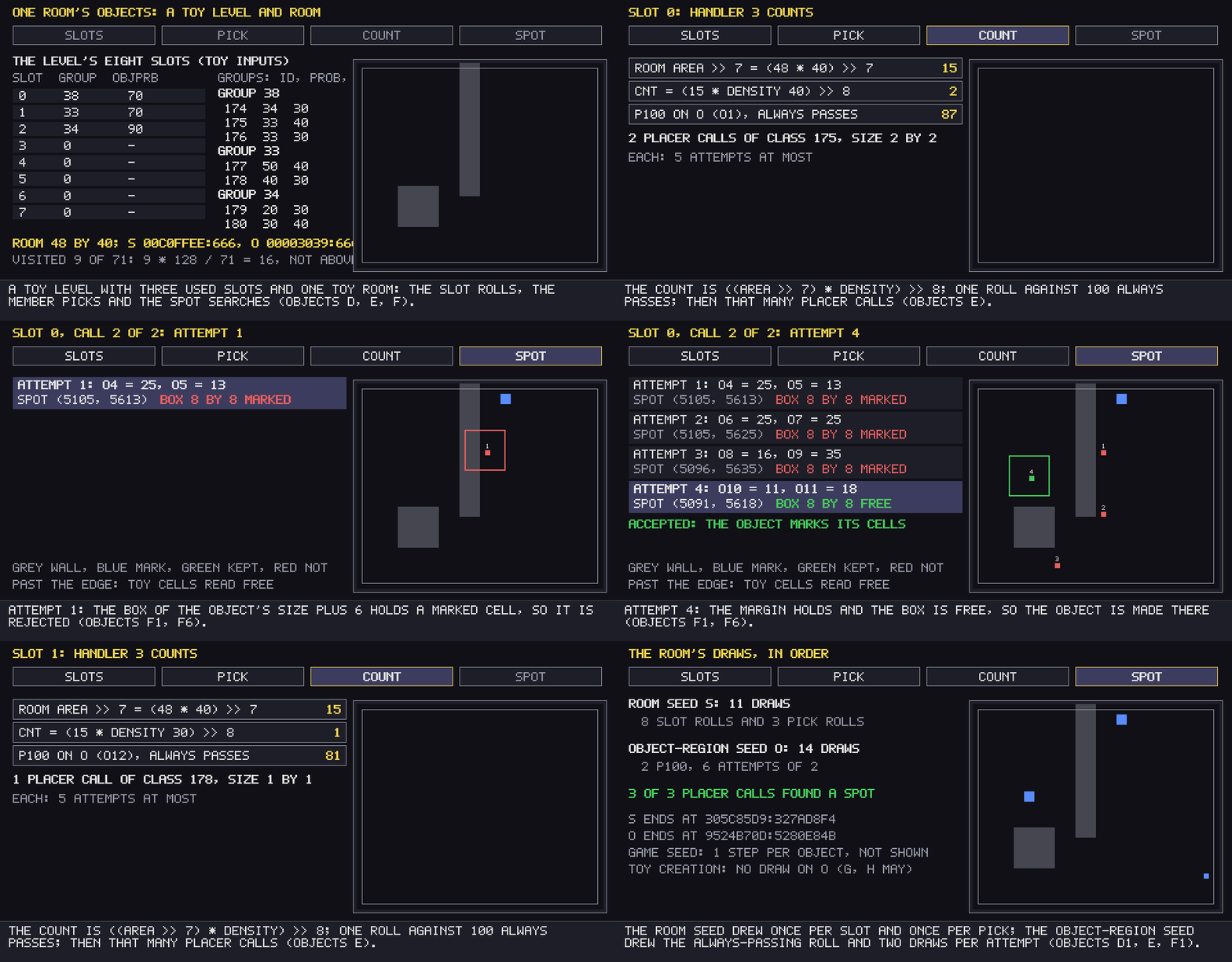
One invented room of 48 by 40 subtiles on an invented level with three used slots, every number a toy input and the toy wall and pillar standing in for the collision grid. The eight slots each cost one draw on the room seed, group 0 included, and a slot passes when its roll is at most its chance. A passing slot costs a second draw for the member pick: the members’ PROB values are added up as the walk goes, and the first member whose running sum is above the roll is the pick; when the sum never rises above the roll nothing is placed (objects § D). The scatter handler turns the member’s DENSITY into a count, ((area >> 7) x DENSITY) >> 8, after a roll against 100 that always passes, and makes that many placer calls on the object-region seed (§ E). Each call makes at most five attempts of two draws; an attempt is kept only inside the one-subtile margin and with no marked cell in the box of the object’s size plus 6, and there is no fallback (§ F). A spot accepted marks the cells for the later calls (every toy object has collision). Where a box reaches past the room’s edge the toy reads the cells as free; the game reads them in the neighbouring room, and refuses a cell in no room (collision § E). Not shown: the gate, the theme roll, the unit creation (the toy objects make no draw on the object-region seed when created; real ones may) and the other handlers. Seed: illustrative, an input of our own. Every value shown is computed by our model, not observed in the game.
Hand-placed objects and the pseudo-objects
Section titled “Hand-placed objects and the pseudo-objects”Objects placed in a map piece go straight to creation in their stored mode, with no room-seed draw (unless the object spawns monsters when it is created). All hand-placed objects come before the hand-placed monsters.
A few map-piece ids are not objects but instructions, the pseudo-objects:
| Id | Makes |
|---|---|
| 581 | a random chest: one object-region draw picks a chest class from a per-act list (special lists for levels 74 and 83) |
| 580 | a sparkle chest: a 581 chest, then the sparkle flag |
| 582 | a quest object chosen from a quest’s state |
| 574–579 | a shrine of a fixed range of types |
The sparkle chest’s flag is set after all of the chest’s creation rolls. In Maggot Lair levels 1–3 one more roll skips the sparkle with chance about one half (a roll above 50 out of 0..99); two sparkle chests of the run stood in Maggot Lair 1 and drew in exactly that order. The closing mode reset of the 580 chest draws nothing: seven recorded super chests reproduce with it doing nothing. The level-25 variant (a fixed class, 371, with trap type 3) was met in Tower Cellar Level 5; whether the code writes the trap type over the whole state byte or only adds it is read from the code, since the byte was 0 before. The fixed shrines 574–579 (no stock map piece places them) and the 582 quest object are read from the code only.
Creation rolls
Section titled “Creation rolls”Every object, hand-placed or random, is created the same way, with its rolls in this order:
- one step of the game seed, which gives the object its own unit seed;
- an animation-start draw on that unit seed, unless the object’s
Synccolumn is set; - the draws of its
InitFn(the table below), on the object-region seed; - for a row with PreOperate, a 1-in-14 roll that creates the object already opened.
After that, the object marks the collision grid if its mode has collision, with a size of its own: an object with
collision but a size of 0 marks nothing, and a door that blocks neither sight nor missiles marks the plain object bit
(both met in a recorded game). The class used is the Objects record’s position in the table: the only code that reads
the table computes the record from that position, and the Id column is never read (a whole-program scan with a
second tool agrees). The two differ only at records 410–412.
The InitFn column selects what extra rolls an object makes when created:
| What | Rolls |
|---|---|
| urns, jars, baskets | trapped if a roll 0..99 is below MonLvl1 ÷ 8 + 5; then a trap type 1..8 |
| chests | the same trap roll; for a lockable chest, locked if a roll is below MonLvl1 ÷ 2 + 8; then a new unit seed for the chest |
| shrines | which shrine (below) |
| gold-pile dummy | 1 to 9 gold piles around it |
| goo pile, fires | one roll each for a state |
Two things here matter to a player:
- Trap and lock chances use the normal-difficulty monster level in every difficulty.
MonLvl1is read in Nightmare and Hell too, and every trap and lock roll of 212 chests and 397 containers in a recorded game matched that. In Lower Kurast (MonLvl122) a chest locks with chance 19 %. - A chest gets a fresh seed at creation. Its drop later draws from that seed, never from the object-region stream.
Shrine types. A shrine row’s Parm0 picks one of the shrine class lists (the Shrines effectclass
column): Parm0 1 gives list 2 (in the spec’s shrine example it holds codes 2 and 4), Parm0 2 gives list 3, and
otherwise one roll gives list 1 with chance 1/10 and list 4 otherwise. A code is then drawn uniformly from that
list; the rarity column is not read. The draw is retried up to 8 times until the code’s LevelMin is at most the
level’s Id (the level number, not a monster level). If all 8 fail, the eighth code is kept anyway: a recorded game
hit this once, a shrine in Cold Plains that kept a shrine type whose LevelMin is 5. Codes 4, 5 and 16 are rewritten
to 2, 3 and 18, so Health Exchange, Mana Exchange and the Shrine of Enirhs are never placed by the random population.
For the 13 other InitFns that the recorded games reached, “no draw” is confirmed: every seed matched after each with
no draw. For the ones never reached it is read from the code. The sparkle chest’s own InitFn (57: the chest’s rolls,
then the sparkle flag) and the fissure’s (58: one roll) were met in a later recorded game; the Zoo (79) was not.
Quest objects, the objects of nine more InitFns that a full scan of the code found, and the City of the Damned
spawn monsters when created. Where the recorded games met such an object,
it drew nothing from the object-region seed. The City of the Damned’s spawns, with their room, game and
object-region draws, are now modelled; for the other monster-spawning objects the rolls are still taken from the
recording. Each pile of the gold-pile dummy is now a modelled item, with its two game-seed steps and its mark on the
grid and no object-region draw (71 of 71 piles); where a pile lands is read from the code, and that reading placed 69
of the 71 (objects § H, rows 28 and 46).
Leaving and coming back
Section titled “Leaving and coming back”When a room goes inactive, the game saves its eligible objects (oldest first, confirmed: 392 of 392 recorded pairs
came back in their creation order), and when the room is activated again, it re-creates them. The re-creation makes
every creation roll again, including a fresh trap and lock roll, and then overwrites the result with the saved
state: a chest locked the first time stays locked, whatever the new roll said. A random or sparkle chest comes back
as its plain class, without the pseudo-object’s extra draws. The run reproduced 548 re-creations, and every object of
its 190 restores was saved or left out as the saving test says. A later run checked the saving test on 3 023 objects;
the flag it starts from is the level’s SaveMonsters column. Neither run met an
object refused for its sparkle flag, or one whose level flag and placed-by-preset flag were both clear, so those two
refusals are read from the code only. The room and game seeds at a revisit are still taken from the recording in the
objects model: the monster and item restores that come before the objects are described by the
room lifecycle spec.
Operating chests, urns and barrels
Section titled “Operating chests, urns and barrels”When a player operates an object, its OperateFn decides what happens; the operate rolls are on the object-region
seed.
%3btext-align:center%3b%7d%23mermaid-2 .edgeLabel p%7bbackground-color:rgba(232%2c232%2c232%2c 0.8)%3b%7d%23mermaid-2 .edgeLabel rect%7bopacity:0.5%3bbackground-color:rgba(232%2c232%2c232%2c 0.8)%3bfill:rgba(232%2c232%2c232%2c 0.8)%3b%7d%23mermaid-2 .labelBkg%7bbackground-color:rgba(232%2c 232%2c 232%2c 0.5)%3b%7d%23mermaid-2 .cluster rect%7bfill:%23ffffde%3bstroke:%23aaaa33%3bstroke-width:1px%3b%7d%23mermaid-2 .cluster text%7bfill:%23333%3b%7d%23mermaid-2 .cluster span%7bcolor:%23333%3b%7d%23mermaid-2 .node .collapsed-indicator%7bfill:%23aaaa33%3bstroke:none%3bopacity:0.6%3b%7d%23mermaid-2 .node .collapsed-separator%7bstroke:%23aaaa33%3bstroke-width:0.75px%3b%7d%23mermaid-2 div.mermaidTooltip%7bposition:absolute%3btext-align:center%3bmax-width:200px%3bpadding:2px%3bfont-family:arial%2csans-serif%3bfont-size:12px%3bbackground:hsl(80%2c 100%25%2c 96.2745098039%25)%3bborder:1px solid %23aaaa33%3bborder-radius:2px%3bpointer-events:none%3bz-index:100%3b%7d%23mermaid-2 .flowchartTitleText%7btext-anchor:middle%3bfont-size:18px%3bfill:%23333%3b%7d%23mermaid-2 rect.text%7bfill:none%3bstroke-width:0%3b%7d%23mermaid-2 .icon-shape%2c%23mermaid-2 .image-shape%7bbackground-color:rgba(232%2c232%2c232%2c 0.8)%3btext-align:center%3b%7d%23mermaid-2 .icon-shape p%2c%23mermaid-2 .image-shape p%7bbackground-color:rgba(232%2c232%2c232%2c 0.8)%3bpadding:2px%3b%7d%23mermaid-2 .icon-shape .label rect%2c%23mermaid-2 .image-shape .label rect%7bopacity:0.5%3bbackground-color:rgba(232%2c232%2c232%2c 0.8)%3bfill:rgba(232%2c232%2c232%2c 0.8)%3b%7d%23mermaid-2 .label-icon%7bdisplay:inline-block%3bheight:1em%3boverflow:visible%3bvertical-align:-0.125em%3b%7d%23mermaid-2 .node .label-icon path%7bfill:currentColor%3bstroke:revert%3bstroke-width:revert%3b%7d%23mermaid-2 .node .neo-node%7bstroke:%239370DB%3b%7d%23mermaid-2 %5bdata-look='neo'%5d.node rect%2c%23mermaid-2 %5bdata-look='neo'%5d.cluster rect%2c%23mermaid-2 %5bdata-look='neo'%5d.node polygon%7bstroke:%239370DB%3bfilter:drop-shadow(1px 2px 2px rgba(185%2c 185%2c 185%2c 1))%3b%7d%23mermaid-2 %5bdata-look='neo'%5d.swimlane.cluster rect%7bfilter:none%3b%7d%23mermaid-2 %5bdata-look='neo'%5d.node path%7bstroke:%239370DB%3bstroke-width:1px%3b%7d%23mermaid-2 %5bdata-look='neo'%5d.node .outer-path%7bfilter:drop-shadow(1px 2px 2px rgba(185%2c 185%2c 185%2c 1))%3b%7d%23mermaid-2 %5bdata-look='neo'%5d.node .neo-line path%7bstroke:%239370DB%3bfilter:none%3b%7d%23mermaid-2 %5bdata-look='neo'%5d.node circle%7bstroke:%239370DB%3bfilter:drop-shadow(1px 2px 2px rgba(185%2c 185%2c 185%2c 1))%3b%7d%23mermaid-2 %5bdata-look='neo'%5d.node circle .state-start%7bfill:black%3b%7d%23mermaid-2 %5bdata-look='neo'%5d.icon-shape .icon%7bfill:%239370DB%3bfilter:drop-shadow(1px 2px 2px rgba(185%2c 185%2c 185%2c 1))%3b%7d%23mermaid-2 %5bdata-look='neo'%5d.icon-shape .icon-neo path%7bstroke:%239370DB%3bfilter:drop-shadow(1px 2px 2px rgba(185%2c 185%2c 185%2c 1))%3b%7d%23mermaid-2 :root%7b--mermaid-font-family:arial%2csans-serif%3b%7d%3c/style%3e%3cg%3e%3cmarker id='mermaid-2_flowchart-v2-pointEnd' class='marker flowchart-v2' viewBox='0 0 10 10' refX='5' refY='5' markerUnits='userSpaceOnUse' markerWidth='8' markerHeight='8' orient='auto'%3e%3cpath d='M 0 0 L 10 5 L 0 10 z' class='arrowMarkerPath' style='stroke-width: 1%3b stroke-dasharray: 1%2c 0%3b'/%3e%3c/marker%3e%3cmarker id='mermaid-2_flowchart-v2-pointStart' class='marker flowchart-v2' viewBox='0 0 10 10' refX='4.5' refY='5' markerUnits='userSpaceOnUse' markerWidth='8' markerHeight='8' orient='auto'%3e%3cpath d='M 0 5 L 10 10 L 10 0 z' class='arrowMarkerPath' style='stroke-width: 1%3b stroke-dasharray: 1%2c 0%3b'/%3e%3c/marker%3e%3cmarker id='mermaid-2_flowchart-v2-pointEnd-margin' class='marker flowchart-v2' viewBox='0 0 11.5 14' refX='11.5' refY='7' markerUnits='userSpaceOnUse' markerWidth='10.5' markerHeight='14' orient='auto'%3e%3cpath d='M 0 0 L 11.5 7 L 0 14 z' class='arrowMarkerPath' style='stroke-width: 0%3b stroke-dasharray: 1%2c 0%3b'/%3e%3c/marker%3e%3cmarker id='mermaid-2_flowchart-v2-pointStart-margin' class='marker flowchart-v2' viewBox='0 0 11.5 14' refX='1' refY='7' markerUnits='userSpaceOnUse' markerWidth='11.5' markerHeight='14' orient='auto'%3e%3cpolygon points='0%2c7 11.5%2c14 11.5%2c0' class='arrowMarkerPath' style='stroke-width: 0%3b stroke-dasharray: 1%2c 0%3b'/%3e%3c/marker%3e%3cmarker id='mermaid-2_flowchart-v2-circleEnd' class='marker flowchart-v2' viewBox='0 0 10 10' refX='11' refY='5' markerUnits='userSpaceOnUse' markerWidth='11' markerHeight='11' orient='auto'%3e%3ccircle cx='5' cy='5' r='5' class='arrowMarkerPath' style='stroke-width: 1%3b stroke-dasharray: 1%2c 0%3b'/%3e%3c/marker%3e%3cmarker id='mermaid-2_flowchart-v2-circleStart' class='marker flowchart-v2' viewBox='0 0 10 10' refX='-1' refY='5' markerUnits='userSpaceOnUse' markerWidth='11' markerHeight='11' orient='auto'%3e%3ccircle cx='5' cy='5' r='5' class='arrowMarkerPath' style='stroke-width: 1%3b stroke-dasharray: 1%2c 0%3b'/%3e%3c/marker%3e%3cmarker id='mermaid-2_flowchart-v2-circleEnd-margin' class='marker flowchart-v2' viewBox='0 0 10 10' refY='5' refX='12.25' markerUnits='userSpaceOnUse' markerWidth='14' markerHeight='14' orient='auto'%3e%3ccircle cx='5' cy='5' r='5' class='arrowMarkerPath' style='stroke-width: 0%3b stroke-dasharray: 1%2c 0%3b'/%3e%3c/marker%3e%3cmarker id='mermaid-2_flowchart-v2-circleStart-margin' class='marker flowchart-v2' viewBox='0 0 10 10' refX='-2' refY='5' markerUnits='userSpaceOnUse' markerWidth='14' markerHeight='14' orient='auto'%3e%3ccircle cx='5' cy='5' r='5' class='arrowMarkerPath' style='stroke-width: 0%3b stroke-dasharray: 1%2c 0%3b'/%3e%3c/marker%3e%3cmarker id='mermaid-2_flowchart-v2-crossEnd' class='marker cross flowchart-v2' viewBox='0 0 11 11' refX='12' refY='5.2' markerUnits='userSpaceOnUse' markerWidth='11' markerHeight='11' orient='auto'%3e%3cpath d='M 1%2c1 l 9%2c9 M 10%2c1 l -9%2c9' class='arrowMarkerPath' style='stroke-width: 2%3b stroke-dasharray: 1%2c 0%3b'/%3e%3c/marker%3e%3cmarker id='mermaid-2_flowchart-v2-crossStart' class='marker cross flowchart-v2' viewBox='0 0 11 11' refX='-1' refY='5.2' markerUnits='userSpaceOnUse' markerWidth='11' markerHeight='11' orient='auto'%3e%3cpath d='M 1%2c1 l 9%2c9 M 10%2c1 l -9%2c9' class='arrowMarkerPath' style='stroke-width: 2%3b stroke-dasharray: 1%2c 0%3b'/%3e%3c/marker%3e%3cmarker id='mermaid-2_flowchart-v2-crossEnd-margin' class='marker cross flowchart-v2' viewBox='0 0 15 15' refX='17.7' refY='7.5' markerUnits='userSpaceOnUse' markerWidth='12' markerHeight='12' orient='auto'%3e%3cpath d='M 1%2c1 L 14%2c14 M 1%2c14 L 14%2c1' class='arrowMarkerPath' style='stroke-width: 2.5%3b'/%3e%3c/marker%3e%3cmarker id='mermaid-2_flowchart-v2-crossStart-margin' class='marker cross flowchart-v2' viewBox='0 0 15 15' refX='-3.5' refY='7.5' markerUnits='userSpaceOnUse' markerWidth='12' markerHeight='12' orient='auto'%3e%3cpath d='M 1%2c1 L 14%2c14 M 1%2c14 L 14%2c1' class='arrowMarkerPath' style='stroke-width: 2.5%3b stroke-dasharray: 1%2c 0%3b'/%3e%3c/marker%3e%3cg class='root'%3e%3cg class='clusters'/%3e%3cg class='edgePaths'%3e%3cpath d='M731.246%2c62L731.246%2c66.167C731.246%2c70.333%2c731.246%2c78.667%2c731.246%2c86.333C731.246%2c94%2c731.246%2c101%2c731.246%2c104.5L731.246%2c108' id='mermaid-2-L_op_c4_0' class='edge-thickness-normal edge-pattern-solid edge-thickness-normal edge-pattern-solid flowchart-link' style='%3b' data-edge='true' data-et='edge' data-id='L_op_c4_0' data-points='W3sieCI6NzMxLjI0NjA5Mzc1LCJ5Ijo2Mn0seyJ4Ijo3MzEuMjQ2MDkzNzUsInkiOjg3fSx7IngiOjczMS4yNDYwOTM3NSwieSI6MTEyfV0=' data-look='classic' marker-end='url(%23mermaid-2_flowchart-v2-pointEnd)'/%3e%3cpath d='M678.304%2c189.543L613.786%2c204.533C549.268%2c219.523%2c420.232%2c249.504%2c355.714%2c269.994C291.195%2c290.484%2c291.195%2c301.484%2c291.195%2c306.984L291.195%2c312.484' id='mermaid-2-L_c4_lk_0' class='edge-thickness-normal edge-pattern-solid edge-thickness-normal edge-pattern-solid flowchart-link' style='%3b' data-edge='true' data-et='edge' data-id='L_c4_lk_0' data-points='W3sieCI6Njc4LjMwNDQ2MDI4OTM3OTksInkiOjE4OS41NDI3NDE1MzkzNzk5Nn0seyJ4IjoyOTEuMTk1MzEyNSwieSI6Mjc5LjQ4NDM3NX0seyJ4IjoyOTEuMTk1MzEyNSwieSI6MzE2LjQ4NDM3NX1d' data-look='classic' marker-end='url(%23mermaid-2_flowchart-v2-pointEnd)'/%3e%3cpath d='M254.117%2c388.562L227.958%2c400.909C201.799%2c413.255%2c149.482%2c437.948%2c123.323%2c464.392C97.164%2c490.836%2c97.164%2c519.031%2c97.164%2c533.129L97.164%2c547.227' id='mermaid-2-L_lk_stop_0' class='edge-thickness-normal edge-pattern-solid edge-thickness-normal edge-pattern-solid flowchart-link' style='%3b' data-edge='true' data-et='edge' data-id='L_lk_stop_0' data-points='W3sieCI6MjU0LjExNzE4MTUxNjM1NzU2LCJ5IjozODguNTYyNDk0MDE2MzU3NTZ9LHsieCI6OTcuMTY0MDYyNSwieSI6NDYyLjY0MDYyNX0seyJ4Ijo5Ny4xNjQwNjI1LCJ5Ijo1NTEuMjI2NTYyNX1d' data-look='classic' marker-end='url(%23mermaid-2_flowchart-v2-pointEnd)'/%3e%3cpath d='M291.195%2c425.641L291.195%2c431.807C291.195%2c437.974%2c291.195%2c450.307%2c296.219%2c466.436C301.243%2c482.565%2c311.291%2c502.489%2c316.315%2c512.452L321.338%2c522.414' id='mermaid-2-L_lk_sp_0' class='edge-thickness-normal edge-pattern-solid edge-thickness-normal edge-pattern-solid flowchart-link' style='%3b' data-edge='true' data-et='edge' data-id='L_lk_sp_0' data-points='W3sieCI6MjkxLjE5NTMxMjUsInkiOjQyNS42NDA2MjV9LHsieCI6MjkxLjE5NTMxMjUsInkiOjQ2Mi42NDA2MjV9LHsieCI6MzIzLjEzOTU4MzQ5NzE0NjgsInkiOjUyNS45ODU0MTY1MDI4NTMxfV0=' data-look='classic' marker-end='url(%23mermaid-2_flowchart-v2-pointEnd)'/%3e%3cpath d='M332.196%2c384.64L371.453%2c397.64C410.71%2c410.64%2c489.224%2c436.64%2c501.258%2c464.058C513.291%2c491.476%2c458.844%2c520.311%2c431.62%2c534.728L404.396%2c549.146' id='mermaid-2-L_lk_sp_2' class='edge-thickness-normal edge-pattern-solid edge-thickness-normal edge-pattern-solid flowchart-link' style='%3b' data-edge='true' data-et='edge' data-id='L_lk_sp_2' data-points='W3sieCI6MzMyLjE5NTk0MjM4MTIwNjMsInkiOjM4NC42Mzk5OTUxMTg3OTM3fSx7IngiOjU2Ny43MzgyODEyNSwieSI6NDYyLjY0MDYyNX0seyJ4Ijo0MDAuODYxMzY5NTU4MzE3NiwieSI6NTUxLjAxNzYxOTU1ODMxNzZ9XQ==' data-look='classic' marker-end='url(%23mermaid-2_flowchart-v2-pointEnd)'/%3e%3cpath d='M316.952%2c624.28L308.765%2c635.868C300.578%2c647.457%2c284.205%2c670.635%2c276.019%2c687.724C267.832%2c704.813%2c267.832%2c715.813%2c267.832%2c721.313L267.832%2c726.813' id='mermaid-2-L_sp_q_0' class='edge-thickness-normal edge-pattern-solid edge-thickness-normal edge-pattern-solid flowchart-link' style='%3b' data-edge='true' data-et='edge' data-id='L_sp_q_0' data-points='W3sieCI6MzE2Ljk1MTUxMTk5Nzk1MDIsInkiOjYyNC4yNzk2MzY5OTc5NTAyfSx7IngiOjI2Ny44MzIwMzEyNSwieSI6NjkzLjgxMjV9LHsieCI6MjY3LjgzMjAzMTI1LCJ5Ijo3MzAuODEyNX1d' data-look='classic' marker-end='url(%23mermaid-2_flowchart-v2-pointEnd)'/%3e%3cpath d='M399.807%2c606.49L425.72%2c621.044C451.633%2c635.597%2c503.459%2c664.705%2c529.372%2c691.925C555.285%2c719.146%2c555.285%2c744.479%2c555.285%2c767.813C555.285%2c791.146%2c555.285%2c812.479%2c531.746%2c829.094C508.207%2c845.708%2c461.128%2c857.603%2c437.589%2c863.551L414.05%2c869.499' id='mermaid-2-L_sp_r_0' class='edge-thickness-normal edge-pattern-solid edge-thickness-normal edge-pattern-solid flowchart-link' style='%3b' data-edge='true' data-et='edge' data-id='L_sp_r_0' data-points='W3sieCI6Mzk5LjgwNzA3NDY5MjM0MjgsInkiOjYwNi40ODk4MDAzMDc2NTcyfSx7IngiOjU1NS4yODUxNTYyNSwieSI6NjkzLjgxMjV9LHsieCI6NTU1LjI4NTE1NjI1LCJ5Ijo3NjkuODEyNX0seyJ4Ijo1NTUuMjg1MTU2MjUsInkiOjgzMy44MTI1fSx7IngiOjQxMC4xNzE4NzUsInkiOjg3MC40Nzg0OTYwMTQwNDU3fV0=' data-look='classic' marker-end='url(%23mermaid-2_flowchart-v2-pointEnd)'/%3e%3cpath d='M267.832%2c808.813L267.832%2c812.979C267.832%2c817.146%2c267.832%2c825.479%2c273.812%2c833.454C279.793%2c841.43%2c291.753%2c849.047%2c297.734%2c852.855L303.714%2c856.664' id='mermaid-2-L_q_r_0' class='edge-thickness-normal edge-pattern-solid edge-thickness-normal edge-pattern-solid flowchart-link' style='%3b' data-edge='true' data-et='edge' data-id='L_q_r_0' data-points='W3sieCI6MjY3LjgzMjAzMTI1LCJ5Ijo4MDguODEyNX0seyJ4IjoyNjcuODMyMDMxMjUsInkiOjgzMy44MTI1fSx7IngiOjMwNy4wODc5NjU3NDUxOTIzLCJ5Ijo4NTguODEyNX1d' data-look='classic' marker-end='url(%23mermaid-2_flowchart-v2-pointEnd)'/%3e%3cpath d='M349.484%2c912.813L349.484%2c916.979C349.484%2c921.146%2c349.484%2c929.479%2c349.484%2c937.146C349.484%2c944.813%2c349.484%2c951.813%2c349.484%2c955.313L349.484%2c958.813' id='mermaid-2-L_r_e_0' class='edge-thickness-normal edge-pattern-solid edge-thickness-normal edge-pattern-solid flowchart-link' style='%3b' data-edge='true' data-et='edge' data-id='L_r_e_0' data-points='W3sieCI6MzQ5LjQ4NDM3NSwieSI6OTEyLjgxMjV9LHsieCI6MzQ5LjQ4NDM3NSwieSI6OTM3LjgxMjV9LHsieCI6MzQ5LjQ4NDM3NSwieSI6OTYyLjgxMjV9XQ==' data-look='classic' marker-end='url(%23mermaid-2_flowchart-v2-pointEnd)'/%3e%3cpath d='M301.716%2c1163.81L292.907%2c1177.938C284.098%2c1192.066%2c266.481%2c1220.322%2c257.672%2c1241.95C248.863%2c1263.578%2c248.863%2c1278.578%2c248.863%2c1286.078L248.863%2c1293.578' id='mermaid-2-L_e_none_0' class='edge-thickness-normal edge-pattern-solid edge-thickness-normal edge-pattern-solid flowchart-link' style='%3b' data-edge='true' data-et='edge' data-id='L_e_none_0' data-points='W3sieCI6MzAxLjcxNTg3MTAyMzkyMTcsInkiOjExNjMuODA5NjIxMDIzOTIxNn0seyJ4IjoyNDguODYzMjgxMjUsInkiOjEyNDguNTc4MTI1fSx7IngiOjI0OC44NjMyODEyNSwieSI6MTI5Ny41NzgxMjV9XQ==' data-look='classic' marker-end='url(%23mermaid-2_flowchart-v2-pointEnd)'/%3e%3cpath d='M400.23%2c1160.832L410.308%2c1175.457C420.387%2c1190.081%2c440.543%2c1219.329%2c450.621%2c1241.454C460.699%2c1263.578%2c460.699%2c1278.578%2c460.699%2c1286.078L460.699%2c1293.578' id='mermaid-2-L_e_d_0' class='edge-thickness-normal edge-pattern-solid edge-thickness-normal edge-pattern-solid flowchart-link' style='%3b' data-edge='true' data-et='edge' data-id='L_e_d_0' data-points='W3sieCI6NDAwLjIzMDI4MTA2NDE2MTQsInkiOjExNjAuODMyMjE4OTM1ODM4N30seyJ4Ijo0NjAuNjk5MjE4NzUsInkiOjEyNDguNTc4MTI1fSx7IngiOjQ2MC42OTkyMTg3NSwieSI6MTI5Ny41NzgxMjV9XQ==' data-look='classic' marker-end='url(%23mermaid-2_flowchart-v2-pointEnd)'/%3e%3cpath d='M731.246%2c242.484L731.246%2c248.651C731.246%2c254.818%2c731.246%2c267.151%2c731.246%2c288.581C731.246%2c310.01%2c731.246%2c340.536%2c731.246%2c371.063C731.246%2c401.589%2c731.246%2c432.115%2c731.246%2c466.642C731.246%2c501.169%2c731.246%2c539.698%2c731.246%2c578.227C731.246%2c616.755%2c731.246%2c655.284%2c731.246%2c687.215C731.246%2c719.146%2c731.246%2c744.479%2c731.246%2c767.813C731.246%2c791.146%2c731.246%2c812.479%2c731.246%2c831.813C731.246%2c851.146%2c731.246%2c868.479%2c731.246%2c885.813C731.246%2c903.146%2c731.246%2c920.479%2c731.246%2c954.043C731.246%2c987.607%2c731.246%2c1037.401%2c731.246%2c1089.195C731.246%2c1140.99%2c731.246%2c1194.784%2c731.246%2c1229.181C731.246%2c1263.578%2c731.246%2c1278.578%2c731.246%2c1286.078L731.246%2c1293.578' id='mermaid-2-L_c4_u_0' class='edge-thickness-normal edge-pattern-solid edge-thickness-normal edge-pattern-solid flowchart-link' style='%3b' data-edge='true' data-et='edge' data-id='L_c4_u_0' data-points='W3sieCI6NzMxLjI0NjA5Mzc1LCJ5IjoyNDIuNDg0Mzc1fSx7IngiOjczMS4yNDYwOTM3NSwieSI6Mjc5LjQ4NDM3NX0seyJ4Ijo3MzEuMjQ2MDkzNzUsInkiOjM3MS4wNjI1fSx7IngiOjczMS4yNDYwOTM3NSwieSI6NDYyLjY0MDYyNX0seyJ4Ijo3MzEuMjQ2MDkzNzUsInkiOjU3OC4yMjY1NjI1fSx7IngiOjczMS4yNDYwOTM3NSwieSI6NjkzLjgxMjV9LHsieCI6NzMxLjI0NjA5Mzc1LCJ5Ijo3NjkuODEyNX0seyJ4Ijo3MzEuMjQ2MDkzNzUsInkiOjgzMy44MTI1fSx7IngiOjczMS4yNDYwOTM3NSwieSI6ODg1LjgxMjV9LHsieCI6NzMxLjI0NjA5Mzc1LCJ5Ijo5MzcuODEyNX0seyJ4Ijo3MzEuMjQ2MDkzNzUsInkiOjEwODcuMTk1MzEyNX0seyJ4Ijo3MzEuMjQ2MDkzNzUsInkiOjEyNDguNTc4MTI1fSx7IngiOjczMS4yNDYwOTM3NSwieSI6MTI5Ny41NzgxMjV9XQ==' data-look='classic' marker-end='url(%23mermaid-2_flowchart-v2-pointEnd)'/%3e%3cpath d='M779.504%2c194.227L819.878%2c208.436C860.251%2c222.646%2c940.999%2c251.065%2c981.372%2c280.538C1021.746%2c310.01%2c1021.746%2c340.536%2c1021.746%2c371.063C1021.746%2c401.589%2c1021.746%2c432.115%2c1021.746%2c466.642C1021.746%2c501.169%2c1021.746%2c539.698%2c1021.746%2c578.227C1021.746%2c616.755%2c1021.746%2c655.284%2c1021.746%2c687.215C1021.746%2c719.146%2c1021.746%2c744.479%2c1021.746%2c767.813C1021.746%2c791.146%2c1021.746%2c812.479%2c1021.746%2c831.813C1021.746%2c851.146%2c1021.746%2c868.479%2c1021.746%2c885.813C1021.746%2c903.146%2c1021.746%2c920.479%2c1021.746%2c954.043C1021.746%2c987.607%2c1021.746%2c1037.401%2c1021.746%2c1089.195C1021.746%2c1140.99%2c1021.746%2c1194.784%2c1021.746%2c1227.181C1021.746%2c1259.578%2c1021.746%2c1270.578%2c1021.746%2c1276.078L1021.746%2c1281.578' id='mermaid-2-L_c4_b_0' class='edge-thickness-normal edge-pattern-solid edge-thickness-normal edge-pattern-solid flowchart-link' style='%3b' data-edge='true' data-et='edge' data-id='L_c4_b_0' data-points='W3sieCI6Nzc5LjUwMzg0NjcyODg1NDYsInkiOjE5NC4yMjY2MjIwMjExNDU0fSx7IngiOjEwMjEuNzQ2MDkzNzUsInkiOjI3OS40ODQzNzV9LHsieCI6MTAyMS43NDYwOTM3NSwieSI6MzcxLjA2MjV9LHsieCI6MTAyMS43NDYwOTM3NSwieSI6NDYyLjY0MDYyNX0seyJ4IjoxMDIxLjc0NjA5Mzc1LCJ5Ijo1NzguMjI2NTYyNX0seyJ4IjoxMDIxLjc0NjA5Mzc1LCJ5Ijo2OTMuODEyNX0seyJ4IjoxMDIxLjc0NjA5Mzc1LCJ5Ijo3NjkuODEyNX0seyJ4IjoxMDIxLjc0NjA5Mzc1LCJ5Ijo4MzMuODEyNX0seyJ4IjoxMDIxLjc0NjA5Mzc1LCJ5Ijo4ODUuODEyNX0seyJ4IjoxMDIxLjc0NjA5Mzc1LCJ5Ijo5MzcuODEyNX0seyJ4IjoxMDIxLjc0NjA5Mzc1LCJ5IjoxMDg3LjE5NTMxMjV9LHsieCI6MTAyMS43NDYwOTM3NSwieSI6MTI0OC41NzgxMjV9LHsieCI6MTAyMS43NDYwOTM3NSwieSI6MTI4NS41NzgxMjV9XQ==' data-look='classic' marker-end='url(%23mermaid-2_flowchart-v2-pointEnd)'/%3e%3cpath d='M456.48%2c1351.578L455.517%2c1357.745C454.553%2c1363.911%2c452.626%2c1376.245%2c483.462%2c1389.291C514.297%2c1402.336%2c577.895%2c1416.094%2c609.694%2c1422.973L641.493%2c1429.853' id='mermaid-2-L_d_tc_0' class='edge-thickness-normal edge-pattern-solid edge-thickness-normal edge-pattern-solid flowchart-link' style='%3b' data-edge='true' data-et='edge' data-id='L_d_tc_0' data-points='W3sieCI6NDU2LjQ4MDQ2ODc1LCJ5IjoxMzUxLjU3ODEyNX0seyJ4Ijo0NTAuNjk5MjE4NzUsInkiOjEzODguNTc4MTI1fSx7IngiOjY0NS40MDIzNDM3NSwieSI6MTQzMC42OTgzMzIwMzQ5NjM2fV0=' data-look='classic' marker-end='url(%23mermaid-2_flowchart-v2-pointEnd)'/%3e%3cpath d='M731.246%2c1351.578L731.246%2c1357.745C731.246%2c1363.911%2c731.246%2c1376.245%2c732.565%2c1387.93C733.884%2c1399.615%2c736.522%2c1410.651%2c737.841%2c1416.169L739.16%2c1421.688' id='mermaid-2-L_u_tc_0' class='edge-thickness-normal edge-pattern-solid edge-thickness-normal edge-pattern-solid flowchart-link' style='%3b' data-edge='true' data-et='edge' data-id='L_u_tc_0' data-points='W3sieCI6NzMxLjI0NjA5Mzc1LCJ5IjoxMzUxLjU3ODEyNX0seyJ4Ijo3MzEuMjQ2MDkzNzUsInkiOjEzODguNTc4MTI1fSx7IngiOjc0MC4wODk1OTk2MDkzNzUsInkiOjE0MjUuNTc4MTI1fV0=' data-look='classic' marker-end='url(%23mermaid-2_flowchart-v2-pointEnd)'/%3e%3cpath d='M1021.746%2c1363.578L1021.746%2c1367.745C1021.746%2c1371.911%2c1021.746%2c1380.245%2c993.385%2c1391.007C965.024%2c1401.769%2c908.302%2c1414.96%2c879.941%2c1421.556L851.58%2c1428.151' id='mermaid-2-L_b_tc_0' class='edge-thickness-normal edge-pattern-solid edge-thickness-normal edge-pattern-solid flowchart-link' style='%3b' data-edge='true' data-et='edge' data-id='L_b_tc_0' data-points='W3sieCI6MTAyMS43NDYwOTM3NSwieSI6MTM2My41NzgxMjV9LHsieCI6MTAyMS43NDYwOTM3NSwieSI6MTM4OC41NzgxMjV9LHsieCI6ODQ3LjY4MzU5Mzc1LCJ5IjoxNDI5LjA1NzMxNjUwNjI3Mzh9XQ==' data-look='classic' marker-end='url(%23mermaid-2_flowchart-v2-pointEnd)'/%3e%3cpath d='M464.918%2c1351.578L465.882%2c1357.745C466.845%2c1363.911%2c468.772%2c1376.245%2c464.964%2c1386.166C461.155%2c1396.087%2c451.611%2c1403.596%2c446.839%2c1407.35L442.066%2c1411.105' id='mermaid-2-L_d_trap_0' class='edge-thickness-normal edge-pattern-solid edge-thickness-normal edge-pattern-solid flowchart-link' style='%3b' data-edge='true' data-et='edge' data-id='L_d_trap_0' data-points='W3sieCI6NDY0LjkxNzk2ODc1LCJ5IjoxMzUxLjU3ODEyNX0seyJ4Ijo0NzAuNjk5MjE4NzUsInkiOjEzODguNTc4MTI1fSx7IngiOjQzOC45MjI3OTA1MjczNDM3NSwieSI6MTQxMy41NzgxMjV9XQ==' data-look='classic' marker-end='url(%23mermaid-2_flowchart-v2-pointEnd)'/%3e%3c/g%3e%3cg class='edgeLabels'%3e%3cg class='edgeLabel'%3e%3cg class='label' data-id='L_op_c4_0' transform='translate(0%2c 0)'%3e%3cforeignObject width='0' height='0'%3e%3cdiv xmlns='http://www.w3.org/1999/xhtml' class='labelBkg' style='display: table-cell%3b white-space: nowrap%3b line-height: 1.5%3b max-width: 200px%3b text-align: center%3b'%3e%3cspan class='edgeLabel'%3e%3c/span%3e%3c/div%3e%3c/foreignObject%3e%3c/g%3e%3c/g%3e%3cg class='edgeLabel' transform='translate(291.1953125%2c 279.484375)'%3e%3cg class='label' data-id='L_c4_lk_0' transform='translate(-19.125%2c -12)'%3e%3cforeignObject width='38.25' height='24'%3e%3cdiv xmlns='http://www.w3.org/1999/xhtml' class='labelBkg' style='display: table-cell%3b white-space: nowrap%3b line-height: 1.5%3b max-width: 200px%3b text-align: center%3b'%3e%3cspan class='edgeLabel'%3e%3cp%3echest%3c/p%3e%3c/span%3e%3c/div%3e%3c/foreignObject%3e%3c/g%3e%3c/g%3e%3cg class='edgeLabel' transform='translate(97.1640625%2c 462.640625)'%3e%3cg class='label' data-id='L_lk_stop_0' transform='translate(-79.609375%2c -12)'%3e%3cforeignObject width='159.21875' height='24'%3e%3cdiv xmlns='http://www.w3.org/1999/xhtml' class='labelBkg' style='display: table-cell%3b white-space: nowrap%3b line-height: 1.5%3b max-width: 200px%3b text-align: center%3b'%3e%3cspan class='edgeLabel'%3e%3cp%3eno key and not class 6%3c/p%3e%3c/span%3e%3c/div%3e%3c/foreignObject%3e%3c/g%3e%3c/g%3e%3cg class='edgeLabel' transform='translate(291.1953125%2c 462.640625)'%3e%3cg class='label' data-id='L_lk_sp_0' transform='translate(-70.703125%2c -12)'%3e%3cforeignObject width='141.40625' height='24'%3e%3cdiv xmlns='http://www.w3.org/1999/xhtml' class='labelBkg' style='display: table-cell%3b white-space: nowrap%3b line-height: 1.5%3b max-width: 200px%3b text-align: center%3b'%3e%3cspan class='edgeLabel'%3e%3cp%3ekey used%2c or class 6%3c/p%3e%3c/span%3e%3c/div%3e%3c/foreignObject%3e%3c/g%3e%3c/g%3e%3cg class='edgeLabel' transform='translate(539.59754%2c 453.32172)'%3e%3cg class='label' data-id='L_lk_sp_2' transform='translate(-36.46875%2c -12)'%3e%3cforeignObject width='72.9375' height='24'%3e%3cdiv xmlns='http://www.w3.org/1999/xhtml' class='labelBkg' style='display: table-cell%3b white-space: nowrap%3b line-height: 1.5%3b max-width: 200px%3b text-align: center%3b'%3e%3cspan class='edgeLabel'%3e%3cp%3enot locked%3c/p%3e%3c/span%3e%3c/div%3e%3c/foreignObject%3e%3c/g%3e%3c/g%3e%3cg class='edgeLabel' transform='translate(267.83203125%2c 693.8125)'%3e%3cg class='label' data-id='L_sp_q_0' transform='translate(-12.453125%2c -12)'%3e%3cforeignObject width='24.90625' height='24'%3e%3cdiv xmlns='http://www.w3.org/1999/xhtml' class='labelBkg' style='display: table-cell%3b white-space: nowrap%3b line-height: 1.5%3b max-width: 200px%3b text-align: center%3b'%3e%3cspan class='edgeLabel'%3e%3cp%3eyes%3c/p%3e%3c/span%3e%3c/div%3e%3c/foreignObject%3e%3c/g%3e%3c/g%3e%3cg class='edgeLabel' transform='translate(555.28515625%2c 769.8125)'%3e%3cg class='label' data-id='L_sp_r_0' transform='translate(-8.8984375%2c -12)'%3e%3cforeignObject width='17.796875' height='24'%3e%3cdiv xmlns='http://www.w3.org/1999/xhtml' class='labelBkg' style='display: table-cell%3b white-space: nowrap%3b line-height: 1.5%3b max-width: 200px%3b text-align: center%3b'%3e%3cspan class='edgeLabel'%3e%3cp%3eno%3c/p%3e%3c/span%3e%3c/div%3e%3c/foreignObject%3e%3c/g%3e%3c/g%3e%3cg class='edgeLabel'%3e%3cg class='label' data-id='L_q_r_0' transform='translate(0%2c 0)'%3e%3cforeignObject width='0' height='0'%3e%3cdiv xmlns='http://www.w3.org/1999/xhtml' class='labelBkg' style='display: table-cell%3b white-space: nowrap%3b line-height: 1.5%3b max-width: 200px%3b text-align: center%3b'%3e%3cspan class='edgeLabel'%3e%3c/span%3e%3c/div%3e%3c/foreignObject%3e%3c/g%3e%3c/g%3e%3cg class='edgeLabel'%3e%3cg class='label' data-id='L_r_e_0' transform='translate(0%2c 0)'%3e%3cforeignObject width='0' height='0'%3e%3cdiv xmlns='http://www.w3.org/1999/xhtml' class='labelBkg' style='display: table-cell%3b white-space: nowrap%3b line-height: 1.5%3b max-width: 200px%3b text-align: center%3b'%3e%3cspan class='edgeLabel'%3e%3c/span%3e%3c/div%3e%3c/foreignObject%3e%3c/g%3e%3c/g%3e%3cg class='edgeLabel' transform='translate(248.86328125%2c 1248.578125)'%3e%3cg class='label' data-id='L_e_none_0' transform='translate(-12.453125%2c -12)'%3e%3cforeignObject width='24.90625' height='24'%3e%3cdiv xmlns='http://www.w3.org/1999/xhtml' class='labelBkg' style='display: table-cell%3b white-space: nowrap%3b line-height: 1.5%3b max-width: 200px%3b text-align: center%3b'%3e%3cspan class='edgeLabel'%3e%3cp%3eyes%3c/p%3e%3c/span%3e%3c/div%3e%3c/foreignObject%3e%3c/g%3e%3c/g%3e%3cg class='edgeLabel' transform='translate(460.69921875%2c 1248.578125)'%3e%3cg class='label' data-id='L_e_d_0' transform='translate(-8.8984375%2c -12)'%3e%3cforeignObject width='17.796875' height='24'%3e%3cdiv xmlns='http://www.w3.org/1999/xhtml' class='labelBkg' style='display: table-cell%3b white-space: nowrap%3b line-height: 1.5%3b max-width: 200px%3b text-align: center%3b'%3e%3cspan class='edgeLabel'%3e%3cp%3eno%3c/p%3e%3c/span%3e%3c/div%3e%3c/foreignObject%3e%3c/g%3e%3c/g%3e%3cg class='edgeLabel' transform='translate(731.24609375%2c 769.8125)'%3e%3cg class='label' data-id='L_c4_u_0' transform='translate(-52.4765625%2c -12)'%3e%3cforeignObject width='104.953125' height='24'%3e%3cdiv xmlns='http://www.w3.org/1999/xhtml' class='labelBkg' style='display: table-cell%3b white-space: nowrap%3b line-height: 1.5%3b max-width: 200px%3b text-align: center%3b'%3e%3cspan class='edgeLabel'%3e%3cp%3eurn%2c jar%2c basket%3c/p%3e%3c/span%3e%3c/div%3e%3c/foreignObject%3e%3c/g%3e%3c/g%3e%3cg class='edgeLabel' transform='translate(1021.74609375%2c 769.8125)'%3e%3cg class='label' data-id='L_c4_b_0' transform='translate(-20.453125%2c -12)'%3e%3cforeignObject width='40.90625' height='24'%3e%3cdiv xmlns='http://www.w3.org/1999/xhtml' class='labelBkg' style='display: table-cell%3b white-space: nowrap%3b line-height: 1.5%3b max-width: 200px%3b text-align: center%3b'%3e%3cspan class='edgeLabel'%3e%3cp%3ebarrel%3c/p%3e%3c/span%3e%3c/div%3e%3c/foreignObject%3e%3c/g%3e%3c/g%3e%3cg class='edgeLabel'%3e%3cg class='label' data-id='L_d_tc_0' transform='translate(0%2c 0)'%3e%3cforeignObject width='0' height='0'%3e%3cdiv xmlns='http://www.w3.org/1999/xhtml' class='labelBkg' style='display: table-cell%3b white-space: nowrap%3b line-height: 1.5%3b max-width: 200px%3b text-align: center%3b'%3e%3cspan class='edgeLabel'%3e%3c/span%3e%3c/div%3e%3c/foreignObject%3e%3c/g%3e%3c/g%3e%3cg class='edgeLabel'%3e%3cg class='label' data-id='L_u_tc_0' transform='translate(0%2c 0)'%3e%3cforeignObject width='0' height='0'%3e%3cdiv xmlns='http://www.w3.org/1999/xhtml' class='labelBkg' style='display: table-cell%3b white-space: nowrap%3b line-height: 1.5%3b max-width: 200px%3b text-align: center%3b'%3e%3cspan class='edgeLabel'%3e%3c/span%3e%3c/div%3e%3c/foreignObject%3e%3c/g%3e%3c/g%3e%3cg class='edgeLabel'%3e%3cg class='label' data-id='L_b_tc_0' transform='translate(0%2c 0)'%3e%3cforeignObject width='0' height='0'%3e%3cdiv xmlns='http://www.w3.org/1999/xhtml' class='labelBkg' style='display: table-cell%3b white-space: nowrap%3b line-height: 1.5%3b max-width: 200px%3b text-align: center%3b'%3e%3cspan class='edgeLabel'%3e%3c/span%3e%3c/div%3e%3c/foreignObject%3e%3c/g%3e%3c/g%3e%3cg class='edgeLabel'%3e%3cg class='label' data-id='L_d_trap_0' transform='translate(0%2c 0)'%3e%3cforeignObject width='0' height='0'%3e%3cdiv xmlns='http://www.w3.org/1999/xhtml' class='labelBkg' style='display: table-cell%3b white-space: nowrap%3b line-height: 1.5%3b max-width: 200px%3b text-align: center%3b'%3e%3cspan class='edgeLabel'%3e%3c/span%3e%3c/div%3e%3c/foreignObject%3e%3c/g%3e%3c/g%3e%3c/g%3e%3cg class='nodes'%3e%3cg class='node default' id='mermaid-2-flowchart-op-0' data-look='classic' transform='translate(731.24609375%2c 35)'%3e%3crect class='basic label-container' style='' x='-122.0625' y='-27' width='244.125' height='54'/%3e%3cg class='label' style='' transform='translate(-92.0625%2c -12)'%3e%3crect/%3e%3cforeignObject width='184.125' height='24'%3e%3cdiv xmlns='http://www.w3.org/1999/xhtml' style='display: table-cell%3b white-space: nowrap%3b line-height: 1.5%3b max-width: 200px%3b text-align: center%3b'%3e%3cspan class='nodeLabel'%3e%3cp%3eplayer operates the object%3c/p%3e%3c/span%3e%3c/div%3e%3c/foreignObject%3e%3c/g%3e%3c/g%3e%3cg class='node default' id='mermaid-2-flowchart-c4-1' data-look='classic' transform='translate(731.24609375%2c 177.2421875)'%3e%3cpolygon points='65.2421875%2c0 130.484375%2c-65.2421875 65.2421875%2c-130.484375 0%2c-65.2421875' class='label-container' transform='translate(-64.7421875%2c 65.2421875)'/%3e%3cg class='label' style='' transform='translate(-38.2421875%2c -12)'%3e%3crect/%3e%3cforeignObject width='76.484375' height='24'%3e%3cdiv xmlns='http://www.w3.org/1999/xhtml' style='display: table-cell%3b white-space: nowrap%3b line-height: 1.5%3b max-width: 200px%3b text-align: center%3b'%3e%3cspan class='nodeLabel'%3e%3cp%3eOperateFn%3c/p%3e%3c/span%3e%3c/div%3e%3c/foreignObject%3e%3c/g%3e%3c/g%3e%3cg class='node default' id='mermaid-2-flowchart-lk-3' data-look='classic' transform='translate(291.1953125%2c 371.0625)'%3e%3cpolygon points='54.578125%2c0 109.15625%2c-54.578125 54.578125%2c-109.15625 0%2c-54.578125' class='label-container' transform='translate(-54.078125%2c 54.578125)'/%3e%3cg class='label' style='' transform='translate(-27.578125%2c -12)'%3e%3crect/%3e%3cforeignObject width='55.15625' height='24'%3e%3cdiv xmlns='http://www.w3.org/1999/xhtml' style='display: table-cell%3b white-space: nowrap%3b line-height: 1.5%3b max-width: 200px%3b text-align: center%3b'%3e%3cspan class='nodeLabel'%3e%3cp%3elocked%3f%3c/p%3e%3c/span%3e%3c/div%3e%3c/foreignObject%3e%3c/g%3e%3c/g%3e%3cg class='node default' id='mermaid-2-flowchart-stop-5' data-look='classic' transform='translate(97.1640625%2c 578.2265625)'%3e%3crect class='basic label-container' style='' x='-89.1640625' y='-27' width='178.328125' height='54'/%3e%3cg class='label' style='' transform='translate(-59.1640625%2c -12)'%3e%3crect/%3e%3cforeignObject width='118.328125' height='24'%3e%3cdiv xmlns='http://www.w3.org/1999/xhtml' style='display: table-cell%3b white-space: nowrap%3b line-height: 1.5%3b max-width: 200px%3b text-align: center%3b'%3e%3cspan class='nodeLabel'%3e%3cp%3enothing happens%3c/p%3e%3c/span%3e%3c/div%3e%3c/foreignObject%3e%3c/g%3e%3c/g%3e%3cg class='node default' id='mermaid-2-flowchart-sp-7' data-look='classic' transform='translate(349.484375%2c 578.2265625)'%3e%3cpolygon points='78.5859375%2c0 157.171875%2c-78.5859375 78.5859375%2c-157.171875 0%2c-78.5859375' class='label-container' transform='translate(-78.0859375%2c 78.5859375)'/%3e%3cg class='label' style='' transform='translate(-51.5859375%2c -12)'%3e%3crect/%3e%3cforeignObject width='103.171875' height='24'%3e%3cdiv xmlns='http://www.w3.org/1999/xhtml' style='display: table-cell%3b white-space: nowrap%3b line-height: 1.5%3b max-width: 200px%3b text-align: center%3b'%3e%3cspan class='nodeLabel'%3e%3cp%3esparkle chest%3f%3c/p%3e%3c/span%3e%3c/div%3e%3c/foreignObject%3e%3c/g%3e%3c/g%3e%3cg class='node default' id='mermaid-2-flowchart-q-11' data-look='classic' transform='translate(267.83203125%2c 769.8125)'%3e%3crect class='basic label-container' style='' x='-130' y='-39' width='260' height='78'/%3e%3cg class='label' style='' transform='translate(-100%2c -24)'%3e%3crect/%3e%3cforeignObject width='200' height='48'%3e%3cdiv xmlns='http://www.w3.org/1999/xhtml' style='display: table%3b white-space: break-spaces%3b line-height: 1.5%3b max-width: 200px%3b text-align: center%3b width: 200px%3b'%3e%3cspan class='nodeLabel'%3e%3cp%3eroll: under 5 forces rare%2c else magic%3c/p%3e%3c/span%3e%3c/div%3e%3c/foreignObject%3e%3c/g%3e%3c/g%3e%3cg class='node default' id='mermaid-2-flowchart-r-13' data-look='classic' transform='translate(349.484375%2c 885.8125)'%3e%3crect class='basic label-container' style='' x='-60.6875' y='-27' width='121.375' height='54'/%3e%3cg class='label' style='' transform='translate(-30.6875%2c -12)'%3e%3crect/%3e%3cforeignObject width='61.375' height='24'%3e%3cdiv xmlns='http://www.w3.org/1999/xhtml' style='display: table-cell%3b white-space: nowrap%3b line-height: 1.5%3b max-width: 200px%3b text-align: center%3b'%3e%3cspan class='nodeLabel'%3e%3cp%3eroll 0..99%3c/p%3e%3c/span%3e%3c/div%3e%3c/foreignObject%3e%3c/g%3e%3c/g%3e%3cg class='node default' id='mermaid-2-flowchart-e-17' data-look='classic' transform='translate(349.484375%2c 1087.1953125)'%3e%3cpolygon points='124.3828125%2c0 248.765625%2c-124.3828125 124.3828125%2c-248.765625 0%2c-124.3828125' class='label-container' transform='translate(-123.8828125%2c 124.3828125)'/%3e%3cg class='label' style='' transform='translate(-97.3828125%2c -12)'%3e%3crect/%3e%3cforeignObject width='194.765625' height='24'%3e%3cdiv xmlns='http://www.w3.org/1999/xhtml' style='display: table-cell%3b white-space: nowrap%3b line-height: 1.5%3b max-width: 200px%3b text-align: center%3b'%3e%3cspan class='nodeLabel'%3e%3cp%3eroll at most 24%2c plain chest%3f%3c/p%3e%3c/span%3e%3c/div%3e%3c/foreignObject%3e%3c/g%3e%3c/g%3e%3cg class='node default' id='mermaid-2-flowchart-none-19' data-look='classic' transform='translate(248.86328125%2c 1324.578125)'%3e%3crect class='basic label-container' style='' x='-51.7890625' y='-27' width='103.578125' height='54'/%3e%3cg class='label' style='' transform='translate(-21.7890625%2c -12)'%3e%3crect/%3e%3cforeignObject width='43.578125' height='24'%3e%3cdiv xmlns='http://www.w3.org/1999/xhtml' style='display: table-cell%3b white-space: nowrap%3b line-height: 1.5%3b max-width: 200px%3b text-align: center%3b'%3e%3cspan class='nodeLabel'%3e%3cp%3eempty%3c/p%3e%3c/span%3e%3c/div%3e%3c/foreignObject%3e%3c/g%3e%3c/g%3e%3cg class='node default' id='mermaid-2-flowchart-d-21' data-look='classic' transform='translate(460.69921875%2c 1324.578125)'%3e%3crect class='basic label-container' style='' x='-110.046875' y='-27' width='220.09375' height='54'/%3e%3cg class='label' style='' transform='translate(-80.046875%2c -12)'%3e%3crect/%3e%3cforeignObject width='160.09375' height='24'%3e%3cdiv xmlns='http://www.w3.org/1999/xhtml' style='display: table-cell%3b white-space: nowrap%3b line-height: 1.5%3b max-width: 200px%3b text-align: center%3b'%3e%3cspan class='nodeLabel'%3e%3cp%3eone drop%2c two if locked%3c/p%3e%3c/span%3e%3c/div%3e%3c/foreignObject%3e%3c/g%3e%3c/g%3e%3cg class='node default' id='mermaid-2-flowchart-u-23' data-look='classic' transform='translate(731.24609375%2c 1324.578125)'%3e%3crect class='basic label-container' style='' x='-110.5' y='-27' width='221' height='54'/%3e%3cg class='label' style='' transform='translate(-80.5%2c -12)'%3e%3crect/%3e%3cforeignObject width='161' height='24'%3e%3cdiv xmlns='http://www.w3.org/1999/xhtml' style='display: table-cell%3b white-space: nowrap%3b line-height: 1.5%3b max-width: 200px%3b text-align: center%3b'%3e%3cspan class='nodeLabel'%3e%3cp%3eroll under 21: one drop%3c/p%3e%3c/span%3e%3c/div%3e%3c/foreignObject%3e%3c/g%3e%3c/g%3e%3cg class='node default' id='mermaid-2-flowchart-b-25' data-look='classic' transform='translate(1021.74609375%2c 1324.578125)'%3e%3crect class='basic label-container' style='' x='-130' y='-39' width='260' height='78'/%3e%3cg class='label' style='' transform='translate(-100%2c -24)'%3e%3crect/%3e%3cforeignObject width='200' height='48'%3e%3cdiv xmlns='http://www.w3.org/1999/xhtml' style='display: table%3b white-space: break-spaces%3b line-height: 1.5%3b max-width: 200px%3b text-align: center%3b width: 200px%3b'%3e%3cspan class='nodeLabel'%3e%3cp%3emaybe a monster%2c then roll under 21: one drop%3c/p%3e%3c/span%3e%3c/div%3e%3c/foreignObject%3e%3c/g%3e%3c/g%3e%3cg class='node default' id='mermaid-2-flowchart-tc-27' data-look='classic' transform='translate(746.54296875%2c 1452.578125)'%3e%3crect class='basic label-container' style='' x='-101.140625' y='-27' width='202.28125' height='54'/%3e%3cg class='label' style='' transform='translate(-71.140625%2c -12)'%3e%3crect/%3e%3cforeignObject width='142.28125' height='24'%3e%3cdiv xmlns='http://www.w3.org/1999/xhtml' style='display: table-cell%3b white-space: nowrap%3b line-height: 1.5%3b max-width: 200px%3b text-align: center%3b'%3e%3cspan class='nodeLabel'%3e%3cp%3echest treasure class%3c/p%3e%3c/span%3e%3c/div%3e%3c/foreignObject%3e%3c/g%3e%3c/g%3e%3cg class='node default' id='mermaid-2-flowchart-trap-33' data-look='classic' transform='translate(389.3515625%2c 1452.578125)'%3e%3crect class='basic label-container' style='' x='-130' y='-39' width='260' height='78'/%3e%3cg class='label' style='' transform='translate(-100%2c -24)'%3e%3crect/%3e%3cforeignObject width='200' height='48'%3e%3cdiv xmlns='http://www.w3.org/1999/xhtml' style='display: table%3b white-space: break-spaces%3b line-height: 1.5%3b max-width: 200px%3b text-align: center%3b width: 200px%3b'%3e%3cspan class='nodeLabel'%3e%3cp%3echest opens%2c the trap is queued%3c/p%3e%3c/span%3e%3c/div%3e%3c/foreignObject%3e%3c/g%3e%3c/g%3e%3c/g%3e%3c/g%3e%3c/g%3e%3cdefs%3e%3cfilter id='mermaid-2-drop-shadow' height='130%25' width='130%25'%3e%3cfeDropShadow dx='4' dy='4' stdDeviation='0' flood-opacity='0.06' flood-color='black'/%3e%3c/filter%3e%3c/defs%3e%3cdefs%3e%3cfilter id='mermaid-2-drop-shadow-small' height='150%25' width='150%25'%3e%3cfeDropShadow dx='2' dy='2' stdDeviation='0' flood-opacity='0.06' flood-color='black'/%3e%3c/filter%3e%3c/defs%3e%3c/svg%3e)
For a chest:
- A locked chest needs a key (consumed), or a player of character class 6; then it drops twice.
- A plain chest is empty when its roll is at most 24: 25 % of plain chests are empty. Locked and sparkle chests never are.
- A sparkle chest first rolls its forced quality: rare with chance 5/100, magic otherwise, on every drop. If none of its items is magic or better, it drops up to 10 more times until one is.
- After the drops the chest changes mode and its trap fires.
In a recorded game 40 chests were operated: 11 were empty, 6 locked ones dropped twice, and 3 sparkle chests (all forced to magic) repeated their drop until one item was magic or better, taking 4, 4 and 6 drops.
Other containers:
| Object | What the operate does |
|---|---|
| urns, jars, baskets | one drop with chance 21/100, then the trap |
| barrels | an effect on the player; a monster with chance 18.08 % (a roll of 8192 or more out of 10000); then one drop with chance 21/100 |
| caskets, sarcophagi | one drop; only if it made an item, a monster with chance 18.08 %; then the trap |
| bookshelves | the book or scroll pick: a roll 0..19 (above 12 a book, else a scroll) and one more for which kind, then the item |
| trapped souls | a roll 0..99: under 90 a drop; 90 or more, a mode change and two timer events instead |
| the evil urn | one drop; only if it made an item, a special monster from the region, then the trap |
A recorded game operated 58 caskets: 44 made an item and then rolled for the monster (3 got one), and 14 made none and rolled nothing more. It also operated one bookshelf (which gave a book), nine trapped souls (all under 90, each with an item) and one evil urn (an item, then the monster). So those three handlers are confirmed on the branch they took; the scroll side of the bookshelf, the trapped soul’s 90-or-more branch and the urn’s no-item case are read from the code. When an operate does spawn a monster, the operate itself is a player’s action and so an input; the monster’s creation is not run by the composed model, and the end-to-end check counts such creations rather than predicting them. Class 397, a special chest with its own tiered drop table, was never operated in a run (a later game created it three times but never reached it), so its table is read from the code only. Of the 68 operate handlers, exactly seven roll the object-region seed directly and seven more (the quest scripts) the quest seed, as two independent scans of the code agree; the others reach the object-region seed only through an object they create, a trap fired later, or a room they activate (for example a portal), read from the code. The three other handlers operated in the run (an exploding barrel, a door and waypoints, 25 operates) left the stream untouched. A portal-like operate that activates a room runs that room’s object window inside the operate; this too is read from the code (the 19 recorded operates of the Arcane Sanctuary’s pads activated no room).
What a chest drops: the hand-off
Section titled “What a chest drops: the hand-off”The chest drop itself makes no roll. It chooses one of the act’s chest treasure classes (TC), named
Act N Chest A, B or C for the difficulty, and hands it to the drop resolver with the object as the
source unit and the player as the killer. From there the drop is the treasure class
resolution of the items page, drawing the object’s own unit seed (for a chest, the fresh seed of its
creation).
- Which of A, B or C: the level’s monster level (the same value the monster pages call the area level), compared
with the monster levels of the act’s two reference levels, the span between them cut into thirds: a third of the
span (plus one) rounded toward zero, tier A below the first third, C from the second on. Both specs check it against the 59
chest drops of a recorded objects run (three difficulties, classic and expansion, acts I, II, III and V, all three
tiers, both boundaries met). The shape of the drop (no roll of its own, one hand-off) is confirmed too; the 11
object drops of one test run (all
Act 1 Chest A) and the Jail chest of the worked example below reproduced. - The tier also goes to the resolver as the drop’s item level for the quality roll, so a chest drop rolls its quality at item level 0 to 2: its odds of magic and better are no better than those of a monster drop of the same base in the same area; the item’s own level still comes from the chest. The same 59 chest drops pass their tier as that item level.
- The forced quality: 0 from urns, caskets and barrels, the sparkle chest’s rare or magic quality code otherwise. A non-zero forced quality replaces the normal quality roll for every entry that is not a unique or set entry. A sparkle chest uses the same act chest TC as any other chest; only the quality is forced.
- When the TC entry is gold or a potion, the sparkle chest’s forced quality makes no difference: the item skips the quality roll, and then item creation’s always-normal rule builds it as normal quality anyway (elixirs excepted, which keep the forced quality). This is read from the code.
Traps and timer events
Section titled “Traps and timer events”A trap does not go off during the operate. Operating a trapped object only queues a timer event 35 frames later, and the trap goes off then, among the other timer events. A recorded game confirms it for ten traps of types 1 to 7: each was queued as the operate’s last step and ran 35 frames later. Which effect a trap gets depends on its type and the level: below level 40, a lightning or nova trap fires firebolts instead, and so does a poison trap outside the Tower Cellar’s level 25; from level 75 on a monster trap does too. The recorded game met the nova case (a casket in level 35 fired firebolts); the other remapped cases are read from the code. The lightning, firebolt, poison and nova traps create a trap monster; the six that went off in the game (lightning, firebolt and poison) left the object-region seed alone. The fire trap creates two fires (the second one subtile to the side, when that is still in the room), each one game-seed step, and both were predicted. The monster traps (types 8 and 9), the only ones that roll the object-region seed, were not reached, so their roll is read from the code.
Some objects also have periodic timer events that roll the object-region seed. One callback draws a new event time at every call (3042 such draws in one run); the spec gives the act-town fires as an example of such a periodic effect. When an event runs is game simulation, an input to the model; what each callback does is only named. A reimplementation that advances the object-region seed only during population and operates drifts as soon as such an object has run.
Quest objects
Section titled “Quest objects”Quest objects (the Hellforge, the quest chests, the altar that gives the viper amulet, Wirt’s body, the Inifuss tree, the Malus, the Horadric orifice) are operated like any object: the quest script is their own operate function. Their later steps (the forge’s gem waves, Wirt’s gold piles) run as a timer event that a quest dispatcher hands to the right script by object class. Their item creations roll the quest seed, not the object-region seed. That timer event is entry 7 of the object timer events. The objects spec only places them; their drops are explained on the other item paths page, and the quest scripts behind them, the waypoints and the portals on quests and travel.
What the recorded games confirm:
- The Hellforge, for one player in Normal, Nightmare and Hell: its click reaches its operate function and its waves come through the timer event, its 25 item creations in a test run left the quest seed unchanged on each entry and exit and drew nothing from the object-region seed, and in Hell its gems and rune took item level 85.
- The timer route for Wirt’s body and the Kurast sewer lever: 19 timer events went through entry 7 and the dispatcher to the right script by class. For the other quest objects it is read from the code.
- Wirt’s body, on its first click: it gives the leg, with no quest-seed roll, then 18 timer events give one gold pile each; the count, 10 to 19, is one quest-seed roll at the first event.
- The Act II quest chests (the scroll, the staff and the cube chest): the quest item when the player passes the chest’s test, then the ordinary chest drop, then 5 to 9 gold piles on the quest seed. A player who already holds a cube gets no new one, and the drop and the gold still come.
- The Khalim chests go the other way round: the gold piles first, then the part (for a player who holds neither that part nor Khalim’s Will), then the ordinary drop. Recorded games met this on all three chests, the heart, the eye and the brain, each with the gold count its quest seed gives. That a player who already holds the part or Khalim’s Will gets none is read from the code. The altar was not run.
- The Inifuss tree and the Lam Esen tome each give their item on the first click when the quest allows it, with no roll. Both items are asked for at normal quality and come out at quality 7; that the 7 comes from the item’s base is read from the code, as is the tome’s refusal once its quest bit is set. The Malus was not run.
- The orifice: placing the staff sets the two quest bits the code names. That it opens only for a player holding the staff is read from the code.
A worked example
Section titled “A worked example”These are copied from the spec’s worked example, taken from recorded games and reproduced with no mismatch.
One room in Cold Plains.
Game seed 2302, Normal, expansion. The room is 40 × 40 subtiles. The gate is open, Themes is 0 so there is no
theme roll, and the level has had 9 of its 71 rooms gated, so the forced rule does not apply (9·128 ÷ 71 = 16).
The slots are group 4 (ObjPrb 3), groups 38, 33 and 34 (ObjPrb 22 each), then four empty slots.
| Draw | Seed | Value | Meaning |
|---|---|---|---|
| S1 | room | 17 | slot 0: 17 > 3, fails |
| S2 | room | 5 | slot 1: 5 ≤ 22, passes |
| S3 | room | 41 | member pick in group 38: sums 34, 67, so member 1, class 174 (loose rock, handler 3, DENSITY 30) |
| — | — | — | count: ((40·40 >> 7)·30) >> 8 = (12·30) >> 8 = 1 |
| O1 | object-region | 40 | the handler’s roll against 100: passes |
| O2, O3 | object-region | 27, 36 | attempt 1 at (5107, 5636): blocked |
| O4, O5 | object-region | 20, 11 | attempt 2 at (5100, 5611): free, accepted |
| G1 | game | — | the rock is created; no other roll (no InitFn, no PreOperate, Sync set) |
| S4, S5 | room | 31, 99 | slots 2 and 3 fail |
| S6–S9 | room | 69, 88, 55, 36 | slots 4–7, group 0: drawn, nothing placed |
The room took 9 room-seed draws, 5 object-region draws and 1 game-seed step, as recorded.
A chest in Jail Level 1.
A hand-placed lockable chest, class 241, in level 29 with MonLvl1 10, so the trap chance is 10 ÷ 8 + 5 = 6 and
the lock chance 10 ÷ 2 + 8 = 13.
| Draw | Seed | Value | Meaning |
|---|---|---|---|
| G1 | game | — | the chest’s unit seed |
| O1 | object-region | 5 | trap roll: 5 < 6, trapped |
| O2 | object-region | 6 | trap type 1 + 6 = 7 |
| O3 | object-region | 74 | lock roll: 74 ≥ 13, not locked |
| O4 | object-region | 47047 | the chest is re-seeded from 47047 + 1 |
Later in the same game, after the object-region stream had moved through other rooms, operates and timer events, the
player opens it. The roll is 74 (> 24), so it drops once with no forced quality: tier 2, Act 1 Chest C. The
resolver draws the chest’s own seed and, in this case, makes no item. The chest opens and trap type 7 fires.
What is not known yet
Section titled “What is not known yet”From the spec’s open questions and its inputs list:
- Never reached in a run, so stated as read from the code: the crate handler; the class-397 chest table; the Zoo; the 10-shrine cap and the well cap; the fixed shrines 574–579 and the 582 quest object; the room-theme handlers.
- Read from the code, but no run told it apart: the branches of the bookshelf, trapped-soul and evil-urn operates that no click took, the monster traps (types 8 and 9) and most of the trap’s level remap, whether the level-25 sparkle chest’s trap is written over the whole state byte, and whether bookshelves test any quest state. No stock data reaches orientation-2 shrines, a door that blocks missiles but not sight, or a guard in the shrine pick.
- Still taken from the recording, not modelled: when timer events run; the room and game seeds at a revisit; a room activated inside a portal-like operate (never met).
- Not tried on the collision model: a gold pile placed off its room, and units that move between a room’s activation and its object window.
- Open leads: whether any code reads the Objects column
TrapProb: none of the functions that fetch an Objects record reads it, but code that keeps a record from elsewhere could. A whole-image scan finds no reader ofSpawnMaxorActeither, though a reader through a computed address is not ruled out. Also open: two contradictions with a community guide (aDENSITYof 128 and a shrine row withParm00) that only modified data could reach. - Who changes a chest’s state byte before it is opened. Seven chests of the end-to-end run reached their operate with a lock bit or state their creation had not left (set, cleared, or the whole byte cleared), and no recorded line wrote it; the check takes the byte at the operate.
- Multiplayer games were not recorded, and quest-state objects stay inputs.
Where to read more
Section titled “Where to read more”- The full rules, with exact draw order: objects spec, and its notes for a reimplementer.
- What happens after the hand-off: treasure class spec § J and the items page.
- How rooms and map pieces come to exist: levels. The monster pass that follows the object window: monsters. Seeds and draws: randomness. Quest scripts, waypoints and portals: quests and travel.
- Terms: the glossary.