Items that do not come from a monster drop
A monster drop is only one way an item comes into the game. This page covers four others: putting gems, runes and jewels into sockets (and the runewords that can result), the Horadric Cube, vendors and gambling, and the items that quests drop or give. Each of these paths either calls the same item creation as a drop, with a different starting record, or changes an item that already exists. The shared machinery (the treasure class (TC) walk, the quality roll, uniques and sets, affixes, base stats) is explained on the items page and is not repeated here. This page restates four reviewed specs: socket filling and runewords, the Horadric Cube, vendor stock and gambling and quest drops, quest rewards and special drops.
The big picture
Section titled “The big picture”Every path below ends in one of two places. Either it builds a creation record (a base, an ilvl, a quality, sometimes forced affixes) and hands it to the ordinary item creation, or it copies or edits an item the player already has. What differs between paths is who makes the choices and which seed they draw on:
| Path | Who chooses | Seed the choices draw on |
|---|---|---|
| Socketing | the player picks the child and the order | the completing rune’s own item seed (runeword rolls only) |
| Cube | the first matching recipe row | the game seed for new items, then each item’s own seeds |
| Vendors and gambling | the stock and gamble builders | the store seed, one per game |
| Quests | a boss’s quest TC, or a quest script | the dying monster’s seed (TC walk) or the quest seed |
In every path that creates an item, the item’s own unit seed and item seed come from two steps of the game seed, as they do for a drop.
%3btext-align:center%3b%7d%23mermaid-0 .edgeLabel p%7bbackground-color:rgba(232%2c232%2c232%2c 0.8)%3b%7d%23mermaid-0 .edgeLabel rect%7bopacity:0.5%3bbackground-color:rgba(232%2c232%2c232%2c 0.8)%3bfill:rgba(232%2c232%2c232%2c 0.8)%3b%7d%23mermaid-0 .labelBkg%7bbackground-color:rgba(232%2c 232%2c 232%2c 0.5)%3b%7d%23mermaid-0 .cluster rect%7bfill:%23ffffde%3bstroke:%23aaaa33%3bstroke-width:1px%3b%7d%23mermaid-0 .cluster text%7bfill:%23333%3b%7d%23mermaid-0 .cluster span%7bcolor:%23333%3b%7d%23mermaid-0 .node .collapsed-indicator%7bfill:%23aaaa33%3bstroke:none%3bopacity:0.6%3b%7d%23mermaid-0 .node .collapsed-separator%7bstroke:%23aaaa33%3bstroke-width:0.75px%3b%7d%23mermaid-0 div.mermaidTooltip%7bposition:absolute%3btext-align:center%3bmax-width:200px%3bpadding:2px%3bfont-family:arial%2csans-serif%3bfont-size:12px%3bbackground:hsl(80%2c 100%25%2c 96.2745098039%25)%3bborder:1px solid %23aaaa33%3bborder-radius:2px%3bpointer-events:none%3bz-index:100%3b%7d%23mermaid-0 .flowchartTitleText%7btext-anchor:middle%3bfont-size:18px%3bfill:%23333%3b%7d%23mermaid-0 rect.text%7bfill:none%3bstroke-width:0%3b%7d%23mermaid-0 .icon-shape%2c%23mermaid-0 .image-shape%7bbackground-color:rgba(232%2c232%2c232%2c 0.8)%3btext-align:center%3b%7d%23mermaid-0 .icon-shape p%2c%23mermaid-0 .image-shape p%7bbackground-color:rgba(232%2c232%2c232%2c 0.8)%3bpadding:2px%3b%7d%23mermaid-0 .icon-shape .label rect%2c%23mermaid-0 .image-shape .label rect%7bopacity:0.5%3bbackground-color:rgba(232%2c232%2c232%2c 0.8)%3bfill:rgba(232%2c232%2c232%2c 0.8)%3b%7d%23mermaid-0 .label-icon%7bdisplay:inline-block%3bheight:1em%3boverflow:visible%3bvertical-align:-0.125em%3b%7d%23mermaid-0 .node .label-icon path%7bfill:currentColor%3bstroke:revert%3bstroke-width:revert%3b%7d%23mermaid-0 .node .neo-node%7bstroke:%239370DB%3b%7d%23mermaid-0 %5bdata-look='neo'%5d.node rect%2c%23mermaid-0 %5bdata-look='neo'%5d.cluster rect%2c%23mermaid-0 %5bdata-look='neo'%5d.node polygon%7bstroke:%239370DB%3bfilter:drop-shadow(1px 2px 2px rgba(185%2c 185%2c 185%2c 1))%3b%7d%23mermaid-0 %5bdata-look='neo'%5d.swimlane.cluster rect%7bfilter:none%3b%7d%23mermaid-0 %5bdata-look='neo'%5d.node path%7bstroke:%239370DB%3bstroke-width:1px%3b%7d%23mermaid-0 %5bdata-look='neo'%5d.node .outer-path%7bfilter:drop-shadow(1px 2px 2px rgba(185%2c 185%2c 185%2c 1))%3b%7d%23mermaid-0 %5bdata-look='neo'%5d.node .neo-line path%7bstroke:%239370DB%3bfilter:none%3b%7d%23mermaid-0 %5bdata-look='neo'%5d.node circle%7bstroke:%239370DB%3bfilter:drop-shadow(1px 2px 2px rgba(185%2c 185%2c 185%2c 1))%3b%7d%23mermaid-0 %5bdata-look='neo'%5d.node circle .state-start%7bfill:black%3b%7d%23mermaid-0 %5bdata-look='neo'%5d.icon-shape .icon%7bfill:%239370DB%3bfilter:drop-shadow(1px 2px 2px rgba(185%2c 185%2c 185%2c 1))%3b%7d%23mermaid-0 %5bdata-look='neo'%5d.icon-shape .icon-neo path%7bstroke:%239370DB%3bfilter:drop-shadow(1px 2px 2px rgba(185%2c 185%2c 185%2c 1))%3b%7d%23mermaid-0 :root%7b--mermaid-font-family:arial%2csans-serif%3b%7d%3c/style%3e%3cg%3e%3cmarker id='mermaid-0_flowchart-v2-pointEnd' class='marker flowchart-v2' viewBox='0 0 10 10' refX='5' refY='5' markerUnits='userSpaceOnUse' markerWidth='8' markerHeight='8' orient='auto'%3e%3cpath d='M 0 0 L 10 5 L 0 10 z' class='arrowMarkerPath' style='stroke-width: 1%3b stroke-dasharray: 1%2c 0%3b'/%3e%3c/marker%3e%3cmarker id='mermaid-0_flowchart-v2-pointStart' class='marker flowchart-v2' viewBox='0 0 10 10' refX='4.5' refY='5' markerUnits='userSpaceOnUse' markerWidth='8' markerHeight='8' orient='auto'%3e%3cpath d='M 0 5 L 10 10 L 10 0 z' class='arrowMarkerPath' style='stroke-width: 1%3b stroke-dasharray: 1%2c 0%3b'/%3e%3c/marker%3e%3cmarker id='mermaid-0_flowchart-v2-pointEnd-margin' class='marker flowchart-v2' viewBox='0 0 11.5 14' refX='11.5' refY='7' markerUnits='userSpaceOnUse' markerWidth='10.5' markerHeight='14' orient='auto'%3e%3cpath d='M 0 0 L 11.5 7 L 0 14 z' class='arrowMarkerPath' style='stroke-width: 0%3b stroke-dasharray: 1%2c 0%3b'/%3e%3c/marker%3e%3cmarker id='mermaid-0_flowchart-v2-pointStart-margin' class='marker flowchart-v2' viewBox='0 0 11.5 14' refX='1' refY='7' markerUnits='userSpaceOnUse' markerWidth='11.5' markerHeight='14' orient='auto'%3e%3cpolygon points='0%2c7 11.5%2c14 11.5%2c0' class='arrowMarkerPath' style='stroke-width: 0%3b stroke-dasharray: 1%2c 0%3b'/%3e%3c/marker%3e%3cmarker id='mermaid-0_flowchart-v2-circleEnd' class='marker flowchart-v2' viewBox='0 0 10 10' refX='11' refY='5' markerUnits='userSpaceOnUse' markerWidth='11' markerHeight='11' orient='auto'%3e%3ccircle cx='5' cy='5' r='5' class='arrowMarkerPath' style='stroke-width: 1%3b stroke-dasharray: 1%2c 0%3b'/%3e%3c/marker%3e%3cmarker id='mermaid-0_flowchart-v2-circleStart' class='marker flowchart-v2' viewBox='0 0 10 10' refX='-1' refY='5' markerUnits='userSpaceOnUse' markerWidth='11' markerHeight='11' orient='auto'%3e%3ccircle cx='5' cy='5' r='5' class='arrowMarkerPath' style='stroke-width: 1%3b stroke-dasharray: 1%2c 0%3b'/%3e%3c/marker%3e%3cmarker id='mermaid-0_flowchart-v2-circleEnd-margin' class='marker flowchart-v2' viewBox='0 0 10 10' refY='5' refX='12.25' markerUnits='userSpaceOnUse' markerWidth='14' markerHeight='14' orient='auto'%3e%3ccircle cx='5' cy='5' r='5' class='arrowMarkerPath' style='stroke-width: 0%3b stroke-dasharray: 1%2c 0%3b'/%3e%3c/marker%3e%3cmarker id='mermaid-0_flowchart-v2-circleStart-margin' class='marker flowchart-v2' viewBox='0 0 10 10' refX='-2' refY='5' markerUnits='userSpaceOnUse' markerWidth='14' markerHeight='14' orient='auto'%3e%3ccircle cx='5' cy='5' r='5' class='arrowMarkerPath' style='stroke-width: 0%3b stroke-dasharray: 1%2c 0%3b'/%3e%3c/marker%3e%3cmarker id='mermaid-0_flowchart-v2-crossEnd' class='marker cross flowchart-v2' viewBox='0 0 11 11' refX='12' refY='5.2' markerUnits='userSpaceOnUse' markerWidth='11' markerHeight='11' orient='auto'%3e%3cpath d='M 1%2c1 l 9%2c9 M 10%2c1 l -9%2c9' class='arrowMarkerPath' style='stroke-width: 2%3b stroke-dasharray: 1%2c 0%3b'/%3e%3c/marker%3e%3cmarker id='mermaid-0_flowchart-v2-crossStart' class='marker cross flowchart-v2' viewBox='0 0 11 11' refX='-1' refY='5.2' markerUnits='userSpaceOnUse' markerWidth='11' markerHeight='11' orient='auto'%3e%3cpath d='M 1%2c1 l 9%2c9 M 10%2c1 l -9%2c9' class='arrowMarkerPath' style='stroke-width: 2%3b stroke-dasharray: 1%2c 0%3b'/%3e%3c/marker%3e%3cmarker id='mermaid-0_flowchart-v2-crossEnd-margin' class='marker cross flowchart-v2' viewBox='0 0 15 15' refX='17.7' refY='7.5' markerUnits='userSpaceOnUse' markerWidth='12' markerHeight='12' orient='auto'%3e%3cpath d='M 1%2c1 L 14%2c14 M 1%2c14 L 14%2c1' class='arrowMarkerPath' style='stroke-width: 2.5%3b'/%3e%3c/marker%3e%3cmarker id='mermaid-0_flowchart-v2-crossStart-margin' class='marker cross flowchart-v2' viewBox='0 0 15 15' refX='-3.5' refY='7.5' markerUnits='userSpaceOnUse' markerWidth='12' markerHeight='12' orient='auto'%3e%3cpath d='M 1%2c1 L 14%2c14 M 1%2c14 L 14%2c1' class='arrowMarkerPath' style='stroke-width: 2.5%3b stroke-dasharray: 1%2c 0%3b'/%3e%3c/marker%3e%3cg class='root'%3e%3cg class='clusters'/%3e%3cg class='edgePaths'%3e%3cpath d='M135.828%2c62L135.828%2c66.167C135.828%2c70.333%2c135.828%2c78.667%2c135.828%2c97.671C135.828%2c116.674%2c135.828%2c146.349%2c135.828%2c161.186L135.828%2c176.023' id='mermaid-0-L_SO_PAR_0' class='edge-thickness-normal edge-pattern-solid edge-thickness-normal edge-pattern-solid flowchart-link' style='%3b' data-edge='true' data-et='edge' data-id='L_SO_PAR_0' data-points='W3sieCI6MTM1LjgyODEyNSwieSI6NjJ9LHsieCI6MTM1LjgyODEyNSwieSI6ODd9LHsieCI6MTM1LjgyODEyNSwieSI6MTgwLjAyMzQzNzV9XQ==' data-look='classic' marker-end='url(%23mermaid-0_flowchart-v2-pointEnd)'/%3e%3cpath d='M1566.891%2c62L1566.891%2c66.167C1566.891%2c70.333%2c1566.891%2c78.667%2c1566.891%2c86.333C1566.891%2c94%2c1566.891%2c101%2c1566.891%2c104.5L1566.891%2c108' id='mermaid-0-L_CU_ROW_0' class='edge-thickness-normal edge-pattern-solid edge-thickness-normal edge-pattern-solid flowchart-link' style='%3b' data-edge='true' data-et='edge' data-id='L_CU_ROW_0' data-points='W3sieCI6MTU2Ni44OTA2MjUsInkiOjYyfSx7IngiOjE1NjYuODkwNjI1LCJ5Ijo4N30seyJ4IjoxNTY2Ljg5MDYyNSwieSI6MTEyfV0=' data-look='classic' marker-end='url(%23mermaid-0_flowchart-v2-pointEnd)'/%3e%3cpath d='M1612.795%2c280.142L1623.173%2c293.96C1633.551%2c307.777%2c1654.307%2c335.412%2c1615.036%2c357.478C1575.766%2c379.545%2c1476.469%2c396.043%2c1426.821%2c404.292L1377.172%2c412.541' id='mermaid-0-L_ROW_REC_0' class='edge-thickness-normal edge-pattern-solid edge-thickness-normal edge-pattern-solid flowchart-link' style='%3b' data-edge='true' data-et='edge' data-id='L_ROW_REC_0' data-points='W3sieCI6MTYxMi43OTUyMjg4MTEwNjUzLCJ5IjoyODAuMTQyMjcxMTg4OTM0Njd9LHsieCI6MTY3NS4wNjI1LCJ5IjozNjMuMDQ2ODc1fSx7IngiOjEzNzMuMjI2NTYyNSwieSI6NDEzLjE5Njc1ODM3ODk2Nzd9XQ==' data-look='classic' marker-end='url(%23mermaid-0_flowchart-v2-pointEnd)'/%3e%3cpath d='M1527.551%2c286.707L1520.156%2c299.43C1512.76%2c312.154%2c1497.97%2c337.6%2c1502.435%2c356.194C1506.899%2c374.789%2c1530.618%2c386.53%2c1542.478%2c392.401L1554.338%2c398.272' id='mermaid-0-L_ROW_CPY_0' class='edge-thickness-normal edge-pattern-solid edge-thickness-normal edge-pattern-solid flowchart-link' style='%3b' data-edge='true' data-et='edge' data-id='L_ROW_CPY_0' data-points='W3sieCI6MTUyNy41NTA3OTE5NzA0MTE2LCJ5IjoyODYuNzA3MDQxOTcwNDExNjR9LHsieCI6MTQ4My4xNzk2ODc1LCJ5IjozNjMuMDQ2ODc1fSx7IngiOjE1NTcuOTIyNjY4NDU3MDMxMiwieSI6NDAwLjA0Njg3NX1d' data-look='classic' marker-end='url(%23mermaid-0_flowchart-v2-pointEnd)'/%3e%3cpath d='M1279.867%2c62L1279.867%2c66.167C1279.867%2c70.333%2c1279.867%2c78.667%2c1279.867%2c97.671C1279.867%2c116.674%2c1279.867%2c146.349%2c1279.867%2c161.186L1279.867%2c176.023' id='mermaid-0-L_VS_SB_0' class='edge-thickness-normal edge-pattern-solid edge-thickness-normal edge-pattern-solid flowchart-link' style='%3b' data-edge='true' data-et='edge' data-id='L_VS_SB_0' data-points='W3sieCI6MTI3OS44NjcxODc1LCJ5Ijo2Mn0seyJ4IjoxMjc5Ljg2NzE4NzUsInkiOjg3fSx7IngiOjEyNzkuODY3MTg3NSwieSI6MTgwLjAyMzQzNzV9XQ==' data-look='classic' marker-end='url(%23mermaid-0_flowchart-v2-pointEnd)'/%3e%3cpath d='M752.336%2c62L752.336%2c66.167C752.336%2c70.333%2c752.336%2c78.667%2c752.336%2c97.671C752.336%2c116.674%2c752.336%2c146.349%2c752.336%2c161.186L752.336%2c176.023' id='mermaid-0-L_GA_GB_0' class='edge-thickness-normal edge-pattern-solid edge-thickness-normal edge-pattern-solid flowchart-link' style='%3b' data-edge='true' data-et='edge' data-id='L_GA_GB_0' data-points='W3sieCI6NzUyLjMzNTkzNzUsInkiOjYyfSx7IngiOjc1Mi4zMzU5Mzc1LCJ5Ijo4N30seyJ4Ijo3NTIuMzM1OTM3NSwieSI6MTgwLjAyMzQzNzV9XQ==' data-look='classic' marker-end='url(%23mermaid-0_flowchart-v2-pointEnd)'/%3e%3cpath d='M1279.867%2c258.023L1279.867%2c275.527C1279.867%2c293.031%2c1279.867%2c328.039%2c1280.728%2c351.051C1281.588%2c374.063%2c1283.31%2c385.079%2c1284.17%2c390.587L1285.031%2c396.095' id='mermaid-0-L_SB_REC_0' class='edge-thickness-normal edge-pattern-solid edge-thickness-normal edge-pattern-solid flowchart-link' style='%3b' data-edge='true' data-et='edge' data-id='L_SB_REC_0' data-points='W3sieCI6MTI3OS44NjcxODc1LCJ5IjoyNTguMDIzNDM3NX0seyJ4IjoxMjc5Ljg2NzE4NzUsInkiOjM2My4wNDY4NzV9LHsieCI6MTI4NS42NDg0Mzc1LCJ5Ijo0MDAuMDQ2ODc1fV0=' data-look='classic' marker-end='url(%23mermaid-0_flowchart-v2-pointEnd)'/%3e%3cpath d='M752.336%2c258.023L752.336%2c275.527C752.336%2c293.031%2c752.336%2c328.039%2c827.369%2c354.477C902.403%2c380.914%2c1052.469%2c398.782%2c1127.503%2c407.715L1202.536%2c416.649' id='mermaid-0-L_GB_REC_0' class='edge-thickness-normal edge-pattern-solid edge-thickness-normal edge-pattern-solid flowchart-link' style='%3b' data-edge='true' data-et='edge' data-id='L_GB_REC_0' data-points='W3sieCI6NzUyLjMzNTkzNzUsInkiOjI1OC4wMjM0Mzc1fSx7IngiOjc1Mi4zMzU5Mzc1LCJ5IjozNjMuMDQ2ODc1fSx7IngiOjEyMDYuNTA3ODEyNSwieSI6NDE3LjEyMTg3MDYzOTc4ODM3fV0=' data-look='classic' marker-end='url(%23mermaid-0_flowchart-v2-pointEnd)'/%3e%3cpath d='M1006.486%2c62L1008.089%2c66.167C1009.691%2c70.333%2c1012.896%2c78.667%2c1014.499%2c90.21C1016.102%2c101.753%2c1016.102%2c116.505%2c1016.102%2c123.882L1016.102%2c131.258' id='mermaid-0-L_KILL_QT_0' class='edge-thickness-normal edge-pattern-solid edge-thickness-normal edge-pattern-solid flowchart-link' style='%3b' data-edge='true' data-et='edge' data-id='L_KILL_QT_0' data-points='W3sieCI6MTAwNi40ODYxNzc4ODQ2MTU0LCJ5Ijo2Mn0seyJ4IjoxMDE2LjEwMTU2MjUsInkiOjg3fSx7IngiOjEwMTYuMTAxNTYyNSwieSI6MTM1LjI1NzgxMjV9XQ==' data-look='classic' marker-end='url(%23mermaid-0_flowchart-v2-pointEnd)'/%3e%3cpath d='M1016.102%2c302.789L1016.102%2c312.832C1016.102%2c322.875%2c1016.102%2c342.961%2c1007.246%2c358.805C998.389%2c374.65%2c980.677%2c386.252%2c971.821%2c392.054L962.965%2c397.855' id='mermaid-0-L_QT_TCW_0' class='edge-thickness-normal edge-pattern-solid edge-thickness-normal edge-pattern-solid flowchart-link' style='%3b' data-edge='true' data-et='edge' data-id='L_QT_TCW_0' data-points='W3sieCI6MTAxNi4xMDE1NjI1LCJ5IjozMDIuNzg5MDYyNX0seyJ4IjoxMDE2LjEwMTU2MjUsInkiOjM2My4wNDY4NzV9LHsieCI6OTU5LjYxOTIwMTY2MDE1NjIsInkiOjQwMC4wNDY4NzV9XQ==' data-look='classic' marker-end='url(%23mermaid-0_flowchart-v2-pointEnd)'/%3e%3cpath d='M943.201%2c62L935.037%2c66.167C926.873%2c70.333%2c910.546%2c78.667%2c849.375%2c98.32C788.204%2c117.973%2c682.19%2c148.947%2c629.183%2c164.434L576.175%2c179.92' id='mermaid-0-L_KILL_SCR_0' class='edge-thickness-normal edge-pattern-solid edge-thickness-normal edge-pattern-solid flowchart-link' style='%3b' data-edge='true' data-et='edge' data-id='L_KILL_SCR_0' data-points='W3sieCI6OTQzLjIwMDg3MTM5NDIzMDcsInkiOjYyfSx7IngiOjg5NC4yMTg3NSwieSI6ODd9LHsieCI6NTcyLjMzNTkzNzUsInkiOjE4MS4wNDIyNDc2ODY1NDU4Nn1d' data-look='classic' marker-end='url(%23mermaid-0_flowchart-v2-pointEnd)'/%3e%3cpath d='M442.336%2c62L442.336%2c66.167C442.336%2c70.333%2c442.336%2c78.667%2c442.336%2c97.671C442.336%2c116.674%2c442.336%2c146.349%2c442.336%2c161.186L442.336%2c176.023' id='mermaid-0-L_OBJ_SCR_0' class='edge-thickness-normal edge-pattern-solid edge-thickness-normal edge-pattern-solid flowchart-link' style='%3b' data-edge='true' data-et='edge' data-id='L_OBJ_SCR_0' data-points='W3sieCI6NDQyLjMzNTkzNzUsInkiOjYyfSx7IngiOjQ0Mi4zMzU5Mzc1LCJ5Ijo4N30seyJ4Ijo0NDIuMzM1OTM3NSwieSI6MTgwLjAyMzQzNzV9XQ==' data-look='classic' marker-end='url(%23mermaid-0_flowchart-v2-pointEnd)'/%3e%3cpath d='M442.336%2c258.023L442.336%2c275.527C442.336%2c293.031%2c442.336%2c328.039%2c569.033%2c355.11C695.73%2c382.182%2c949.125%2c401.316%2c1075.822%2c410.884L1202.519%2c420.451' id='mermaid-0-L_SCR_REC_0' class='edge-thickness-normal edge-pattern-solid edge-thickness-normal edge-pattern-solid flowchart-link' style='%3b' data-edge='true' data-et='edge' data-id='L_SCR_REC_0' data-points='W3sieCI6NDQyLjMzNTkzNzUsInkiOjI1OC4wMjM0Mzc1fSx7IngiOjQ0Mi4zMzU5Mzc1LCJ5IjozNjMuMDQ2ODc1fSx7IngiOjEyMDYuNTA3ODEyNSwieSI6NDIwLjc1MjEyMTg1NjY3OTN9XQ==' data-look='classic' marker-end='url(%23mermaid-0_flowchart-v2-pointEnd)'/%3e%3cpath d='M1838.132%2c246.023L1840.841%2c265.527C1843.549%2c285.031%2c1848.966%2c324.039%2c1772.144%2c352.559C1695.322%2c381.08%2c1536.262%2c399.113%2c1456.731%2c408.129L1377.201%2c417.146' id='mermaid-0-L_NPC_REC_0' class='edge-thickness-normal edge-pattern-solid edge-thickness-normal edge-pattern-solid flowchart-link' style='%3b' data-edge='true' data-et='edge' data-id='L_NPC_REC_0' data-points='W3sieCI6MTgzOC4xMzIyMDIyNDc3NjI1LCJ5IjoyNDYuMDIzNDM3NX0seyJ4IjoxODU0LjM4MjgxMjUsInkiOjM2My4wNDY4NzV9LHsieCI6MTM3My4yMjY1NjI1LCJ5Ijo0MTcuNTk2Mjk1MTMzNDEwOH1d' data-look='classic' marker-end='url(%23mermaid-0_flowchart-v2-pointEnd)'/%3e%3cpath d='M1817.853%2c246.023L1805.913%2c265.527C1793.972%2c285.031%2c1770.092%2c324.039%2c1745.866%2c349.422C1721.64%2c374.805%2c1697.068%2c386.562%2c1684.783%2c392.441L1672.497%2c398.32' id='mermaid-0-L_NPC_CPY_0' class='edge-thickness-normal edge-pattern-solid edge-thickness-normal edge-pattern-solid flowchart-link' style='%3b' data-edge='true' data-et='edge' data-id='L_NPC_CPY_0' data-points='W3sieCI6MTgxNy44NTMyNzYyOTE3MDA1LCJ5IjoyNDYuMDIzNDM3NX0seyJ4IjoxNzQ2LjIxMDkzNzUsInkiOjM2My4wNDY4NzV9LHsieCI6MTY2OC44ODg5NzcwNTA3ODEyLCJ5Ijo0MDAuMDQ2ODc1fV0=' data-look='classic' marker-end='url(%23mermaid-0_flowchart-v2-pointEnd)'/%3e%3cpath d='M918.402%2c454.047L918.402%2c458.214C918.402%2c462.38%2c918.402%2c470.714%2c936.948%2c478.905C955.494%2c487.097%2c992.585%2c495.148%2c1011.131%2c499.173L1029.677%2c503.198' id='mermaid-0-L_TCW_IC_0' class='edge-thickness-normal edge-pattern-solid edge-thickness-normal edge-pattern-solid flowchart-link' style='%3b' data-edge='true' data-et='edge' data-id='L_TCW_IC_0' data-points='W3sieCI6OTE4LjQwMjM0Mzc1LCJ5Ijo0NTQuMDQ2ODc1fSx7IngiOjkxOC40MDIzNDM3NSwieSI6NDc5LjA0Njg3NX0seyJ4IjoxMDMzLjU4NjAxMjYyMDE5MjQsInkiOjUwNC4wNDY4NzV9XQ==' data-look='classic' marker-end='url(%23mermaid-0_flowchart-v2-pointEnd)'/%3e%3cpath d='M1289.867%2c454.047L1289.867%2c458.214C1289.867%2c462.38%2c1289.867%2c470.714%2c1279.92%2c478.802C1269.973%2c486.891%2c1250.078%2c494.735%2c1240.131%2c498.658L1230.183%2c502.58' id='mermaid-0-L_REC_IC_0' class='edge-thickness-normal edge-pattern-solid edge-thickness-normal edge-pattern-solid flowchart-link' style='%3b' data-edge='true' data-et='edge' data-id='L_REC_IC_0' data-points='W3sieCI6MTI4OS44NjcxODc1LCJ5Ijo0NTQuMDQ2ODc1fSx7IngiOjEyODkuODY3MTg3NSwieSI6NDc5LjA0Njg3NX0seyJ4IjoxMjI2LjQ2MTk4OTE4MjY5MjQsInkiOjUwNC4wNDY4NzV9XQ==' data-look='classic' marker-end='url(%23mermaid-0_flowchart-v2-pointEnd)'/%3e%3c/g%3e%3cg class='edgeLabels'%3e%3cg class='edgeLabel'%3e%3cg class='label' data-id='L_SO_PAR_0' transform='translate(0%2c 0)'%3e%3cforeignObject width='0' height='0'%3e%3cdiv xmlns='http://www.w3.org/1999/xhtml' class='labelBkg' style='display: table-cell%3b white-space: nowrap%3b line-height: 1.5%3b max-width: 200px%3b text-align: center%3b'%3e%3cspan class='edgeLabel'%3e%3c/span%3e%3c/div%3e%3c/foreignObject%3e%3c/g%3e%3c/g%3e%3cg class='edgeLabel'%3e%3cg class='label' data-id='L_CU_ROW_0' transform='translate(0%2c 0)'%3e%3cforeignObject width='0' height='0'%3e%3cdiv xmlns='http://www.w3.org/1999/xhtml' class='labelBkg' style='display: table-cell%3b white-space: nowrap%3b line-height: 1.5%3b max-width: 200px%3b text-align: center%3b'%3e%3cspan class='edgeLabel'%3e%3c/span%3e%3c/div%3e%3c/foreignObject%3e%3c/g%3e%3c/g%3e%3cg class='edgeLabel' transform='translate(1575.28548%2c 379.62477)'%3e%3cg class='label' data-id='L_ROW_REC_0' transform='translate(-51.1484375%2c -12)'%3e%3cforeignObject width='102.296875' height='24'%3e%3cdiv xmlns='http://www.w3.org/1999/xhtml' class='labelBkg' style='display: table-cell%3b white-space: nowrap%3b line-height: 1.5%3b max-width: 200px%3b text-align: center%3b'%3e%3cspan class='edgeLabel'%3e%3cp%3ecreated output%3c/p%3e%3c/span%3e%3c/div%3e%3c/foreignObject%3e%3c/g%3e%3c/g%3e%3cg class='edgeLabel' transform='translate(1484.41046%2c 360.92936)'%3e%3cg class='label' data-id='L_ROW_CPY_0' transform='translate(-79.6015625%2c -12)'%3e%3cforeignObject width='159.203125' height='24'%3e%3cdiv xmlns='http://www.w3.org/1999/xhtml' class='labelBkg' style='display: table-cell%3b white-space: nowrap%3b line-height: 1.5%3b max-width: 200px%3b text-align: center%3b'%3e%3cspan class='edgeLabel'%3e%3cp%3euseitem or mod output%3c/p%3e%3c/span%3e%3c/div%3e%3c/foreignObject%3e%3c/g%3e%3c/g%3e%3cg class='edgeLabel'%3e%3cg class='label' data-id='L_VS_SB_0' transform='translate(0%2c 0)'%3e%3cforeignObject width='0' height='0'%3e%3cdiv xmlns='http://www.w3.org/1999/xhtml' class='labelBkg' style='display: table-cell%3b white-space: nowrap%3b line-height: 1.5%3b max-width: 200px%3b text-align: center%3b'%3e%3cspan class='edgeLabel'%3e%3c/span%3e%3c/div%3e%3c/foreignObject%3e%3c/g%3e%3c/g%3e%3cg class='edgeLabel'%3e%3cg class='label' data-id='L_GA_GB_0' transform='translate(0%2c 0)'%3e%3cforeignObject width='0' height='0'%3e%3cdiv xmlns='http://www.w3.org/1999/xhtml' class='labelBkg' style='display: table-cell%3b white-space: nowrap%3b line-height: 1.5%3b max-width: 200px%3b text-align: center%3b'%3e%3cspan class='edgeLabel'%3e%3c/span%3e%3c/div%3e%3c/foreignObject%3e%3c/g%3e%3c/g%3e%3cg class='edgeLabel'%3e%3cg class='label' data-id='L_SB_REC_0' transform='translate(0%2c 0)'%3e%3cforeignObject width='0' height='0'%3e%3cdiv xmlns='http://www.w3.org/1999/xhtml' class='labelBkg' style='display: table-cell%3b white-space: nowrap%3b line-height: 1.5%3b max-width: 200px%3b text-align: center%3b'%3e%3cspan class='edgeLabel'%3e%3c/span%3e%3c/div%3e%3c/foreignObject%3e%3c/g%3e%3c/g%3e%3cg class='edgeLabel'%3e%3cg class='label' data-id='L_GB_REC_0' transform='translate(0%2c 0)'%3e%3cforeignObject width='0' height='0'%3e%3cdiv xmlns='http://www.w3.org/1999/xhtml' class='labelBkg' style='display: table-cell%3b white-space: nowrap%3b line-height: 1.5%3b max-width: 200px%3b text-align: center%3b'%3e%3cspan class='edgeLabel'%3e%3c/span%3e%3c/div%3e%3c/foreignObject%3e%3c/g%3e%3c/g%3e%3cg class='edgeLabel'%3e%3cg class='label' data-id='L_KILL_QT_0' transform='translate(0%2c 0)'%3e%3cforeignObject width='0' height='0'%3e%3cdiv xmlns='http://www.w3.org/1999/xhtml' class='labelBkg' style='display: table-cell%3b white-space: nowrap%3b line-height: 1.5%3b max-width: 200px%3b text-align: center%3b'%3e%3cspan class='edgeLabel'%3e%3c/span%3e%3c/div%3e%3c/foreignObject%3e%3c/g%3e%3c/g%3e%3cg class='edgeLabel'%3e%3cg class='label' data-id='L_QT_TCW_0' transform='translate(0%2c 0)'%3e%3cforeignObject width='0' height='0'%3e%3cdiv xmlns='http://www.w3.org/1999/xhtml' class='labelBkg' style='display: table-cell%3b white-space: nowrap%3b line-height: 1.5%3b max-width: 200px%3b text-align: center%3b'%3e%3cspan class='edgeLabel'%3e%3c/span%3e%3c/div%3e%3c/foreignObject%3e%3c/g%3e%3c/g%3e%3cg class='edgeLabel'%3e%3cg class='label' data-id='L_KILL_SCR_0' transform='translate(0%2c 0)'%3e%3cforeignObject width='0' height='0'%3e%3cdiv xmlns='http://www.w3.org/1999/xhtml' class='labelBkg' style='display: table-cell%3b white-space: nowrap%3b line-height: 1.5%3b max-width: 200px%3b text-align: center%3b'%3e%3cspan class='edgeLabel'%3e%3c/span%3e%3c/div%3e%3c/foreignObject%3e%3c/g%3e%3c/g%3e%3cg class='edgeLabel'%3e%3cg class='label' data-id='L_OBJ_SCR_0' transform='translate(0%2c 0)'%3e%3cforeignObject width='0' height='0'%3e%3cdiv xmlns='http://www.w3.org/1999/xhtml' class='labelBkg' style='display: table-cell%3b white-space: nowrap%3b line-height: 1.5%3b max-width: 200px%3b text-align: center%3b'%3e%3cspan class='edgeLabel'%3e%3c/span%3e%3c/div%3e%3c/foreignObject%3e%3c/g%3e%3c/g%3e%3cg class='edgeLabel'%3e%3cg class='label' data-id='L_SCR_REC_0' transform='translate(0%2c 0)'%3e%3cforeignObject width='0' height='0'%3e%3cdiv xmlns='http://www.w3.org/1999/xhtml' class='labelBkg' style='display: table-cell%3b white-space: nowrap%3b line-height: 1.5%3b max-width: 200px%3b text-align: center%3b'%3e%3cspan class='edgeLabel'%3e%3c/span%3e%3c/div%3e%3c/foreignObject%3e%3c/g%3e%3c/g%3e%3cg class='edgeLabel'%3e%3cg class='label' data-id='L_NPC_REC_0' transform='translate(0%2c 0)'%3e%3cforeignObject width='0' height='0'%3e%3cdiv xmlns='http://www.w3.org/1999/xhtml' class='labelBkg' style='display: table-cell%3b white-space: nowrap%3b line-height: 1.5%3b max-width: 200px%3b text-align: center%3b'%3e%3cspan class='edgeLabel'%3e%3c/span%3e%3c/div%3e%3c/foreignObject%3e%3c/g%3e%3c/g%3e%3cg class='edgeLabel'%3e%3cg class='label' data-id='L_NPC_CPY_0' transform='translate(0%2c 0)'%3e%3cforeignObject width='0' height='0'%3e%3cdiv xmlns='http://www.w3.org/1999/xhtml' class='labelBkg' style='display: table-cell%3b white-space: nowrap%3b line-height: 1.5%3b max-width: 200px%3b text-align: center%3b'%3e%3cspan class='edgeLabel'%3e%3c/span%3e%3c/div%3e%3c/foreignObject%3e%3c/g%3e%3c/g%3e%3cg class='edgeLabel'%3e%3cg class='label' data-id='L_TCW_IC_0' transform='translate(0%2c 0)'%3e%3cforeignObject width='0' height='0'%3e%3cdiv xmlns='http://www.w3.org/1999/xhtml' class='labelBkg' style='display: table-cell%3b white-space: nowrap%3b line-height: 1.5%3b max-width: 200px%3b text-align: center%3b'%3e%3cspan class='edgeLabel'%3e%3c/span%3e%3c/div%3e%3c/foreignObject%3e%3c/g%3e%3c/g%3e%3cg class='edgeLabel'%3e%3cg class='label' data-id='L_REC_IC_0' transform='translate(0%2c 0)'%3e%3cforeignObject width='0' height='0'%3e%3cdiv xmlns='http://www.w3.org/1999/xhtml' class='labelBkg' style='display: table-cell%3b white-space: nowrap%3b line-height: 1.5%3b max-width: 200px%3b text-align: center%3b'%3e%3cspan class='edgeLabel'%3e%3c/span%3e%3c/div%3e%3c/foreignObject%3e%3c/g%3e%3c/g%3e%3c/g%3e%3cg class='nodes'%3e%3cg class='node default' id='mermaid-0-flowchart-SO-0' data-look='classic' transform='translate(135.828125%2c 35)'%3e%3crect class='basic label-container' style='' x='-127.828125' y='-27' width='255.65625' height='54'/%3e%3cg class='label' style='' transform='translate(-97.828125%2c -12)'%3e%3crect/%3e%3cforeignObject width='195.65625' height='24'%3e%3cdiv xmlns='http://www.w3.org/1999/xhtml' style='display: table-cell%3b white-space: nowrap%3b line-height: 1.5%3b max-width: 200px%3b text-align: center%3b'%3e%3cspan class='nodeLabel'%3e%3cp%3esocket a gem%2c rune or jewel%3c/p%3e%3c/span%3e%3c/div%3e%3c/foreignObject%3e%3c/g%3e%3c/g%3e%3cg class='node default' id='mermaid-0-flowchart-PAR-1' data-look='classic' transform='translate(135.828125%2c 219.0234375)'%3e%3crect class='basic label-container' style='' x='-126.5078125' y='-39' width='253.015625' height='78'/%3e%3cg class='label' style='' transform='translate(-96.5078125%2c -24)'%3e%3crect/%3e%3cforeignObject width='193.015625' height='48'%3e%3cdiv xmlns='http://www.w3.org/1999/xhtml' style='display: table-cell%3b white-space: nowrap%3b line-height: 1.5%3b max-width: 200px%3b text-align: center%3b'%3e%3cspan class='nodeLabel'%3e%3cp%3ethe parent item is changed%2c%3cbr /%3emaybe into a runeword%3c/p%3e%3c/span%3e%3c/div%3e%3c/foreignObject%3e%3c/g%3e%3c/g%3e%3cg class='node default' id='mermaid-0-flowchart-CU-2' data-look='classic' transform='translate(1566.890625%2c 35)'%3e%3crect class='basic label-container' style='' x='-89.5859375' y='-27' width='179.171875' height='54'/%3e%3cg class='label' style='' transform='translate(-59.5859375%2c -12)'%3e%3crect/%3e%3cforeignObject width='119.171875' height='24'%3e%3cdiv xmlns='http://www.w3.org/1999/xhtml' style='display: table-cell%3b white-space: nowrap%3b line-height: 1.5%3b max-width: 200px%3b text-align: center%3b'%3e%3cspan class='nodeLabel'%3e%3cp%3ecube: Transmute%3c/p%3e%3c/span%3e%3c/div%3e%3c/foreignObject%3e%3c/g%3e%3c/g%3e%3cg class='node default' id='mermaid-0-flowchart-ROW-3' data-look='classic' transform='translate(1566.890625%2c 219.0234375)'%3e%3cpolygon points='107.0234375%2c0 214.046875%2c-107.0234375 107.0234375%2c-214.046875 0%2c-107.0234375' class='label-container' transform='translate(-106.5234375%2c 107.0234375)'/%3e%3cg class='label' style='' transform='translate(-80.0234375%2c -12)'%3e%3crect/%3e%3cforeignObject width='160.046875' height='24'%3e%3cdiv xmlns='http://www.w3.org/1999/xhtml' style='display: table-cell%3b white-space: nowrap%3b line-height: 1.5%3b max-width: 200px%3b text-align: center%3b'%3e%3cspan class='nodeLabel'%3e%3cp%3efirst recipe row that fits%3c/p%3e%3c/span%3e%3c/div%3e%3c/foreignObject%3e%3c/g%3e%3c/g%3e%3cg class='node default' id='mermaid-0-flowchart-REC-5' data-look='classic' transform='translate(1289.8671875%2c 427.046875)'%3e%3crect class='basic label-container' style='' x='-83.359375' y='-27' width='166.71875' height='54'/%3e%3cg class='label' style='' transform='translate(-53.359375%2c -12)'%3e%3crect/%3e%3cforeignObject width='106.71875' height='24'%3e%3cdiv xmlns='http://www.w3.org/1999/xhtml' style='display: table-cell%3b white-space: nowrap%3b line-height: 1.5%3b max-width: 200px%3b text-align: center%3b'%3e%3cspan class='nodeLabel'%3e%3cp%3ecreation record%3c/p%3e%3c/span%3e%3c/div%3e%3c/foreignObject%3e%3c/g%3e%3c/g%3e%3cg class='node default' id='mermaid-0-flowchart-CPY-7' data-look='classic' transform='translate(1612.46484375%2c 427.046875)'%3e%3crect class='basic label-container' style='' x='-82.0390625' y='-27' width='164.078125' height='54'/%3e%3cg class='label' style='' transform='translate(-52.0390625%2c -12)'%3e%3crect/%3e%3cforeignObject width='104.078125' height='24'%3e%3cdiv xmlns='http://www.w3.org/1999/xhtml' style='display: table-cell%3b white-space: nowrap%3b line-height: 1.5%3b max-width: 200px%3b text-align: center%3b'%3e%3cspan class='nodeLabel'%3e%3cp%3ecopy of input 1%3c/p%3e%3c/span%3e%3c/div%3e%3c/foreignObject%3e%3c/g%3e%3c/g%3e%3cg class='node default' id='mermaid-0-flowchart-VS-8' data-look='classic' transform='translate(1279.8671875%2c 35)'%3e%3crect class='basic label-container' style='' x='-94.9375' y='-27' width='189.875' height='54'/%3e%3cg class='label' style='' transform='translate(-64.9375%2c -12)'%3e%3crect/%3e%3cforeignObject width='129.875' height='24'%3e%3cdiv xmlns='http://www.w3.org/1999/xhtml' style='display: table-cell%3b white-space: nowrap%3b line-height: 1.5%3b max-width: 200px%3b text-align: center%3b'%3e%3cspan class='nodeLabel'%3e%3cp%3evendor trade open%3c/p%3e%3c/span%3e%3c/div%3e%3c/foreignObject%3e%3c/g%3e%3c/g%3e%3cg class='node default' id='mermaid-0-flowchart-SB-9' data-look='classic' transform='translate(1279.8671875%2c 219.0234375)'%3e%3crect class='basic label-container' style='' x='-130' y='-39' width='260' height='78'/%3e%3cg class='label' style='' transform='translate(-100%2c -24)'%3e%3crect/%3e%3cforeignObject width='200' height='48'%3e%3cdiv xmlns='http://www.w3.org/1999/xhtml' style='display: table%3b white-space: break-spaces%3b line-height: 1.5%3b max-width: 200px%3b text-align: center%3b width: 200px%3b'%3e%3cspan class='nodeLabel'%3e%3cp%3estock build on the store seed%3c/p%3e%3c/span%3e%3c/div%3e%3c/foreignObject%3e%3c/g%3e%3c/g%3e%3cg class='node default' id='mermaid-0-flowchart-GA-10' data-look='classic' transform='translate(752.3359375%2c 35)'%3e%3crect class='basic label-container' style='' x='-76.2578125' y='-27' width='152.515625' height='54'/%3e%3cg class='label' style='' transform='translate(-46.2578125%2c -12)'%3e%3crect/%3e%3cforeignObject width='92.515625' height='24'%3e%3cdiv xmlns='http://www.w3.org/1999/xhtml' style='display: table-cell%3b white-space: nowrap%3b line-height: 1.5%3b max-width: 200px%3b text-align: center%3b'%3e%3cspan class='nodeLabel'%3e%3cp%3egamble open%3c/p%3e%3c/span%3e%3c/div%3e%3c/foreignObject%3e%3c/g%3e%3c/g%3e%3cg class='node default' id='mermaid-0-flowchart-GB-11' data-look='classic' transform='translate(752.3359375%2c 219.0234375)'%3e%3crect class='basic label-container' style='' x='-130' y='-39' width='260' height='78'/%3e%3cg class='label' style='' transform='translate(-100%2c -24)'%3e%3crect/%3e%3cforeignObject width='200' height='48'%3e%3cdiv xmlns='http://www.w3.org/1999/xhtml' style='display: table%3b white-space: break-spaces%3b line-height: 1.5%3b max-width: 200px%3b text-align: center%3b width: 200px%3b'%3e%3cspan class='nodeLabel'%3e%3cp%3egamble build on the store seed%3c/p%3e%3c/span%3e%3c/div%3e%3c/foreignObject%3e%3c/g%3e%3c/g%3e%3cg class='node default' id='mermaid-0-flowchart-KILL-16' data-look='classic' transform='translate(996.1015625%2c 35)'%3e%3crect class='basic label-container' style='' x='-67.3515625' y='-27' width='134.703125' height='54'/%3e%3cg class='label' style='' transform='translate(-37.3515625%2c -12)'%3e%3crect/%3e%3cforeignObject width='74.703125' height='24'%3e%3cdiv xmlns='http://www.w3.org/1999/xhtml' style='display: table-cell%3b white-space: nowrap%3b line-height: 1.5%3b max-width: 200px%3b text-align: center%3b'%3e%3cspan class='nodeLabel'%3e%3cp%3eboss killed%3c/p%3e%3c/span%3e%3c/div%3e%3c/foreignObject%3e%3c/g%3e%3c/g%3e%3cg class='node default' id='mermaid-0-flowchart-QT-17' data-look='classic' transform='translate(1016.1015625%2c 219.0234375)'%3e%3cpolygon points='83.765625%2c0 167.53125%2c-83.765625 83.765625%2c-167.53125 0%2c-83.765625' class='label-container' transform='translate(-83.265625%2c 83.765625)'/%3e%3cg class='label' style='' transform='translate(-56.765625%2c -12)'%3e%3crect/%3e%3cforeignObject width='113.53125' height='24'%3e%3cdiv xmlns='http://www.w3.org/1999/xhtml' style='display: table-cell%3b white-space: nowrap%3b line-height: 1.5%3b max-width: 200px%3b text-align: center%3b'%3e%3cspan class='nodeLabel'%3e%3cp%3equest TC switch%3c/p%3e%3c/span%3e%3c/div%3e%3c/foreignObject%3e%3c/g%3e%3c/g%3e%3cg class='node default' id='mermaid-0-flowchart-TCW-19' data-look='classic' transform='translate(918.40234375%2c 427.046875)'%3e%3crect class='basic label-container' style='' x='-89.875' y='-27' width='179.75' height='54'/%3e%3cg class='label' style='' transform='translate(-59.875%2c -12)'%3e%3crect/%3e%3cforeignObject width='119.75' height='24'%3e%3cdiv xmlns='http://www.w3.org/1999/xhtml' style='display: table-cell%3b white-space: nowrap%3b line-height: 1.5%3b max-width: 200px%3b text-align: center%3b'%3e%3cspan class='nodeLabel'%3e%3cp%3eordinary TC walk%3c/p%3e%3c/span%3e%3c/div%3e%3c/foreignObject%3e%3c/g%3e%3c/g%3e%3cg class='node default' id='mermaid-0-flowchart-SCR-21' data-look='classic' transform='translate(442.3359375%2c 219.0234375)'%3e%3crect class='basic label-container' style='' x='-130' y='-39' width='260' height='78'/%3e%3cg class='label' style='' transform='translate(-100%2c -24)'%3e%3crect/%3e%3cforeignObject width='200' height='48'%3e%3cdiv xmlns='http://www.w3.org/1999/xhtml' style='display: table%3b white-space: break-spaces%3b line-height: 1.5%3b max-width: 200px%3b text-align: center%3b width: 200px%3b'%3e%3cspan class='nodeLabel'%3e%3cp%3equest scripts on the quest seed%3c/p%3e%3c/span%3e%3c/div%3e%3c/foreignObject%3e%3c/g%3e%3c/g%3e%3cg class='node default' id='mermaid-0-flowchart-OBJ-22' data-look='classic' transform='translate(442.3359375%2c 35)'%3e%3crect class='basic label-container' style='' x='-106.9453125' y='-27' width='213.890625' height='54'/%3e%3cg class='label' style='' transform='translate(-76.9453125%2c -12)'%3e%3crect/%3e%3cforeignObject width='153.890625' height='24'%3e%3cdiv xmlns='http://www.w3.org/1999/xhtml' style='display: table-cell%3b white-space: nowrap%3b line-height: 1.5%3b max-width: 200px%3b text-align: center%3b'%3e%3cspan class='nodeLabel'%3e%3cp%3equest object operated%3c/p%3e%3c/span%3e%3c/div%3e%3c/foreignObject%3e%3c/g%3e%3c/g%3e%3cg class='node default' id='mermaid-0-flowchart-NPC-26' data-look='classic' transform='translate(1834.3828125%2c 219.0234375)'%3e%3crect class='basic label-container' style='' x='-110.46875' y='-27' width='220.9375' height='54'/%3e%3cg class='label' style='' transform='translate(-80.46875%2c -12)'%3e%3crect/%3e%3cforeignObject width='160.9375' height='24'%3e%3cdiv xmlns='http://www.w3.org/1999/xhtml' style='display: table-cell%3b white-space: nowrap%3b line-height: 1.5%3b max-width: 200px%3b text-align: center%3b'%3e%3cspan class='nodeLabel'%3e%3cp%3eNPC reward or service%3c/p%3e%3c/span%3e%3c/div%3e%3c/foreignObject%3e%3c/g%3e%3c/g%3e%3cg class='node default' id='mermaid-0-flowchart-IC-31' data-look='classic' transform='translate(1157.984375%2c 531.046875)'%3e%3crect class='basic label-container' style='' x='-125.15625' y='-27' width='250.3125' height='54'/%3e%3cg class='label' style='' transform='translate(-95.15625%2c -12)'%3e%3crect/%3e%3cforeignObject width='190.3125' height='24'%3e%3cdiv xmlns='http://www.w3.org/1999/xhtml' style='display: table-cell%3b white-space: nowrap%3b line-height: 1.5%3b max-width: 200px%3b text-align: center%3b'%3e%3cspan class='nodeLabel'%3e%3cp%3eitem creation%2c as for a drop%3c/p%3e%3c/span%3e%3c/div%3e%3c/foreignObject%3e%3c/g%3e%3c/g%3e%3c/g%3e%3c/g%3e%3c/g%3e%3cdefs%3e%3cfilter id='mermaid-0-drop-shadow' height='130%25' width='130%25'%3e%3cfeDropShadow dx='4' dy='4' stdDeviation='0' flood-opacity='0.06' flood-color='black'/%3e%3c/filter%3e%3c/defs%3e%3cdefs%3e%3cfilter id='mermaid-0-drop-shadow-small' height='150%25' width='150%25'%3e%3cfeDropShadow dx='2' dy='2' stdDeviation='0' flood-opacity='0.06' flood-color='black'/%3e%3c/filter%3e%3c/defs%3e%3c/svg%3e)
Socketing and runewords
Section titled “Socketing and runewords”When the player drops a gem, rune or jewel (the socket filler, or child) onto a socketed item (the parent), the client first checks that the request makes sense, then the server checks again and decides. The server’s list of refusals is the authority. A test run saw the whole chain pass hundreds of times, and saw one server refusal: an unidentified jewel, which the client lets through because the client does not test the child’s identified flag. The other server refusals (child not on the cursor, parent not identified, child not a socket filler, parent not socketed, parent full, and so on) are read from the code and were never seen failing.
Some things are not tested at all. The insert does not look at the parent’s quality, its item class or the game type. Low, magic, rare and crafted parents all accepted children in the test run, and a rune went into a helm in a classic game. There is no level-requirement test for the child either: a level-1 character put in runes up to Jah (level 65). In the two cases logged, an unidentified socketed item looked “not socketed” to the client, so the client refused the insert as if the item had no sockets; the one of them that was then identified took the child. That this holds for every unidentified socketed item, and what tells the client at identification, are not shown.
Socket order is insertion order. Each child goes to the end of the parent’s list of children, and that order is the one a runeword is compared against.
What a child brings. A gem or rune
applies one of three property groups from the Gems table, chosen by the parent’s base: a weapon takes the weapon
group, body armour and helms take the helm group, shields and the other shield types take the shield group. The properties are written onto the
child’s own stat list, which is then linked to the parent, so the parent sees them through the link. On the stock
data no gem or rune property needs a random roll, so an insert that does not complete a runeword moves no seed at
all. A jewel applies nothing at this point: its properties were rolled when the jewel itself was created.
When the children make a runeword
Section titled “When the children make a runeword”After every insert the game checks the Runes table for a matching runeword. Only a full item can match: until the last socket
is filled the count of children differs from the socket count and the check stops.
%3btext-align:center%3b%7d%23mermaid-1 .edgeLabel p%7bbackground-color:rgba(232%2c232%2c232%2c 0.8)%3b%7d%23mermaid-1 .edgeLabel rect%7bopacity:0.5%3bbackground-color:rgba(232%2c232%2c232%2c 0.8)%3bfill:rgba(232%2c232%2c232%2c 0.8)%3b%7d%23mermaid-1 .labelBkg%7bbackground-color:rgba(232%2c 232%2c 232%2c 0.5)%3b%7d%23mermaid-1 .cluster rect%7bfill:%23ffffde%3bstroke:%23aaaa33%3bstroke-width:1px%3b%7d%23mermaid-1 .cluster text%7bfill:%23333%3b%7d%23mermaid-1 .cluster span%7bcolor:%23333%3b%7d%23mermaid-1 .node .collapsed-indicator%7bfill:%23aaaa33%3bstroke:none%3bopacity:0.6%3b%7d%23mermaid-1 .node .collapsed-separator%7bstroke:%23aaaa33%3bstroke-width:0.75px%3b%7d%23mermaid-1 div.mermaidTooltip%7bposition:absolute%3btext-align:center%3bmax-width:200px%3bpadding:2px%3bfont-family:arial%2csans-serif%3bfont-size:12px%3bbackground:hsl(80%2c 100%25%2c 96.2745098039%25)%3bborder:1px solid %23aaaa33%3bborder-radius:2px%3bpointer-events:none%3bz-index:100%3b%7d%23mermaid-1 .flowchartTitleText%7btext-anchor:middle%3bfont-size:18px%3bfill:%23333%3b%7d%23mermaid-1 rect.text%7bfill:none%3bstroke-width:0%3b%7d%23mermaid-1 .icon-shape%2c%23mermaid-1 .image-shape%7bbackground-color:rgba(232%2c232%2c232%2c 0.8)%3btext-align:center%3b%7d%23mermaid-1 .icon-shape p%2c%23mermaid-1 .image-shape p%7bbackground-color:rgba(232%2c232%2c232%2c 0.8)%3bpadding:2px%3b%7d%23mermaid-1 .icon-shape .label rect%2c%23mermaid-1 .image-shape .label rect%7bopacity:0.5%3bbackground-color:rgba(232%2c232%2c232%2c 0.8)%3bfill:rgba(232%2c232%2c232%2c 0.8)%3b%7d%23mermaid-1 .label-icon%7bdisplay:inline-block%3bheight:1em%3boverflow:visible%3bvertical-align:-0.125em%3b%7d%23mermaid-1 .node .label-icon path%7bfill:currentColor%3bstroke:revert%3bstroke-width:revert%3b%7d%23mermaid-1 .node .neo-node%7bstroke:%239370DB%3b%7d%23mermaid-1 %5bdata-look='neo'%5d.node rect%2c%23mermaid-1 %5bdata-look='neo'%5d.cluster rect%2c%23mermaid-1 %5bdata-look='neo'%5d.node polygon%7bstroke:%239370DB%3bfilter:drop-shadow(1px 2px 2px rgba(185%2c 185%2c 185%2c 1))%3b%7d%23mermaid-1 %5bdata-look='neo'%5d.swimlane.cluster rect%7bfilter:none%3b%7d%23mermaid-1 %5bdata-look='neo'%5d.node path%7bstroke:%239370DB%3bstroke-width:1px%3b%7d%23mermaid-1 %5bdata-look='neo'%5d.node .outer-path%7bfilter:drop-shadow(1px 2px 2px rgba(185%2c 185%2c 185%2c 1))%3b%7d%23mermaid-1 %5bdata-look='neo'%5d.node .neo-line path%7bstroke:%239370DB%3bfilter:none%3b%7d%23mermaid-1 %5bdata-look='neo'%5d.node circle%7bstroke:%239370DB%3bfilter:drop-shadow(1px 2px 2px rgba(185%2c 185%2c 185%2c 1))%3b%7d%23mermaid-1 %5bdata-look='neo'%5d.node circle .state-start%7bfill:black%3b%7d%23mermaid-1 %5bdata-look='neo'%5d.icon-shape .icon%7bfill:%239370DB%3bfilter:drop-shadow(1px 2px 2px rgba(185%2c 185%2c 185%2c 1))%3b%7d%23mermaid-1 %5bdata-look='neo'%5d.icon-shape .icon-neo path%7bstroke:%239370DB%3bfilter:drop-shadow(1px 2px 2px rgba(185%2c 185%2c 185%2c 1))%3b%7d%23mermaid-1 :root%7b--mermaid-font-family:arial%2csans-serif%3b%7d%3c/style%3e%3cg%3e%3cmarker id='mermaid-1_flowchart-v2-pointEnd' class='marker flowchart-v2' viewBox='0 0 10 10' refX='5' refY='5' markerUnits='userSpaceOnUse' markerWidth='8' markerHeight='8' orient='auto'%3e%3cpath d='M 0 0 L 10 5 L 0 10 z' class='arrowMarkerPath' style='stroke-width: 1%3b stroke-dasharray: 1%2c 0%3b'/%3e%3c/marker%3e%3cmarker id='mermaid-1_flowchart-v2-pointStart' class='marker flowchart-v2' viewBox='0 0 10 10' refX='4.5' refY='5' markerUnits='userSpaceOnUse' markerWidth='8' markerHeight='8' orient='auto'%3e%3cpath d='M 0 5 L 10 10 L 10 0 z' class='arrowMarkerPath' style='stroke-width: 1%3b stroke-dasharray: 1%2c 0%3b'/%3e%3c/marker%3e%3cmarker id='mermaid-1_flowchart-v2-pointEnd-margin' class='marker flowchart-v2' viewBox='0 0 11.5 14' refX='11.5' refY='7' markerUnits='userSpaceOnUse' markerWidth='10.5' markerHeight='14' orient='auto'%3e%3cpath d='M 0 0 L 11.5 7 L 0 14 z' class='arrowMarkerPath' style='stroke-width: 0%3b stroke-dasharray: 1%2c 0%3b'/%3e%3c/marker%3e%3cmarker id='mermaid-1_flowchart-v2-pointStart-margin' class='marker flowchart-v2' viewBox='0 0 11.5 14' refX='1' refY='7' markerUnits='userSpaceOnUse' markerWidth='11.5' markerHeight='14' orient='auto'%3e%3cpolygon points='0%2c7 11.5%2c14 11.5%2c0' class='arrowMarkerPath' style='stroke-width: 0%3b stroke-dasharray: 1%2c 0%3b'/%3e%3c/marker%3e%3cmarker id='mermaid-1_flowchart-v2-circleEnd' class='marker flowchart-v2' viewBox='0 0 10 10' refX='11' refY='5' markerUnits='userSpaceOnUse' markerWidth='11' markerHeight='11' orient='auto'%3e%3ccircle cx='5' cy='5' r='5' class='arrowMarkerPath' style='stroke-width: 1%3b stroke-dasharray: 1%2c 0%3b'/%3e%3c/marker%3e%3cmarker id='mermaid-1_flowchart-v2-circleStart' class='marker flowchart-v2' viewBox='0 0 10 10' refX='-1' refY='5' markerUnits='userSpaceOnUse' markerWidth='11' markerHeight='11' orient='auto'%3e%3ccircle cx='5' cy='5' r='5' class='arrowMarkerPath' style='stroke-width: 1%3b stroke-dasharray: 1%2c 0%3b'/%3e%3c/marker%3e%3cmarker id='mermaid-1_flowchart-v2-circleEnd-margin' class='marker flowchart-v2' viewBox='0 0 10 10' refY='5' refX='12.25' markerUnits='userSpaceOnUse' markerWidth='14' markerHeight='14' orient='auto'%3e%3ccircle cx='5' cy='5' r='5' class='arrowMarkerPath' style='stroke-width: 0%3b stroke-dasharray: 1%2c 0%3b'/%3e%3c/marker%3e%3cmarker id='mermaid-1_flowchart-v2-circleStart-margin' class='marker flowchart-v2' viewBox='0 0 10 10' refX='-2' refY='5' markerUnits='userSpaceOnUse' markerWidth='14' markerHeight='14' orient='auto'%3e%3ccircle cx='5' cy='5' r='5' class='arrowMarkerPath' style='stroke-width: 0%3b stroke-dasharray: 1%2c 0%3b'/%3e%3c/marker%3e%3cmarker id='mermaid-1_flowchart-v2-crossEnd' class='marker cross flowchart-v2' viewBox='0 0 11 11' refX='12' refY='5.2' markerUnits='userSpaceOnUse' markerWidth='11' markerHeight='11' orient='auto'%3e%3cpath d='M 1%2c1 l 9%2c9 M 10%2c1 l -9%2c9' class='arrowMarkerPath' style='stroke-width: 2%3b stroke-dasharray: 1%2c 0%3b'/%3e%3c/marker%3e%3cmarker id='mermaid-1_flowchart-v2-crossStart' class='marker cross flowchart-v2' viewBox='0 0 11 11' refX='-1' refY='5.2' markerUnits='userSpaceOnUse' markerWidth='11' markerHeight='11' orient='auto'%3e%3cpath d='M 1%2c1 l 9%2c9 M 10%2c1 l -9%2c9' class='arrowMarkerPath' style='stroke-width: 2%3b stroke-dasharray: 1%2c 0%3b'/%3e%3c/marker%3e%3cmarker id='mermaid-1_flowchart-v2-crossEnd-margin' class='marker cross flowchart-v2' viewBox='0 0 15 15' refX='17.7' refY='7.5' markerUnits='userSpaceOnUse' markerWidth='12' markerHeight='12' orient='auto'%3e%3cpath d='M 1%2c1 L 14%2c14 M 1%2c14 L 14%2c1' class='arrowMarkerPath' style='stroke-width: 2.5%3b'/%3e%3c/marker%3e%3cmarker id='mermaid-1_flowchart-v2-crossStart-margin' class='marker cross flowchart-v2' viewBox='0 0 15 15' refX='-3.5' refY='7.5' markerUnits='userSpaceOnUse' markerWidth='12' markerHeight='12' orient='auto'%3e%3cpath d='M 1%2c1 L 14%2c14 M 1%2c14 L 14%2c1' class='arrowMarkerPath' style='stroke-width: 2.5%3b stroke-dasharray: 1%2c 0%3b'/%3e%3c/marker%3e%3cg class='root'%3e%3cg class='clusters'/%3e%3cg class='edgePaths'%3e%3cpath d='M106.286%2c192.853L91.981%2c208.63C77.675%2c224.407%2c49.064%2c255.961%2c34.759%2c289.671C20.453%2c323.38%2c20.453%2c359.245%2c20.453%2c395.109C20.453%2c430.974%2c20.453%2c466.839%2c20.453%2c506.776C20.453%2c546.714%2c20.453%2c590.724%2c20.453%2c634.734C20.453%2c678.745%2c20.453%2c722.755%2c20.453%2c757.427C20.453%2c792.099%2c20.453%2c817.432%2c20.453%2c842.766C20.453%2c868.099%2c20.453%2c893.432%2c20.453%2c931.513C20.453%2c969.594%2c20.453%2c1020.422%2c20.453%2c1071.25C20.453%2c1122.078%2c20.453%2c1172.906%2c20.453%2c1224.329C20.453%2c1275.753%2c20.453%2c1327.771%2c20.453%2c1379.789C20.453%2c1431.807%2c20.453%2c1483.826%2c27.832%2c1515.591C35.211%2c1547.357%2c49.968%2c1558.87%2c57.347%2c1564.627L64.726%2c1570.383' id='mermaid-1-L_Q_N_0' class='edge-thickness-normal edge-pattern-solid edge-thickness-normal edge-pattern-solid flowchart-link' style='%3b' data-edge='true' data-et='edge' data-id='L_Q_N_0' data-points='W3sieCI6MTA2LjI4NjI2MjA0OTEwNDIsInkiOjE5Mi44NTI2NjgyOTkxMDQyfSx7IngiOjIwLjQ1MzEyNSwieSI6Mjg3LjUxNTYyNX0seyJ4IjoyMC40NTMxMjUsInkiOjM5NS4xMDkzNzV9LHsieCI6MjAuNDUzMTI1LCJ5Ijo1MDIuNzAzMTI1fSx7IngiOjIwLjQ1MzEyNSwieSI6NjM0LjczNDM3NX0seyJ4IjoyMC40NTMxMjUsInkiOjc2Ni43NjU2MjV9LHsieCI6MjAuNDUzMTI1LCJ5Ijo4NDIuNzY1NjI1fSx7IngiOjIwLjQ1MzEyNSwieSI6OTE4Ljc2NTYyNX0seyJ4IjoyMC40NTMxMjUsInkiOjEwNzEuMjV9LHsieCI6MjAuNDUzMTI1LCJ5IjoxMjIzLjczNDM3NX0seyJ4IjoyMC40NTMxMjUsInkiOjEzNzkuNzg5MDYyNX0seyJ4IjoyMC40NTMxMjUsInkiOjE1MzUuODQzNzV9LHsieCI6NjcuODc5Njk5NzA3MDMxMjUsInkiOjE1NzIuODQzNzV9XQ==' data-look='classic' marker-end='url(%23mermaid-1_flowchart-v2-pointEnd)'/%3e%3cpath d='M194.618%2c219.847L198.436%2c231.125C202.254%2c242.403%2c209.891%2c264.959%2c213.709%2c281.737C217.527%2c298.516%2c217.527%2c309.516%2c217.527%2c315.016L217.527%2c320.516' id='mermaid-1-L_Q_QB_0' class='edge-thickness-normal edge-pattern-solid edge-thickness-normal edge-pattern-solid flowchart-link' style='%3b' data-edge='true' data-et='edge' data-id='L_Q_QB_0' data-points='W3sieCI6MTk0LjYxODA3NjUwODYyMDcsInkiOjIxOS44NDY3NjcyNDEzNzkzfSx7IngiOjIxNy41MjczNDM3NSwieSI6Mjg3LjUxNTYyNX0seyJ4IjoyMTcuNTI3MzQzNzUsInkiOjMyNC41MTU2MjV9XQ==' data-look='classic' marker-end='url(%23mermaid-1_flowchart-v2-pointEnd)'/%3e%3cpath d='M179.273%2c427.449L164.438%2c439.992C149.602%2c452.534%2c119.93%2c477.618%2c105.094%2c512.166C90.258%2c546.714%2c90.258%2c590.724%2c90.258%2c634.734C90.258%2c678.745%2c90.258%2c722.755%2c90.258%2c757.427C90.258%2c792.099%2c90.258%2c817.432%2c90.258%2c842.766C90.258%2c868.099%2c90.258%2c893.432%2c90.258%2c931.513C90.258%2c969.594%2c90.258%2c1020.422%2c90.258%2c1071.25C90.258%2c1122.078%2c90.258%2c1172.906%2c90.258%2c1224.329C90.258%2c1275.753%2c90.258%2c1327.771%2c90.258%2c1379.789C90.258%2c1431.807%2c90.258%2c1483.826%2c91.311%2c1515.346C92.364%2c1546.867%2c94.471%2c1557.891%2c95.524%2c1563.403L96.578%2c1568.915' id='mermaid-1-L_QB_N_0' class='edge-thickness-normal edge-pattern-solid edge-thickness-normal edge-pattern-solid flowchart-link' style='%3b' data-edge='true' data-et='edge' data-id='L_QB_N_0' data-points='W3sieCI6MTc5LjI3MzQ1NjUzNTg2Mjc4LCJ5Ijo0MjcuNDQ5MjM3Nzg1ODYyOH0seyJ4Ijo5MC4yNTc4MTI1LCJ5Ijo1MDIuNzAzMTI1fSx7IngiOjkwLjI1NzgxMjUsInkiOjYzNC43MzQzNzV9LHsieCI6OTAuMjU3ODEyNSwieSI6NzY2Ljc2NTYyNX0seyJ4Ijo5MC4yNTc4MTI1LCJ5Ijo4NDIuNzY1NjI1fSx7IngiOjkwLjI1NzgxMjUsInkiOjkxOC43NjU2MjV9LHsieCI6OTAuMjU3ODEyNSwieSI6MTA3MS4yNX0seyJ4Ijo5MC4yNTc4MTI1LCJ5IjoxMjIzLjczNDM3NX0seyJ4Ijo5MC4yNTc4MTI1LCJ5IjoxMzc5Ljc4OTA2MjV9LHsieCI6OTAuMjU3ODEyNSwieSI6MTUzNS44NDM3NX0seyJ4Ijo5Ny4zMjg1NTIyNDYwOTM3NSwieSI6MTU3Mi44NDM3NX1d' data-look='classic' marker-end='url(%23mermaid-1_flowchart-v2-pointEnd)'/%3e%3cpath d='M244.117%2c439.113L250.522%2c449.711C256.926%2c460.31%2c269.734%2c481.506%2c276.139%2c497.605C282.543%2c513.703%2c282.543%2c524.703%2c282.543%2c530.203L282.543%2c535.703' id='mermaid-1-L_QB_F_0' class='edge-thickness-normal edge-pattern-solid edge-thickness-normal edge-pattern-solid flowchart-link' style='%3b' data-edge='true' data-et='edge' data-id='L_QB_F_0' data-points='W3sieCI6MjQ0LjExNzQyMTkzODY0ODUsInkiOjQzOS4xMTMwNDY4MTEzNTE1fSx7IngiOjI4Mi41NDI5Njg3NSwieSI6NTAyLjcwMzEyNX0seyJ4IjoyODIuNTQyOTY4NzUsInkiOjUzOS43MDMxMjV9XQ==' data-look='classic' marker-end='url(%23mermaid-1_flowchart-v2-pointEnd)'/%3e%3cpath d='M239.13%2c686.353L227.858%2c699.755C216.587%2c713.157%2c194.043%2c739.961%2c182.772%2c766.03C171.5%2c792.099%2c171.5%2c817.432%2c171.5%2c842.766C171.5%2c868.099%2c171.5%2c893.432%2c171.5%2c931.513C171.5%2c969.594%2c171.5%2c1020.422%2c171.5%2c1071.25C171.5%2c1122.078%2c171.5%2c1172.906%2c171.5%2c1224.329C171.5%2c1275.753%2c171.5%2c1327.771%2c171.5%2c1379.789C171.5%2c1431.807%2c171.5%2c1483.826%2c165.339%2c1515.548C159.179%2c1547.27%2c146.857%2c1558.697%2c140.696%2c1564.41L134.536%2c1570.124' id='mermaid-1-L_F_N_0' class='edge-thickness-normal edge-pattern-solid edge-thickness-normal edge-pattern-solid flowchart-link' style='%3b' data-edge='true' data-et='edge' data-id='L_F_N_0' data-points='W3sieCI6MjM5LjEzMDA4Nzc4NTk0OTAzLCJ5Ijo2ODYuMzUyNzQ0MDM1OTQ5MX0seyJ4IjoxNzEuNSwieSI6NzY2Ljc2NTYyNX0seyJ4IjoxNzEuNSwieSI6ODQyLjc2NTYyNX0seyJ4IjoxNzEuNSwieSI6OTE4Ljc2NTYyNX0seyJ4IjoxNzEuNSwieSI6MTA3MS4yNX0seyJ4IjoxNzEuNSwieSI6MTIyMy43MzQzNzV9LHsieCI6MTcxLjUsInkiOjEzNzkuNzg5MDYyNX0seyJ4IjoxNzEuNSwieSI6MTUzNS44NDM3NX0seyJ4IjoxMzEuNjAyNjAwMDk3NjU2MjUsInkiOjE1NzIuODQzNzV9XQ==' data-look='classic' marker-end='url(%23mermaid-1_flowchart-v2-pointEnd)'/%3e%3cpath d='M319.088%2c693.22L326.747%2c705.478C334.406%2c717.736%2c349.725%2c742.251%2c357.384%2c760.008C365.043%2c777.766%2c365.043%2c788.766%2c365.043%2c794.266L365.043%2c799.766' id='mermaid-1-L_F_R_0' class='edge-thickness-normal edge-pattern-solid edge-thickness-normal edge-pattern-solid flowchart-link' style='%3b' data-edge='true' data-et='edge' data-id='L_F_R_0' data-points='W3sieCI6MzE5LjA4ODEyNTM0MTQwNTY2LCJ5Ijo2OTMuMjIwNDY4NDA4NTk0M30seyJ4IjozNjUuMDQyOTY4NzUsInkiOjc2Ni43NjU2MjV9LHsieCI6MzY1LjA0Mjk2ODc1LCJ5Ijo4MDMuNzY1NjI1fV0=' data-look='classic' marker-end='url(%23mermaid-1_flowchart-v2-pointEnd)'/%3e%3cpath d='M365.043%2c881.766L365.043%2c887.932C365.043%2c894.099%2c365.043%2c906.432%2c365.043%2c918.099C365.043%2c929.766%2c365.043%2c940.766%2c365.043%2c946.266L365.043%2c951.766' id='mermaid-1-L_R_M_0' class='edge-thickness-normal edge-pattern-solid edge-thickness-normal edge-pattern-solid flowchart-link' style='%3b' data-edge='true' data-et='edge' data-id='L_R_M_0' data-points='W3sieCI6MzY1LjA0Mjk2ODc1LCJ5Ijo4ODEuNzY1NjI1fSx7IngiOjM2NS4wNDI5Njg3NSwieSI6OTE4Ljc2NTYyNX0seyJ4IjozNjUuMDQyOTY4NzUsInkiOjk1NS43NjU2MjV9XQ==' data-look='classic' marker-end='url(%23mermaid-1_flowchart-v2-pointEnd)'/%3e%3cpath d='M407.616%2c1144.162L415.36%2c1157.424C423.103%2c1170.686%2c438.591%2c1197.21%2c446.334%2c1215.972C454.078%2c1234.734%2c454.078%2c1245.734%2c454.078%2c1251.234L454.078%2c1256.734' id='mermaid-1-L_M_L_0' class='edge-thickness-normal edge-pattern-solid edge-thickness-normal edge-pattern-solid flowchart-link' style='%3b' data-edge='true' data-et='edge' data-id='L_M_L_0' data-points='W3sieCI6NDA3LjYxNTc5NjM3NzQwNzgzLCJ5IjoxMTQ0LjE2MTU0NzM3MjU5MjJ9LHsieCI6NDU0LjA3ODEyNSwieSI6MTIyMy43MzQzNzV9LHsieCI6NDU0LjA3ODEyNSwieSI6MTI2MC43MzQzNzV9XQ==' data-look='classic' marker-end='url(%23mermaid-1_flowchart-v2-pointEnd)'/%3e%3cpath d='M322.47%2c1144.162L314.726%2c1157.424C306.983%2c1170.686%2c291.495%2c1197.21%2c283.752%2c1236.481C276.008%2c1275.753%2c276.008%2c1327.771%2c276.008%2c1379.789C276.008%2c1431.807%2c276.008%2c1483.826%2c259.914%2c1515.771C243.82%2c1547.716%2c211.632%2c1559.588%2c195.539%2c1565.524L179.445%2c1571.46' id='mermaid-1-L_M_N_0' class='edge-thickness-normal edge-pattern-solid edge-thickness-normal edge-pattern-solid flowchart-link' style='%3b' data-edge='true' data-et='edge' data-id='L_M_N_0' data-points='W3sieCI6MzIyLjQ3MDE0MTEyMjU5MjE3LCJ5IjoxMTQ0LjE2MTU0NzM3MjU5MjJ9LHsieCI6Mjc2LjAwNzgxMjUsInkiOjEyMjMuNzM0Mzc1fSx7IngiOjI3Ni4wMDc4MTI1LCJ5IjoxMzc5Ljc4OTA2MjV9LHsieCI6Mjc2LjAwNzgxMjUsInkiOjE1MzUuODQzNzV9LHsieCI6MTc1LjY5MTgzMzQ5NjA5Mzc1LCJ5IjoxNTcyLjg0Mzc1fV0=' data-look='classic' marker-end='url(%23mermaid-1_flowchart-v2-pointEnd)'/%3e%3cpath d='M416.203%2c1460.969L410.381%2c1473.448C404.559%2c1485.927%2c392.914%2c1510.885%2c353.691%2c1531.032C314.467%2c1551.18%2c247.665%2c1566.515%2c214.264%2c1574.183L180.863%2c1581.851' id='mermaid-1-L_L_N_0' class='edge-thickness-normal edge-pattern-solid edge-thickness-normal edge-pattern-solid flowchart-link' style='%3b' data-edge='true' data-et='edge' data-id='L_L_N_0' data-points='W3sieCI6NDE2LjIwMzA5MTc5NzMwODQsInkiOjE0NjAuOTY4NzE2Nzk3MzA4NH0seyJ4IjozODEuMjY5NTMxMjUsInkiOjE1MzUuODQzNzV9LHsieCI6MTc2Ljk2NDg0Mzc1LCJ5IjoxNTgyLjc0NjExNTIwNTY5NDR9XQ==' data-look='classic' marker-end='url(%23mermaid-1_flowchart-v2-pointEnd)'/%3e%3cpath d='M468.006%2c1484.915L469.131%2c1493.404C470.256%2c1501.892%2c472.505%2c1518.868%2c473.629%2c1532.856C474.754%2c1546.844%2c474.754%2c1557.844%2c474.754%2c1563.344L474.754%2c1568.844' id='mermaid-1-L_L_RW_0' class='edge-thickness-normal edge-pattern-solid edge-thickness-normal edge-pattern-solid flowchart-link' style='%3b' data-edge='true' data-et='edge' data-id='L_L_RW_0' data-points='W3sieCI6NDY4LjAwNjM4OTI4MjU5NjIsInkiOjE0ODQuOTE1NDg1NzE3NDAzN30seyJ4Ijo0NzQuNzUzOTA2MjUsInkiOjE1MzUuODQzNzV9LHsieCI6NDc0Ljc1MzkwNjI1LCJ5IjoxNTcyLjg0Mzc1fV0=' data-look='classic' marker-end='url(%23mermaid-1_flowchart-v2-pointEnd)'/%3e%3c/g%3e%3cg class='edgeLabels'%3e%3cg class='edgeLabel' transform='translate(20.453125%2c 842.765625)'%3e%3cg class='label' data-id='L_Q_N_0' transform='translate(-12.453125%2c -12)'%3e%3cforeignObject width='24.90625' height='24'%3e%3cdiv xmlns='http://www.w3.org/1999/xhtml' class='labelBkg' style='display: table-cell%3b white-space: nowrap%3b line-height: 1.5%3b max-width: 200px%3b text-align: center%3b'%3e%3cspan class='edgeLabel'%3e%3cp%3eyes%3c/p%3e%3c/span%3e%3c/div%3e%3c/foreignObject%3e%3c/g%3e%3c/g%3e%3cg class='edgeLabel' transform='translate(217.52734375%2c 287.515625)'%3e%3cg class='label' data-id='L_Q_QB_0' transform='translate(-87.15625%2c -12)'%3e%3cforeignObject width='174.3125' height='24'%3e%3cdiv xmlns='http://www.w3.org/1999/xhtml' class='labelBkg' style='display: table-cell%3b white-space: nowrap%3b line-height: 1.5%3b max-width: 200px%3b text-align: center%3b'%3e%3cspan class='edgeLabel'%3e%3cp%3eno: low%2c normal%2c superior%3c/p%3e%3c/span%3e%3c/div%3e%3c/foreignObject%3e%3c/g%3e%3c/g%3e%3cg class='edgeLabel' transform='translate(90.2578125%2c 918.765625)'%3e%3cg class='label' data-id='L_QB_N_0' transform='translate(-12.453125%2c -12)'%3e%3cforeignObject width='24.90625' height='24'%3e%3cdiv xmlns='http://www.w3.org/1999/xhtml' class='labelBkg' style='display: table-cell%3b white-space: nowrap%3b line-height: 1.5%3b max-width: 200px%3b text-align: center%3b'%3e%3cspan class='edgeLabel'%3e%3cp%3eyes%3c/p%3e%3c/span%3e%3c/div%3e%3c/foreignObject%3e%3c/g%3e%3c/g%3e%3cg class='edgeLabel' transform='translate(282.54296875%2c 502.703125)'%3e%3cg class='label' data-id='L_QB_F_0' transform='translate(-8.8984375%2c -12)'%3e%3cforeignObject width='17.796875' height='24'%3e%3cdiv xmlns='http://www.w3.org/1999/xhtml' class='labelBkg' style='display: table-cell%3b white-space: nowrap%3b line-height: 1.5%3b max-width: 200px%3b text-align: center%3b'%3e%3cspan class='edgeLabel'%3e%3cp%3eno%3c/p%3e%3c/span%3e%3c/div%3e%3c/foreignObject%3e%3c/g%3e%3c/g%3e%3cg class='edgeLabel' transform='translate(171.5%2c 1071.25)'%3e%3cg class='label' data-id='L_F_N_0' transform='translate(-8.8984375%2c -12)'%3e%3cforeignObject width='17.796875' height='24'%3e%3cdiv xmlns='http://www.w3.org/1999/xhtml' class='labelBkg' style='display: table-cell%3b white-space: nowrap%3b line-height: 1.5%3b max-width: 200px%3b text-align: center%3b'%3e%3cspan class='edgeLabel'%3e%3cp%3eno%3c/p%3e%3c/span%3e%3c/div%3e%3c/foreignObject%3e%3c/g%3e%3c/g%3e%3cg class='edgeLabel' transform='translate(365.04296875%2c 766.765625)'%3e%3cg class='label' data-id='L_F_R_0' transform='translate(-12.453125%2c -12)'%3e%3cforeignObject width='24.90625' height='24'%3e%3cdiv xmlns='http://www.w3.org/1999/xhtml' class='labelBkg' style='display: table-cell%3b white-space: nowrap%3b line-height: 1.5%3b max-width: 200px%3b text-align: center%3b'%3e%3cspan class='edgeLabel'%3e%3cp%3eyes%3c/p%3e%3c/span%3e%3c/div%3e%3c/foreignObject%3e%3c/g%3e%3c/g%3e%3cg class='edgeLabel'%3e%3cg class='label' data-id='L_R_M_0' transform='translate(0%2c 0)'%3e%3cforeignObject width='0' height='0'%3e%3cdiv xmlns='http://www.w3.org/1999/xhtml' class='labelBkg' style='display: table-cell%3b white-space: nowrap%3b line-height: 1.5%3b max-width: 200px%3b text-align: center%3b'%3e%3cspan class='edgeLabel'%3e%3c/span%3e%3c/div%3e%3c/foreignObject%3e%3c/g%3e%3c/g%3e%3cg class='edgeLabel' transform='translate(454.078125%2c 1223.734375)'%3e%3cg class='label' data-id='L_M_L_0' transform='translate(-56.015625%2c -12)'%3e%3cforeignObject width='112.03125' height='24'%3e%3cdiv xmlns='http://www.w3.org/1999/xhtml' class='labelBkg' style='display: table-cell%3b white-space: nowrap%3b line-height: 1.5%3b max-width: 200px%3b text-align: center%3b'%3e%3cspan class='edgeLabel'%3e%3cp%3efirst row that fits%3c/p%3e%3c/span%3e%3c/div%3e%3c/foreignObject%3e%3c/g%3e%3c/g%3e%3cg class='edgeLabel' transform='translate(276.0078125%2c 1379.7890625)'%3e%3cg class='label' data-id='L_M_N_0' transform='translate(-24.015625%2c -12)'%3e%3cforeignObject width='48.03125' height='24'%3e%3cdiv xmlns='http://www.w3.org/1999/xhtml' class='labelBkg' style='display: table-cell%3b white-space: nowrap%3b line-height: 1.5%3b max-width: 200px%3b text-align: center%3b'%3e%3cspan class='edgeLabel'%3e%3cp%3eno row%3c/p%3e%3c/span%3e%3c/div%3e%3c/foreignObject%3e%3c/g%3e%3c/g%3e%3cg class='edgeLabel' transform='translate(319.38149%2c 1550.05143)'%3e%3cg class='label' data-id='L_L_N_0' transform='translate(-12.453125%2c -12)'%3e%3cforeignObject width='24.90625' height='24'%3e%3cdiv xmlns='http://www.w3.org/1999/xhtml' class='labelBkg' style='display: table-cell%3b white-space: nowrap%3b line-height: 1.5%3b max-width: 200px%3b text-align: center%3b'%3e%3cspan class='edgeLabel'%3e%3cp%3eyes%3c/p%3e%3c/span%3e%3c/div%3e%3c/foreignObject%3e%3c/g%3e%3c/g%3e%3cg class='edgeLabel' transform='translate(474.75390625%2c 1535.84375)'%3e%3cg class='label' data-id='L_L_RW_0' transform='translate(-8.8984375%2c -12)'%3e%3cforeignObject width='17.796875' height='24'%3e%3cdiv xmlns='http://www.w3.org/1999/xhtml' class='labelBkg' style='display: table-cell%3b white-space: nowrap%3b line-height: 1.5%3b max-width: 200px%3b text-align: center%3b'%3e%3cspan class='edgeLabel'%3e%3cp%3eno%3c/p%3e%3c/span%3e%3c/div%3e%3c/foreignObject%3e%3c/g%3e%3c/g%3e%3c/g%3e%3cg class='nodes'%3e%3cg class='node default' id='mermaid-1-flowchart-Q-0' data-look='classic' transform='translate(163.94921875%2c 129.2578125)'%3e%3cpolygon points='121.2578125%2c0 242.515625%2c-121.2578125 121.2578125%2c-242.515625 0%2c-121.2578125' class='label-container' transform='translate(-120.7578125%2c 121.2578125)'/%3e%3cg class='label' style='' transform='translate(-82.2578125%2c -24)'%3e%3crect/%3e%3cforeignObject width='164.515625' height='48'%3e%3cdiv xmlns='http://www.w3.org/1999/xhtml' style='display: table-cell%3b white-space: nowrap%3b line-height: 1.5%3b max-width: 200px%3b text-align: center%3b'%3e%3cspan class='nodeLabel'%3e%3cp%3eparent magic%2c set%2c rare%2c%3cbr /%3eunique or crafted%3f%3c/p%3e%3c/span%3e%3c/div%3e%3c/foreignObject%3e%3c/g%3e%3c/g%3e%3cg class='node default' id='mermaid-1-flowchart-N-1' data-look='classic' transform='translate(102.48828125%2c 1599.84375)'%3e%3crect class='basic label-container' style='' x='-74.4765625' y='-27' width='148.953125' height='54'/%3e%3cg class='label' style='' transform='translate(-44.4765625%2c -12)'%3e%3crect/%3e%3cforeignObject width='88.953125' height='24'%3e%3cdiv xmlns='http://www.w3.org/1999/xhtml' style='display: table-cell%3b white-space: nowrap%3b line-height: 1.5%3b max-width: 200px%3b text-align: center%3b'%3e%3cspan class='nodeLabel'%3e%3cp%3eno runeword%3c/p%3e%3c/span%3e%3c/div%3e%3c/foreignObject%3e%3c/g%3e%3c/g%3e%3cg class='node default' id='mermaid-1-flowchart-QB-3' data-look='classic' transform='translate(217.52734375%2c 395.109375)'%3e%3cpolygon points='70.59375%2c0 141.1875%2c-70.59375 70.59375%2c-141.1875 0%2c-70.59375' class='label-container' transform='translate(-70.09375%2c 70.59375)'/%3e%3cg class='label' style='' transform='translate(-43.59375%2c -12)'%3e%3crect/%3e%3cforeignObject width='87.1875' height='24'%3e%3cdiv xmlns='http://www.w3.org/1999/xhtml' style='display: table-cell%3b white-space: nowrap%3b line-height: 1.5%3b max-width: 200px%3b text-align: center%3b'%3e%3cspan class='nodeLabel'%3e%3cp%3equest base%3f%3c/p%3e%3c/span%3e%3c/div%3e%3c/foreignObject%3e%3c/g%3e%3c/g%3e%3cg class='node default' id='mermaid-1-flowchart-F-7' data-look='classic' transform='translate(282.54296875%2c 634.734375)'%3e%3cpolygon points='95.03125%2c0 190.0625%2c-95.03125 95.03125%2c-190.0625 0%2c-95.03125' class='label-container' transform='translate(-94.53125%2c 95.03125)'/%3e%3cg class='label' style='' transform='translate(-68.03125%2c -12)'%3e%3crect/%3e%3cforeignObject width='136.0625' height='24'%3e%3cdiv xmlns='http://www.w3.org/1999/xhtml' style='display: table-cell%3b white-space: nowrap%3b line-height: 1.5%3b max-width: 200px%3b text-align: center%3b'%3e%3cspan class='nodeLabel'%3e%3cp%3eevery socket filled%3f%3c/p%3e%3c/span%3e%3c/div%3e%3c/foreignObject%3e%3c/g%3e%3c/g%3e%3cg class='node default' id='mermaid-1-flowchart-R-11' data-look='classic' transform='translate(365.04296875%2c 842.765625)'%3e%3crect class='basic label-container' style='' x='-130' y='-39' width='260' height='78'/%3e%3cg class='label' style='' transform='translate(-100%2c -24)'%3e%3crect/%3e%3cforeignObject width='200' height='48'%3e%3cdiv xmlns='http://www.w3.org/1999/xhtml' style='display: table%3b white-space: break-spaces%3b line-height: 1.5%3b max-width: 200px%3b text-align: center%3b width: 200px%3b'%3e%3cspan class='nodeLabel'%3e%3cp%3escan Runes rows from the top%3c/p%3e%3c/span%3e%3c/div%3e%3c/foreignObject%3e%3c/g%3e%3c/g%3e%3cg class='node default' id='mermaid-1-flowchart-M-13' data-look='classic' transform='translate(365.04296875%2c 1071.25)'%3e%3cpolygon points='115.484375%2c0 230.96875%2c-115.484375 115.484375%2c-230.96875 0%2c-115.484375' class='label-container' transform='translate(-114.984375%2c 115.484375)'/%3e%3cg class='label' style='' transform='translate(-76.484375%2c -24)'%3e%3crect/%3e%3cforeignObject width='152.96875' height='48'%3e%3cdiv xmlns='http://www.w3.org/1999/xhtml' style='display: table-cell%3b white-space: nowrap%3b line-height: 1.5%3b max-width: 200px%3b text-align: center%3b'%3e%3cspan class='nodeLabel'%3e%3cp%3erunes in socket order%2c%3cbr /%3eallowed item type%3f%3c/p%3e%3c/span%3e%3c/div%3e%3c/foreignObject%3e%3c/g%3e%3c/g%3e%3cg class='node default' id='mermaid-1-flowchart-L-15' data-look='classic' transform='translate(454.078125%2c 1379.7890625)'%3e%3cpolygon points='119.0546875%2c0 238.109375%2c-119.0546875 119.0546875%2c-238.109375 0%2c-119.0546875' class='label-container' transform='translate(-118.5546875%2c 119.0546875)'/%3e%3cg class='label' style='' transform='translate(-80.0546875%2c -24)'%3e%3crect/%3e%3cforeignObject width='160.109375' height='48'%3e%3cdiv xmlns='http://www.w3.org/1999/xhtml' style='display: table-cell%3b white-space: nowrap%3b line-height: 1.5%3b max-width: 200px%3b text-align: center%3b'%3e%3cspan class='nodeLabel'%3e%3cp%3eladder-only row%3cbr /%3ein a non-ladder game%3f%3c/p%3e%3c/span%3e%3c/div%3e%3c/foreignObject%3e%3c/g%3e%3c/g%3e%3cg class='node default' id='mermaid-1-flowchart-RW-21' data-look='classic' transform='translate(474.75390625%2c 1599.84375)'%3e%3crect class='basic label-container' style='' x='-63.3515625' y='-27' width='126.703125' height='54'/%3e%3cg class='label' style='' transform='translate(-33.3515625%2c -12)'%3e%3crect/%3e%3cforeignObject width='66.703125' height='24'%3e%3cdiv xmlns='http://www.w3.org/1999/xhtml' style='display: table-cell%3b white-space: nowrap%3b line-height: 1.5%3b max-width: 200px%3b text-align: center%3b'%3e%3cspan class='nodeLabel'%3e%3cp%3eruneword%3c/p%3e%3c/span%3e%3c/div%3e%3c/foreignObject%3e%3c/g%3e%3c/g%3e%3c/g%3e%3c/g%3e%3c/g%3e%3cdefs%3e%3cfilter id='mermaid-1-drop-shadow' height='130%25' width='130%25'%3e%3cfeDropShadow dx='4' dy='4' stdDeviation='0' flood-opacity='0.06' flood-color='black'/%3e%3c/filter%3e%3c/defs%3e%3cdefs%3e%3cfilter id='mermaid-1-drop-shadow-small' height='150%25' width='150%25'%3e%3cfeDropShadow dx='2' dy='2' stdDeviation='0' flood-opacity='0.06' flood-color='black'/%3e%3c/filter%3e%3c/defs%3e%3c/svg%3e)
Step through items-runeword-sanctuary-match
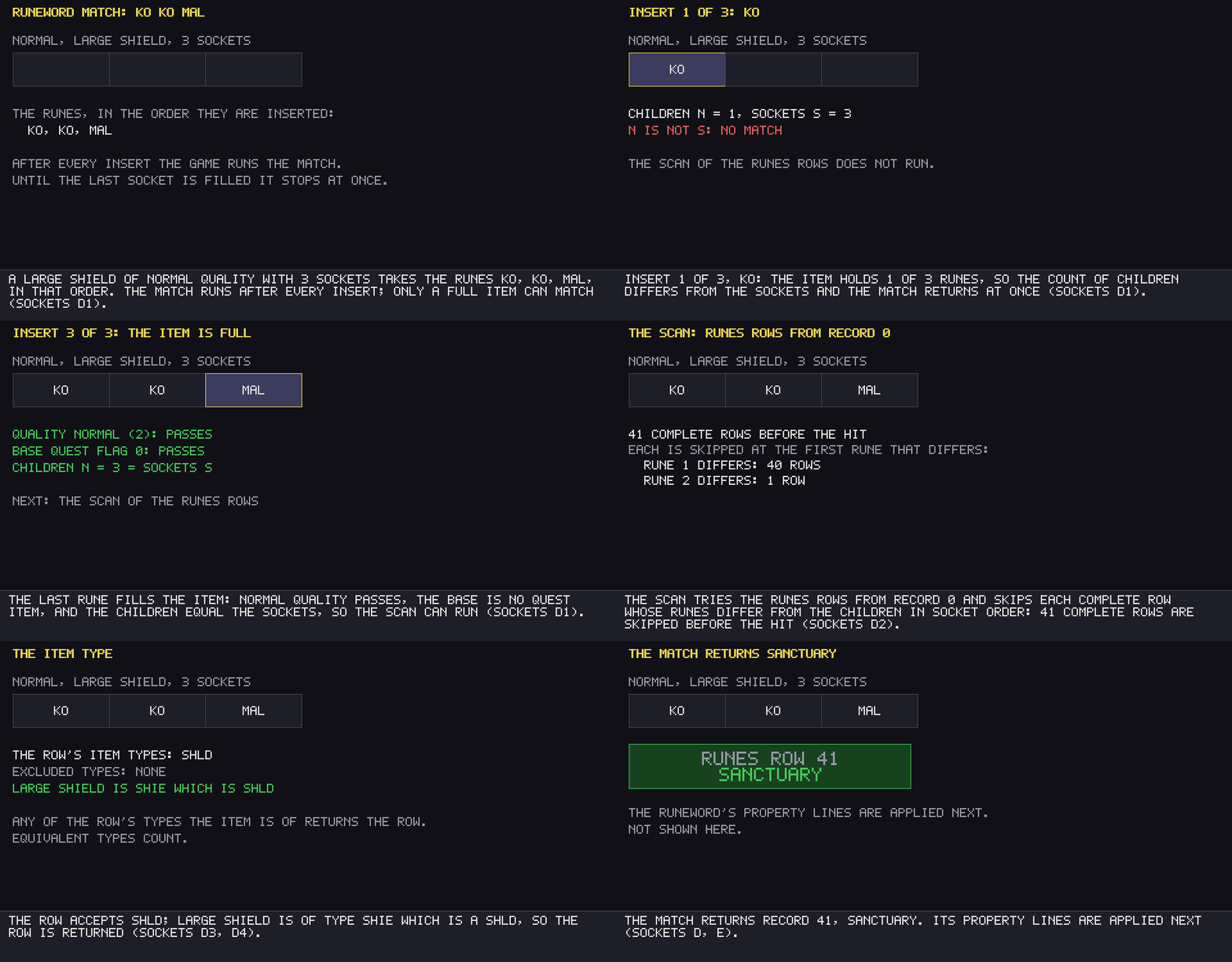
The match for Sanctuary in a normal large shield with three sockets, taking Ko, Ko and Mal in that order. After the first two inserts the item holds fewer runes than sockets, so the match returns at once. After the third it passes the quality test (low, normal and superior bases pass), the base’s quest test and the count of children equal to the sockets, and scans the Runes rows from record 0 (sockets-runewords § D1). A row that is not complete is skipped, and a complete row is skipped at its first rune that differs from the children in socket order: of the 41 complete rows before record 41, 40 differ at the first rune and one at the second. Record 41 lists Ko, Ko, Mal, equal to the children in socket order, and allows the item type shld, which a large shield is through the equivalence of shie (§ D2 to D4). Not shown: the server’s refusal list, and the runeword’s property lines and rolls. The picture takes no seed. Every value shown is computed by our model, not observed in the game.
- Low-quality and superior bases make runewords, as normal ones do; magic, set, rare, unique and crafted bases never do. Ethereal is not tested: an ethereal normal sword made Steel in a save the game itself wrote.
- A quest base never makes one (Wirt’s Leg made none in the run).
- The runes must be in the row’s order: the right runes in the wrong order, or in the wrong item type, matched nothing. Item type equivalences count, so a row for “weapons” accepts every weapon.
- A row marked for the ladder (Spirit in the run) makes no runeword in a non-ladder game, and the insert still succeeds. That it does apply in a ladder game is read from the code: no ladder game was run.
- A classic game accepts runes in sockets (confirmed) but forms no runeword. That second part is read from the code and the data, not seen in a run: the match has no game-type test, and every rune is an expansion item, so no row is classic-legal.
- Patience never forms: its row is not marked complete, and the match skips every incomplete row. That is checked against the stock table. Passion and Patience share one name, so the name a runeword shows only ever comes from Passion.
A quirk in the bound check means a row with exactly one rune more than the item has sockets compares that extra rune against a leftover memory slot. Read from the code, such a row matches only if the leftover happens to hold that rune’s item index; the single logged case did not match. The slot holds whatever the code that ran before at the same depth of the call stack left there, so a false match would need an earlier match check on a fuller item, not chance. What it holds in a given game cannot be worked out from the code alone; only a run could show it.
What the runeword rolls
Section titled “What the runeword rolls”When a row matches, the parent is marked as a runeword and gets one new stat list with the row’s lines, applied in column order. The lines that have a range are rolled on the item seed of the child whose insert completed the word, not on the parent’s seeds and not on the game seed. Two consequences matter to a player:
- The property handlers treat the rune as “the item”. So
ac%on a runeword does not reset the parent’s base defense the way it would on a magic item,dmg-min/dmg-maxwrite all three related damage stats, and Famine’s ethereal line never makes the parent ethereal (all confirmed by a run or a game-written save), and Eternity’s indestructible line was made in a run. A few other handler branches are read from the code only: no stock runeword line uses them, or the runewords that would use them are ladder-only rows, or the branch needs the rune to be a weapon, so no stock single-player game reaches them. - A rune loaded from a save starts with a fixed item seed derived from its saved start value, so the same save with the same insert order gives the same rolls.
Charged skills still draw their roll, and then a player-made runeword has its charges refilled to the maximum. That refill is confirmed for the insert a player makes, and the save reader does not refill. A runeword loaded from a save is not rolled again: the reader rebuilds the parent with its saved lists first, so when the last rune goes back in, the game finds the runeword list already present and adds nothing (seen on the Steel save). The save does not name the runeword’s row either: the writer runs the match again and saves that row’s name index, and the reader keeps the number without looking a row up; the row of a loaded runeword is always found again from its runes (read from the code; sockets-runewords, Inputs). Also read from the code only: a loaded item still marked as a runeword whose row no longer matches is discarded.
Socket counts
Section titled “Socket counts”There are two ways an item gets its number of sockets. At creation (a drop, the cube, a quest reward) the count is capped by the inventory size, by 6, by the base’s maximum, and by quality: magic at most 4, rare at most 2, crafted at most 3, sets and uniques 1 (or the count they already have). On drops, the size, 6 and base caps and their order are confirmed, and normal and superior items get no quality cap; the quality caps themselves are read from the code, since no run executed them. A count loaded from a save is kept as it is, above those caps: a magic crystal sword with 6 sockets loaded with 6 and took 6 children.
The Horadric Cube
Section titled “The Horadric Cube”Pressing Transmute runs a scan over the CubeMain table, in row order. The first row whose header conditions and
seven inputs fit the items in the cube is the recipe, and the scan stops there. This is a
transmute (cube recipe).
%3btext-align:center%3b%7d%23mermaid-2 .edgeLabel p%7bbackground-color:rgba(232%2c232%2c232%2c 0.8)%3b%7d%23mermaid-2 .edgeLabel rect%7bopacity:0.5%3bbackground-color:rgba(232%2c232%2c232%2c 0.8)%3bfill:rgba(232%2c232%2c232%2c 0.8)%3b%7d%23mermaid-2 .labelBkg%7bbackground-color:rgba(232%2c 232%2c 232%2c 0.5)%3b%7d%23mermaid-2 .cluster rect%7bfill:%23ffffde%3bstroke:%23aaaa33%3bstroke-width:1px%3b%7d%23mermaid-2 .cluster text%7bfill:%23333%3b%7d%23mermaid-2 .cluster span%7bcolor:%23333%3b%7d%23mermaid-2 .node .collapsed-indicator%7bfill:%23aaaa33%3bstroke:none%3bopacity:0.6%3b%7d%23mermaid-2 .node .collapsed-separator%7bstroke:%23aaaa33%3bstroke-width:0.75px%3b%7d%23mermaid-2 div.mermaidTooltip%7bposition:absolute%3btext-align:center%3bmax-width:200px%3bpadding:2px%3bfont-family:arial%2csans-serif%3bfont-size:12px%3bbackground:hsl(80%2c 100%25%2c 96.2745098039%25)%3bborder:1px solid %23aaaa33%3bborder-radius:2px%3bpointer-events:none%3bz-index:100%3b%7d%23mermaid-2 .flowchartTitleText%7btext-anchor:middle%3bfont-size:18px%3bfill:%23333%3b%7d%23mermaid-2 rect.text%7bfill:none%3bstroke-width:0%3b%7d%23mermaid-2 .icon-shape%2c%23mermaid-2 .image-shape%7bbackground-color:rgba(232%2c232%2c232%2c 0.8)%3btext-align:center%3b%7d%23mermaid-2 .icon-shape p%2c%23mermaid-2 .image-shape p%7bbackground-color:rgba(232%2c232%2c232%2c 0.8)%3bpadding:2px%3b%7d%23mermaid-2 .icon-shape .label rect%2c%23mermaid-2 .image-shape .label rect%7bopacity:0.5%3bbackground-color:rgba(232%2c232%2c232%2c 0.8)%3bfill:rgba(232%2c232%2c232%2c 0.8)%3b%7d%23mermaid-2 .label-icon%7bdisplay:inline-block%3bheight:1em%3boverflow:visible%3bvertical-align:-0.125em%3b%7d%23mermaid-2 .node .label-icon path%7bfill:currentColor%3bstroke:revert%3bstroke-width:revert%3b%7d%23mermaid-2 .node .neo-node%7bstroke:%239370DB%3b%7d%23mermaid-2 %5bdata-look='neo'%5d.node rect%2c%23mermaid-2 %5bdata-look='neo'%5d.cluster rect%2c%23mermaid-2 %5bdata-look='neo'%5d.node polygon%7bstroke:%239370DB%3bfilter:drop-shadow(1px 2px 2px rgba(185%2c 185%2c 185%2c 1))%3b%7d%23mermaid-2 %5bdata-look='neo'%5d.swimlane.cluster rect%7bfilter:none%3b%7d%23mermaid-2 %5bdata-look='neo'%5d.node path%7bstroke:%239370DB%3bstroke-width:1px%3b%7d%23mermaid-2 %5bdata-look='neo'%5d.node .outer-path%7bfilter:drop-shadow(1px 2px 2px rgba(185%2c 185%2c 185%2c 1))%3b%7d%23mermaid-2 %5bdata-look='neo'%5d.node .neo-line path%7bstroke:%239370DB%3bfilter:none%3b%7d%23mermaid-2 %5bdata-look='neo'%5d.node circle%7bstroke:%239370DB%3bfilter:drop-shadow(1px 2px 2px rgba(185%2c 185%2c 185%2c 1))%3b%7d%23mermaid-2 %5bdata-look='neo'%5d.node circle .state-start%7bfill:black%3b%7d%23mermaid-2 %5bdata-look='neo'%5d.icon-shape .icon%7bfill:%239370DB%3bfilter:drop-shadow(1px 2px 2px rgba(185%2c 185%2c 185%2c 1))%3b%7d%23mermaid-2 %5bdata-look='neo'%5d.icon-shape .icon-neo path%7bstroke:%239370DB%3bfilter:drop-shadow(1px 2px 2px rgba(185%2c 185%2c 185%2c 1))%3b%7d%23mermaid-2 :root%7b--mermaid-font-family:arial%2csans-serif%3b%7d%3c/style%3e%3cg%3e%3cmarker id='mermaid-2_flowchart-v2-pointEnd' class='marker flowchart-v2' viewBox='0 0 10 10' refX='5' refY='5' markerUnits='userSpaceOnUse' markerWidth='8' markerHeight='8' orient='auto'%3e%3cpath d='M 0 0 L 10 5 L 0 10 z' class='arrowMarkerPath' style='stroke-width: 1%3b stroke-dasharray: 1%2c 0%3b'/%3e%3c/marker%3e%3cmarker id='mermaid-2_flowchart-v2-pointStart' class='marker flowchart-v2' viewBox='0 0 10 10' refX='4.5' refY='5' markerUnits='userSpaceOnUse' markerWidth='8' markerHeight='8' orient='auto'%3e%3cpath d='M 0 5 L 10 10 L 10 0 z' class='arrowMarkerPath' style='stroke-width: 1%3b stroke-dasharray: 1%2c 0%3b'/%3e%3c/marker%3e%3cmarker id='mermaid-2_flowchart-v2-pointEnd-margin' class='marker flowchart-v2' viewBox='0 0 11.5 14' refX='11.5' refY='7' markerUnits='userSpaceOnUse' markerWidth='10.5' markerHeight='14' orient='auto'%3e%3cpath d='M 0 0 L 11.5 7 L 0 14 z' class='arrowMarkerPath' style='stroke-width: 0%3b stroke-dasharray: 1%2c 0%3b'/%3e%3c/marker%3e%3cmarker id='mermaid-2_flowchart-v2-pointStart-margin' class='marker flowchart-v2' viewBox='0 0 11.5 14' refX='1' refY='7' markerUnits='userSpaceOnUse' markerWidth='11.5' markerHeight='14' orient='auto'%3e%3cpolygon points='0%2c7 11.5%2c14 11.5%2c0' class='arrowMarkerPath' style='stroke-width: 0%3b stroke-dasharray: 1%2c 0%3b'/%3e%3c/marker%3e%3cmarker id='mermaid-2_flowchart-v2-circleEnd' class='marker flowchart-v2' viewBox='0 0 10 10' refX='11' refY='5' markerUnits='userSpaceOnUse' markerWidth='11' markerHeight='11' orient='auto'%3e%3ccircle cx='5' cy='5' r='5' class='arrowMarkerPath' style='stroke-width: 1%3b stroke-dasharray: 1%2c 0%3b'/%3e%3c/marker%3e%3cmarker id='mermaid-2_flowchart-v2-circleStart' class='marker flowchart-v2' viewBox='0 0 10 10' refX='-1' refY='5' markerUnits='userSpaceOnUse' markerWidth='11' markerHeight='11' orient='auto'%3e%3ccircle cx='5' cy='5' r='5' class='arrowMarkerPath' style='stroke-width: 1%3b stroke-dasharray: 1%2c 0%3b'/%3e%3c/marker%3e%3cmarker id='mermaid-2_flowchart-v2-circleEnd-margin' class='marker flowchart-v2' viewBox='0 0 10 10' refY='5' refX='12.25' markerUnits='userSpaceOnUse' markerWidth='14' markerHeight='14' orient='auto'%3e%3ccircle cx='5' cy='5' r='5' class='arrowMarkerPath' style='stroke-width: 0%3b stroke-dasharray: 1%2c 0%3b'/%3e%3c/marker%3e%3cmarker id='mermaid-2_flowchart-v2-circleStart-margin' class='marker flowchart-v2' viewBox='0 0 10 10' refX='-2' refY='5' markerUnits='userSpaceOnUse' markerWidth='14' markerHeight='14' orient='auto'%3e%3ccircle cx='5' cy='5' r='5' class='arrowMarkerPath' style='stroke-width: 0%3b stroke-dasharray: 1%2c 0%3b'/%3e%3c/marker%3e%3cmarker id='mermaid-2_flowchart-v2-crossEnd' class='marker cross flowchart-v2' viewBox='0 0 11 11' refX='12' refY='5.2' markerUnits='userSpaceOnUse' markerWidth='11' markerHeight='11' orient='auto'%3e%3cpath d='M 1%2c1 l 9%2c9 M 10%2c1 l -9%2c9' class='arrowMarkerPath' style='stroke-width: 2%3b stroke-dasharray: 1%2c 0%3b'/%3e%3c/marker%3e%3cmarker id='mermaid-2_flowchart-v2-crossStart' class='marker cross flowchart-v2' viewBox='0 0 11 11' refX='-1' refY='5.2' markerUnits='userSpaceOnUse' markerWidth='11' markerHeight='11' orient='auto'%3e%3cpath d='M 1%2c1 l 9%2c9 M 10%2c1 l -9%2c9' class='arrowMarkerPath' style='stroke-width: 2%3b stroke-dasharray: 1%2c 0%3b'/%3e%3c/marker%3e%3cmarker id='mermaid-2_flowchart-v2-crossEnd-margin' class='marker cross flowchart-v2' viewBox='0 0 15 15' refX='17.7' refY='7.5' markerUnits='userSpaceOnUse' markerWidth='12' markerHeight='12' orient='auto'%3e%3cpath d='M 1%2c1 L 14%2c14 M 1%2c14 L 14%2c1' class='arrowMarkerPath' style='stroke-width: 2.5%3b'/%3e%3c/marker%3e%3cmarker id='mermaid-2_flowchart-v2-crossStart-margin' class='marker cross flowchart-v2' viewBox='0 0 15 15' refX='-3.5' refY='7.5' markerUnits='userSpaceOnUse' markerWidth='12' markerHeight='12' orient='auto'%3e%3cpath d='M 1%2c1 L 14%2c14 M 1%2c14 L 14%2c1' class='arrowMarkerPath' style='stroke-width: 2.5%3b stroke-dasharray: 1%2c 0%3b'/%3e%3c/marker%3e%3cg class='root'%3e%3cg class='clusters'/%3e%3cg class='edgePaths'%3e%3cpath d='M399.512%2c62L399.512%2c66.167C399.512%2c70.333%2c399.512%2c78.667%2c399.512%2c86.333C399.512%2c94%2c399.512%2c101%2c399.512%2c104.5L399.512%2c108' id='mermaid-2-L_T_RW_0' class='edge-thickness-normal edge-pattern-solid edge-thickness-normal edge-pattern-solid flowchart-link' style='%3b' data-edge='true' data-et='edge' data-id='L_T_RW_0' data-points='W3sieCI6Mzk5LjUxMTcxODc1LCJ5Ijo2Mn0seyJ4IjozOTkuNTExNzE4NzUsInkiOjg3fSx7IngiOjM5OS41MTE3MTg3NSwieSI6MTEyfV0=' data-look='classic' marker-end='url(%23mermaid-2_flowchart-v2-pointEnd)'/%3e%3cpath d='M300.59%2c161.628L270.445%2c168.523C240.301%2c175.419%2c180.012%2c189.209%2c150.506%2c203.318C121%2c217.426%2c122.278%2c231.853%2c122.916%2c239.066L123.555%2c246.279' id='mermaid-2-L_RW_H_0' class='edge-thickness-normal edge-pattern-solid edge-thickness-normal edge-pattern-solid flowchart-link' style='%3b' data-edge='true' data-et='edge' data-id='L_RW_H_0' data-points='W3sieCI6MzAwLjU4OTg0Mzc1LCJ5IjoxNjEuNjI3NzYwODY4OTU4Mn0seyJ4IjoxMTkuNzIyNjU2MjUsInkiOjIwM30seyJ4IjoxMjMuOTA3OTc1Njg3ODAxMDEsInkiOjI1MC4yNjM4OTkzMTIxOTl9XQ==' data-look='classic' marker-end='url(%23mermaid-2_flowchart-v2-pointEnd)'/%3e%3cpath d='M186.656%2c292.484L197.278%2c277.57C207.901%2c262.656%2c229.146%2c232.828%2c253.524%2c212.01C277.902%2c191.193%2c305.414%2c179.385%2c319.17%2c173.481L332.925%2c167.578' id='mermaid-2-L_H_RW_0' class='edge-thickness-normal edge-pattern-solid edge-thickness-normal edge-pattern-solid flowchart-link' style='%3b' data-edge='true' data-et='edge' data-id='L_H_RW_0' data-points='W3sieCI6MTg2LjY1NTg3NTEyNTgzMTksInkiOjI5Mi40ODQwMDAxMjU4MzE4N30seyJ4IjoyNTAuMzkwNjI1LCJ5IjoyMDN9LHsieCI6MzM2LjYwMTI1NzMyNDIxODc1LCJ5IjoxNjZ9XQ==' data-look='classic' marker-end='url(%23mermaid-2_flowchart-v2-pointEnd)'/%3e%3cpath d='M134.172%2c492.344L134.172%2c498.51C134.172%2c504.677%2c134.172%2c517.01%2c161.026%2c540.254C187.879%2c563.498%2c241.587%2c597.651%2c268.44%2c614.728L295.294%2c631.805' id='mermaid-2-L_H_IN_0' class='edge-thickness-normal edge-pattern-solid edge-thickness-normal edge-pattern-solid flowchart-link' style='%3b' data-edge='true' data-et='edge' data-id='L_H_IN_0' data-points='W3sieCI6MTM0LjE3MTg3NSwieSI6NDkyLjM0Mzc1fSx7IngiOjEzNC4xNzE4NzUsInkiOjUyOS4zNDM3NX0seyJ4IjoyOTguNjY5MzU4MTMwMDQ3MywieSI6NjMzLjk1MTczNTYxOTk1Mjd9XQ==' data-look='classic' marker-end='url(%23mermaid-2_flowchart-v2-pointEnd)'/%3e%3cpath d='M433.885%2c633.952L461.302%2c616.517C488.718%2c599.082%2c543.55%2c564.213%2c570.967%2c519.583C598.383%2c474.953%2c598.383%2c420.563%2c598.383%2c366.172C598.383%2c311.781%2c598.383%2c257.391%2c579.855%2c224.233C561.328%2c191.075%2c524.273%2c179.15%2c505.746%2c173.188L487.218%2c167.225' id='mermaid-2-L_IN_RW_0' class='edge-thickness-normal edge-pattern-solid edge-thickness-normal edge-pattern-solid flowchart-link' style='%3b' data-edge='true' data-et='edge' data-id='L_IN_RW_0' data-points='W3sieCI6NDMzLjg4NTMyOTM2OTk1MjcsInkiOjYzMy45NTE3MzU2MTk5NTI3fSx7IngiOjU5OC4zODI4MTI1LCJ5Ijo1MjkuMzQzNzV9LHsieCI6NTk4LjM4MjgxMjUsInkiOjM2Ni4xNzE4NzV9LHsieCI6NTk4LjM4MjgxMjUsInkiOjIwM30seyJ4Ijo0ODMuNDEwNDYxNDI1NzgxMjUsInkiOjE2Nn1d' data-look='classic' marker-end='url(%23mermaid-2_flowchart-v2-pointEnd)'/%3e%3cpath d='M413.392%2c166L416.563%2c172.167C419.733%2c178.333%2c426.074%2c190.667%2c429.244%2c218.862C432.414%2c247.057%2c432.414%2c291.115%2c432.414%2c313.143L432.414%2c335.172' id='mermaid-2-L_RW_X_0' class='edge-thickness-normal edge-pattern-solid edge-thickness-normal edge-pattern-solid flowchart-link' style='%3b' data-edge='true' data-et='edge' data-id='L_RW_X_0' data-points='W3sieCI6NDEzLjM5MjM5NTAxOTUzMTI1LCJ5IjoxNjZ9LHsieCI6NDMyLjQxNDA2MjUsInkiOjIwM30seyJ4Ijo0MzIuNDE0MDYyNSwieSI6MzM5LjE3MTg3NX1d' data-look='classic' marker-end='url(%23mermaid-2_flowchart-v2-pointEnd)'/%3e%3cpath d='M366.277%2c787.547L366.277%2c793.714C366.277%2c799.88%2c366.277%2c812.214%2c366.277%2c823.88C366.277%2c835.547%2c366.277%2c846.547%2c366.277%2c852.047L366.277%2c857.547' id='mermaid-2-L_IN_OUT_0' class='edge-thickness-normal edge-pattern-solid edge-thickness-normal edge-pattern-solid flowchart-link' style='%3b' data-edge='true' data-et='edge' data-id='L_IN_OUT_0' data-points='W3sieCI6MzY2LjI3NzM0Mzc1LCJ5Ijo3ODcuNTQ2ODc1fSx7IngiOjM2Ni4yNzczNDM3NSwieSI6ODI0LjU0Njg3NX0seyJ4IjozNjYuMjc3MzQzNzUsInkiOjg2MS41NDY4NzV9XQ==' data-look='classic' marker-end='url(%23mermaid-2_flowchart-v2-pointEnd)'/%3e%3cpath d='M366.277%2c939.547L366.277%2c943.714C366.277%2c947.88%2c366.277%2c956.214%2c366.277%2c963.88C366.277%2c971.547%2c366.277%2c978.547%2c366.277%2c982.047L366.277%2c985.547' id='mermaid-2-L_OUT_P_0' class='edge-thickness-normal edge-pattern-solid edge-thickness-normal edge-pattern-solid flowchart-link' style='%3b' data-edge='true' data-et='edge' data-id='L_OUT_P_0' data-points='W3sieCI6MzY2LjI3NzM0Mzc1LCJ5Ijo5MzkuNTQ2ODc1fSx7IngiOjM2Ni4yNzczNDM3NSwieSI6OTY0LjU0Njg3NX0seyJ4IjozNjYuMjc3MzQzNzUsInkiOjk4OS41NDY4NzV9XQ==' data-look='classic' marker-end='url(%23mermaid-2_flowchart-v2-pointEnd)'/%3e%3cpath d='M317.818%2c1135.65L303.68%2c1149.893C289.543%2c1164.136%2c261.267%2c1192.623%2c247.13%2c1214.366C232.992%2c1236.109%2c232.992%2c1251.109%2c232.992%2c1258.609L232.992%2c1266.109' id='mermaid-2-L_P_K_0' class='edge-thickness-normal edge-pattern-solid edge-thickness-normal edge-pattern-solid flowchart-link' style='%3b' data-edge='true' data-et='edge' data-id='L_P_K_0' data-points='W3sieCI6MzE3LjgxNzc5NzYyMDI0MjUsInkiOjExMzUuNjQ5ODI4ODcwMjQyNn0seyJ4IjoyMzIuOTkyMTg3NSwieSI6MTIyMS4xMDkzNzV9LHsieCI6MjMyLjk5MjE4NzUsInkiOjEyNzAuMTA5Mzc1fV0=' data-look='classic' marker-end='url(%23mermaid-2_flowchart-v2-pointEnd)'/%3e%3cpath d='M414.737%2c1135.65L428.874%2c1149.893C443.012%2c1164.136%2c471.287%2c1192.623%2c485.425%2c1212.366C499.563%2c1232.109%2c499.563%2c1243.109%2c499.563%2c1248.609L499.563%2c1254.109' id='mermaid-2-L_P_D_0' class='edge-thickness-normal edge-pattern-solid edge-thickness-normal edge-pattern-solid flowchart-link' style='%3b' data-edge='true' data-et='edge' data-id='L_P_D_0' data-points='W3sieCI6NDE0LjczNjg4OTg3OTc1NzUsInkiOjExMzUuNjQ5ODI4ODcwMjQyNn0seyJ4Ijo0OTkuNTYyNSwieSI6MTIyMS4xMDkzNzV9LHsieCI6NDk5LjU2MjUsInkiOjEyNTguMTA5Mzc1fV0=' data-look='classic' marker-end='url(%23mermaid-2_flowchart-v2-pointEnd)'/%3e%3c/g%3e%3cg class='edgeLabels'%3e%3cg class='edgeLabel'%3e%3cg class='label' data-id='L_T_RW_0' transform='translate(0%2c 0)'%3e%3cforeignObject width='0' height='0'%3e%3cdiv xmlns='http://www.w3.org/1999/xhtml' class='labelBkg' style='display: table-cell%3b white-space: nowrap%3b line-height: 1.5%3b max-width: 200px%3b text-align: center%3b'%3e%3cspan class='edgeLabel'%3e%3c/span%3e%3c/div%3e%3c/foreignObject%3e%3c/g%3e%3c/g%3e%3cg class='edgeLabel'%3e%3cg class='label' data-id='L_RW_H_0' transform='translate(0%2c 0)'%3e%3cforeignObject width='0' height='0'%3e%3cdiv xmlns='http://www.w3.org/1999/xhtml' class='labelBkg' style='display: table-cell%3b white-space: nowrap%3b line-height: 1.5%3b max-width: 200px%3b text-align: center%3b'%3e%3cspan class='edgeLabel'%3e%3c/span%3e%3c/div%3e%3c/foreignObject%3e%3c/g%3e%3c/g%3e%3cg class='edgeLabel' transform='translate(245.73612%2c 209.53496)'%3e%3cg class='label' data-id='L_H_RW_0' transform='translate(-8.8984375%2c -12)'%3e%3cforeignObject width='17.796875' height='24'%3e%3cdiv xmlns='http://www.w3.org/1999/xhtml' class='labelBkg' style='display: table-cell%3b white-space: nowrap%3b line-height: 1.5%3b max-width: 200px%3b text-align: center%3b'%3e%3cspan class='edgeLabel'%3e%3cp%3eno%3c/p%3e%3c/span%3e%3c/div%3e%3c/foreignObject%3e%3c/g%3e%3c/g%3e%3cg class='edgeLabel' transform='translate(134.171875%2c 529.34375)'%3e%3cg class='label' data-id='L_H_IN_0' transform='translate(-12.453125%2c -12)'%3e%3cforeignObject width='24.90625' height='24'%3e%3cdiv xmlns='http://www.w3.org/1999/xhtml' class='labelBkg' style='display: table-cell%3b white-space: nowrap%3b line-height: 1.5%3b max-width: 200px%3b text-align: center%3b'%3e%3cspan class='edgeLabel'%3e%3cp%3eyes%3c/p%3e%3c/span%3e%3c/div%3e%3c/foreignObject%3e%3c/g%3e%3c/g%3e%3cg class='edgeLabel' transform='translate(598.3828125%2c 366.171875)'%3e%3cg class='label' data-id='L_IN_RW_0' transform='translate(-8.8984375%2c -12)'%3e%3cforeignObject width='17.796875' height='24'%3e%3cdiv xmlns='http://www.w3.org/1999/xhtml' class='labelBkg' style='display: table-cell%3b white-space: nowrap%3b line-height: 1.5%3b max-width: 200px%3b text-align: center%3b'%3e%3cspan class='edgeLabel'%3e%3cp%3eno%3c/p%3e%3c/span%3e%3c/div%3e%3c/foreignObject%3e%3c/g%3e%3c/g%3e%3cg class='edgeLabel' transform='translate(432.4140625%2c 203)'%3e%3cg class='label' data-id='L_RW_X_0' transform='translate(-36.90625%2c -12)'%3e%3cforeignObject width='73.8125' height='24'%3e%3cdiv xmlns='http://www.w3.org/1999/xhtml' class='labelBkg' style='display: table-cell%3b white-space: nowrap%3b line-height: 1.5%3b max-width: 200px%3b text-align: center%3b'%3e%3cspan class='edgeLabel'%3e%3cp%3eno row left%3c/p%3e%3c/span%3e%3c/div%3e%3c/foreignObject%3e%3c/g%3e%3c/g%3e%3cg class='edgeLabel' transform='translate(366.27734375%2c 824.546875)'%3e%3cg class='label' data-id='L_IN_OUT_0' transform='translate(-12.453125%2c -12)'%3e%3cforeignObject width='24.90625' height='24'%3e%3cdiv xmlns='http://www.w3.org/1999/xhtml' class='labelBkg' style='display: table-cell%3b white-space: nowrap%3b line-height: 1.5%3b max-width: 200px%3b text-align: center%3b'%3e%3cspan class='edgeLabel'%3e%3cp%3eyes%3c/p%3e%3c/span%3e%3c/div%3e%3c/foreignObject%3e%3c/g%3e%3c/g%3e%3cg class='edgeLabel'%3e%3cg class='label' data-id='L_OUT_P_0' transform='translate(0%2c 0)'%3e%3cforeignObject width='0' height='0'%3e%3cdiv xmlns='http://www.w3.org/1999/xhtml' class='labelBkg' style='display: table-cell%3b white-space: nowrap%3b line-height: 1.5%3b max-width: 200px%3b text-align: center%3b'%3e%3cspan class='edgeLabel'%3e%3c/span%3e%3c/div%3e%3c/foreignObject%3e%3c/g%3e%3c/g%3e%3cg class='edgeLabel' transform='translate(232.9921875%2c 1221.109375)'%3e%3cg class='label' data-id='L_P_K_0' transform='translate(-8.8984375%2c -12)'%3e%3cforeignObject width='17.796875' height='24'%3e%3cdiv xmlns='http://www.w3.org/1999/xhtml' class='labelBkg' style='display: table-cell%3b white-space: nowrap%3b line-height: 1.5%3b max-width: 200px%3b text-align: center%3b'%3e%3cspan class='edgeLabel'%3e%3cp%3eno%3c/p%3e%3c/span%3e%3c/div%3e%3c/foreignObject%3e%3c/g%3e%3c/g%3e%3cg class='edgeLabel' transform='translate(499.5625%2c 1221.109375)'%3e%3cg class='label' data-id='L_P_D_0' transform='translate(-12.453125%2c -12)'%3e%3cforeignObject width='24.90625' height='24'%3e%3cdiv xmlns='http://www.w3.org/1999/xhtml' class='labelBkg' style='display: table-cell%3b white-space: nowrap%3b line-height: 1.5%3b max-width: 200px%3b text-align: center%3b'%3e%3cspan class='edgeLabel'%3e%3cp%3eyes%3c/p%3e%3c/span%3e%3c/div%3e%3c/foreignObject%3e%3c/g%3e%3c/g%3e%3c/g%3e%3cg class='nodes'%3e%3cg class='node default' id='mermaid-2-flowchart-T-0' data-look='classic' transform='translate(399.51171875%2c 35)'%3e%3crect class='basic label-container' style='' x='-67.9375' y='-27' width='135.875' height='54'/%3e%3cg class='label' style='' transform='translate(-37.9375%2c -12)'%3e%3crect/%3e%3cforeignObject width='75.875' height='24'%3e%3cdiv xmlns='http://www.w3.org/1999/xhtml' style='display: table-cell%3b white-space: nowrap%3b line-height: 1.5%3b max-width: 200px%3b text-align: center%3b'%3e%3cspan class='nodeLabel'%3e%3cp%3eTransmute%3c/p%3e%3c/span%3e%3c/div%3e%3c/foreignObject%3e%3c/g%3e%3c/g%3e%3cg class='node default' id='mermaid-2-flowchart-RW-1' data-look='classic' transform='translate(399.51171875%2c 139)'%3e%3crect class='basic label-container' style='' x='-98.921875' y='-27' width='197.84375' height='54'/%3e%3cg class='label' style='' transform='translate(-68.921875%2c -12)'%3e%3crect/%3e%3cforeignObject width='137.84375' height='24'%3e%3cdiv xmlns='http://www.w3.org/1999/xhtml' style='display: table-cell%3b white-space: nowrap%3b line-height: 1.5%3b max-width: 200px%3b text-align: center%3b'%3e%3cspan class='nodeLabel'%3e%3cp%3enext CubeMain row%3c/p%3e%3c/span%3e%3c/div%3e%3c/foreignObject%3e%3c/g%3e%3c/g%3e%3cg class='node default' id='mermaid-2-flowchart-H-3' data-look='classic' transform='translate(134.171875%2c 366.171875)'%3e%3cpolygon points='126.171875%2c0 252.34375%2c-126.171875 126.171875%2c-252.34375 0%2c-126.171875' class='label-container' transform='translate(-125.671875%2c 126.171875)'/%3e%3cg class='label' style='' transform='translate(-87.171875%2c -24)'%3e%3crect/%3e%3cforeignObject width='174.34375' height='48'%3e%3cdiv xmlns='http://www.w3.org/1999/xhtml' style='display: table-cell%3b white-space: nowrap%3b line-height: 1.5%3b max-width: 200px%3b text-align: center%3b'%3e%3cspan class='nodeLabel'%3e%3cp%3eenabled%2c version%2c ladder%2c%3cbr /%3eexact item count%3f%3c/p%3e%3c/span%3e%3c/div%3e%3c/foreignObject%3e%3c/g%3e%3c/g%3e%3cg class='node default' id='mermaid-2-flowchart-IN-7' data-look='classic' transform='translate(366.27734375%2c 676.9453125)'%3e%3cpolygon points='110.6015625%2c0 221.203125%2c-110.6015625 110.6015625%2c-221.203125 0%2c-110.6015625' class='label-container' transform='translate(-110.1015625%2c 110.6015625)'/%3e%3cg class='label' style='' transform='translate(-83.6015625%2c -12)'%3e%3crect/%3e%3cforeignObject width='167.203125' height='24'%3e%3cdiv xmlns='http://www.w3.org/1999/xhtml' style='display: table-cell%3b white-space: nowrap%3b line-height: 1.5%3b max-width: 200px%3b text-align: center%3b'%3e%3cspan class='nodeLabel'%3e%3cp%3eall seven inputs match%3f%3c/p%3e%3c/span%3e%3c/div%3e%3c/foreignObject%3e%3c/g%3e%3c/g%3e%3cg class='node default' id='mermaid-2-flowchart-X-11' data-look='classic' transform='translate(432.4140625%2c 366.171875)'%3e%3crect class='basic label-container' style='' x='-122.0703125' y='-27' width='244.140625' height='54'/%3e%3cg class='label' style='' transform='translate(-92.0703125%2c -12)'%3e%3crect/%3e%3cforeignObject width='184.140625' height='24'%3e%3cdiv xmlns='http://www.w3.org/1999/xhtml' style='display: table-cell%3b white-space: nowrap%3b line-height: 1.5%3b max-width: 200px%3b text-align: center%3b'%3e%3cspan class='nodeLabel'%3e%3cp%3enothing happens%2c no draw%3c/p%3e%3c/span%3e%3c/div%3e%3c/foreignObject%3e%3c/g%3e%3c/g%3e%3cg class='node default' id='mermaid-2-flowchart-OUT-13' data-look='classic' transform='translate(366.27734375%2c 900.546875)'%3e%3crect class='basic label-container' style='' x='-130' y='-39' width='260' height='78'/%3e%3cg class='label' style='' transform='translate(-100%2c -24)'%3e%3crect/%3e%3cforeignObject width='200' height='48'%3e%3cdiv xmlns='http://www.w3.org/1999/xhtml' style='display: table%3b white-space: break-spaces%3b line-height: 1.5%3b max-width: 200px%3b text-align: center%3b width: 200px%3b'%3e%3cspan class='nodeLabel'%3e%3cp%3ebuild outputs A%2c B%2c C in order%3c/p%3e%3c/span%3e%3c/div%3e%3c/foreignObject%3e%3c/g%3e%3c/g%3e%3cg class='node default' id='mermaid-2-flowchart-P-15' data-look='classic' transform='translate(366.27734375%2c 1086.828125)'%3e%3cpolygon points='97.28125%2c0 194.5625%2c-97.28125 97.28125%2c-194.5625 0%2c-97.28125' class='label-container' transform='translate(-96.78125%2c 97.28125)'/%3e%3cg class='label' style='' transform='translate(-70.28125%2c -12)'%3e%3crect/%3e%3cforeignObject width='140.5625' height='24'%3e%3cdiv xmlns='http://www.w3.org/1999/xhtml' style='display: table-cell%3b white-space: nowrap%3b line-height: 1.5%3b max-width: 200px%3b text-align: center%3b'%3e%3cspan class='nodeLabel'%3e%3cp%3eanything produced%3f%3c/p%3e%3c/span%3e%3c/div%3e%3c/foreignObject%3e%3c/g%3e%3c/g%3e%3cg class='node default' id='mermaid-2-flowchart-K-17' data-look='classic' transform='translate(232.9921875%2c 1297.109375)'%3e%3crect class='basic label-container' style='' x='-89.1640625' y='-27' width='178.328125' height='54'/%3e%3cg class='label' style='' transform='translate(-59.1640625%2c -12)'%3e%3crect/%3e%3cforeignObject width='118.328125' height='24'%3e%3cdiv xmlns='http://www.w3.org/1999/xhtml' style='display: table-cell%3b white-space: nowrap%3b line-height: 1.5%3b max-width: 200px%3b text-align: center%3b'%3e%3cspan class='nodeLabel'%3e%3cp%3ecube unchanged%3c/p%3e%3c/span%3e%3c/div%3e%3c/foreignObject%3e%3c/g%3e%3c/g%3e%3cg class='node default' id='mermaid-2-flowchart-D-19' data-look='classic' transform='translate(499.5625%2c 1297.109375)'%3e%3crect class='basic label-container' style='' x='-127.40625' y='-39' width='254.8125' height='78'/%3e%3cg class='label' style='' transform='translate(-97.40625%2c -24)'%3e%3crect/%3e%3cforeignObject width='194.8125' height='48'%3e%3cdiv xmlns='http://www.w3.org/1999/xhtml' style='display: table-cell%3b white-space: nowrap%3b line-height: 1.5%3b max-width: 200px%3b text-align: center%3b'%3e%3cspan class='nodeLabel'%3e%3cp%3edestroy every cube item%2c%3cbr /%3eplace the outputs%2c identified%3c/p%3e%3c/span%3e%3c/div%3e%3c/foreignObject%3e%3c/g%3e%3c/g%3e%3c/g%3e%3c/g%3e%3c/g%3e%3cdefs%3e%3cfilter id='mermaid-2-drop-shadow' height='130%25' width='130%25'%3e%3cfeDropShadow dx='4' dy='4' stdDeviation='0' flood-opacity='0.06' flood-color='black'/%3e%3c/filter%3e%3c/defs%3e%3cdefs%3e%3cfilter id='mermaid-2-drop-shadow-small' height='150%25' width='150%25'%3e%3cfeDropShadow dx='2' dy='2' stdDeviation='0' flood-opacity='0.06' flood-color='black'/%3e%3c/filter%3e%3c/defs%3e%3c/svg%3e)
The row filter. A few rules decide which rows can be tried at all:
- The item count is exact. Each stack counts as one item, and on the stock data every row expects exactly the summed quantity of its inputs, so one extra item in the cube refuses every recipe.
- A classic game skips expansion rows.
- Ladder rows work in single player. The rune upgrades and the two elite unique upgrades are marked for the ladder, but the skip only applies to a game type that single player is not, and the run made those runes offline.
- The five disabled rows can never be reached: the switch that would enable them is read once, written nowhere, and starts at 0 in the executable.
The inputs. Inputs are taken in column order, and an input claims every matching item in the cube, not just its quantity, then compares the count. An input can ask for a base code or an item type, a quality, sockets or no sockets, ethereal or not, a tier (normal, exceptional, elite). The exceptional test was seen deciding: an elite-upgrade recipe refused a normal and an elite dagger and took an exceptional one. The “ethereal” and elite input tests are read from the code only; no stock recipe uses them. An input that names a base also takes a higher tier of it: a gloves recipe matched magic heavy bracers and vambraces. On the recipes that need it, a quest item is tested against the difficulty: Wirt’s Leg matches only if its quest-difficulty stat is at least the current difficulty. A leg with that stat at 0 matched no row in Nightmare, one at 1 did; in Normal every leg passes. Read from the table, the same test binds the Staff of Kings, the Viper Amulet, Khalim’s Flail and Khalim’s organs. A recipe whose output adds a socket refuses a first input that cannot hold sockets (a rare amulet stayed unmatched). The rows’ optional player tests (day of the month, stats) are read from the code only; no stock row uses them. Some of the stat tests (on the player, and on the first input) compare not the stat itself but its bonus over the base value (from items, skills and states); that reading is from the code too.
That a stackable item relaxes the exact count is also read from the code; on the stock recipes it changes nothing.
What an output can be
Section titled “What an output can be”Outputs A, B and C are built in that order. The output ilvl comes from the row’s lvl, plvl and ilvl columns: a
fixed lvl wins; otherwise a percentage of the player’s level plus a percentage of input 1’s ilvl, each truncated,
at least 1. Capping that value at 99 is read from the code; no
transmute reached it.
| Output kind | What it does |
|---|---|
a fixed item code, an item type, or usetype |
a new item through ordinary item creation, with the row’s quality and any forced affix ids |
useitem |
a copy of input 1, with its affixes, names and stats |
mod |
a copy of input 1 moved to another base (the exceptional upgrade rows); base stats are re-rolled, affixes and sockets stay |
| Cow Portal | opens the portal to the cow level |
| the two Pandemonium portals | nothing: both do nothing in this game version |
Some details from § E, § M and § F:
- Created items are ordinary creations, entered with the cube’s record: the ethereal roll is switched off and so is the socket roll. A record of quality 0 (runes, gems, potions) still goes through a quality roll that draws on the new item’s seed, and only afterwards does the rune or gem type force the quality to normal.
- An item-type output picks a random base of that type with a level no higher than the output ilvl, with two draws on the game seed. The polearm recipe drew a scythe out of ten candidates. The edge cases of that pick (an empty list, the candidate cap) are read from the code only.
- Copies are not clones of the seed. A
useitemormodcopy takes two game-seed steps and gets a fresh item seed, so its later rolls (the recipe’s own lines, a socket) start from new values. A copy keeps the gems or runes in its sockets unless the recipe strips them (the unsocket recipe does), and a copy with one socketed item took two more game-seed steps; two per socketed item is read from the code. The unsocket recipe on a runeword also removes the runeword. - An ethereal upgrade first gets the plain values of its new base, then the ethereal bonus (×3/2) from the recipe’s property line, as seen on an ethereal Gull upgraded to an exceptional dagger.
- The recipe’s own property lines come after the item exists. On the rune socket recipes the line rolls 1 to 6 sockets for every item class, then the base caps it: a roll of 6 on a gothic plate gave 4 sockets. Each line could have a chance to apply; every stock chance cell is blank, so that gate is read from the code only.
sock=1(the recipe that adds a socket to a rare) gave one socket to a rare short sword, cap and kite shield. Its quality caps are read from the code; with one socket they never bind.- Repair and recharge. The repair recipe restored a damaged sword’s durability and a broken one’s (clearing the broken state), and refilled throwing knives to their maximum stack of 160; the recharge recipe refilled a wand’s charges. Read from the code only: which maximum durability the repair takes when the item has a durability bonus (both swords had none), the refill of an item with several charged skills, and a stack whose maximum is above 255.
Finishing. If anything was produced, every item in the cube is destroyed (with the stock rows that is exactly the inputs) and the outputs are placed in the cube, identified, crafted items included. Placing the Horadric Staff sets the player’s staff quest bit, and Khalim’s Will calls its own quest hook; neither hook ran for any of the 18 other outputs placed in that run. Where each output lands is the same free-spot search the game uses for a player’s inventory, run on the empty 3 × 4 cube grid: a 1 × 1 item lands at cell (2, 3), a 2 × 1 item at (1, 3), and anything larger at (0, 0). That search reproduced all 100 logged placements. A partly filled cube never meets an output, since the inputs are destroyed first. If nothing was produced, the cube stays as it was: nothing produced, nothing consumed.
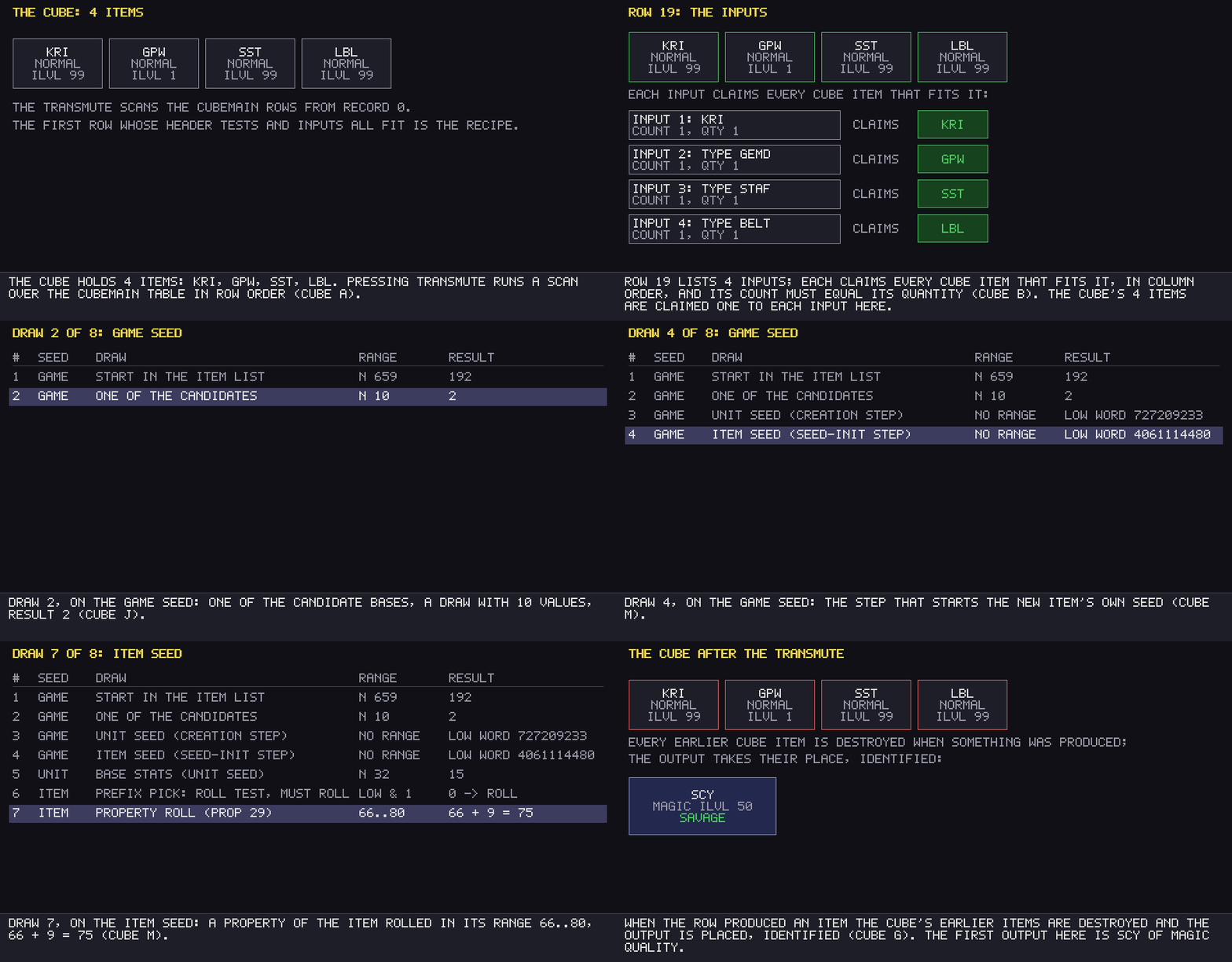
Step through items-cube-polearm-transmute
One transmute of the polearm recipe, row 19 of the CubeMain table, taken from a game: a Kri, a gem, a staff and a belt in the cube. The scan passes over the 15 of the first 20 rows whose count of inputs is not 4, four more rows reach the matcher and fail an input, and row 19 fits, so the scan stops there (cube § A). Each input claims every cube item that fits it, here one item each, and the count must equal the quantity (§ B). Output A is an item of a type, a polearm of magic quality, and the row’s fixed level of 50 wins (§ D, E). The pick of the base draws twice on the game seed, a start and one of the ten candidates, which gave a scythe (§ J). The creation then steps the game seed twice, draws the base stats on the unit seed, and on the item seed makes the magic builder’s draws: the roll test of the prefix pick, which rolls whatever its bit because the row forces the prefix Savage, so no weighted draw follows, the prefix’s property roll, and the roll test of the suffix pick, whose 0 gave no suffix (§ M, worked example 3). The cube then holds the scythe, identified (§ G). The inputs, the seed among them, come from one recorded game; every value after them is computed by our model, which reproduces each value that game logged.
Crafted items
Section titled “Crafted items”A crafted item is built by the crafted builder. It draws two rare names, then an affix count of the remainder of a draw by 5, raised to a tier set by the ilvl (above 70: 4; above 50: 3; above 30: 2; else 1), so it is never lowered. Each slot first draws a side (prefix or suffix), every slot, then picks an affix. Properties are rolled only after all picks, then the recipe’s own three lines are added. So tier 4 always gives four affixes, while tier 1 gives one with probability 2/5. An affix pick can find no candidate on the stock data: on a short staff at output ilvl 1, light boots up to 5 and light gloves up to 3 (the output ilvl is half the character’s level plus half the input’s, so it takes a low-level character and low-level inputs). When that side already holds an affix the game crashes, as was seen at output ilvl 1 on light boots. The same pick on an empty side, and the limit of 252 retries against a duplicate, are read from the code only.
The cow portal and the Pandemonium rows
Section titled “The cow portal and the Pandemonium rows”The Cow Portal opens only from the Act I town (level 1), once per game. It is refused for a character whose quest record has the bit that the Cow King’s death script sets for his killer, and in an expansion game the character’s Baal quest word must show the quest done (in a classic game, Diablo’s; both seen). The run tested these gates with forced save states, so it checks the gates, not which quest events set the bits. A refused portal leaves the leg and the tome in the cube. Outside the encampment it was refused (tried in the Act IV town). Finding the portal’s spot draws nothing; the portal object draws from the game seed (171 to 173 steps in the logged openings), and what those draws are spent on is not yet known. The two Pandemonium rows match, produce nothing, and leave the cube untouched in any game this executable hosts.
Vendors and gambling
Section titled “Vendors and gambling”Vendor stock and gambling never go through the TC resolver. All their choices draw on one store seed per game, seeded from one game-seed step at game creation. Each item they make is then created like a drop, its own seeds coming from two game-seed steps. Other units draw on the game seed between builds, so each item’s own seeds depend on every game-seed draw made before it.
%3btext-align:center%3b%7d%23mermaid-3 .edgeLabel p%7bbackground-color:rgba(232%2c232%2c232%2c 0.8)%3b%7d%23mermaid-3 .edgeLabel rect%7bopacity:0.5%3bbackground-color:rgba(232%2c232%2c232%2c 0.8)%3bfill:rgba(232%2c232%2c232%2c 0.8)%3b%7d%23mermaid-3 .labelBkg%7bbackground-color:rgba(232%2c 232%2c 232%2c 0.5)%3b%7d%23mermaid-3 .cluster rect%7bfill:%23ffffde%3bstroke:%23aaaa33%3bstroke-width:1px%3b%7d%23mermaid-3 .cluster text%7bfill:%23333%3b%7d%23mermaid-3 .cluster span%7bcolor:%23333%3b%7d%23mermaid-3 .node .collapsed-indicator%7bfill:%23aaaa33%3bstroke:none%3bopacity:0.6%3b%7d%23mermaid-3 .node .collapsed-separator%7bstroke:%23aaaa33%3bstroke-width:0.75px%3b%7d%23mermaid-3 div.mermaidTooltip%7bposition:absolute%3btext-align:center%3bmax-width:200px%3bpadding:2px%3bfont-family:arial%2csans-serif%3bfont-size:12px%3bbackground:hsl(80%2c 100%25%2c 96.2745098039%25)%3bborder:1px solid %23aaaa33%3bborder-radius:2px%3bpointer-events:none%3bz-index:100%3b%7d%23mermaid-3 .flowchartTitleText%7btext-anchor:middle%3bfont-size:18px%3bfill:%23333%3b%7d%23mermaid-3 rect.text%7bfill:none%3bstroke-width:0%3b%7d%23mermaid-3 .icon-shape%2c%23mermaid-3 .image-shape%7bbackground-color:rgba(232%2c232%2c232%2c 0.8)%3btext-align:center%3b%7d%23mermaid-3 .icon-shape p%2c%23mermaid-3 .image-shape p%7bbackground-color:rgba(232%2c232%2c232%2c 0.8)%3bpadding:2px%3b%7d%23mermaid-3 .icon-shape .label rect%2c%23mermaid-3 .image-shape .label rect%7bopacity:0.5%3bbackground-color:rgba(232%2c232%2c232%2c 0.8)%3bfill:rgba(232%2c232%2c232%2c 0.8)%3b%7d%23mermaid-3 .label-icon%7bdisplay:inline-block%3bheight:1em%3boverflow:visible%3bvertical-align:-0.125em%3b%7d%23mermaid-3 .node .label-icon path%7bfill:currentColor%3bstroke:revert%3bstroke-width:revert%3b%7d%23mermaid-3 .node .neo-node%7bstroke:%239370DB%3b%7d%23mermaid-3 %5bdata-look='neo'%5d.node rect%2c%23mermaid-3 %5bdata-look='neo'%5d.cluster rect%2c%23mermaid-3 %5bdata-look='neo'%5d.node polygon%7bstroke:%239370DB%3bfilter:drop-shadow(1px 2px 2px rgba(185%2c 185%2c 185%2c 1))%3b%7d%23mermaid-3 %5bdata-look='neo'%5d.swimlane.cluster rect%7bfilter:none%3b%7d%23mermaid-3 %5bdata-look='neo'%5d.node path%7bstroke:%239370DB%3bstroke-width:1px%3b%7d%23mermaid-3 %5bdata-look='neo'%5d.node .outer-path%7bfilter:drop-shadow(1px 2px 2px rgba(185%2c 185%2c 185%2c 1))%3b%7d%23mermaid-3 %5bdata-look='neo'%5d.node .neo-line path%7bstroke:%239370DB%3bfilter:none%3b%7d%23mermaid-3 %5bdata-look='neo'%5d.node circle%7bstroke:%239370DB%3bfilter:drop-shadow(1px 2px 2px rgba(185%2c 185%2c 185%2c 1))%3b%7d%23mermaid-3 %5bdata-look='neo'%5d.node circle .state-start%7bfill:black%3b%7d%23mermaid-3 %5bdata-look='neo'%5d.icon-shape .icon%7bfill:%239370DB%3bfilter:drop-shadow(1px 2px 2px rgba(185%2c 185%2c 185%2c 1))%3b%7d%23mermaid-3 %5bdata-look='neo'%5d.icon-shape .icon-neo path%7bstroke:%239370DB%3bfilter:drop-shadow(1px 2px 2px rgba(185%2c 185%2c 185%2c 1))%3b%7d%23mermaid-3 :root%7b--mermaid-font-family:arial%2csans-serif%3b%7d%3c/style%3e%3cg%3e%3cmarker id='mermaid-3_flowchart-v2-pointEnd' class='marker flowchart-v2' viewBox='0 0 10 10' refX='5' refY='5' markerUnits='userSpaceOnUse' markerWidth='8' markerHeight='8' orient='auto'%3e%3cpath d='M 0 0 L 10 5 L 0 10 z' class='arrowMarkerPath' style='stroke-width: 1%3b stroke-dasharray: 1%2c 0%3b'/%3e%3c/marker%3e%3cmarker id='mermaid-3_flowchart-v2-pointStart' class='marker flowchart-v2' viewBox='0 0 10 10' refX='4.5' refY='5' markerUnits='userSpaceOnUse' markerWidth='8' markerHeight='8' orient='auto'%3e%3cpath d='M 0 5 L 10 10 L 10 0 z' class='arrowMarkerPath' style='stroke-width: 1%3b stroke-dasharray: 1%2c 0%3b'/%3e%3c/marker%3e%3cmarker id='mermaid-3_flowchart-v2-pointEnd-margin' class='marker flowchart-v2' viewBox='0 0 11.5 14' refX='11.5' refY='7' markerUnits='userSpaceOnUse' markerWidth='10.5' markerHeight='14' orient='auto'%3e%3cpath d='M 0 0 L 11.5 7 L 0 14 z' class='arrowMarkerPath' style='stroke-width: 0%3b stroke-dasharray: 1%2c 0%3b'/%3e%3c/marker%3e%3cmarker id='mermaid-3_flowchart-v2-pointStart-margin' class='marker flowchart-v2' viewBox='0 0 11.5 14' refX='1' refY='7' markerUnits='userSpaceOnUse' markerWidth='11.5' markerHeight='14' orient='auto'%3e%3cpolygon points='0%2c7 11.5%2c14 11.5%2c0' class='arrowMarkerPath' style='stroke-width: 0%3b stroke-dasharray: 1%2c 0%3b'/%3e%3c/marker%3e%3cmarker id='mermaid-3_flowchart-v2-circleEnd' class='marker flowchart-v2' viewBox='0 0 10 10' refX='11' refY='5' markerUnits='userSpaceOnUse' markerWidth='11' markerHeight='11' orient='auto'%3e%3ccircle cx='5' cy='5' r='5' class='arrowMarkerPath' style='stroke-width: 1%3b stroke-dasharray: 1%2c 0%3b'/%3e%3c/marker%3e%3cmarker id='mermaid-3_flowchart-v2-circleStart' class='marker flowchart-v2' viewBox='0 0 10 10' refX='-1' refY='5' markerUnits='userSpaceOnUse' markerWidth='11' markerHeight='11' orient='auto'%3e%3ccircle cx='5' cy='5' r='5' class='arrowMarkerPath' style='stroke-width: 1%3b stroke-dasharray: 1%2c 0%3b'/%3e%3c/marker%3e%3cmarker id='mermaid-3_flowchart-v2-circleEnd-margin' class='marker flowchart-v2' viewBox='0 0 10 10' refY='5' refX='12.25' markerUnits='userSpaceOnUse' markerWidth='14' markerHeight='14' orient='auto'%3e%3ccircle cx='5' cy='5' r='5' class='arrowMarkerPath' style='stroke-width: 0%3b stroke-dasharray: 1%2c 0%3b'/%3e%3c/marker%3e%3cmarker id='mermaid-3_flowchart-v2-circleStart-margin' class='marker flowchart-v2' viewBox='0 0 10 10' refX='-2' refY='5' markerUnits='userSpaceOnUse' markerWidth='14' markerHeight='14' orient='auto'%3e%3ccircle cx='5' cy='5' r='5' class='arrowMarkerPath' style='stroke-width: 0%3b stroke-dasharray: 1%2c 0%3b'/%3e%3c/marker%3e%3cmarker id='mermaid-3_flowchart-v2-crossEnd' class='marker cross flowchart-v2' viewBox='0 0 11 11' refX='12' refY='5.2' markerUnits='userSpaceOnUse' markerWidth='11' markerHeight='11' orient='auto'%3e%3cpath d='M 1%2c1 l 9%2c9 M 10%2c1 l -9%2c9' class='arrowMarkerPath' style='stroke-width: 2%3b stroke-dasharray: 1%2c 0%3b'/%3e%3c/marker%3e%3cmarker id='mermaid-3_flowchart-v2-crossStart' class='marker cross flowchart-v2' viewBox='0 0 11 11' refX='-1' refY='5.2' markerUnits='userSpaceOnUse' markerWidth='11' markerHeight='11' orient='auto'%3e%3cpath d='M 1%2c1 l 9%2c9 M 10%2c1 l -9%2c9' class='arrowMarkerPath' style='stroke-width: 2%3b stroke-dasharray: 1%2c 0%3b'/%3e%3c/marker%3e%3cmarker id='mermaid-3_flowchart-v2-crossEnd-margin' class='marker cross flowchart-v2' viewBox='0 0 15 15' refX='17.7' refY='7.5' markerUnits='userSpaceOnUse' markerWidth='12' markerHeight='12' orient='auto'%3e%3cpath d='M 1%2c1 L 14%2c14 M 1%2c14 L 14%2c1' class='arrowMarkerPath' style='stroke-width: 2.5%3b'/%3e%3c/marker%3e%3cmarker id='mermaid-3_flowchart-v2-crossStart-margin' class='marker cross flowchart-v2' viewBox='0 0 15 15' refX='-3.5' refY='7.5' markerUnits='userSpaceOnUse' markerWidth='12' markerHeight='12' orient='auto'%3e%3cpath d='M 1%2c1 L 14%2c14 M 1%2c14 L 14%2c1' class='arrowMarkerPath' style='stroke-width: 2.5%3b stroke-dasharray: 1%2c 0%3b'/%3e%3c/marker%3e%3cg class='root'%3e%3cg class='clusters'/%3e%3cg class='edgePaths'%3e%3cpath d='M88.695%2c62L88.695%2c68.167C88.695%2c74.333%2c88.695%2c86.667%2c88.695%2c98.333C88.695%2c110%2c88.695%2c121%2c88.695%2c126.5L88.695%2c132' id='mermaid-3-L_GC_S_0' class='edge-thickness-normal edge-pattern-solid edge-thickness-normal edge-pattern-solid flowchart-link' style='%3b' data-edge='true' data-et='edge' data-id='L_GC_S_0' data-points='W3sieCI6ODguNjk1MzEyNSwieSI6NjJ9LHsieCI6ODguNjk1MzEyNSwieSI6OTl9LHsieCI6ODguNjk1MzEyNSwieSI6MTM2fV0=' data-look='classic' marker-end='url(%23mermaid-3_flowchart-v2-pointEnd)'/%3e%3cpath d='M274.313%2c190L274.313%2c194.167C274.313%2c198.333%2c274.313%2c206.667%2c284.241%2c226.015C294.169%2c245.363%2c314.025%2c275.726%2c323.953%2c290.908L333.882%2c306.089' id='mermaid-3-L_TO_B_0' class='edge-thickness-normal edge-pattern-solid edge-thickness-normal edge-pattern-solid flowchart-link' style='%3b' data-edge='true' data-et='edge' data-id='L_TO_B_0' data-points='W3sieCI6Mjc0LjMxMjUsInkiOjE5MH0seyJ4IjoyNzQuMzEyNSwieSI6MjE1fSx7IngiOjMzNi4wNzA4MzA5MzMxNzk3LCJ5IjozMDkuNDM2OTgxNTY2ODIwM31d' data-look='classic' marker-end='url(%23mermaid-3_flowchart-v2-pointEnd)'/%3e%3cpath d='M332.369%2c444.862L318.659%2c463.218C304.948%2c481.574%2c277.527%2c518.287%2c263.816%2c542.144C250.105%2c566%2c250.105%2c577%2c250.105%2c582.5L250.105%2c588' id='mermaid-3-L_B_SB_0' class='edge-thickness-normal edge-pattern-solid edge-thickness-normal edge-pattern-solid flowchart-link' style='%3b' data-edge='true' data-et='edge' data-id='L_B_SB_0' data-points='W3sieCI6MzMyLjM2OTQ1NDc1MTgzOTA0LCJ5Ijo0NDQuODYxNjQyMjUxODM5MDR9LHsieCI6MjUwLjEwNTQ2ODc1LCJ5Ijo1NTV9LHsieCI6MjUwLjEwNTQ2ODc1LCJ5Ijo1OTJ9XQ==' data-look='classic' marker-end='url(%23mermaid-3_flowchart-v2-pointEnd)'/%3e%3cpath d='M430.756%2c444.862L444.466%2c463.218C458.177%2c481.574%2c485.598%2c518.287%2c499.309%2c546.144C513.02%2c574%2c513.02%2c593%2c513.02%2c602.5L513.02%2c612' id='mermaid-3-L_B_SEND_0' class='edge-thickness-normal edge-pattern-solid edge-thickness-normal edge-pattern-solid flowchart-link' style='%3b' data-edge='true' data-et='edge' data-id='L_B_SEND_0' data-points='W3sieCI6NDMwLjc1NTU0NTI0ODE2MDk2LCJ5Ijo0NDQuODYxNjQyMjUxODM5MDR9LHsieCI6NTEzLjAxOTUzMTI1LCJ5Ijo1NTV9LHsieCI6NTEzLjAxOTUzMTI1LCJ5Ijo2MTZ9XQ==' data-look='classic' marker-end='url(%23mermaid-3_flowchart-v2-pointEnd)'/%3e%3cpath d='M859.457%2c190L859.457%2c194.167C859.457%2c198.333%2c859.457%2c206.667%2c859.457%2c214.333C859.457%2c222%2c859.457%2c229%2c859.457%2c232.5L859.457%2c236' id='mermaid-3-L_GO_G_0' class='edge-thickness-normal edge-pattern-solid edge-thickness-normal edge-pattern-solid flowchart-link' style='%3b' data-edge='true' data-et='edge' data-id='L_GO_G_0' data-points='W3sieCI6ODU5LjQ1NzAzMTI1LCJ5IjoxOTB9LHsieCI6ODU5LjQ1NzAzMTI1LCJ5IjoyMTV9LHsieCI6ODU5LjQ1NzAzMTI1LCJ5IjoyNDB9XQ==' data-look='classic' marker-end='url(%23mermaid-3_flowchart-v2-pointEnd)'/%3e%3cpath d='M807.166%2c465.709L798.191%2c480.59C789.216%2c495.472%2c771.266%2c525.236%2c762.291%2c549.618C753.316%2c574%2c753.316%2c593%2c753.316%2c602.5L753.316%2c612' id='mermaid-3-L_G_GB_0' class='edge-thickness-normal edge-pattern-solid edge-thickness-normal edge-pattern-solid flowchart-link' style='%3b' data-edge='true' data-et='edge' data-id='L_G_GB_0' data-points='W3sieCI6ODA3LjE2NTU2NTMzNjUwMzgsInkiOjQ2NS43MDg1MzQwODY1MDM4NX0seyJ4Ijo3NTMuMzE2NDA2MjUsInkiOjU1NX0seyJ4Ijo3NTMuMzE2NDA2MjUsInkiOjYxNn1d' data-look='classic' marker-end='url(%23mermaid-3_flowchart-v2-pointEnd)'/%3e%3cpath d='M911.748%2c465.709L920.723%2c480.59C929.698%2c495.472%2c947.648%2c525.236%2c956.623%2c549.618C965.598%2c574%2c965.598%2c593%2c965.598%2c602.5L965.598%2c612' id='mermaid-3-L_G_SEND2_0' class='edge-thickness-normal edge-pattern-solid edge-thickness-normal edge-pattern-solid flowchart-link' style='%3b' data-edge='true' data-et='edge' data-id='L_G_SEND2_0' data-points='W3sieCI6OTExLjc0ODQ5NzE2MzQ5NjIsInkiOjQ2NS43MDg1MzQwODY1MDM4NX0seyJ4Ijo5NjUuNTk3NjU2MjUsInkiOjU1NX0seyJ4Ijo5NjUuNTk3NjU2MjUsInkiOjYxNn1d' data-look='classic' marker-end='url(%23mermaid-3_flowchart-v2-pointEnd)'/%3e%3cpath d='M250.105%2c694L250.105%2c698.167C250.105%2c702.333%2c250.105%2c710.667%2c278.754%2c720.754C307.403%2c730.842%2c364.7%2c742.684%2c393.348%2c748.604L421.997%2c754.525' id='mermaid-3-L_SB_IC_0' class='edge-thickness-normal edge-pattern-solid edge-thickness-normal edge-pattern-solid flowchart-link' style='%3b' data-edge='true' data-et='edge' data-id='L_SB_IC_0' data-points='W3sieCI6MjUwLjEwNTQ2ODc1LCJ5Ijo2OTR9LHsieCI6MjUwLjEwNTQ2ODc1LCJ5Ijo3MTl9LHsieCI6NDI1LjkxNDA2MjUsInkiOjc1NS4zMzQ4NDk2Mzc0ODQyfV0=' data-look='classic' marker-end='url(%23mermaid-3_flowchart-v2-pointEnd)'/%3e%3cpath d='M753.316%2c670L753.316%2c678.167C753.316%2c686.333%2c753.316%2c702.667%2c724.668%2c716.754C696.019%2c730.842%2c638.722%2c742.684%2c610.074%2c748.604L581.425%2c754.525' id='mermaid-3-L_GB_IC_0' class='edge-thickness-normal edge-pattern-solid edge-thickness-normal edge-pattern-solid flowchart-link' style='%3b' data-edge='true' data-et='edge' data-id='L_GB_IC_0' data-points='W3sieCI6NzUzLjMxNjQwNjI1LCJ5Ijo2NzB9LHsieCI6NzUzLjMxNjQwNjI1LCJ5Ijo3MTl9LHsieCI6NTc3LjUwNzgxMjUsInkiOjc1NS4zMzQ4NDk2Mzc0ODQyfV0=' data-look='classic' marker-end='url(%23mermaid-3_flowchart-v2-pointEnd)'/%3e%3cpath d='M521.918%2c62L521.918%2c68.167C521.918%2c74.333%2c521.918%2c86.667%2c521.918%2c98.333C521.918%2c110%2c521.918%2c121%2c521.918%2c126.5L521.918%2c132' id='mermaid-3-L_LV_ST_0' class='edge-thickness-normal edge-pattern-solid edge-thickness-normal edge-pattern-solid flowchart-link' style='%3b' data-edge='true' data-et='edge' data-id='L_LV_ST_0' data-points='W3sieCI6NTIxLjkxNzk2ODc1LCJ5Ijo2Mn0seyJ4Ijo1MjEuOTE3OTY4NzUsInkiOjk5fSx7IngiOjUyMS45MTc5Njg3NSwieSI6MTM2fV0=' data-look='classic' marker-end='url(%23mermaid-3_flowchart-v2-pointEnd)'/%3e%3cpath d='M521.918%2c190L521.918%2c194.167C521.918%2c198.333%2c521.918%2c206.667%2c507.802%2c227.327C493.686%2c247.988%2c465.454%2c280.976%2c451.338%2c297.47L437.222%2c313.965' id='mermaid-3-L_ST_B_0' class='edge-thickness-normal edge-pattern-solid edge-thickness-normal edge-pattern-solid flowchart-link' style='%3b' data-edge='true' data-et='edge' data-id='L_ST_B_0' data-points='W3sieCI6NTIxLjkxNzk2ODc1LCJ5IjoxOTB9LHsieCI6NTIxLjkxNzk2ODc1LCJ5IjoyMTV9LHsieCI6NDM0LjYyMDcwNDE1Mjc2MjY0LCJ5IjozMTcuMDAzNTE2NjUyNzYyNjR9XQ==' data-look='classic' marker-end='url(%23mermaid-3_flowchart-v2-pointEnd)'/%3e%3c/g%3e%3cg class='edgeLabels'%3e%3cg class='edgeLabel' transform='translate(88.6953125%2c 99)'%3e%3cg class='label' data-id='L_GC_S_0' transform='translate(-72.9375%2c -12)'%3e%3cforeignObject width='145.875' height='24'%3e%3cdiv xmlns='http://www.w3.org/1999/xhtml' class='labelBkg' style='display: table-cell%3b white-space: nowrap%3b line-height: 1.5%3b max-width: 200px%3b text-align: center%3b'%3e%3cspan class='edgeLabel'%3e%3cp%3eone game-seed step%3c/p%3e%3c/span%3e%3c/div%3e%3c/foreignObject%3e%3c/g%3e%3c/g%3e%3cg class='edgeLabel'%3e%3cg class='label' data-id='L_TO_B_0' transform='translate(0%2c 0)'%3e%3cforeignObject width='0' height='0'%3e%3cdiv xmlns='http://www.w3.org/1999/xhtml' class='labelBkg' style='display: table-cell%3b white-space: nowrap%3b line-height: 1.5%3b max-width: 200px%3b text-align: center%3b'%3e%3cspan class='edgeLabel'%3e%3c/span%3e%3c/div%3e%3c/foreignObject%3e%3c/g%3e%3c/g%3e%3cg class='edgeLabel' transform='translate(250.10546875%2c 555)'%3e%3cg class='label' data-id='L_B_SB_0' transform='translate(-8.8984375%2c -12)'%3e%3cforeignObject width='17.796875' height='24'%3e%3cdiv xmlns='http://www.w3.org/1999/xhtml' class='labelBkg' style='display: table-cell%3b white-space: nowrap%3b line-height: 1.5%3b max-width: 200px%3b text-align: center%3b'%3e%3cspan class='edgeLabel'%3e%3cp%3eno%3c/p%3e%3c/span%3e%3c/div%3e%3c/foreignObject%3e%3c/g%3e%3c/g%3e%3cg class='edgeLabel' transform='translate(513.01953125%2c 555)'%3e%3cg class='label' data-id='L_B_SEND_0' transform='translate(-12.453125%2c -12)'%3e%3cforeignObject width='24.90625' height='24'%3e%3cdiv xmlns='http://www.w3.org/1999/xhtml' class='labelBkg' style='display: table-cell%3b white-space: nowrap%3b line-height: 1.5%3b max-width: 200px%3b text-align: center%3b'%3e%3cspan class='edgeLabel'%3e%3cp%3eyes%3c/p%3e%3c/span%3e%3c/div%3e%3c/foreignObject%3e%3c/g%3e%3c/g%3e%3cg class='edgeLabel'%3e%3cg class='label' data-id='L_GO_G_0' transform='translate(0%2c 0)'%3e%3cforeignObject width='0' height='0'%3e%3cdiv xmlns='http://www.w3.org/1999/xhtml' class='labelBkg' style='display: table-cell%3b white-space: nowrap%3b line-height: 1.5%3b max-width: 200px%3b text-align: center%3b'%3e%3cspan class='edgeLabel'%3e%3c/span%3e%3c/div%3e%3c/foreignObject%3e%3c/g%3e%3c/g%3e%3cg class='edgeLabel' transform='translate(753.31640625%2c 555)'%3e%3cg class='label' data-id='L_G_GB_0' transform='translate(-8.8984375%2c -12)'%3e%3cforeignObject width='17.796875' height='24'%3e%3cdiv xmlns='http://www.w3.org/1999/xhtml' class='labelBkg' style='display: table-cell%3b white-space: nowrap%3b line-height: 1.5%3b max-width: 200px%3b text-align: center%3b'%3e%3cspan class='edgeLabel'%3e%3cp%3eno%3c/p%3e%3c/span%3e%3c/div%3e%3c/foreignObject%3e%3c/g%3e%3c/g%3e%3cg class='edgeLabel' transform='translate(965.59765625%2c 555)'%3e%3cg class='label' data-id='L_G_SEND2_0' transform='translate(-12.453125%2c -12)'%3e%3cforeignObject width='24.90625' height='24'%3e%3cdiv xmlns='http://www.w3.org/1999/xhtml' class='labelBkg' style='display: table-cell%3b white-space: nowrap%3b line-height: 1.5%3b max-width: 200px%3b text-align: center%3b'%3e%3cspan class='edgeLabel'%3e%3cp%3eyes%3c/p%3e%3c/span%3e%3c/div%3e%3c/foreignObject%3e%3c/g%3e%3c/g%3e%3cg class='edgeLabel'%3e%3cg class='label' data-id='L_SB_IC_0' transform='translate(0%2c 0)'%3e%3cforeignObject width='0' height='0'%3e%3cdiv xmlns='http://www.w3.org/1999/xhtml' class='labelBkg' style='display: table-cell%3b white-space: nowrap%3b line-height: 1.5%3b max-width: 200px%3b text-align: center%3b'%3e%3cspan class='edgeLabel'%3e%3c/span%3e%3c/div%3e%3c/foreignObject%3e%3c/g%3e%3c/g%3e%3cg class='edgeLabel'%3e%3cg class='label' data-id='L_GB_IC_0' transform='translate(0%2c 0)'%3e%3cforeignObject width='0' height='0'%3e%3cdiv xmlns='http://www.w3.org/1999/xhtml' class='labelBkg' style='display: table-cell%3b white-space: nowrap%3b line-height: 1.5%3b max-width: 200px%3b text-align: center%3b'%3e%3cspan class='edgeLabel'%3e%3c/span%3e%3c/div%3e%3c/foreignObject%3e%3c/g%3e%3c/g%3e%3cg class='edgeLabel'%3e%3cg class='label' data-id='L_LV_ST_0' transform='translate(0%2c 0)'%3e%3cforeignObject width='0' height='0'%3e%3cdiv xmlns='http://www.w3.org/1999/xhtml' class='labelBkg' style='display: table-cell%3b white-space: nowrap%3b line-height: 1.5%3b max-width: 200px%3b text-align: center%3b'%3e%3cspan class='edgeLabel'%3e%3c/span%3e%3c/div%3e%3c/foreignObject%3e%3c/g%3e%3c/g%3e%3cg class='edgeLabel'%3e%3cg class='label' data-id='L_ST_B_0' transform='translate(0%2c 0)'%3e%3cforeignObject width='0' height='0'%3e%3cdiv xmlns='http://www.w3.org/1999/xhtml' class='labelBkg' style='display: table-cell%3b white-space: nowrap%3b line-height: 1.5%3b max-width: 200px%3b text-align: center%3b'%3e%3cspan class='edgeLabel'%3e%3c/span%3e%3c/div%3e%3c/foreignObject%3e%3c/g%3e%3c/g%3e%3c/g%3e%3cg class='nodes'%3e%3cg class='node default' id='mermaid-3-flowchart-GC-0' data-look='classic' transform='translate(88.6953125%2c 35)'%3e%3crect class='basic label-container' style='' x='-80.6953125' y='-27' width='161.390625' height='54'/%3e%3cg class='label' style='' transform='translate(-50.6953125%2c -12)'%3e%3crect/%3e%3cforeignObject width='101.390625' height='24'%3e%3cdiv xmlns='http://www.w3.org/1999/xhtml' style='display: table-cell%3b white-space: nowrap%3b line-height: 1.5%3b max-width: 200px%3b text-align: center%3b'%3e%3cspan class='nodeLabel'%3e%3cp%3egame creation%3c/p%3e%3c/span%3e%3c/div%3e%3c/foreignObject%3e%3c/g%3e%3c/g%3e%3cg class='node default' id='mermaid-3-flowchart-S-1' data-look='classic' transform='translate(88.6953125%2c 163)'%3e%3crect class='basic label-container' style='' x='-67.359375' y='-27' width='134.71875' height='54'/%3e%3cg class='label' style='' transform='translate(-37.359375%2c -12)'%3e%3crect/%3e%3cforeignObject width='74.71875' height='24'%3e%3cdiv xmlns='http://www.w3.org/1999/xhtml' style='display: table-cell%3b white-space: nowrap%3b line-height: 1.5%3b max-width: 200px%3b text-align: center%3b'%3e%3cspan class='nodeLabel'%3e%3cp%3estore seed%3c/p%3e%3c/span%3e%3c/div%3e%3c/foreignObject%3e%3c/g%3e%3c/g%3e%3cg class='node default' id='mermaid-3-flowchart-TO-2' data-look='classic' transform='translate(274.3125%2c 163)'%3e%3crect class='basic label-container' style='' x='-68.2578125' y='-27' width='136.515625' height='54'/%3e%3cg class='label' style='' transform='translate(-38.2578125%2c -12)'%3e%3crect/%3e%3cforeignObject width='76.515625' height='24'%3e%3cdiv xmlns='http://www.w3.org/1999/xhtml' style='display: table-cell%3b white-space: nowrap%3b line-height: 1.5%3b max-width: 200px%3b text-align: center%3b'%3e%3cspan class='nodeLabel'%3e%3cp%3etrade open%3c/p%3e%3c/span%3e%3c/div%3e%3c/foreignObject%3e%3c/g%3e%3c/g%3e%3cg class='node default' id='mermaid-3-flowchart-B-3' data-look='classic' transform='translate(381.5625%2c 379)'%3e%3cpolygon points='115.0546875%2c0 230.109375%2c-115.0546875 115.0546875%2c-230.109375 0%2c-115.0546875' class='label-container' transform='translate(-114.5546875%2c 115.0546875)'/%3e%3cg class='label' style='' transform='translate(-88.0546875%2c -12)'%3e%3crect/%3e%3cforeignObject width='176.109375' height='24'%3e%3cdiv xmlns='http://www.w3.org/1999/xhtml' style='display: table-cell%3b white-space: nowrap%3b line-height: 1.5%3b max-width: 200px%3b text-align: center%3b'%3e%3cspan class='nodeLabel'%3e%3cp%3estock built and not stale%3f%3c/p%3e%3c/span%3e%3c/div%3e%3c/foreignObject%3e%3c/g%3e%3c/g%3e%3cg class='node default' id='mermaid-3-flowchart-SB-5' data-look='classic' transform='translate(250.10546875%2c 643)'%3e%3crect class='basic label-container' style='' x='-130' y='-51' width='260' height='102'/%3e%3cg class='label' style='' transform='translate(-100%2c -36)'%3e%3crect/%3e%3cforeignObject width='200' height='72'%3e%3cdiv xmlns='http://www.w3.org/1999/xhtml' style='display: table%3b white-space: break-spaces%3b line-height: 1.5%3b max-width: 200px%3b text-align: center%3b width: 200px%3b'%3e%3cspan class='nodeLabel'%3e%3cp%3estock build: counts%2c quality%2c%3cbr /%3eupgrade draws on the store seed%3c/p%3e%3c/span%3e%3c/div%3e%3c/foreignObject%3e%3c/g%3e%3c/g%3e%3cg class='node default' id='mermaid-3-flowchart-SEND-7' data-look='classic' transform='translate(513.01953125%2c 643)'%3e%3crect class='basic label-container' style='' x='-82.9140625' y='-27' width='165.828125' height='54'/%3e%3cg class='label' style='' transform='translate(-52.9140625%2c -12)'%3e%3crect/%3e%3cforeignObject width='105.828125' height='24'%3e%3cdiv xmlns='http://www.w3.org/1999/xhtml' style='display: table-cell%3b white-space: nowrap%3b line-height: 1.5%3b max-width: 200px%3b text-align: center%3b'%3e%3cspan class='nodeLabel'%3e%3cp%3eshow the stock%3c/p%3e%3c/span%3e%3c/div%3e%3c/foreignObject%3e%3c/g%3e%3c/g%3e%3cg class='node default' id='mermaid-3-flowchart-GO-8' data-look='classic' transform='translate(859.45703125%2c 163)'%3e%3crect class='basic label-container' style='' x='-76.2578125' y='-27' width='152.515625' height='54'/%3e%3cg class='label' style='' transform='translate(-46.2578125%2c -12)'%3e%3crect/%3e%3cforeignObject width='92.515625' height='24'%3e%3cdiv xmlns='http://www.w3.org/1999/xhtml' style='display: table-cell%3b white-space: nowrap%3b line-height: 1.5%3b max-width: 200px%3b text-align: center%3b'%3e%3cspan class='nodeLabel'%3e%3cp%3egamble open%3c/p%3e%3c/span%3e%3c/div%3e%3c/foreignObject%3e%3c/g%3e%3c/g%3e%3cg class='node default' id='mermaid-3-flowchart-G-9' data-look='classic' transform='translate(859.45703125%2c 379)'%3e%3cpolygon points='139%2c0 278%2c-139 139%2c-278 0%2c-139' class='label-container' transform='translate(-138.5%2c 139)'/%3e%3cg class='label' style='' transform='translate(-100%2c -24)'%3e%3crect/%3e%3cforeignObject width='200' height='48'%3e%3cdiv xmlns='http://www.w3.org/1999/xhtml' style='display: table%3b white-space: break-spaces%3b line-height: 1.5%3b max-width: 200px%3b text-align: center%3b width: 200px%3b'%3e%3cspan class='nodeLabel'%3e%3cp%3ethis player has a window here%3f%3c/p%3e%3c/span%3e%3c/div%3e%3c/foreignObject%3e%3c/g%3e%3c/g%3e%3cg class='node default' id='mermaid-3-flowchart-GB-11' data-look='classic' transform='translate(753.31640625%2c 643)'%3e%3crect class='basic label-container' style='' x='-107.3828125' y='-27' width='214.765625' height='54'/%3e%3cg class='label' style='' transform='translate(-77.3828125%2c -12)'%3e%3crect/%3e%3cforeignObject width='154.765625' height='24'%3e%3cdiv xmlns='http://www.w3.org/1999/xhtml' style='display: table-cell%3b white-space: nowrap%3b line-height: 1.5%3b max-width: 200px%3b text-align: center%3b'%3e%3cspan class='nodeLabel'%3e%3cp%3egamble build: 14 slots%3c/p%3e%3c/span%3e%3c/div%3e%3c/foreignObject%3e%3c/g%3e%3c/g%3e%3cg class='node default' id='mermaid-3-flowchart-SEND2-13' data-look='classic' transform='translate(965.59765625%2c 643)'%3e%3crect class='basic label-container' style='' x='-54.8984375' y='-27' width='109.796875' height='54'/%3e%3cg class='label' style='' transform='translate(-24.8984375%2c -12)'%3e%3crect/%3e%3cforeignObject width='49.796875' height='24'%3e%3cdiv xmlns='http://www.w3.org/1999/xhtml' style='display: table-cell%3b white-space: nowrap%3b line-height: 1.5%3b max-width: 200px%3b text-align: center%3b'%3e%3cspan class='nodeLabel'%3e%3cp%3eshow it%3c/p%3e%3c/span%3e%3c/div%3e%3c/foreignObject%3e%3c/g%3e%3c/g%3e%3cg class='node default' id='mermaid-3-flowchart-IC-15' data-look='classic' transform='translate(501.7109375%2c 771)'%3e%3crect class='basic label-container' style='' x='-75.796875' y='-27' width='151.59375' height='54'/%3e%3cg class='label' style='' transform='translate(-45.796875%2c -12)'%3e%3crect/%3e%3cforeignObject width='91.59375' height='24'%3e%3cdiv xmlns='http://www.w3.org/1999/xhtml' style='display: table-cell%3b white-space: nowrap%3b line-height: 1.5%3b max-width: 200px%3b text-align: center%3b'%3e%3cspan class='nodeLabel'%3e%3cp%3eitem creation%3c/p%3e%3c/span%3e%3c/div%3e%3c/foreignObject%3e%3c/g%3e%3c/g%3e%3cg class='node default' id='mermaid-3-flowchart-LV-18' data-look='classic' transform='translate(521.91796875%2c 35)'%3e%3crect class='basic label-container' style='' x='-128.28125' y='-27' width='256.5625' height='54'/%3e%3cg class='label' style='' transform='translate(-98.28125%2c -12)'%3e%3crect/%3e%3cforeignObject width='196.5625' height='24'%3e%3cdiv xmlns='http://www.w3.org/1999/xhtml' style='display: table-cell%3b white-space: nowrap%3b line-height: 1.5%3b max-width: 200px%3b text-align: center%3b'%3e%3cspan class='nodeLabel'%3e%3cp%3ea player leaves a town level%3c/p%3e%3c/span%3e%3c/div%3e%3c/foreignObject%3e%3c/g%3e%3c/g%3e%3cg class='node default' id='mermaid-3-flowchart-ST-19' data-look='classic' transform='translate(521.91796875%2c 163)'%3e%3crect class='basic label-container' style='' x='-96.2421875' y='-27' width='192.484375' height='54'/%3e%3cg class='label' style='' transform='translate(-66.2421875%2c -12)'%3e%3crect/%3e%3cforeignObject width='132.484375' height='24'%3e%3cdiv xmlns='http://www.w3.org/1999/xhtml' style='display: table-cell%3b white-space: nowrap%3b line-height: 1.5%3b max-width: 200px%3b text-align: center%3b'%3e%3cspan class='nodeLabel'%3e%3cp%3ereset or mark stale%3c/p%3e%3c/span%3e%3c/div%3e%3c/foreignObject%3e%3c/g%3e%3c/g%3e%3c/g%3e%3c/g%3e%3c/g%3e%3cdefs%3e%3cfilter id='mermaid-3-drop-shadow' height='130%25' width='130%25'%3e%3cfeDropShadow dx='4' dy='4' stdDeviation='0' flood-opacity='0.06' flood-color='black'/%3e%3c/filter%3e%3c/defs%3e%3cdefs%3e%3cfilter id='mermaid-3-drop-shadow-small' height='150%25' width='150%25'%3e%3cfeDropShadow dx='2' dy='2' stdDeviation='0' flood-opacity='0.06' flood-color='black'/%3e%3c/filter%3e%3c/defs%3e%3c/svg%3e)
When stock is built and refreshed
Section titled “When stock is built and refreshed”There is one stock per vendor per game, shared by every player: a two-client game confirmed it for two players, and beyond that it is read from the code. It is built the first time anyone opens the trade window, from the opener’s level:
- A waypoint to another level of the same act resets every built store of that act at once; the next trade open rebuilds from the opener’s current level.
- A waypoint to another act only marks the old act’s stores stale, and only those built more than 240 seconds (240 000 ms) before. A stale store is rebuilt at the next trade open when the opener is the only player interacting. The leaving player still counts as in town here because, for a change of act, the town-leave check runs before the player leaves its town room; within an act it runs only after the player is found in the new level. That ordering is read from the code and matches the run’s counts.
- Walking out of town behaves like a waypoint within the act: the walk from the Rogue Encampment into the Blood Moor reset Akara’s and Charsi’s stores at once.
- The same player reopening a built store keeps its stock, and so do entering a town and a level-up: in a test run a store built at level 30 was reopened after an act change, a level-up and a return by waypoint, and showed the same items each time. That level-up was a single event of two levels, made from a character file built by a tool, not by play. Read from the code: a quest event rebuilds nothing either, and the level-up’s note to the stores is never read, so the stock keeps the level of its build.
- Asheara sells both items and mercenaries, and the two lists draw on the same store seed. Her mercenary list is built when a player first starts talking to her, before any menu choice, so it always comes before her first stock build. The runs confirmed this order; that no other order can occur is read from the code.
- A two-client game confirmed the multiplayer cases: a store one player built is kept, unchanged, when the other opens it; when a player leaves the game from a town, a store is only marked stale (if built more than 240 seconds before) while the other player is still in that town, and every built store is reset when nobody is left there; a stale store keeps its stock while a second player is talking to the merchant, and is rebuilt once only one is; and leaving the game from Harrogath triggers nothing. Whether a dropped connection and Save and Exit take the same path out is not known, and the case of a player leaving with a trade window open was seen only in part.
The stock build
Section titled “The stock build”The stock level is the opener’s level + 5. In Normal it is capped per act at 12, 20, 28, 36 and 45; in Nightmare and Hell there is no cap, not even at 99: a level-99 character in Hell got stock level 104.
For each base on the vendor’s list, in order, and only if the base level is not above the stock level:
- Normal copies. Below stock level 25 the vendor makes between the base’s
MinandMaxcopies; from 25 on, none. Each copy draws its quality: normal, or superior with 14 in 100 below stock level 10 and 25 in 100 from 10 on (the code’s bounds, not a measured frequency). The low-quality branch can never be reached, so stock is normal, superior or magic, never low, rare, set or unique; the 4 656 logged stock items of the first run bear this out. - Magic copies, if the base allows them and its
MagicLvlis not above the stock level.MagicLvlis a minimum stock level, not an affix level; the affixes come from the ordinary affix level (alvl) rule with the item’s ilvl. From stock level 25 the top of the magic count range rises by 1 or 2 (one more draw picks which). - Permanent items (the bases marked
PermStoreItem; Akara has ten) are made once per build, as normal items.
In Nightmare and Hell, with the opener above level 25, every stock item (permanent ones included) first draws an
upgrade, one draw out of 100 000. In Nightmare it becomes the exceptional base when the draw is below
stock level × 64 + 4000, else the base’s NightmareUpgrade if it has one. In Hell it becomes the elite base (expansion
only) below stock level × 16 + 1000, else the exceptional base below stock level × 128 + 5000; the base’s HellUpgrade,
when it has one, then replaces either result. Those two upgrade columns always name a normal-tier base one step up the
same type, so exceptional and elite stock comes only from the two thresholds. Vendor and gamble items are never ethereal: the creation record switches the ethereal roll off.
Each stock item goes on the tab of its item type: armor, weapons or miscellaneous. A weapon that does not fit tries the store’s third tab, which no item type names, so it holds only weapons that did not fit; and an item that still does not fit is created anyway, its random draws spent, and then left out of the stock as a failed creation. The runs confirmed the tabs; exactly which free cell the game picks is not modelled yet. No build reached 32 failed creations (the most was 27, Larzuk in Hell). Read from the code, the check that finds a 33rd failure ends the whole build at once, permanent items included; the check runs only after a normal copy or a permanent item. Also read from the code: a “Cracked” low-quality result would be retried.
Gambling
Section titled “Gambling”A gamble window has 14 slots and belongs to one player at one gambler NPC. Every gamble open in the runs built a new window. Read from the code, it is built only when that player has no window there yet, and a window can survive to a second open only while another player is talking to the same NPC, so single player has no such case. For each slot:
- A gamble level is drawn in the range character level − 5 to + 4 and clamped to 5..99 (seen at character levels 1 and 99). It is the base filter, the item’s ilvl and the upgrade level. There is no separate affix window around the character’s level.
- A base is drawn uniformly among the gamble list rows whose level is at most the gamble level. Slot 0 is always a ring and slot 1 always an amulet: their draws are made and thrown away, but their gamble level is kept.
- In an expansion game the base may be upgraded: one draw against an exceptional chance, and only if that fails, one against an elite chance.
- One draw out of 100 000 sets the quality. With the stock
DifficultyLevelsvalues that is 50 unique, 100 set, 10 000 rare and the rest magic, in every difficulty. A unique or set that cannot be built falls back as for any item.
The gambled item is fully decided at the build, base and quality included. Closing the window frees it, and the next Gamble builds a new one. Buying an item copies it to the player without making a replacement. Read from the code: opening the window twice within one interaction shows the same items, but that needs a second player talking to the NPC.
Buying from the stock removes the item unless it is one of the vendor’s permanent items. Selling copies the item into
the stock unless it is refused. The runs saw refusals of a permanent item, of an item sold in the gamble window, and
of healing potions sold outside Normal (hp5 there; that hp4, mp4 and mp5 are refused the same way is read
from the code). The prices page covers the ethereal, 0x100 and carry1 refusals. A gambled unique enters the
made-uniques set when the window is built, as a dropped one does, whether or not it is bought, so a
later pick of that row fails and falls back; this is read from the code. Prices and repair have their own spec, which the
vendor spec points to; the prices, repair, gold and wear
page explains it.
Quest drops and quest rewards
Section titled “Quest drops and quest rewards”Quest state changes item creation in three places: five bosses switch to a special TC, quest scripts create items on their own, and three NPC services rebuild an item the player hands over. When a quest bit gets set (dialogue, timers) is treated as an input here; the quest scripts that set the bits are on the quests and travel page.
The quest TC of the five act bosses
Section titled “The quest TC of the five act bosses”Andariel, Duriel, Mephisto, Diablo and Baal each have a quest TC, used instead of their usual TC while the killer’s quest record says the quest is not done. Three bits of the boss’s quest word are tested in order, and the first one that is set keeps the usual TC: a bit that the save loader sets (read from the code, it means “saved the game while bit 1 was set”), the “killed” bit, and a per-boss checkpoint bit.
The drop runs before the quest scripts see the death, so the first kill always gets the quest TC; the bits the boss’s own script sets for that kill cannot hide it. What each boss’s state gives:
| Boss | Quest TC while | Evidence |
|---|---|---|
| Andariel | fresh: the quest bits are clear | confirmed |
| Andariel | killed and reported to Warriv: in every later game | confirmed: the report cleared the “killed” bit and set the “done” bit, the game saved them, and the next game gave the quest TC again |
| Andariel | killed in this game, not yet reported: normal TC | read from the code |
| Andariel | saved and reloaded before reporting: normal TC for good | confirmed |
| Duriel | until the character’s first kill in that difficulty, even with the quest marked done | confirmed |
| Mephisto | until the first kill | confirmed both ways: a fresh killer got the quest TC, a character with the quest done got the usual TC (and no soulstone) |
| Baal | until the first kill | confirmed both ways: a fresh killer got the quest TC, a character with the quest done got the usual TC |
| Diablo | until the first kill | read from the code (he was not killed in any run) |
Scope: these results are for single player. A kill by a hireling or a summon counts as the owner’s: a hireling and a Hydra each killed Andariel, the owner’s quest record was read and the quest TC used, and the owner got the quest credit and Andariel’s gems; the drop itself still records the hireling or the summon as the killer. A monster under a state such as conversion is also resolved to its caster by the code, but that was not run, and no party was run either; only the resolved player’s own record is read. The Countess, the Cow King and Nihlathak have no quest TC (only the five bosses above have one), so their drops are their ordinary superunique TCs.
Special drops on the quest seed
Section titled “Special drops on the quest seed”Quest scripts run after the TC drop and make their own items. Their picks draw on the quest seed, seeded from one game-seed step at game creation and kept for the whole game. Creating the item itself never moves the quest seed. In the run no other quest code drew it before a scripted drop, but the code shows other quest code that does, so in general its state at a drop depends on the game’s quest history and is asserted rather than derived. Its game-creation step is the fourth draw on the game seed, after the monster regions, the object region and the store seed: confirmed in every recorded game.
- Andariel: on a kill whose killer’s quest word shows neither an unreported kill nor the quest done, two picks from a list of seven (six chipped gems and a chipped skull), then one from the seven standard ones, one draw of 7 each, all normal quality, at Andariel’s level. Kills with either of those bits set drew nothing. The same held in Normal, Nightmare and Hell and in a classic Normal game; the credit the script also gives the killer’s party is read from the code.
- The Countess: her death script creates no item and draws nothing; her runes come from her superunique TC, so quest state does not enter. Confirmed in Normal and Nightmare, with her quest done and not done (one owner-played kill in each of the four states); Hell is read from the code.
- The Cow King: after his own TC, eight stamina potions for a qualifying killer (one who has killed Baal, in an expansion game, and has not been credited before), with no draw on the quest seed. Confirmed in one owner-played kill: the script asks for quality 0 and the potions came out normal quality, at his level. By the code, quality 0 makes item creation run a quality roll on the item’s own seed, and then the stamina potion’s type, which is always normal, overrides the result; the roll’s draws are not checked by any log. The two refusals and the classic game’s test (Diablo instead of Baal) are read from the code. The cow level itself was played: 565 hell bovines dropped ordinary TC drops.
- The Hellforge: the hammer must be found and equipped
in the right hand, and its quest-difficulty stat must be at least the current difficulty (in Nightmare a hammer at 0
counted no strike and one at 2 did; in Hell a hammer and a soulstone at exactly 2 were found, which settles the
equal case). Three strikes start four waves: perfect gems, flawless, flawless, standard, one draw of 7 per gem, at
the forge’s area level; then, in an expansion game, one rune from the difficulty’s list of 11 (
r01–r11in Normal,r12–r22in Nightmare,r15–r25in Hell). Confirmed in all three difficulties with one player (the Hell forge in an owner-played session). The classic game (no rune) and several players (one gem per credited player per wave) are read from the code. The hammer itself drops from Hephasto as a unique and draws nothing on the quest seed. The forge’s click goes to the forge’s own operate function like any object’s, and its waves arrive later as a timer event of the quest objects; both confirmed. - Baal: on a first kill, a gold amount of 6000·difficulty + 1500 to + 2999 per qualifying player, one draw on the quest seed each, dropped as gold piles made like any dropped gold, so each takes that item’s draws. Confirmed for one player in Normal (2 178 gold, one pile); a kill with the quest already done drew nothing. That a pile holds up to 2 000 000 000, so any Baal amount is one pile, is read from the code, as are Nightmare, Hell and several players.
Quest items and quest chests
Section titled “Quest items and quest chests”The Horadric parts, Wirt’s Leg, the scrolls, the books and the other quest items are created by their scripts with fixed codes and qualities. Most of that table is now confirmed for the case where the script gives its item: Wirt’s Leg, the Inifuss scroll, the Lam Esen tome, Radament’s book, the Horadric scroll, staff and cube, the three Khalim parts, the figurine and the gifts that follow it, the soulstone and the hammer. The refusals (a quest bit already set, the item already held) were mostly not run; the altar, the Malus, Akara’s book, the Gidbinn and the council’s flail are read from the code. The quality in the table is the one the script asks for: seven of these items (Radament’s book, the Inifuss scroll, the tome, the figurine, the soulstone, Malah’s scroll and the golden bird) ask for normal quality and come out at quality 7. The cause is their base’s unique flag: confirmed for the figurine, the soulstone, Malah’s scroll and the golden bird (a gift whose base lacks the flag kept its asked quality), and read from the code for the book, the Inifuss scroll and the tome.
A duplicate is refused by each script’s own test (its quest bits, or “the player already holds the item”); that no other test refuses one is read from the code. Because a quest item checked against the difficulty only counts when its quest-difficulty stat is at least the current difficulty, a Normal staff does not stop a Nightmare chest from making a new one, while a held cube stops the cube chest; both were seen. The item on the cursor is tested slightly differently: the cube held on the cursor counts only in Normal, while in the inventory it counts in every difficulty (read from the code). Separately, the check on picking up or moving an item refuses a second copy of a quest item, a quest item whose finished form (the Horadric Staff, Khalim’s Will) is already held, and a second copy of a carry-one unique (read from the code); at a pickup it was seen refusing six quest items and allowing the cube and the tome as the reading gives, though not which quest word each test reads.
The quest chests come in two orders. The Act II chests (the scroll, the staff and the cube) make their quest item,
then their ordinary chest drop, then 5 to 9 gold piles with one draw on the quest seed. The three Khalim chests make
the gold first, then the part, then the ordinary drop. Both orders were seen, with the gold count the logged quest
seed gives each time; the altar was not run. A chest gives nothing a second time in the same game (read from the
code). An object’s drop takes its item level from the monster level of the object’s level; in a level with no
Levels record, or a town (monster level 0 or 1), that is 1 (read from the code).
NPC services: imbue, socket, personalize
Section titled “NPC services: imbue, socket, personalize”Three NPC services take the item on the cursor and give back a new or changed one. All three call the repair and then identify their result, in that order. Runs showed the socketed and the personalized item come back repaired, and a throwing knife stack refilled. The imbued item is repaired only when it comes out of its creation already identified, as an imbued Wirt’s Leg did; an imbued cap, created unidentified, kept its damage, because the repair runs before the service identifies it. That an ethereal item is never repaired here is read from the code. Each service then sets bit 0 of its quest word and clears bit 1. Every refused item in the runs was refused by the client before it reached the server, so the server’s own refusal is read from the code.
- Charsi’s imbue is a fresh creation, not an edit: same base, quality rare, ilvl = character level + 4 (character level when it is 5 or less), on two new game-seed steps, so the old item’s seeds are not reused. 17 imbues in one run confirm it, and the low-level branch (character level 5 gives item level 5, 6 gives 10) and an ethereal item (it stays ethereal) are confirmed too. Only low, normal and superior bases qualify: magic, set, rare, unique and crafted items, a quest item other than the leg, a socketed item and an item holding a gem were all refused. Throwing knives were accepted: the throwing-weapon refusal in the code was skipped for every item the run tested, and what makes it apply is not known.
- Larzuk’s socket copies the item on fresh seeds. A magic item gets 1 or 2 sockets (one draw, confirmed on 15 magic caps: 1 eight times, 2 seven times), and a magic item whose base allows only 1 still takes that draw. Low, normal and superior items get their base’s maximum, and set, rare, unique and crafted items get 1, with no draw: confirmed once each.
- Anya’s personalization copies the item and writes the player’s name on it after placing it; the service itself touches no affix or seed.
Items NPCs give
Section titled “Items NPCs give”Confirmed in all three difficulties: Akara’s ring (magic in Normal, rare in Nightmare and Hell, at a fixed ilvl of 7, 30 or 60), Ormus’s rare ring (ilvl 21, 35 or 75), Qual-Kehk’s one to three runes (by his quest bits), Malah’s scroll, and Anya’s class item from the Prison of Ice, picked with one quest-seed draw from a per-class list for the difficulty. Alkor’s potion (in Normal) and Meshif’s golden bird (in Nightmare) were each confirmed in one difficulty. Each is created like a store item, at the character’s level unless a fixed level is given. Malah’s potion was not given: her talk offers it only in one quest state, which no run reached and whose cause is not known.
The boss level exception
Section titled “The boss level exception”A monster flagged as a boss keeps its own Nightmare and Hell level instead of the area level in an expansion game. Andariel was level 49 in Nightmare and 75 in Hell; a monster’s scripted drop takes the monster’s level as its ilvl. Four more boss-flagged monsters (Blood Raven, Radament, Mephisto, Nihlathak) were seen keeping their own Nightmare level; the remaining classes and the Hell levels of all but Andariel follow from the same test in the code.
Worked examples
Section titled “Worked examples”Sanctuary in a large shield
Section titled “Sanctuary in a large shield”Copied from sockets-runewords § Worked example. A normal large
shield with 3 sockets already holds Ko, Ko. The player inserts Mal, loaded from a save, so its item seed is its saved
start value with the fixed high word 666. Mal brings its shield-group line, red-mag 7..7, with no draw. The shield is now full, the runes read Ko Ko Mal and a large shield is a shield, so Sanctuary matches. Its
seven lines are applied on Mal’s item seed:
| Line | Range | Draw | Result |
|---|---|---|---|
block |
20..20 | none | 20 |
block2 |
20..20 | none | 20 |
ac% |
130..160 | #1, out of 31 | 12 → 142 |
ac-miss |
250..250 | none | 250 |
res-all |
50..70 | #2, out of 21 | 20 → 70 on all four resistances |
balance2 |
20..20 | none | 20 |
charged Slow Missiles level 12 |
60 charges | #3, out of 53 | 9 of 60, then refilled to 60 of 60 |
The game seed and the shield’s own seeds are unchanged at the end; only Mal’s item seed moved, three times.
A crafted Hit Power amulet
Section titled “A crafted Hit Power amulet”Copied from cube § Example 1. A level-80
Sorceress, expansion, Normal, puts a magic amulet (ilvl 41), a magic jewel, r10 and gpb in the cube. Row 70 is the
first that fits. The output ilvl is 80 × 50 ÷ 100 + 41 × 50 ÷ 100 = 40 + 20 = 60, which is tier 3.
- Two game-seed steps give the amulet its unit seed and its item seed.
- Rare names: Shadow and gorget.
- Count draw: 0, raised to the tier: 3 affixes.
- Slots: side suffix → of Worth; side prefix → Garnet; side suffix → of Holy Bolts.
- Properties, after all picks: fire resistance 24, minimum damage 2, Holy Bolts level 3 charges 22 of 27.
- The recipe’s lines:
gethit-skill(skill 44, level 4, value 5) with no draw,thorns4,howl15.
The game seed ends only two steps further on. The four inputs are destroyed and the identified amulet is placed in the cube.
Akara’s stock at character level 30
Section titled “Akara’s stock at character level 30”Copied from vendors § Worked example. Expansion, Normal, Act I, so the stock level is min(35, 12) = 12. Akara’s list has 5 bases and 10 permanent codes.
| Draw | Result |
|---|---|
wnd count, 4..6 |
5 normal copies |
| their five quality draws | 37, 95, 75, 80, 81 → normal, superior, superior, superior, superior |
wnd magic count, 7..9 |
7 magic copies |
ywn count, 1..2 |
1 copy, quality draw 22 → normal |
ywn magic count, 1..1 |
1, a draw spent although the range has one value |
The build goes on the same way for 27 store-seed draws in all, then makes the 10 permanent items with no store-seed
draw: 46 items. The example also shows a gamble window at Jamella in Hell for a level-75 character. Slot 0 drew gamble
level 79 and the base hlm, which was replaced by a ring, and its quality draw 85041 (not below 10 150) made it magic.
Slot 6 drew level 72 and hgl, upgraded to its exceptional base xhg because the draw 899 was below the bound
(72 − 54) × 90 + 1 = 1621. The whole window took 58 store-seed draws.
Andariel’s first kill and the Hellforge
Section titled “Andariel’s first kill and the Hellforge”Copied from quest-drops § Example 1
and Example 3. A
level-80 Sorceress, expansion, Normal, single player, kills Andariel (level 12) with the three tested quest bits clear. The quest TC
switch picks Andarielq. The TC walk on Andariel’s own seed makes 7 picks: the first lands on a
crs that rolls rare, the other six are NoDrop. Then the death script draws three gems on the quest seed:
| Pick | Draw of 7 | Item |
|---|---|---|
| chipped list | 3 | gcy |
| chipped list | 6 | skc |
| standard list | 4 | gsg |
All three are normal quality at ilvl 12, and creating them left the quest seed where the picks put it. In another
session, one player in Normal operated the Hellforge with the quest seed at its start value: four waves drew gpv,
glw, glw and gsb, then the rune draw of 11 gave 6, the seventh rune of the Normal list, r07.
What is not known yet
Section titled “What is not known yet”Collected from the specs’ open questions and unconfirmed points:
- Socketing: the server refusals behind the
client test were never seen failing; a child above the player’s level, ladder-only rows in a ladder game, and the
etypeexclusion were not tested; what the leftover slot of the one-extra-rune case holds in a game needs a run; the creation-side socket caps were not executed (the crafted cap is 3 in the code). - Cube: what the cow portal object’s game-seed draws are spent on; whether the stat-bonus reading of the stat tests holds, since no stock row uses them; what no stock recipe reaches (outputs B and C, the player and item tests, ethereal and elite inputs, the item level cap, an affix pick with no candidate on an empty side); and stock cases no run has logged (a repair on an item with a durability bonus, a recharge with several charged skills, a stack above 255, a copy with two socketed items).
- Vendors: the rest of the multiplayer cases (a leave with a trade window open, the two ways of leaving, a gamble window kept while a second player talks to the same NPC, three or more players); the cell a stock item is placed in; three bytes of the vendor record that nothing read in the windows a run watched (a reader elsewhere is not excluded); and how many draws the mercenary (hireling) list takes from the shared store seed, which the vendor run did not follow: it took the store seed after each hire-list build from the recording (16 builds, each entered with the seed the model predicted). The hire list’s own draws are specified with the hirelings, and a reimplementation runs them in that build’s place.
- Quests: kills by converted monsters, parties, a classic Hellforge, Diablo, the Countess in Hell, the Cow King’s refusals, the altar, the Malus and a few other quest items, and most refusal cases were not attempted; Malah’s potion waits on a quest state no run reached; and, for quest objects other than the Hellforge, Wirt’s body and the Kurast sewer lever, the timer route at run time.
Where to read more
Section titled “Where to read more”- The specs: socket filling and runewords, the Horadric Cube, vendor stock and gambling, quest drops and rewards.
- Each spec’s Reimplementation notes lists the traps: sockets, cube, vendors, quests.
- The glossary for the terms, and the wiki pages on item drops, using items and the inventory (pickup, drop, stacks and the belt), randomness and saves.