Pathing
A unit that moves, or a missile that needs a route, holds a path record with a path type from 0 to 16. One routine, the plan, takes that record, checks the request, takes the unit’s own marks off the collision grid, calls the type’s planner, puts the marks back and aims the path at the first point it got. This page explains that routine, the planners behind it, the grid they read and the few draws they make. It restates the path overview and the path search, and for corpses collision § F5.
Who asks for a plan and why is each caller’s. The per-frame step along the points is animation and timing. What the grid’s cells mean is levels.
How sure each statement is
Section titled “How sure each statement is”This page names its ground at each statement, because the kinds differ and they do not add up. The specs’ own words on what their confirmed tags cover are in the search’s purpose.
| Kind | What it is | Where it stops |
|---|---|---|
| Seen in a game | Plans logged in two runs of the game, 21 and 25 sessions, 46 in all, and compared with a model. | It holds for the types and outcomes the logs hold, and a planner’s count is given the live cells from the log. |
| Emulated | The game’s own code run in an emulator on declared inputs, and compared byte for byte with a model. | It shows what the code does with the bytes it reads, not what the game stores there or when it runs. |
| Checked by a second reading | The instructions read again with a second tool, or a scan of every reference to, call of or store into the thing named. The spec counts it confirmed. | It covers what the code says, as far as the scan reaches, not that a game reached it. |
| Read from the code | The instructions were read, and nothing ran. | No run has checked it. |
| Unknown | Listed under What is not known yet. |
Stock and not stock. 842 plans of the first run come after a breakpoint wrote the start’s fraction word, in two sessions (532 and 310). They are not stock, they show 0 mismatches too, and they back nothing. A first-run count on this page holds them unless it says stock.
The big picture
Section titled “The big picture”The order of the checks is overview § C’s; the steps below say how sure each one is.
%3btext-align:center%3b%7d%23mermaid-0 .edgeLabel p%7bbackground-color:rgba(232%2c232%2c232%2c 0.8)%3b%7d%23mermaid-0 .edgeLabel rect%7bopacity:0.5%3bbackground-color:rgba(232%2c232%2c232%2c 0.8)%3bfill:rgba(232%2c232%2c232%2c 0.8)%3b%7d%23mermaid-0 .labelBkg%7bbackground-color:rgba(232%2c 232%2c 232%2c 0.5)%3b%7d%23mermaid-0 .cluster rect%7bfill:%23ffffde%3bstroke:%23aaaa33%3bstroke-width:1px%3b%7d%23mermaid-0 .cluster text%7bfill:%23333%3b%7d%23mermaid-0 .cluster span%7bcolor:%23333%3b%7d%23mermaid-0 .node .collapsed-indicator%7bfill:%23aaaa33%3bstroke:none%3bopacity:0.6%3b%7d%23mermaid-0 .node .collapsed-separator%7bstroke:%23aaaa33%3bstroke-width:0.75px%3b%7d%23mermaid-0 div.mermaidTooltip%7bposition:absolute%3btext-align:center%3bmax-width:200px%3bpadding:2px%3bfont-family:arial%2csans-serif%3bfont-size:12px%3bbackground:hsl(80%2c 100%25%2c 96.2745098039%25)%3bborder:1px solid %23aaaa33%3bborder-radius:2px%3bpointer-events:none%3bz-index:100%3b%7d%23mermaid-0 .flowchartTitleText%7btext-anchor:middle%3bfont-size:18px%3bfill:%23333%3b%7d%23mermaid-0 rect.text%7bfill:none%3bstroke-width:0%3b%7d%23mermaid-0 .icon-shape%2c%23mermaid-0 .image-shape%7bbackground-color:rgba(232%2c232%2c232%2c 0.8)%3btext-align:center%3b%7d%23mermaid-0 .icon-shape p%2c%23mermaid-0 .image-shape p%7bbackground-color:rgba(232%2c232%2c232%2c 0.8)%3bpadding:2px%3b%7d%23mermaid-0 .icon-shape .label rect%2c%23mermaid-0 .image-shape .label rect%7bopacity:0.5%3bbackground-color:rgba(232%2c232%2c232%2c 0.8)%3bfill:rgba(232%2c232%2c232%2c 0.8)%3b%7d%23mermaid-0 .label-icon%7bdisplay:inline-block%3bheight:1em%3boverflow:visible%3bvertical-align:-0.125em%3b%7d%23mermaid-0 .node .label-icon path%7bfill:currentColor%3bstroke:revert%3bstroke-width:revert%3b%7d%23mermaid-0 .node .neo-node%7bstroke:%239370DB%3b%7d%23mermaid-0 %5bdata-look='neo'%5d.node rect%2c%23mermaid-0 %5bdata-look='neo'%5d.cluster rect%2c%23mermaid-0 %5bdata-look='neo'%5d.node polygon%7bstroke:%239370DB%3bfilter:drop-shadow(1px 2px 2px rgba(185%2c 185%2c 185%2c 1))%3b%7d%23mermaid-0 %5bdata-look='neo'%5d.swimlane.cluster rect%7bfilter:none%3b%7d%23mermaid-0 %5bdata-look='neo'%5d.node path%7bstroke:%239370DB%3bstroke-width:1px%3b%7d%23mermaid-0 %5bdata-look='neo'%5d.node .outer-path%7bfilter:drop-shadow(1px 2px 2px rgba(185%2c 185%2c 185%2c 1))%3b%7d%23mermaid-0 %5bdata-look='neo'%5d.node .neo-line path%7bstroke:%239370DB%3bfilter:none%3b%7d%23mermaid-0 %5bdata-look='neo'%5d.node circle%7bstroke:%239370DB%3bfilter:drop-shadow(1px 2px 2px rgba(185%2c 185%2c 185%2c 1))%3b%7d%23mermaid-0 %5bdata-look='neo'%5d.node circle .state-start%7bfill:black%3b%7d%23mermaid-0 %5bdata-look='neo'%5d.icon-shape .icon%7bfill:%239370DB%3bfilter:drop-shadow(1px 2px 2px rgba(185%2c 185%2c 185%2c 1))%3b%7d%23mermaid-0 %5bdata-look='neo'%5d.icon-shape .icon-neo path%7bstroke:%239370DB%3bfilter:drop-shadow(1px 2px 2px rgba(185%2c 185%2c 185%2c 1))%3b%7d%23mermaid-0 :root%7b--mermaid-font-family:arial%2csans-serif%3b%7d%3c/style%3e%3cg%3e%3cmarker id='mermaid-0_flowchart-v2-pointEnd' class='marker flowchart-v2' viewBox='0 0 10 10' refX='5' refY='5' markerUnits='userSpaceOnUse' markerWidth='8' markerHeight='8' orient='auto'%3e%3cpath d='M 0 0 L 10 5 L 0 10 z' class='arrowMarkerPath' style='stroke-width: 1%3b stroke-dasharray: 1%2c 0%3b'/%3e%3c/marker%3e%3cmarker id='mermaid-0_flowchart-v2-pointStart' class='marker flowchart-v2' viewBox='0 0 10 10' refX='4.5' refY='5' markerUnits='userSpaceOnUse' markerWidth='8' markerHeight='8' orient='auto'%3e%3cpath d='M 0 5 L 10 10 L 10 0 z' class='arrowMarkerPath' style='stroke-width: 1%3b stroke-dasharray: 1%2c 0%3b'/%3e%3c/marker%3e%3cmarker id='mermaid-0_flowchart-v2-pointEnd-margin' class='marker flowchart-v2' viewBox='0 0 11.5 14' refX='11.5' refY='7' markerUnits='userSpaceOnUse' markerWidth='10.5' markerHeight='14' orient='auto'%3e%3cpath d='M 0 0 L 11.5 7 L 0 14 z' class='arrowMarkerPath' style='stroke-width: 0%3b stroke-dasharray: 1%2c 0%3b'/%3e%3c/marker%3e%3cmarker id='mermaid-0_flowchart-v2-pointStart-margin' class='marker flowchart-v2' viewBox='0 0 11.5 14' refX='1' refY='7' markerUnits='userSpaceOnUse' markerWidth='11.5' markerHeight='14' orient='auto'%3e%3cpolygon points='0%2c7 11.5%2c14 11.5%2c0' class='arrowMarkerPath' style='stroke-width: 0%3b stroke-dasharray: 1%2c 0%3b'/%3e%3c/marker%3e%3cmarker id='mermaid-0_flowchart-v2-circleEnd' class='marker flowchart-v2' viewBox='0 0 10 10' refX='11' refY='5' markerUnits='userSpaceOnUse' markerWidth='11' markerHeight='11' orient='auto'%3e%3ccircle cx='5' cy='5' r='5' class='arrowMarkerPath' style='stroke-width: 1%3b stroke-dasharray: 1%2c 0%3b'/%3e%3c/marker%3e%3cmarker id='mermaid-0_flowchart-v2-circleStart' class='marker flowchart-v2' viewBox='0 0 10 10' refX='-1' refY='5' markerUnits='userSpaceOnUse' markerWidth='11' markerHeight='11' orient='auto'%3e%3ccircle cx='5' cy='5' r='5' class='arrowMarkerPath' style='stroke-width: 1%3b stroke-dasharray: 1%2c 0%3b'/%3e%3c/marker%3e%3cmarker id='mermaid-0_flowchart-v2-circleEnd-margin' class='marker flowchart-v2' viewBox='0 0 10 10' refY='5' refX='12.25' markerUnits='userSpaceOnUse' markerWidth='14' markerHeight='14' orient='auto'%3e%3ccircle cx='5' cy='5' r='5' class='arrowMarkerPath' style='stroke-width: 0%3b stroke-dasharray: 1%2c 0%3b'/%3e%3c/marker%3e%3cmarker id='mermaid-0_flowchart-v2-circleStart-margin' class='marker flowchart-v2' viewBox='0 0 10 10' refX='-2' refY='5' markerUnits='userSpaceOnUse' markerWidth='14' markerHeight='14' orient='auto'%3e%3ccircle cx='5' cy='5' r='5' class='arrowMarkerPath' style='stroke-width: 0%3b stroke-dasharray: 1%2c 0%3b'/%3e%3c/marker%3e%3cmarker id='mermaid-0_flowchart-v2-crossEnd' class='marker cross flowchart-v2' viewBox='0 0 11 11' refX='12' refY='5.2' markerUnits='userSpaceOnUse' markerWidth='11' markerHeight='11' orient='auto'%3e%3cpath d='M 1%2c1 l 9%2c9 M 10%2c1 l -9%2c9' class='arrowMarkerPath' style='stroke-width: 2%3b stroke-dasharray: 1%2c 0%3b'/%3e%3c/marker%3e%3cmarker id='mermaid-0_flowchart-v2-crossStart' class='marker cross flowchart-v2' viewBox='0 0 11 11' refX='-1' refY='5.2' markerUnits='userSpaceOnUse' markerWidth='11' markerHeight='11' orient='auto'%3e%3cpath d='M 1%2c1 l 9%2c9 M 10%2c1 l -9%2c9' class='arrowMarkerPath' style='stroke-width: 2%3b stroke-dasharray: 1%2c 0%3b'/%3e%3c/marker%3e%3cmarker id='mermaid-0_flowchart-v2-crossEnd-margin' class='marker cross flowchart-v2' viewBox='0 0 15 15' refX='17.7' refY='7.5' markerUnits='userSpaceOnUse' markerWidth='12' markerHeight='12' orient='auto'%3e%3cpath d='M 1%2c1 L 14%2c14 M 1%2c14 L 14%2c1' class='arrowMarkerPath' style='stroke-width: 2.5%3b'/%3e%3c/marker%3e%3cmarker id='mermaid-0_flowchart-v2-crossStart-margin' class='marker cross flowchart-v2' viewBox='0 0 15 15' refX='-3.5' refY='7.5' markerUnits='userSpaceOnUse' markerWidth='12' markerHeight='12' orient='auto'%3e%3cpath d='M 1%2c1 L 14%2c14 M 1%2c14 L 14%2c1' class='arrowMarkerPath' style='stroke-width: 2.5%3b stroke-dasharray: 1%2c 0%3b'/%3e%3c/marker%3e%3cg class='root'%3e%3cg class='clusters'/%3e%3cg class='edgePaths'%3e%3cpath d='M280.188%2c62L280.188%2c66.167C280.188%2c70.333%2c280.188%2c78.667%2c280.188%2c86.333C280.188%2c94%2c280.188%2c101%2c280.188%2c104.5L280.188%2c108' id='mermaid-0-L_A_B_0' class='edge-thickness-normal edge-pattern-solid edge-thickness-normal edge-pattern-solid flowchart-link' style='%3b' data-edge='true' data-et='edge' data-id='L_A_B_0' data-points='W3sieCI6MjgwLjE4NzUsInkiOjYyfSx7IngiOjI4MC4xODc1LCJ5Ijo4N30seyJ4IjoyODAuMTg3NSwieSI6MTEyfV0=' data-look='classic' marker-end='url(%23mermaid-0_flowchart-v2-pointEnd)'/%3e%3cpath d='M235.659%2c230.877L219.382%2c244.466C203.106%2c258.054%2c170.553%2c285.23%2c154.276%2c315.214C138%2c345.198%2c138%2c377.99%2c138%2c394.385L138%2c410.781' id='mermaid-0-L_B_S_0' class='edge-thickness-normal edge-pattern-solid edge-thickness-normal edge-pattern-solid flowchart-link' style='%3b' data-edge='true' data-et='edge' data-id='L_B_S_0' data-points='W3sieCI6MjM1LjY1ODYzNjI4MTk2NjgsInkiOjIzMC44NzczODYyODE5NjY4fSx7IngiOjEzOCwieSI6MzEyLjQwNjI1fSx7IngiOjEzOCwieSI6NDE0Ljc4MTI1fV0=' data-look='classic' marker-end='url(%23mermaid-0_flowchart-v2-pointEnd)'/%3e%3cpath d='M324.716%2c230.877L340.993%2c244.466C357.269%2c258.054%2c389.822%2c285.23%2c406.099%2c304.318C422.375%2c323.406%2c422.375%2c334.406%2c422.375%2c339.906L422.375%2c345.406' id='mermaid-0-L_B_C_0' class='edge-thickness-normal edge-pattern-solid edge-thickness-normal edge-pattern-solid flowchart-link' style='%3b' data-edge='true' data-et='edge' data-id='L_B_C_0' data-points='W3sieCI6MzI0LjcxNjM2MzcxODAzMzE2LCJ5IjoyMzAuODc3Mzg2MjgxOTY2OH0seyJ4Ijo0MjIuMzc1LCJ5IjozMTIuNDA2MjV9LHsieCI6NDIyLjM3NSwieSI6MzQ5LjQwNjI1fV0=' data-look='classic' marker-end='url(%23mermaid-0_flowchart-v2-pointEnd)'/%3e%3cpath d='M367.044%2c502.825L349.682%2c518.213C332.321%2c533.602%2c297.598%2c564.379%2c280.236%2c601.934C262.875%2c639.49%2c262.875%2c683.823%2c262.875%2c705.99L262.875%2c728.156' id='mermaid-0-L_C_R0_0' class='edge-thickness-normal edge-pattern-solid edge-thickness-normal edge-pattern-solid flowchart-link' style='%3b' data-edge='true' data-et='edge' data-id='L_C_R0_0' data-points='W3sieCI6MzY3LjA0MzY3NDY5ODc5NTIsInkiOjUwMi44MjQ5MjQ2OTg3OTUyfSx7IngiOjI2Mi44NzUsInkiOjU5NS4xNTYyNX0seyJ4IjoyNjIuODc1LCJ5Ijo3MzIuMTU2MjV9XQ==' data-look='classic' marker-end='url(%23mermaid-0_flowchart-v2-pointEnd)'/%3e%3cpath d='M477.706%2c502.825L495.068%2c518.213C512.429%2c533.602%2c547.152%2c564.379%2c564.514%2c585.268C581.875%2c606.156%2c581.875%2c617.156%2c581.875%2c622.656L581.875%2c628.156' id='mermaid-0-L_C_D_0' class='edge-thickness-normal edge-pattern-solid edge-thickness-normal edge-pattern-solid flowchart-link' style='%3b' data-edge='true' data-et='edge' data-id='L_C_D_0' data-points='W3sieCI6NDc3LjcwNjMyNTMwMTIwNDgsInkiOjUwMi44MjQ5MjQ2OTg3OTUyfSx7IngiOjU4MS44NzUsInkiOjU5NS4xNTYyNX0seyJ4Ijo1ODEuODc1LCJ5Ijo2MzIuMTU2MjV9XQ==' data-look='classic' marker-end='url(%23mermaid-0_flowchart-v2-pointEnd)'/%3e%3cpath d='M520.145%2c848.426L506.999%2c864.881C493.853%2c881.336%2c467.561%2c914.246%2c454.415%2c945.368C441.27%2c976.49%2c441.27%2c1005.823%2c441.27%2c1033.156C441.27%2c1060.49%2c441.27%2c1085.823%2c441.27%2c1109.156C441.27%2c1132.49%2c441.27%2c1153.823%2c441.27%2c1177.156C441.27%2c1200.49%2c441.27%2c1225.823%2c441.27%2c1249.156C441.27%2c1272.49%2c441.27%2c1293.823%2c441.27%2c1313.156C441.27%2c1332.49%2c441.27%2c1349.823%2c441.27%2c1381.832C441.27%2c1413.841%2c441.27%2c1460.526%2c441.27%2c1509.211C441.27%2c1557.896%2c441.27%2c1608.581%2c442.515%2c1639.44C443.76%2c1670.298%2c446.251%2c1681.331%2c447.497%2c1686.847L448.742%2c1692.364' id='mermaid-0-L_D_F_0' class='edge-thickness-normal edge-pattern-solid edge-thickness-normal edge-pattern-solid flowchart-link' style='%3b' data-edge='true' data-et='edge' data-id='L_D_F_0' data-points='W3sieCI6NTIwLjE0NDY2OTcxNDEzMDYsInkiOjg0OC40MjU5MTk3MTQxMzA2fSx7IngiOjQ0MS4yNjk1MzEyNSwieSI6OTQ3LjE1NjI1fSx7IngiOjQ0MS4yNjk1MzEyNSwieSI6MTAzNS4xNTYyNX0seyJ4Ijo0NDEuMjY5NTMxMjUsInkiOjExMTEuMTU2MjV9LHsieCI6NDQxLjI2OTUzMTI1LCJ5IjoxMTc1LjE1NjI1fSx7IngiOjQ0MS4yNjk1MzEyNSwieSI6MTI1MS4xNTYyNX0seyJ4Ijo0NDEuMjY5NTMxMjUsInkiOjEzMTUuMTU2MjV9LHsieCI6NDQxLjI2OTUzMTI1LCJ5IjoxMzY3LjE1NjI1fSx7IngiOjQ0MS4yNjk1MzEyNSwieSI6MTUwNy4yMTA5Mzc1fSx7IngiOjQ0MS4yNjk1MzEyNSwieSI6MTY1OS4yNjU2MjV9LHsieCI6NDQ5LjYyMjk4NTgzOTg0Mzc1LCJ5IjoxNjk2LjI2NTYyNX1d' data-look='classic' marker-end='url(%23mermaid-0_flowchart-v2-pointEnd)'/%3e%3cpath d='M633.963%2c858.068L642.862%2c872.916C651.761%2c887.764%2c669.558%2c917.46%2c678.457%2c937.808C687.355%2c958.156%2c687.355%2c969.156%2c687.355%2c974.656L687.355%2c980.156' id='mermaid-0-L_D_E_0' class='edge-thickness-normal edge-pattern-solid edge-thickness-normal edge-pattern-solid flowchart-link' style='%3b' data-edge='true' data-et='edge' data-id='L_D_E_0' data-points='W3sieCI6NjMzLjk2MzEwODM1NTY1MywieSI6ODU4LjA2ODE0MTY0NDM0N30seyJ4Ijo2ODcuMzU1NDY4NzUsInkiOjk0Ny4xNTYyNX0seyJ4Ijo2ODcuMzU1NDY4NzUsInkiOjk4NC4xNTYyNX1d' data-look='classic' marker-end='url(%23mermaid-0_flowchart-v2-pointEnd)'/%3e%3cpath d='M687.355%2c1086.156L687.355%2c1090.323C687.355%2c1094.49%2c687.355%2c1102.823%2c687.355%2c1110.49C687.355%2c1118.156%2c687.355%2c1125.156%2c687.355%2c1128.656L687.355%2c1132.156' id='mermaid-0-L_E_H_0' class='edge-thickness-normal edge-pattern-solid edge-thickness-normal edge-pattern-solid flowchart-link' style='%3b' data-edge='true' data-et='edge' data-id='L_E_H_0' data-points='W3sieCI6Njg3LjM1NTQ2ODc1LCJ5IjoxMDg2LjE1NjI1fSx7IngiOjY4Ny4zNTU0Njg3NSwieSI6MTExMS4xNTYyNX0seyJ4Ijo2ODcuMzU1NDY4NzUsInkiOjExMzYuMTU2MjV9XQ==' data-look='classic' marker-end='url(%23mermaid-0_flowchart-v2-pointEnd)'/%3e%3cpath d='M687.355%2c1214.156L687.355%2c1220.323C687.355%2c1226.49%2c687.355%2c1238.823%2c687.355%2c1250.49C687.355%2c1262.156%2c687.355%2c1273.156%2c687.355%2c1278.656L687.355%2c1284.156' id='mermaid-0-L_H_T_0' class='edge-thickness-normal edge-pattern-solid edge-thickness-normal edge-pattern-solid flowchart-link' style='%3b' data-edge='true' data-et='edge' data-id='L_H_T_0' data-points='W3sieCI6Njg3LjM1NTQ2ODc1LCJ5IjoxMjE0LjE1NjI1fSx7IngiOjY4Ny4zNTU0Njg3NSwieSI6MTI1MS4xNTYyNX0seyJ4Ijo2ODcuMzU1NDY4NzUsInkiOjEyODguMTU2MjV9XQ==' data-look='classic' marker-end='url(%23mermaid-0_flowchart-v2-pointEnd)'/%3e%3cpath d='M687.355%2c1342.156L687.355%2c1346.323C687.355%2c1350.49%2c687.355%2c1358.823%2c687.355%2c1366.49C687.355%2c1374.156%2c687.355%2c1381.156%2c687.355%2c1384.656L687.355%2c1388.156' id='mermaid-0-L_T_I_0' class='edge-thickness-normal edge-pattern-solid edge-thickness-normal edge-pattern-solid flowchart-link' style='%3b' data-edge='true' data-et='edge' data-id='L_T_I_0' data-points='W3sieCI6Njg3LjM1NTQ2ODc1LCJ5IjoxMzQyLjE1NjI1fSx7IngiOjY4Ny4zNTU0Njg3NSwieSI6MTM2Ny4xNTYyNX0seyJ4Ijo2ODcuMzU1NDY4NzUsInkiOjEzOTIuMTU2MjV9XQ==' data-look='classic' marker-end='url(%23mermaid-0_flowchart-v2-pointEnd)'/%3e%3cpath d='M635.183%2c1570.093L622.853%2c1584.955C610.522%2c1599.818%2c585.861%2c1629.542%2c563.936%2c1650.224C542.012%2c1670.907%2c522.825%2c1682.549%2c513.232%2c1688.37L503.638%2c1694.191' id='mermaid-0-L_I_F_0' class='edge-thickness-normal edge-pattern-solid edge-thickness-normal edge-pattern-solid flowchart-link' style='%3b' data-edge='true' data-et='edge' data-id='L_I_F_0' data-points='W3sieCI6NjM1LjE4MzMwMDIxMzU5MjcsInkiOjE1NzAuMDkzNDU2NDYzNTkyN30seyJ4Ijo1NjEuMTk5MjE4NzUsInkiOjE2NTkuMjY1NjI1fSx7IngiOjUwMC4yMTgzMjI3NTM5MDYyNSwieSI6MTY5Ni4yNjU2MjV9XQ==' data-look='classic' marker-end='url(%23mermaid-0_flowchart-v2-pointEnd)'/%3e%3cpath d='M701.127%2c1608.494L702.278%2c1616.956C703.429%2c1625.418%2c705.73%2c1642.342%2c706.881%2c1656.304C708.031%2c1670.266%2c708.031%2c1681.266%2c708.031%2c1686.766L708.031%2c1692.266' id='mermaid-0-L_I_J_0' class='edge-thickness-normal edge-pattern-solid edge-thickness-normal edge-pattern-solid flowchart-link' style='%3b' data-edge='true' data-et='edge' data-id='L_I_J_0' data-points='W3sieCI6NzAxLjEyNzQ3NzYzNjE2ODgsInkiOjE2MDguNDkzNjE2MTEzODMxMn0seyJ4Ijo3MDguMDMxMjUsInkiOjE2NTkuMjY1NjI1fSx7IngiOjcwOC4wMzEyNSwieSI6MTY5Ni4yNjU2MjV9XQ==' data-look='classic' marker-end='url(%23mermaid-0_flowchart-v2-pointEnd)'/%3e%3c/g%3e%3cg class='edgeLabels'%3e%3cg class='edgeLabel'%3e%3cg class='label' data-id='L_A_B_0' transform='translate(0%2c 0)'%3e%3cforeignObject width='0' height='0'%3e%3cdiv xmlns='http://www.w3.org/1999/xhtml' class='labelBkg' style='display: table-cell%3b white-space: nowrap%3b line-height: 1.5%3b max-width: 200px%3b text-align: center%3b'%3e%3cspan class='edgeLabel'%3e%3c/span%3e%3c/div%3e%3c/foreignObject%3e%3c/g%3e%3c/g%3e%3cg class='edgeLabel' transform='translate(138%2c 312.40625)'%3e%3cg class='label' data-id='L_B_S_0' transform='translate(-12.453125%2c -12)'%3e%3cforeignObject width='24.90625' height='24'%3e%3cdiv xmlns='http://www.w3.org/1999/xhtml' class='labelBkg' style='display: table-cell%3b white-space: nowrap%3b line-height: 1.5%3b max-width: 200px%3b text-align: center%3b'%3e%3cspan class='edgeLabel'%3e%3cp%3eyes%3c/p%3e%3c/span%3e%3c/div%3e%3c/foreignObject%3e%3c/g%3e%3c/g%3e%3cg class='edgeLabel' transform='translate(422.375%2c 312.40625)'%3e%3cg class='label' data-id='L_B_C_0' transform='translate(-8.8984375%2c -12)'%3e%3cforeignObject width='17.796875' height='24'%3e%3cdiv xmlns='http://www.w3.org/1999/xhtml' class='labelBkg' style='display: table-cell%3b white-space: nowrap%3b line-height: 1.5%3b max-width: 200px%3b text-align: center%3b'%3e%3cspan class='edgeLabel'%3e%3cp%3eno%3c/p%3e%3c/span%3e%3c/div%3e%3c/foreignObject%3e%3c/g%3e%3c/g%3e%3cg class='edgeLabel' transform='translate(262.875%2c 595.15625)'%3e%3cg class='label' data-id='L_C_R0_0' transform='translate(-12.453125%2c -12)'%3e%3cforeignObject width='24.90625' height='24'%3e%3cdiv xmlns='http://www.w3.org/1999/xhtml' class='labelBkg' style='display: table-cell%3b white-space: nowrap%3b line-height: 1.5%3b max-width: 200px%3b text-align: center%3b'%3e%3cspan class='edgeLabel'%3e%3cp%3eyes%3c/p%3e%3c/span%3e%3c/div%3e%3c/foreignObject%3e%3c/g%3e%3c/g%3e%3cg class='edgeLabel' transform='translate(581.875%2c 595.15625)'%3e%3cg class='label' data-id='L_C_D_0' transform='translate(-8.8984375%2c -12)'%3e%3cforeignObject width='17.796875' height='24'%3e%3cdiv xmlns='http://www.w3.org/1999/xhtml' class='labelBkg' style='display: table-cell%3b white-space: nowrap%3b line-height: 1.5%3b max-width: 200px%3b text-align: center%3b'%3e%3cspan class='edgeLabel'%3e%3cp%3eno%3c/p%3e%3c/span%3e%3c/div%3e%3c/foreignObject%3e%3c/g%3e%3c/g%3e%3cg class='edgeLabel' transform='translate(441.26953125%2c 1251.15625)'%3e%3cg class='label' data-id='L_D_F_0' transform='translate(-26.6875%2c -12)'%3e%3cforeignObject width='53.375' height='24'%3e%3cdiv xmlns='http://www.w3.org/1999/xhtml' class='labelBkg' style='display: table-cell%3b white-space: nowrap%3b line-height: 1.5%3b max-width: 200px%3b text-align: center%3b'%3e%3cspan class='edgeLabel'%3e%3cp%3erefused%3c/p%3e%3c/span%3e%3c/div%3e%3c/foreignObject%3e%3c/g%3e%3c/g%3e%3cg class='edgeLabel' transform='translate(687.35546875%2c 947.15625)'%3e%3cg class='label' data-id='L_D_E_0' transform='translate(-25.796875%2c -12)'%3e%3cforeignObject width='51.59375' height='24'%3e%3cdiv xmlns='http://www.w3.org/1999/xhtml' class='labelBkg' style='display: table-cell%3b white-space: nowrap%3b line-height: 1.5%3b max-width: 200px%3b text-align: center%3b'%3e%3cspan class='edgeLabel'%3e%3cp%3epassed%3c/p%3e%3c/span%3e%3c/div%3e%3c/foreignObject%3e%3c/g%3e%3c/g%3e%3cg class='edgeLabel'%3e%3cg class='label' data-id='L_E_H_0' transform='translate(0%2c 0)'%3e%3cforeignObject width='0' height='0'%3e%3cdiv xmlns='http://www.w3.org/1999/xhtml' class='labelBkg' style='display: table-cell%3b white-space: nowrap%3b line-height: 1.5%3b max-width: 200px%3b text-align: center%3b'%3e%3cspan class='edgeLabel'%3e%3c/span%3e%3c/div%3e%3c/foreignObject%3e%3c/g%3e%3c/g%3e%3cg class='edgeLabel'%3e%3cg class='label' data-id='L_H_T_0' transform='translate(0%2c 0)'%3e%3cforeignObject width='0' height='0'%3e%3cdiv xmlns='http://www.w3.org/1999/xhtml' class='labelBkg' style='display: table-cell%3b white-space: nowrap%3b line-height: 1.5%3b max-width: 200px%3b text-align: center%3b'%3e%3cspan class='edgeLabel'%3e%3c/span%3e%3c/div%3e%3c/foreignObject%3e%3c/g%3e%3c/g%3e%3cg class='edgeLabel'%3e%3cg class='label' data-id='L_T_I_0' transform='translate(0%2c 0)'%3e%3cforeignObject width='0' height='0'%3e%3cdiv xmlns='http://www.w3.org/1999/xhtml' class='labelBkg' style='display: table-cell%3b white-space: nowrap%3b line-height: 1.5%3b max-width: 200px%3b text-align: center%3b'%3e%3cspan class='edgeLabel'%3e%3c/span%3e%3c/div%3e%3c/foreignObject%3e%3c/g%3e%3c/g%3e%3cg class='edgeLabel' transform='translate(575.41904%2c 1642.12664)'%3e%3cg class='label' data-id='L_I_F_0' transform='translate(-8.8984375%2c -12)'%3e%3cforeignObject width='17.796875' height='24'%3e%3cdiv xmlns='http://www.w3.org/1999/xhtml' class='labelBkg' style='display: table-cell%3b white-space: nowrap%3b line-height: 1.5%3b max-width: 200px%3b text-align: center%3b'%3e%3cspan class='edgeLabel'%3e%3cp%3eno%3c/p%3e%3c/span%3e%3c/div%3e%3c/foreignObject%3e%3c/g%3e%3c/g%3e%3cg class='edgeLabel' transform='translate(708.03125%2c 1659.265625)'%3e%3cg class='label' data-id='L_I_J_0' transform='translate(-12.453125%2c -12)'%3e%3cforeignObject width='24.90625' height='24'%3e%3cdiv xmlns='http://www.w3.org/1999/xhtml' class='labelBkg' style='display: table-cell%3b white-space: nowrap%3b line-height: 1.5%3b max-width: 200px%3b text-align: center%3b'%3e%3cspan class='edgeLabel'%3e%3cp%3eyes%3c/p%3e%3c/span%3e%3c/div%3e%3c/foreignObject%3e%3c/g%3e%3c/g%3e%3c/g%3e%3cg class='nodes'%3e%3cg class='node default' id='mermaid-0-flowchart-A-0' data-look='classic' transform='translate(280.1875%2c 35)'%3e%3crect class='basic label-container' style='' x='-94.9296875' y='-27' width='189.859375' height='54'/%3e%3cg class='label' style='' transform='translate(-64.9296875%2c -12)'%3e%3crect/%3e%3cforeignObject width='129.859375' height='24'%3e%3cdiv xmlns='http://www.w3.org/1999/xhtml' style='display: table-cell%3b white-space: nowrap%3b line-height: 1.5%3b max-width: 200px%3b text-align: center%3b'%3e%3cspan class='nodeLabel'%3e%3cp%3ea plan is asked for%3c/p%3e%3c/span%3e%3c/div%3e%3c/foreignObject%3e%3c/g%3e%3c/g%3e%3cg class='node default' id='mermaid-0-flowchart-B-1' data-look='classic' transform='translate(280.1875%2c 193.703125)'%3e%3cpolygon points='81.703125%2c0 163.40625%2c-81.703125 81.703125%2c-163.40625 0%2c-81.703125' class='label-container' transform='translate(-81.203125%2c 81.703125)'/%3e%3cg class='label' style='' transform='translate(-54.703125%2c -12)'%3e%3crect/%3e%3cforeignObject width='109.40625' height='24'%3e%3cdiv xmlns='http://www.w3.org/1999/xhtml' style='display: table-cell%3b white-space: nowrap%3b line-height: 1.5%3b max-width: 200px%3b text-align: center%3b'%3e%3cspan class='nodeLabel'%3e%3cp%3ea straight type%3f%3c/p%3e%3c/span%3e%3c/div%3e%3c/foreignObject%3e%3c/g%3e%3c/g%3e%3cg class='node default' id='mermaid-0-flowchart-S-3' data-look='classic' transform='translate(138%2c 453.78125)'%3e%3crect class='basic label-container' style='' x='-130' y='-39' width='260' height='78'/%3e%3cg class='label' style='' transform='translate(-100%2c -24)'%3e%3crect/%3e%3cforeignObject width='200' height='48'%3e%3cdiv xmlns='http://www.w3.org/1999/xhtml' style='display: table%3b white-space: break-spaces%3b line-height: 1.5%3b max-width: 200px%3b text-align: center%3b width: 200px%3b'%3e%3cspan class='nodeLabel'%3e%3cp%3ethe straight planner: type 4%2c 10 or 14%3c/p%3e%3c/span%3e%3c/div%3e%3c/foreignObject%3e%3c/g%3e%3c/g%3e%3cg class='node default' id='mermaid-0-flowchart-C-5' data-look='classic' transform='translate(422.375%2c 453.78125)'%3e%3cpolygon points='104.375%2c0 208.75%2c-104.375 104.375%2c-208.75 0%2c-104.375' class='label-container' transform='translate(-103.875%2c 104.375)'/%3e%3cg class='label' style='' transform='translate(-77.375%2c -12)'%3e%3crect/%3e%3cforeignObject width='154.75' height='24'%3e%3cdiv xmlns='http://www.w3.org/1999/xhtml' style='display: table-cell%3b white-space: nowrap%3b line-height: 1.5%3b max-width: 200px%3b text-align: center%3b'%3e%3cspan class='nodeLabel'%3e%3cp%3etarget unit at x or y 0%3f%3c/p%3e%3c/span%3e%3c/div%3e%3c/foreignObject%3e%3c/g%3e%3c/g%3e%3cg class='node default' id='mermaid-0-flowchart-R0-7' data-look='classic' transform='translate(262.875%2c 771.15625)'%3e%3crect class='basic label-container' style='' x='-130' y='-39' width='260' height='78'/%3e%3cg class='label' style='' transform='translate(-100%2c -24)'%3e%3crect/%3e%3cforeignObject width='200' height='48'%3e%3cdiv xmlns='http://www.w3.org/1999/xhtml' style='display: table%3b white-space: break-spaces%3b line-height: 1.5%3b max-width: 200px%3b text-align: center%3b width: 200px%3b'%3e%3cspan class='nodeLabel'%3e%3cp%3ereturn 0%2c nothing else written%3c/p%3e%3c/span%3e%3c/div%3e%3c/foreignObject%3e%3c/g%3e%3c/g%3e%3cg class='node default' id='mermaid-0-flowchart-D-9' data-look='classic' transform='translate(581.875%2c 771.15625)'%3e%3cpolygon points='139%2c0 278%2c-139 139%2c-278 0%2c-139' class='label-container' transform='translate(-138.5%2c 139)'/%3e%3cg class='label' style='' transform='translate(-100%2c -24)'%3e%3crect/%3e%3cforeignObject width='200' height='48'%3e%3cdiv xmlns='http://www.w3.org/1999/xhtml' style='display: table%3b white-space: break-spaces%3b line-height: 1.5%3b max-width: 200px%3b text-align: center%3b width: 200px%3b'%3e%3cspan class='nodeLabel'%3e%3cp%3estart%2c refresh%2c target%2c window%2c rooms%2c town%3c/p%3e%3c/span%3e%3c/div%3e%3c/foreignObject%3e%3c/g%3e%3c/g%3e%3cg class='node default' id='mermaid-0-flowchart-F-11' data-look='classic' transform='translate(455.71875%2c 1723.265625)'%3e%3crect class='basic label-container' style='' x='-116.2734375' y='-27' width='232.546875' height='54'/%3e%3cg class='label' style='' transform='translate(-86.2734375%2c -12)'%3e%3crect/%3e%3cforeignObject width='172.546875' height='24'%3e%3cdiv xmlns='http://www.w3.org/1999/xhtml' style='display: table-cell%3b white-space: nowrap%3b line-height: 1.5%3b max-width: 200px%3b text-align: center%3b'%3e%3cspan class='nodeLabel'%3e%3cp%3eclear the points%3b return 0%3c/p%3e%3c/span%3e%3c/div%3e%3c/foreignObject%3e%3c/g%3e%3c/g%3e%3cg class='node default' id='mermaid-0-flowchart-E-13' data-look='classic' transform='translate(687.35546875%2c 1035.15625)'%3e%3crect class='basic label-container' style='' x='-130' y='-51' width='260' height='102'/%3e%3cg class='label' style='' transform='translate(-100%2c -36)'%3e%3crect/%3e%3cforeignObject width='200' height='72'%3e%3cdiv xmlns='http://www.w3.org/1999/xhtml' style='display: table%3b white-space: break-spaces%3b line-height: 1.5%3b max-width: 200px%3b text-align: center%3b width: 200px%3b'%3e%3cspan class='nodeLabel'%3e%3cp%3eunmark the unit%3b the target%2c if flagged%3b free step%2c if flagged%3c/p%3e%3c/span%3e%3c/div%3e%3c/foreignObject%3e%3c/g%3e%3c/g%3e%3cg class='node default' id='mermaid-0-flowchart-H-15' data-look='classic' transform='translate(687.35546875%2c 1175.15625)'%3e%3crect class='basic label-container' style='' x='-130' y='-39' width='260' height='78'/%3e%3cg class='label' style='' transform='translate(-100%2c -24)'%3e%3crect/%3e%3cforeignObject width='200' height='48'%3e%3cdiv xmlns='http://www.w3.org/1999/xhtml' style='display: table%3b white-space: break-spaces%3b line-height: 1.5%3b max-width: 200px%3b text-align: center%3b width: 200px%3b'%3e%3cspan class='nodeLabel'%3e%3cp%3ethe type's planner%2c unless the free step failed%3c/p%3e%3c/span%3e%3c/div%3e%3c/foreignObject%3e%3c/g%3e%3c/g%3e%3cg class='node default' id='mermaid-0-flowchart-T-17' data-look='classic' transform='translate(687.35546875%2c 1315.15625)'%3e%3crect class='basic label-container' style='' x='-110.9296875' y='-27' width='221.859375' height='54'/%3e%3cg class='label' style='' transform='translate(-80.9296875%2c -12)'%3e%3crect/%3e%3cforeignObject width='161.859375' height='24'%3e%3cdiv xmlns='http://www.w3.org/1999/xhtml' style='display: table-cell%3b white-space: nowrap%3b line-height: 1.5%3b max-width: 200px%3b text-align: center%3b'%3e%3cspan class='nodeLabel'%3e%3cp%3ere-mark target and unit%3c/p%3e%3c/span%3e%3c/div%3e%3c/foreignObject%3e%3c/g%3e%3c/g%3e%3cg class='node default' id='mermaid-0-flowchart-I-19' data-look='classic' transform='translate(687.35546875%2c 1507.2109375)'%3e%3cpolygon points='115.0546875%2c0 230.109375%2c-115.0546875 115.0546875%2c-230.109375 0%2c-115.0546875' class='label-container' transform='translate(-114.5546875%2c 115.0546875)'/%3e%3cg class='label' style='' transform='translate(-88.0546875%2c -12)'%3e%3crect/%3e%3cforeignObject width='176.109375' height='24'%3e%3cdiv xmlns='http://www.w3.org/1999/xhtml' style='display: table-cell%3b white-space: nowrap%3b line-height: 1.5%3b max-width: 200px%3b text-align: center%3b'%3e%3cspan class='nodeLabel'%3e%3cp%3ea point left after the aim%3f%3c/p%3e%3c/span%3e%3c/div%3e%3c/foreignObject%3e%3c/g%3e%3c/g%3e%3cg class='node default' id='mermaid-0-flowchart-J-23' data-look='classic' transform='translate(708.03125%2c 1723.265625)'%3e%3crect class='basic label-container' style='' x='-86.0390625' y='-27' width='172.078125' height='54'/%3e%3cg class='label' style='' transform='translate(-56.0390625%2c -12)'%3e%3crect/%3e%3cforeignObject width='112.078125' height='24'%3e%3cdiv xmlns='http://www.w3.org/1999/xhtml' style='display: table-cell%3b white-space: nowrap%3b line-height: 1.5%3b max-width: 200px%3b text-align: center%3b'%3e%3cspan class='nodeLabel'%3e%3cp%3ereturn the count%3c/p%3e%3c/span%3e%3c/div%3e%3c/foreignObject%3e%3c/g%3e%3c/g%3e%3c/g%3e%3c/g%3e%3c/g%3e%3cdefs%3e%3cfilter id='mermaid-0-drop-shadow' height='130%25' width='130%25'%3e%3cfeDropShadow dx='4' dy='4' stdDeviation='0' flood-opacity='0.06' flood-color='black'/%3e%3c/filter%3e%3c/defs%3e%3cdefs%3e%3cfilter id='mermaid-0-drop-shadow-small' height='150%25' width='150%25'%3e%3cfeDropShadow dx='2' dy='2' stdDeviation='0' flood-opacity='0.06' flood-color='black'/%3e%3c/filter%3e%3c/defs%3e%3c/svg%3e)
The plan, step by step
Section titled “The plan, step by step”Steps 2 to 7 ran under emulation, 1 200 cases, 0 mismatches, as far as the planner slot’s code-pointer check; the two unmarks of steps 5 and 6 are shown there only on units whose unmark returns at once, and what they do to the grid is below. Step 1 and the steps after the planner call are read from the code, unless a step says otherwise.
- No record returns 0, and a record whose unit is not the caller’s is a fatal error.
- A straight type (4, 10 or 14) goes to the straight planner before any other test. Any other type reaching that planner is a fatal error, read from the code and never run.
- A target unit standing at subtile x or y 0 returns 0 and clears nothing. The other refusals clear the point index, the count and one flag of the path.
- The refusals, in this order. The unit’s position is (0, 0). The target point, after the target refresh (below), is (0, 0). The target equals the start. The target is more than 100 subtiles away on an axis, where 100 itself passes. The unit’s room is missing, or the room at the target. The town test fails and the caller did not force it.
- The unit’s own marks come off. A dead player (mode 0 or 17) or a dead monster (mode 0 or 12) leaves its cells alone here (collision § F5, read from the code).
- The target’s marks come off when the path’s flags ask for it and the target’s size is not 0.
- The free step runs when the path’s flags ask for it and the target is blocked.
- The planner runs, unless the free step failed. A planner may move the target, not the start: a changed start is a fatal error.
- The marks go back: the target’s if its unmark did something, then the unit’s. The unit’s mark goes back also when the free step returned 0 (13 emulated cases).
- The aim. A count of 0 clears the flag and returns 0. Otherwise the path aims at its next point, and when every point is at the position the plan fails like a refusal. A plan that survives notes whether any point lies outside its room, keeps a copy of its target, and, with no target unit and one flag clear, takes its last point as the target.
The aim is seen in the game. The aim and its “every point at the position” refusal agree in all 13 265 plans of the first run that reached a planner or a straight type, 72 of them with a non-zero count and a return of 0. The aim’s writes equal the game’s record in all 19 284 plans with a return over both runs, and in the 154 with a count and a return of 0, apart from the point index, which the fail path zeroes.
The window tests the request’s target, before the free step, so a target the free step moved may lie a few subtiles further, and the planners see the moved one. The room lookup uses the near list of the unit’s room, so a target in an inactive room refuses (both read from the code).
The target refresh. With a target unit, the target point becomes that unit’s position. The routine returns 0 when
that position is (0, 0), which then refuses the plan, 2 for an object or item target and 1 otherwise. That return is the refresh distance
the planners below test against. It also moves a door’s target 2 subtiles
toward the start, along the axis the door’s Orientation picks, and that step never tests the grid. A player or
monster target with a non-zero offset field goes through an offset routine that is not read. All of this ran under
emulation except that branch.
The town test. A monster that is not an NPC is refused a target in a town (levels 1, 40, 75, 103 and 109). “NPC” here is
the npc or inTown column of MonStats, or a negative unit field. Anything that is not a monster passes. It ran under
emulation, 400 cases. Of the 68 call sites, 66 pass 0 for
“force”, one passes a register holding 0, and only one client site can force; “force” is read once, and lets a refused town target through
and changes nothing else (checked by a second reading).
Refusals draw nothing. The return was 0 and the seed unchanged in all 628 + 814 refusals of the two runs, 624 + 814 of them stock. Of those, the 211 and the 281 whose reason needs the town test, the room or the free step are observed, not predicted: their match says only that the game returned 0.
A replan follows a blocked step, or a path that ended short with no target unit or whose target unit moved more than 5 subtiles (read from the code). It ran under emulation as far as its first boundary, 300 cases. A monster with one flag clear and no re-plan budget left returns 0. For types 2, 13 and 15 it plans again as 13 when its flag argument is set and as 2 otherwise, and a failed plan then tries 15 (that retry read from the code). It writes the type directly, so the path keeps the flags word of the type before it (read from the code). 836 + 889 replans of the two runs reproduce, 810 of the 836 stock, each with a target unit at the plan’s entry and the seed unchanged; the target revalidation before the call is not compared.
Two masks
Section titled “Two masks”A path record holds two masks, and they are not interchangeable: the test mask, the bits a planner and the step
refuse, and the mark mask, the bits the unit writes into the grid. Players mark 0x80,
monsters 0x100; a missile marks nothing at creation and 0x40 when its Collision column is not 0. The marks are
confirmed at collision § F. The path module stores each mask only through its own setter and at
creation, and the mark calls take the mark mask while the plan reads the test mask (checked by a second reading).
The test masks are seen in the game for players and monsters:
- A player tests
0x1C09: every logged plan of a walk or run start, 3 999, and of Charge, 213. The other player plans are skill overrides, Whirlwind’s 158 and the 400 of the flight path Leap and Leap Attack share, whose test and mark masks are both 0. - A monster tests by its MonStats flags:
0x1804when flying,0x3401when it opens doors,0x3C01otherwise, in 21 126 plans. The wraith base class tests0x804by the creation’s own branch, taken before the flag rule, in 27 plans. All 21 375 monster plans mark0x100. - A vulture after its take-off tests 0, set by its AI: the other 249 monster plans, of the two vulture classes.
Neither of Whirlwind’s masks, the plan’s and the flight’s, holds 0x100, 0x1000 or 0x2000 (checked by a second reading), so no live unit’s mark
refuses that plan or that flight. The Whirlwind plan’s mask ran to its boundary under emulation. The flight of Leap or Leap Attack sets the player’s test mask to 0 and back
at the landing; the 400 plans above are that flight’s, read from the code (one helper serves both skills, and which of the two made each plan is not told apart).
Two AI removals read a monster’s SizeY. A monster’s footprint reads SizeY only through the rectangle mark and unmark, and two AI routines, one of them Baal’s
walk to the stairs, unmark their own monster’s SizeX × SizeY rectangle (checked by a second reading). The two columns are
equal in every stock row, so the data cannot tell them apart. The rectangle routines’ client callers are not followed.
A blocked target, and a player’s target step
Section titled “A blocked target, and a player’s target step”The free step ran under emulation in all its branches. From a blocked target it walks back toward the start along up to three lines at once: a main direction and two alternates, the second of which may be none, each moved one step per round and tested in that order. The first cell not blocked becomes the target, and only the main direction is recomputed between rounds. The main line reaching the start returns 0 and leaves the plan’s target as it was, and a new target equal to the start also returns 0.
A player’s target is then pushed outward. When the moved target lies under 5 subtiles from the start on both axes, and not on the start, it is extended away from the start until it is 5 away or the next cell is blocked. The step moves one axis unless the two differences are equal: x moves by the sign of the x difference when that difference is at least as large as the y difference, and y likewise; this ran under emulation too. A target at (3, 1) from the start steps (1, 0), not (1, 1).
The 17 types
Section titled “The 17 types”Every type’s planner and draws. Only types 10 and 16 draw. “Stock server request” is what the logs and the scans found; The shorts says what each “no” rests on.
| Type | Planner | Draws | Stock server request |
|---|---|---|---|
| 0 | the search | none, emulated | no plan in 46 sessions |
| 1 | best-first over 200 nodes | none, emulated, and 824 plans through type 7 | no request observed in 46 sessions |
| 2 | greedy | none, seen | yes |
| 3 | greedy, client slot | none, checked by a second reading; the emulated map reads no seed | none |
| 4 | one point at the target | none, seen | yes |
| 5 | the sideways walk, one way | none, seen | yes |
| 6 | the sideways walk, the other way | none, seen | yes |
| 7 | greedy, then best-first when near | none, seen | yes |
| 8 | knockback | none, seen | yes |
| 9 | one point along a line | none, seen | yes |
| 10 | the random walk | the limit halved, on the seed passed, seen and emulated | yes |
| 11 | one point along a line, client slot | none, checked by a second reading; the emulated map reads no seed | client only |
| 12 | sideways walks at up to three settings, client slot | none, checked by a second reading; the emulated map reads no seed | none |
| 13 | greedy, the same plan as 2 | none, seen | yes |
| 14 | the spiral | none, seen | yes |
| 15 | a line with two wall followers | none, seen | yes |
| 16 | the search, with draws | at each child and each turn, on the unit’s seed, emulated | none: two functions nothing references |
The plan routine itself draws nothing: checked by a second reading, a second tool’s call graph under it and the routines around it, no random step lies in it or in what it calls, apart from the one indirect call to the planner; and in the emulated domain the unit’s seed is not read. So every draw of a plan is in a planner. Under the eight planners other than the search, the one random step is the random walk’s, and under the search the three are type 16’s (checked by a second reading). Monster plans of types 2, 5, 6, 7, 13 and 15 reproduced in the game with the unit seed unchanged, each above a floor of 50 plans; type 1 has none. What runs after a path is created (the mode set, the population) does reach random functions, the nearest two calls deep, and the creation’s own body draws nothing (checked by a second reading); those are not the path’s and are not followed here.
The planners
Section titled “The planners”Every planner that reads the grid tests a cell the same way. The unit’s footprint pattern at a cell is tested against the mask: pattern 0 is the cell, patterns 1, 3 and 5 a plus, patterns 2 and 4 a 3×3 rectangle, and any other is blocked. No room at the cell (for a plus, at its centre) is blocked. A cell in a room outside the near list of the planner’s room counts as blocked, however large the search’s rectangle (emulated: search § A1). The limit that several planners use is a byte of the path record: at most 77, and 73 for a player and 14 for a monster at creation. That 77 is the most any writer of the path module or any immediate gives is checked by a second reading; that the stores outside the module whose base is not traced give no more is read from the code.
Greedy: types 2 and 13
Section titled “Greedy: types 2 and 13”The planner first tests a straight line from the unit’s position to the target. If the line reaches the target, or its end is within the refresh distance of it, the plan is that one point. Otherwise it walks from the line’s end, at most the limit in steps. Each step tries the three directions toward the target, in order. A walk ends at the target, when all three are blocked, or when the step found would reverse the last one, and it writes a point at each turn (search § B; emulated, and seen in the game’s plans).
Its quirks are behaviour to keep. A walk whose last step turned ends one step short. The first point is written twice when the walk turns at once. At most limit + 1 points, so 78 at limit 77, which only the emulation reached; the game’s longest list of any greedy plan is 21 in the first run and 27 in the second, both of type 7. Types 2 and 13 are one plan: 13 differs in a flag no planner tests, and the difference lies in the replan (read from the code).
The sideways walk: types 5 and 6
Section titled “The sideways walk: types 5 and 6”These skip the line and the refresh test. The walk starts at the start, which is its first point, with the three directions shifted by a parameter of the type: 2 for type 5 and −2 for type 6, which is the row turned by 90° (that reading from the code), so the walk goes sideways to the line to the target. At most limit points from an empty list. In the second run these plans hold 6 points at most; the walk’s other branches rest on the emulation.
Greedy-near: type 7
Section titled “Greedy-near: type 7”A greedy plan, kept if its last point is within the refresh distance and is not the start. Otherwise, if the start and the target are more than 324 apart in squared distance, it returns what it has. So (18, 0) falls through to the next step, and (18, 1) at 325 does not. Next comes a best-first plan, and if that gives nothing, a greedy plan is run again, unless the first gave 0. This is emulated. A player plans this type, and seen in the game: of the players’ plans of this type, greedy stopped short in 462; the 461 at a squared distance of 324 or less (all 317 or less) switched to best-first, and the 1 above 360 did not. In the game 270 + 554 plans took the switch, of 2 725 + 4 355 that reached the planner. The 324 edge itself and the retry separate no plan in either run, since no short plan fell between 318 and 360, so they rest on the emulation.
Knockback: type 8
Section titled “Knockback: type 8”The distance is half the path’s knockback byte, rounded down, plus 1. The point lies that far from the start, away from the target unit, by truncating division; with no target unit it is the plan’s target. A line test from the start cuts it to the last free point. The plan clears the path’s target unit, whether or not it finds a point, and returns 0 if the point is the start (search § E; emulated and seen, in the game monsters’ plans with 2 player plans in the second run). A unit standing on its target gets the start as the point, and so a return of 0 (read from the code).
One point: type 9
Section titled “One point: type 9”The line test alone, and the plan is its end, or 0 if that is the start. In the game, 54 + 346 plans of the player’s own Leap or Leap Attack, on one branch, one point each. The refusal branch rests on the emulation.
Best-first: type 1
Section titled “Best-first: type 1”A best-first search over a pool of 200 nodes (search § G, emulated to its return, and in the game through type 7’s switch).
- With a target unit, if all 8 cells two away from the target are blocked, it returns 0 and writes nothing else.
- The diagonals are tried first, and no corner test applies: a diagonal between two blocked cells is taken.
- Among equal scores the newest node comes first, and an open node given a better cost is not moved.
- A plan past the pool ends short with what it has, even when no route reached the target.
- The start is never kept, so a route of one segment gives one point. 77 points at most: a raw 78 returns 0.
- It does not read the limit or the refresh, so a route has no length limit but its pool.
A line with two wall followers: type 15
Section titled “A line with two wall followers: type 15”It draws a line of cells from the start to the target. The limit is the record’s limit byte, at least 40 under a target unit, and a line of 2 cells or fewer returns 0. At a blocked cell two followers go round the block, in turns. One that comes back onto the line is spliced in. One that meets the other’s trail again ends the plan at the line before the block. When one stops, the nearer end to the target is taken unless the start is nearer still. The list is then reduced: a point whose step equals the last is dropped, and, with nothing dropped since, a point where both coordinates of the step change. So east, south, east, south loses every other corner, and east, south-east, east, south-east loses none (search § H; emulated, and seen). Most plans end at 0: 2 273 of the second run’s 3 309, the planner’s own refusal or a free line of too few cells. A limit above 80 is reached only with bytes no writer of the path module gives (checked by a second reading). A monster with its creation’s limit of 14 and a target unit reaches 39 subtiles here where its other plans have 14 (read from the code).
One point at the target: type 4
Section titled “One point at the target: type 4”One straight segment, with no collision test. It refuses at 100 or more on an axis, or a target coordinate of 0, and these paths skip the plan’s own window. In the game all 2 740 + 3 713 plans are this one point.
The random walk: type 10
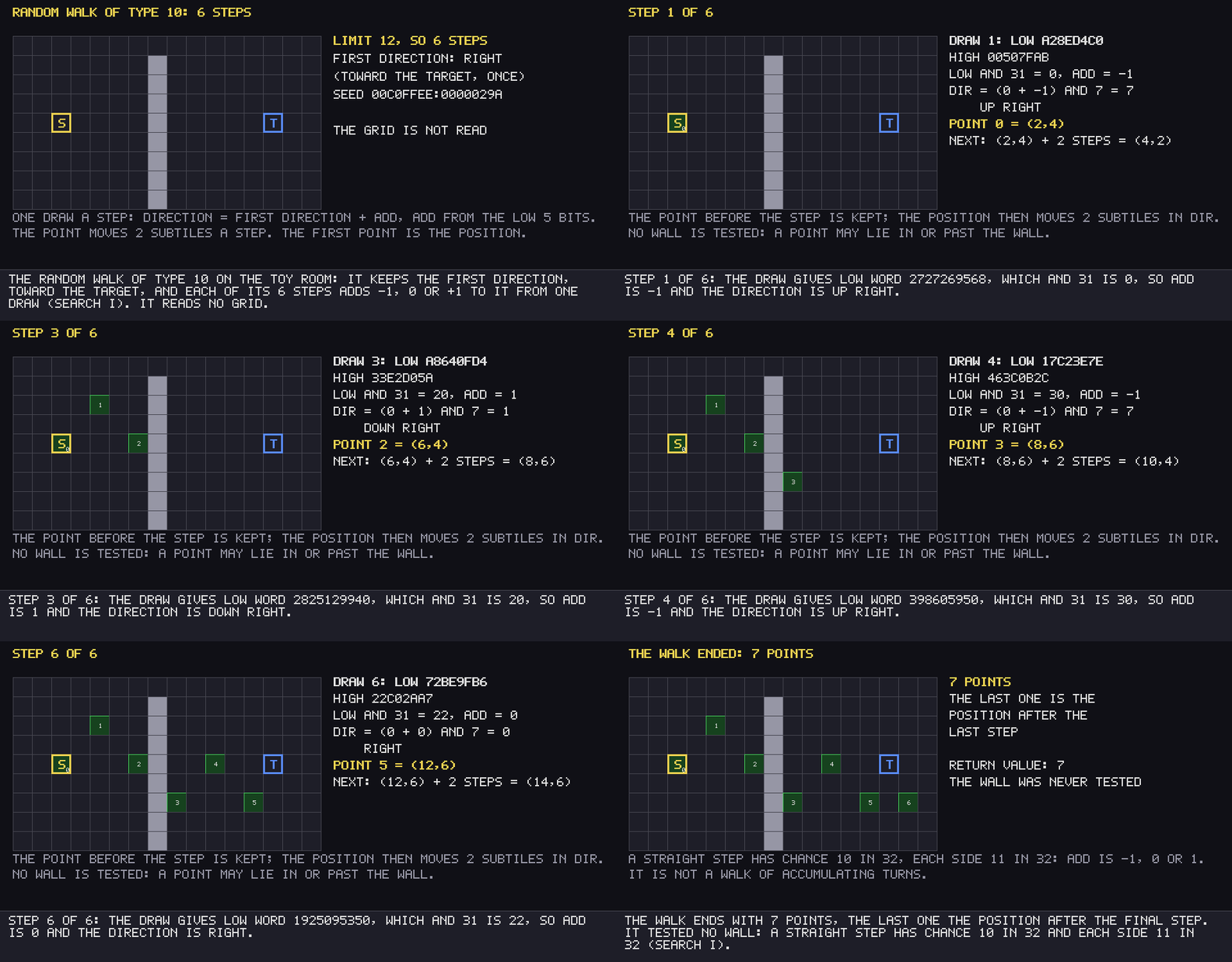
Section titled “The random walk: type 10”The first direction toward the target is found once. Then each draw takes one step on the seed passed: it writes a point, and the direction of the move is the first direction plus −1, 0 or 1 from the draw’s low 5 bits, moving 2 subtiles. Every step is the first direction ±1 or straight, so it is not a walk of accumulating turns. The first point is the position itself. No grid and no room are read: a missile’s collision is its own. A straight step has chance 10/32 and each side 11/32, seen in the game: the rule reproduces all 946 plans’ points and seeds, a variant with 12/32 straight fails all 851 it separates, and 10 616 of the game’s 33 500 steps are straight (31.7 %).
Step through path-walk-toy-room
The random walk of type 10 on a toy room of 16 by 9 subtiles with a wall that has a gap, the room the search below uses, from the start (2, 4), with the path’s limit 12 and the seed 12648430 started with Init: 12 ÷ 2 = 6 draws and 7 points. The first direction toward the target is found once, and it is to the right. Each draw steps the seed once; the direction of the move is the first direction plus an addend read from a 32-value table by the new low word AND 31, which gives a straight step chance 10 in 32 and each side 11 in 32. The point written is the position before the move, and the position then moves 2 subtiles (search § I). No grid and no room are read, so the points ignore the wall. The last point is the position after the last move, and the plan returns the number of points. Seed: illustrative, an input of our own. Every value shown is computed by our model, not observed in the game.
The count of draws is the missile’s limit halved, and the count of points one more. At limit 77 that is 38 draws and 39 points. In the game, 698 + 248 plans return 39 at that limit, and in 654 of 654 creations the exit seed is the one predicted from the seed set up and the logged range: 20 steps for class 458, 38 for class 195, 10 for class 408.
A worked example, from the game’s logs: a class 225 missile at subtile (4225, 5126), target (4225, 5125), limit 77, so 38 draws and a first direction of 6, which is (0, −1).
| Draw | Add | Direction | Point written |
|---|---|---|---|
| 1 | +1 | 7 | (4225, 5126), the position |
| 2 | +1 | 7 | (4227, 5124) |
| 3 | 0 | 6 | (4229, 5122) |
| 4 | −1 | 5 | (4229, 5120) |
| 5 | −1 | 5 | (4227, 5118) |
It returns 39 with a last point of (4207, 5050). No cell is read, so a wall on the way changes nothing in the plan.
After such a plan, class 458 draws nothing more on that seed within its life: 68 seeds watched, each next write a block write over the unit’s memory with the high half of the seed still the plan’s exit value; that the write is the block’s release or reuse is read from the code. Classes 225 and 195 are short of the floor of 50 each, with 22 and 3 seeds watched in one run and one more each in the other, and stay inferred.
The spiral: type 14
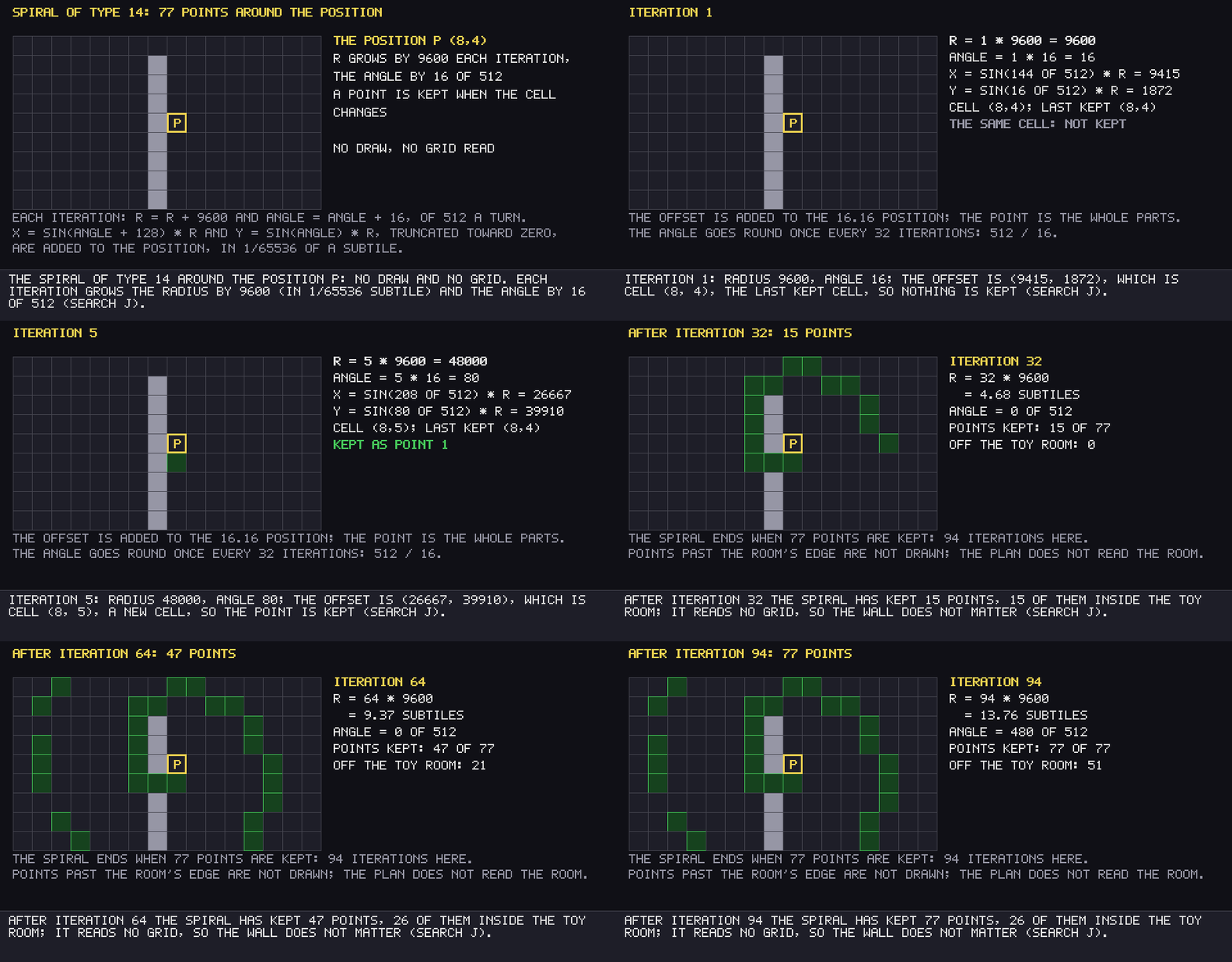
Section titled “The spiral: type 14”77 points in a growing spiral around the position, with no draw and no grid. Its structure is seen in the game: it reproduces all 260 stock plans, and other step sizes or angles fail all 260. The seed, the grid (no grid read) and the limit bytes are unchanged in 260 of 260 plans. The truncation is seen too. The code sets the rounding field around each conversion, and the game’s own stored integers agree: 233 natural plans, 43 804 stored products, 18 174 of which separate the readings, all 18 174 truncating toward zero and 0 rounding. The point list reproduces in 27 stock plans of the first run, which are one list relative to the start, and in 233 natural plans of the second. The emulator’s rounding ignores that field, so its own spiral cases say nothing about the game. The plan reads no grid, seen in the game: no grid read in 260 of 260 plans, 123 of them through cells with the wall bit. The hammer’s end at a wall is the missile’s own step (read from the code).
Step through path-spiral-toy-room
The spiral of type 14 around a position at the middle of the same toy room, (8, 4), with the position’s fraction at one half. Each iteration adds 9600 to the radius, in 1/65536 of a subtile, and 16 to the angle out of 512; the offset is the table’s sine at the angle plus 128 and at the angle, each times the radius and truncated toward zero, added to the position; a point is kept when its whole part differs from the last kept one (search § J). The first point is kept on iteration 5, at the cell (8, 5), and the 77th on iteration 94, which ends the loop; 26 of the 77 lie inside the toy room. The picture takes the table’s values as the sine of the angle, which the table is within 1.8e-07 of. No draw and no grid are used, so the wall changes nothing. The picture takes no seed. Every value shown is computed by our model, not observed in the game.
The search: types 0 and 16
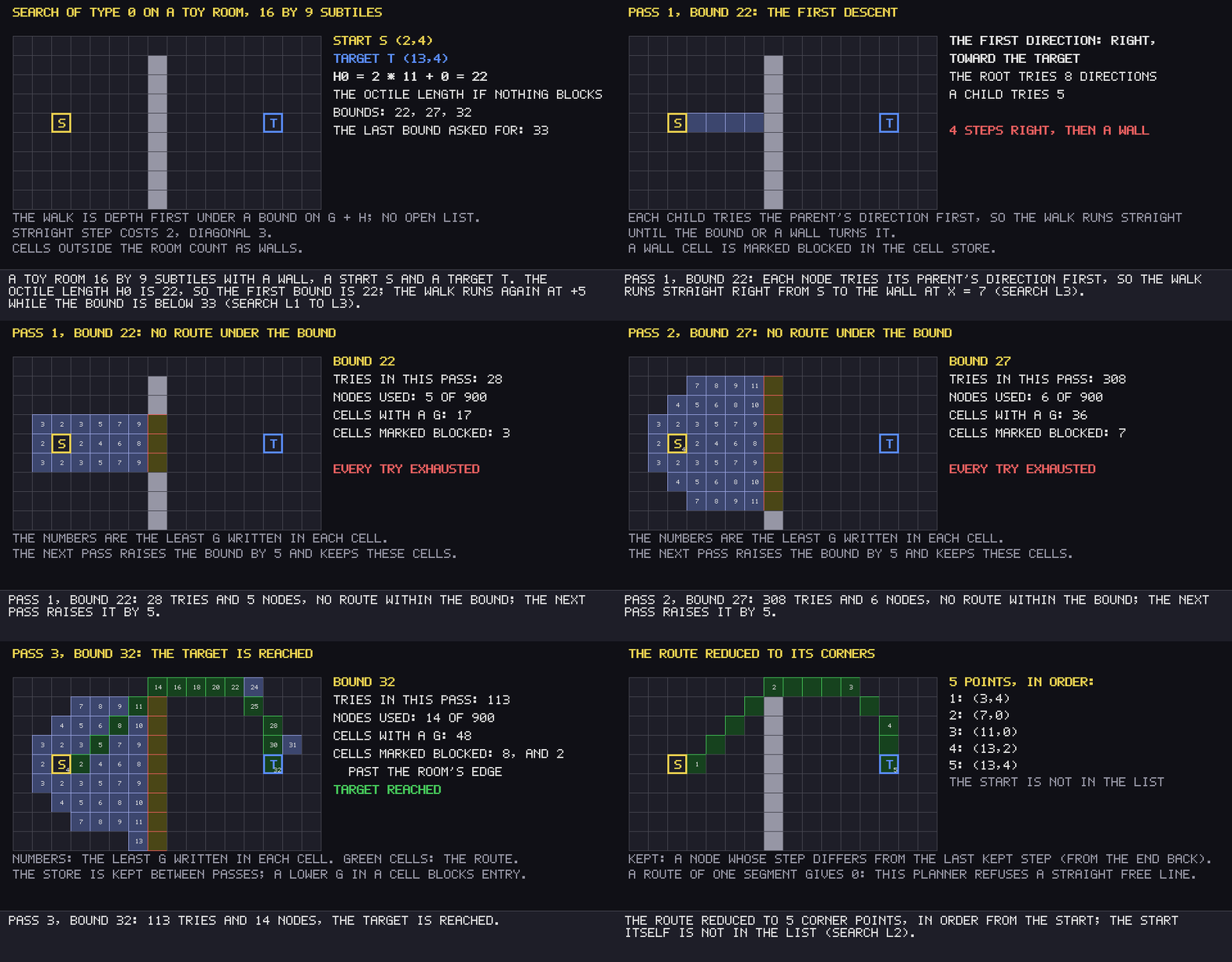
Section titled “The search: types 0 and 16”An iterative-deepening depth-first walk with no open list: each node takes the first direction of a fixed fan that passes the tests, so the fan’s order is the tie-break. All of this is emulated (2 116 cases, 0 mismatches, plus 120 boundary cases). No type 0 or 16 plan appears in 46 sessions.
Step through path-search-toy-room
One search of type 0 on a toy room of 16 by 9 subtiles with a wall that has a gap, a start at (2, 4) and a target at (13, 4). The octile length is h0 = 2 × 11 + 0 = 22, the first bound, and the last bound asked for is 33, so the walk runs at 22, 27 and 32 (search § L2). Each pass is a depth-first walk: a node takes the first direction of the fan that passes the tests, so it runs straight until the wall or the bound turns it; a straight step costs 2 and a diagonal 3, and a cell that already holds a lower cost than the new one is not entered again, the cell store being kept from one pass to the next (§ L3). Bound 22 and bound 27 find no route; bound 32 reaches the target around the wall through its gap, and the route is reduced to five corner points with the start not among them (§ L2). The toy has one room, and its target is a point with no unit, so the near-target stop (§ L3 step 20) ends no walk short of the target. Not shown: type 16’s draws and a real room’s masks. The picture takes no seed. Every value shown is computed by our model, not observed in the game.
- The rectangle it searches is not the true union of the two rooms: a target room with a smaller far end can shrink it below the unit’s own room, and a start beyond it returns 0.
- A route of one segment returns 0, so this planner refuses a free straight or exactly diagonal line. Type 1 accepts one.
- Type 0 with its last bound at or below the unblocked distance has one pass, and finds only a route of that exact length.
- Type 16 starts at half as much again and draws at each child and each turn, a node’s fifth try excepted: 994 022 draws in the emulated cases, every exit seed compared.
- At most 77 points. The node store of 900 is out of reach under the plan’s window (read from the code).
- A rectangle can pass the size check and still overrun the stack frame: 217 × 217 fits and 218 × 218 overruns. No single stock room overruns (checked against the level tables: the largest room is 60 × 60 subtiles, and a pair of near rooms has a side of at most 145, a clear of at most 22 801 cells against the frame’s 50 010). That the builders make no room outside these extents is read from the code.
The client slots: types 3, 11 and 12
Section titled “The client slots: types 3, 11 and 12”No server code sets them, as far as the scan reaches. Their code maps ran under emulation, 60 cases each. That they run in the client is out of scope.
The aim and the facing
Section titled “The aim and the facing”After a plan the path aims at its next point: it works out the vector and the step per frame, and it may set the direction to turn to and a turn step. An emulated family of 500 cases reproduces this, which is the code’s map over declared cases, not when the game calls it. The names “facing” and “turn step” are the project’s, not an observed use. The turn-step table equals the exact rule that section’s H4 gives, on this image, element by element, 64 of 64, with no claim about how it was made.
Only the client turns. Read from the code: the step that turns the facing toward its aim, by the turn step each time, snapping to the aim once it is reached or passed, is called only from the client’s per-unit updates. The server’s walk aims the facing at the next point after every move step, which sets only the direction to turn to and the step; a player’s or monster’s facing itself changes on the server only when code sets it outright. That rests on the client update passes being the turn’s only callers (overview § H, H5).
The grid a planner reads
Section titled “The grid a planner reads”The planners take the live grid. It is seen in the game: given the game’s own cells at the planner call, with the unit’s and the target’s unmarks already run, the models reproduce 33 722 stock plans with 0 mismatches, 20 671 of the second run and 13 051 of the first, on 11 types (2, 4, 5, 6, 7, 8, 9, 10, 13, 14, 15). Each is compared on its return, as many point words as that return says, and its exit seed. Apart from those stand the 842 of the first run after the written probe, which show 0 mismatches and back nothing. The model took the planner’s address, the context and the record at the call and the target unit’s position from the game, so the plan’s head, the refresh, the free step, the town test and the slot are inputs to this count, not predictions of it.
This is not the predicted grid. The 0 mismatches take the grid from the game. The same planners on a grid predicted from the built map plus the units are another claim, and it failed.
A unit does not block itself, and a target under the path’s flag does not block either: seen in the game, the start cell holds none of the unit’s own blocking bits in 8 334 of 8 334 plans with no other unit within 3 subtiles, and a target’s cell none of its own in 1 286 of 1 286, where a lone other unit holds them in 83 839 of 94 349. That an unmark there can take a neighbour’s bit, and the tail gives back only the unit’s own footprint, is read from the code.
The grid is its operations in order, never a union of holders. The grid at a planner call is the result of the marks and unmarks in order. An unmark takes the same footprint off and no bit is counted, so it clears a shared bit another holder also set: that is seen in a game run that logged the marks, not in the planners’ counts above. A rebuild runs the operations and never computes a union of holders.
The prediction is wrong in 11 of 15 663 plans, a counted oracle.
Those are the plans with a built map on a run kept apart: 2 of type 2, 3 of type 13 and 6 of type 15, the bit 0x1000 alone
sufficing in all 11. The test asked for 0 wrong plans and failed by its own terms. Its rules were frozen before the run, no rule
was changed after it, and the prediction was made without the corpse call’s seventh caller. Adding the rules one at a time on
the same logs: own marks alone 472 wrong; with the objects, corpses and plan’s target 72; with the act change 62; with the reserved
landing 11.
The candidates for the 11 were chosen after the result and not tested on data they did not see:
- 8 are order: the planning unit’s own unmark over a reservation (4), a monster that left a reserved cell (1), the target’s unmark (2), the player’s mask set to 0 at the flight of Leap or Leap Attack (1).
- 3 are the seventh caller of the corpse call: class 194 in mode 14.
No tested rule exists for either. So a plan’s grid stays an input, “the live cells”, and a checker feeds the planners the logged cells. What this does not establish is that the grid is a function of the present holders; it is not. The wrong-plan count raises nothing either: each rule below rests on its own bit or line.
| Rule | What the grid holds | How sure |
|---|---|---|
| Objects | An object’s rectangle is in the grid when its class’s HasCollision is set for its mode; each operate handler that changes the state marks or unmarks itself; the mode change does not |
Seen for the bits 0x400 and 0x800: 0 cells differ over the 154 780 rooms of the 15 663 plans, against 64 229 and 1 572 with the rule off. The handlers’ route is read from the code. The object bits 0x0002 and 0x0004 keep 626 and 3 708 cells of unnamed source |
| The plan’s target | Under a path flag, a target whose size is not 0 is unmarked, whatever its type, and marked again when the unmark did something | Seen for a targeted object of size 1 or more: with the rule off, 274 0x400 and 20 0x800 cells differ and 35 more plans are wrong; with it on, 0 of those cells. The size test’s 0 branch and other unit types as targets are read from the code |
| The player after an act change | Unmarked until a later move or a plan’s tail; a level change inside an act keeps the mark | Read from the code. In the logs 7 of 7 act changes unmarked and a control of 3 of 3 marked, short of the floors of 10 (7 of 16 and 3 of 9 seen) |
| A reserved landing | Four skill starts mark the landing before the flight; landing unmarks it | Seen: the calls at the three reached sites, 128, 237 and 109 lines, and 474 releases. The holding until release (51 plans in the prediction), Jump’s site and a monster’s arm are read from the code |
The 0x200 bit |
Its source is unknown: 92 597 cells differ on that run and no logged unit holds them | No plan depends on them on these logs, and no move mask read holds it, though a spawn mask does (read from the code) |
The operations behind the target, the act change and the landing are at collision § F6, and the rows above at overview § F4.
Corpses
Section titled “Corpses”The game holds a room’s grid twice, the server’s and the client’s, and they take a corpse differently. A server planner reads the server’s, never the client’s plus. Every statement here holds for the copy it names, and the logged counts are lines, not deaths.
| Corpse | Copy | What it does | How sure |
|---|---|---|---|
Monster, deadCol 0 |
server | The live mark off and a 3×3 of 0x8000, from mode 0 on, with the record’s mask and pattern unchanged |
Seen: 1 527 lines, all the full 3×3, 1 505 in mode 0 and 22 in mode 12, and 1 474 distinct mode-12 monsters of the unit lists in that shape |
Monster, deadCol 0 |
client | A plus of 0x8000 |
Seen: 396 of 408 lines in one run, 3 419 in another |
Monster, deadCol 1 |
server | The call is skipped and the live mark stays | Seen for classes 403 and 404, 18 distinct dead. Class 273 is read from the code here; the other 10 rows with deadCol 1 are in neither corpse run |
Monster, deadCol 1 |
client | The same | Seen: the other 12 of the 408 lines |
| Class 194 in mode 14 | server | The same 3×3, by a skill start, so corpse cells cannot be predicted from a mode | Seen: 35 lines. That it causes 3 of the 11 is a candidate |
Monster re-created dead, deadCol 0 |
server | The 3×3, then the plus on top, the record ending at pattern 5 and mask 0x8000 |
Seen: 134 cases compared line by line, and 3 distinct units holding that shape later |
Monster re-created dead, deadCol 1 |
server | Nothing more than the one creation mark | Seen: 6 cases |
| Monster relocated dead | server | The plus alone at the new place, its old cells left. It tests the dead mode only, not deadCol, so a deadCol 1 monster takes it too |
Read from the code; no such case is logged |
| Dead player | server | The 3×3 | Read from the code; the call did not fire |
| Player created in mode 0 or 17 | server | The plus, not the 3×3 | Read from the code |
These are read from the code, and no game ran on them, unless a bullet says otherwise:
- The corpse call’s last step marks nothing. It snaps the corpse’s position to the middle of its subtile, which moves no cell and, in practice, no room.
- A plan does not force the unmark. The plan’s unmark leaves a dead player’s or monster’s cells alone, and an object it
unmarks needs
HasCollisionset. A corpse call, a creation and a relocation force the unmark. - The server’s 3×3 has no paired clear. No routine read clears it: an unmark takes only the unit’s own mask and pattern, which on a
server corpse are still the live ones. So the cells outlast the corpse until the grid is
rebuilt. This is the likely source of the 26 034 differing
0x8000cells of the predicted grid. - A revival. The client’s revive routine acts only at mask
0x8000, which the corpse of an ordinary server death does not hold. The server’s revive-in-place routine sets the mask to0x100, which that corpse already holds, refreshes the pattern from the size, and marks it again; two skill routines also refresh. None of these clears the 3×3, so it stays. A monster re-created or relocated dead holds mask0x8000, so setting the mask takes that plus off, and a re-created one is left with the 3×3’s four corners. Not followed: the mercenary’s resurrect, the fetish revive callback, the resurrect packet, skill start 21’s revive and three callees of the revive routines. A mode set from dead to alive is not given as a route, since where the mode word is written was not located. No server revival is logged with its grid. 0x8000is in no immediate move mask scanned: 0 of 53 immediates that reach a move mask, and none of the monsters’ masks. Checked by a second reading, it is in no mask the path module builds in a register or reads from a table either: the setter’s register calls, the two missile collision tables, the monster rule’s three returns and creation’s stores. 77 register stores to the test mask outside the path module, whose bases are not traced, are read from the code only. It is in no spawn mask either. So on what the specs state a corpse mark is not a blocker, but whether corpses block movement stays open.unflatDeadis no route to it (checked by a second reading). Its one direct reader is a client draw-list test, so it changes no grid mark and no move mask, and no direct call on the server reads it.
Who asks
Section titled “Who asks”The plan routine has 68 direct calls in 58 functions, 34 on the server and 34 on the client, and no jump or address reference to it. The 68 calls are checked by a second reading; the register’s types are read from the code, each at its site, unless a line below says otherwise. The path record is created by nine calls, six on the server and three in the client (checked by a second reading). Seen in the game: all 33 722 stock plans came through sites of this register, by their return addresses, and the first run’s other 842 did too: 0 outside it in either run. “Current” plans with the type the path already holds: a missile’s 4 unless a callback set 10 or a do function 14 (checked by a second reading: the seven server calls that set a missile path’s type give 4, 10 or 14), a monster’s last request type, and a player’s 7 after a mode reset (read from the code; the reset itself ran under emulation, 300 cases).
| Who | Sites | Type at the call |
|---|---|---|
| player | 2 | 7, or 8 in mode 19; 15 for the reach test of the position packet |
| mode machine | 5 | the request’s type, 15 as its fallback, current, 8 for knockback |
| AI | 3 | 2, test plans that restore the path |
| skill | 10 | 8 and 9 (Jump), 2 then 1 (a swarm’s move), 1 (Diablo’s run), current (Charge), 14 (Blessed Hammer), 7 (Whirlwind), 9 then 8 (Leap or Leap Attack) |
| missile | 10 | 4 at creation, 10 from the four reseed callbacks, current for the rest |
| movement | 2 | 13 or 2, then 15 or current (the replan) |
| referenced by nothing | 2 | 16 |
| client | 34 | out of scope |
Seen in the game: a walk, run or town walk start planned type 7 (3 997) or type 8 (2), none else. The AI’s requests through its type routine were of types 2, 5, 6, 7 and 13 (13 004), and 13 is also asked directly (7 363) beside the replan’s 1 202; an empty request of type 2, 7 or 13 was followed by the unit’s type-15 plan in its frame 2 469 times, the other 84 with no logged follow-up each after the type-15 plan’s cap line or its own refusal, and none came after an empty 5 or 6 or a request with points. Read from the code: the AI’s types are 1, 2, 5, 6, 7, 13 and 15, and the fallback to 15 also follows a failed type 9; monster AI has how a think asks. No Missiles column chooses a type: it is a constant in the code that asks (checked by a second reading).
What each count tests
Section titled “What each count tests”Plans are the logged calls of the two runs, the first run’s 842 among them. “Return 0” counts among the second run’s plans that reached a planner or a straight type. The last column is the project’s reading of the first run’s controls: “weak” means these logs add little, and the emulation covers the rest of the code. A planner’s 0 mismatches given live grids says nothing about predicting the grid.
| Type | Plans, run 1 + run 2 | Return 0, run 2 | Largest return, run 2 | The 0 is |
|---|---|---|---|---|
| 2 | 162 + 476 | 62 | 17 | fair: 158 of the first 162 one class |
| 4 | 2 740 + 3 713 | 0 | 1 | weak for its size: one branch, 1 point, no control |
| 5 | 696 + 628 | 74 | 6 | fair: short lists |
| 6 | 655 + 664 | 71 | 6 | fair: as type 5 |
| 7 | 2 894 + 4 589 | 64 | 27 | strong; the 324 boundary and the retry unobserved |
| 7 through type 1 | 270 + 554 | — | — | fair: the switch only |
| 8 | 282 + 1 303 | 242 | 1 | fair: monster knockback, with 2 player plans in run 2 |
| 9 | 54 + 346 | 0 | 1 | weak: one branch, 1 point, no grid |
| 10 | 698 + 248 | 0 | 39 | strong for count and draws; no grid |
| 13 | 4 078 + 4 872 | 1 105 | 20 | strong |
| 14 | 54 + 233 | 0 | 77 | weak: the first run’s stock plans are one list relative to the start |
| 15 | 1 580 + 3 599 | 2 273 | 29 | strong on those with points; most are the planner’s own 0 |
In either run no control passed a plan it separates. On the second, 7 of 30 separate none, so those claims stay on the emulation. Flipping the first tested cell changes the model’s output in 10 938 of 15 261 plans that tested one, so the model does read the live grid.
The shorts, by name
Section titled “The shorts, by name”What the logs did not reach, each stated as it stands.
- Type 1. The planner is confirmed: emulated to its return, and seen in the game through greedy-near’s switch, 270 + 554 plans. No stock request was observed in 46 sessions (21 + 25): no plan with type 1 at the plan’s entry, and in the 25 all seven sites that request it count 0. The seven sites are checked by a second reading. Two are a retry, reached only when the request before returned 0, and followers planned in these logs without one (a mercenary 103 plans, a clay golem 65). Five were not staged, so their 0 says nothing of why.
- Type 0. Planned where a “current” site holds it. No plan in 46 sessions. The planner rests on emulation only.
- Types 3, 11 and 12. No server code sets them, by a scan of immediate stores (read from the code; 18 register stores of unresolved base and 4 read-modify-write stores remain). Ten of those 22 resolve without reading the base, as the value 0, pointers, hash schedule words and runtime stack frames (checked by a second reading); the other twelve rest on a reading of the owner’s block. Break lines over 46 sessions show no server caller: types 3 and 12 no line on either side, type 11 client callers only, 229 + 1 105 hits. The control under the same break is counted on the second run and capped on the first, so there the absence past its last line is inferred. Of the 22 store sites 7 and 6 executed, none storing those types.
- Type 16. Planned only from two functions nothing references, whose pushes are the only ones that set it (checked by a second reading), with no line on either side in 46 sessions.
- Town-follow. Attempted in the Rogue Encampment, 313 plans, with no hostile monster in the town room, so it is short (inferred). The geometry stays with the room lifecycle. Whether a stock town’s geometry admits the route is open.
- Jump. No stock user: no MonStats skill column and no other excel table holds it, and it occurs in
skills.txtonly (checked over 92 tables).
What is not known yet
Section titled “What is not known yet”From the specs’ open questions:
- Do corpses block movement? No immediate mask scanned holds the corpse bit, and no mask the path module builds or reads from a table, but that is what the reading did not find, and no run tests it. 77 register stores to the test mask outside the module are not resolved.
- The operations in order. Whether marks and unmarks applied in the game’s order, with the seventh caller, leave 0 wrong plans. The logs hold no line per ordinary mark. The same question carries the player after an act change beyond its 7 and 3, and the shorts above.
- The
0x200cells: what sets them. No logged unit does. - A relocated dead monster and a server revival in a log, and the routes not followed.
- Pets against players: no pet-specific mask was read, and a pet’s route has a callee not followed.
- No readable community record for type 10, for Teleport as a pathing event (the named pages could not be fetched, so it is unread, not empty) or for corner stalls.
- Whirlwind’s flight: its mask and its stop at a blocked subtile are read, not compared for a flight; no run shows a flight stopping or passing a unit.
- Classes 225 and 195 beyond their watched seeds, and who creates class 195.
- Type 1’s stages: the Countess’s state, Diablo’s run, a far-behind mercenary, a swarm’s move.
- Type 0’s last bound on the server: a monster’s would be 0 by the writes read, which gives one pass; no plan logged it.
- The 18 unresolved type stores and the unobserved rest of the store sites.
- The target offset for a player or monster target: that routine is not read.
- Two flags of the path: what they do, and any reader outside the planners.
- Town-follow: whether a stock town’s geometry admits the route.
- A warp-paired room’s rectangle: whether a stock pair lies far enough to overrun the search’s store, and whether a request takes it.
- Type 1’s propagation stack: whether it can reach its 200 slots; the model’s depth is 23 on the emulation’s cases and 3 on the first run’s plans, and no bound is proved.
- The reasons behind type 1’s “more than 5” tie and the greedy walk’s one-step-short end: only the behaviour is read.
- Branches no game plan separated: type 7’s 324 boundary and retry, the context room of knockback and one-point, type 15’s limit above 80, all of the search. Each stays on its emulation until a stage reaches it, and no stage is planned.
Where to read more
Section titled “Where to read more”- The specs: path overview and path search, whose Reimplementation notes list the traps, and the collision grid for the marks.
- The glossary for D2 terms.
- Related wiki pages: animation and timing (the step along the points, speeds, knockback’s length), levels (rooms and the collision grid), skills and missiles (the skills and missiles that ask for a plan and the re-seed sites), monster AI (what a monster asks for), monsters (how a monster is created), randomness (unit seeds and draws) and how we know.