Quests and travel: how a character moves through the acts
Quests in Diablo II are not data. No excel table the game loads describes a quest: each one is a small script built into the game, which listens for things that happen (a talk, a kill, entering a level, using an item) and sets bits in the player’s quest record. Travel is the other half of moving through the game: waypoints, the NPCs and portals that change act, town portals, warp tiles, and where a player lands after each of them. This page explains both, and which of them draw on a seed. It restates three reviewed specs: the quests and travel overview, quest progression and travel.
What a quest drops or gives (the quest treasure classes, Andariel’s and the Hellforge’s special drops, the imbue, socket and personalise services) is on other item paths; how the record is stored in the save file is on saves.
Much of the quest code is known only from reading it. The specs separate what is confirmed (by three test runs, later checks of their logs, a second reading of the code with other tools, or an emulation of the code) from what is only read from the code, and so does this page: where a step was not met in a run, the text says so. A second reading covers what the code says, not that a game reached it.
The big picture
Section titled “The big picture”The game keeps two kinds of quest state: one record per player and difficulty, loaded from the save and written back at Save and Exit, and one game-wide record that lives only as long as the game. Events reach the quest scripts, the scripts write both records, and the game-wide record and the scripts’ own state are read by the code that builds objects and monsters and by the warp gates.
%3btext-align:center%3b%7d%23mermaid-0 .edgeLabel p%7bbackground-color:rgba(232%2c232%2c232%2c 0.8)%3b%7d%23mermaid-0 .edgeLabel rect%7bopacity:0.5%3bbackground-color:rgba(232%2c232%2c232%2c 0.8)%3bfill:rgba(232%2c232%2c232%2c 0.8)%3b%7d%23mermaid-0 .labelBkg%7bbackground-color:rgba(232%2c 232%2c 232%2c 0.5)%3b%7d%23mermaid-0 .cluster rect%7bfill:%23ffffde%3bstroke:%23aaaa33%3bstroke-width:1px%3b%7d%23mermaid-0 .cluster text%7bfill:%23333%3b%7d%23mermaid-0 .cluster span%7bcolor:%23333%3b%7d%23mermaid-0 .node .collapsed-indicator%7bfill:%23aaaa33%3bstroke:none%3bopacity:0.6%3b%7d%23mermaid-0 .node .collapsed-separator%7bstroke:%23aaaa33%3bstroke-width:0.75px%3b%7d%23mermaid-0 div.mermaidTooltip%7bposition:absolute%3btext-align:center%3bmax-width:200px%3bpadding:2px%3bfont-family:arial%2csans-serif%3bfont-size:12px%3bbackground:hsl(80%2c 100%25%2c 96.2745098039%25)%3bborder:1px solid %23aaaa33%3bborder-radius:2px%3bpointer-events:none%3bz-index:100%3b%7d%23mermaid-0 .flowchartTitleText%7btext-anchor:middle%3bfont-size:18px%3bfill:%23333%3b%7d%23mermaid-0 rect.text%7bfill:none%3bstroke-width:0%3b%7d%23mermaid-0 .icon-shape%2c%23mermaid-0 .image-shape%7bbackground-color:rgba(232%2c232%2c232%2c 0.8)%3btext-align:center%3b%7d%23mermaid-0 .icon-shape p%2c%23mermaid-0 .image-shape p%7bbackground-color:rgba(232%2c232%2c232%2c 0.8)%3bpadding:2px%3b%7d%23mermaid-0 .icon-shape .label rect%2c%23mermaid-0 .image-shape .label rect%7bopacity:0.5%3bbackground-color:rgba(232%2c232%2c232%2c 0.8)%3bfill:rgba(232%2c232%2c232%2c 0.8)%3b%7d%23mermaid-0 .label-icon%7bdisplay:inline-block%3bheight:1em%3boverflow:visible%3bvertical-align:-0.125em%3b%7d%23mermaid-0 .node .label-icon path%7bfill:currentColor%3bstroke:revert%3bstroke-width:revert%3b%7d%23mermaid-0 .node .neo-node%7bstroke:%239370DB%3b%7d%23mermaid-0 %5bdata-look='neo'%5d.node rect%2c%23mermaid-0 %5bdata-look='neo'%5d.cluster rect%2c%23mermaid-0 %5bdata-look='neo'%5d.node polygon%7bstroke:%239370DB%3bfilter:drop-shadow(1px 2px 2px rgba(185%2c 185%2c 185%2c 1))%3b%7d%23mermaid-0 %5bdata-look='neo'%5d.swimlane.cluster rect%7bfilter:none%3b%7d%23mermaid-0 %5bdata-look='neo'%5d.node path%7bstroke:%239370DB%3bstroke-width:1px%3b%7d%23mermaid-0 %5bdata-look='neo'%5d.node .outer-path%7bfilter:drop-shadow(1px 2px 2px rgba(185%2c 185%2c 185%2c 1))%3b%7d%23mermaid-0 %5bdata-look='neo'%5d.node .neo-line path%7bstroke:%239370DB%3bfilter:none%3b%7d%23mermaid-0 %5bdata-look='neo'%5d.node circle%7bstroke:%239370DB%3bfilter:drop-shadow(1px 2px 2px rgba(185%2c 185%2c 185%2c 1))%3b%7d%23mermaid-0 %5bdata-look='neo'%5d.node circle .state-start%7bfill:black%3b%7d%23mermaid-0 %5bdata-look='neo'%5d.icon-shape .icon%7bfill:%239370DB%3bfilter:drop-shadow(1px 2px 2px rgba(185%2c 185%2c 185%2c 1))%3b%7d%23mermaid-0 %5bdata-look='neo'%5d.icon-shape .icon-neo path%7bstroke:%239370DB%3bfilter:drop-shadow(1px 2px 2px rgba(185%2c 185%2c 185%2c 1))%3b%7d%23mermaid-0 :root%7b--mermaid-font-family:arial%2csans-serif%3b%7d%3c/style%3e%3cg%3e%3cmarker id='mermaid-0_flowchart-v2-pointEnd' class='marker flowchart-v2' viewBox='0 0 10 10' refX='5' refY='5' markerUnits='userSpaceOnUse' markerWidth='8' markerHeight='8' orient='auto'%3e%3cpath d='M 0 0 L 10 5 L 0 10 z' class='arrowMarkerPath' style='stroke-width: 1%3b stroke-dasharray: 1%2c 0%3b'/%3e%3c/marker%3e%3cmarker id='mermaid-0_flowchart-v2-pointStart' class='marker flowchart-v2' viewBox='0 0 10 10' refX='4.5' refY='5' markerUnits='userSpaceOnUse' markerWidth='8' markerHeight='8' orient='auto'%3e%3cpath d='M 0 5 L 10 10 L 10 0 z' class='arrowMarkerPath' style='stroke-width: 1%3b stroke-dasharray: 1%2c 0%3b'/%3e%3c/marker%3e%3cmarker id='mermaid-0_flowchart-v2-pointEnd-margin' class='marker flowchart-v2' viewBox='0 0 11.5 14' refX='11.5' refY='7' markerUnits='userSpaceOnUse' markerWidth='10.5' markerHeight='14' orient='auto'%3e%3cpath d='M 0 0 L 11.5 7 L 0 14 z' class='arrowMarkerPath' style='stroke-width: 0%3b stroke-dasharray: 1%2c 0%3b'/%3e%3c/marker%3e%3cmarker id='mermaid-0_flowchart-v2-pointStart-margin' class='marker flowchart-v2' viewBox='0 0 11.5 14' refX='1' refY='7' markerUnits='userSpaceOnUse' markerWidth='11.5' markerHeight='14' orient='auto'%3e%3cpolygon points='0%2c7 11.5%2c14 11.5%2c0' class='arrowMarkerPath' style='stroke-width: 0%3b stroke-dasharray: 1%2c 0%3b'/%3e%3c/marker%3e%3cmarker id='mermaid-0_flowchart-v2-circleEnd' class='marker flowchart-v2' viewBox='0 0 10 10' refX='11' refY='5' markerUnits='userSpaceOnUse' markerWidth='11' markerHeight='11' orient='auto'%3e%3ccircle cx='5' cy='5' r='5' class='arrowMarkerPath' style='stroke-width: 1%3b stroke-dasharray: 1%2c 0%3b'/%3e%3c/marker%3e%3cmarker id='mermaid-0_flowchart-v2-circleStart' class='marker flowchart-v2' viewBox='0 0 10 10' refX='-1' refY='5' markerUnits='userSpaceOnUse' markerWidth='11' markerHeight='11' orient='auto'%3e%3ccircle cx='5' cy='5' r='5' class='arrowMarkerPath' style='stroke-width: 1%3b stroke-dasharray: 1%2c 0%3b'/%3e%3c/marker%3e%3cmarker id='mermaid-0_flowchart-v2-circleEnd-margin' class='marker flowchart-v2' viewBox='0 0 10 10' refY='5' refX='12.25' markerUnits='userSpaceOnUse' markerWidth='14' markerHeight='14' orient='auto'%3e%3ccircle cx='5' cy='5' r='5' class='arrowMarkerPath' style='stroke-width: 0%3b stroke-dasharray: 1%2c 0%3b'/%3e%3c/marker%3e%3cmarker id='mermaid-0_flowchart-v2-circleStart-margin' class='marker flowchart-v2' viewBox='0 0 10 10' refX='-2' refY='5' markerUnits='userSpaceOnUse' markerWidth='14' markerHeight='14' orient='auto'%3e%3ccircle cx='5' cy='5' r='5' class='arrowMarkerPath' style='stroke-width: 0%3b stroke-dasharray: 1%2c 0%3b'/%3e%3c/marker%3e%3cmarker id='mermaid-0_flowchart-v2-crossEnd' class='marker cross flowchart-v2' viewBox='0 0 11 11' refX='12' refY='5.2' markerUnits='userSpaceOnUse' markerWidth='11' markerHeight='11' orient='auto'%3e%3cpath d='M 1%2c1 l 9%2c9 M 10%2c1 l -9%2c9' class='arrowMarkerPath' style='stroke-width: 2%3b stroke-dasharray: 1%2c 0%3b'/%3e%3c/marker%3e%3cmarker id='mermaid-0_flowchart-v2-crossStart' class='marker cross flowchart-v2' viewBox='0 0 11 11' refX='-1' refY='5.2' markerUnits='userSpaceOnUse' markerWidth='11' markerHeight='11' orient='auto'%3e%3cpath d='M 1%2c1 l 9%2c9 M 10%2c1 l -9%2c9' class='arrowMarkerPath' style='stroke-width: 2%3b stroke-dasharray: 1%2c 0%3b'/%3e%3c/marker%3e%3cmarker id='mermaid-0_flowchart-v2-crossEnd-margin' class='marker cross flowchart-v2' viewBox='0 0 15 15' refX='17.7' refY='7.5' markerUnits='userSpaceOnUse' markerWidth='12' markerHeight='12' orient='auto'%3e%3cpath d='M 1%2c1 L 14%2c14 M 1%2c14 L 14%2c1' class='arrowMarkerPath' style='stroke-width: 2.5%3b'/%3e%3c/marker%3e%3cmarker id='mermaid-0_flowchart-v2-crossStart-margin' class='marker cross flowchart-v2' viewBox='0 0 15 15' refX='-3.5' refY='7.5' markerUnits='userSpaceOnUse' markerWidth='12' markerHeight='12' orient='auto'%3e%3cpath d='M 1%2c1 L 14%2c14 M 1%2c14 L 14%2c1' class='arrowMarkerPath' style='stroke-width: 2.5%3b stroke-dasharray: 1%2c 0%3b'/%3e%3c/marker%3e%3cg class='root'%3e%3cg class='clusters'/%3e%3cg class='edgePaths'%3e%3cpath d='M918.758%2c86L918.758%2c90.167C918.758%2c94.333%2c918.758%2c102.667%2c918.758%2c112.333C918.758%2c122%2c918.758%2c133%2c918.758%2c138.5L918.758%2c144' id='mermaid-0-L_save_load_0' class='edge-thickness-normal edge-pattern-solid edge-thickness-normal edge-pattern-solid flowchart-link' style='%3b' data-edge='true' data-et='edge' data-id='L_save_load_0' data-points='W3sieCI6OTE4Ljc1NzgxMjUsInkiOjg2fSx7IngiOjkxOC43NTc4MTI1LCJ5IjoxMTF9LHsieCI6OTE4Ljc1NzgxMjUsInkiOjE0OH1d' data-look='classic' marker-end='url(%23mermaid-0_flowchart-v2-pointEnd)'/%3e%3cpath d='M918.758%2c202L918.758%2c208.167C918.758%2c214.333%2c918.758%2c226.667%2c918.758%2c236.333C918.758%2c246%2c918.758%2c253%2c918.758%2c256.5L918.758%2c260' id='mermaid-0-L_load_rec_0' class='edge-thickness-normal edge-pattern-solid edge-thickness-normal edge-pattern-solid flowchart-link' style='%3b' data-edge='true' data-et='edge' data-id='L_load_rec_0' data-points='W3sieCI6OTE4Ljc1NzgxMjUsInkiOjIwMn0seyJ4Ijo5MTguNzU3ODEyNSwieSI6MjM5fSx7IngiOjkxOC43NTc4MTI1LCJ5IjoyNjR9XQ==' data-look='classic' marker-end='url(%23mermaid-0_flowchart-v2-pointEnd)'/%3e%3cpath d='M88.695%2c494L88.695%2c502.167C88.695%2c510.333%2c88.695%2c526.667%2c161.482%2c542.996C234.269%2c559.325%2c379.842%2c575.65%2c452.629%2c583.813L525.416%2c591.976' id='mermaid-0-L_create_qobj_0' class='edge-thickness-normal edge-pattern-solid edge-thickness-normal edge-pattern-solid flowchart-link' style='%3b' data-edge='true' data-et='edge' data-id='L_create_qobj_0' data-points='W3sieCI6ODguNjk1MzEyNSwieSI6NDk0fSx7IngiOjg4LjY5NTMxMjUsInkiOjU0M30seyJ4Ijo1MjkuMzkwNjI1LCJ5Ijo1OTIuNDIxMjkyNTU3MDUwN31d' data-look='classic' marker-end='url(%23mermaid-0_flowchart-v2-pointEnd)'/%3e%3cpath d='M788.758%2c320.353L715.53%2c330.127C642.302%2c339.902%2c495.846%2c359.451%2c422.618%2c376.725C349.391%2c394%2c349.391%2c409%2c349.391%2c416.5L349.391%2c424' id='mermaid-0-L_rec_join_0' class='edge-thickness-normal edge-pattern-solid edge-thickness-normal edge-pattern-solid flowchart-link' style='%3b' data-edge='true' data-et='edge' data-id='L_rec_join_0' data-points='W3sieCI6Nzg4Ljc1NzgxMjUsInkiOjMyMC4zNTI1OTgxNDIxMjZ9LHsieCI6MzQ5LjM5MDYyNSwieSI6Mzc5fSx7IngiOjM0OS4zOTA2MjUsInkiOjQyOH1d' data-look='classic' marker-end='url(%23mermaid-0_flowchart-v2-pointEnd)'/%3e%3cpath d='M349.391%2c506L349.391%2c512.167C349.391%2c518.333%2c349.391%2c530.667%2c378.738%2c542.892C408.085%2c555.118%2c466.779%2c567.235%2c496.126%2c573.294L525.473%2c579.353' id='mermaid-0-L_join_qobj_0' class='edge-thickness-normal edge-pattern-solid edge-thickness-normal edge-pattern-solid flowchart-link' style='%3b' data-edge='true' data-et='edge' data-id='L_join_qobj_0' data-points='W3sieCI6MzQ5LjM5MDYyNSwieSI6NTA2fSx7IngiOjM0OS4zOTA2MjUsInkiOjU0M30seyJ4Ijo1MjkuMzkwNjI1LCJ5Ijo1ODAuMTYxMjkwMzIyNTgwNn1d' data-look='classic' marker-end='url(%23mermaid-0_flowchart-v2-pointEnd)'/%3e%3cpath d='M659.391%2c518L659.391%2c522.167C659.391%2c526.333%2c659.391%2c534.667%2c659.391%2c542.333C659.391%2c550%2c659.391%2c557%2c659.391%2c560.5L659.391%2c564' id='mermaid-0-L_ev_qobj_0' class='edge-thickness-normal edge-pattern-solid edge-thickness-normal edge-pattern-solid flowchart-link' style='%3b' data-edge='true' data-et='edge' data-id='L_ev_qobj_0' data-points='W3sieCI6NjU5LjM5MDYyNSwieSI6NTE4fSx7IngiOjY1OS4zOTA2MjUsInkiOjU0M30seyJ4Ijo2NTkuMzkwNjI1LCJ5Ijo1Njh9XQ==' data-look='classic' marker-end='url(%23mermaid-0_flowchart-v2-pointEnd)'/%3e%3cpath d='M789.391%2c584.738L830.013%2c577.782C870.635%2c570.825%2c951.88%2c556.913%2c992.503%2c537.29C1033.125%2c517.667%2c1033.125%2c492.333%2c1033.125%2c465C1033.125%2c437.667%2c1033.125%2c408.333%2c1024.4%2c387.869C1015.676%2c367.405%2c998.227%2c355.809%2c989.502%2c350.012L980.778%2c344.214' id='mermaid-0-L_qobj_rec_0' class='edge-thickness-normal edge-pattern-solid edge-thickness-normal edge-pattern-solid flowchart-link' style='%3b' data-edge='true' data-et='edge' data-id='L_qobj_rec_0' data-points='W3sieCI6Nzg5LjM5MDYyNSwieSI6NTg0LjczODE5OTc1NzUxNX0seyJ4IjoxMDMzLjEyNSwieSI6NTQzfSx7IngiOjEwMzMuMTI1LCJ5Ijo0Njd9LHsieCI6MTAzMy4xMjUsInkiOjM3OX0seyJ4Ijo5NzcuNDQ2MjM3NjY0NDczNiwieSI6MzQyfV0=' data-look='classic' marker-end='url(%23mermaid-0_flowchart-v2-pointEnd)'/%3e%3cpath d='M659.391%2c646L659.391%2c650.167C659.391%2c654.333%2c659.391%2c662.667%2c659.391%2c670.333C659.391%2c678%2c659.391%2c685%2c659.391%2c688.5L659.391%2c692' id='mermaid-0-L_qobj_grec_0' class='edge-thickness-normal edge-pattern-solid edge-thickness-normal edge-pattern-solid flowchart-link' style='%3b' data-edge='true' data-et='edge' data-id='L_qobj_grec_0' data-points='W3sieCI6NjU5LjM5MDYyNSwieSI6NjQ2fSx7IngiOjY1OS4zOTA2MjUsInkiOjY3MX0seyJ4Ijo2NTkuMzkwNjI1LCJ5Ijo2OTZ9XQ==' data-look='classic' marker-end='url(%23mermaid-0_flowchart-v2-pointEnd)'/%3e%3cpath d='M659.391%2c750L659.391%2c754.167C659.391%2c758.333%2c659.391%2c766.667%2c659.391%2c774.333C659.391%2c782%2c659.391%2c789%2c659.391%2c792.5L659.391%2c796' id='mermaid-0-L_grec_readers_0' class='edge-thickness-normal edge-pattern-solid edge-thickness-normal edge-pattern-solid flowchart-link' style='%3b' data-edge='true' data-et='edge' data-id='L_grec_readers_0' data-points='W3sieCI6NjU5LjM5MDYyNSwieSI6NzUwfSx7IngiOjY1OS4zOTA2MjUsInkiOjc3NX0seyJ4Ijo2NTkuMzkwNjI1LCJ5Ijo4MDB9XQ==' data-look='classic' marker-end='url(%23mermaid-0_flowchart-v2-pointEnd)'/%3e%3cpath d='M1344.938%2c214L1344.938%2c218.167C1344.938%2c222.333%2c1344.938%2c230.667%2c1344.938%2c240.333C1344.938%2c250%2c1344.938%2c261%2c1344.938%2c266.5L1344.938%2c272' id='mermaid-0-L_click_place_0' class='edge-thickness-normal edge-pattern-solid edge-thickness-normal edge-pattern-solid flowchart-link' style='%3b' data-edge='true' data-et='edge' data-id='L_click_place_0' data-points='W3sieCI6MTM0NC45Mzc1LCJ5IjoyMTR9LHsieCI6MTM0NC45Mzc1LCJ5IjoyMzl9LHsieCI6MTM0NC45Mzc1LCJ5IjoyNzZ9XQ==' data-look='classic' marker-end='url(%23mermaid-0_flowchart-v2-pointEnd)'/%3e%3cpath d='M1292.78%2c330L1277.005%2c338.167C1261.229%2c346.333%2c1229.677%2c362.667%2c1213.901%2c378.333C1198.125%2c394%2c1198.125%2c409%2c1198.125%2c416.5L1198.125%2c424' id='mermaid-0-L_place_lseed_0' class='edge-thickness-normal edge-pattern-solid edge-thickness-normal edge-pattern-solid flowchart-link' style='%3b' data-edge='true' data-et='edge' data-id='L_place_lseed_0' data-points='W3sieCI6MTI5Mi43ODA0Mjc2MzE1NzksInkiOjMzMH0seyJ4IjoxMTk4LjEyNSwieSI6Mzc5fSx7IngiOjExOTguMTI1LCJ5Ijo0Mjh9XQ==' data-look='classic' marker-end='url(%23mermaid-0_flowchart-v2-pointEnd)'/%3e%3cpath d='M1393.614%2c330L1408.337%2c338.167C1423.06%2c346.333%2c1452.507%2c362.667%2c1467.23%2c380.333C1481.953%2c398%2c1481.953%2c417%2c1481.953%2c426.5L1481.953%2c436' id='mermaid-0-L_place_e3_0' class='edge-thickness-normal edge-pattern-solid edge-thickness-normal edge-pattern-solid flowchart-link' style='%3b' data-edge='true' data-et='edge' data-id='L_place_e3_0' data-points='W3sieCI6MTM5My42MTQxMDM2MTg0MjEsInkiOjMzMH0seyJ4IjoxNDgxLjk1MzEyNSwieSI6Mzc5fSx7IngiOjE0ODEuOTUzMTI1LCJ5Ijo0NDB9XQ==' data-look='classic' marker-end='url(%23mermaid-0_flowchart-v2-pointEnd)'/%3e%3cpath d='M1481.953%2c494L1481.953%2c502.167C1481.953%2c510.333%2c1481.953%2c526.667%2c1367.191%2c543.762C1252.428%2c560.858%2c1022.903%2c578.717%2c908.141%2c587.646L793.379%2c596.575' id='mermaid-0-L_e3_qobj_0' class='edge-thickness-normal edge-pattern-solid edge-thickness-normal edge-pattern-solid flowchart-link' style='%3b' data-edge='true' data-et='edge' data-id='L_e3_qobj_0' data-points='W3sieCI6MTQ4MS45NTMxMjUsInkiOjQ5NH0seyJ4IjoxNDgxLjk1MzEyNSwieSI6NTQzfSx7IngiOjc4OS4zOTA2MjUsInkiOjU5Ni44ODUyNjcwNzY5Njk5fV0=' data-look='classic' marker-end='url(%23mermaid-0_flowchart-v2-pointEnd)'/%3e%3cpath d='M918.758%2c342L918.758%2c348.167C918.758%2c354.333%2c918.758%2c366.667%2c918.758%2c382.333C918.758%2c398%2c918.758%2c417%2c918.758%2c426.5L918.758%2c436' id='mermaid-0-L_rec_out_0' class='edge-thickness-normal edge-pattern-solid edge-thickness-normal edge-pattern-solid flowchart-link' style='%3b' data-edge='true' data-et='edge' data-id='L_rec_out_0' data-points='W3sieCI6OTE4Ljc1NzgxMjUsInkiOjM0Mn0seyJ4Ijo5MTguNzU3ODEyNSwieSI6Mzc5fSx7IngiOjkxOC43NTc4MTI1LCJ5Ijo0NDB9XQ==' data-look='classic' marker-end='url(%23mermaid-0_flowchart-v2-pointEnd)'/%3e%3c/g%3e%3cg class='edgeLabels'%3e%3cg class='edgeLabel'%3e%3cg class='label' data-id='L_save_load_0' transform='translate(0%2c 0)'%3e%3cforeignObject width='0' height='0'%3e%3cdiv xmlns='http://www.w3.org/1999/xhtml' class='labelBkg' style='display: table-cell%3b white-space: nowrap%3b line-height: 1.5%3b max-width: 200px%3b text-align: center%3b'%3e%3cspan class='edgeLabel'%3e%3c/span%3e%3c/div%3e%3c/foreignObject%3e%3c/g%3e%3c/g%3e%3cg class='edgeLabel'%3e%3cg class='label' data-id='L_load_rec_0' transform='translate(0%2c 0)'%3e%3cforeignObject width='0' height='0'%3e%3cdiv xmlns='http://www.w3.org/1999/xhtml' class='labelBkg' style='display: table-cell%3b white-space: nowrap%3b line-height: 1.5%3b max-width: 200px%3b text-align: center%3b'%3e%3cspan class='edgeLabel'%3e%3c/span%3e%3c/div%3e%3c/foreignObject%3e%3c/g%3e%3c/g%3e%3cg class='edgeLabel'%3e%3cg class='label' data-id='L_create_qobj_0' transform='translate(0%2c 0)'%3e%3cforeignObject width='0' height='0'%3e%3cdiv xmlns='http://www.w3.org/1999/xhtml' class='labelBkg' style='display: table-cell%3b white-space: nowrap%3b line-height: 1.5%3b max-width: 200px%3b text-align: center%3b'%3e%3cspan class='edgeLabel'%3e%3c/span%3e%3c/div%3e%3c/foreignObject%3e%3c/g%3e%3c/g%3e%3cg class='edgeLabel'%3e%3cg class='label' data-id='L_rec_join_0' transform='translate(0%2c 0)'%3e%3cforeignObject width='0' height='0'%3e%3cdiv xmlns='http://www.w3.org/1999/xhtml' class='labelBkg' style='display: table-cell%3b white-space: nowrap%3b line-height: 1.5%3b max-width: 200px%3b text-align: center%3b'%3e%3cspan class='edgeLabel'%3e%3c/span%3e%3c/div%3e%3c/foreignObject%3e%3c/g%3e%3c/g%3e%3cg class='edgeLabel'%3e%3cg class='label' data-id='L_join_qobj_0' transform='translate(0%2c 0)'%3e%3cforeignObject width='0' height='0'%3e%3cdiv xmlns='http://www.w3.org/1999/xhtml' class='labelBkg' style='display: table-cell%3b white-space: nowrap%3b line-height: 1.5%3b max-width: 200px%3b text-align: center%3b'%3e%3cspan class='edgeLabel'%3e%3c/span%3e%3c/div%3e%3c/foreignObject%3e%3c/g%3e%3c/g%3e%3cg class='edgeLabel'%3e%3cg class='label' data-id='L_ev_qobj_0' transform='translate(0%2c 0)'%3e%3cforeignObject width='0' height='0'%3e%3cdiv xmlns='http://www.w3.org/1999/xhtml' class='labelBkg' style='display: table-cell%3b white-space: nowrap%3b line-height: 1.5%3b max-width: 200px%3b text-align: center%3b'%3e%3cspan class='edgeLabel'%3e%3c/span%3e%3c/div%3e%3c/foreignObject%3e%3c/g%3e%3c/g%3e%3cg class='edgeLabel'%3e%3cg class='label' data-id='L_qobj_rec_0' transform='translate(0%2c 0)'%3e%3cforeignObject width='0' height='0'%3e%3cdiv xmlns='http://www.w3.org/1999/xhtml' class='labelBkg' style='display: table-cell%3b white-space: nowrap%3b line-height: 1.5%3b max-width: 200px%3b text-align: center%3b'%3e%3cspan class='edgeLabel'%3e%3c/span%3e%3c/div%3e%3c/foreignObject%3e%3c/g%3e%3c/g%3e%3cg class='edgeLabel'%3e%3cg class='label' data-id='L_qobj_grec_0' transform='translate(0%2c 0)'%3e%3cforeignObject width='0' height='0'%3e%3cdiv xmlns='http://www.w3.org/1999/xhtml' class='labelBkg' style='display: table-cell%3b white-space: nowrap%3b line-height: 1.5%3b max-width: 200px%3b text-align: center%3b'%3e%3cspan class='edgeLabel'%3e%3c/span%3e%3c/div%3e%3c/foreignObject%3e%3c/g%3e%3c/g%3e%3cg class='edgeLabel'%3e%3cg class='label' data-id='L_grec_readers_0' transform='translate(0%2c 0)'%3e%3cforeignObject width='0' height='0'%3e%3cdiv xmlns='http://www.w3.org/1999/xhtml' class='labelBkg' style='display: table-cell%3b white-space: nowrap%3b line-height: 1.5%3b max-width: 200px%3b text-align: center%3b'%3e%3cspan class='edgeLabel'%3e%3c/span%3e%3c/div%3e%3c/foreignObject%3e%3c/g%3e%3c/g%3e%3cg class='edgeLabel'%3e%3cg class='label' data-id='L_click_place_0' transform='translate(0%2c 0)'%3e%3cforeignObject width='0' height='0'%3e%3cdiv xmlns='http://www.w3.org/1999/xhtml' class='labelBkg' style='display: table-cell%3b white-space: nowrap%3b line-height: 1.5%3b max-width: 200px%3b text-align: center%3b'%3e%3cspan class='edgeLabel'%3e%3c/span%3e%3c/div%3e%3c/foreignObject%3e%3c/g%3e%3c/g%3e%3cg class='edgeLabel'%3e%3cg class='label' data-id='L_place_lseed_0' transform='translate(0%2c 0)'%3e%3cforeignObject width='0' height='0'%3e%3cdiv xmlns='http://www.w3.org/1999/xhtml' class='labelBkg' style='display: table-cell%3b white-space: nowrap%3b line-height: 1.5%3b max-width: 200px%3b text-align: center%3b'%3e%3cspan class='edgeLabel'%3e%3c/span%3e%3c/div%3e%3c/foreignObject%3e%3c/g%3e%3c/g%3e%3cg class='edgeLabel' transform='translate(1481.953125%2c 379)'%3e%3cg class='label' data-id='L_place_e3_0' transform='translate(-48.921875%2c -12)'%3e%3cforeignObject width='97.84375' height='24'%3e%3cdiv xmlns='http://www.w3.org/1999/xhtml' class='labelBkg' style='display: table-cell%3b white-space: nowrap%3b line-height: 1.5%3b max-width: 200px%3b text-align: center%3b'%3e%3cspan class='edgeLabel'%3e%3cp%3ewithin one act%3c/p%3e%3c/span%3e%3c/div%3e%3c/foreignObject%3e%3c/g%3e%3c/g%3e%3cg class='edgeLabel'%3e%3cg class='label' data-id='L_e3_qobj_0' transform='translate(0%2c 0)'%3e%3cforeignObject width='0' height='0'%3e%3cdiv xmlns='http://www.w3.org/1999/xhtml' class='labelBkg' style='display: table-cell%3b white-space: nowrap%3b line-height: 1.5%3b max-width: 200px%3b text-align: center%3b'%3e%3cspan class='edgeLabel'%3e%3c/span%3e%3c/div%3e%3c/foreignObject%3e%3c/g%3e%3c/g%3e%3cg class='edgeLabel'%3e%3cg class='label' data-id='L_rec_out_0' transform='translate(0%2c 0)'%3e%3cforeignObject width='0' height='0'%3e%3cdiv xmlns='http://www.w3.org/1999/xhtml' class='labelBkg' style='display: table-cell%3b white-space: nowrap%3b line-height: 1.5%3b max-width: 200px%3b text-align: center%3b'%3e%3cspan class='edgeLabel'%3e%3c/span%3e%3c/div%3e%3c/foreignObject%3e%3c/g%3e%3c/g%3e%3c/g%3e%3cg class='nodes'%3e%3cg class='node default' id='mermaid-0-flowchart-save-0' data-look='classic' transform='translate(918.7578125%2c 47)'%3e%3crect class='basic label-container' style='' x='-130' y='-39' width='260' height='78'/%3e%3cg class='label' style='' transform='translate(-100%2c -24)'%3e%3crect/%3e%3cforeignObject width='200' height='48'%3e%3cdiv xmlns='http://www.w3.org/1999/xhtml' style='display: table%3b white-space: break-spaces%3b line-height: 1.5%3b max-width: 200px%3b text-align: center%3b width: 200px%3b'%3e%3cspan class='nodeLabel'%3e%3cp%3esave file: quest and waypoint records%3c/p%3e%3c/span%3e%3c/div%3e%3c/foreignObject%3e%3c/g%3e%3c/g%3e%3cg class='node default' id='mermaid-0-flowchart-load-1' data-look='classic' transform='translate(918.7578125%2c 175)'%3e%3crect class='basic label-container' style='' x='-74.03125' y='-27' width='148.0625' height='54'/%3e%3cg class='label' style='' transform='translate(-44.03125%2c -12)'%3e%3crect/%3e%3cforeignObject width='88.0625' height='24'%3e%3cdiv xmlns='http://www.w3.org/1999/xhtml' style='display: table-cell%3b white-space: nowrap%3b line-height: 1.5%3b max-width: 200px%3b text-align: center%3b'%3e%3cspan class='nodeLabel'%3e%3cp%3ethe load rule%3c/p%3e%3c/span%3e%3c/div%3e%3c/foreignObject%3e%3c/g%3e%3c/g%3e%3cg class='node default' id='mermaid-0-flowchart-rec-3' data-look='classic' transform='translate(918.7578125%2c 303)'%3e%3crect class='basic label-container' style='' x='-130' y='-39' width='260' height='78'/%3e%3cg class='label' style='' transform='translate(-100%2c -24)'%3e%3crect/%3e%3cforeignObject width='200' height='48'%3e%3cdiv xmlns='http://www.w3.org/1999/xhtml' style='display: table%3b white-space: break-spaces%3b line-height: 1.5%3b max-width: 200px%3b text-align: center%3b width: 200px%3b'%3e%3cspan class='nodeLabel'%3e%3cp%3ethe player's records%2c one per difficulty%3c/p%3e%3c/span%3e%3c/div%3e%3c/foreignObject%3e%3c/g%3e%3c/g%3e%3cg class='node default' id='mermaid-0-flowchart-create-4' data-look='classic' transform='translate(88.6953125%2c 467)'%3e%3crect class='basic label-container' style='' x='-80.6953125' y='-27' width='161.390625' height='54'/%3e%3cg class='label' style='' transform='translate(-50.6953125%2c -12)'%3e%3crect/%3e%3cforeignObject width='101.390625' height='24'%3e%3cdiv xmlns='http://www.w3.org/1999/xhtml' style='display: table-cell%3b white-space: nowrap%3b line-height: 1.5%3b max-width: 200px%3b text-align: center%3b'%3e%3cspan class='nodeLabel'%3e%3cp%3egame creation%3c/p%3e%3c/span%3e%3c/div%3e%3c/foreignObject%3e%3c/g%3e%3c/g%3e%3cg class='node default' id='mermaid-0-flowchart-qobj-5' data-look='classic' transform='translate(659.390625%2c 607)'%3e%3crect class='basic label-container' style='' x='-130' y='-39' width='260' height='78'/%3e%3cg class='label' style='' transform='translate(-100%2c -24)'%3e%3crect/%3e%3cforeignObject width='200' height='48'%3e%3cdiv xmlns='http://www.w3.org/1999/xhtml' style='display: table%3b white-space: break-spaces%3b line-height: 1.5%3b max-width: 200px%3b text-align: center%3b width: 200px%3b'%3e%3cspan class='nodeLabel'%3e%3cp%3e41 quest scripts%2c the quest seed%2c the game record%3c/p%3e%3c/span%3e%3c/div%3e%3c/foreignObject%3e%3c/g%3e%3c/g%3e%3cg class='node default' id='mermaid-0-flowchart-join-7' data-look='classic' transform='translate(349.390625%2c 467)'%3e%3crect class='basic label-container' style='' x='-130' y='-39' width='260' height='78'/%3e%3cg class='label' style='' transform='translate(-100%2c -24)'%3e%3crect/%3e%3cforeignObject width='200' height='48'%3e%3cdiv xmlns='http://www.w3.org/1999/xhtml' style='display: table%3b white-space: break-spaces%3b line-height: 1.5%3b max-width: 200px%3b text-align: center%3b width: 200px%3b'%3e%3cspan class='nodeLabel'%3e%3cp%3efirst join: the creator's finished quests switched off%3c/p%3e%3c/span%3e%3c/div%3e%3c/foreignObject%3e%3c/g%3e%3c/g%3e%3cg class='node default' id='mermaid-0-flowchart-ev-10' data-look='classic' transform='translate(659.390625%2c 467)'%3e%3crect class='basic label-container' style='' x='-130' y='-51' width='260' height='102'/%3e%3cg class='label' style='' transform='translate(-100%2c -36)'%3e%3crect/%3e%3cforeignObject width='200' height='72'%3e%3cdiv xmlns='http://www.w3.org/1999/xhtml' style='display: table%3b white-space: break-spaces%3b line-height: 1.5%3b max-width: 200px%3b text-align: center%3b width: 200px%3b'%3e%3cspan class='nodeLabel'%3e%3cp%3etalks%2c messages%2c level changes%2c items%2c deaths%2c timers%2c operates%3c/p%3e%3c/span%3e%3c/div%3e%3c/foreignObject%3e%3c/g%3e%3c/g%3e%3cg class='node default' id='mermaid-0-flowchart-grec-15' data-look='classic' transform='translate(659.390625%2c 723)'%3e%3crect class='basic label-container' style='' x='-88.2578125' y='-27' width='176.515625' height='54'/%3e%3cg class='label' style='' transform='translate(-58.2578125%2c -12)'%3e%3crect/%3e%3cforeignObject width='116.515625' height='24'%3e%3cdiv xmlns='http://www.w3.org/1999/xhtml' style='display: table-cell%3b white-space: nowrap%3b line-height: 1.5%3b max-width: 200px%3b text-align: center%3b'%3e%3cspan class='nodeLabel'%3e%3cp%3ethe game record%3c/p%3e%3c/span%3e%3c/div%3e%3c/foreignObject%3e%3c/g%3e%3c/g%3e%3cg class='node default' id='mermaid-0-flowchart-readers-17' data-look='classic' transform='translate(659.390625%2c 839)'%3e%3crect class='basic label-container' style='' x='-130' y='-39' width='260' height='78'/%3e%3cg class='label' style='' transform='translate(-100%2c -24)'%3e%3crect/%3e%3cforeignObject width='200' height='48'%3e%3cdiv xmlns='http://www.w3.org/1999/xhtml' style='display: table%3b white-space: break-spaces%3b line-height: 1.5%3b max-width: 200px%3b text-align: center%3b width: 200px%3b'%3e%3cspan class='nodeLabel'%3e%3cp%3eobject set-up%2c the spawn gate%2c warp gates%3c/p%3e%3c/span%3e%3c/div%3e%3c/foreignObject%3e%3c/g%3e%3c/g%3e%3cg class='node default' id='mermaid-0-flowchart-click-18' data-look='classic' transform='translate(1344.9375%2c 175)'%3e%3crect class='basic label-container' style='' x='-130' y='-39' width='260' height='78'/%3e%3cg class='label' style='' transform='translate(-100%2c -24)'%3e%3crect/%3e%3cforeignObject width='200' height='48'%3e%3cdiv xmlns='http://www.w3.org/1999/xhtml' style='display: table%3b white-space: break-spaces%3b line-height: 1.5%3b max-width: 200px%3b text-align: center%3b width: 200px%3b'%3e%3cspan class='nodeLabel'%3e%3cp%3ewaypoint%2c NPC menu%2c scroll%2c resurrect%2c join%3c/p%3e%3c/span%3e%3c/div%3e%3c/foreignObject%3e%3c/g%3e%3c/g%3e%3cg class='node default' id='mermaid-0-flowchart-place-19' data-look='classic' transform='translate(1344.9375%2c 303)'%3e%3crect class='basic label-container' style='' x='-109.1640625' y='-27' width='218.328125' height='54'/%3e%3cg class='label' style='' transform='translate(-79.1640625%2c -12)'%3e%3crect/%3e%3cforeignObject width='158.328125' height='24'%3e%3cdiv xmlns='http://www.w3.org/1999/xhtml' style='display: table-cell%3b white-space: nowrap%3b line-height: 1.5%3b max-width: 200px%3b text-align: center%3b'%3e%3cspan class='nodeLabel'%3e%3cp%3eone placement routine%3c/p%3e%3c/span%3e%3c/div%3e%3c/foreignObject%3e%3c/g%3e%3c/g%3e%3cg class='node default' id='mermaid-0-flowchart-lseed-21' data-look='classic' transform='translate(1198.125%2c 467)'%3e%3crect class='basic label-container' style='' x='-130' y='-39' width='260' height='78'/%3e%3cg class='label' style='' transform='translate(-100%2c -24)'%3e%3crect/%3e%3cforeignObject width='200' height='48'%3e%3cdiv xmlns='http://www.w3.org/1999/xhtml' style='display: table%3b white-space: break-spaces%3b line-height: 1.5%3b max-width: 200px%3b text-align: center%3b width: 200px%3b'%3e%3cspan class='nodeLabel'%3e%3cp%3ea step of the level seed on some levels%3c/p%3e%3c/span%3e%3c/div%3e%3c/foreignObject%3e%3c/g%3e%3c/g%3e%3cg class='node default' id='mermaid-0-flowchart-e3-23' data-look='classic' transform='translate(1481.953125%2c 467)'%3e%3crect class='basic label-container' style='' x='-103.828125' y='-27' width='207.65625' height='54'/%3e%3cg class='label' style='' transform='translate(-73.828125%2c -12)'%3e%3crect/%3e%3cforeignObject width='147.65625' height='24'%3e%3cdiv xmlns='http://www.w3.org/1999/xhtml' style='display: table-cell%3b white-space: nowrap%3b line-height: 1.5%3b max-width: 200px%3b text-align: center%3b'%3e%3cspan class='nodeLabel'%3e%3cp%3ea level-change event%3c/p%3e%3c/span%3e%3c/div%3e%3c/foreignObject%3e%3c/g%3e%3c/g%3e%3cg class='node default' id='mermaid-0-flowchart-out-27' data-look='classic' transform='translate(918.7578125%2c 467)'%3e%3crect class='basic label-container' style='' x='-79.3671875' y='-27' width='158.734375' height='54'/%3e%3cg class='label' style='' transform='translate(-49.3671875%2c -12)'%3e%3crect/%3e%3cforeignObject width='98.734375' height='24'%3e%3cdiv xmlns='http://www.w3.org/1999/xhtml' style='display: table-cell%3b white-space: nowrap%3b line-height: 1.5%3b max-width: 200px%3b text-align: center%3b'%3e%3cspan class='nodeLabel'%3e%3cp%3eSave and Exit%3c/p%3e%3c/span%3e%3c/div%3e%3c/foreignObject%3e%3c/g%3e%3c/g%3e%3c/g%3e%3c/g%3e%3c/g%3e%3cdefs%3e%3cfilter id='mermaid-0-drop-shadow' height='130%25' width='130%25'%3e%3cfeDropShadow dx='4' dy='4' stdDeviation='0' flood-opacity='0.06' flood-color='black'/%3e%3c/filter%3e%3c/defs%3e%3cdefs%3e%3cfilter id='mermaid-0-drop-shadow-small' height='150%25' width='150%25'%3e%3cfeDropShadow dx='2' dy='2' stdDeviation='0' flood-opacity='0.06' flood-color='black'/%3e%3c/filter%3e%3c/defs%3e%3c/svg%3e)
The confirmed core, from the overview’s shared model: the record’s load rule, the fixed order in which events reach the quests, the first join’s treatment of the game creator’s history, the quest-seed draws the runs reached, and the one placement routine that the logged waypoint, NPC and join arrivals and the town portals’ town ends went through.
The quest record
Section titled “The quest record”A player has one record per difficulty: 48 words of 16 bits each, so quest q’s word holds 16 flags. Most words follow one grammar:
)%3b%7d%23mermaid-1 %5bdata-look='neo'%5d.swimlane.cluster rect%7bfilter:none%3b%7d%23mermaid-1 %5bdata-look='neo'%5d.node path%7bstroke:%239370DB%3bstroke-width:1px%3b%7d%23mermaid-1 %5bdata-look='neo'%5d.node .outer-path%7bfilter:drop-shadow(1px 2px 2px rgba(185%2c 185%2c 185%2c 1))%3b%7d%23mermaid-1 %5bdata-look='neo'%5d.node .neo-line path%7bstroke:%239370DB%3bfilter:none%3b%7d%23mermaid-1 %5bdata-look='neo'%5d.node circle%7bstroke:%239370DB%3bfilter:drop-shadow(1px 2px 2px rgba(185%2c 185%2c 185%2c 1))%3b%7d%23mermaid-1 %5bdata-look='neo'%5d.node circle .state-start%7bfill:black%3b%7d%23mermaid-1 %5bdata-look='neo'%5d.icon-shape .icon%7bfill:%239370DB%3bfilter:drop-shadow(1px 2px 2px rgba(185%2c 185%2c 185%2c 1))%3b%7d%23mermaid-1 %5bdata-look='neo'%5d.icon-shape .icon-neo path%7bstroke:%239370DB%3bfilter:drop-shadow(1px 2px 2px rgba(185%2c 185%2c 185%2c 1))%3b%7d%23mermaid-1 :root%7b--mermaid-font-family:arial%2csans-serif%3b%7d%3c/style%3e%3cg/%3e%3cg%3e%3crect x='1' y='15' width='27' height='32' class='packetBlock'/%3e%3ctext x='14.5' y='31' class='packetLabel' dominant-baseline='middle' text-anchor='middle'%3edone%3c/text%3e%3ctext x='14.5' y='13' class='packetByte start' dominant-baseline='auto' text-anchor='middle'%3e0%3c/text%3e%3crect x='33' y='15' width='27' height='32' class='packetBlock'/%3e%3ctext x='46.5' y='31' class='packetLabel' dominant-baseline='middle' text-anchor='middle'%3ereward pending%3c/text%3e%3ctext x='46.5' y='13' class='packetByte start' dominant-baseline='auto' text-anchor='middle'%3e1%3c/text%3e%3crect x='65' y='15' width='315' height='32' class='packetBlock'/%3e%3ctext x='222.5' y='31' class='packetLabel' dominant-baseline='middle' text-anchor='middle'%3elog steps%3c/text%3e%3ctext x='65' y='13' class='packetByte start' dominant-baseline='auto' text-anchor='start'%3e2%3c/text%3e%3ctext x='380' y='13' class='packetByte end' dominant-baseline='auto' text-anchor='end'%3e11%3c/text%3e%3crect x='385' y='15' width='27' height='32' class='packetBlock'/%3e%3ctext x='398.5' y='31' class='packetLabel' dominant-baseline='middle' text-anchor='middle'%3eseen%3c/text%3e%3ctext x='398.5' y='13' class='packetByte start' dominant-baseline='auto' text-anchor='middle'%3e12%3c/text%3e%3crect x='417' y='15' width='27' height='32' class='packetBlock'/%3e%3ctext x='430.5' y='31' class='packetLabel' dominant-baseline='middle' text-anchor='middle'%3edone in this game%3c/text%3e%3ctext x='430.5' y='13' class='packetByte start' dominant-baseline='auto' text-anchor='middle'%3e13%3c/text%3e%3crect x='449' y='15' width='27' height='32' class='packetBlock'/%3e%3ctext x='462.5' y='31' class='packetLabel' dominant-baseline='middle' text-anchor='middle'%3efailed in this game%3c/text%3e%3ctext x='462.5' y='13' class='packetByte start' dominant-baseline='auto' text-anchor='middle'%3e14%3c/text%3e%3crect x='481' y='15' width='27' height='32' class='packetBlock'/%3e%3ctext x='494.5' y='31' class='packetLabel' dominant-baseline='middle' text-anchor='middle'%3epending%2c saved%3c/text%3e%3ctext x='494.5' y='13' class='packetByte start' dominant-baseline='auto' text-anchor='middle'%3e15%3c/text%3e%3c/g%3e%3ctext x='513' y='70.5' dominant-baseline='middle' text-anchor='middle' class='packetTitle'%3eOne quest word%2c 16 bits%3c/text%3e%3c/svg%3e)
| bit | meaning |
|---|---|
| 0 | the quest is finished (the reward taken, or there was none) |
| 1 | finished in a game, reward not yet collected |
| 2–11 | the quest-log steps; they gate nothing outside the quest’s own log |
| 12 | the player opened this quest’s entry in the quest log |
| 13 | finished in this game |
| 14 | failed in this game (someone else finished it) |
| 15 | a reward was pending when the character last saved |
Each quest also uses some of the bits for its own story (Anya’s word, below, uses bits 7 to 10). Bits 0, 1, 12, 13 and 15 are confirmed as far as the kept logs test them: each of the 430 bit sets and 38 bit clears logged changed the one bit predicted, the reward talks set bit 0 and cleared bit 1, bit 12 is set when the client reports a quest-log entry opened, and the loader’s handling of bits 13, 14 and 15 holds. Which steps set the log bits, and who sets bit 14, are read from the code.
The load rule is confirmed. For the first 42 words of a saved record, the loader clears bits 13 and 14 (they only mean something inside one game) and sets bit 15 wherever bit 1 is set; the last six words are copied as they are. Nothing ever clears bit 15 except one first-join check of the Radament quest’s word, so a character that saved with a reward pending carries bit 15 from then on; that is read from the code. The Radament check itself is confirmed: a game creator whose word shows the quest done with the Book of Skill still unread (bits 0 and 5), and who carries no Book, loses the quest at the next first join, bits 0, 1, 15 and 5 cleared (two such joins; a creator holding the Book kept them). That he can then do the quest again is read from the code. Save and Exit writes each record as it stands: the runs checked the saved words against the loaded record plus every write logged during play, 2 304 word checks with no mismatch.
Some words are no quest script’s own word: words 7, 15, 23 and 28 are the act-travel words (below), word 41 (the Hell respec offer) is written only by the Den of Evil quest’s scripts as their second word, word 34 is written by no script, word 42 is held by the NPC-introduction scripts but never written, and words 43 to 47 are never used; word 28 is also written by the Harrogath portal. This is confirmed by a second reading of every record write in the code, with two tools.
The game record has the same shape and lives only in the game. Only the game-record setter and the first join write it, which a second reading of the code confirms. Bit 13 of a word marks “this quest’s step was done in this game”, bit 15 “the game’s creator had already finished it”, and word 4 bit 11 “the cow portal was opened”; these meanings, and that the record is sent to the clients after every NPC message, are read from the code, while the cow-portal bit’s write was seen at both cow-portal openings the runs logged. See the glossary’s game record.
Events and the order quests hear them
Section titled “Events and the order quests hear them”There are 41 quest scripts: 37 in the main table, one or more per quest, and four that only handle the NPC introductions of Acts I, II, III and V. Each script fills a slot per event kind it cares about:
| event | raised by |
|---|---|
| talk start, talk end | the player starts or ends a talk with an NPC |
| NPC message | the client reports which dialogue line it played |
| level change | the player’s level changes within one act (an act change raises none), or the player uses a portal while standing in a town |
| item placed, item dropped | a quest item’s own hooks |
| hooked death | a monster a quest has hooked dies, after its drop |
| leave | a player leaves (first once per quest item carried) |
| first join, later join | a player joins the game |
The order is fixed and confirmed: an event runs through the scripts from the last one built (the Act V introductions) down to the first (Warriv’s), so later acts hear an event first. Talk, message, level-change and leave events are forced: they reach every script with a slot for them, even one that has been switched off for this game. The runs logged 503 such dispatches of talks, messages and level changes, with 8 203 calls, and 32 leave events. The other half, an unforced event skipping a switched-off script, was not logged and is read from the code. The list of special deaths that are forced too (four monster classes, Diablo’s among them, and a fixed set of superuniques) is confirmed by a second reading of the code.
The level-change event is raised for a level change within one act and not for one that changes act: confirmed over the 341 level changes inside an act the runs logged (waypoints, warps, portals and resurrections), each followed by one event, and the 87 act changes (by NPC and by waypoint), followed by none. A portal used from a town raises one more inside the use. Warriv’s trip to Act II instead calls one Act I script’s level-change handler directly, when Andariel’s word shows her done in this game and finished; that is read from the code.
%3btext-align:center%3b%7d%23mermaid-2 .edgeLabel p%7bbackground-color:rgba(232%2c232%2c232%2c 0.8)%3b%7d%23mermaid-2 .edgeLabel rect%7bopacity:0.5%3bbackground-color:rgba(232%2c232%2c232%2c 0.8)%3bfill:rgba(232%2c232%2c232%2c 0.8)%3b%7d%23mermaid-2 .labelBkg%7bbackground-color:rgba(232%2c 232%2c 232%2c 0.5)%3b%7d%23mermaid-2 .cluster rect%7bfill:%23ffffde%3bstroke:%23aaaa33%3bstroke-width:1px%3b%7d%23mermaid-2 .cluster text%7bfill:%23333%3b%7d%23mermaid-2 .cluster span%7bcolor:%23333%3b%7d%23mermaid-2 .node .collapsed-indicator%7bfill:%23aaaa33%3bstroke:none%3bopacity:0.6%3b%7d%23mermaid-2 .node .collapsed-separator%7bstroke:%23aaaa33%3bstroke-width:0.75px%3b%7d%23mermaid-2 div.mermaidTooltip%7bposition:absolute%3btext-align:center%3bmax-width:200px%3bpadding:2px%3bfont-family:arial%2csans-serif%3bfont-size:12px%3bbackground:hsl(80%2c 100%25%2c 96.2745098039%25)%3bborder:1px solid %23aaaa33%3bborder-radius:2px%3bpointer-events:none%3bz-index:100%3b%7d%23mermaid-2 .flowchartTitleText%7btext-anchor:middle%3bfont-size:18px%3bfill:%23333%3b%7d%23mermaid-2 rect.text%7bfill:none%3bstroke-width:0%3b%7d%23mermaid-2 .icon-shape%2c%23mermaid-2 .image-shape%7bbackground-color:rgba(232%2c232%2c232%2c 0.8)%3btext-align:center%3b%7d%23mermaid-2 .icon-shape p%2c%23mermaid-2 .image-shape p%7bbackground-color:rgba(232%2c232%2c232%2c 0.8)%3bpadding:2px%3b%7d%23mermaid-2 .icon-shape .label rect%2c%23mermaid-2 .image-shape .label rect%7bopacity:0.5%3bbackground-color:rgba(232%2c232%2c232%2c 0.8)%3bfill:rgba(232%2c232%2c232%2c 0.8)%3b%7d%23mermaid-2 .label-icon%7bdisplay:inline-block%3bheight:1em%3boverflow:visible%3bvertical-align:-0.125em%3b%7d%23mermaid-2 .node .label-icon path%7bfill:currentColor%3bstroke:revert%3bstroke-width:revert%3b%7d%23mermaid-2 .node .neo-node%7bstroke:%239370DB%3b%7d%23mermaid-2 %5bdata-look='neo'%5d.node rect%2c%23mermaid-2 %5bdata-look='neo'%5d.cluster rect%2c%23mermaid-2 %5bdata-look='neo'%5d.node polygon%7bstroke:%239370DB%3bfilter:drop-shadow(1px 2px 2px rgba(185%2c 185%2c 185%2c 1))%3b%7d%23mermaid-2 %5bdata-look='neo'%5d.swimlane.cluster rect%7bfilter:none%3b%7d%23mermaid-2 %5bdata-look='neo'%5d.node path%7bstroke:%239370DB%3bstroke-width:1px%3b%7d%23mermaid-2 %5bdata-look='neo'%5d.node .outer-path%7bfilter:drop-shadow(1px 2px 2px rgba(185%2c 185%2c 185%2c 1))%3b%7d%23mermaid-2 %5bdata-look='neo'%5d.node .neo-line path%7bstroke:%239370DB%3bfilter:none%3b%7d%23mermaid-2 %5bdata-look='neo'%5d.node circle%7bstroke:%239370DB%3bfilter:drop-shadow(1px 2px 2px rgba(185%2c 185%2c 185%2c 1))%3b%7d%23mermaid-2 %5bdata-look='neo'%5d.node circle .state-start%7bfill:black%3b%7d%23mermaid-2 %5bdata-look='neo'%5d.icon-shape .icon%7bfill:%239370DB%3bfilter:drop-shadow(1px 2px 2px rgba(185%2c 185%2c 185%2c 1))%3b%7d%23mermaid-2 %5bdata-look='neo'%5d.icon-shape .icon-neo path%7bstroke:%239370DB%3bfilter:drop-shadow(1px 2px 2px rgba(185%2c 185%2c 185%2c 1))%3b%7d%23mermaid-2 :root%7b--mermaid-font-family:arial%2csans-serif%3b%7d%3c/style%3e%3cg%3e%3cmarker id='mermaid-2_flowchart-v2-pointEnd' class='marker flowchart-v2' viewBox='0 0 10 10' refX='5' refY='5' markerUnits='userSpaceOnUse' markerWidth='8' markerHeight='8' orient='auto'%3e%3cpath d='M 0 0 L 10 5 L 0 10 z' class='arrowMarkerPath' style='stroke-width: 1%3b stroke-dasharray: 1%2c 0%3b'/%3e%3c/marker%3e%3cmarker id='mermaid-2_flowchart-v2-pointStart' class='marker flowchart-v2' viewBox='0 0 10 10' refX='4.5' refY='5' markerUnits='userSpaceOnUse' markerWidth='8' markerHeight='8' orient='auto'%3e%3cpath d='M 0 5 L 10 10 L 10 0 z' class='arrowMarkerPath' style='stroke-width: 1%3b stroke-dasharray: 1%2c 0%3b'/%3e%3c/marker%3e%3cmarker id='mermaid-2_flowchart-v2-pointEnd-margin' class='marker flowchart-v2' viewBox='0 0 11.5 14' refX='11.5' refY='7' markerUnits='userSpaceOnUse' markerWidth='10.5' markerHeight='14' orient='auto'%3e%3cpath d='M 0 0 L 11.5 7 L 0 14 z' class='arrowMarkerPath' style='stroke-width: 0%3b stroke-dasharray: 1%2c 0%3b'/%3e%3c/marker%3e%3cmarker id='mermaid-2_flowchart-v2-pointStart-margin' class='marker flowchart-v2' viewBox='0 0 11.5 14' refX='1' refY='7' markerUnits='userSpaceOnUse' markerWidth='11.5' markerHeight='14' orient='auto'%3e%3cpolygon points='0%2c7 11.5%2c14 11.5%2c0' class='arrowMarkerPath' style='stroke-width: 0%3b stroke-dasharray: 1%2c 0%3b'/%3e%3c/marker%3e%3cmarker id='mermaid-2_flowchart-v2-circleEnd' class='marker flowchart-v2' viewBox='0 0 10 10' refX='11' refY='5' markerUnits='userSpaceOnUse' markerWidth='11' markerHeight='11' orient='auto'%3e%3ccircle cx='5' cy='5' r='5' class='arrowMarkerPath' style='stroke-width: 1%3b stroke-dasharray: 1%2c 0%3b'/%3e%3c/marker%3e%3cmarker id='mermaid-2_flowchart-v2-circleStart' class='marker flowchart-v2' viewBox='0 0 10 10' refX='-1' refY='5' markerUnits='userSpaceOnUse' markerWidth='11' markerHeight='11' orient='auto'%3e%3ccircle cx='5' cy='5' r='5' class='arrowMarkerPath' style='stroke-width: 1%3b stroke-dasharray: 1%2c 0%3b'/%3e%3c/marker%3e%3cmarker id='mermaid-2_flowchart-v2-circleEnd-margin' class='marker flowchart-v2' viewBox='0 0 10 10' refY='5' refX='12.25' markerUnits='userSpaceOnUse' markerWidth='14' markerHeight='14' orient='auto'%3e%3ccircle cx='5' cy='5' r='5' class='arrowMarkerPath' style='stroke-width: 0%3b stroke-dasharray: 1%2c 0%3b'/%3e%3c/marker%3e%3cmarker id='mermaid-2_flowchart-v2-circleStart-margin' class='marker flowchart-v2' viewBox='0 0 10 10' refX='-2' refY='5' markerUnits='userSpaceOnUse' markerWidth='14' markerHeight='14' orient='auto'%3e%3ccircle cx='5' cy='5' r='5' class='arrowMarkerPath' style='stroke-width: 0%3b stroke-dasharray: 1%2c 0%3b'/%3e%3c/marker%3e%3cmarker id='mermaid-2_flowchart-v2-crossEnd' class='marker cross flowchart-v2' viewBox='0 0 11 11' refX='12' refY='5.2' markerUnits='userSpaceOnUse' markerWidth='11' markerHeight='11' orient='auto'%3e%3cpath d='M 1%2c1 l 9%2c9 M 10%2c1 l -9%2c9' class='arrowMarkerPath' style='stroke-width: 2%3b stroke-dasharray: 1%2c 0%3b'/%3e%3c/marker%3e%3cmarker id='mermaid-2_flowchart-v2-crossStart' class='marker cross flowchart-v2' viewBox='0 0 11 11' refX='-1' refY='5.2' markerUnits='userSpaceOnUse' markerWidth='11' markerHeight='11' orient='auto'%3e%3cpath d='M 1%2c1 l 9%2c9 M 10%2c1 l -9%2c9' class='arrowMarkerPath' style='stroke-width: 2%3b stroke-dasharray: 1%2c 0%3b'/%3e%3c/marker%3e%3cmarker id='mermaid-2_flowchart-v2-crossEnd-margin' class='marker cross flowchart-v2' viewBox='0 0 15 15' refX='17.7' refY='7.5' markerUnits='userSpaceOnUse' markerWidth='12' markerHeight='12' orient='auto'%3e%3cpath d='M 1%2c1 L 14%2c14 M 1%2c14 L 14%2c1' class='arrowMarkerPath' style='stroke-width: 2.5%3b'/%3e%3c/marker%3e%3cmarker id='mermaid-2_flowchart-v2-crossStart-margin' class='marker cross flowchart-v2' viewBox='0 0 15 15' refX='-3.5' refY='7.5' markerUnits='userSpaceOnUse' markerWidth='12' markerHeight='12' orient='auto'%3e%3cpath d='M 1%2c1 L 14%2c14 M 1%2c14 L 14%2c1' class='arrowMarkerPath' style='stroke-width: 2.5%3b stroke-dasharray: 1%2c 0%3b'/%3e%3c/marker%3e%3cg class='root'%3e%3cg class='clusters'/%3e%3cg class='edgePaths'%3e%3cpath d='M345.629%2c62L345.629%2c66.167C345.629%2c70.333%2c345.629%2c78.667%2c345.629%2c86.333C345.629%2c94%2c345.629%2c101%2c345.629%2c104.5L345.629%2c108' id='mermaid-2-L_e_q_0' class='edge-thickness-normal edge-pattern-solid edge-thickness-normal edge-pattern-solid flowchart-link' style='%3b' data-edge='true' data-et='edge' data-id='L_e_q_0' data-points='W3sieCI6MzQ1LjYyODkwNjI1LCJ5Ijo2Mn0seyJ4IjozNDUuNjI4OTA2MjUsInkiOjg3fSx7IngiOjM0NS42Mjg5MDYyNSwieSI6MTEyfV0=' data-look='classic' marker-end='url(%23mermaid-2_flowchart-v2-pointEnd)'/%3e%3cpath d='M223.313%2c190L203.972%2c196.167C184.632%2c202.333%2c145.951%2c214.667%2c127.297%2c227.994C108.643%2c241.322%2c110.016%2c255.644%2c110.702%2c262.805L111.389%2c269.967' id='mermaid-2-L_q_s_0' class='edge-thickness-normal edge-pattern-solid edge-thickness-normal edge-pattern-solid flowchart-link' style='%3b' data-edge='true' data-et='edge' data-id='L_q_s_0' data-points='W3sieCI6MjIzLjMxMjkxMTE4NDIxMDUyLCJ5IjoxOTB9LHsieCI6MTA3LjI2OTUzMTI1LCJ5IjoyMjd9LHsieCI6MTExLjc3MDQxMDA5Mzg5MTE2LCJ5IjoyNzMuOTQ4MzM5OTA2MTA4ODZ9XQ==' data-look='classic' marker-end='url(%23mermaid-2_flowchart-v2-pointEnd)'/%3e%3cpath d='M155.748%2c298.029L160.803%2c286.191C165.858%2c274.353%2c175.968%2c250.676%2c193.367%2c232.958C210.766%2c215.24%2c235.455%2c203.48%2c247.799%2c197.6L260.143%2c191.72' id='mermaid-2-L_s_q_0' class='edge-thickness-normal edge-pattern-solid edge-thickness-normal edge-pattern-solid flowchart-link' style='%3b' data-edge='true' data-et='edge' data-id='L_s_q_0' data-points='W3sieCI6MTU1Ljc0NzYyOTg1ODMzNjM1LCJ5IjoyOTguMDI4ODc5ODU4MzM2NH0seyJ4IjoxODYuMDc4MTI1LCJ5IjoyMjd9LHsieCI6MjYzLjc1NDE2MzI0MDEzMTU2LCJ5IjoxOTB9XQ==' data-look='classic' marker-end='url(%23mermaid-2_flowchart-v2-pointEnd)'/%3e%3cpath d='M121.719%2c491.438L121.719%2c497.604C121.719%2c503.771%2c121.719%2c516.104%2c127.416%2c534.994C133.113%2c553.884%2c144.508%2c579.331%2c150.205%2c592.054L155.902%2c604.777' id='mermaid-2-L_s_f_0' class='edge-thickness-normal edge-pattern-solid edge-thickness-normal edge-pattern-solid flowchart-link' style='%3b' data-edge='true' data-et='edge' data-id='L_s_f_0' data-points='W3sieCI6MTIxLjcxODc1LCJ5Ijo0OTEuNDM3NX0seyJ4IjoxMjEuNzE4NzUsInkiOjUyOC40Mzc1fSx7IngiOjE1Ny41MzY2NjQ0NzE3NDI3NCwieSI6NjA4LjQyODE3OTI3ODI1NzN9XQ==' data-look='classic' marker-end='url(%23mermaid-2_flowchart-v2-pointEnd)'/%3e%3cpath d='M243.518%2c608.428L249.488%2c595.096C255.457%2c581.765%2c267.397%2c555.101%2c273.366%2c516.649C279.336%2c478.198%2c279.336%2c427.958%2c279.336%2c377.719C279.336%2c327.479%2c279.336%2c277.24%2c284.277%2c246.456C289.218%2c215.671%2c299.099%2c204.343%2c304.04%2c198.679L308.981%2c193.014' id='mermaid-2-L_f_q_0' class='edge-thickness-normal edge-pattern-solid edge-thickness-normal edge-pattern-solid flowchart-link' style='%3b' data-edge='true' data-et='edge' data-id='L_f_q_0' data-points='W3sieCI6MjQzLjUxODAyMzAyODI1NzI2LCJ5Ijo2MDguNDI4MTc5Mjc4MjU3M30seyJ4IjoyNzkuMzM1OTM3NSwieSI6NTI4LjQzNzV9LHsieCI6Mjc5LjMzNTkzNzUsInkiOjM3Ny43MTg3NX0seyJ4IjoyNzkuMzM1OTM3NSwieSI6MjI3fSx7IngiOjMxMS42MTAxNDU5NzAzOTQ3NCwieSI6MTkwfV0=' data-look='classic' marker-end='url(%23mermaid-2_flowchart-v2-pointEnd)'/%3e%3cpath d='M200.527%2c843.438L200.527%2c849.604C200.527%2c855.771%2c200.527%2c868.104%2c207.068%2c887.503C213.61%2c906.903%2c226.692%2c933.368%2c233.233%2c946.6L239.774%2c959.833' id='mermaid-2-L_f_a_0' class='edge-thickness-normal edge-pattern-solid edge-thickness-normal edge-pattern-solid flowchart-link' style='%3b' data-edge='true' data-et='edge' data-id='L_f_a_0' data-points='W3sieCI6MjAwLjUyNzM0Mzc1LCJ5Ijo4NDMuNDM3NX0seyJ4IjoyMDAuNTI3MzQzNzUsInkiOjg4MC40Mzc1fSx7IngiOjI0MS41NDYzNTUxNTY4NDQxLCJ5Ijo5NjMuNDE4NDg4NTkzMTU1OX1d' data-look='classic' marker-end='url(%23mermaid-2_flowchart-v2-pointEnd)'/%3e%3cpath d='M335.67%2c965.58L343.189%2c951.39C350.709%2c937.199%2c365.747%2c908.818%2c373.266%2c865.295C380.785%2c821.771%2c380.785%2c763.104%2c380.785%2c704.438C380.785%2c645.771%2c380.785%2c587.104%2c380.785%2c532.651C380.785%2c478.198%2c380.785%2c427.958%2c380.785%2c377.719C380.785%2c327.479%2c380.785%2c277.24%2c378.212%2c246.558C375.64%2c215.877%2c370.494%2c204.754%2c367.922%2c199.192L365.349%2c193.63' id='mermaid-2-L_a_q_0' class='edge-thickness-normal edge-pattern-solid edge-thickness-normal edge-pattern-solid flowchart-link' style='%3b' data-edge='true' data-et='edge' data-id='L_a_q_0' data-points='W3sieCI6MzM1LjY3MDE4NDMxMjg4OTksInkiOjk2NS41ODAzNDA1NjI4ODk5fSx7IngiOjM4MC43ODUxNTYyNSwieSI6ODgwLjQzNzV9LHsieCI6MzgwLjc4NTE1NjI1LCJ5Ijo3MDQuNDM3NX0seyJ4IjozODAuNzg1MTU2MjUsInkiOjUyOC40Mzc1fSx7IngiOjM4MC43ODUxNTYyNSwieSI6Mzc3LjcxODc1fSx7IngiOjM4MC43ODUxNTYyNSwieSI6MjI3fSx7IngiOjM2My42Njk2MTM0ODY4NDIxLCJ5IjoxOTB9XQ==' data-look='classic' marker-end='url(%23mermaid-2_flowchart-v2-pointEnd)'/%3e%3cpath d='M287.527%2c1195.438L287.527%2c1201.604C287.527%2c1207.771%2c287.527%2c1220.104%2c295.373%2c1232.042C303.219%2c1243.981%2c318.911%2c1255.524%2c326.756%2c1261.296L334.602%2c1267.067' id='mermaid-2-L_a_cb_0' class='edge-thickness-normal edge-pattern-solid edge-thickness-normal edge-pattern-solid flowchart-link' style='%3b' data-edge='true' data-et='edge' data-id='L_a_cb_0' data-points='W3sieCI6Mjg3LjUyNzM0Mzc1LCJ5IjoxMTk1LjQzNzV9LHsieCI6Mjg3LjUyNzM0Mzc1LCJ5IjoxMjMyLjQzNzV9LHsieCI6MzM3LjgyNDIxODc1LCJ5IjoxMjY5LjQzNzV9XQ==' data-look='classic' marker-end='url(%23mermaid-2_flowchart-v2-pointEnd)'/%3e%3cpath d='M419.966%2c1269.438L430.344%2c1263.271C440.722%2c1257.104%2c461.478%2c1244.771%2c471.856%2c1209.271C482.234%2c1173.771%2c482.234%2c1115.104%2c482.234%2c1056.438C482.234%2c997.771%2c482.234%2c939.104%2c482.234%2c880.438C482.234%2c821.771%2c482.234%2c763.104%2c482.234%2c704.438C482.234%2c645.771%2c482.234%2c587.104%2c482.234%2c532.651C482.234%2c478.198%2c482.234%2c427.958%2c482.234%2c377.719C482.234%2c327.479%2c482.234%2c277.24%2c471.733%2c246.277C461.231%2c215.315%2c440.228%2c203.63%2c429.726%2c197.787L419.225%2c191.945' id='mermaid-2-L_cb_q_0' class='edge-thickness-normal edge-pattern-solid edge-thickness-normal edge-pattern-solid flowchart-link' style='%3b' data-edge='true' data-et='edge' data-id='L_cb_q_0' data-points='W3sieCI6NDE5Ljk2NjI0NzU1ODU5Mzc1LCJ5IjoxMjY5LjQzNzV9LHsieCI6NDgyLjIzNDM3NSwieSI6MTIzMi40Mzc1fSx7IngiOjQ4Mi4yMzQzNzUsInkiOjEwNTYuNDM3NX0seyJ4Ijo0ODIuMjM0Mzc1LCJ5Ijo4ODAuNDM3NX0seyJ4Ijo0ODIuMjM0Mzc1LCJ5Ijo3MDQuNDM3NX0seyJ4Ijo0ODIuMjM0Mzc1LCJ5Ijo1MjguNDM3NX0seyJ4Ijo0ODIuMjM0Mzc1LCJ5IjozNzcuNzE4NzV9LHsieCI6NDgyLjIzNDM3NSwieSI6MjI3fSx7IngiOjQxNS43MjkwODEwMDMyODk1LCJ5IjoxOTB9XQ==' data-look='classic' marker-end='url(%23mermaid-2_flowchart-v2-pointEnd)'/%3e%3c/g%3e%3cg class='edgeLabels'%3e%3cg class='edgeLabel'%3e%3cg class='label' data-id='L_e_q_0' transform='translate(0%2c 0)'%3e%3cforeignObject width='0' height='0'%3e%3cdiv xmlns='http://www.w3.org/1999/xhtml' class='labelBkg' style='display: table-cell%3b white-space: nowrap%3b line-height: 1.5%3b max-width: 200px%3b text-align: center%3b'%3e%3cspan class='edgeLabel'%3e%3c/span%3e%3c/div%3e%3c/foreignObject%3e%3c/g%3e%3c/g%3e%3cg class='edgeLabel'%3e%3cg class='label' data-id='L_q_s_0' transform='translate(0%2c 0)'%3e%3cforeignObject width='0' height='0'%3e%3cdiv xmlns='http://www.w3.org/1999/xhtml' class='labelBkg' style='display: table-cell%3b white-space: nowrap%3b line-height: 1.5%3b max-width: 200px%3b text-align: center%3b'%3e%3cspan class='edgeLabel'%3e%3c/span%3e%3c/div%3e%3c/foreignObject%3e%3c/g%3e%3c/g%3e%3cg class='edgeLabel' transform='translate(190.05251%2c 225.10685)'%3e%3cg class='label' data-id='L_s_q_0' transform='translate(-8.8984375%2c -12)'%3e%3cforeignObject width='17.796875' height='24'%3e%3cdiv xmlns='http://www.w3.org/1999/xhtml' class='labelBkg' style='display: table-cell%3b white-space: nowrap%3b line-height: 1.5%3b max-width: 200px%3b text-align: center%3b'%3e%3cspan class='edgeLabel'%3e%3cp%3eno%3c/p%3e%3c/span%3e%3c/div%3e%3c/foreignObject%3e%3c/g%3e%3c/g%3e%3cg class='edgeLabel' transform='translate(121.71875%2c 528.4375)'%3e%3cg class='label' data-id='L_s_f_0' transform='translate(-12.453125%2c -12)'%3e%3cforeignObject width='24.90625' height='24'%3e%3cdiv xmlns='http://www.w3.org/1999/xhtml' class='labelBkg' style='display: table-cell%3b white-space: nowrap%3b line-height: 1.5%3b max-width: 200px%3b text-align: center%3b'%3e%3cspan class='edgeLabel'%3e%3cp%3eyes%3c/p%3e%3c/span%3e%3c/div%3e%3c/foreignObject%3e%3c/g%3e%3c/g%3e%3cg class='edgeLabel' transform='translate(279.3359375%2c 377.71875)'%3e%3cg class='label' data-id='L_f_q_0' transform='translate(-8.8984375%2c -12)'%3e%3cforeignObject width='17.796875' height='24'%3e%3cdiv xmlns='http://www.w3.org/1999/xhtml' class='labelBkg' style='display: table-cell%3b white-space: nowrap%3b line-height: 1.5%3b max-width: 200px%3b text-align: center%3b'%3e%3cspan class='edgeLabel'%3e%3cp%3eno%3c/p%3e%3c/span%3e%3c/div%3e%3c/foreignObject%3e%3c/g%3e%3c/g%3e%3cg class='edgeLabel' transform='translate(200.52734375%2c 880.4375)'%3e%3cg class='label' data-id='L_f_a_0' transform='translate(-12.453125%2c -12)'%3e%3cforeignObject width='24.90625' height='24'%3e%3cdiv xmlns='http://www.w3.org/1999/xhtml' class='labelBkg' style='display: table-cell%3b white-space: nowrap%3b line-height: 1.5%3b max-width: 200px%3b text-align: center%3b'%3e%3cspan class='edgeLabel'%3e%3cp%3eyes%3c/p%3e%3c/span%3e%3c/div%3e%3c/foreignObject%3e%3c/g%3e%3c/g%3e%3cg class='edgeLabel' transform='translate(380.78515625%2c 528.4375)'%3e%3cg class='label' data-id='L_a_q_0' transform='translate(-8.8984375%2c -12)'%3e%3cforeignObject width='17.796875' height='24'%3e%3cdiv xmlns='http://www.w3.org/1999/xhtml' class='labelBkg' style='display: table-cell%3b white-space: nowrap%3b line-height: 1.5%3b max-width: 200px%3b text-align: center%3b'%3e%3cspan class='edgeLabel'%3e%3cp%3eno%3c/p%3e%3c/span%3e%3c/div%3e%3c/foreignObject%3e%3c/g%3e%3c/g%3e%3cg class='edgeLabel' transform='translate(287.52734375%2c 1232.4375)'%3e%3cg class='label' data-id='L_a_cb_0' transform='translate(-12.453125%2c -12)'%3e%3cforeignObject width='24.90625' height='24'%3e%3cdiv xmlns='http://www.w3.org/1999/xhtml' class='labelBkg' style='display: table-cell%3b white-space: nowrap%3b line-height: 1.5%3b max-width: 200px%3b text-align: center%3b'%3e%3cspan class='edgeLabel'%3e%3cp%3eyes%3c/p%3e%3c/span%3e%3c/div%3e%3c/foreignObject%3e%3c/g%3e%3c/g%3e%3cg class='edgeLabel'%3e%3cg class='label' data-id='L_cb_q_0' transform='translate(0%2c 0)'%3e%3cforeignObject width='0' height='0'%3e%3cdiv xmlns='http://www.w3.org/1999/xhtml' class='labelBkg' style='display: table-cell%3b white-space: nowrap%3b line-height: 1.5%3b max-width: 200px%3b text-align: center%3b'%3e%3cspan class='edgeLabel'%3e%3c/span%3e%3c/div%3e%3c/foreignObject%3e%3c/g%3e%3c/g%3e%3c/g%3e%3cg class='nodes'%3e%3cg class='node default' id='mermaid-2-flowchart-e-0' data-look='classic' transform='translate(345.62890625%2c 35)'%3e%3crect class='basic label-container' style='' x='-60.6953125' y='-27' width='121.390625' height='54'/%3e%3cg class='label' style='' transform='translate(-30.6953125%2c -12)'%3e%3crect/%3e%3cforeignObject width='61.390625' height='24'%3e%3cdiv xmlns='http://www.w3.org/1999/xhtml' style='display: table-cell%3b white-space: nowrap%3b line-height: 1.5%3b max-width: 200px%3b text-align: center%3b'%3e%3cspan class='nodeLabel'%3e%3cp%3ean event%3c/p%3e%3c/span%3e%3c/div%3e%3c/foreignObject%3e%3c/g%3e%3c/g%3e%3cg class='node default' id='mermaid-2-flowchart-q-1' data-look='classic' transform='translate(345.62890625%2c 151)'%3e%3crect class='basic label-container' style='' x='-130' y='-39' width='260' height='78'/%3e%3cg class='label' style='' transform='translate(-100%2c -24)'%3e%3crect/%3e%3cforeignObject width='200' height='48'%3e%3cdiv xmlns='http://www.w3.org/1999/xhtml' style='display: table%3b white-space: break-spaces%3b line-height: 1.5%3b max-width: 200px%3b text-align: center%3b width: 200px%3b'%3e%3cspan class='nodeLabel'%3e%3cp%3enext quest script%2c last built first%3c/p%3e%3c/span%3e%3c/div%3e%3c/foreignObject%3e%3c/g%3e%3c/g%3e%3cg class='node default' id='mermaid-2-flowchart-s-3' data-look='classic' transform='translate(121.71875%2c 377.71875)'%3e%3cpolygon points='113.71875%2c0 227.4375%2c-113.71875 113.71875%2c-227.4375 0%2c-113.71875' class='label-container' transform='translate(-113.21875%2c 113.71875)'/%3e%3cg class='label' style='' transform='translate(-86.71875%2c -12)'%3e%3crect/%3e%3cforeignObject width='173.4375' height='24'%3e%3cdiv xmlns='http://www.w3.org/1999/xhtml' style='display: table-cell%3b white-space: nowrap%3b line-height: 1.5%3b max-width: 200px%3b text-align: center%3b'%3e%3cspan class='nodeLabel'%3e%3cp%3ehas a slot for this event%3f%3c/p%3e%3c/span%3e%3c/div%3e%3c/foreignObject%3e%3c/g%3e%3c/g%3e%3cg class='node default' id='mermaid-2-flowchart-f-7' data-look='classic' transform='translate(200.52734375%2c 704.4375)'%3e%3cpolygon points='139%2c0 278%2c-139 139%2c-278 0%2c-139' class='label-container' transform='translate(-138.5%2c 139)'/%3e%3cg class='label' style='' transform='translate(-100%2c -24)'%3e%3crect/%3e%3cforeignObject width='200' height='48'%3e%3cdiv xmlns='http://www.w3.org/1999/xhtml' style='display: table%3b white-space: break-spaces%3b line-height: 1.5%3b max-width: 200px%3b text-align: center%3b width: 200px%3b'%3e%3cspan class='nodeLabel'%3e%3cp%3escript active%2c or the event forced%3f%3c/p%3e%3c/span%3e%3c/div%3e%3c/foreignObject%3e%3c/g%3e%3c/g%3e%3cg class='node default' id='mermaid-2-flowchart-a-11' data-look='classic' transform='translate(287.52734375%2c 1056.4375)'%3e%3cpolygon points='139%2c0 278%2c-139 139%2c-278 0%2c-139' class='label-container' transform='translate(-138.5%2c 139)'/%3e%3cg class='label' style='' transform='translate(-100%2c -24)'%3e%3crect/%3e%3cforeignObject width='200' height='48'%3e%3cdiv xmlns='http://www.w3.org/1999/xhtml' style='display: table%3b white-space: break-spaces%3b line-height: 1.5%3b max-width: 200px%3b text-align: center%3b width: 200px%3b'%3e%3cspan class='nodeLabel'%3e%3cp%3eact filter on: is the script's act the player's act%3f%3c/p%3e%3c/span%3e%3c/div%3e%3c/foreignObject%3e%3c/g%3e%3c/g%3e%3cg class='node default' id='mermaid-2-flowchart-cb-15' data-look='classic' transform='translate(374.52734375%2c 1296.4375)'%3e%3crect class='basic label-container' style='' x='-110.6796875' y='-27' width='221.359375' height='54'/%3e%3cg class='label' style='' transform='translate(-80.6796875%2c -12)'%3e%3crect/%3e%3cforeignObject width='161.359375' height='24'%3e%3cdiv xmlns='http://www.w3.org/1999/xhtml' style='display: table-cell%3b white-space: nowrap%3b line-height: 1.5%3b max-width: 200px%3b text-align: center%3b'%3e%3cspan class='nodeLabel'%3e%3cp%3erun the script's handler%3c/p%3e%3c/span%3e%3c/div%3e%3c/foreignObject%3e%3c/g%3e%3c/g%3e%3c/g%3e%3c/g%3e%3c/g%3e%3cdefs%3e%3cfilter id='mermaid-2-drop-shadow' height='130%25' width='130%25'%3e%3cfeDropShadow dx='4' dy='4' stdDeviation='0' flood-opacity='0.06' flood-color='black'/%3e%3c/filter%3e%3c/defs%3e%3cdefs%3e%3cfilter id='mermaid-2-drop-shadow-small' height='150%25' width='150%25'%3e%3cfeDropShadow dx='2' dy='2' stdDeviation='0' flood-opacity='0.06' flood-color='black'/%3e%3c/filter%3e%3c/defs%3e%3c/svg%3e)
What actually advances most quests is the NPC message. When a talk starts the server tells the client which quest line an NPC has, the client plays it and reports the line’s number back, and the scripts react to that number. No dialogue text is involved. The runs predicted 41 talk steps over 20 table rows from the logged messages.
Four event kinds have no code that raises them, so some handlers are dead; object operates reach quest code through the objects’ own operate functions instead. This is confirmed by a second reading of every call into the quest handlers, with three tools.
The game creator’s history
Section titled “The game creator’s history”When the first player joins a new game, every quest that player had finished (bit 0 or bit 15 in their record) is switched off for the whole game, and its word in the game record gets bit 15. This is confirmed: 11 first joins in the first run switched off 176 quests (26 for a creator who had done everything, none for a fresh one), the second run 464 more, in the same way. Later players’ records never feed this pass. See the glossary’s switched-off quest.
“Switched off” does not mean “does nothing”. Forced events still reach the script, and whether a handler then writes depends only on its own tests. Two cases are confirmed: the Act II palace script’s handler for the talk with the NPC at the palace writes its bit with the quest off (44 times, once per talk), and the reward talks test the word’s own bits, not whether the script is active, so a reward is still handed out in a game where that quest is off.
A character made just now joins twice (once when it is built, once when its fresh save is read), and neither join runs the switch-off pass: that is confirmed. On the first join every quest also gets its first-join call, and one chain of “offer the next quest” is started per act; that part is read from the code. A first-join call may restore a quest’s log progress from the creator’s step bits, and each quest does this its own way: two quests seen in the runs differ (one restored its progress from a step bit, the other wrote nothing from the bit it has). The other quests’ rules are read from the code.
How a quest script is shaped
Section titled “How a quest script is shaped”Each quest has its own copy of a few helpers, and the bit tables of the spec name them by effect. The first three are read from the code; the spec’s bit tables mark the credits the logs did catch, quest by quest:
- Near credit: a boss’s death credits every player in the death room or a room near it whose quest bits are clear. Level credit credits every player in a named level.
- Party credit: each party member of a credited player who has not finished the quest gets the same bits, but only if they stand somewhere in that quest’s act. A two-client game confirmed it once, for the Den of Evil with the partied member waiting in the Rogue Encampment; the act test and the unpartied case are read from the code.
- Fail others: every other player who has not finished the quest gets bit 14 and a message.
- The reward pattern: the completing event sets bits 13 and 1 (or 13 and 0 when there is no reward talk), read from the code for most quests. The reward, with bit 1 set, sets bit 0 and clears bit 1: confirmed for the rewards of nine quests and the three item services. Some rewards also wipe the log steps and some do not: among the rewards logged, those of words 1, 20, 25 and 35 wipe them, those of words 2, 4, 6, 9, 27 and 37 do not (confirmed).
Timers run every 20th game frame. A timer added with period p first runs p + 1 of those boundaries later, and one that reports it is done is removed: that is confirmed for the two quest timers the runs reached (the eclipse and the Dark Wanderer), seven runs in four games. Both are one-shots, so a timer that repeats, and the wrap of the timer clock, are read from the code only.
A few quests, bit by bit
Section titled “A few quests, bit by bit”The spec has a bit table and a state diagram for every quest word. Five of them show the range.
Akara’s reward and the Hell respec (words 1 and 41)
Section titled “Akara’s reward and the Hell respec (words 1 and 41)”The Den of Evil’s word is set as pending when the last monster of the level-8 monster region dies, for each player who killed one of its monsters, and the others fail. The write itself was seen at the logged Den completion (bits 13 and 1 on the player, and bit 13 of the game record); which players the kill credits and the failing of the others are read from the code. Akara’s reward talk, with bit 1 set, is confirmed: it sets bit 0, clears bit 1 and the log steps, and in the same message sets bits 13 and 1 of word 41, which is the offer of a free skill reset in Hell. The reward also adds one to the player’s stat 5 (confirmed).
The spec’s third worked example follows one save through this:
| step | word 1 | word 41 |
|---|---|---|
| saved | bit 1 | 0 |
| loaded (bit 15 from bit 1) | bits 15, 1 | 0 |
| Akara’s reward talk | bits 15, 0 | bits 13, 1 |
| written at Save and Exit | bits 15, 0 | bits 13, 1 |
| loaded again | bits 15, 0 | bits 15, 1 |
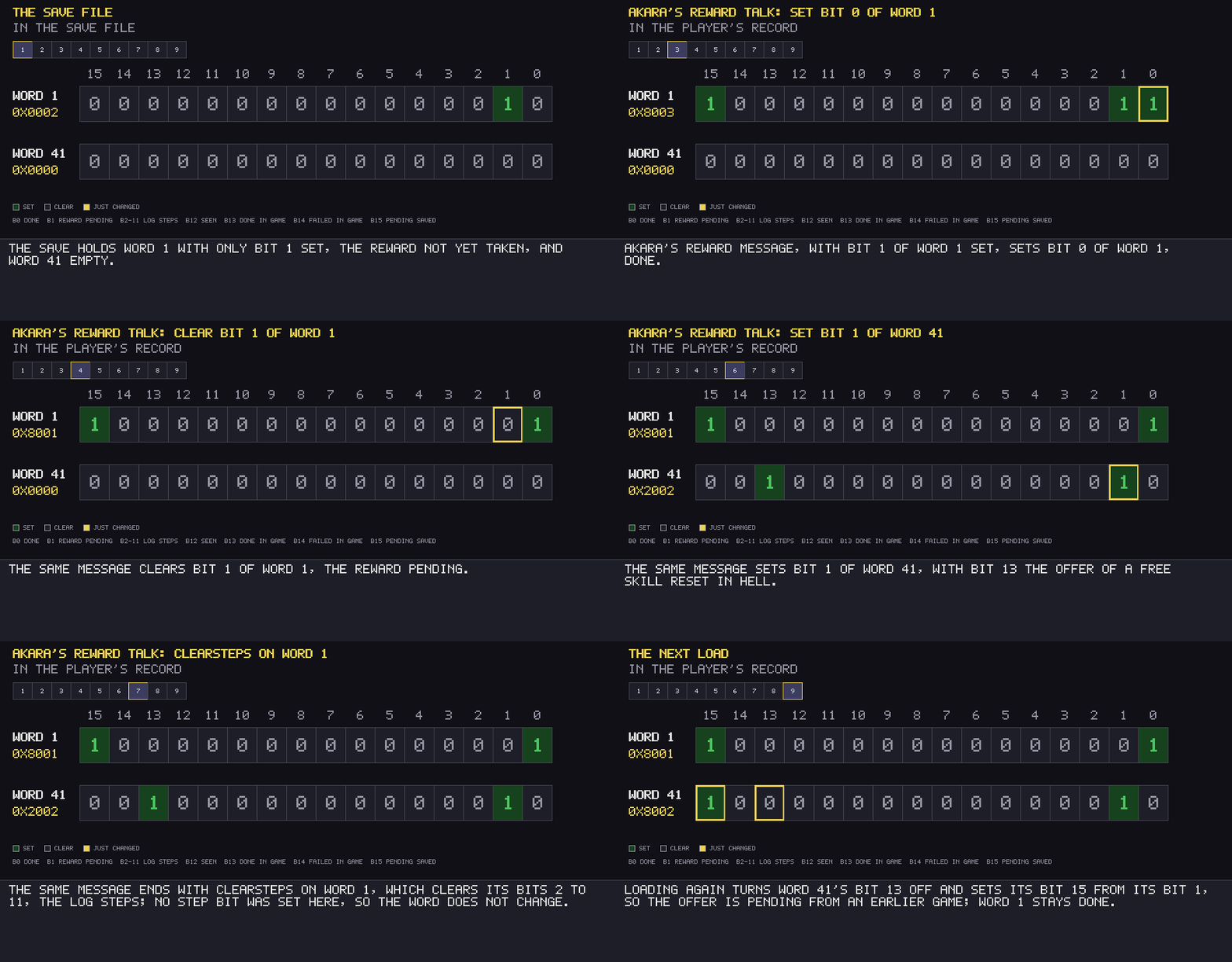
Step through quests-word1-word41-reward
Word 1 and word 41 as the table above follows them, one bit at a time. The save holds word 1 with only bit 1 set and word 41 empty. The load clears bits 13 and 14 and sets bit 15 where bit 1 is set, so word 1 gains bit 15 (progression § A, A3). Akara’s reward message with bit 1 of word 1 set then writes, in this order, bit 0 of word 1, the clearing of its bit 1, bits 13 and 1 of word 41 (the offer of a free skill reset in Hell) and the clearing of the log steps, bits 2 to 11 of word 1, which changes nothing here because none is set (§ D7, the word 1 and word 41 tables). Save and Exit writes each word as it stands, and the next load turns off bit 13 of word 41 and sets its bit 15 from its bit 1 (§ A, A3, A4). The starting words are those of the spec’s worked example; the picture leaves out the first join’s switch-off of the quest and the game record. The picture takes no seed. The picture restates the spec; nothing shown is observed in the game.
The respec itself, taken from an NPC menu in Hell, is read from the code.
Cain, the cairn stones and Tristram (word 4)
Section titled “Cain, the cairn stones and Tristram (word 4)”%3btext-align:center%3b%7d%23mermaid-3 .edgeLabel p%7bbackground-color:rgba(232%2c232%2c232%2c 0.8)%3b%7d%23mermaid-3 .edgeLabel rect%7bopacity:0.5%3bbackground-color:rgba(232%2c232%2c232%2c 0.8)%3bfill:rgba(232%2c232%2c232%2c 0.8)%3b%7d%23mermaid-3 .edgeLabel .label text%7bfill:%23333%3b%7d%23mermaid-3 .label div .edgeLabel%7bcolor:%23333%3b%7d%23mermaid-3 .stateLabel text%7bfill:%23131300%3bfont-size:10px%3bfont-weight:bold%3b%7d%23mermaid-3 .node circle.state-start%7bfill:%23333333%3bstroke:%23333333%3b%7d%23mermaid-3 .node .fork-join%7bfill:%23333333%3bstroke:%23333333%3b%7d%23mermaid-3 .node circle.state-end%7bfill:%239370DB%3bstroke:white%3bstroke-width:1.5%3b%7d%23mermaid-3 .end-state-inner%7bfill:white%3bstroke-width:1.5%3b%7d%23mermaid-3 .node rect%7bfill:%23ECECFF%3bstroke:%239370DB%3bstroke-width:1px%3b%7d%23mermaid-3 .node polygon%7bfill:%23ECECFF%3bstroke:%239370DB%3bstroke-width:1px%3b%7d%23mermaid-3 %5bid%24='-barbEnd'%5d%7bfill:%23333333%3b%7d%23mermaid-3 .statediagram-cluster rect%7bfill:%23ECECFF%3bstroke:%239370DB%3bstroke-width:1px%3b%7d%23mermaid-3 .cluster-label%2c%23mermaid-3 .nodeLabel%7bcolor:%23131300%3b%7d%23mermaid-3 .statediagram-cluster rect.outer%7brx:5px%3bry:5px%3b%7d%23mermaid-3 .statediagram-state .divider%7bstroke:%239370DB%3b%7d%23mermaid-3 .statediagram-state .title-state%7brx:5px%3bry:5px%3b%7d%23mermaid-3 .statediagram-cluster.statediagram-cluster .inner%7bfill:white%3b%7d%23mermaid-3 .statediagram-cluster.statediagram-cluster-alt .inner%7bfill:%23f0f0f0%3b%7d%23mermaid-3 .statediagram-cluster .inner%7brx:0%3bry:0%3b%7d%23mermaid-3 .statediagram-state rect.basic%7brx:5px%3bry:5px%3b%7d%23mermaid-3 .statediagram-state rect.divider%7bstroke-dasharray:10%2c10%3bfill:%23f0f0f0%3b%7d%23mermaid-3 .note-edge%7bstroke-dasharray:5%3b%7d%23mermaid-3 .statediagram-note rect%7bfill:%23fff5ad%3bstroke:%23aaaa33%3bstroke-width:1px%3brx:0%3bry:0%3b%7d%23mermaid-3 .statediagram-note rect%7bfill:%23fff5ad%3bstroke:%23aaaa33%3bstroke-width:1px%3brx:0%3bry:0%3b%7d%23mermaid-3 .statediagram-note text%7bfill:black%3b%7d%23mermaid-3 .statediagram-note .nodeLabel%7bcolor:black%3b%7d%23mermaid-3 .statediagram .edgeLabel%7bcolor:red%3b%7d%23mermaid-3 %5bid%24='-dependencyStart'%5d%2c%23mermaid-3 %5bid%24='-dependencyEnd'%5d%7bfill:%23333333%3bstroke:%23333333%3bstroke-width:1%3b%7d%23mermaid-3 .statediagramTitleText%7btext-anchor:middle%3bfont-size:18px%3bfill:%23333%3b%7d%23mermaid-3 %5bdata-look='neo'%5d.statediagram-cluster rect%7bfill:%23ECECFF%3bstroke:%239370DB%3bstroke-width:1%3b%7d%23mermaid-3 %5bdata-look='neo'%5d.statediagram-cluster rect.outer%7brx:5px%3bry:5px%3bfilter:drop-shadow(1px 2px 2px rgba(185%2c 185%2c 185%2c 1))%3b%7d%23mermaid-3 .node .neo-node%7bstroke:%239370DB%3b%7d%23mermaid-3 %5bdata-look='neo'%5d.node rect%2c%23mermaid-3 %5bdata-look='neo'%5d.cluster rect%2c%23mermaid-3 %5bdata-look='neo'%5d.node polygon%7bstroke:%239370DB%3bfilter:drop-shadow(1px 2px 2px rgba(185%2c 185%2c 185%2c 1))%3b%7d%23mermaid-3 %5bdata-look='neo'%5d.swimlane.cluster rect%7bfilter:none%3b%7d%23mermaid-3 %5bdata-look='neo'%5d.node path%7bstroke:%239370DB%3bstroke-width:1px%3b%7d%23mermaid-3 %5bdata-look='neo'%5d.node .outer-path%7bfilter:drop-shadow(1px 2px 2px rgba(185%2c 185%2c 185%2c 1))%3b%7d%23mermaid-3 %5bdata-look='neo'%5d.node .neo-line path%7bstroke:%239370DB%3bfilter:none%3b%7d%23mermaid-3 %5bdata-look='neo'%5d.node circle%7bstroke:%239370DB%3bfilter:drop-shadow(1px 2px 2px rgba(185%2c 185%2c 185%2c 1))%3b%7d%23mermaid-3 %5bdata-look='neo'%5d.node circle .state-start%7bfill:black%3b%7d%23mermaid-3 %5bdata-look='neo'%5d.icon-shape .icon%7bfill:%239370DB%3bfilter:drop-shadow(1px 2px 2px rgba(185%2c 185%2c 185%2c 1))%3b%7d%23mermaid-3 %5bdata-look='neo'%5d.icon-shape .icon-neo path%7bstroke:%239370DB%3bfilter:drop-shadow(1px 2px 2px rgba(185%2c 185%2c 185%2c 1))%3b%7d%23mermaid-3 :root%7b--mermaid-font-family:arial%2csans-serif%3b%7d%3c/style%3e%3cg%3e%3cdefs%3e%3cmarker id='mermaid-3_stateDiagram-barbEnd' refX='19' refY='7' markerWidth='20' markerHeight='14' markerUnits='userSpaceOnUse' orient='auto'%3e%3cpath d='M 19%2c7 L9%2c13 L14%2c7 L9%2c1 Z'/%3e%3c/marker%3e%3c/defs%3e%3cg class='root'%3e%3cg class='clusters'/%3e%3cg class='edgePaths'%3e%3cpath d='M328%2c22L328%2c26.167C328%2c30.333%2c328%2c38.667%2c328%2c47C328%2c55.333%2c328%2c63.667%2c328%2c67.833L328%2c72' id='mermaid-3-edge0' class='edge-thickness-normal edge-pattern-solid transition' style='fill:none%3b%3b%3bfill:none' data-edge='true' data-et='edge' data-id='edge0' data-points='W3sieCI6MzI4LCJ5IjoyMn0seyJ4IjozMjgsInkiOjQ3fSx7IngiOjMyOCwieSI6NzJ9XQ==' data-look='classic' marker-end='url(%23mermaid-3_stateDiagram-barbEnd)'/%3e%3cpath d='M328%2c112L328%2c118.167C328%2c124.333%2c328%2c136.667%2c328%2c149C328%2c161.333%2c328%2c173.667%2c328%2c179.833L328%2c186' id='mermaid-3-edge1' class='edge-thickness-normal edge-pattern-solid transition' style='fill:none%3b%3b%3bfill:none' data-edge='true' data-et='edge' data-id='edge1' data-points='W3sieCI6MzI4LCJ5IjoxMTJ9LHsieCI6MzI4LCJ5IjoxNDl9LHsieCI6MzI4LCJ5IjoxODZ9XQ==' data-look='classic' marker-end='url(%23mermaid-3_stateDiagram-barbEnd)'/%3e%3cpath d='M328%2c226L328%2c234.167C328%2c242.333%2c328%2c258.667%2c328%2c275C328%2c291.333%2c328%2c307.667%2c328%2c315.833L328%2c324' id='mermaid-3-edge2' class='edge-thickness-normal edge-pattern-solid transition' style='fill:none%3b%3b%3bfill:none' data-edge='true' data-et='edge' data-id='edge2' data-points='W3sieCI6MzI4LCJ5IjoyMjZ9LHsieCI6MzI4LCJ5IjoyNzV9LHsieCI6MzI4LCJ5IjozMjR9XQ==' data-look='classic' marker-end='url(%23mermaid-3_stateDiagram-barbEnd)'/%3e%3cpath d='M305.866%2c364L299.041%2c370.167C292.217%2c376.333%2c278.567%2c388.667%2c259.489%2c401.183C240.41%2c413.7%2c215.902%2c426.399%2c203.648%2c432.749L191.395%2c439.099' id='mermaid-3-edge3' class='edge-thickness-normal edge-pattern-solid transition' style='fill:none%3b%3b%3bfill:none' data-edge='true' data-et='edge' data-id='edge3' data-points='W3sieCI6MzA1Ljg2NTk1Mzk0NzM2ODQ0LCJ5IjozNjR9LHsieCI6MjY0LjkxNzk2ODc1LCJ5Ijo0MDF9LHsieCI6MTkxLjM5NDUzMTI1LCJ5Ijo0MzkuMDk4NTA4NTIyNzI3M31d' data-look='classic' marker-end='url(%23mermaid-3_stateDiagram-barbEnd)'/%3e%3cpath d='M302.203%2c98.684L269.836%2c107.07C237.469%2c115.456%2c172.734%2c132.228%2c140.367%2c150.114C108%2c168%2c108%2c187%2c108%2c208C108%2c229%2c108%2c252%2c108%2c275C108%2c298%2c108%2c321%2c108%2c342C108%2c363%2c108%2c382%2c113.076%2c397.667C118.152%2c413.333%2c128.304%2c425.667%2c133.38%2c431.833L138.456%2c438' id='mermaid-3-edge4' class='edge-thickness-normal edge-pattern-solid transition' style='fill:none%3b%3b%3bfill:none' data-edge='true' data-et='edge' data-id='edge4' data-points='W3sieCI6MzAyLjIwMzEyNSwieSI6OTguNjgzNzM1Nzk1NDU0NTR9LHsieCI6MTA4LCJ5IjoxNDl9LHsieCI6MTA4LCJ5IjoyMDZ9LHsieCI6MTA4LCJ5IjoyNzV9LHsieCI6MTA4LCJ5IjozNDR9LHsieCI6MTA4LCJ5Ijo0MDF9LHsieCI6MTM4LjQ1NTUyMzU3NDU2MTQsInkiOjQzOH1d' data-look='classic' marker-end='url(%23mermaid-3_stateDiagram-barbEnd)'/%3e%3cpath d='M154.918%2c478L154.918%2c484.167C154.918%2c490.333%2c154.918%2c502.667%2c154.918%2c515C154.918%2c527.333%2c154.918%2c539.667%2c154.918%2c545.833L154.918%2c552' id='mermaid-3-edge5' class='edge-thickness-normal edge-pattern-solid transition' style='fill:none%3b%3b%3bfill:none' data-edge='true' data-et='edge' data-id='edge5' data-points='W3sieCI6MTU0LjkxNzk2ODc1LCJ5Ijo0Nzh9LHsieCI6MTU0LjkxNzk2ODc1LCJ5Ijo1MTV9LHsieCI6MTU0LjkxNzk2ODc1LCJ5Ijo1NTJ9XQ==' data-look='classic' marker-end='url(%23mermaid-3_stateDiagram-barbEnd)'/%3e%3cpath d='M353.797%2c100.988L376.765%2c108.99C399.733%2c116.992%2c445.669%2c132.996%2c468.637%2c150.498C491.605%2c168%2c491.605%2c187%2c491.605%2c208C491.605%2c229%2c491.605%2c252%2c491.605%2c275C491.605%2c298%2c491.605%2c321%2c491.605%2c342C491.605%2c363%2c491.605%2c382%2c488.84%2c397.667C486.074%2c413.333%2c480.543%2c425.667%2c477.778%2c431.833L475.012%2c438' id='mermaid-3-edge6' class='edge-thickness-normal edge-pattern-solid transition' style='fill:none%3b%3b%3bfill:none' data-edge='true' data-et='edge' data-id='edge6' data-points='W3sieCI6MzUzLjc5Njg3NSwieSI6MTAwLjk4NzYwODMzNzUxMTY1fSx7IngiOjQ5MS42MDU0Njg3NSwieSI6MTQ5fSx7IngiOjQ5MS42MDU0Njg3NSwieSI6MjA2fSx7IngiOjQ5MS42MDU0Njg3NSwieSI6Mjc1fSx7IngiOjQ5MS42MDU0Njg3NSwieSI6MzQ0fSx7IngiOjQ5MS42MDU0Njg3NSwieSI6NDAxfSx7IngiOjQ3NS4wMTIyNjY5OTU2MTQsInkiOjQzOH1d' data-look='classic' marker-end='url(%23mermaid-3_stateDiagram-barbEnd)'/%3e%3cpath d='M349.923%2c364L356.683%2c370.167C363.442%2c376.333%2c376.961%2c388.667%2c391.896%2c401C406.83%2c413.333%2c423.18%2c425.667%2c431.355%2c431.833L439.53%2c438' id='mermaid-3-edge7' class='edge-thickness-normal edge-pattern-solid transition' style='fill:none%3b%3b%3bfill:none' data-edge='true' data-et='edge' data-id='edge7' data-points='W3sieCI6MzQ5LjkyMjk3MTQ5MTIyODA1LCJ5IjozNjR9LHsieCI6MzkwLjQ4MDQ2ODc1LCJ5Ijo0MDF9LHsieCI6NDM5LjUyOTgxMDg1NTI2MzIsInkiOjQzOH1d' data-look='classic' marker-end='url(%23mermaid-3_stateDiagram-barbEnd)'/%3e%3c/g%3e%3cg class='edgeLabels'%3e%3cg class='edgeLabel'%3e%3cg class='label' data-id='edge0' transform='translate(0%2c 0)'%3e%3cforeignObject width='0' height='0'%3e%3cdiv xmlns='http://www.w3.org/1999/xhtml' class='labelBkg' style='display: table-cell%3b white-space: nowrap%3b line-height: 1.5%3b max-width: 200px%3b text-align: center%3b'%3e%3cspan class='edgeLabel'%3e%3c/span%3e%3c/div%3e%3c/foreignObject%3e%3c/g%3e%3c/g%3e%3cg class='edgeLabel' transform='translate(328%2c 149)'%3e%3cg class='label' data-id='edge1' transform='translate(-80.03125%2c -12)'%3e%3cforeignObject width='160.0625' height='24'%3e%3cdiv xmlns='http://www.w3.org/1999/xhtml' class='labelBkg' style='display: table-cell%3b white-space: nowrap%3b line-height: 1.5%3b max-width: 200px%3b text-align: center%3b'%3e%3cspan class='edgeLabel'%3e%3cp%3eAkara swaps the scroll%3c/p%3e%3c/span%3e%3c/div%3e%3c/foreignObject%3e%3c/g%3e%3c/g%3e%3cg class='edgeLabel' transform='translate(328%2c 275)'%3e%3cg class='label' data-id='edge2' transform='translate(-100%2c -24)'%3e%3cforeignObject width='200' height='48'%3e%3cdiv xmlns='http://www.w3.org/1999/xhtml' class='labelBkg' style='display: table%3b white-space: break-spaces%3b line-height: 1.5%3b max-width: 200px%3b text-align: center%3b width: 200px%3b'%3e%3cspan class='edgeLabel'%3e%3cp%3ethe fifth stone in the drawn order%3c/p%3e%3c/span%3e%3c/div%3e%3c/foreignObject%3e%3c/g%3e%3c/g%3e%3cg class='edgeLabel' transform='translate(264.91796875%2c 401)'%3e%3cg class='label' data-id='edge3' transform='translate(-73.8359375%2c -12)'%3e%3cforeignObject width='147.671875' height='24'%3e%3cdiv xmlns='http://www.w3.org/1999/xhtml' class='labelBkg' style='display: table-cell%3b white-space: nowrap%3b line-height: 1.5%3b max-width: 200px%3b text-align: center%3b'%3e%3cspan class='edgeLabel'%3e%3cp%3ethe Gibbet is opened%3c/p%3e%3c/span%3e%3c/div%3e%3c/foreignObject%3e%3c/g%3e%3c/g%3e%3cg class='edgeLabel' transform='translate(108%2c 275)'%3e%3cg class='label' data-id='edge4' transform='translate(-100%2c -24)'%3e%3cforeignObject width='200' height='48'%3e%3cdiv xmlns='http://www.w3.org/1999/xhtml' class='labelBkg' style='display: table%3b white-space: break-spaces%3b line-height: 1.5%3b max-width: 200px%3b text-align: center%3b width: 200px%3b'%3e%3cspan class='edgeLabel'%3e%3cp%3ethe Gibbet%2c players in Tristram%3c/p%3e%3c/span%3e%3c/div%3e%3c/foreignObject%3e%3c/g%3e%3c/g%3e%3cg class='edgeLabel' transform='translate(154.91796875%2c 515)'%3e%3cg class='label' data-id='edge5' transform='translate(-67.7734375%2c -12)'%3e%3cforeignObject width='135.546875' height='24'%3e%3cdiv xmlns='http://www.w3.org/1999/xhtml' class='labelBkg' style='display: table-cell%3b white-space: nowrap%3b line-height: 1.5%3b max-width: 200px%3b text-align: center%3b'%3e%3cspan class='edgeLabel'%3e%3cp%3eAkara's reward talk%3c/p%3e%3c/span%3e%3c/div%3e%3c/foreignObject%3e%3c/g%3e%3c/g%3e%3cg class='edgeLabel' transform='translate(491.60546875%2c 275)'%3e%3cg class='label' data-id='edge6' transform='translate(-31.125%2c -12)'%3e%3cforeignObject width='62.25' height='24'%3e%3cdiv xmlns='http://www.w3.org/1999/xhtml' class='labelBkg' style='display: table-cell%3b white-space: nowrap%3b line-height: 1.5%3b max-width: 200px%3b text-align: center%3b'%3e%3cspan class='edgeLabel'%3e%3cp%3eCain lost%3c/p%3e%3c/span%3e%3c/div%3e%3c/foreignObject%3e%3c/g%3e%3c/g%3e%3cg class='edgeLabel' transform='translate(390.48046875%2c 401)'%3e%3cg class='label' data-id='edge7' transform='translate(-31.125%2c -12)'%3e%3cforeignObject width='62.25' height='24'%3e%3cdiv xmlns='http://www.w3.org/1999/xhtml' class='labelBkg' style='display: table-cell%3b white-space: nowrap%3b line-height: 1.5%3b max-width: 200px%3b text-align: center%3b'%3e%3cspan class='edgeLabel'%3e%3cp%3eCain lost%3c/p%3e%3c/span%3e%3c/div%3e%3c/foreignObject%3e%3c/g%3e%3c/g%3e%3c/g%3e%3cg class='nodes'%3e%3cg class='node default' id='mermaid-3-state-root_start-0' data-look='classic' transform='translate(328%2c 15)'%3e%3ccircle class='state-start' r='7' width='14' height='14'/%3e%3c/g%3e%3cg class='node statediagram-state' id='mermaid-3-state-open-6' data-look='classic' transform='translate(328%2c 92)'%3e%3crect class='basic label-container' style='' rx='5' ry='5' x='-25.796875' y='-20' width='51.59375' height='40'/%3e%3cg class='label' style='' transform='translate(-17.796875%2c -12)'%3e%3crect/%3e%3cforeignObject width='35.59375' height='24'%3e%3cdiv xmlns='http://www.w3.org/1999/xhtml' style='display: table-cell%3b white-space: nowrap%3b line-height: 1.5%3b max-width: 200px%3b text-align: center%3b'%3e%3cspan class='nodeLabel markdown-node-label'%3e%3cp%3eopen%3c/p%3e%3c/span%3e%3c/div%3e%3c/foreignObject%3e%3c/g%3e%3c/g%3e%3cg class='node statediagram-state' id='mermaid-3-state-scroll-2' data-look='classic' transform='translate(328%2c 206)'%3e%3crect class='basic label-container' style='' rx='5' ry='5' x='-26.671875' y='-20' width='53.34375' height='40'/%3e%3cg class='label' style='' transform='translate(-18.671875%2c -12)'%3e%3crect/%3e%3cforeignObject width='37.34375' height='24'%3e%3cdiv xmlns='http://www.w3.org/1999/xhtml' style='display: table-cell%3b white-space: nowrap%3b line-height: 1.5%3b max-width: 200px%3b text-align: center%3b'%3e%3cspan class='nodeLabel markdown-node-label'%3e%3cp%3escroll%3c/p%3e%3c/span%3e%3c/div%3e%3c/foreignObject%3e%3c/g%3e%3c/g%3e%3cg class='node statediagram-state' id='mermaid-3-state-stones-7' data-look='classic' transform='translate(328%2c 344)'%3e%3crect class='basic label-container' style='' rx='5' ry='5' x='-31.5703125' y='-20' width='63.140625' height='40'/%3e%3cg class='label' style='' transform='translate(-23.5703125%2c -12)'%3e%3crect/%3e%3cforeignObject width='47.140625' height='24'%3e%3cdiv xmlns='http://www.w3.org/1999/xhtml' style='display: table-cell%3b white-space: nowrap%3b line-height: 1.5%3b max-width: 200px%3b text-align: center%3b'%3e%3cspan class='nodeLabel markdown-node-label'%3e%3cp%3estones%3c/p%3e%3c/span%3e%3c/div%3e%3c/foreignObject%3e%3c/g%3e%3c/g%3e%3cg class='node statediagram-state' id='mermaid-3-state-pending-5' data-look='classic' transform='translate(154.91796875%2c 458)'%3e%3crect class='basic label-container' style='' rx='5' ry='5' x='-36.4765625' y='-20' width='72.953125' height='40'/%3e%3cg class='label' style='' transform='translate(-28.4765625%2c -12)'%3e%3crect/%3e%3cforeignObject width='56.953125' height='24'%3e%3cdiv xmlns='http://www.w3.org/1999/xhtml' style='display: table-cell%3b white-space: nowrap%3b line-height: 1.5%3b max-width: 200px%3b text-align: center%3b'%3e%3cspan class='nodeLabel markdown-node-label'%3e%3cp%3epending%3c/p%3e%3c/span%3e%3c/div%3e%3c/foreignObject%3e%3c/g%3e%3c/g%3e%3cg class='node statediagram-state' id='mermaid-3-state-done-5' data-look='classic' transform='translate(154.91796875%2c 572)'%3e%3crect class='basic label-container' style='' rx='5' ry='5' x='-25.796875' y='-20' width='51.59375' height='40'/%3e%3cg class='label' style='' transform='translate(-17.796875%2c -12)'%3e%3crect/%3e%3cforeignObject width='35.59375' height='24'%3e%3cdiv xmlns='http://www.w3.org/1999/xhtml' style='display: table-cell%3b white-space: nowrap%3b line-height: 1.5%3b max-width: 200px%3b text-align: center%3b'%3e%3cspan class='nodeLabel markdown-node-label'%3e%3cp%3edone%3c/p%3e%3c/span%3e%3c/div%3e%3c/foreignObject%3e%3c/g%3e%3c/g%3e%3cg class='node statediagram-state' id='mermaid-3-state-failed-7' data-look='classic' transform='translate(466.04296875%2c 458)'%3e%3crect class='basic label-container' style='' rx='5' ry='5' x='-27.125' y='-20' width='54.25' height='40'/%3e%3cg class='label' style='' transform='translate(-19.125%2c -12)'%3e%3crect/%3e%3cforeignObject width='38.25' height='24'%3e%3cdiv xmlns='http://www.w3.org/1999/xhtml' style='display: table-cell%3b white-space: nowrap%3b line-height: 1.5%3b max-width: 200px%3b text-align: center%3b'%3e%3cspan class='nodeLabel markdown-node-label'%3e%3cp%3efailed%3c/p%3e%3c/span%3e%3c/div%3e%3c/foreignObject%3e%3c/g%3e%3c/g%3e%3c/g%3e%3c/g%3e%3c/g%3e%3cdefs%3e%3cfilter id='mermaid-3-drop-shadow' height='130%25' width='130%25'%3e%3cfeDropShadow dx='4' dy='4' stdDeviation='0' flood-opacity='0.06' flood-color='black'/%3e%3c/filter%3e%3c/defs%3e%3cdefs%3e%3cfilter id='mermaid-3-drop-shadow-small' height='150%25' width='150%25'%3e%3cfeDropShadow dx='2' dy='2' stdDeviation='0' flood-opacity='0.06' flood-color='black'/%3e%3c/filter%3e%3c/defs%3e%3c/svg%3e)
The order the five cairn stones must be touched in is a draw on the quest seed, made once per game at the first use of the decoded scroll. The game takes steps of the quest seed and each step picks one of five slots (the remainder of the low half by 5); an empty slot gets the next stone, a filled one wastes the step, until all five are filled. So the draw count is at least five and varies: three first uses took 15, 6 and 7 steps, each predicted from the seed before, and a second use drew nothing. That touching the first stone draws the order the same way (when the scroll was not used first) is read from the code.
“Cain lost” is confirmed for one client: the first arrival in Lut Gholein from Act I with word 4 still empty marks the game record and gives the player bit 14. Akara’s reward talk is confirmed. The stone and Gibbet credits, Cain’s rescue spawn, the Tristram portal that reappears in later games, and the Cow King bit (set on his death only for a killer who has beaten Diablo in a classic game or Baal in an expansion game, and for the players then in the cow level) are read from the code.
The fifth stone creates a missile, and the Countess’s death one missile at each of her recorded chests; these missiles do the rest of the work over the frames that follow. Their draws are confirmed by emulating the two functions up to the calls they make; what those calls then do is not covered. The stones’ missile scatters smaller missiles around itself, each placed with two numbers from the missile’s own seed, which it re-seeds first, and it calls the portal function. Each of the Countess’s missiles runs its chest’s drop, then takes two numbers from its own seed for each gold pile’s spot. With the stock settings, as read from the code: the stones’ missile scatters every second frame for a while and opens the Tristram portal once; each chest opens 150 frames after the Countess dies (one more per missile level), then a gold pile lands within 5 of it every 8 frames until the missile ends.
The eclipse (word 11)
Section titled “The eclipse (word 11)”Entering the Lost City or the Valley of Snakes while the altar quest has not started arms the eclipse: one step of the quest seed picks a timer period of 15 or 16 (15 plus the low bit; the call looks as if it could give 17, but it cannot), and when the timer fires the eclipse starts and bit 2 is set. This is confirmed for the Lost City in three games (periods 15, 16, 16), each predicted from the quest seed at the entry. A second entry in the same game drew nothing: what keeps it to once per game is the quest’s state, not the flag the timer clears. The Valley of Snakes branch, the altar and the reward are read from the code.
Diablo and the Harrogath portal (word 26)
Section titled “Diablo and the Harrogath portal (word 26)”Diablo’s death credits the players near him and fails the others; in a classic game it also sets two more bits, and afterwards locks the cube and trading until the game ends. All of that is read from the code, and so is the gate it feeds: once all five seals are open and the three seal bosses are dead, the Chaos Sanctuary’s rooms stop being populated. Diablo’s end-of-game timer counts real milliseconds, not frames (75, 90 and 95 seconds), which is also read from the code.
Confirmed: in an expansion game Tyrael’s message after Diablo sets bit 9 and creates the Harrogath portal next to him; Cain’s message sets bit 8. That portal, not Tyrael’s menu, is how the runs went from Act IV to Act V (see Changing act below).
Anya (word 37)
Section titled “Anya (word 37)”%3btext-align:center%3b%7d%23mermaid-4 .edgeLabel p%7bbackground-color:rgba(232%2c232%2c232%2c 0.8)%3b%7d%23mermaid-4 .edgeLabel rect%7bopacity:0.5%3bbackground-color:rgba(232%2c232%2c232%2c 0.8)%3bfill:rgba(232%2c232%2c232%2c 0.8)%3b%7d%23mermaid-4 .edgeLabel .label text%7bfill:%23333%3b%7d%23mermaid-4 .label div .edgeLabel%7bcolor:%23333%3b%7d%23mermaid-4 .stateLabel text%7bfill:%23131300%3bfont-size:10px%3bfont-weight:bold%3b%7d%23mermaid-4 .node circle.state-start%7bfill:%23333333%3bstroke:%23333333%3b%7d%23mermaid-4 .node .fork-join%7bfill:%23333333%3bstroke:%23333333%3b%7d%23mermaid-4 .node circle.state-end%7bfill:%239370DB%3bstroke:white%3bstroke-width:1.5%3b%7d%23mermaid-4 .end-state-inner%7bfill:white%3bstroke-width:1.5%3b%7d%23mermaid-4 .node rect%7bfill:%23ECECFF%3bstroke:%239370DB%3bstroke-width:1px%3b%7d%23mermaid-4 .node polygon%7bfill:%23ECECFF%3bstroke:%239370DB%3bstroke-width:1px%3b%7d%23mermaid-4 %5bid%24='-barbEnd'%5d%7bfill:%23333333%3b%7d%23mermaid-4 .statediagram-cluster rect%7bfill:%23ECECFF%3bstroke:%239370DB%3bstroke-width:1px%3b%7d%23mermaid-4 .cluster-label%2c%23mermaid-4 .nodeLabel%7bcolor:%23131300%3b%7d%23mermaid-4 .statediagram-cluster rect.outer%7brx:5px%3bry:5px%3b%7d%23mermaid-4 .statediagram-state .divider%7bstroke:%239370DB%3b%7d%23mermaid-4 .statediagram-state .title-state%7brx:5px%3bry:5px%3b%7d%23mermaid-4 .statediagram-cluster.statediagram-cluster .inner%7bfill:white%3b%7d%23mermaid-4 .statediagram-cluster.statediagram-cluster-alt .inner%7bfill:%23f0f0f0%3b%7d%23mermaid-4 .statediagram-cluster .inner%7brx:0%3bry:0%3b%7d%23mermaid-4 .statediagram-state rect.basic%7brx:5px%3bry:5px%3b%7d%23mermaid-4 .statediagram-state rect.divider%7bstroke-dasharray:10%2c10%3bfill:%23f0f0f0%3b%7d%23mermaid-4 .note-edge%7bstroke-dasharray:5%3b%7d%23mermaid-4 .statediagram-note rect%7bfill:%23fff5ad%3bstroke:%23aaaa33%3bstroke-width:1px%3brx:0%3bry:0%3b%7d%23mermaid-4 .statediagram-note rect%7bfill:%23fff5ad%3bstroke:%23aaaa33%3bstroke-width:1px%3brx:0%3bry:0%3b%7d%23mermaid-4 .statediagram-note text%7bfill:black%3b%7d%23mermaid-4 .statediagram-note .nodeLabel%7bcolor:black%3b%7d%23mermaid-4 .statediagram .edgeLabel%7bcolor:red%3b%7d%23mermaid-4 %5bid%24='-dependencyStart'%5d%2c%23mermaid-4 %5bid%24='-dependencyEnd'%5d%7bfill:%23333333%3bstroke:%23333333%3bstroke-width:1%3b%7d%23mermaid-4 .statediagramTitleText%7btext-anchor:middle%3bfont-size:18px%3bfill:%23333%3b%7d%23mermaid-4 %5bdata-look='neo'%5d.statediagram-cluster rect%7bfill:%23ECECFF%3bstroke:%239370DB%3bstroke-width:1%3b%7d%23mermaid-4 %5bdata-look='neo'%5d.statediagram-cluster rect.outer%7brx:5px%3bry:5px%3bfilter:drop-shadow(1px 2px 2px rgba(185%2c 185%2c 185%2c 1))%3b%7d%23mermaid-4 .node .neo-node%7bstroke:%239370DB%3b%7d%23mermaid-4 %5bdata-look='neo'%5d.node rect%2c%23mermaid-4 %5bdata-look='neo'%5d.cluster rect%2c%23mermaid-4 %5bdata-look='neo'%5d.node polygon%7bstroke:%239370DB%3bfilter:drop-shadow(1px 2px 2px rgba(185%2c 185%2c 185%2c 1))%3b%7d%23mermaid-4 %5bdata-look='neo'%5d.swimlane.cluster rect%7bfilter:none%3b%7d%23mermaid-4 %5bdata-look='neo'%5d.node path%7bstroke:%239370DB%3bstroke-width:1px%3b%7d%23mermaid-4 %5bdata-look='neo'%5d.node .outer-path%7bfilter:drop-shadow(1px 2px 2px rgba(185%2c 185%2c 185%2c 1))%3b%7d%23mermaid-4 %5bdata-look='neo'%5d.node .neo-line path%7bstroke:%239370DB%3bfilter:none%3b%7d%23mermaid-4 %5bdata-look='neo'%5d.node circle%7bstroke:%239370DB%3bfilter:drop-shadow(1px 2px 2px rgba(185%2c 185%2c 185%2c 1))%3b%7d%23mermaid-4 %5bdata-look='neo'%5d.node circle .state-start%7bfill:black%3b%7d%23mermaid-4 %5bdata-look='neo'%5d.icon-shape .icon%7bfill:%239370DB%3bfilter:drop-shadow(1px 2px 2px rgba(185%2c 185%2c 185%2c 1))%3b%7d%23mermaid-4 %5bdata-look='neo'%5d.icon-shape .icon-neo path%7bstroke:%239370DB%3bfilter:drop-shadow(1px 2px 2px rgba(185%2c 185%2c 185%2c 1))%3b%7d%23mermaid-4 :root%7b--mermaid-font-family:arial%2csans-serif%3b%7d%3c/style%3e%3cg%3e%3cdefs%3e%3cmarker id='mermaid-4_stateDiagram-barbEnd' refX='19' refY='7' markerWidth='20' markerHeight='14' markerUnits='userSpaceOnUse' orient='auto'%3e%3cpath d='M 19%2c7 L9%2c13 L14%2c7 L9%2c1 Z'/%3e%3c/marker%3e%3c/defs%3e%3cg class='root'%3e%3cg class='clusters'/%3e%3cg class='edgePaths'%3e%3cpath d='M312.277%2c22L312.277%2c26.167C312.277%2c30.333%2c312.277%2c38.667%2c312.277%2c47C312.277%2c55.333%2c312.277%2c63.667%2c312.277%2c67.833L312.277%2c72' id='mermaid-4-edge0' class='edge-thickness-normal edge-pattern-solid transition' style='fill:none%3b%3b%3bfill:none' data-edge='true' data-et='edge' data-id='edge0' data-points='W3sieCI6MzEyLjI3NzM0Mzc1LCJ5IjoyMn0seyJ4IjozMTIuMjc3MzQzNzUsInkiOjQ3fSx7IngiOjMxMi4yNzczNDM3NSwieSI6NzJ9XQ==' data-look='classic' marker-end='url(%23mermaid-4_stateDiagram-barbEnd)'/%3e%3cpath d='M286.48%2c110.201L274.48%2c118.667C262.48%2c127.134%2c238.48%2c144.067%2c226.48%2c160.7C214.48%2c177.333%2c214.48%2c193.667%2c214.48%2c201.833L214.48%2c210' id='mermaid-4-edge1' class='edge-thickness-normal edge-pattern-solid transition' style='fill:none%3b%3b%3bfill:none' data-edge='true' data-et='edge' data-id='edge1' data-points='W3sieCI6Mjg2LjQ4MDQ2ODc1LCJ5IjoxMTAuMjAwODMwODAzNjQyNzZ9LHsieCI6MjE0LjQ4MDQ2ODc1LCJ5IjoxNjF9LHsieCI6MjE0LjQ4MDQ2ODc1LCJ5IjoyMTB9XQ==' data-look='classic' marker-end='url(%23mermaid-4_stateDiagram-barbEnd)'/%3e%3cpath d='M178.004%2c249.489L166.303%2c255.741C154.602%2c261.993%2c131.199%2c274.496%2c119.498%2c286.915C107.797%2c299.333%2c107.797%2c311.667%2c107.797%2c317.833L107.797%2c324' id='mermaid-4-edge2' class='edge-thickness-normal edge-pattern-solid transition' style='fill:none%3b%3b%3bfill:none' data-edge='true' data-et='edge' data-id='edge2' data-points='W3sieCI6MTc4LjAwMzkwNjI1LCJ5IjoyNDkuNDg5MDcwMzM3OTU5MDV9LHsieCI6MTA3Ljc5Njg3NSwieSI6Mjg3fSx7IngiOjEwNy43OTY4NzUsInkiOjMyNH1d' data-look='classic' marker-end='url(%23mermaid-4_stateDiagram-barbEnd)'/%3e%3cpath d='M250.957%2c249.489L262.658%2c255.741C274.359%2c261.993%2c297.762%2c274.496%2c309.463%2c286.915C321.164%2c299.333%2c321.164%2c311.667%2c321.164%2c317.833L321.164%2c324' id='mermaid-4-edge3' class='edge-thickness-normal edge-pattern-solid transition' style='fill:none%3b%3b%3bfill:none' data-edge='true' data-et='edge' data-id='edge3' data-points='W3sieCI6MjUwLjk1NzAzMTI1LCJ5IjoyNDkuNDg5MDcwMzM3OTU5MDV9LHsieCI6MzIxLjE2NDA2MjUsInkiOjI4N30seyJ4IjozMjEuMTY0MDYyNSwieSI6MzI0fV0=' data-look='classic' marker-end='url(%23mermaid-4_stateDiagram-barbEnd)'/%3e%3cpath d='M107.797%2c364L107.797%2c370.167C107.797%2c376.333%2c107.797%2c388.667%2c121.278%2c402.036C134.759%2c415.406%2c161.721%2c429.811%2c175.202%2c437.014L188.684%2c444.217' id='mermaid-4-edge4' class='edge-thickness-normal edge-pattern-solid transition' style='fill:none%3b%3b%3bfill:none' data-edge='true' data-et='edge' data-id='edge4' data-points='W3sieCI6MTA3Ljc5Njg3NSwieSI6MzY0fSx7IngiOjEwNy43OTY4NzUsInkiOjQwMX0seyJ4IjoxODguNjgzNTkzNzUsInkiOjQ0NC4yMTY5ODIxNjgzNTcwNX1d' data-look='classic' marker-end='url(%23mermaid-4_stateDiagram-barbEnd)'/%3e%3cpath d='M321.164%2c364L321.164%2c370.167C321.164%2c376.333%2c321.164%2c388.667%2c307.683%2c402.036C294.202%2c415.406%2c267.24%2c429.811%2c253.758%2c437.014L240.277%2c444.217' id='mermaid-4-edge5' class='edge-thickness-normal edge-pattern-solid transition' style='fill:none%3b%3b%3bfill:none' data-edge='true' data-et='edge' data-id='edge5' data-points='W3sieCI6MzIxLjE2NDA2MjUsInkiOjM2NH0seyJ4IjozMjEuMTY0MDYyNSwieSI6NDAxfSx7IngiOjI0MC4yNzczNDM3NSwieSI6NDQ0LjIxNjk4MjE2ODM1NzA1fV0=' data-look='classic' marker-end='url(%23mermaid-4_stateDiagram-barbEnd)'/%3e%3cpath d='M214.48%2c478L214.48%2c484.167C214.48%2c490.333%2c214.48%2c502.667%2c214.48%2c515C214.48%2c527.333%2c214.48%2c539.667%2c214.48%2c545.833L214.48%2c552' id='mermaid-4-edge6' class='edge-thickness-normal edge-pattern-solid transition' style='fill:none%3b%3b%3bfill:none' data-edge='true' data-et='edge' data-id='edge6' data-points='W3sieCI6MjE0LjQ4MDQ2ODc1LCJ5Ijo0Nzh9LHsieCI6MjE0LjQ4MDQ2ODc1LCJ5Ijo1MTV9LHsieCI6MjE0LjQ4MDQ2ODc1LCJ5Ijo1NTJ9XQ==' data-look='classic' marker-end='url(%23mermaid-4_stateDiagram-barbEnd)'/%3e%3cpath d='M338.074%2c110.201L350.074%2c118.667C362.074%2c127.134%2c386.074%2c144.067%2c398.074%2c160.7C410.074%2c177.333%2c410.074%2c193.667%2c410.074%2c201.833L410.074%2c210' id='mermaid-4-edge7' class='edge-thickness-normal edge-pattern-solid transition' style='fill:none%3b%3b%3bfill:none' data-edge='true' data-et='edge' data-id='edge7' data-points='W3sieCI6MzM4LjA3NDIxODc1LCJ5IjoxMTAuMjAwODMwODAzNjQyNzZ9LHsieCI6NDEwLjA3NDIxODc1LCJ5IjoxNjF9LHsieCI6NDEwLjA3NDIxODc1LCJ5IjoyMTB9XQ==' data-look='classic' marker-end='url(%23mermaid-4_stateDiagram-barbEnd)'/%3e%3c/g%3e%3cg class='edgeLabels'%3e%3cg class='edgeLabel'%3e%3cg class='label' data-id='edge0' transform='translate(0%2c 0)'%3e%3cforeignObject width='0' height='0'%3e%3cdiv xmlns='http://www.w3.org/1999/xhtml' class='labelBkg' style='display: table-cell%3b white-space: nowrap%3b line-height: 1.5%3b max-width: 200px%3b text-align: center%3b'%3e%3cspan class='edgeLabel'%3e%3c/span%3e%3c/div%3e%3c/foreignObject%3e%3c/g%3e%3c/g%3e%3cg class='edgeLabel' transform='translate(214.48046875%2c 161)'%3e%3cg class='label' data-id='edge1' transform='translate(-100%2c -24)'%3e%3cforeignObject width='200' height='48'%3e%3cdiv xmlns='http://www.w3.org/1999/xhtml' class='labelBkg' style='display: table%3b white-space: break-spaces%3b line-height: 1.5%3b max-width: 200px%3b text-align: center%3b width: 200px%3b'%3e%3cspan class='edgeLabel'%3e%3cp%3eAnya thawed with the potion%3c/p%3e%3c/span%3e%3c/div%3e%3c/foreignObject%3e%3c/g%3e%3c/g%3e%3cg class='edgeLabel' transform='translate(107.796875%2c 287)'%3e%3cg class='label' data-id='edge2' transform='translate(-99.796875%2c -12)'%3e%3cforeignObject width='199.59375' height='24'%3e%3cdiv xmlns='http://www.w3.org/1999/xhtml' class='labelBkg' style='display: table-cell%3b white-space: nowrap%3b line-height: 1.5%3b max-width: 200px%3b text-align: center%3b'%3e%3cspan class='edgeLabel'%3e%3cp%3eMalah's talk%2c the scroll given%3c/p%3e%3c/span%3e%3c/div%3e%3c/foreignObject%3e%3c/g%3e%3c/g%3e%3cg class='edgeLabel' transform='translate(321.1640625%2c 287)'%3e%3cg class='label' data-id='edge3' transform='translate(-93.5703125%2c -12)'%3e%3cforeignObject width='187.140625' height='24'%3e%3cdiv xmlns='http://www.w3.org/1999/xhtml' class='labelBkg' style='display: table-cell%3b white-space: nowrap%3b line-height: 1.5%3b max-width: 200px%3b text-align: center%3b'%3e%3cspan class='edgeLabel'%3e%3cp%3eAnya's talk%2c the item made%3c/p%3e%3c/span%3e%3c/div%3e%3c/foreignObject%3e%3c/g%3e%3c/g%3e%3cg class='edgeLabel' transform='translate(107.796875%2c 401)'%3e%3cg class='label' data-id='edge4' transform='translate(-94.7265625%2c -12)'%3e%3cforeignObject width='189.453125' height='24'%3e%3cdiv xmlns='http://www.w3.org/1999/xhtml' class='labelBkg' style='display: table-cell%3b white-space: nowrap%3b line-height: 1.5%3b max-width: 200px%3b text-align: center%3b'%3e%3cspan class='edgeLabel'%3e%3cp%3ethe second of the two talks%3c/p%3e%3c/span%3e%3c/div%3e%3c/foreignObject%3e%3c/g%3e%3c/g%3e%3cg class='edgeLabel' transform='translate(321.1640625%2c 401)'%3e%3cg class='label' data-id='edge5' transform='translate(-94.7265625%2c -12)'%3e%3cforeignObject width='189.453125' height='24'%3e%3cdiv xmlns='http://www.w3.org/1999/xhtml' class='labelBkg' style='display: table-cell%3b white-space: nowrap%3b line-height: 1.5%3b max-width: 200px%3b text-align: center%3b'%3e%3cspan class='edgeLabel'%3e%3cp%3ethe second of the two talks%3c/p%3e%3c/span%3e%3c/div%3e%3c/foreignObject%3e%3c/g%3e%3c/g%3e%3cg class='edgeLabel' transform='translate(214.48046875%2c 515)'%3e%3cg class='label' data-id='edge6' transform='translate(-50.25%2c -12)'%3e%3cforeignObject width='100.5' height='24'%3e%3cdiv xmlns='http://www.w3.org/1999/xhtml' class='labelBkg' style='display: table-cell%3b white-space: nowrap%3b line-height: 1.5%3b max-width: 200px%3b text-align: center%3b'%3e%3cspan class='edgeLabel'%3e%3cp%3ethe scroll read%3c/p%3e%3c/span%3e%3c/div%3e%3c/foreignObject%3e%3c/g%3e%3c/g%3e%3cg class='edgeLabel' transform='translate(410.07421875%2c 161)'%3e%3cg class='label' data-id='edge7' transform='translate(-75.59375%2c -12)'%3e%3cforeignObject width='151.1875' height='24'%3e%3cdiv xmlns='http://www.w3.org/1999/xhtml' class='labelBkg' style='display: table-cell%3b white-space: nowrap%3b line-height: 1.5%3b max-width: 200px%3b text-align: center%3b'%3e%3cspan class='edgeLabel'%3e%3cp%3ethe Halls entered first%3c/p%3e%3c/span%3e%3c/div%3e%3c/foreignObject%3e%3c/g%3e%3c/g%3e%3c/g%3e%3cg class='nodes'%3e%3cg class='node default' id='mermaid-4-state-root_start-0' data-look='classic' transform='translate(312.27734375%2c 15)'%3e%3ccircle class='state-start' r='7' width='14' height='14'/%3e%3c/g%3e%3cg class='node statediagram-state' id='mermaid-4-state-open-7' data-look='classic' transform='translate(312.27734375%2c 92)'%3e%3crect class='basic label-container' style='' rx='5' ry='5' x='-25.796875' y='-20' width='51.59375' height='40'/%3e%3cg class='label' style='' transform='translate(-17.796875%2c -12)'%3e%3crect/%3e%3cforeignObject width='35.59375' height='24'%3e%3cdiv xmlns='http://www.w3.org/1999/xhtml' style='display: table-cell%3b white-space: nowrap%3b line-height: 1.5%3b max-width: 200px%3b text-align: center%3b'%3e%3cspan class='nodeLabel markdown-node-label'%3e%3cp%3eopen%3c/p%3e%3c/span%3e%3c/div%3e%3c/foreignObject%3e%3c/g%3e%3c/g%3e%3cg class='node statediagram-state' id='mermaid-4-state-pending-3' data-look='classic' transform='translate(214.48046875%2c 230)'%3e%3crect class='basic label-container' style='' rx='5' ry='5' x='-36.4765625' y='-20' width='72.953125' height='40'/%3e%3cg class='label' style='' transform='translate(-28.4765625%2c -12)'%3e%3crect/%3e%3cforeignObject width='56.953125' height='24'%3e%3cdiv xmlns='http://www.w3.org/1999/xhtml' style='display: table-cell%3b white-space: nowrap%3b line-height: 1.5%3b max-width: 200px%3b text-align: center%3b'%3e%3cspan class='nodeLabel markdown-node-label'%3e%3cp%3epending%3c/p%3e%3c/span%3e%3c/div%3e%3c/foreignObject%3e%3c/g%3e%3c/g%3e%3cg class='node statediagram-state' id='mermaid-4-state-scroll-4' data-look='classic' transform='translate(107.796875%2c 344)'%3e%3crect class='basic label-container' style='' rx='5' ry='5' x='-26.671875' y='-20' width='53.34375' height='40'/%3e%3cg class='label' style='' transform='translate(-18.671875%2c -12)'%3e%3crect/%3e%3cforeignObject width='37.34375' height='24'%3e%3cdiv xmlns='http://www.w3.org/1999/xhtml' style='display: table-cell%3b white-space: nowrap%3b line-height: 1.5%3b max-width: 200px%3b text-align: center%3b'%3e%3cspan class='nodeLabel markdown-node-label'%3e%3cp%3escroll%3c/p%3e%3c/span%3e%3c/div%3e%3c/foreignObject%3e%3c/g%3e%3c/g%3e%3cg class='node statediagram-state' id='mermaid-4-state-reward-5' data-look='classic' transform='translate(321.1640625%2c 344)'%3e%3crect class='basic label-container' style='' rx='5' ry='5' x='-32.453125' y='-20' width='64.90625' height='40'/%3e%3cg class='label' style='' transform='translate(-24.453125%2c -12)'%3e%3crect/%3e%3cforeignObject width='48.90625' height='24'%3e%3cdiv xmlns='http://www.w3.org/1999/xhtml' style='display: table-cell%3b white-space: nowrap%3b line-height: 1.5%3b max-width: 200px%3b text-align: center%3b'%3e%3cspan class='nodeLabel markdown-node-label'%3e%3cp%3ereward%3c/p%3e%3c/span%3e%3c/div%3e%3c/foreignObject%3e%3c/g%3e%3c/g%3e%3cg class='node statediagram-state' id='mermaid-4-state-done-6' data-look='classic' transform='translate(214.48046875%2c 458)'%3e%3crect class='basic label-container' style='' rx='5' ry='5' x='-25.796875' y='-20' width='51.59375' height='40'/%3e%3cg class='label' style='' transform='translate(-17.796875%2c -12)'%3e%3crect/%3e%3cforeignObject width='35.59375' height='24'%3e%3cdiv xmlns='http://www.w3.org/1999/xhtml' style='display: table-cell%3b white-space: nowrap%3b line-height: 1.5%3b max-width: 200px%3b text-align: center%3b'%3e%3cspan class='nodeLabel markdown-node-label'%3e%3cp%3edone%3c/p%3e%3c/span%3e%3c/div%3e%3c/foreignObject%3e%3c/g%3e%3c/g%3e%3cg class='node statediagram-state' id='mermaid-4-state-used-6' data-look='classic' transform='translate(214.48046875%2c 572)'%3e%3crect class='basic label-container' style='' rx='5' ry='5' x='-25.3515625' y='-20' width='50.703125' height='40'/%3e%3cg class='label' style='' transform='translate(-17.3515625%2c -12)'%3e%3crect/%3e%3cforeignObject width='34.703125' height='24'%3e%3cdiv xmlns='http://www.w3.org/1999/xhtml' style='display: table-cell%3b white-space: nowrap%3b line-height: 1.5%3b max-width: 200px%3b text-align: center%3b'%3e%3cspan class='nodeLabel markdown-node-label'%3e%3cp%3eused%3c/p%3e%3c/span%3e%3c/div%3e%3c/foreignObject%3e%3c/g%3e%3c/g%3e%3cg class='node statediagram-state' id='mermaid-4-state-failed-7' data-look='classic' transform='translate(410.07421875%2c 230)'%3e%3crect class='basic label-container' style='' rx='5' ry='5' x='-27.125' y='-20' width='54.25' height='40'/%3e%3cg class='label' style='' transform='translate(-19.125%2c -12)'%3e%3crect/%3e%3cforeignObject width='38.25' height='24'%3e%3cdiv xmlns='http://www.w3.org/1999/xhtml' style='display: table-cell%3b white-space: nowrap%3b line-height: 1.5%3b max-width: 200px%3b text-align: center%3b'%3e%3cspan class='nodeLabel markdown-node-label'%3e%3cp%3efailed%3c/p%3e%3c/span%3e%3c/div%3e%3c/foreignObject%3e%3c/g%3e%3c/g%3e%3c/g%3e%3c/g%3e%3c/g%3e%3cdefs%3e%3cfilter id='mermaid-4-drop-shadow' height='130%25' width='130%25'%3e%3cfeDropShadow dx='4' dy='4' stdDeviation='0' flood-opacity='0.06' flood-color='black'/%3e%3c/filter%3e%3c/defs%3e%3cdefs%3e%3cfilter id='mermaid-4-drop-shadow-small' height='150%25' width='150%25'%3e%3cfeDropShadow dx='2' dy='2' stdDeviation='0' flood-opacity='0.06' flood-color='black'/%3e%3c/filter%3e%3c/defs%3e%3c/svg%3e)
Entering the Halls of Pain before Anya is freed fails the quest (bit 14): confirmed in Normal and Hell; the other Nihlathak levels and a thaw by another player are read from the code. Thawing her with the potion is read from the code. Anya’s reward talk is confirmed in all three difficulties: the reward item is one draw on the quest seed among the entries for the player’s class in that difficulty’s table, then bits 9 and 10 are set (and bits 0 and 1 settle when this talk comes second); a second talk gives nothing. Reading the scroll sets bit 7, confirmed for the branch reached. That each difficulty whose word has bit 7 adds 10 to all four resistances, so +10, +20 or +30, is read from the code. So is the table choice in a game of type 3, which the run did not separate from the character-level rule.
The Dark Wanderer (word 32)
Section titled “The Dark Wanderer (word 32)”When his timer fires, every player in Act III gets bit 0, and if he is still there the game takes one quest-seed step whose low bit chooses whether to place 8 or 7 objects around him. Four games confirmed the 8-object branch; the 7-object branch was never reached. His script stores the wrong word number for the quest log (16 instead of 32), which matters only to the log.
The quest seed and the player’s seed
Section titled “The quest seed and the player’s seed”Quest events draw on two seeds. The quest seed is one per game, started from one game-seed step when the game is created; see the glossary’s quest seed and randomness. The player’s own unit seed is the other.
| event | draws | seed | status |
|---|---|---|---|
| a talk to the Act I NPC 266 | two, one for each of the two scripts that share its handler | player | confirmed |
| a talk to the Act II NPC 377 | one per talk | player | read from the code; no stock map or table places this NPC |
| a talk to the palace NPC 331 with the palace open | one, choosing the line | quest | confirmed |
| the first entry to the Lost City or the Valley of Snakes | one, the eclipse period | quest | confirmed for the Lost City |
| the first use of the decoded scroll | five or more, the stone order | quest | confirmed (the first-stone route read from the code) |
| Anya’s reward | one | quest | confirmed |
| the Dark Wanderer’s timer | one | quest | confirmed |
| the Zoo’s set-up | one to ten | quest | read from the code; no stock map places its object |
| the quest drops (Andariel, the Hellforge, Wirt, Baal, the Cow King, quest chests) | see other item paths | quest | as there |
| every other quest event | none | — | confirmed for the talk, message, level-change and leave events logged; read from the code for kills, operates and items |
Because there is one quest seed per game, its value at any of these draws depends on which drawing events ran before it, in the order they ran; a reimplementation checks the seed on entry to each. Monsters, objects, portals and items that a quest creates draw on their own seeds.
The spec’s first worked example: in one session the game seed at creation steps once, so the quest seed starts at
41772032:0000029a. The first talk to NPC 331 steps it to fd73e914:1b4e1a7c, and the line is that low half modulo 3,
plus 8: line 8. The second talk steps on to e613b6e0:69b6957c: line 9. The runs logged 44 such talks, one step each;
in all 42 pairs of consecutive talks, each talk’s exit seed was the next talk’s entry.
What quest state opens and closes
Section titled “What quest state opens and closes”A few gates read quest state. The summit door is confirmed. The warp into the Durance’s first level and the NPC act travel are confirmed on their passing side only (the warp after the orb was broken; 18 trips by the Act I and Act II travel NPCs); every other gate, and every refusal but the summit door’s, is read from the code:
| gate | refuses while |
|---|---|
| the warp into Duriel’s lair | an Act II quest’s own flag is still unset |
| the warp into the Durance of Hate’s first level | the Compelling Orb is whole and the player is not coming up from the second level |
| the warps out of Arreat Summit | the Ancients are not beaten in this game |
| the warp into the Worldstone Chamber | Baal has not opened it |
| another player’s town portal | the user has not finished the quest that the destination level names |
| the Durance portal to Act IV | Mephisto’s word has neither bit 13 nor bit 0 |
| the NPC act travel | the act boss’s word (Andariel, Duriel, Diablo) has no bit 0 |
| the summit door back down | the Ancients are not beaten in this game, whatever the creator had done (88 refusals) |
The waypoint menu and waypoint travel read no quest word on the server, nor do the Arcane Sanctuary’s waypoint and portal (a second reading of their calls confirms it). Object set-up reads the game record for Hratli’s place and for one other NPC’s; the Dark Wanderer, Diablo’s start point, Nihlathak and the Tristram portal read only the quest scripts’ own state (a second reading of the object set-up table confirms which reads which); the Chaos Sanctuary’s spawn gate is the one in Diablo’s story above; the cow portal reads the Diablo or Baal word and the game record’s “cow portal opened” bit.
Where a player lands
Section titled “Where a player lands”Arrivals by waypoint, NPC, resurrection and join, and a town portal’s town end, go through one placement routine: look up a point in the destination level, turn its tile into the subtile at the tile’s centre (five subtiles per tile, plus 3), then take the nearest free cell around it. This is confirmed over 124 placements (waypoints, NPC act changes and joins).
%3btext-align:center%3b%7d%23mermaid-5 .edgeLabel p%7bbackground-color:rgba(232%2c232%2c232%2c 0.8)%3b%7d%23mermaid-5 .edgeLabel rect%7bopacity:0.5%3bbackground-color:rgba(232%2c232%2c232%2c 0.8)%3bfill:rgba(232%2c232%2c232%2c 0.8)%3b%7d%23mermaid-5 .labelBkg%7bbackground-color:rgba(232%2c 232%2c 232%2c 0.5)%3b%7d%23mermaid-5 .cluster rect%7bfill:%23ffffde%3bstroke:%23aaaa33%3bstroke-width:1px%3b%7d%23mermaid-5 .cluster text%7bfill:%23333%3b%7d%23mermaid-5 .cluster span%7bcolor:%23333%3b%7d%23mermaid-5 .node .collapsed-indicator%7bfill:%23aaaa33%3bstroke:none%3bopacity:0.6%3b%7d%23mermaid-5 .node .collapsed-separator%7bstroke:%23aaaa33%3bstroke-width:0.75px%3b%7d%23mermaid-5 div.mermaidTooltip%7bposition:absolute%3btext-align:center%3bmax-width:200px%3bpadding:2px%3bfont-family:arial%2csans-serif%3bfont-size:12px%3bbackground:hsl(80%2c 100%25%2c 96.2745098039%25)%3bborder:1px solid %23aaaa33%3bborder-radius:2px%3bpointer-events:none%3bz-index:100%3b%7d%23mermaid-5 .flowchartTitleText%7btext-anchor:middle%3bfont-size:18px%3bfill:%23333%3b%7d%23mermaid-5 rect.text%7bfill:none%3bstroke-width:0%3b%7d%23mermaid-5 .icon-shape%2c%23mermaid-5 .image-shape%7bbackground-color:rgba(232%2c232%2c232%2c 0.8)%3btext-align:center%3b%7d%23mermaid-5 .icon-shape p%2c%23mermaid-5 .image-shape p%7bbackground-color:rgba(232%2c232%2c232%2c 0.8)%3bpadding:2px%3b%7d%23mermaid-5 .icon-shape .label rect%2c%23mermaid-5 .image-shape .label rect%7bopacity:0.5%3bbackground-color:rgba(232%2c232%2c232%2c 0.8)%3bfill:rgba(232%2c232%2c232%2c 0.8)%3b%7d%23mermaid-5 .label-icon%7bdisplay:inline-block%3bheight:1em%3boverflow:visible%3bvertical-align:-0.125em%3b%7d%23mermaid-5 .node .label-icon path%7bfill:currentColor%3bstroke:revert%3bstroke-width:revert%3b%7d%23mermaid-5 .node .neo-node%7bstroke:%239370DB%3b%7d%23mermaid-5 %5bdata-look='neo'%5d.node rect%2c%23mermaid-5 %5bdata-look='neo'%5d.cluster rect%2c%23mermaid-5 %5bdata-look='neo'%5d.node polygon%7bstroke:%239370DB%3bfilter:drop-shadow(1px 2px 2px rgba(185%2c 185%2c 185%2c 1))%3b%7d%23mermaid-5 %5bdata-look='neo'%5d.swimlane.cluster rect%7bfilter:none%3b%7d%23mermaid-5 %5bdata-look='neo'%5d.node path%7bstroke:%239370DB%3bstroke-width:1px%3b%7d%23mermaid-5 %5bdata-look='neo'%5d.node .outer-path%7bfilter:drop-shadow(1px 2px 2px rgba(185%2c 185%2c 185%2c 1))%3b%7d%23mermaid-5 %5bdata-look='neo'%5d.node .neo-line path%7bstroke:%239370DB%3bfilter:none%3b%7d%23mermaid-5 %5bdata-look='neo'%5d.node circle%7bstroke:%239370DB%3bfilter:drop-shadow(1px 2px 2px rgba(185%2c 185%2c 185%2c 1))%3b%7d%23mermaid-5 %5bdata-look='neo'%5d.node circle .state-start%7bfill:black%3b%7d%23mermaid-5 %5bdata-look='neo'%5d.icon-shape .icon%7bfill:%239370DB%3bfilter:drop-shadow(1px 2px 2px rgba(185%2c 185%2c 185%2c 1))%3b%7d%23mermaid-5 %5bdata-look='neo'%5d.icon-shape .icon-neo path%7bstroke:%239370DB%3bfilter:drop-shadow(1px 2px 2px rgba(185%2c 185%2c 185%2c 1))%3b%7d%23mermaid-5 :root%7b--mermaid-font-family:arial%2csans-serif%3b%7d%3c/style%3e%3cg%3e%3cmarker id='mermaid-5_flowchart-v2-pointEnd' class='marker flowchart-v2' viewBox='0 0 10 10' refX='5' refY='5' markerUnits='userSpaceOnUse' markerWidth='8' markerHeight='8' orient='auto'%3e%3cpath d='M 0 0 L 10 5 L 0 10 z' class='arrowMarkerPath' style='stroke-width: 1%3b stroke-dasharray: 1%2c 0%3b'/%3e%3c/marker%3e%3cmarker id='mermaid-5_flowchart-v2-pointStart' class='marker flowchart-v2' viewBox='0 0 10 10' refX='4.5' refY='5' markerUnits='userSpaceOnUse' markerWidth='8' markerHeight='8' orient='auto'%3e%3cpath d='M 0 5 L 10 10 L 10 0 z' class='arrowMarkerPath' style='stroke-width: 1%3b stroke-dasharray: 1%2c 0%3b'/%3e%3c/marker%3e%3cmarker id='mermaid-5_flowchart-v2-pointEnd-margin' class='marker flowchart-v2' viewBox='0 0 11.5 14' refX='11.5' refY='7' markerUnits='userSpaceOnUse' markerWidth='10.5' markerHeight='14' orient='auto'%3e%3cpath d='M 0 0 L 11.5 7 L 0 14 z' class='arrowMarkerPath' style='stroke-width: 0%3b stroke-dasharray: 1%2c 0%3b'/%3e%3c/marker%3e%3cmarker id='mermaid-5_flowchart-v2-pointStart-margin' class='marker flowchart-v2' viewBox='0 0 11.5 14' refX='1' refY='7' markerUnits='userSpaceOnUse' markerWidth='11.5' markerHeight='14' orient='auto'%3e%3cpolygon points='0%2c7 11.5%2c14 11.5%2c0' class='arrowMarkerPath' style='stroke-width: 0%3b stroke-dasharray: 1%2c 0%3b'/%3e%3c/marker%3e%3cmarker id='mermaid-5_flowchart-v2-circleEnd' class='marker flowchart-v2' viewBox='0 0 10 10' refX='11' refY='5' markerUnits='userSpaceOnUse' markerWidth='11' markerHeight='11' orient='auto'%3e%3ccircle cx='5' cy='5' r='5' class='arrowMarkerPath' style='stroke-width: 1%3b stroke-dasharray: 1%2c 0%3b'/%3e%3c/marker%3e%3cmarker id='mermaid-5_flowchart-v2-circleStart' class='marker flowchart-v2' viewBox='0 0 10 10' refX='-1' refY='5' markerUnits='userSpaceOnUse' markerWidth='11' markerHeight='11' orient='auto'%3e%3ccircle cx='5' cy='5' r='5' class='arrowMarkerPath' style='stroke-width: 1%3b stroke-dasharray: 1%2c 0%3b'/%3e%3c/marker%3e%3cmarker id='mermaid-5_flowchart-v2-circleEnd-margin' class='marker flowchart-v2' viewBox='0 0 10 10' refY='5' refX='12.25' markerUnits='userSpaceOnUse' markerWidth='14' markerHeight='14' orient='auto'%3e%3ccircle cx='5' cy='5' r='5' class='arrowMarkerPath' style='stroke-width: 0%3b stroke-dasharray: 1%2c 0%3b'/%3e%3c/marker%3e%3cmarker id='mermaid-5_flowchart-v2-circleStart-margin' class='marker flowchart-v2' viewBox='0 0 10 10' refX='-2' refY='5' markerUnits='userSpaceOnUse' markerWidth='14' markerHeight='14' orient='auto'%3e%3ccircle cx='5' cy='5' r='5' class='arrowMarkerPath' style='stroke-width: 0%3b stroke-dasharray: 1%2c 0%3b'/%3e%3c/marker%3e%3cmarker id='mermaid-5_flowchart-v2-crossEnd' class='marker cross flowchart-v2' viewBox='0 0 11 11' refX='12' refY='5.2' markerUnits='userSpaceOnUse' markerWidth='11' markerHeight='11' orient='auto'%3e%3cpath d='M 1%2c1 l 9%2c9 M 10%2c1 l -9%2c9' class='arrowMarkerPath' style='stroke-width: 2%3b stroke-dasharray: 1%2c 0%3b'/%3e%3c/marker%3e%3cmarker id='mermaid-5_flowchart-v2-crossStart' class='marker cross flowchart-v2' viewBox='0 0 11 11' refX='-1' refY='5.2' markerUnits='userSpaceOnUse' markerWidth='11' markerHeight='11' orient='auto'%3e%3cpath d='M 1%2c1 l 9%2c9 M 10%2c1 l -9%2c9' class='arrowMarkerPath' style='stroke-width: 2%3b stroke-dasharray: 1%2c 0%3b'/%3e%3c/marker%3e%3cmarker id='mermaid-5_flowchart-v2-crossEnd-margin' class='marker cross flowchart-v2' viewBox='0 0 15 15' refX='17.7' refY='7.5' markerUnits='userSpaceOnUse' markerWidth='12' markerHeight='12' orient='auto'%3e%3cpath d='M 1%2c1 L 14%2c14 M 1%2c14 L 14%2c1' class='arrowMarkerPath' style='stroke-width: 2.5%3b'/%3e%3c/marker%3e%3cmarker id='mermaid-5_flowchart-v2-crossStart-margin' class='marker cross flowchart-v2' viewBox='0 0 15 15' refX='-3.5' refY='7.5' markerUnits='userSpaceOnUse' markerWidth='12' markerHeight='12' orient='auto'%3e%3cpath d='M 1%2c1 L 14%2c14 M 1%2c14 L 14%2c1' class='arrowMarkerPath' style='stroke-width: 2.5%3b stroke-dasharray: 1%2c 0%3b'/%3e%3c/marker%3e%3cg class='root'%3e%3cg class='clusters'/%3e%3cg class='edgePaths'%3e%3cpath d='M571.066%2c86L571.066%2c90.167C571.066%2c94.333%2c571.066%2c102.667%2c571.066%2c110.333C571.066%2c118%2c571.066%2c125%2c571.066%2c128.5L571.066%2c132' id='mermaid-5-L_s_p_0' class='edge-thickness-normal edge-pattern-solid edge-thickness-normal edge-pattern-solid flowchart-link' style='%3b' data-edge='true' data-et='edge' data-id='L_s_p_0' data-points='W3sieCI6NTcxLjA2NjQwNjI1LCJ5Ijo4Nn0seyJ4Ijo1NzEuMDY2NDA2MjUsInkiOjExMX0seyJ4Ijo1NzEuMDY2NDA2MjUsInkiOjEzNn1d' data-look='classic' marker-end='url(%23mermaid-5_flowchart-v2-pointEnd)'/%3e%3cpath d='M472.233%2c315.166L416.527%2c337.805C360.822%2c360.444%2c249.411%2c405.722%2c193.705%2c457.694C138%2c509.667%2c138%2c568.333%2c138%2c627C138%2c685.667%2c138%2c744.333%2c138%2c783.167C138%2c822%2c138%2c841%2c138%2c850.5L138%2c860' id='mermaid-5-L_p_wr_0' class='edge-thickness-normal edge-pattern-solid edge-thickness-normal edge-pattern-solid flowchart-link' style='%3b' data-edge='true' data-et='edge' data-id='L_p_wr_0' data-points='W3sieCI6NDcyLjIzMjc5ODIwNDkwMDIzLCJ5IjozMTUuMTY2MzkxOTU0OTAwMjN9LHsieCI6MTM4LCJ5Ijo0NTF9LHsieCI6MTM4LCJ5Ijo2Mjd9LHsieCI6MTM4LCJ5Ijo4MDN9LHsieCI6MTM4LCJ5Ijo4NjR9XQ==' data-look='classic' marker-end='url(%23mermaid-5_flowchart-v2-pointEnd)'/%3e%3cpath d='M571.066%2c414L571.066%2c420.167C571.066%2c426.333%2c571.066%2c438.667%2c571.066%2c450.333C571.066%2c462%2c571.066%2c473%2c571.066%2c478.5L571.066%2c484' id='mermaid-5-L_p_n_0' class='edge-thickness-normal edge-pattern-solid edge-thickness-normal edge-pattern-solid flowchart-link' style='%3b' data-edge='true' data-et='edge' data-id='L_p_n_0' data-points='W3sieCI6NTcxLjA2NjQwNjI1LCJ5Ijo0MTR9LHsieCI6NTcxLjA2NjQwNjI1LCJ5Ijo0NTF9LHsieCI6NTcxLjA2NjQwNjI1LCJ5Ijo0ODh9XQ==' data-look='classic' marker-end='url(%23mermaid-5_flowchart-v2-pointEnd)'/%3e%3cpath d='M508.432%2c703.365L494.811%2c719.971C481.191%2c736.577%2c453.951%2c769.788%2c440.331%2c797.894C426.711%2c826%2c426.711%2c849%2c426.711%2c860.5L426.711%2c872' id='mermaid-5-L_n_p0_0' class='edge-thickness-normal edge-pattern-solid edge-thickness-normal edge-pattern-solid flowchart-link' style='%3b' data-edge='true' data-et='edge' data-id='L_n_p0_0' data-points='W3sieCI6NTA4LjQzMTU3Njc3NTkwNTA2LCJ5Ijo3MDMuMzY1MTcwNTI1OTA1MX0seyJ4Ijo0MjYuNzEwOTM3NSwieSI6ODAzfSx7IngiOjQyNi43MTA5Mzc1LCJ5Ijo4NzZ9XQ==' data-look='classic' marker-end='url(%23mermaid-5_flowchart-v2-pointEnd)'/%3e%3cpath d='M633.701%2c703.365L647.321%2c719.971C660.941%2c736.577%2c688.182%2c769.788%2c701.802%2c795.894C715.422%2c822%2c715.422%2c841%2c715.422%2c850.5L715.422%2c860' id='mermaid-5-L_n_d_0' class='edge-thickness-normal edge-pattern-solid edge-thickness-normal edge-pattern-solid flowchart-link' style='%3b' data-edge='true' data-et='edge' data-id='L_n_d_0' data-points='W3sieCI6NjMzLjcwMTIzNTcyNDA5NDksInkiOjcwMy4zNjUxNzA1MjU5MDUxfSx7IngiOjcxNS40MjE4NzUsInkiOjgwM30seyJ4Ijo3MTUuNDIxODc1LCJ5Ijo4NjR9XQ==' data-look='classic' marker-end='url(%23mermaid-5_flowchart-v2-pointEnd)'/%3e%3cpath d='M671.257%2c313.81L730.284%2c336.675C789.312%2c359.54%2c907.367%2c405.27%2c966.394%2c457.468C1025.422%2c509.667%2c1025.422%2c568.333%2c1025.422%2c627C1025.422%2c685.667%2c1025.422%2c744.333%2c1025.422%2c779.167C1025.422%2c814%2c1025.422%2c825%2c1025.422%2c830.5L1025.422%2c836' id='mermaid-5-L_p_f_0' class='edge-thickness-normal edge-pattern-solid edge-thickness-normal edge-pattern-solid flowchart-link' style='%3b' data-edge='true' data-et='edge' data-id='L_p_f_0' data-points='W3sieCI6NjcxLjI1NjU1ODEzNjAyNjYsInkiOjMxMy44MDk4NDgxMTM5NzM0fSx7IngiOjEwMjUuNDIxODc1LCJ5Ijo0NTF9LHsieCI6MTAyNS40MjE4NzUsInkiOjYyN30seyJ4IjoxMDI1LjQyMTg3NSwieSI6ODAzfSx7IngiOjEwMjUuNDIxODc1LCJ5Ijo4NDB9XQ==' data-look='classic' marker-end='url(%23mermaid-5_flowchart-v2-pointEnd)'/%3e%3cpath d='M138%2c942L138%2c950.167C138%2c958.333%2c138%2c974.667%2c195.029%2c989.681C252.058%2c1004.695%2c366.115%2c1018.391%2c423.144%2c1025.238L480.173%2c1032.086' id='mermaid-5-L_wr_sub_0' class='edge-thickness-normal edge-pattern-solid edge-thickness-normal edge-pattern-solid flowchart-link' style='%3b' data-edge='true' data-et='edge' data-id='L_wr_sub_0' data-points='W3sieCI6MTM4LCJ5Ijo5NDJ9LHsieCI6MTM4LCJ5Ijo5OTF9LHsieCI6NDg0LjE0NDUzMTI1LCJ5IjoxMDMyLjU2Mjk0NTkyNTIyNDN9XQ==' data-look='classic' marker-end='url(%23mermaid-5_flowchart-v2-pointEnd)'/%3e%3cpath d='M426.711%2c930L426.711%2c940.167C426.711%2c950.333%2c426.711%2c970.667%2c437.651%2c984.774C448.59%2c998.881%2c470.47%2c1006.763%2c481.41%2c1010.704L492.349%2c1014.644' id='mermaid-5-L_p0_sub_0' class='edge-thickness-normal edge-pattern-solid edge-thickness-normal edge-pattern-solid flowchart-link' style='%3b' data-edge='true' data-et='edge' data-id='L_p0_sub_0' data-points='W3sieCI6NDI2LjcxMDkzNzUsInkiOjkzMH0seyJ4Ijo0MjYuNzEwOTM3NSwieSI6OTkxfSx7IngiOjQ5Ni4xMTI2MDUxNjgyNjkyLCJ5IjoxMDE2fV0=' data-look='classic' marker-end='url(%23mermaid-5_flowchart-v2-pointEnd)'/%3e%3cpath d='M715.422%2c942L715.422%2c950.167C715.422%2c958.333%2c715.422%2c974.667%2c704.482%2c986.774C693.542%2c998.881%2c671.663%2c1006.763%2c660.723%2c1010.704L649.783%2c1014.644' id='mermaid-5-L_d_sub_0' class='edge-thickness-normal edge-pattern-solid edge-thickness-normal edge-pattern-solid flowchart-link' style='%3b' data-edge='true' data-et='edge' data-id='L_d_sub_0' data-points='W3sieCI6NzE1LjQyMTg3NSwieSI6OTQyfSx7IngiOjcxNS40MjE4NzUsInkiOjk5MX0seyJ4Ijo2NDYuMDIwMjA3MzMxNzMwNywieSI6MTAxNn1d' data-look='classic' marker-end='url(%23mermaid-5_flowchart-v2-pointEnd)'/%3e%3cpath d='M1025.422%2c966L1025.422%2c970.167C1025.422%2c974.333%2c1025.422%2c982.667%2c964.845%2c993.766C904.269%2c1004.866%2c783.116%2c1018.731%2c722.539%2c1025.664L661.962%2c1032.597' id='mermaid-5-L_f_sub_0' class='edge-thickness-normal edge-pattern-solid edge-thickness-normal edge-pattern-solid flowchart-link' style='%3b' data-edge='true' data-et='edge' data-id='L_f_sub_0' data-points='W3sieCI6MTAyNS40MjE4NzUsInkiOjk2Nn0seyJ4IjoxMDI1LjQyMTg3NSwieSI6OTkxfSx7IngiOjY1Ny45ODgyODEyNSwieSI6MTAzMy4wNTE5Nzk1MzgzMjI3fV0=' data-look='classic' marker-end='url(%23mermaid-5_flowchart-v2-pointEnd)'/%3e%3cpath d='M571.066%2c1070L571.066%2c1074.167C571.066%2c1078.333%2c571.066%2c1086.667%2c571.066%2c1094.333C571.066%2c1102%2c571.066%2c1109%2c571.066%2c1112.5L571.066%2c1116' id='mermaid-5-L_sub_free_0' class='edge-thickness-normal edge-pattern-solid edge-thickness-normal edge-pattern-solid flowchart-link' style='%3b' data-edge='true' data-et='edge' data-id='L_sub_free_0' data-points='W3sieCI6NTcxLjA2NjQwNjI1LCJ5IjoxMDcwfSx7IngiOjU3MS4wNjY0MDYyNSwieSI6MTA5NX0seyJ4Ijo1NzEuMDY2NDA2MjUsInkiOjExMjB9XQ==' data-look='classic' marker-end='url(%23mermaid-5_flowchart-v2-pointEnd)'/%3e%3c/g%3e%3cg class='edgeLabels'%3e%3cg class='edgeLabel'%3e%3cg class='label' data-id='L_s_p_0' transform='translate(0%2c 0)'%3e%3cforeignObject width='0' height='0'%3e%3cdiv xmlns='http://www.w3.org/1999/xhtml' class='labelBkg' style='display: table-cell%3b white-space: nowrap%3b line-height: 1.5%3b max-width: 200px%3b text-align: center%3b'%3e%3cspan class='edgeLabel'%3e%3c/span%3e%3c/div%3e%3c/foreignObject%3e%3c/g%3e%3c/g%3e%3cg class='edgeLabel' transform='translate(138%2c 627)'%3e%3cg class='label' data-id='L_p_wr_0' transform='translate(-72.4765625%2c -12)'%3e%3cforeignObject width='144.953125' height='24'%3e%3cdiv xmlns='http://www.w3.org/1999/xhtml' class='labelBkg' style='display: table-cell%3b white-space: nowrap%3b line-height: 1.5%3b max-width: 200px%3b text-align: center%3b'%3e%3cspan class='edgeLabel'%3e%3cp%3eyes%2c waypoint arrival%3c/p%3e%3c/span%3e%3c/div%3e%3c/foreignObject%3e%3c/g%3e%3c/g%3e%3cg class='edgeLabel' transform='translate(571.06640625%2c 451)'%3e%3cg class='label' data-id='L_p_n_0' transform='translate(-61.375%2c -12)'%3e%3cforeignObject width='122.75' height='24'%3e%3cdiv xmlns='http://www.w3.org/1999/xhtml' class='labelBkg' style='display: table-cell%3b white-space: nowrap%3b line-height: 1.5%3b max-width: 200px%3b text-align: center%3b'%3e%3cspan class='edgeLabel'%3e%3cp%3eyes%2c another type%3c/p%3e%3c/span%3e%3c/div%3e%3c/foreignObject%3e%3c/g%3e%3c/g%3e%3cg class='edgeLabel' transform='translate(426.7109375%2c 803)'%3e%3cg class='label' data-id='L_n_p0_0' transform='translate(-17.796875%2c -12)'%3e%3cforeignObject width='35.59375' height='24'%3e%3cdiv xmlns='http://www.w3.org/1999/xhtml' class='labelBkg' style='display: table-cell%3b white-space: nowrap%3b line-height: 1.5%3b max-width: 200px%3b text-align: center%3b'%3e%3cspan class='edgeLabel'%3e%3cp%3enone%3c/p%3e%3c/span%3e%3c/div%3e%3c/foreignObject%3e%3c/g%3e%3c/g%3e%3cg class='edgeLabel' transform='translate(715.421875%2c 803)'%3e%3cg class='label' data-id='L_n_d_0' transform='translate(-43.1328125%2c -12)'%3e%3cforeignObject width='86.265625' height='24'%3e%3cdiv xmlns='http://www.w3.org/1999/xhtml' class='labelBkg' style='display: table-cell%3b white-space: nowrap%3b line-height: 1.5%3b max-width: 200px%3b text-align: center%3b'%3e%3cspan class='edgeLabel'%3e%3cp%3eone or more%3c/p%3e%3c/span%3e%3c/div%3e%3c/foreignObject%3e%3c/g%3e%3c/g%3e%3cg class='edgeLabel' transform='translate(1025.421875%2c 627)'%3e%3cg class='label' data-id='L_p_f_0' transform='translate(-8.8984375%2c -12)'%3e%3cforeignObject width='17.796875' height='24'%3e%3cdiv xmlns='http://www.w3.org/1999/xhtml' class='labelBkg' style='display: table-cell%3b white-space: nowrap%3b line-height: 1.5%3b max-width: 200px%3b text-align: center%3b'%3e%3cspan class='edgeLabel'%3e%3cp%3eno%3c/p%3e%3c/span%3e%3c/div%3e%3c/foreignObject%3e%3c/g%3e%3c/g%3e%3cg class='edgeLabel'%3e%3cg class='label' data-id='L_wr_sub_0' transform='translate(0%2c 0)'%3e%3cforeignObject width='0' height='0'%3e%3cdiv xmlns='http://www.w3.org/1999/xhtml' class='labelBkg' style='display: table-cell%3b white-space: nowrap%3b line-height: 1.5%3b max-width: 200px%3b text-align: center%3b'%3e%3cspan class='edgeLabel'%3e%3c/span%3e%3c/div%3e%3c/foreignObject%3e%3c/g%3e%3c/g%3e%3cg class='edgeLabel'%3e%3cg class='label' data-id='L_p0_sub_0' transform='translate(0%2c 0)'%3e%3cforeignObject width='0' height='0'%3e%3cdiv xmlns='http://www.w3.org/1999/xhtml' class='labelBkg' style='display: table-cell%3b white-space: nowrap%3b line-height: 1.5%3b max-width: 200px%3b text-align: center%3b'%3e%3cspan class='edgeLabel'%3e%3c/span%3e%3c/div%3e%3c/foreignObject%3e%3c/g%3e%3c/g%3e%3cg class='edgeLabel'%3e%3cg class='label' data-id='L_d_sub_0' transform='translate(0%2c 0)'%3e%3cforeignObject width='0' height='0'%3e%3cdiv xmlns='http://www.w3.org/1999/xhtml' class='labelBkg' style='display: table-cell%3b white-space: nowrap%3b line-height: 1.5%3b max-width: 200px%3b text-align: center%3b'%3e%3cspan class='edgeLabel'%3e%3c/span%3e%3c/div%3e%3c/foreignObject%3e%3c/g%3e%3c/g%3e%3cg class='edgeLabel'%3e%3cg class='label' data-id='L_f_sub_0' transform='translate(0%2c 0)'%3e%3cforeignObject width='0' height='0'%3e%3cdiv xmlns='http://www.w3.org/1999/xhtml' class='labelBkg' style='display: table-cell%3b white-space: nowrap%3b line-height: 1.5%3b max-width: 200px%3b text-align: center%3b'%3e%3cspan class='edgeLabel'%3e%3c/span%3e%3c/div%3e%3c/foreignObject%3e%3c/g%3e%3c/g%3e%3cg class='edgeLabel'%3e%3cg class='label' data-id='L_sub_free_0' transform='translate(0%2c 0)'%3e%3cforeignObject width='0' height='0'%3e%3cdiv xmlns='http://www.w3.org/1999/xhtml' class='labelBkg' style='display: table-cell%3b white-space: nowrap%3b line-height: 1.5%3b max-width: 200px%3b text-align: center%3b'%3e%3cspan class='edgeLabel'%3e%3c/span%3e%3c/div%3e%3c/foreignObject%3e%3c/g%3e%3c/g%3e%3c/g%3e%3cg class='nodes'%3e%3cg class='node default' id='mermaid-5-flowchart-s-0' data-look='classic' transform='translate(571.06640625%2c 47)'%3e%3crect class='basic label-container' style='' x='-130' y='-39' width='260' height='78'/%3e%3cg class='label' style='' transform='translate(-100%2c -24)'%3e%3crect/%3e%3cforeignObject width='200' height='48'%3e%3cdiv xmlns='http://www.w3.org/1999/xhtml' style='display: table%3b white-space: break-spaces%3b line-height: 1.5%3b max-width: 200px%3b text-align: center%3b width: 200px%3b'%3e%3cspan class='nodeLabel'%3e%3cp%3earrive at a level%2c with a point type%3c/p%3e%3c/span%3e%3c/div%3e%3c/foreignObject%3e%3c/g%3e%3c/g%3e%3cg class='node default' id='mermaid-5-flowchart-p-1' data-look='classic' transform='translate(571.06640625%2c 275)'%3e%3cpolygon points='139%2c0 278%2c-139 139%2c-278 0%2c-139' class='label-container' transform='translate(-138.5%2c 139)'/%3e%3cg class='label' style='' transform='translate(-100%2c -24)'%3e%3crect/%3e%3cforeignObject width='200' height='48'%3e%3cdiv xmlns='http://www.w3.org/1999/xhtml' style='display: table%3b white-space: break-spaces%3b line-height: 1.5%3b max-width: 200px%3b text-align: center%3b width: 200px%3b'%3e%3cspan class='nodeLabel'%3e%3cp%3ethe level's Position column set%3f%3c/p%3e%3c/span%3e%3c/div%3e%3c/foreignObject%3e%3c/g%3e%3c/g%3e%3cg class='node default' id='mermaid-5-flowchart-wr-3' data-look='classic' transform='translate(138%2c 903)'%3e%3crect class='basic label-container' style='' x='-130' y='-39' width='260' height='78'/%3e%3cg class='label' style='' transform='translate(-100%2c -24)'%3e%3crect/%3e%3cforeignObject width='200' height='48'%3e%3cdiv xmlns='http://www.w3.org/1999/xhtml' style='display: table%3b white-space: break-spaces%3b line-height: 1.5%3b max-width: 200px%3b text-align: center%3b width: 200px%3b'%3e%3cspan class='nodeLabel'%3e%3cp%3ethe waypoint's room%2c no draw%3c/p%3e%3c/span%3e%3c/div%3e%3c/foreignObject%3e%3c/g%3e%3c/g%3e%3cg class='node default' id='mermaid-5-flowchart-n-5' data-look='classic' transform='translate(571.06640625%2c 627)'%3e%3cpolygon points='139%2c0 278%2c-139 139%2c-278 0%2c-139' class='label-container' transform='translate(-138.5%2c 139)'/%3e%3cg class='label' style='' transform='translate(-100%2c -24)'%3e%3crect/%3e%3cforeignObject width='200' height='48'%3e%3cdiv xmlns='http://www.w3.org/1999/xhtml' style='display: table%3b white-space: break-spaces%3b line-height: 1.5%3b max-width: 200px%3b text-align: center%3b width: 200px%3b'%3e%3cspan class='nodeLabel'%3e%3cp%3ehow many points of that type%3f%3c/p%3e%3c/span%3e%3c/div%3e%3c/foreignObject%3e%3c/g%3e%3c/g%3e%3cg class='node default' id='mermaid-5-flowchart-p0-7' data-look='classic' transform='translate(426.7109375%2c 903)'%3e%3crect class='basic label-container' style='' x='-108.7109375' y='-27' width='217.421875' height='54'/%3e%3cg class='label' style='' transform='translate(-78.7109375%2c -12)'%3e%3crect/%3e%3cforeignObject width='157.421875' height='24'%3e%3cdiv xmlns='http://www.w3.org/1999/xhtml' style='display: table-cell%3b white-space: nowrap%3b line-height: 1.5%3b max-width: 200px%3b text-align: center%3b'%3e%3cspan class='nodeLabel'%3e%3cp%3ethe first point%2c no draw%3c/p%3e%3c/span%3e%3c/div%3e%3c/foreignObject%3e%3c/g%3e%3c/g%3e%3cg class='node default' id='mermaid-5-flowchart-d-9' data-look='classic' transform='translate(715.421875%2c 903)'%3e%3crect class='basic label-container' style='' x='-130' y='-39' width='260' height='78'/%3e%3cg class='label' style='' transform='translate(-100%2c -24)'%3e%3crect/%3e%3cforeignObject width='200' height='48'%3e%3cdiv xmlns='http://www.w3.org/1999/xhtml' style='display: table%3b white-space: break-spaces%3b line-height: 1.5%3b max-width: 200px%3b text-align: center%3b width: 200px%3b'%3e%3cspan class='nodeLabel'%3e%3cp%3eone step of the level seed picks one%3c/p%3e%3c/span%3e%3c/div%3e%3c/foreignObject%3e%3c/g%3e%3c/g%3e%3cg class='node default' id='mermaid-5-flowchart-f-11' data-look='classic' transform='translate(1025.421875%2c 903)'%3e%3crect class='basic label-container' style='' x='-130' y='-63' width='260' height='126'/%3e%3cg class='label' style='' transform='translate(-100%2c -48)'%3e%3crect/%3e%3cforeignObject width='200' height='96'%3e%3cdiv xmlns='http://www.w3.org/1999/xhtml' style='display: table%3b white-space: break-spaces%3b line-height: 1.5%3b max-width: 200px%3b text-align: center%3b width: 200px%3b'%3e%3cspan class='nodeLabel'%3e%3cp%3ethe waypoint room%2c else an entry-warp room%2c else the middle room%2c else a random room%3c/p%3e%3c/span%3e%3c/div%3e%3c/foreignObject%3e%3c/g%3e%3c/g%3e%3cg class='node default' id='mermaid-5-flowchart-sub-13' data-look='classic' transform='translate(571.06640625%2c 1043)'%3e%3crect class='basic label-container' style='' x='-86.921875' y='-27' width='173.84375' height='54'/%3e%3cg class='label' style='' transform='translate(-56.921875%2c -12)'%3e%3crect/%3e%3cforeignObject width='113.84375' height='24'%3e%3cdiv xmlns='http://www.w3.org/1999/xhtml' style='display: table-cell%3b white-space: nowrap%3b line-height: 1.5%3b max-width: 200px%3b text-align: center%3b'%3e%3cspan class='nodeLabel'%3e%3cp%3ecentre of the tile%3c/p%3e%3c/span%3e%3c/div%3e%3c/foreignObject%3e%3c/g%3e%3c/g%3e%3cg class='node default' id='mermaid-5-flowchart-free-21' data-look='classic' transform='translate(571.06640625%2c 1147)'%3e%3crect class='basic label-container' style='' x='-119.828125' y='-27' width='239.65625' height='54'/%3e%3cg class='label' style='' transform='translate(-89.828125%2c -12)'%3e%3crect/%3e%3cforeignObject width='179.65625' height='24'%3e%3cdiv xmlns='http://www.w3.org/1999/xhtml' style='display: table-cell%3b white-space: nowrap%3b line-height: 1.5%3b max-width: 200px%3b text-align: center%3b'%3e%3cspan class='nodeLabel'%3e%3cp%3enearest free cell%2c no draw%3c/p%3e%3c/span%3e%3c/div%3e%3c/foreignObject%3e%3c/g%3e%3c/g%3e%3c/g%3e%3c/g%3e%3c/g%3e%3cdefs%3e%3cfilter id='mermaid-5-drop-shadow' height='130%25' width='130%25'%3e%3cfeDropShadow dx='4' dy='4' stdDeviation='0' flood-opacity='0.06' flood-color='black'/%3e%3c/filter%3e%3c/defs%3e%3cdefs%3e%3cfilter id='mermaid-5-drop-shadow-small' height='150%25' width='150%25'%3e%3cfeDropShadow dx='2' dy='2' stdDeviation='0' flood-opacity='0.06' flood-color='black'/%3e%3c/filter%3e%3c/defs%3e%3c/svg%3e)
The point is where the seed comes in. On the 18 levels whose Position column is set (all five towns among them; see
the glossary’s Position level), an arrival of any point type other than “waypoint” takes one step
of that level’s seed to choose among the matching points. A waypoint arrival into a town, the Canyon of the Magi or the Arcane Sanctuary draws nothing (28 confirmed),
point types 0 and 11 (used by joins, resurrections and NPC trips, and by a town portal’s partner) step the seed once
when a point matches (356 lookups, chained from one to the next), and Meshif’s westward return to Lut Gholein steps it
too, while the same kind of arrival in Harrogath, which has no point of that kind, takes the first point with no draw. On other levels the lookup draws nothing (1 958 confirmed); its
last fallback, a random room, never ran.
The free-cell search draws nothing (confirmed). It looks in growing rings around the point and takes the closest free cell by the sum of the horizontal and vertical distances, and each lookup starts from the last room it found rather than the first. That model reproduces all 1 102 searches the runs logged, at the footprints and ring steps the game used there; an emulation of the game’s own search agrees with it for footprints 0 to 4 and ring steps 1 to 5, up to the search’s return. A town portal’s field end also needs the cells of a walk back to its point to be clear, at footprint 3: confirmed by the same emulation, though in the 62 field ends logged the walk never changed the cell. What a caller does when no cell is found is read from the code.
Waypoints
Section titled “Waypoints”A waypoint is activated by operating it, not by walking near it; a second reading confirms the operate is the only way in. Every operate sets the player’s bit for that waypoint first. A waypoint that is already lit opens the menu and draws on no seed: confirmed for 108 operates, all on waypoints already in their final mode (the one a town waypoint is built in). A waypoint that has not yet been lit by anyone starts its animation on the first operate, and only the next operate opens the menu. The quest runs operated no unlit waypoint; two later runs operated seven, each of which behaved as the code says (one draw on its seed, as its object row allows), but seven cases are short of the twenty asked, so this is still read from the code. Five of the sixteen waypoint object rows carry a setting the other eleven lack (the object table, read in both its forms), and by the code those five take a draw on the object’s own seed when their animation starts while the other eleven never do. The later change from the animation to the lit mode draws on no seed for any row: the game sets that mode directly, without starting an animation (read from the code, and one logged waypoint’s change predicted).
%3btext-align:center%3b%7d%23mermaid-6 .edgeLabel p%7bbackground-color:rgba(232%2c232%2c232%2c 0.8)%3b%7d%23mermaid-6 .edgeLabel rect%7bopacity:0.5%3bbackground-color:rgba(232%2c232%2c232%2c 0.8)%3bfill:rgba(232%2c232%2c232%2c 0.8)%3b%7d%23mermaid-6 .edgeLabel .label text%7bfill:%23333%3b%7d%23mermaid-6 .label div .edgeLabel%7bcolor:%23333%3b%7d%23mermaid-6 .stateLabel text%7bfill:%23131300%3bfont-size:10px%3bfont-weight:bold%3b%7d%23mermaid-6 .node circle.state-start%7bfill:%23333333%3bstroke:%23333333%3b%7d%23mermaid-6 .node .fork-join%7bfill:%23333333%3bstroke:%23333333%3b%7d%23mermaid-6 .node circle.state-end%7bfill:%239370DB%3bstroke:white%3bstroke-width:1.5%3b%7d%23mermaid-6 .end-state-inner%7bfill:white%3bstroke-width:1.5%3b%7d%23mermaid-6 .node rect%7bfill:%23ECECFF%3bstroke:%239370DB%3bstroke-width:1px%3b%7d%23mermaid-6 .node polygon%7bfill:%23ECECFF%3bstroke:%239370DB%3bstroke-width:1px%3b%7d%23mermaid-6 %5bid%24='-barbEnd'%5d%7bfill:%23333333%3b%7d%23mermaid-6 .statediagram-cluster rect%7bfill:%23ECECFF%3bstroke:%239370DB%3bstroke-width:1px%3b%7d%23mermaid-6 .cluster-label%2c%23mermaid-6 .nodeLabel%7bcolor:%23131300%3b%7d%23mermaid-6 .statediagram-cluster rect.outer%7brx:5px%3bry:5px%3b%7d%23mermaid-6 .statediagram-state .divider%7bstroke:%239370DB%3b%7d%23mermaid-6 .statediagram-state .title-state%7brx:5px%3bry:5px%3b%7d%23mermaid-6 .statediagram-cluster.statediagram-cluster .inner%7bfill:white%3b%7d%23mermaid-6 .statediagram-cluster.statediagram-cluster-alt .inner%7bfill:%23f0f0f0%3b%7d%23mermaid-6 .statediagram-cluster .inner%7brx:0%3bry:0%3b%7d%23mermaid-6 .statediagram-state rect.basic%7brx:5px%3bry:5px%3b%7d%23mermaid-6 .statediagram-state rect.divider%7bstroke-dasharray:10%2c10%3bfill:%23f0f0f0%3b%7d%23mermaid-6 .note-edge%7bstroke-dasharray:5%3b%7d%23mermaid-6 .statediagram-note rect%7bfill:%23fff5ad%3bstroke:%23aaaa33%3bstroke-width:1px%3brx:0%3bry:0%3b%7d%23mermaid-6 .statediagram-note rect%7bfill:%23fff5ad%3bstroke:%23aaaa33%3bstroke-width:1px%3brx:0%3bry:0%3b%7d%23mermaid-6 .statediagram-note text%7bfill:black%3b%7d%23mermaid-6 .statediagram-note .nodeLabel%7bcolor:black%3b%7d%23mermaid-6 .statediagram .edgeLabel%7bcolor:red%3b%7d%23mermaid-6 %5bid%24='-dependencyStart'%5d%2c%23mermaid-6 %5bid%24='-dependencyEnd'%5d%7bfill:%23333333%3bstroke:%23333333%3bstroke-width:1%3b%7d%23mermaid-6 .statediagramTitleText%7btext-anchor:middle%3bfont-size:18px%3bfill:%23333%3b%7d%23mermaid-6 %5bdata-look='neo'%5d.statediagram-cluster rect%7bfill:%23ECECFF%3bstroke:%239370DB%3bstroke-width:1%3b%7d%23mermaid-6 %5bdata-look='neo'%5d.statediagram-cluster rect.outer%7brx:5px%3bry:5px%3bfilter:drop-shadow(1px 2px 2px rgba(185%2c 185%2c 185%2c 1))%3b%7d%23mermaid-6 .node .neo-node%7bstroke:%239370DB%3b%7d%23mermaid-6 %5bdata-look='neo'%5d.node rect%2c%23mermaid-6 %5bdata-look='neo'%5d.cluster rect%2c%23mermaid-6 %5bdata-look='neo'%5d.node polygon%7bstroke:%239370DB%3bfilter:drop-shadow(1px 2px 2px rgba(185%2c 185%2c 185%2c 1))%3b%7d%23mermaid-6 %5bdata-look='neo'%5d.swimlane.cluster rect%7bfilter:none%3b%7d%23mermaid-6 %5bdata-look='neo'%5d.node path%7bstroke:%239370DB%3bstroke-width:1px%3b%7d%23mermaid-6 %5bdata-look='neo'%5d.node .outer-path%7bfilter:drop-shadow(1px 2px 2px rgba(185%2c 185%2c 185%2c 1))%3b%7d%23mermaid-6 %5bdata-look='neo'%5d.node .neo-line path%7bstroke:%239370DB%3bfilter:none%3b%7d%23mermaid-6 %5bdata-look='neo'%5d.node circle%7bstroke:%239370DB%3bfilter:drop-shadow(1px 2px 2px rgba(185%2c 185%2c 185%2c 1))%3b%7d%23mermaid-6 %5bdata-look='neo'%5d.node circle .state-start%7bfill:black%3b%7d%23mermaid-6 %5bdata-look='neo'%5d.icon-shape .icon%7bfill:%239370DB%3bfilter:drop-shadow(1px 2px 2px rgba(185%2c 185%2c 185%2c 1))%3b%7d%23mermaid-6 %5bdata-look='neo'%5d.icon-shape .icon-neo path%7bstroke:%239370DB%3bfilter:drop-shadow(1px 2px 2px rgba(185%2c 185%2c 185%2c 1))%3b%7d%23mermaid-6 :root%7b--mermaid-font-family:arial%2csans-serif%3b%7d%3c/style%3e%3cg%3e%3cdefs%3e%3cmarker id='mermaid-6_stateDiagram-barbEnd' refX='19' refY='7' markerWidth='20' markerHeight='14' markerUnits='userSpaceOnUse' orient='auto'%3e%3cpath d='M 19%2c7 L9%2c13 L14%2c7 L9%2c1 Z'/%3e%3c/marker%3e%3c/defs%3e%3cg class='root'%3e%3cg class='clusters'/%3e%3cg class='edgePaths'%3e%3cpath d='M258.937%2c16.881L233.781%2c23.901C208.625%2c30.921%2c158.312%2c44.96%2c133.156%2c58.814C108%2c72.667%2c108%2c86.333%2c108%2c93.167L108%2c100' id='mermaid-6-edge0' class='edge-thickness-normal edge-pattern-solid transition' style='fill:none%3b%3b%3bfill:none' data-edge='true' data-et='edge' data-id='edge0' data-points='W3sieCI6MjU4LjkzNzI3MzE2MzcyNDQ2LCJ5IjoxNi44ODE0NDg2MjIyMDIwNDN9LHsieCI6MTA4LCJ5Ijo1OX0seyJ4IjoxMDgsInkiOjEwMH1d' data-look='classic' marker-end='url(%23mermaid-6_stateDiagram-barbEnd)'/%3e%3cpath d='M265.68%2c22L265.68%2c28.167C265.68%2c34.333%2c265.68%2c46.667%2c265.68%2c63C265.68%2c79.333%2c265.68%2c99.667%2c265.68%2c122C265.68%2c144.333%2c265.68%2c168.667%2c254.837%2c190.323C243.993%2c211.98%2c222.307%2c230.959%2c211.464%2c240.449L200.621%2c249.939' id='mermaid-6-edge1' class='edge-thickness-normal edge-pattern-solid transition' style='fill:none%3b%3b%3bfill:none' data-edge='true' data-et='edge' data-id='edge1' data-points='W3sieCI6MjY1LjY3OTY4NzUsInkiOjIyfSx7IngiOjI2NS42Nzk2ODc1LCJ5Ijo1OX0seyJ4IjoyNjUuNjc5Njg3NSwieSI6MTIwfSx7IngiOjI2NS42Nzk2ODc1LCJ5IjoxOTN9LHsieCI6MjAwLjYyMTA5Mzc1LCJ5IjoyNDkuOTM4NzYwMzQyODYyOH1d' data-look='classic' marker-end='url(%23mermaid-6_stateDiagram-barbEnd)'/%3e%3cpath d='M272.474%2c16.686L300.897%2c23.738C329.32%2c30.79%2c386.166%2c44.895%2c414.589%2c58.781C443.012%2c72.667%2c443.012%2c86.333%2c443.012%2c93.167L443.012%2c100' id='mermaid-6-edge2' class='edge-thickness-normal edge-pattern-solid transition' style='fill:none%3b%3b%3bfill:none' data-edge='true' data-et='edge' data-id='edge2' data-points='W3sieCI6MjcyLjQ3MzY3NjMzMjczODksInkiOjE2LjY4NTczODkzMDE0ODkyMn0seyJ4Ijo0NDMuMDExNzE4NzUsInkiOjU5fSx7IngiOjQ0My4wMTE3MTg3NSwieSI6MTAwfV0=' data-look='classic' marker-end='url(%23mermaid-6_stateDiagram-barbEnd)'/%3e%3cpath d='M108%2c140L108%2c148.833C108%2c157.667%2c108%2c175.333%2c118.843%2c193.656C129.686%2c211.98%2c151.372%2c230.959%2c162.215%2c240.449L173.059%2c249.939' id='mermaid-6-edge3' class='edge-thickness-normal edge-pattern-solid transition' style='fill:none%3b%3b%3bfill:none' data-edge='true' data-et='edge' data-id='edge3' data-points='W3sieCI6MTA4LCJ5IjoxNDB9LHsieCI6MTA4LCJ5IjoxOTN9LHsieCI6MTczLjA1ODU5Mzc1LCJ5IjoyNDkuOTM4NzYwMzQyODYyOH1d' data-look='classic' marker-end='url(%23mermaid-6_stateDiagram-barbEnd)'/%3e%3cpath d='M178.658%2c282L177.022%2c286C175.385%2c290%2c172.113%2c298%2c176.476%2c302C180.84%2c306%2c192.84%2c306%2c197.203%2c302C201.567%2c298%2c198.294%2c290%2c196.658%2c286L195.022%2c282' id='mermaid-6-edge4' class='edge-thickness-normal edge-pattern-solid transition' style='fill:none%3b%3b%3bfill:none' data-edge='true' data-et='edge' data-id='edge4' data-points='W3sieCI6MTc4LjY1ODAyNTU2ODE4MTgsInkiOjI4Mn0seyJ4IjoxNjguODM5ODQzNzUsInkiOjMwNn0seyJ4IjoyMDQuODM5ODQzNzUsInkiOjMwNn0seyJ4IjoxOTUuMDIxNjYxOTMxODE4MiwieSI6MjgyfV0=' data-look='classic' marker-end='url(%23mermaid-6_stateDiagram-barbEnd)'/%3e%3cpath d='M433.958%2c140L432.147%2c144C430.336%2c148%2c426.715%2c156%2c431.543%2c160C436.372%2c164%2c449.651%2c164%2c454.48%2c160C459.309%2c156%2c455.687%2c148%2c453.876%2c144L452.066%2c140' id='mermaid-6-edge5' class='edge-thickness-normal edge-pattern-solid transition' style='fill:none%3b%3b%3bfill:none' data-edge='true' data-et='edge' data-id='edge5' data-points='W3sieCI6NDMzLjk1Nzc0MTQ3NzI3Mjc1LCJ5IjoxNDB9LHsieCI6NDIzLjA5Mjk2ODc1LCJ5IjoxNjR9LHsieCI6NDYyLjkzMDQ2ODc1LCJ5IjoxNjR9LHsieCI6NDUyLjA2NTY5NjAyMjcyNzI1LCJ5IjoxNDB9XQ==' data-look='classic' marker-end='url(%23mermaid-6_stateDiagram-barbEnd)'/%3e%3c/g%3e%3cg class='edgeLabels'%3e%3cg class='edgeLabel' transform='translate(108%2c 59)'%3e%3cg class='label' data-id='edge0' transform='translate(-68.4921875%2c -12)'%3e%3cforeignObject width='136.984375' height='24'%3e%3cdiv xmlns='http://www.w3.org/1999/xhtml' class='labelBkg' style='display: table-cell%3b white-space: nowrap%3b line-height: 1.5%3b max-width: 200px%3b text-align: center%3b'%3e%3cspan class='edgeLabel'%3e%3cp%3ebuilt outside a town%3c/p%3e%3c/span%3e%3c/div%3e%3c/foreignObject%3e%3c/g%3e%3c/g%3e%3cg class='edgeLabel' transform='translate(265.6796875%2c 120)'%3e%3cg class='label' data-id='edge1' transform='translate(-100%2c -24)'%3e%3cforeignObject width='200' height='48'%3e%3cdiv xmlns='http://www.w3.org/1999/xhtml' class='labelBkg' style='display: table%3b white-space: break-spaces%3b line-height: 1.5%3b max-width: 200px%3b text-align: center%3b width: 200px%3b'%3e%3cspan class='edgeLabel'%3e%3cp%3ebuilt where a waypoint arrival lands%3c/p%3e%3c/span%3e%3c/div%3e%3c/foreignObject%3e%3c/g%3e%3c/g%3e%3cg class='edgeLabel' transform='translate(443.01171875%2c 59)'%3e%3cg class='label' data-id='edge2' transform='translate(-48.921875%2c -12)'%3e%3cforeignObject width='97.84375' height='24'%3e%3cdiv xmlns='http://www.w3.org/1999/xhtml' class='labelBkg' style='display: table-cell%3b white-space: nowrap%3b line-height: 1.5%3b max-width: 200px%3b text-align: center%3b'%3e%3cspan class='edgeLabel'%3e%3cp%3ebuilt in a town%3c/p%3e%3c/span%3e%3c/div%3e%3c/foreignObject%3e%3c/g%3e%3c/g%3e%3cg class='edgeLabel' transform='translate(108%2c 193)'%3e%3cg class='label' data-id='edge3' transform='translate(-100%2c -24)'%3e%3cforeignObject width='200' height='48'%3e%3cdiv xmlns='http://www.w3.org/1999/xhtml' class='labelBkg' style='display: table%3b white-space: break-spaces%3b line-height: 1.5%3b max-width: 200px%3b text-align: center%3b width: 200px%3b'%3e%3cspan class='edgeLabel'%3e%3cp%3efirst operate%2c bit set%2c animation%3c/p%3e%3c/span%3e%3c/div%3e%3c/foreignObject%3e%3c/g%3e%3c/g%3e%3cg class='edgeLabel' transform='translate(186.83984375%2c 322)'%3e%3cg class='label' data-id='edge4' transform='translate(-77.3828125%2c -12)'%3e%3cforeignObject width='154.765625' height='24'%3e%3cdiv xmlns='http://www.w3.org/1999/xhtml' class='labelBkg' style='display: table-cell%3b white-space: nowrap%3b line-height: 1.5%3b max-width: 200px%3b text-align: center%3b'%3e%3cspan class='edgeLabel'%3e%3cp%3eoperate%2c bit set%2c menu%3c/p%3e%3c/span%3e%3c/div%3e%3c/foreignObject%3e%3c/g%3e%3c/g%3e%3cg class='edgeLabel' transform='translate(443.01171875%2c 180)'%3e%3cg class='label' data-id='edge5' transform='translate(-77.3828125%2c -12)'%3e%3cforeignObject width='154.765625' height='24'%3e%3cdiv xmlns='http://www.w3.org/1999/xhtml' class='labelBkg' style='display: table-cell%3b white-space: nowrap%3b line-height: 1.5%3b max-width: 200px%3b text-align: center%3b'%3e%3cspan class='edgeLabel'%3e%3cp%3eoperate%2c bit set%2c menu%3c/p%3e%3c/span%3e%3c/div%3e%3c/foreignObject%3e%3c/g%3e%3c/g%3e%3c/g%3e%3cg class='nodes'%3e%3cg class='node default' id='mermaid-6-state-root_start-2' data-look='classic' transform='translate(265.6796875%2c 15)'%3e%3ccircle class='state-start' r='7' width='14' height='14'/%3e%3c/g%3e%3cg class='node statediagram-state' id='mermaid-6-state-unlit-3' data-look='classic' transform='translate(108%2c 120)'%3e%3crect class='basic label-container' style='' rx='5' ry='5' x='-22.6796875' y='-20' width='45.359375' height='40'/%3e%3cg class='label' style='' transform='translate(-14.6796875%2c -12)'%3e%3crect/%3e%3cforeignObject width='29.359375' height='24'%3e%3cdiv xmlns='http://www.w3.org/1999/xhtml' style='display: table-cell%3b white-space: nowrap%3b line-height: 1.5%3b max-width: 200px%3b text-align: center%3b'%3e%3cspan class='nodeLabel markdown-node-label'%3e%3cp%3eunlit%3c/p%3e%3c/span%3e%3c/div%3e%3c/foreignObject%3e%3c/g%3e%3c/g%3e%3cg class='node statediagram-state' id='mermaid-6-state-lit-4' data-look='classic' transform='translate(186.83984375%2c 262)'%3e%3crect class='basic label-container' style='' rx='5' ry='5' x='-13.78125' y='-20' width='27.5625' height='40'/%3e%3cg class='label' style='' transform='translate(-5.78125%2c -12)'%3e%3crect/%3e%3cforeignObject width='11.5625' height='24'%3e%3cdiv xmlns='http://www.w3.org/1999/xhtml' style='display: table-cell%3b white-space: nowrap%3b line-height: 1.5%3b max-width: 200px%3b text-align: center%3b'%3e%3cspan class='nodeLabel markdown-node-label'%3e%3cp%3elit%3c/p%3e%3c/span%3e%3c/div%3e%3c/foreignObject%3e%3c/g%3e%3c/g%3e%3cg class='node statediagram-state' id='mermaid-6-state-town-5' data-look='classic' transform='translate(443.01171875%2c 120)'%3e%3crect class='basic label-container' style='' rx='5' ry='5' x='-24.8984375' y='-20' width='49.796875' height='40'/%3e%3cg class='label' style='' transform='translate(-16.8984375%2c -12)'%3e%3crect/%3e%3cforeignObject width='33.796875' height='24'%3e%3cdiv xmlns='http://www.w3.org/1999/xhtml' style='display: table-cell%3b white-space: nowrap%3b line-height: 1.5%3b max-width: 200px%3b text-align: center%3b'%3e%3cspan class='nodeLabel markdown-node-label'%3e%3cp%3etown%3c/p%3e%3c/span%3e%3c/div%3e%3c/foreignObject%3e%3c/g%3e%3c/g%3e%3cg class='label edgeLabel' id='lit---lit---1' transform='translate(138.1484375%2c 356.05000000074506)'%3e%3crect width='0.1' height='0.1'/%3e%3cg class='label' style='' transform='translate(0%2c 0)'%3e%3crect/%3e%3cforeignObject width='0' height='0'%3e%3cdiv xmlns='http://www.w3.org/1999/xhtml' style='display: table-cell%3b white-space: nowrap%3b line-height: 1.5%3b max-width: 10px%3b text-align: center%3b'%3e%3cspan class='nodeLabel'%3e%3c/span%3e%3c/div%3e%3c/foreignObject%3e%3c/g%3e%3c/g%3e%3cg class='label edgeLabel' id='lit---lit---2' transform='translate(186.83984375%2c 430.1500000022352)'%3e%3crect width='0.1' height='0.1'/%3e%3cg class='label' style='' transform='translate(0%2c 0)'%3e%3crect/%3e%3cforeignObject width='0' height='0'%3e%3cdiv xmlns='http://www.w3.org/1999/xhtml' style='display: table-cell%3b white-space: nowrap%3b line-height: 1.5%3b max-width: 10px%3b text-align: center%3b'%3e%3cspan class='nodeLabel'%3e%3c/span%3e%3c/div%3e%3c/foreignObject%3e%3c/g%3e%3c/g%3e%3cg class='label edgeLabel' id='town---town---1' transform='translate(394.3203125%2c 262)'%3e%3crect width='0.1' height='0.1'/%3e%3cg class='label' style='' transform='translate(0%2c 0)'%3e%3crect/%3e%3cforeignObject width='0' height='0'%3e%3cdiv xmlns='http://www.w3.org/1999/xhtml' style='display: table-cell%3b white-space: nowrap%3b line-height: 1.5%3b max-width: 10px%3b text-align: center%3b'%3e%3cspan class='nodeLabel'%3e%3c/span%3e%3c/div%3e%3c/foreignObject%3e%3c/g%3e%3c/g%3e%3cg class='label edgeLabel' id='town---town---2' transform='translate(443.01171875%2c 356.05000000074506)'%3e%3crect width='0.1' height='0.1'/%3e%3cg class='label' style='' transform='translate(0%2c 0)'%3e%3crect/%3e%3cforeignObject width='0' height='0'%3e%3cdiv xmlns='http://www.w3.org/1999/xhtml' style='display: table-cell%3b white-space: nowrap%3b line-height: 1.5%3b max-width: 10px%3b text-align: center%3b'%3e%3cspan class='nodeLabel'%3e%3c/span%3e%3c/div%3e%3c/foreignObject%3e%3c/g%3e%3c/g%3e%3c/g%3e%3c/g%3e%3c/g%3e%3cdefs%3e%3cfilter id='mermaid-6-drop-shadow' height='130%25' width='130%25'%3e%3cfeDropShadow dx='4' dy='4' stdDeviation='0' flood-opacity='0.06' flood-color='black'/%3e%3c/filter%3e%3c/defs%3e%3cdefs%3e%3cfilter id='mermaid-6-drop-shadow-small' height='150%25' width='150%25'%3e%3cfeDropShadow dx='2' dy='2' stdDeviation='0' flood-opacity='0.06' flood-color='black'/%3e%3c/filter%3e%3c/defs%3e%3c/svg%3e)
Travel by waypoint checks, of the destination, only that the player has its bit (the act tabs of the menu are the client’s business), confirmed by a second reading; besides, it refuses when the player and the waypoint stand in different acts, tests the player’s position, and waits in real time, as described below. It reads no quest word and draws nothing but the destination level’s seed by the rule above: confirmed for 108 trips. The towns, the Canyon of the Magi and the Arcane Sanctuary are reached with the waypoint point type, so those arrivals draw nothing, and the other levels the runs reached with the start point type (106 arrivals), both confirmed; four more levels in the waypoint-type list are read from the code.
Changing act
Section titled “Changing act”The NPCs who take a player to the next act test the previous act boss’s word, move the player, and only then write the act-travel word. The order, move first and write second, is confirmed on 22 of Warriv’s trips and Meshif’s eastward one. The travel word gets bits 0 and 13 the first time only, and only then is a flag set that the client’s “act loaded” report clears (both confirmed). The trip also lights the new town in the waypoint record (confirmed by a second reading of every waypoint-record write). While the flag is set the player can operate nothing; that is read from the code. An act change raises no level-change event for the quests (above).
)%3b%7d%23mermaid-7 rect.note%5bdata-look='neo'%5d%7bstroke:%23aaaa33%3bfill:%23fff5ad%3bfilter:drop-shadow(1px 2px 2px rgba(185%2c 185%2c 185%2c 1))%3b%7d%23mermaid-7 text.actor%26gt%3btspan%7bfill:black%3bstroke:none%3b%7d%23mermaid-7 .actor-line%7bstroke:%239370DB%3b%7d%23mermaid-7 .innerArc%7bstroke-width:1.5%3bstroke-dasharray:none%3b%7d%23mermaid-7 .messageLine0%7bstroke-width:1.5%3bstroke-dasharray:none%3bstroke:%23333%3b%7d%23mermaid-7 .messageLine1%7bstroke-width:1.5%3bstroke-dasharray:2%2c2%3bstroke:%23333%3b%7d%23mermaid-7 %5bid%24='-arrowhead'%5d path%7bfill:%23333%3bstroke:%23333%3b%7d%23mermaid-7 .sequenceNumber%7bfill:white%3b%7d%23mermaid-7 %5bid%24='-sequencenumber'%5d%7bfill:%23333%3b%7d%23mermaid-7 %5bid%24='-crosshead'%5d path%7bfill:%23333%3bstroke:%23333%3b%7d%23mermaid-7 .messageText%7bfill:%23333%3bstroke:none%3b%7d%23mermaid-7 .labelBox%7bstroke:%239370DB%3bfill:%23ECECFF%3bfilter:none%3b%7d%23mermaid-7 .labelText%2c%23mermaid-7 .labelText%26gt%3btspan%7bfill:black%3bstroke:none%3b%7d%23mermaid-7 .loopText%2c%23mermaid-7 .loopText%26gt%3btspan%7bfill:black%3bstroke:none%3b%7d%23mermaid-7 .sectionTitle%2c%23mermaid-7 .sectionTitle%26gt%3btspan%7bfill:black%3bstroke:none%3b%7d%23mermaid-7 .loopLine%7bstroke-width:2px%3bstroke-dasharray:2%2c2%3bstroke:%239370DB%3bfill:%239370DB%3b%7d%23mermaid-7 .note%7bstroke:%23aaaa33%3bfill:%23fff5ad%3b%7d%23mermaid-7 .noteText%2c%23mermaid-7 .noteText%26gt%3btspan%7bfill:black%3bstroke:none%3bfont-weight:normal%3b%7d%23mermaid-7 .activation0%7bfill:%23f4f4f4%3bstroke:%23666%3b%7d%23mermaid-7 .activation1%7bfill:%23f4f4f4%3bstroke:%23666%3b%7d%23mermaid-7 .activation2%7bfill:%23f4f4f4%3bstroke:%23666%3b%7d%23mermaid-7 .actorPopupMenu%7bposition:absolute%3b%7d%23mermaid-7 .actorPopupMenuPanel%7bposition:absolute%3bfill:%23ECECFF%3bbox-shadow:0px 8px 16px 0px rgba(0%2c0%2c0%2c0.2)%3bfilter:drop-shadow(3px 5px 2px rgb(0 0 0 / 0.4))%3b%7d%23mermaid-7 .actor-man circle%2c%23mermaid-7 line%7bfill:%23ECECFF%3bstroke-width:2px%3b%7d%23mermaid-7 g rect.rect%7bfilter:drop-shadow(1px 2px 2px rgba(185%2c 185%2c 185%2c 1))%3bstroke:%239370DB%3b%7d%23mermaid-7 .node .neo-node%7bstroke:%239370DB%3b%7d%23mermaid-7 %5bdata-look='neo'%5d.node rect%2c%23mermaid-7 %5bdata-look='neo'%5d.cluster rect%2c%23mermaid-7 %5bdata-look='neo'%5d.node polygon%7bstroke:%239370DB%3bfilter:drop-shadow(1px 2px 2px rgba(185%2c 185%2c 185%2c 1))%3b%7d%23mermaid-7 %5bdata-look='neo'%5d.swimlane.cluster rect%7bfilter:none%3b%7d%23mermaid-7 %5bdata-look='neo'%5d.node path%7bstroke:%239370DB%3bstroke-width:1px%3b%7d%23mermaid-7 %5bdata-look='neo'%5d.node .outer-path%7bfilter:drop-shadow(1px 2px 2px rgba(185%2c 185%2c 185%2c 1))%3b%7d%23mermaid-7 %5bdata-look='neo'%5d.node .neo-line path%7bstroke:%239370DB%3bfilter:none%3b%7d%23mermaid-7 %5bdata-look='neo'%5d.node circle%7bstroke:%239370DB%3bfilter:drop-shadow(1px 2px 2px rgba(185%2c 185%2c 185%2c 1))%3b%7d%23mermaid-7 %5bdata-look='neo'%5d.node circle .state-start%7bfill:black%3b%7d%23mermaid-7 %5bdata-look='neo'%5d.icon-shape .icon%7bfill:%239370DB%3bfilter:drop-shadow(1px 2px 2px rgba(185%2c 185%2c 185%2c 1))%3b%7d%23mermaid-7 %5bdata-look='neo'%5d.icon-shape .icon-neo path%7bstroke:%239370DB%3bfilter:drop-shadow(1px 2px 2px rgba(185%2c 185%2c 185%2c 1))%3b%7d%23mermaid-7 :root%7b--mermaid-font-family:arial%2csans-serif%3b%7d%3c/style%3e%3cg/%3e%3cdefs%3e%3csymbol id='mermaid-7-computer' width='24' height='24'%3e%3cpath transform='scale(.5)' d='M2 2v13h20v-13h-20zm18 11h-16v-9h16v9zm-10.228 6l.466-1h3.524l.467 1h-4.457zm14.228 3h-24l2-6h2.104l-1.33 4h18.45l-1.297-4h2.073l2 6zm-5-10h-14v-7h14v7z'/%3e%3c/symbol%3e%3c/defs%3e%3cdefs%3e%3csymbol id='mermaid-7-database' fill-rule='evenodd' clip-rule='evenodd'%3e%3cpath transform='scale(.5)' d='M12.258.001l.256.004.255.005.253.008.251.01.249.012.247.015.246.016.242.019.241.02.239.023.236.024.233.027.231.028.229.031.225.032.223.034.22.036.217.038.214.04.211.041.208.043.205.045.201.046.198.048.194.05.191.051.187.053.183.054.18.056.175.057.172.059.168.06.163.061.16.063.155.064.15.066.074.033.073.033.071.034.07.034.069.035.068.035.067.035.066.035.064.036.064.036.062.036.06.036.06.037.058.037.058.037.055.038.055.038.053.038.052.038.051.039.05.039.048.039.047.039.045.04.044.04.043.04.041.04.04.041.039.041.037.041.036.041.034.041.033.042.032.042.03.042.029.042.027.042.026.043.024.043.023.043.021.043.02.043.018.044.017.043.015.044.013.044.012.044.011.045.009.044.007.045.006.045.004.045.002.045.001.045v17l-.001.045-.002.045-.004.045-.006.045-.007.045-.009.044-.011.045-.012.044-.013.044-.015.044-.017.043-.018.044-.02.043-.021.043-.023.043-.024.043-.026.043-.027.042-.029.042-.03.042-.032.042-.033.042-.034.041-.036.041-.037.041-.039.041-.04.041-.041.04-.043.04-.044.04-.045.04-.047.039-.048.039-.05.039-.051.039-.052.038-.053.038-.055.038-.055.038-.058.037-.058.037-.06.037-.06.036-.062.036-.064.036-.064.036-.066.035-.067.035-.068.035-.069.035-.07.034-.071.034-.073.033-.074.033-.15.066-.155.064-.16.063-.163.061-.168.06-.172.059-.175.057-.18.056-.183.054-.187.053-.191.051-.194.05-.198.048-.201.046-.205.045-.208.043-.211.041-.214.04-.217.038-.22.036-.223.034-.225.032-.229.031-.231.028-.233.027-.236.024-.239.023-.241.02-.242.019-.246.016-.247.015-.249.012-.251.01-.253.008-.255.005-.256.004-.258.001-.258-.001-.256-.004-.255-.005-.253-.008-.251-.01-.249-.012-.247-.015-.245-.016-.243-.019-.241-.02-.238-.023-.236-.024-.234-.027-.231-.028-.228-.031-.226-.032-.223-.034-.22-.036-.217-.038-.214-.04-.211-.041-.208-.043-.204-.045-.201-.046-.198-.048-.195-.05-.19-.051-.187-.053-.184-.054-.179-.056-.176-.057-.172-.059-.167-.06-.164-.061-.159-.063-.155-.064-.151-.066-.074-.033-.072-.033-.072-.034-.07-.034-.069-.035-.068-.035-.067-.035-.066-.035-.064-.036-.063-.036-.062-.036-.061-.036-.06-.037-.058-.037-.057-.037-.056-.038-.055-.038-.053-.038-.052-.038-.051-.039-.049-.039-.049-.039-.046-.039-.046-.04-.044-.04-.043-.04-.041-.04-.04-.041-.039-.041-.037-.041-.036-.041-.034-.041-.033-.042-.032-.042-.03-.042-.029-.042-.027-.042-.026-.043-.024-.043-.023-.043-.021-.043-.02-.043-.018-.044-.017-.043-.015-.044-.013-.044-.012-.044-.011-.045-.009-.044-.007-.045-.006-.045-.004-.045-.002-.045-.001-.045v-17l.001-.045.002-.045.004-.045.006-.045.007-.045.009-.044.011-.045.012-.044.013-.044.015-.044.017-.043.018-.044.02-.043.021-.043.023-.043.024-.043.026-.043.027-.042.029-.042.03-.042.032-.042.033-.042.034-.041.036-.041.037-.041.039-.041.04-.041.041-.04.043-.04.044-.04.046-.04.046-.039.049-.039.049-.039.051-.039.052-.038.053-.038.055-.038.056-.038.057-.037.058-.037.06-.037.061-.036.062-.036.063-.036.064-.036.066-.035.067-.035.068-.035.069-.035.07-.034.072-.034.072-.033.074-.033.151-.066.155-.064.159-.063.164-.061.167-.06.172-.059.176-.057.179-.056.184-.054.187-.053.19-.051.195-.05.198-.048.201-.046.204-.045.208-.043.211-.041.214-.04.217-.038.22-.036.223-.034.226-.032.228-.031.231-.028.234-.027.236-.024.238-.023.241-.02.243-.019.245-.016.247-.015.249-.012.251-.01.253-.008.255-.005.256-.004.258-.001.258.001zm-9.258 20.499v.01l.001.021.003.021.004.022.005.021.006.022.007.022.009.023.01.022.011.023.012.023.013.023.015.023.016.024.017.023.018.024.019.024.021.024.022.025.023.024.024.025.052.049.056.05.061.051.066.051.07.051.075.051.079.052.084.052.088.052.092.052.097.052.102.051.105.052.11.052.114.051.119.051.123.051.127.05.131.05.135.05.139.048.144.049.147.047.152.047.155.047.16.045.163.045.167.043.171.043.176.041.178.041.183.039.187.039.19.037.194.035.197.035.202.033.204.031.209.03.212.029.216.027.219.025.222.024.226.021.23.02.233.018.236.016.24.015.243.012.246.01.249.008.253.005.256.004.259.001.26-.001.257-.004.254-.005.25-.008.247-.011.244-.012.241-.014.237-.016.233-.018.231-.021.226-.021.224-.024.22-.026.216-.027.212-.028.21-.031.205-.031.202-.034.198-.034.194-.036.191-.037.187-.039.183-.04.179-.04.175-.042.172-.043.168-.044.163-.045.16-.046.155-.046.152-.047.148-.048.143-.049.139-.049.136-.05.131-.05.126-.05.123-.051.118-.052.114-.051.11-.052.106-.052.101-.052.096-.052.092-.052.088-.053.083-.051.079-.052.074-.052.07-.051.065-.051.06-.051.056-.05.051-.05.023-.024.023-.025.021-.024.02-.024.019-.024.018-.024.017-.024.015-.023.014-.024.013-.023.012-.023.01-.023.01-.022.008-.022.006-.022.006-.022.004-.022.004-.021.001-.021.001-.021v-4.127l-.077.055-.08.053-.083.054-.085.053-.087.052-.09.052-.093.051-.095.05-.097.05-.1.049-.102.049-.105.048-.106.047-.109.047-.111.046-.114.045-.115.045-.118.044-.12.043-.122.042-.124.042-.126.041-.128.04-.13.04-.132.038-.134.038-.135.037-.138.037-.139.035-.142.035-.143.034-.144.033-.147.032-.148.031-.15.03-.151.03-.153.029-.154.027-.156.027-.158.026-.159.025-.161.024-.162.023-.163.022-.165.021-.166.02-.167.019-.169.018-.169.017-.171.016-.173.015-.173.014-.175.013-.175.012-.177.011-.178.01-.179.008-.179.008-.181.006-.182.005-.182.004-.184.003-.184.002h-.37l-.184-.002-.184-.003-.182-.004-.182-.005-.181-.006-.179-.008-.179-.008-.178-.01-.176-.011-.176-.012-.175-.013-.173-.014-.172-.015-.171-.016-.17-.017-.169-.018-.167-.019-.166-.02-.165-.021-.163-.022-.162-.023-.161-.024-.159-.025-.157-.026-.156-.027-.155-.027-.153-.029-.151-.03-.15-.03-.148-.031-.146-.032-.145-.033-.143-.034-.141-.035-.14-.035-.137-.037-.136-.037-.134-.038-.132-.038-.13-.04-.128-.04-.126-.041-.124-.042-.122-.042-.12-.044-.117-.043-.116-.045-.113-.045-.112-.046-.109-.047-.106-.047-.105-.048-.102-.049-.1-.049-.097-.05-.095-.05-.093-.052-.09-.051-.087-.052-.085-.053-.083-.054-.08-.054-.077-.054v4.127zm0-5.654v.011l.001.021.003.021.004.021.005.022.006.022.007.022.009.022.01.022.011.023.012.023.013.023.015.024.016.023.017.024.018.024.019.024.021.024.022.024.023.025.024.024.052.05.056.05.061.05.066.051.07.051.075.052.079.051.084.052.088.052.092.052.097.052.102.052.105.052.11.051.114.051.119.052.123.05.127.051.131.05.135.049.139.049.144.048.147.048.152.047.155.046.16.045.163.045.167.044.171.042.176.042.178.04.183.04.187.038.19.037.194.036.197.034.202.033.204.032.209.03.212.028.216.027.219.025.222.024.226.022.23.02.233.018.236.016.24.014.243.012.246.01.249.008.253.006.256.003.259.001.26-.001.257-.003.254-.006.25-.008.247-.01.244-.012.241-.015.237-.016.233-.018.231-.02.226-.022.224-.024.22-.025.216-.027.212-.029.21-.03.205-.032.202-.033.198-.035.194-.036.191-.037.187-.039.183-.039.179-.041.175-.042.172-.043.168-.044.163-.045.16-.045.155-.047.152-.047.148-.048.143-.048.139-.05.136-.049.131-.05.126-.051.123-.051.118-.051.114-.052.11-.052.106-.052.101-.052.096-.052.092-.052.088-.052.083-.052.079-.052.074-.051.07-.052.065-.051.06-.05.056-.051.051-.049.023-.025.023-.024.021-.025.02-.024.019-.024.018-.024.017-.024.015-.023.014-.023.013-.024.012-.022.01-.023.01-.023.008-.022.006-.022.006-.022.004-.021.004-.022.001-.021.001-.021v-4.139l-.077.054-.08.054-.083.054-.085.052-.087.053-.09.051-.093.051-.095.051-.097.05-.1.049-.102.049-.105.048-.106.047-.109.047-.111.046-.114.045-.115.044-.118.044-.12.044-.122.042-.124.042-.126.041-.128.04-.13.039-.132.039-.134.038-.135.037-.138.036-.139.036-.142.035-.143.033-.144.033-.147.033-.148.031-.15.03-.151.03-.153.028-.154.028-.156.027-.158.026-.159.025-.161.024-.162.023-.163.022-.165.021-.166.02-.167.019-.169.018-.169.017-.171.016-.173.015-.173.014-.175.013-.175.012-.177.011-.178.009-.179.009-.179.007-.181.007-.182.005-.182.004-.184.003-.184.002h-.37l-.184-.002-.184-.003-.182-.004-.182-.005-.181-.007-.179-.007-.179-.009-.178-.009-.176-.011-.176-.012-.175-.013-.173-.014-.172-.015-.171-.016-.17-.017-.169-.018-.167-.019-.166-.02-.165-.021-.163-.022-.162-.023-.161-.024-.159-.025-.157-.026-.156-.027-.155-.028-.153-.028-.151-.03-.15-.03-.148-.031-.146-.033-.145-.033-.143-.033-.141-.035-.14-.036-.137-.036-.136-.037-.134-.038-.132-.039-.13-.039-.128-.04-.126-.041-.124-.042-.122-.043-.12-.043-.117-.044-.116-.044-.113-.046-.112-.046-.109-.046-.106-.047-.105-.048-.102-.049-.1-.049-.097-.05-.095-.051-.093-.051-.09-.051-.087-.053-.085-.052-.083-.054-.08-.054-.077-.054v4.139zm0-5.666v.011l.001.02.003.022.004.021.005.022.006.021.007.022.009.023.01.022.011.023.012.023.013.023.015.023.016.024.017.024.018.023.019.024.021.025.022.024.023.024.024.025.052.05.056.05.061.05.066.051.07.051.075.052.079.051.084.052.088.052.092.052.097.052.102.052.105.051.11.052.114.051.119.051.123.051.127.05.131.05.135.05.139.049.144.048.147.048.152.047.155.046.16.045.163.045.167.043.171.043.176.042.178.04.183.04.187.038.19.037.194.036.197.034.202.033.204.032.209.03.212.028.216.027.219.025.222.024.226.021.23.02.233.018.236.017.24.014.243.012.246.01.249.008.253.006.256.003.259.001.26-.001.257-.003.254-.006.25-.008.247-.01.244-.013.241-.014.237-.016.233-.018.231-.02.226-.022.224-.024.22-.025.216-.027.212-.029.21-.03.205-.032.202-.033.198-.035.194-.036.191-.037.187-.039.183-.039.179-.041.175-.042.172-.043.168-.044.163-.045.16-.045.155-.047.152-.047.148-.048.143-.049.139-.049.136-.049.131-.051.126-.05.123-.051.118-.052.114-.051.11-.052.106-.052.101-.052.096-.052.092-.052.088-.052.083-.052.079-.052.074-.052.07-.051.065-.051.06-.051.056-.05.051-.049.023-.025.023-.025.021-.024.02-.024.019-.024.018-.024.017-.024.015-.023.014-.024.013-.023.012-.023.01-.022.01-.023.008-.022.006-.022.006-.022.004-.022.004-.021.001-.021.001-.021v-4.153l-.077.054-.08.054-.083.053-.085.053-.087.053-.09.051-.093.051-.095.051-.097.05-.1.049-.102.048-.105.048-.106.048-.109.046-.111.046-.114.046-.115.044-.118.044-.12.043-.122.043-.124.042-.126.041-.128.04-.13.039-.132.039-.134.038-.135.037-.138.036-.139.036-.142.034-.143.034-.144.033-.147.032-.148.032-.15.03-.151.03-.153.028-.154.028-.156.027-.158.026-.159.024-.161.024-.162.023-.163.023-.165.021-.166.02-.167.019-.169.018-.169.017-.171.016-.173.015-.173.014-.175.013-.175.012-.177.01-.178.01-.179.009-.179.007-.181.006-.182.006-.182.004-.184.003-.184.001-.185.001-.185-.001-.184-.001-.184-.003-.182-.004-.182-.006-.181-.006-.179-.007-.179-.009-.178-.01-.176-.01-.176-.012-.175-.013-.173-.014-.172-.015-.171-.016-.17-.017-.169-.018-.167-.019-.166-.02-.165-.021-.163-.023-.162-.023-.161-.024-.159-.024-.157-.026-.156-.027-.155-.028-.153-.028-.151-.03-.15-.03-.148-.032-.146-.032-.145-.033-.143-.034-.141-.034-.14-.036-.137-.036-.136-.037-.134-.038-.132-.039-.13-.039-.128-.041-.126-.041-.124-.041-.122-.043-.12-.043-.117-.044-.116-.044-.113-.046-.112-.046-.109-.046-.106-.048-.105-.048-.102-.048-.1-.05-.097-.049-.095-.051-.093-.051-.09-.052-.087-.052-.085-.053-.083-.053-.08-.054-.077-.054v4.153zm8.74-8.179l-.257.004-.254.005-.25.008-.247.011-.244.012-.241.014-.237.016-.233.018-.231.021-.226.022-.224.023-.22.026-.216.027-.212.028-.21.031-.205.032-.202.033-.198.034-.194.036-.191.038-.187.038-.183.04-.179.041-.175.042-.172.043-.168.043-.163.045-.16.046-.155.046-.152.048-.148.048-.143.048-.139.049-.136.05-.131.05-.126.051-.123.051-.118.051-.114.052-.11.052-.106.052-.101.052-.096.052-.092.052-.088.052-.083.052-.079.052-.074.051-.07.052-.065.051-.06.05-.056.05-.051.05-.023.025-.023.024-.021.024-.02.025-.019.024-.018.024-.017.023-.015.024-.014.023-.013.023-.012.023-.01.023-.01.022-.008.022-.006.023-.006.021-.004.022-.004.021-.001.021-.001.021.001.021.001.021.004.021.004.022.006.021.006.023.008.022.01.022.01.023.012.023.013.023.014.023.015.024.017.023.018.024.019.024.02.025.021.024.023.024.023.025.051.05.056.05.06.05.065.051.07.052.074.051.079.052.083.052.088.052.092.052.096.052.101.052.106.052.11.052.114.052.118.051.123.051.126.051.131.05.136.05.139.049.143.048.148.048.152.048.155.046.16.046.163.045.168.043.172.043.175.042.179.041.183.04.187.038.191.038.194.036.198.034.202.033.205.032.21.031.212.028.216.027.22.026.224.023.226.022.231.021.233.018.237.016.241.014.244.012.247.011.25.008.254.005.257.004.26.001.26-.001.257-.004.254-.005.25-.008.247-.011.244-.012.241-.014.237-.016.233-.018.231-.021.226-.022.224-.023.22-.026.216-.027.212-.028.21-.031.205-.032.202-.033.198-.034.194-.036.191-.038.187-.038.183-.04.179-.041.175-.042.172-.043.168-.043.163-.045.16-.046.155-.046.152-.048.148-.048.143-.048.139-.049.136-.05.131-.05.126-.051.123-.051.118-.051.114-.052.11-.052.106-.052.101-.052.096-.052.092-.052.088-.052.083-.052.079-.052.074-.051.07-.052.065-.051.06-.05.056-.05.051-.05.023-.025.023-.024.021-.024.02-.025.019-.024.018-.024.017-.023.015-.024.014-.023.013-.023.012-.023.01-.023.01-.022.008-.022.006-.023.006-.021.004-.022.004-.021.001-.021.001-.021-.001-.021-.001-.021-.004-.021-.004-.022-.006-.021-.006-.023-.008-.022-.01-.022-.01-.023-.012-.023-.013-.023-.014-.023-.015-.024-.017-.023-.018-.024-.019-.024-.02-.025-.021-.024-.023-.024-.023-.025-.051-.05-.056-.05-.06-.05-.065-.051-.07-.052-.074-.051-.079-.052-.083-.052-.088-.052-.092-.052-.096-.052-.101-.052-.106-.052-.11-.052-.114-.052-.118-.051-.123-.051-.126-.051-.131-.05-.136-.05-.139-.049-.143-.048-.148-.048-.152-.048-.155-.046-.16-.046-.163-.045-.168-.043-.172-.043-.175-.042-.179-.041-.183-.04-.187-.038-.191-.038-.194-.036-.198-.034-.202-.033-.205-.032-.21-.031-.212-.028-.216-.027-.22-.026-.224-.023-.226-.022-.231-.021-.233-.018-.237-.016-.241-.014-.244-.012-.247-.011-.25-.008-.254-.005-.257-.004-.26-.001-.26.001z'/%3e%3c/symbol%3e%3c/defs%3e%3cdefs%3e%3csymbol id='mermaid-7-clock' width='24' height='24'%3e%3cpath transform='scale(.5)' d='M12 2c5.514 0 10 4.486 10 10s-4.486 10-10 10-10-4.486-10-10 4.486-10 10-10zm0-2c-6.627 0-12 5.373-12 12s5.373 12 12 12 12-5.373 12-12-5.373-12-12-12zm5.848 12.459c.202.038.202.333.001.372-1.907.361-6.045 1.111-6.547 1.111-.719 0-1.301-.582-1.301-1.301 0-.512.77-5.447 1.125-7.445.034-.192.312-.181.343.014l.985 6.238 5.394 1.011z'/%3e%3c/symbol%3e%3c/defs%3e%3cdefs%3e%3cmarker id='mermaid-7-arrowhead' refX='7.9' refY='5' markerUnits='userSpaceOnUse' markerWidth='12' markerHeight='12' orient='auto-start-reverse'%3e%3cpath d='M -1 0 L 10 5 L 0 10 z'/%3e%3c/marker%3e%3c/defs%3e%3cdefs%3e%3cmarker id='mermaid-7-crosshead' markerWidth='15' markerHeight='8' orient='auto' refX='4' refY='4.5'%3e%3cpath fill='none' stroke='black' stroke-width='1pt' d='M 1%2c2 L 6%2c7 M 6%2c2 L 1%2c7' style='stroke-dasharray: 0%2c 0%3b'/%3e%3c/marker%3e%3c/defs%3e%3cdefs%3e%3cmarker id='mermaid-7-filled-head' refX='15.5' refY='7' markerWidth='20' markerHeight='28' orient='auto'%3e%3cpath d='M 18%2c7 L9%2c13 L14%2c7 L9%2c1 Z'/%3e%3c/marker%3e%3c/defs%3e%3cdefs%3e%3cmarker id='mermaid-7-sequencenumber' refX='15' refY='15' markerWidth='60' markerHeight='40' orient='auto'%3e%3ccircle cx='15' cy='15' r='6'/%3e%3c/marker%3e%3c/defs%3e%3cdefs%3e%3cmarker id='mermaid-7-solidTopArrowHead' refX='7.9' refY='7.25' markerUnits='userSpaceOnUse' markerWidth='12' markerHeight='12' orient='auto-start-reverse'%3e%3cpath d='M 0 0 L 10 8 L 0 8 z'/%3e%3c/marker%3e%3c/defs%3e%3cdefs%3e%3cmarker id='mermaid-7-solidBottomArrowHead' refX='7.9' refY='0.75' markerUnits='userSpaceOnUse' markerWidth='12' markerHeight='12' orient='auto-start-reverse'%3e%3cpath d='M 0 0 L 10 0 L 0 8 z'/%3e%3c/marker%3e%3c/defs%3e%3cdefs%3e%3cmarker id='mermaid-7-stickTopArrowHead' refX='7.5' refY='7' markerUnits='userSpaceOnUse' markerWidth='12' markerHeight='12' orient='auto-start-reverse'%3e%3cpath d='M 0 0 L 7 7' stroke='black' stroke-width='1.5' fill='none'/%3e%3c/marker%3e%3c/defs%3e%3cdefs%3e%3cmarker id='mermaid-7-stickBottomArrowHead' refX='7.5' refY='0' markerUnits='userSpaceOnUse' markerWidth='12' markerHeight='12' orient='auto-start-reverse'%3e%3cpath d='M 0 7 L 7 0' stroke='black' stroke-width='1.5' fill='none'/%3e%3c/marker%3e%3c/defs%3e%3ctext x='207' y='80' text-anchor='middle' dominant-baseline='middle' alignment-baseline='middle' class='messageText' dy='1em' style='font-family: arial%2c sans-serif%3b font-size: 16px%3b font-weight: 400%3b'%3etravel line%3c/text%3e%3cline x1='76' y1='109' x2='337' y2='109' class='messageLine0' data-et='message' data-id='i0' data-from='C' data-to='N' stroke-width='2' stroke='none' marker-end='url(%23mermaid-7-arrowhead)' style='fill: none%3b'/%3e%3ctext x='342' y='124' text-anchor='middle' dominant-baseline='middle' alignment-baseline='middle' class='messageText' dy='1em' style='font-family: arial%2c sans-serif%3b font-size: 16px%3b font-weight: 400%3b'%3ethe act boss's word%2c bit 0%3c/text%3e%3cpath d='M 342%2c153 C 402%2c143 402%2c183 342%2c173' class='messageLine0' data-et='message' data-id='i1' data-from='N' data-to='N' stroke-width='2' stroke='none' marker-end='url(%23mermaid-7-arrowhead)' style='fill: none%3b'/%3e%3ctext x='476' y='198' text-anchor='middle' dominant-baseline='middle' alignment-baseline='middle' class='messageText' dy='1em' style='font-family: arial%2c sans-serif%3b font-size: 16px%3b font-weight: 400%3b'%3emoved to the next act's town%3c/text%3e%3cline x1='342' y1='227' x2='609' y2='227' class='messageLine0' data-et='message' data-id='i2' data-from='N' data-to='P' stroke-width='2' stroke='none' marker-end='url(%23mermaid-7-arrowhead)' style='fill: none%3b'/%3e%3ctext x='342' y='242' text-anchor='middle' dominant-baseline='middle' alignment-baseline='middle' class='messageText' dy='1em' style='font-family: arial%2c sans-serif%3b font-size: 16px%3b font-weight: 400%3b'%3etravel word written%2c first time only%3c/text%3e%3cpath d='M 342%2c271 C 402%2c261 402%2c301 342%2c291' class='messageLine0' data-et='message' data-id='i3' data-from='N' data-to='N' stroke-width='2' stroke='none' marker-end='url(%23mermaid-7-arrowhead)' style='fill: none%3b'/%3e%3ctext x='342' y='316' text-anchor='middle' dominant-baseline='middle' alignment-baseline='middle' class='messageText' dy='1em' style='font-family: arial%2c sans-serif%3b font-size: 16px%3b font-weight: 400%3b'%3ethe new town's waypoint lit%3c/text%3e%3cpath d='M 342%2c345 C 402%2c335 402%2c375 342%2c365' class='messageLine0' data-et='message' data-id='i4' data-from='N' data-to='N' stroke-width='2' stroke='none' marker-end='url(%23mermaid-7-arrowhead)' style='fill: none%3b'/%3e%3ctext x='207' y='390' text-anchor='middle' dominant-baseline='middle' alignment-baseline='middle' class='messageText' dy='1em' style='font-family: arial%2c sans-serif%3b font-size: 16px%3b font-weight: 400%3b'%3e'act loaded': the block lifted%3c/text%3e%3cline x1='76' y1='419' x2='337' y2='419' class='messageLine0' data-et='message' data-id='i5' data-from='C' data-to='N' stroke-width='2' stroke='none' marker-end='url(%23mermaid-7-arrowhead)' style='fill: none%3b'/%3e%3c/svg%3e)
The trips back (Meshif’s sail west to Lut Gholein, Warriv’s return to Act I) use the same placement; Meshif’s steps Lut Gholein’s level seed once per trip and the Act I return draws nothing (confirmed). Warriv’s, Meshif’s and Tyrael’s boss-word tests were not run on their refusing side.
Act IV to Act V goes through the Harrogath portal, not Tyrael’s menu. In five confirmed trips the portal Tyrael creates moved the player to Harrogath with no draw, and wrote the act-travel word on the first trip only. Tyrael’s own menu has a travel branch in the code, and in the state the run reached the server never took it (confirmed). A screenshot of the client in that state shows his menu with only talk and cancel; but a screenshot is not a reading of the client’s menu code, so the menu’s lines, and that no stock state offers his travel line, are read, not confirmed. The Durance portal to Act IV, Duriel’s lair portal, the Arcane Sanctuary portal and Baal’s portals are read from the code.
Town portals
Section titled “Town portals”Using a scroll or tome of Town Portal outside a town opens a pair: an end where you stand and a partner in your act’s town. The previous pair is closed first. Opening one takes exactly three draws, in this order, all confirmed:
)%3b%7d%23mermaid-8 rect.note%5bdata-look='neo'%5d%7bstroke:%23aaaa33%3bfill:%23fff5ad%3bfilter:drop-shadow(1px 2px 2px rgba(185%2c 185%2c 185%2c 1))%3b%7d%23mermaid-8 text.actor%26gt%3btspan%7bfill:black%3bstroke:none%3b%7d%23mermaid-8 .actor-line%7bstroke:%239370DB%3b%7d%23mermaid-8 .innerArc%7bstroke-width:1.5%3bstroke-dasharray:none%3b%7d%23mermaid-8 .messageLine0%7bstroke-width:1.5%3bstroke-dasharray:none%3bstroke:%23333%3b%7d%23mermaid-8 .messageLine1%7bstroke-width:1.5%3bstroke-dasharray:2%2c2%3bstroke:%23333%3b%7d%23mermaid-8 %5bid%24='-arrowhead'%5d path%7bfill:%23333%3bstroke:%23333%3b%7d%23mermaid-8 .sequenceNumber%7bfill:white%3b%7d%23mermaid-8 %5bid%24='-sequencenumber'%5d%7bfill:%23333%3b%7d%23mermaid-8 %5bid%24='-crosshead'%5d path%7bfill:%23333%3bstroke:%23333%3b%7d%23mermaid-8 .messageText%7bfill:%23333%3bstroke:none%3b%7d%23mermaid-8 .labelBox%7bstroke:%239370DB%3bfill:%23ECECFF%3bfilter:none%3b%7d%23mermaid-8 .labelText%2c%23mermaid-8 .labelText%26gt%3btspan%7bfill:black%3bstroke:none%3b%7d%23mermaid-8 .loopText%2c%23mermaid-8 .loopText%26gt%3btspan%7bfill:black%3bstroke:none%3b%7d%23mermaid-8 .sectionTitle%2c%23mermaid-8 .sectionTitle%26gt%3btspan%7bfill:black%3bstroke:none%3b%7d%23mermaid-8 .loopLine%7bstroke-width:2px%3bstroke-dasharray:2%2c2%3bstroke:%239370DB%3bfill:%239370DB%3b%7d%23mermaid-8 .note%7bstroke:%23aaaa33%3bfill:%23fff5ad%3b%7d%23mermaid-8 .noteText%2c%23mermaid-8 .noteText%26gt%3btspan%7bfill:black%3bstroke:none%3bfont-weight:normal%3b%7d%23mermaid-8 .activation0%7bfill:%23f4f4f4%3bstroke:%23666%3b%7d%23mermaid-8 .activation1%7bfill:%23f4f4f4%3bstroke:%23666%3b%7d%23mermaid-8 .activation2%7bfill:%23f4f4f4%3bstroke:%23666%3b%7d%23mermaid-8 .actorPopupMenu%7bposition:absolute%3b%7d%23mermaid-8 .actorPopupMenuPanel%7bposition:absolute%3bfill:%23ECECFF%3bbox-shadow:0px 8px 16px 0px rgba(0%2c0%2c0%2c0.2)%3bfilter:drop-shadow(3px 5px 2px rgb(0 0 0 / 0.4))%3b%7d%23mermaid-8 .actor-man circle%2c%23mermaid-8 line%7bfill:%23ECECFF%3bstroke-width:2px%3b%7d%23mermaid-8 g rect.rect%7bfilter:drop-shadow(1px 2px 2px rgba(185%2c 185%2c 185%2c 1))%3bstroke:%239370DB%3b%7d%23mermaid-8 .node .neo-node%7bstroke:%239370DB%3b%7d%23mermaid-8 %5bdata-look='neo'%5d.node rect%2c%23mermaid-8 %5bdata-look='neo'%5d.cluster rect%2c%23mermaid-8 %5bdata-look='neo'%5d.node polygon%7bstroke:%239370DB%3bfilter:drop-shadow(1px 2px 2px rgba(185%2c 185%2c 185%2c 1))%3b%7d%23mermaid-8 %5bdata-look='neo'%5d.swimlane.cluster rect%7bfilter:none%3b%7d%23mermaid-8 %5bdata-look='neo'%5d.node path%7bstroke:%239370DB%3bstroke-width:1px%3b%7d%23mermaid-8 %5bdata-look='neo'%5d.node .outer-path%7bfilter:drop-shadow(1px 2px 2px rgba(185%2c 185%2c 185%2c 1))%3b%7d%23mermaid-8 %5bdata-look='neo'%5d.node .neo-line path%7bstroke:%239370DB%3bfilter:none%3b%7d%23mermaid-8 %5bdata-look='neo'%5d.node circle%7bstroke:%239370DB%3bfilter:drop-shadow(1px 2px 2px rgba(185%2c 185%2c 185%2c 1))%3b%7d%23mermaid-8 %5bdata-look='neo'%5d.node circle .state-start%7bfill:black%3b%7d%23mermaid-8 %5bdata-look='neo'%5d.icon-shape .icon%7bfill:%239370DB%3bfilter:drop-shadow(1px 2px 2px rgba(185%2c 185%2c 185%2c 1))%3b%7d%23mermaid-8 %5bdata-look='neo'%5d.icon-shape .icon-neo path%7bstroke:%239370DB%3bfilter:drop-shadow(1px 2px 2px rgba(185%2c 185%2c 185%2c 1))%3b%7d%23mermaid-8 :root%7b--mermaid-font-family:arial%2csans-serif%3b%7d%3c/style%3e%3cg/%3e%3cdefs%3e%3csymbol id='mermaid-8-computer' width='24' height='24'%3e%3cpath transform='scale(.5)' d='M2 2v13h20v-13h-20zm18 11h-16v-9h16v9zm-10.228 6l.466-1h3.524l.467 1h-4.457zm14.228 3h-24l2-6h2.104l-1.33 4h18.45l-1.297-4h2.073l2 6zm-5-10h-14v-7h14v7z'/%3e%3c/symbol%3e%3c/defs%3e%3cdefs%3e%3csymbol id='mermaid-8-database' fill-rule='evenodd' clip-rule='evenodd'%3e%3cpath transform='scale(.5)' d='M12.258.001l.256.004.255.005.253.008.251.01.249.012.247.015.246.016.242.019.241.02.239.023.236.024.233.027.231.028.229.031.225.032.223.034.22.036.217.038.214.04.211.041.208.043.205.045.201.046.198.048.194.05.191.051.187.053.183.054.18.056.175.057.172.059.168.06.163.061.16.063.155.064.15.066.074.033.073.033.071.034.07.034.069.035.068.035.067.035.066.035.064.036.064.036.062.036.06.036.06.037.058.037.058.037.055.038.055.038.053.038.052.038.051.039.05.039.048.039.047.039.045.04.044.04.043.04.041.04.04.041.039.041.037.041.036.041.034.041.033.042.032.042.03.042.029.042.027.042.026.043.024.043.023.043.021.043.02.043.018.044.017.043.015.044.013.044.012.044.011.045.009.044.007.045.006.045.004.045.002.045.001.045v17l-.001.045-.002.045-.004.045-.006.045-.007.045-.009.044-.011.045-.012.044-.013.044-.015.044-.017.043-.018.044-.02.043-.021.043-.023.043-.024.043-.026.043-.027.042-.029.042-.03.042-.032.042-.033.042-.034.041-.036.041-.037.041-.039.041-.04.041-.041.04-.043.04-.044.04-.045.04-.047.039-.048.039-.05.039-.051.039-.052.038-.053.038-.055.038-.055.038-.058.037-.058.037-.06.037-.06.036-.062.036-.064.036-.064.036-.066.035-.067.035-.068.035-.069.035-.07.034-.071.034-.073.033-.074.033-.15.066-.155.064-.16.063-.163.061-.168.06-.172.059-.175.057-.18.056-.183.054-.187.053-.191.051-.194.05-.198.048-.201.046-.205.045-.208.043-.211.041-.214.04-.217.038-.22.036-.223.034-.225.032-.229.031-.231.028-.233.027-.236.024-.239.023-.241.02-.242.019-.246.016-.247.015-.249.012-.251.01-.253.008-.255.005-.256.004-.258.001-.258-.001-.256-.004-.255-.005-.253-.008-.251-.01-.249-.012-.247-.015-.245-.016-.243-.019-.241-.02-.238-.023-.236-.024-.234-.027-.231-.028-.228-.031-.226-.032-.223-.034-.22-.036-.217-.038-.214-.04-.211-.041-.208-.043-.204-.045-.201-.046-.198-.048-.195-.05-.19-.051-.187-.053-.184-.054-.179-.056-.176-.057-.172-.059-.167-.06-.164-.061-.159-.063-.155-.064-.151-.066-.074-.033-.072-.033-.072-.034-.07-.034-.069-.035-.068-.035-.067-.035-.066-.035-.064-.036-.063-.036-.062-.036-.061-.036-.06-.037-.058-.037-.057-.037-.056-.038-.055-.038-.053-.038-.052-.038-.051-.039-.049-.039-.049-.039-.046-.039-.046-.04-.044-.04-.043-.04-.041-.04-.04-.041-.039-.041-.037-.041-.036-.041-.034-.041-.033-.042-.032-.042-.03-.042-.029-.042-.027-.042-.026-.043-.024-.043-.023-.043-.021-.043-.02-.043-.018-.044-.017-.043-.015-.044-.013-.044-.012-.044-.011-.045-.009-.044-.007-.045-.006-.045-.004-.045-.002-.045-.001-.045v-17l.001-.045.002-.045.004-.045.006-.045.007-.045.009-.044.011-.045.012-.044.013-.044.015-.044.017-.043.018-.044.02-.043.021-.043.023-.043.024-.043.026-.043.027-.042.029-.042.03-.042.032-.042.033-.042.034-.041.036-.041.037-.041.039-.041.04-.041.041-.04.043-.04.044-.04.046-.04.046-.039.049-.039.049-.039.051-.039.052-.038.053-.038.055-.038.056-.038.057-.037.058-.037.06-.037.061-.036.062-.036.063-.036.064-.036.066-.035.067-.035.068-.035.069-.035.07-.034.072-.034.072-.033.074-.033.151-.066.155-.064.159-.063.164-.061.167-.06.172-.059.176-.057.179-.056.184-.054.187-.053.19-.051.195-.05.198-.048.201-.046.204-.045.208-.043.211-.041.214-.04.217-.038.22-.036.223-.034.226-.032.228-.031.231-.028.234-.027.236-.024.238-.023.241-.02.243-.019.245-.016.247-.015.249-.012.251-.01.253-.008.255-.005.256-.004.258-.001.258.001zm-9.258 20.499v.01l.001.021.003.021.004.022.005.021.006.022.007.022.009.023.01.022.011.023.012.023.013.023.015.023.016.024.017.023.018.024.019.024.021.024.022.025.023.024.024.025.052.049.056.05.061.051.066.051.07.051.075.051.079.052.084.052.088.052.092.052.097.052.102.051.105.052.11.052.114.051.119.051.123.051.127.05.131.05.135.05.139.048.144.049.147.047.152.047.155.047.16.045.163.045.167.043.171.043.176.041.178.041.183.039.187.039.19.037.194.035.197.035.202.033.204.031.209.03.212.029.216.027.219.025.222.024.226.021.23.02.233.018.236.016.24.015.243.012.246.01.249.008.253.005.256.004.259.001.26-.001.257-.004.254-.005.25-.008.247-.011.244-.012.241-.014.237-.016.233-.018.231-.021.226-.021.224-.024.22-.026.216-.027.212-.028.21-.031.205-.031.202-.034.198-.034.194-.036.191-.037.187-.039.183-.04.179-.04.175-.042.172-.043.168-.044.163-.045.16-.046.155-.046.152-.047.148-.048.143-.049.139-.049.136-.05.131-.05.126-.05.123-.051.118-.052.114-.051.11-.052.106-.052.101-.052.096-.052.092-.052.088-.053.083-.051.079-.052.074-.052.07-.051.065-.051.06-.051.056-.05.051-.05.023-.024.023-.025.021-.024.02-.024.019-.024.018-.024.017-.024.015-.023.014-.024.013-.023.012-.023.01-.023.01-.022.008-.022.006-.022.006-.022.004-.022.004-.021.001-.021.001-.021v-4.127l-.077.055-.08.053-.083.054-.085.053-.087.052-.09.052-.093.051-.095.05-.097.05-.1.049-.102.049-.105.048-.106.047-.109.047-.111.046-.114.045-.115.045-.118.044-.12.043-.122.042-.124.042-.126.041-.128.04-.13.04-.132.038-.134.038-.135.037-.138.037-.139.035-.142.035-.143.034-.144.033-.147.032-.148.031-.15.03-.151.03-.153.029-.154.027-.156.027-.158.026-.159.025-.161.024-.162.023-.163.022-.165.021-.166.02-.167.019-.169.018-.169.017-.171.016-.173.015-.173.014-.175.013-.175.012-.177.011-.178.01-.179.008-.179.008-.181.006-.182.005-.182.004-.184.003-.184.002h-.37l-.184-.002-.184-.003-.182-.004-.182-.005-.181-.006-.179-.008-.179-.008-.178-.01-.176-.011-.176-.012-.175-.013-.173-.014-.172-.015-.171-.016-.17-.017-.169-.018-.167-.019-.166-.02-.165-.021-.163-.022-.162-.023-.161-.024-.159-.025-.157-.026-.156-.027-.155-.027-.153-.029-.151-.03-.15-.03-.148-.031-.146-.032-.145-.033-.143-.034-.141-.035-.14-.035-.137-.037-.136-.037-.134-.038-.132-.038-.13-.04-.128-.04-.126-.041-.124-.042-.122-.042-.12-.044-.117-.043-.116-.045-.113-.045-.112-.046-.109-.047-.106-.047-.105-.048-.102-.049-.1-.049-.097-.05-.095-.05-.093-.052-.09-.051-.087-.052-.085-.053-.083-.054-.08-.054-.077-.054v4.127zm0-5.654v.011l.001.021.003.021.004.021.005.022.006.022.007.022.009.022.01.022.011.023.012.023.013.023.015.024.016.023.017.024.018.024.019.024.021.024.022.024.023.025.024.024.052.05.056.05.061.05.066.051.07.051.075.052.079.051.084.052.088.052.092.052.097.052.102.052.105.052.11.051.114.051.119.052.123.05.127.051.131.05.135.049.139.049.144.048.147.048.152.047.155.046.16.045.163.045.167.044.171.042.176.042.178.04.183.04.187.038.19.037.194.036.197.034.202.033.204.032.209.03.212.028.216.027.219.025.222.024.226.022.23.02.233.018.236.016.24.014.243.012.246.01.249.008.253.006.256.003.259.001.26-.001.257-.003.254-.006.25-.008.247-.01.244-.012.241-.015.237-.016.233-.018.231-.02.226-.022.224-.024.22-.025.216-.027.212-.029.21-.03.205-.032.202-.033.198-.035.194-.036.191-.037.187-.039.183-.039.179-.041.175-.042.172-.043.168-.044.163-.045.16-.045.155-.047.152-.047.148-.048.143-.048.139-.05.136-.049.131-.05.126-.051.123-.051.118-.051.114-.052.11-.052.106-.052.101-.052.096-.052.092-.052.088-.052.083-.052.079-.052.074-.051.07-.052.065-.051.06-.05.056-.051.051-.049.023-.025.023-.024.021-.025.02-.024.019-.024.018-.024.017-.024.015-.023.014-.023.013-.024.012-.022.01-.023.01-.023.008-.022.006-.022.006-.022.004-.021.004-.022.001-.021.001-.021v-4.139l-.077.054-.08.054-.083.054-.085.052-.087.053-.09.051-.093.051-.095.051-.097.05-.1.049-.102.049-.105.048-.106.047-.109.047-.111.046-.114.045-.115.044-.118.044-.12.044-.122.042-.124.042-.126.041-.128.04-.13.039-.132.039-.134.038-.135.037-.138.036-.139.036-.142.035-.143.033-.144.033-.147.033-.148.031-.15.03-.151.03-.153.028-.154.028-.156.027-.158.026-.159.025-.161.024-.162.023-.163.022-.165.021-.166.02-.167.019-.169.018-.169.017-.171.016-.173.015-.173.014-.175.013-.175.012-.177.011-.178.009-.179.009-.179.007-.181.007-.182.005-.182.004-.184.003-.184.002h-.37l-.184-.002-.184-.003-.182-.004-.182-.005-.181-.007-.179-.007-.179-.009-.178-.009-.176-.011-.176-.012-.175-.013-.173-.014-.172-.015-.171-.016-.17-.017-.169-.018-.167-.019-.166-.02-.165-.021-.163-.022-.162-.023-.161-.024-.159-.025-.157-.026-.156-.027-.155-.028-.153-.028-.151-.03-.15-.03-.148-.031-.146-.033-.145-.033-.143-.033-.141-.035-.14-.036-.137-.036-.136-.037-.134-.038-.132-.039-.13-.039-.128-.04-.126-.041-.124-.042-.122-.043-.12-.043-.117-.044-.116-.044-.113-.046-.112-.046-.109-.046-.106-.047-.105-.048-.102-.049-.1-.049-.097-.05-.095-.051-.093-.051-.09-.051-.087-.053-.085-.052-.083-.054-.08-.054-.077-.054v4.139zm0-5.666v.011l.001.02.003.022.004.021.005.022.006.021.007.022.009.023.01.022.011.023.012.023.013.023.015.023.016.024.017.024.018.023.019.024.021.025.022.024.023.024.024.025.052.05.056.05.061.05.066.051.07.051.075.052.079.051.084.052.088.052.092.052.097.052.102.052.105.051.11.052.114.051.119.051.123.051.127.05.131.05.135.05.139.049.144.048.147.048.152.047.155.046.16.045.163.045.167.043.171.043.176.042.178.04.183.04.187.038.19.037.194.036.197.034.202.033.204.032.209.03.212.028.216.027.219.025.222.024.226.021.23.02.233.018.236.017.24.014.243.012.246.01.249.008.253.006.256.003.259.001.26-.001.257-.003.254-.006.25-.008.247-.01.244-.013.241-.014.237-.016.233-.018.231-.02.226-.022.224-.024.22-.025.216-.027.212-.029.21-.03.205-.032.202-.033.198-.035.194-.036.191-.037.187-.039.183-.039.179-.041.175-.042.172-.043.168-.044.163-.045.16-.045.155-.047.152-.047.148-.048.143-.049.139-.049.136-.049.131-.051.126-.05.123-.051.118-.052.114-.051.11-.052.106-.052.101-.052.096-.052.092-.052.088-.052.083-.052.079-.052.074-.052.07-.051.065-.051.06-.051.056-.05.051-.049.023-.025.023-.025.021-.024.02-.024.019-.024.018-.024.017-.024.015-.023.014-.024.013-.023.012-.023.01-.022.01-.023.008-.022.006-.022.006-.022.004-.022.004-.021.001-.021.001-.021v-4.153l-.077.054-.08.054-.083.053-.085.053-.087.053-.09.051-.093.051-.095.051-.097.05-.1.049-.102.048-.105.048-.106.048-.109.046-.111.046-.114.046-.115.044-.118.044-.12.043-.122.043-.124.042-.126.041-.128.04-.13.039-.132.039-.134.038-.135.037-.138.036-.139.036-.142.034-.143.034-.144.033-.147.032-.148.032-.15.03-.151.03-.153.028-.154.028-.156.027-.158.026-.159.024-.161.024-.162.023-.163.023-.165.021-.166.02-.167.019-.169.018-.169.017-.171.016-.173.015-.173.014-.175.013-.175.012-.177.01-.178.01-.179.009-.179.007-.181.006-.182.006-.182.004-.184.003-.184.001-.185.001-.185-.001-.184-.001-.184-.003-.182-.004-.182-.006-.181-.006-.179-.007-.179-.009-.178-.01-.176-.01-.176-.012-.175-.013-.173-.014-.172-.015-.171-.016-.17-.017-.169-.018-.167-.019-.166-.02-.165-.021-.163-.023-.162-.023-.161-.024-.159-.024-.157-.026-.156-.027-.155-.028-.153-.028-.151-.03-.15-.03-.148-.032-.146-.032-.145-.033-.143-.034-.141-.034-.14-.036-.137-.036-.136-.037-.134-.038-.132-.039-.13-.039-.128-.041-.126-.041-.124-.041-.122-.043-.12-.043-.117-.044-.116-.044-.113-.046-.112-.046-.109-.046-.106-.048-.105-.048-.102-.048-.1-.05-.097-.049-.095-.051-.093-.051-.09-.052-.087-.052-.085-.053-.083-.053-.08-.054-.077-.054v4.153zm8.74-8.179l-.257.004-.254.005-.25.008-.247.011-.244.012-.241.014-.237.016-.233.018-.231.021-.226.022-.224.023-.22.026-.216.027-.212.028-.21.031-.205.032-.202.033-.198.034-.194.036-.191.038-.187.038-.183.04-.179.041-.175.042-.172.043-.168.043-.163.045-.16.046-.155.046-.152.048-.148.048-.143.048-.139.049-.136.05-.131.05-.126.051-.123.051-.118.051-.114.052-.11.052-.106.052-.101.052-.096.052-.092.052-.088.052-.083.052-.079.052-.074.051-.07.052-.065.051-.06.05-.056.05-.051.05-.023.025-.023.024-.021.024-.02.025-.019.024-.018.024-.017.023-.015.024-.014.023-.013.023-.012.023-.01.023-.01.022-.008.022-.006.023-.006.021-.004.022-.004.021-.001.021-.001.021.001.021.001.021.004.021.004.022.006.021.006.023.008.022.01.022.01.023.012.023.013.023.014.023.015.024.017.023.018.024.019.024.02.025.021.024.023.024.023.025.051.05.056.05.06.05.065.051.07.052.074.051.079.052.083.052.088.052.092.052.096.052.101.052.106.052.11.052.114.052.118.051.123.051.126.051.131.05.136.05.139.049.143.048.148.048.152.048.155.046.16.046.163.045.168.043.172.043.175.042.179.041.183.04.187.038.191.038.194.036.198.034.202.033.205.032.21.031.212.028.216.027.22.026.224.023.226.022.231.021.233.018.237.016.241.014.244.012.247.011.25.008.254.005.257.004.26.001.26-.001.257-.004.254-.005.25-.008.247-.011.244-.012.241-.014.237-.016.233-.018.231-.021.226-.022.224-.023.22-.026.216-.027.212-.028.21-.031.205-.032.202-.033.198-.034.194-.036.191-.038.187-.038.183-.04.179-.041.175-.042.172-.043.168-.043.163-.045.16-.046.155-.046.152-.048.148-.048.143-.048.139-.049.136-.05.131-.05.126-.051.123-.051.118-.051.114-.052.11-.052.106-.052.101-.052.096-.052.092-.052.088-.052.083-.052.079-.052.074-.051.07-.052.065-.051.06-.05.056-.05.051-.05.023-.025.023-.024.021-.024.02-.025.019-.024.018-.024.017-.023.015-.024.014-.023.013-.023.012-.023.01-.023.01-.022.008-.022.006-.023.006-.021.004-.022.004-.021.001-.021.001-.021-.001-.021-.001-.021-.004-.021-.004-.022-.006-.021-.006-.023-.008-.022-.01-.022-.01-.023-.012-.023-.013-.023-.014-.023-.015-.024-.017-.023-.018-.024-.019-.024-.02-.025-.021-.024-.023-.024-.023-.025-.051-.05-.056-.05-.06-.05-.065-.051-.07-.052-.074-.051-.079-.052-.083-.052-.088-.052-.092-.052-.096-.052-.101-.052-.106-.052-.11-.052-.114-.052-.118-.051-.123-.051-.126-.051-.131-.05-.136-.05-.139-.049-.143-.048-.148-.048-.152-.048-.155-.046-.16-.046-.163-.045-.168-.043-.172-.043-.175-.042-.179-.041-.183-.04-.187-.038-.191-.038-.194-.036-.198-.034-.202-.033-.205-.032-.21-.031-.212-.028-.216-.027-.22-.026-.224-.023-.226-.022-.231-.021-.233-.018-.237-.016-.241-.014-.244-.012-.247-.011-.25-.008-.254-.005-.257-.004-.26-.001-.26.001z'/%3e%3c/symbol%3e%3c/defs%3e%3cdefs%3e%3csymbol id='mermaid-8-clock' width='24' height='24'%3e%3cpath transform='scale(.5)' d='M12 2c5.514 0 10 4.486 10 10s-4.486 10-10 10-10-4.486-10-10 4.486-10 10-10zm0-2c-6.627 0-12 5.373-12 12s5.373 12 12 12 12-5.373 12-12-5.373-12-12-12zm5.848 12.459c.202.038.202.333.001.372-1.907.361-6.045 1.111-6.547 1.111-.719 0-1.301-.582-1.301-1.301 0-.512.77-5.447 1.125-7.445.034-.192.312-.181.343.014l.985 6.238 5.394 1.011z'/%3e%3c/symbol%3e%3c/defs%3e%3cdefs%3e%3cmarker id='mermaid-8-arrowhead' refX='7.9' refY='5' markerUnits='userSpaceOnUse' markerWidth='12' markerHeight='12' orient='auto-start-reverse'%3e%3cpath d='M -1 0 L 10 5 L 0 10 z'/%3e%3c/marker%3e%3c/defs%3e%3cdefs%3e%3cmarker id='mermaid-8-crosshead' markerWidth='15' markerHeight='8' orient='auto' refX='4' refY='4.5'%3e%3cpath fill='none' stroke='black' stroke-width='1pt' d='M 1%2c2 L 6%2c7 M 6%2c2 L 1%2c7' style='stroke-dasharray: 0%2c 0%3b'/%3e%3c/marker%3e%3c/defs%3e%3cdefs%3e%3cmarker id='mermaid-8-filled-head' refX='15.5' refY='7' markerWidth='20' markerHeight='28' orient='auto'%3e%3cpath d='M 18%2c7 L9%2c13 L14%2c7 L9%2c1 Z'/%3e%3c/marker%3e%3c/defs%3e%3cdefs%3e%3cmarker id='mermaid-8-sequencenumber' refX='15' refY='15' markerWidth='60' markerHeight='40' orient='auto'%3e%3ccircle cx='15' cy='15' r='6'/%3e%3c/marker%3e%3c/defs%3e%3cdefs%3e%3cmarker id='mermaid-8-solidTopArrowHead' refX='7.9' refY='7.25' markerUnits='userSpaceOnUse' markerWidth='12' markerHeight='12' orient='auto-start-reverse'%3e%3cpath d='M 0 0 L 10 8 L 0 8 z'/%3e%3c/marker%3e%3c/defs%3e%3cdefs%3e%3cmarker id='mermaid-8-solidBottomArrowHead' refX='7.9' refY='0.75' markerUnits='userSpaceOnUse' markerWidth='12' markerHeight='12' orient='auto-start-reverse'%3e%3cpath d='M 0 0 L 10 0 L 0 8 z'/%3e%3c/marker%3e%3c/defs%3e%3cdefs%3e%3cmarker id='mermaid-8-stickTopArrowHead' refX='7.5' refY='7' markerUnits='userSpaceOnUse' markerWidth='12' markerHeight='12' orient='auto-start-reverse'%3e%3cpath d='M 0 0 L 7 7' stroke='black' stroke-width='1.5' fill='none'/%3e%3c/marker%3e%3c/defs%3e%3cdefs%3e%3cmarker id='mermaid-8-stickBottomArrowHead' refX='7.5' refY='0' markerUnits='userSpaceOnUse' markerWidth='12' markerHeight='12' orient='auto-start-reverse'%3e%3cpath d='M 0 7 L 7 0' stroke='black' stroke-width='1.5' fill='none'/%3e%3c/marker%3e%3c/defs%3e%3ctext x='76' y='80' text-anchor='middle' dominant-baseline='middle' alignment-baseline='middle' class='messageText' dy='1em' style='font-family: arial%2c sans-serif%3b font-size: 16px%3b font-weight: 400%3b'%3erefused in a town%3c/text%3e%3cpath d='M 76%2c109 C 136%2c99 136%2c139 76%2c129' class='messageLine0' data-et='message' data-id='i0' data-from='U' data-to='U' stroke-width='2' stroke='none' marker-end='url(%23mermaid-8-arrowhead)' style='fill: none%3b'/%3e%3ctext x='76' y='154' text-anchor='middle' dominant-baseline='middle' alignment-baseline='middle' class='messageText' dy='1em' style='font-family: arial%2c sans-serif%3b font-size: 16px%3b font-weight: 400%3b'%3eclose the previous pair%3c/text%3e%3cpath d='M 76%2c183 C 136%2c173 136%2c213 76%2c203' class='messageLine0' data-et='message' data-id='i1' data-from='U' data-to='U' stroke-width='2' stroke='none' marker-end='url(%23mermaid-8-arrowhead)' style='fill: none%3b'/%3e%3ctext x='210' y='228' text-anchor='middle' dominant-baseline='middle' alignment-baseline='middle' class='messageText' dy='1em' style='font-family: arial%2c sans-serif%3b font-size: 16px%3b font-weight: 400%3b'%3ethe field end created: draw 1%3c/text%3e%3cline x1='76' y1='257' x2='343' y2='257' class='messageLine0' data-et='message' data-id='i2' data-from='U' data-to='G' stroke-width='2' stroke='none' marker-end='url(%23mermaid-8-arrowhead)' style='fill: none%3b'/%3e%3ctext x='314' y='272' text-anchor='middle' dominant-baseline='middle' alignment-baseline='middle' class='messageText' dy='1em' style='font-family: arial%2c sans-serif%3b font-size: 16px%3b font-weight: 400%3b'%3ethe town's portal point: draw 2%3c/text%3e%3cline x1='76' y1='301' x2='552' y2='301' class='messageLine0' data-et='message' data-id='i3' data-from='U' data-to='L' stroke-width='2' stroke='none' marker-end='url(%23mermaid-8-arrowhead)' style='fill: none%3b'/%3e%3ctext x='419' y='316' text-anchor='middle' dominant-baseline='middle' alignment-baseline='middle' class='messageText' dy='1em' style='font-family: arial%2c sans-serif%3b font-size: 16px%3b font-weight: 400%3b'%3efirst update of the town room: its population draws%2c if any%3c/text%3e%3cline x1='76' y1='345' x2='761' y2='345' class='messageLine0' data-et='message' data-id='i4' data-from='U' data-to='R' stroke-width='2' stroke='none' marker-end='url(%23mermaid-8-arrowhead)' style='fill: none%3b'/%3e%3ctext x='210' y='360' text-anchor='middle' dominant-baseline='middle' alignment-baseline='middle' class='messageText' dy='1em' style='font-family: arial%2c sans-serif%3b font-size: 16px%3b font-weight: 400%3b'%3ethe partner created: draw 3%3c/text%3e%3cline x1='76' y1='389' x2='343' y2='389' class='messageLine0' data-et='message' data-id='i5' data-from='U' data-to='G' stroke-width='2' stroke='none' marker-end='url(%23mermaid-8-arrowhead)' style='fill: none%3b'/%3e%3c/svg%3e)
Both ends are created already in their final mode, so neither draws on its own seed afterwards; a reimplementation that sets their mode again must not draw. If the town room is updated for the first time in between, its population draws on the game seed between draws 1 and 3 (41 draws in 9 of 62 opens). Six uses of the tome inside a town were refused with no draw.
The spec’s worked example opens a portal on
level 29 in Act I. The field end moves two subtiles to a free cell and takes the game seed from c806df78:2ad0ed85 to
7c9e64dd:536dfef6. The Rogue Encampment has one town-portal point, at tile (1136, 1169); the step of its level seed
picks it (there is only one) and the partner lands at subtile (5 × 1136 + 3, 5 × 1169 + 3) = (5683, 5848). The partner
takes the game seed to d6fbed07:33fa3ebe. The session’s next portal found the encampment’s level seed where this one
left it.
Using a portal draws on no seed of its own (122 uses confirmed). Going in from a town raises the level-change event inside the use, and going in from the field does not (confirmed, 61 uses each). That both ends are freed when the owner goes back through the town end is read from the code. With one player, the hostility, party and quest checks for using someone else’s portal never come into play. A two-client game confirmed the hostility check: a player hostile to anyone is refused at another player’s portal before any wait. The same game confirmed the first half of the party check, in one refused click and one that passed: a player in no party is refused at another player’s portal, and a player in the owner’s party goes through. The refusal for two different parties, which needs a third player, and the quest check are read from the code.
A pair is closed when the owner goes back through the town end, opens a new one, leaves, declares hostility, or when the Ancients’ altar closes every portal on the summit. The runs saw a new pair after the owner used the town end, consistent with that; the rest is read from the code. The permanent portals (Tristram, the cow level, the Arcane Sanctuary, Duriel’s lair, Nihlathak’s and the Act V side levels) are never closed this way, also read from the code. See the glossary’s town portal pair.
Warps, death and joining
Section titled “Warps, death and joining”A warp tile takes the player to its paired warp in the next level, the nearest free cell, and a short walk out. It draws nothing: confirmed over 106 warps. Five destinations have quest gates (listed above), and the gate is consulted for exactly those five: confirmed over 115 warps. The gate into the Durance was seen allowing once and never refusing, and the summit warp tiles were never taken, so the refusals are read from the code.
A resurrection after death puts the player at the town’s start point with one step of the town’s level seed: confirmed for three deaths in Hell, each chained to the last. The life, mana and stamina refill was not logged.
A join places the player at the start town’s start point the same way (11 joins confirmed); where the hireling is put was not separated in the runs.
Real-time waits
Section titled “Real-time waits”Two travel gates count real milliseconds, not game frames: waypoint travel waits 10 seconds and a portal use 5 seconds after a time stamp. The stamp is written only when a player declares hostility (confirmed by a second reading of every write to it); with one player it stayed 0 and both gates always passed (confirmed for one client). In a two-client game a declaration wrote the stamp, and both gates refused inside their wait and passed after it, so the community’s single 10-second delay holds for waypoints but not for portals (confirmed). The declaration also starts a 60-second wait before the same pair can declare again (confirmed). By the code it needs both players at level 9 or more and the declarer in a town; the game client itself refuses to send it outside town, which was seen, so the server’s own town check was not reached. Withdrawing hostility left the stamp alone in the one case tried. While the act-change block is set, or the player is talking to an NPC or holds an item on the cursor, no object can be operated; that is read from the code.
What is not known yet
Section titled “What is not known yet”From the open questions of the overview, progression and travel, and the points not confirmed by a run:
- Not run: the kill steps the logs do not hold (party credit, the region tests, most log-step writes), boss events and far operates (most quests’ completing events); repeating timers and the timer wrap; lighting an unlit waypoint; Tyrael’s travel branch; the Durance, Arcane and lair portals; the Valley of Snakes eclipse arm; the Dark Wanderer’s 7-object branch; the refusing sides of the act-travel and warp gates; the level-136 portal refusal.
- Not reachable through stock placement: the Zoo’s draws and the NPC 377 talk draw, because no stock map or table places their object or NPC (confirmed by scans with two readers; a class computed while the game runs is not ruled out).
- Two players: party credit beyond the Den’s one case, the portal’s party and quest gates, and what withdrawing hostility does in the code belong to the multiplayer plan.
- Unknown: which monsters are hooked to five quests (the Den of Evil, the Act I boss quest, the Countess, Andariel
and the Act IV monster quest; not all re-read); what the missile created at Baal’s death does; a
descriptor field with no reader; a few AI and missile links; whether Anya’s party callback writes into the wrong
quest’s data harmlessly; two bits of the Act II word 10 with no setter found; what the client sends its “act loaded”
report after; the exact distance tests of an operate and a warp click; the
LevelscolumnPortal, which has no reader found; and the hostility toggle’s way back.
Where to read more
Section titled “Where to read more”- The specs: the quests and travel overview, quest progression with its reimplementation notes, and travel with its draws by event kind and reimplementation notes.
- Related pages: other item paths (quest drops and NPC services), saves (the stored records), randomness (the seeds), levels (the collision grid and warps), monsters, objects, and the glossary.